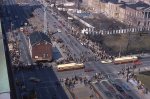
Analysis of 510 Spadina for December-January 2015-6

On January 3, 2016, the schedule for route 510 Spadina changed from one based on the use of standard-sized streetcars (the CLRVs) to the new longer low-floor cars (Flexitys or LFLRVs). This article reviews the operation of the line before and after the new schedule.

The revised service provided an increase in capacity with a replacement ratio of new cars for old on a ratio considerably lower than 2:1, and during periods of infrequent service (early weekend mornings, late evenings), the replacement was 1:1.

510_20151122_ScheduleSummary

510_20160103_ScheduleSummary

In brief, the service actually operated on 510 Spadina bears little resemblance to the advertised schedule. Headways (the time between cars) are erratic and often wider than the scheduled values for both the “old” and “new” service designs. The proportion of service operated to the three destinations (King, Queens Quay and Union Station) do not always match the schedule, and indeed during January (when only two destinations are supposed to be in use at any time), service to all three persists just as in December.

However, padding the schedule, a tactic used on other routes to eliminate the need for short turns, is impractical here because terminal congestion with queued vehicles would severely interfere both with passenger travel times and with terminal operations. Unlike a route such as 501 Queen where most riders depart from vehicles before the terminal, 510 Spadina has very strong demand to its destinations at subway stations.

Line management consists of dispatching cars and operators as available, and the service levels on each branch do not match the actual design, notably the proportion of service that should operate on each section of the route. This particularly affects riders south of King and on Queens Quay whose service is erratic and below the advertised level even though the area has a large and growing population.

Continue reading

Ministerial Hot Air On Fare Integration

Today saw an exchange in the Ontario Legislature showing the true colours of the provincial government when it comes to an informed, intelligent discussion of fare integration in the GTHA. The full exchange is below lest anyone accuse me of quoting them out of context.

Ms. Andrea Horwath: My question is for the Acting Premier.

Throughout its history, TTC fares in Toronto have been based on the simple principle that every Torontonian deserves equal access to their transit system regardless of their income and regardless of where they live.

But now Metrolinx is quietly working on a fare integration plan that could force people living in Scarborough, Etobicoke and North York to pay a higher fare for a subway ride than people living downtown. Will the Liberal government guarantee that Metrolinx will not force people living in Scarborough to pay more to ride the subway?

Hon. Charles Sousa: Minister of Transportation.

Hon. Steven Del Duca: I want to thank the leader of the NDP for the question. Of course, as everyone should know by now, the folks at Metrolinx, who are doing an exceptional job, are working hard to liaise with all of our municipal transit systems around the greater Toronto and Hamilton area to make sure that, collectively, we can deliver on fare integration for this region.

I think anyone who moves around the greater Toronto and Hamilton area would recognize—and certainly I hear it loud and clear from my own constituents in York region—that we need to make sure, in order to support the unprecedented transit investments that this government is making, that we need a fare integration system across this entire region that works seamlessly, that makes transit more accessible, more affordable, more reliable and more dependable for the people of the entire region. That’s the work that Metrolinx is embarking upon in conjunction with all of our municipal transit systems. They will keep working hard, Speaker, to make sure that we can get it right.

The Speaker (Hon. Dave Levac): Supplementary?

Ms. Andrea Horwath: Speaker, in fact, what Metrolinx has been quietly doing is designing a fare integration plan that could force the TTC to become a zone-based system that divides Torontonians based on where they live. So years from now, people in Scarborough might get a new subway but then find out that they can only afford to ride the bus.

Will the Liberal government guarantee that there will be no fare zones within Toronto, and that Metrolinx will not force the TTC to charge higher fares for subway riders?

Hon. Steven Del Duca: I guess only the leader of Ontario’s NDP would think somehow that after months of open conversations, after months in which every single board meeting has a public portion, only the leader of Ontario’s NDP would think that this is somehow hidden. It’s a conversation that’s been ongoing.

It’s part of my mandate letter which, of course, she should know. For the first time in Ontario’s history our mandate letters were posted publicly at the time that we received them, Speaker.

I think what’s also, perhaps, the reason that the leader of the NDP is mistaken about how supposedly hidden this effort is, Speaker, is that because while we are investing in transit through budget after budget after budget, that leader and the NDP caucus continue to vote against them. They are obviously more focused on petty partisan politics in Scarborough instead of being focused on making sure that they support the transit investments needed to deliver the seamless integrated transit network the people of this region and the people of Scarborough deserve.

Let’s get the historical inaccuracy in Horwath’s question out of the way first. The pre-Metro Toronto Transportation Commission used a single fare within the old City of Toronto, and supplementary fares beyond in what were then separate municipalities where the TTC provided some services. Some suburban bus routes were operated by private companies which charged their own fares. After the creation of Metro in 1954, the Toronto Transit Commission had fare zones roughly based on the old city and everything else, but these were abandoned in 1973 as part of the political deal for suburban municipalities helping to finance transit expansion through their Metro taxes.

I am no fan of Andrea Horwath, but she asks a legitimate question.

The Minister’s response is pure political hot air talking about the wonderful work at Metrolinx, and the wonderful spending on transit construction now underway, but utterly avoiding the issue of separate fares either for zones or classes of service within Toronto. Instead, he turns the question into one of “petty partisan politics” and fails to address the matter of whether Scarborough riders will pay more to ride their new subway whenever it opens.

One might ask the same question about the Minister’s constituents in York Region who will be heavily subsidized by Toronto Taxpayers to ride the Spadina extension to Vaughan.

Fare Integration: A TTC/Metrolinx Non-Update

Updated April 29, 2016 at 9:00 am: Information added about the joint meeting.

The joint meeting of the Metrolinx and TTC boards was something of a love-in with much generous praise of each other’s organization and shows of “working together” with joint presentations on major issues. In his opening remarks, TTC Chair Josh Colle noted that although the two organizations had similar goals, there would be times when the TTC and Toronto Council would not agree with Metrolinx. It is too early to tell whether cracks began to form in the building foundations at Union Station where the normal state of Metrolinx meetings is sunny and the concept of disagreement is banished in the (usually) well-managed agendas.

A substantial chunk of the meeting was consumed with opening remarks and overviews of the two organizations by their respective CEOs. At an initial meeting, this might be expected, but it follows a distressing pattern where substantive discussion is pre-empted by management back-patting eating into the limited time available. The idea that Metrolinx and TTC Board members would need an overview of each other’s current activities says much about the degree to which each board is informed about transit in the GTHA in general. (One might make a similar observation about some board members with respect to their own agencies, but that’s another topic.)

The TTC made a point of citing their own ridership numbers and, by implication, the scale of their operation (not to mention its longevity) compared to Metrolinx. For its part, Metrolinx noted that it has just reached 10 years of age, but completely forgot that GO Transit has been around for almost 50 years.

Cross-border travel at 58 million rides per year might increase by as much as 8 million with some form of TTC/GO/905 fare integration and the removal of the boundary between TTC and other systems, but this would still only bring the cross-border total to about 12% of the TTC’s total ridership. The main benefit of fare integration would be to reduce fares for existing riders.

In his opening presentation, TTC CEO Andy Byford dwelt at length on five “megaprojects” within the TTC, and showed a list of other major improvements in the hopper (see p34 of the presentation). All of these have been implemented at least to some degree except for Time-Based Transfers, and the idea has been sidelined for the moment in part because it is perceived to be too expensive by some city politicians. The most recent word on the subject was in a December 2015 update on fare policy:

While introducing a 2 hour time-based transfer is still considered a worthwhile service improvement that would reduce complexity and make the TTC consistent with other transit agencies within the Greater Toronto and Hamilton Area, the ongoing Fare Integration work, led by Metrolinx, may propose changes to transfer rules. That being the case, it is recommended that further analysis or implementation should follow the completion of the Fare Integration work if required. [pp. 2-3]

This is something of a Catch-22 because transfer rules are obviously part of any overall fare strategy – they affect the attractiveness of transit for multiple “short hops” on a single fare without the need to own a Metropass (or some equivalent). Moreover, the ability to make many short trips on one fare speaks to the problem of “trip chaining” often cited in debates about bias in fare policy towards longer commute journeys and against the type of travel more common to the un- and under-employed.

Transfer rules across the GTHA should be part of any “fare integration”, and yet the topic has been completely ignored in Metrolinx work to date. Metrolinx sloughs off the topic claiming that these are local policies, not regional issues, forgetting that regional planning is impossible without considering local effects.

During the update presentation, TTC’s Deputy CEO Chris Upfold noted that the TTC network is an integrated design with free movement between routes and modes. Josh Colle gave as an example the St. Clair streetcar which runs directly into two subway stations and talked of how the system would have to be “de-integrated” to accommodate a separate fare for subway travel.

Metrolinx Chief Planning Officer Leslie Woo replied that the concepts in the study are only for analysis with a business case, economic and operating impact studies to follow. Considering how long the study has been underway (see main article), one might think that economic and operating impacts would have been an integral part of early analysis to determine whether options were viable. Instead, Metrolinx forged onward with its preferred view of fare structures strongly leaning to a distance and class-based tariff ignoring the issues for transit operations, not to mention the potential effect on riders. Again, the blinkered view of an agency with relatively small ridership and a uniform demographic precluded consideration of the effect on an operation ten times its size serving much more complex travel patterns.

TTC Commissioner Shelley Carroll asked about reports to come in fall 2016, and their implication for actual implementation of new fares. Woo replied that Metrolinx is very open to meeting with area Councils, agencies and transit management. That reply dodges the basic problem that Metrolinx has acted as the gorilla in the room in its dealings with local transit agencies, and the threat of losing provincial subsidy always hangs over municipalities who don’t sing from the Metrolinx songbook.

Chris Upfold stated that the TTC Board and Toronto Council need to take a position on fare integration. He suggested that this cannot happen until something is actually proposed, and nothing is going to happen to fares within 2016. That’s all very well, but Metrolinx history shows that once a proposal emerges from staff, it acquires the endorsement of a provincial agency and is cast, if not in stone, in very fast-setting concrete and is almost impossible to change. Toronto needs to understand what a new tariff would actually look like in order to take an informed position. Otherwise, the process is nothing but endless rounds of approving “principles” that could have far-reaching effects. “Equity” to one person might mean time-based transfers (in effect limited-time passes), while to another might mean fares charged by distance and class of service.

“We can leave the decision to later” is a recipe for Metrolinx cooking up a tariff and claiming that Toronto (or other cities) don’t object when the process precludes such objections until after the tariff is fixed. This is the same cart-before-horse process we see in transit project assessments (mini-Environmental Assessments) where early decisions discard options that are almost impossible to reinstate later even if the early work is shown to be flawed or outdated.

Metrolinx Board Member Iain Dobson asked why we couldn’t just “do something, somewhere” such as eliminating the Mississauga/Toronto fare boundary as a trial. Upfold replied that Presto would have to be in place for this (so that fares paid on one system would be valid on the connecting legs of a journey), and that there would be a need to fund such a reduction in fares for the affected riders. The fact that both agencies have had paper transfers for ages and could simply adopt a policy of accepting each other’s as a valid fare seems to escape him.

TTC Commissioner Joe Mihevc noted that “fare integration” is one of those areas where the mandates and outlooks of the regional and local agencies and councils will not align. Toronto residents may not be happy with using the TTC to support lower fares for the 905.

Metrolinx Chair Rob Prichard opined that a $40 million cost to provide an integrated fare is not much of a problem. He should talk to his good friend, John Tory, for whom this amount is more than a 1% tax increase, and who has torpedoed much less expensive transit initiatives through TTC budget cuts.

TTC Vice Chair Alan Heisey remarked that Toronto already subsidizes the 905 by about $50 million annually through the TTC operating subsidy, and Commissioner Rick Byers reiterated that the TTC already has the lion’s share of the region’s transit ridership.

Prichard ended the discussion saying that we don’t know what the right answers are now. One might ask “why” considering how long his staff have been working on the question.

In the media scrum following the meeting, Josh Colle was asked whether subway riders should worry that their fares are going up. He replied that, no, this should not be a concern and gave as strong an indication as any we have seen to date that the whole “subway fare zone” concept is dead in the water. It is amazing what a little political realism can bring to a debate.

As I have said in other forums, I would love to attend a public meeting where the Scarborough MPPs and Councillors (not to mention the well-meaning social activists on the Metrolinx Board) explain to their constituents how they will get a shiny new subway, but will have to pay more to ride it while commuters from Markham enjoy lower fares.

Original article (April 25, 2016):

The TTC and Metrolinx boards will meet in a joint session on the evening of April 27, 2016. Among the items to be discussed is an update on the Fare Integration study that has been underway for some time between these agencies and other GTHA operators.

Based on discussions at recent Toronto Council and TTC meetings regarding the “motherlode of reports” that will hit Council in June on a wide variety of transit issues, one might have expected something definitive about Fare Integration. Alas, this will not be so as the projected date is now in fall 2016. That poses a challenge for discussions of SmartTrack (ST) which depends strongly on integration with the TTC network and fare structure for its attractiveness. Of course, given that ST has dwindled to no more than a few stations added to what the GO Regional Express Rail (RER) would provide anyhow, the point may be moot. However, as long as we pretend that ST is a going concern, then its fare structure remains an issue for debate.

Chris Selley in the National Post wrote recently about the importance of Fare Integration and the political minefield it represents. Recently we have seen just how badly Metrolinx can screw up its planning with the botched implementation of the UPX service to Pearson Airport. The idea of Fare Integration has been around for some time, but discussions have always been quite general on matters of principle and general concepts with no explicit examples of how various schemes might affect riders or subsidy requirements.

It is worth reviewing the history of reports to the Metrolinx Board on this subject.

Continue reading

6 Bay and 94 Wellesley Service Analysis for January 2016 (Part II)

In previous articles, I reviewed the operation of 6 Bay and 94 Wellesley for the month of January 2016. This post updates that review with a different way of looking at headway statistics over the route and by time of day. The new chart format consolidates information previously shown only in separate chart sets.

In earlier analyses, I presented information for headways (the time interval between vehicles) at a point over a month in charts like this:

6 Bay Headways at Charles St. Southbound

This set of charts includes several pages of detail showing individual vehicle headways, day-by-day, with statistics for the entire month at the end. This is useful for looking at behaviour at a point, but another way to summarize the data is to bring the stats for all timepoints on the route onto a single set of charts.

The new charts use the data shown on the weekday, Saturday and Sunday statistics pages from each timepoint set (such as the one linked above) and merge them on a single chart for each direction and type of day.

6_201601_MonthHeadways_TPSummary

94_201601_MonthHeadways_TPSummary

On each chart, the average headways are shown as solid lines while the standard deviation values are dotted and use a lighter version of the same colour as the corresponding averages.

The first page for 6 Bay shows weekday statistics from the south end of the route at Jarvis & Queens Quay to the north end at Bedford & Davenport. The line for Bedford (purple) breaks away from the other values because half of the service is scheduled to short turn at Yorkville during the peak periods. Generally speaking, the averages for each timepoint will stay close to each other except during transitional periods between service levels (the change does not necessarily complete within the same hour over the entire route) and in the case of major disruptions or diversions.

What the charts show, however, is the magnitude and evolution of the standard deviation in headways along the route. This is a value that measures the degree to which data values are close to or scattered around the average value. If the SD is low, then most of the individual values are close to the average, and therefore the headways are all close to the average value. If the SD is high, then headways are erratic. The average may be well-behaved and fit the schedule, but times between individual vehicles can vary considerably. Typically, about 2/3 of the data points will lie within one SD either way of the average. Therefore, if the average is 5 minutes, and the SD is 8 minutes, 2/3 of the data points lie between 2 and 8 minutes. The rest are beyond this range.

This has some relation to the TTC’s own goals for headway reliability. Until fairly recently, vehicles were considered to be “on time” if they were within 3 minutes of their scheduled time. On occasion, the TTC would report this value relative to scheduled headway, rather than to the timetable, to acknowledge that riders care more about reliability than the “on time performance” of individual vehicles. This measure has been replaced with a new target in which vehicles should leave terminals no more than 1 minute early and no more than 5 minutes late. This is ostensibly the same 6 minute window, but with three important differences:

  • The measure is always to timetable values, not to headways. Service can be operating on a regular spacing, but be off schedule, and therefore rank poorly. However, “on time” performance is a TTC goal because it minimizes overtime payments.
  • The measure is only at the terminal point on the assumption that if service begins its trip in good shape, this guarantees reliable service further down the line.
  • Measurement at the terminal will expose excessive short turning because vehicles that do not reach the terminal cannot be counted as part of the “on time” metric.

This sounds good in theory, but the idea runs aground on two important factors.

Continue reading

Why Are Subway Cars on Bloor-Danforth So Dirty?

As a regular traveller on the Bloor-Danforth subway (Line 2), I cannot help noticing how often a car will appear with a very grimy exterior. Although inside the cars look just fine, the exterior can leave much to be desired. The comparison is quite striking with the gleaming trains on Yonge-University-Spadina (Line 1).

It turns out that this problem is caused by a combination of factors including the fact that the BD trains (the T1 sets) are riveted aluminum, while the YUS trains (the newer TR sets) are welded stainless steel.

I asked the TTC about this issue, especially considering how important system cleanliness is in their attempt to present a good face to customers, and they replied:

You’re correct that some of the T1 cars are not as clean as we like.

There are a number of factors in play here.

Trains are not washed regularly through the winter when the ground temperature drops below a certain point. Every winter, it follows that the trains become less clean. We do wash trains mechanically but it is less effective.

Each summer we employ summer students to hand wash the trains using detergent and pressure washers. They can do a train or so a day. They look pretty good, but with the condition of the body and its design –  it takes time.

Chemicals used also make the aluminium more porous and so we have to be careful how much we use, or we potentially make the issue worse over time as the body will attract even more dirt.

The work is made more difficult due to the number of rivets used on the sides of the train. You can see more staining around the doors in general where the normal train wash (think of a car wash for trains) just doesn’t get into these nooks and crannies. On the TR we designed this dirt trap out by the smooth car body.

The students have started work and you’ll see a gradual improvement in the fleet. That said, progress will be slower this year as we are using them to clean also air filters on the trains’ heating system which whilst invisible to customers needs doing across the fleet and is a higher priority.

We will be targeting the worst units first, and working through the fleet on a priority basis.

[Email from Mike Palmer, Deputy Chief Operating Officer, TTC, April 19, 2016]

The T1s will be with us for many years as they are only about 15 years old. TTC has had aluminum bodied cars for decades, and I hope that they can maintain some semblance of cleanliness with this fleet.

TTC Service Changes Effective May 8, 2016

May 2016 brings the first wave of seasonal changes as attendance at universities and community colleges drops, and demand for travel to parks ramps up for the summer.

The 101 Downsview Park bus will now operate on weekdays. This was formerly a seasonal service, but the change is now permanent and it will not be reversed in the fall.

Several bus routes get new early morning trips.  Individually these are small changes, but they illustrate how the city’s work day starts well before the subway opens at 6:00 am.

After several years’ absence for construction on Queens Quay, the Sunday afternoon PCC operation will resume between Victoria Day and Labour Day weekends. One car will run as an unscheduled extra from noon until 5:00 pm on 509 Harbourfront.

Route 501 Queen will divert around water main construction on Queen Street West from May until early October via Spadina, King and Shaw both ways with a replacement shuttle bus covering the gap. Route 510 Spadina will have extra running time to allow for the expected delays caused by the 501 diversion, and the short turn service will remain scheduled to Queens Quay rather than to Charlotte to limit turning moves at King and Spadina.

There is no information yet about special provisions to assist streetcars turning, particularly to and from Spadina, such as changes to traffic signals or use of police to manage traffic. Also unknown is how the congestion this diversion will cause will interact with the King Street closure for the film festival in September.

The 97 Yonge bus will be split with overlapping services running south from York Mills and north from Lawrence, and midday service between St. Clair and Davisville will not be operated. This is intended to isolate the effects of construction at Sheppard to the north end of the route, an arrangement used previously in 2014.

2016.05.08 Service Changes

Asking Santa For Transit Dollars (Updated)

Updated April 15, 2016: Further information received from the Infrastructure Canada has been incorporated, as noted, in this article.

The new, transit-friendly Trudeau government has announced a major shift in Ottawa’s funding for municipal transit including policy changes to improve the flow of money:

  • Decisions about which projects should be funded with federal dollars will rest with local agencies rather than being dictated by Ottawa.
  • Federal funding will pay for up to 50% of projects compared to previous schemes in which each level of government contributed 1/3 (e.g. the Vaughan subway extension).
  • The pool of funds will be distributed based on ridership, not on population, so that provinces with well-used transit systems will receive most of the money.

In the first three years, $3.4-billion will be allocated with about 44% coming to Ontario. Of this, the TTC expects to see about $880-million according to TTC Chair Josh Colle as quoted by the CBC with money going to “what can be done quickly” with “the greatest customer impact.”

That will be a challenge on a few counts.

The TTC’s Capital Budget for 2016-2025 includes about $2.7-billion in unfunded projects, but some of these are not planned to start, indeed are not even required, in the immediate future.

PrelimANotes_CapBelowTheLine

The table above (from the City Budget Analyst Notes) shuffles around a bit every time we see it, but the outline remains the same. The serious problem with capital funding begins in 2018 when the City’s headroom for additional borrowing (in the absence of some other scheme to finance its capital programs) will be exhausted.

The $55.4m shown for 60 additional streetcars may or may not actually be triggered as a 2016 expense depending (a) on how many cars Bombardier delivers this year, and (b) on how much Toronto trusts Bombardier with an add-on order when the base contract is running so late.

Most of the list above deals simply with replacing or repairing vehicles and infrastructure that are at the end of their natural lives, and only a small part of the total (99 buses, 60 LRVs) would actually bring more service and capacity to the system. Toronto has not shown much enthusiasm for funding additional operating costs that a larger fleet represents and persists in the belief that ridership growth can somehow be handled by “efficiencies” within the base budget.

Another problem, of course, is that if $2.7b is “below the line” in unfunded status, and Ottawa is prepared to contribute only 50%, then the remaining 50% still has to come from somewhere, likely from the City of Toronto which claims to have no ability to finance this spending.

Many other projects are not even included in the ten year budget notably Waterfront transit and the Relief Line, not to mention some costs associated with capacity expansion on the existing subway. Queen’s Park is funding the first wave of LRT construction in Toronto, but other proposals sit on the wish list:

  • The main section of the Crosstown from Mount Dennis to Kennedy is fully funded by Queen’s Park, as is the Finch West LRT from Finch West Station to Humber College.
  • The Crosstown East LRT is to be funded through a shuffle of available money among Scarborough transit projects. It is not yet clear whether changes to SmartTrack and the Scarborough Subway Extension will actually balance out the LRT’s full cost.
  • The Crosstown West LRT would, in theory, be funded from “savings” through the cutback of SmartTrack to Mount Dennis, but ST itself is not fully funded or costed. How much will actually be available remains to be seen, especially when Queen’s Park’s share will only be an “in kind” contribution through GO-RER upgrades.
  • The Finch West LRT extension to the airport, the Crosstown extension north beyond UTSC to Malvern, and a Sheppard East rapid transit line have no funding.

Continue reading

Toronto Council Endorses Transit Plan, Seeks Background Details

At its meeting of March 31, 2016, Toronto Council passed several motions relating to the proposed rapid transit plan for the city.These evolved first as a set of staff recommendations, then amendments at the Executive Committee and finally amendments at Council. The changes along the way give a sense of how the attempt at a general approach taken in the new transit plan by staff can be warped into an emphasis on individual projects while losing sight of the overall purpose. This is not new in Toronto’s political theatre, but the city and region are at a crucial time when the “big picture” of the transportation network is essential. The challenge for those who would lead this process is to find a responsible balance between wider priorities and local concerns without making every decision only on political merits.

Many of these motions involve requests for additional reports, and at one point there was some concern about whether city staff could actually handle the workload. One might ask whether the city should be making such important decisions if staff are unable to produce sufficient background material and simply want approval trusting their recommendations. While studying issues to death is a well-known delay tactic, rushing decisions without all the details is a classic method of railroading through decisions the city might regret later. There is certainly nothing wrong with asking for a more thorough study of items that have been omitted, provided that the same requests do not surface over and over again.

If anything, Council has been woefully underinformed on transit options, priorities and tradeoffs, and such an environment “debate” often has little to do with the real world. Will every Councillor read every page of every study? No, but at least the material will be there to answer questions, support the good ideas and counter the dubious schemes. We hear a lot about “evidence based planning”, but this can be a double-edged sword where “evidence” might not support fondly-held proposals.

This article groups Council’s motions by topic so that readers do not have to sort through the relationship of recommendations and amendments.

Continue reading

GO/RER Details Emerge in Business Case Analysis

Metrolinx has published a set of documents containing the “Initial Business Case” for the GO Transit Regional Express Rail (GO/RER) network.

Updated Dec. 13, 2022: Due to a reorganization of Metrolinx’ site, the reports are no longer available there. However, I have archived copies of them. The Summary and Full Report links below are to my site. The Appendices are not yet available as I must break them into chunks small enough that WordPress will allow them to be uploaded.

  • Summary
  • Full Report
  • Appendices A-J
    • A: Corridor Specifications
    • B: Corridor and System Schematics
    • C: Model Assumptions and Results
    • D: Record of Assumptions – Direct Demand Model
    • E: Financial Performance of RER Systems
    • F: Sensitivity Analysis
    • G: Wider Economic Benefits
    • H: Line Speed Analysis
    • I: Environmental Assessment Program
    • J: Fare Structure Issues and Solutions
  • Appendix K:  Station Access Analysis

[Note that except for the Summary, the documents are large PDFs.]

This article begins a review of these documents and of the various RER proposals examined in the Metrolinx studies.

Overview

Work on this review of GO/RER began in April 2014 following the announcement by Queen’s Park of its commitment to the RER concept. Unlike previous reports, this study looks in depth at all of the GO corridors, and reviews the technical issues associated with both increased service and electrification. This is not a final review, and much engineering work remains to be done, but there is a great deal more information now publicly available as the basis for discussions.

These documents were completed sometime in 2015 as is clear from references to future events that will occur later in the year, notably reports from the City of Toronto on SmartTrack. That scheme gets only passing mention, some of it the usual political cover story, because the specifics had yet to be decided. Exactly what the incremental effect of ST will be beyond the proposed GO/RER configuration is not yet known. Preliminary information in City reports implies that ST will amount to considerably less than was foreseen by the Tory election campaign, possibly as little as a few more stations and some sort of TTC/GO fare integration.

Five scenarios were reviewed to compare the effects, benefits, costs and technical issues associated with various possible future networks.

  1. The “Do Minimum” scenario provides only marginal peak period improvements to the existing system in response to projected demand growth, but with no electrification. This is effectively a “business as usual” model for the base case.
  2. The “Two-Way All-Day” scenario expands off peak service, but with diesel operation and no electrification. This is a minimal level of service expansion.
  3. The “10-Year Plan” would provide frequent service on the inner parts of some corridors, but with limited electrification.
  4. The “Full Build” extends beyond the 10-Year Plan to provide frequent service on the inner parts of all corridors, and with full electrification.
  5. The “10-Year Plan Optimized” extends the scope of electrification beyond that contemplated in scenario 3.

This progression implies a certain sequence of events during the study where a full build is impractical and the original 10-year plan was not aggressive enough with electrification, a key component of the announced government direction.

The estimated capital costs rise from $5 billion for scenario 1, through $10b, $12b and $19b for scenarios 2 to 4. The price tag for the latter is well above what Queen’s Park has available, and scenario 5 was developed with a projected cost of $13.5b. All but scenario 4 are said to be achievable by 2024. Given that it is now 2016, and this is a 10 year plan, that date probably requires some adjustment.

Scenario 5 is the 10-Year Plan Optimized, it represents significant progress towards implementing the service levels of Scenario 4. It goes beyond the investments and service included in Scenario 3 (10-Year Plan), with electrification also to Bramalea, Barrie, Stouffville and to Pearson Airport. This scenario and the resulting recommended RER program has been defined to maximize return on investment while mitigating risks. Depending on resolving various challenges, it can be delivered over 10 years for approximately $13.5 billion. It does not preclude, but rather prepares for, services to Milton and Kitchener to be eventually electrified and frequent all-day services introduced when agreement is reached on co-existence of GO and freight on these privately-owned corridors. [p. iv, Full Report]

Annual ridership is expected to go up by a factor of 2.5 over the coming 15 years, but operation costs will not rise at the same rate. The study postulates that an operating profit would be possible, eventually, but that will depend a lot on future fare policies, and on the evolution of trip patterns (length, direction, average fare). The ridership model foresees that “hundreds of thousands” of auto trips would be replaced by GO ridership each weekday comparing scenario 5 to scenario 1. The proportion of trips and its relationship to expected growth is not specified in the Executive Summary. (Possibly in the demand modelling later.)

The rate of demand increase on GO overall is projected at 2.3% which is lower than recent levels, but allows for some leveling off in a more mature service.

One big issue is the problem of getting riders physically to and from the GO trains. Either this will be done with substantially improved local transit services (an option that brings many issues associated with fare integration and cross-system subsidies), or with parking. The cost estimates include $750m for 15,000 new parking spaces, or $50k per space. At that scale, simply paving empty lots is not an option. The study notes the possibility that some of this cost “may not be necessary if service integration and fare integration with local transit services can be improved”. [p. v]

Those 15,000 spaces represent nowhere near the ratio of new parking spaces to existing facilities that the projected ridership growth would entail if everyone arrived by car. Parking charges are listed as a way of raising additional capital for the RER project, and of encouraging a shift to ride sharing and public transit feeder services.

It is amusing to read about the benefits of proven technology, something for which Ontario has not been noted in past endeavours.

Virtually all of the works are within existing rail corridors, so environmental and community impacts are limited mostly to noise and vibration. RER will use proven technology that is working around the world. [p. v]

Descriptions of RER cite similar operations in more than 50 city regions worldwide [page 6], and list a number of factors that simplify implementation [p. 4]. I cannot help thinking of how badly past studies have downplayed the benefits of LRT which bears a family resemblance, but at a local rather than a regional level.

The first electric railway opened in 1883 (the Volks Tourist Railway on the Brighton seafront in the U.K.). Ever since that time, electric traction has increasingly become the default source of power for the world’s more intensively used rail systems. [p. 14]

Finding this statement in a Metrolinx report is quite amusing considering some of the remarks made during community meetings on electrification before Metrolinx and GO “got religion” on the subject. The report skirts that debate by observing that GO is now at the threshold where electrification makes sense:

Until recently, diesel traction has been the appropriate mode of traction for the GO rail operation. However, the service enhancements envisaged in the near future will take GO rail beyond the threshold of service intensity appropriate for electrification. Continued use of diesel traction will become a source of financial and economic inefficiency. [p. 14]

Metrolinx intends to pursue discussions with the railways regarding the upgrades needed on their trackage, and also intends to review “modern, proven technology” with Transport Canada and the railways.

This is an “initial” analysis, and changes are likely depending on the evolution of expectations, changes in provincial funding, and who knows what political meddling that could arise.

A decade is a long time in politics, and the likelihood that the current governing parties or councillors will still be in place at that distant time is minuscule. Moreover, changes could come at any level part way through the project, and only a very strong, unshakeable commitment (i.e. very popular and difficult to derail) is likely to survive. This is not simply a case of showing up for a photo op or two with a gigantic prop cheque, but of supporting the plan for the long haul, including building a constituency that can survive beyond current governments. The arrival of a Ford-equivalent who simply wanted to start over with his own plan would be disastrous.

Continue reading

Analysis of Service on Route 94 Wellesley Bus for January 2016

This is the second of two articles reviewing the operation of a comparatively short downtown bus route to see how it behaves in comparison to longer and busier routes. The first article covered 6 Bay for the same period.

The schedule for 94 Wellesley was adjusted in September 2015 to provide added running time, and to improve service so that the eastern part of the route was in the “10 Minute Network”.

Continue reading