Queen’s Park’s Long Overdue Move on Fare Integration

The recently-announced Ontario Budget includes a lot of spending on transportation that transit riders in the GTHA can only hope to see delivered by whoever is in charge at Queen’s Park after the June 2018 election. Even though the budget is as much about vote-getting as about actual governance, it is worth looking at what the promised fare changes would bring if they are implemented.

From the press release:

  • Beginning in early 2019, the province is reducing the cost of GO Transit trips to just $3 for PRESTO users who are travelling under 10 kilometres anywhere on the GO network
  • All GO Transit and Union-Pearson Express trips anywhere within the City of Toronto will be reduced to $3
  • With proceeds from Ontario’s cap on pollution, the province will also provide fare integration discounts of up to $1.50 per ride for anyone who travels between the York, Durham, Brampton and Mississauga transit networks and the Toronto Transit Commission (TTC), saving regular commuters up to $720 every year
  • PRESTO card users travelling on GO Transit between Union Station and stations near Toronto, such as Port Credit, Malton, Pickering, Ajax or Markham will see fare reductions.

As with any announcement, “the devil is in the details”, and I fired off a series of questions to clarify how this might all work. Responses came back from Metrolinx.

Q1: Regular GO Transit riders now enjoy a monthly cap of 40 fares on their travel. The 36-40th trips are at a discount, and from 41 onward, they are free. Will this apply to the new $3 fare? In other words, is there an upper limit of 40 x $3 = $120 to a rider’s cost of using GO within the 416, or is it open ended like TTC fares where there is no cap unless one buys a pass?

A: Details on this will be worked out as part of our implementation planning and work.

Q2: There are now co-fare arrangements between the 905 systems and GO, as well as between GO and TTC. If someone makes, for example, a YRT-GO-TTC trip, what discounts apply? Are the cofares cumulative?

A: YRT-GO Co-Fare, GO-TTC DDF. Yes, cumulative.

Q3: By analogy to Q1, if a rider makes a three-legged trip regularly, thereby becoming entitled to free rides for the GO segment after 40 trips, what happens to the co-fares? Do they still apply, or does the rider pay full 905 plus TTC fare in this case? The potential savings are “up to $720 per year”. Is this simply a calculation based on 20 commutes for 12 months, or will it be a capped saving?

A: Details on this will be worked out as part of implementation planning and work.

Q4: If someone has a Metropass (or its Presto equivalent), they are not entitled to the TTC-GO co-fare. Is it correct to say that their monthly cost would be the cost of the pass plus $3 times the number of GO trips taken within Toronto?

A: For adults, yes.

Q5: For clarity, is the $3 fare a flat rate even if riders transfer from one GO service to another, such as from Lake Shore to UPX, but stays within Toronto for their trip?

A: Yes as long as [the] individual uses the GO readers for their UP Express trip.

Q5a: If part of their trip is inside Toronto, but a second leg goes outside, does the $3 apply to the “inside Toronto” portion? Example: Rough Hill to Union to Weston is all inside Toronto, but Rouge Hill to Union to Airport is not.

A: Fares for any trips to and from Toronto Pearson Airport remain unchanged.

Q6: The co-fare for GO-TTC is relative to an assumed $1.50 per full adult fare with lower co-fares for those getting discounts like Seniors. Will the same apply to the 905-416 co-fare?

A: Details on this will be worked out in conjunction with the transit agencies.

In brief, the only thing that is nailed down so far is that discounts between each leg of a trip are cumulative so that, for example, a Miway rider travelling to a station within the $3 GO tariff zone and thence to a TTC route will get the Miway co-fare discount, the new low GO transit fare and the GO-TTC discount. Also, transfers between GO services do not attract another fare provided that the trip stays within the city.

Every thing else is to be “worked out”.

There are a variety of scenarios one can construct including the combined effects of bulk fares (passes) on 905 systems, the existing GO Transit monthly fare caps, and whatever co-fare/discount arrangements will exist. Anyone trying to work out the permutations has my sympathy. From the Metrolinx point of view:

The reason these changes will only be introduced in early 2019, is because Metrolinx needs time to work with our transit partners to ensure the various scenarios and all fare rules are in place. This budget provided Metrolinx with direction to move forward on fare integration. [Metrolinx email]

Leaving aside the question of whether the government in place for the 2019-20 budget will support whatever fare scheme Metrolinx comes up with, there are also obvious questions about the implications for service crowding and for possible changes needed in local route networks, mainly on the TTC, to provide better connections with GO stations. The lower fares may look attractive, but actually using the service could be challenging within Toronto.

  • On Lakeshore West, most inbound trains run express from Clarkson to Union with local trains only every half hour in the AM peak. The same arrangement applies outbound on the PM peak.
  • On Lakeshore East, there is a similar pattern with express trains skipping all stops from Rouge Hill to Union, and local trains running roughly twice/hour in the peak, albeit on an irregular headway. Some additional service is provided at Danforth (Main) and Scarborough stations by the Stouffville line’s trains.
    • TTC services in southern Etobicoke and Scarborough focus on the Bloor-Danforth subway, and actually reaching the GO stations (or using the TTC as a connecting service from them) is not easy.
  • On the Milton corridor, trains operate only in the peak period, peak direction although for someone at Kipling Station, the all-local service now operated would actually be better than what is provided at, say, Mimico on the Lakeshore West corridor.
  • The Barrie corridor and the Vaughan subway extension are in direct competition with each other, although service is far more frequent, especially during the off-peak, on the subway than on the hourly GO train, and the GO stations within Toronto are not well-served by the TTC network (other than the connection point at Downsview Park station).
  • The Richmond Hill corridor, like Milton, has only peak service, and its stations within Toronto are poorly served by the TTC.
  • The Stouffville corridor has all-day service with stations that potentially could connect with TTC feeder routes at Steeles (Milliken), Sheppard (Agincourt) and Eglinton (Kennedy). As on Lakeshore, the tradeoff will be for a faster trip bypassing the subway.
  • The Weston corridor is a special case because it hosts not only the GO Kitchener service but also the Union Pearson Express (UPX) trains which provide the most frequent of GO services within Toronto.

The fare reductions for trips from the near-Toronto stations in the 905 could shift some travel away from the subway, although few of the stations are well-located for this purpose. The Richmond Hill corridor is the most obvious of these, but the limited service there does not offer a lot to diverting demand.

As a follow-up question, I asked Metrolinx whether they had any demand studies to show travel patterns with the new fares, to the degree that these are known. Their reply is pending, and I will update this article when I receive further info.

It is well-known that the demand models are sensitive to three factors: trip speed, service frequency and fare level. This came out quite clearly in the background studies for SmartTrack and the Scarborough Subway where ST would succeed in drawing significant riding only if it operated frequently and cheaply, as originally touted in John Tory’s campaign. Just how many riders the lower GO fares, by themselves, will attract remains to be seen. A related problem, of course, is the question of train capacity if many actually shift to GO.

Not to be forgotten in all of this are the cross-border travellers between the 905 and 416 (in both directions) for whom a discounted fare will be a benefit. However, if this is only available to riders paying the full adult fare in each jurisdiction, this could undo the benefit now enjoyed by pass users who will not get any further discount. This would be particularly important if a pass holder took many “local” trips on the TTC in addition to cross-border trips into the 905.

In general, riders who already enjoy some sort of discount like seniors and students will benefit far less from the new tariff.

Whether any of this will come to pass is purely speculative at this point given the tenuous status of the current government and the well-known, vague bluster of their principal opposition.

Metrolinx (and by implication its political masters) have wasted years on pursuit of “fare integration” schemes that began with the premise of revenue neutrality to limit the government’s cost through added subsidies, and with the underlying view that distance-based fares were the end state at which they would aim. Had the option of added subsidy and reduction of short-haul GO fares been part of the mix a few years ago, the entire debate over fare integration could have taken a completely different path and a new tariff would already be in place.

Transit policy should arise from reasoned, open evaluation of alternatives, including those that may require an “investment” to make them work, not from a deathbed change of heart by an unpopular government facing defeat at the polls.

Curb Lane Streetcars on College Street (1972)

Back in June 1972, the TTC had a small problem with the appearance of a sinkhole under the westbound track on College at St. George thanks to a water main break.

Looking E at St. George 1972.06.25

Fixing this was not going to be speedy. Streetcars continued to use the eastbound rails briefly, but the excavation needed to make repairs meant a complete shutdown of service both ways. Rather than leaving the Carlton car on an extended diversion, the TTC built temporary trackage on College Street itself with streetcars running eastbound in the curb lane.


Until the temporary tracks were completed, Carlton cars operated via McCaul, Queen and Spadina. Here are views of those streets as they then were.


The original (April Fool’s Day) post:

With a nearly year-long replacement of streetcars by buses on College Street, riders might ask whether the TTC is up to something in its service plans.

The explanation might be evident in a trial installation discovered by your intrepid reporter. More news to follow as it becomes available.

A Detailed Review of King Street Travel Times

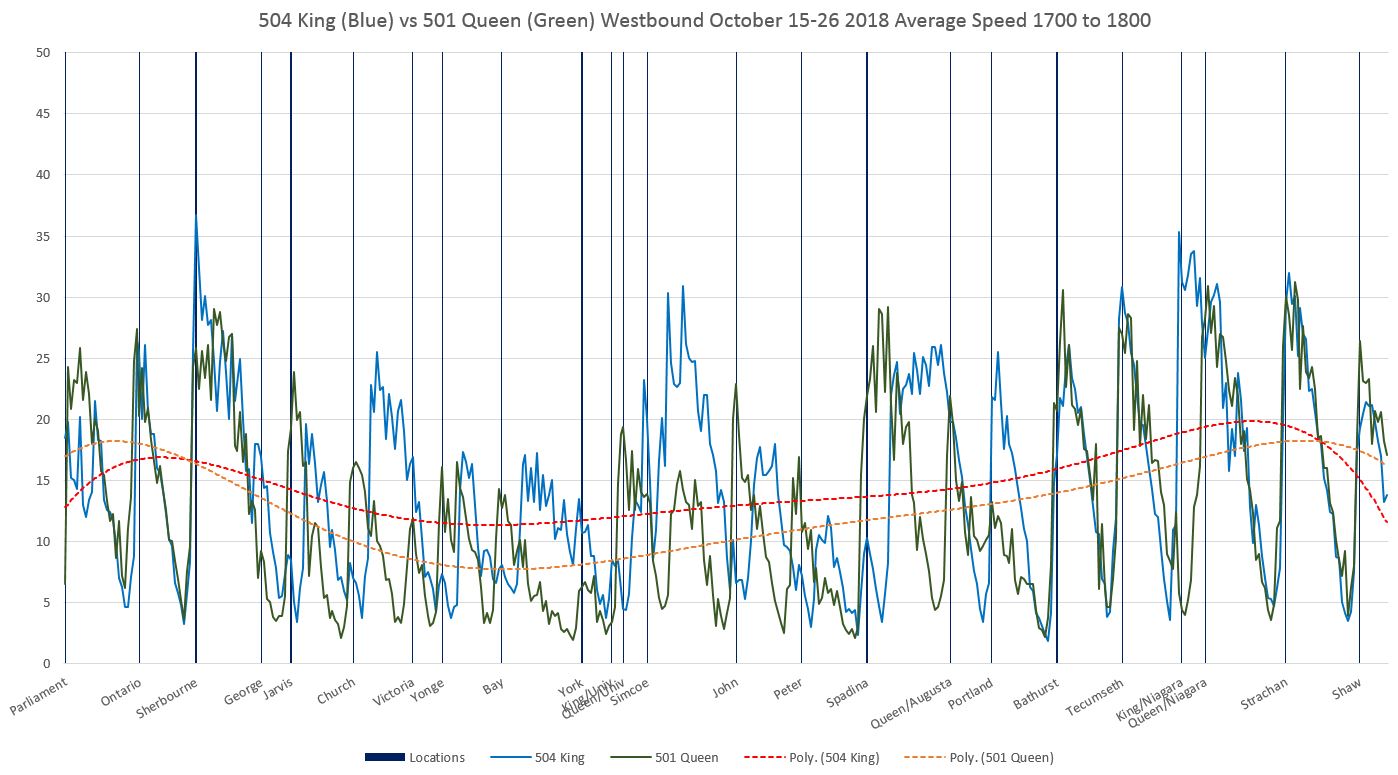
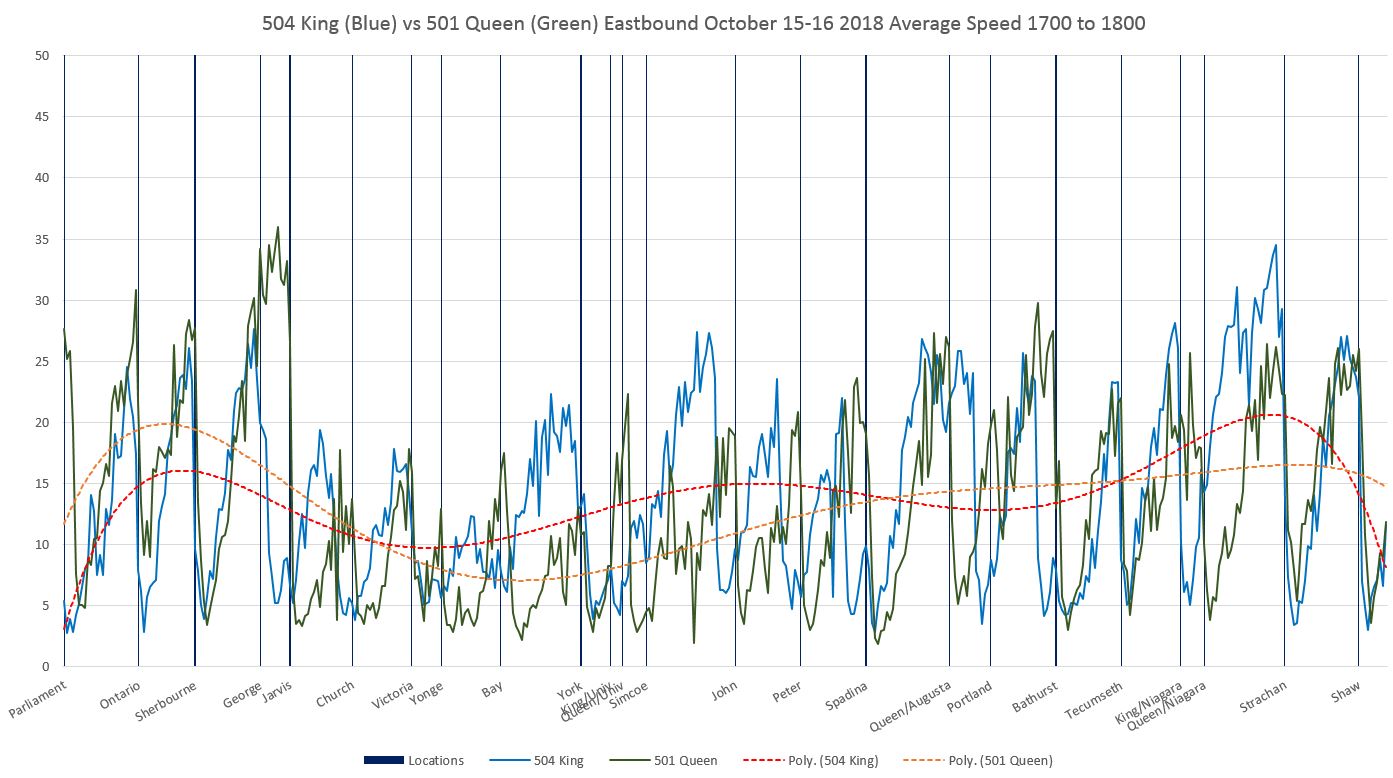
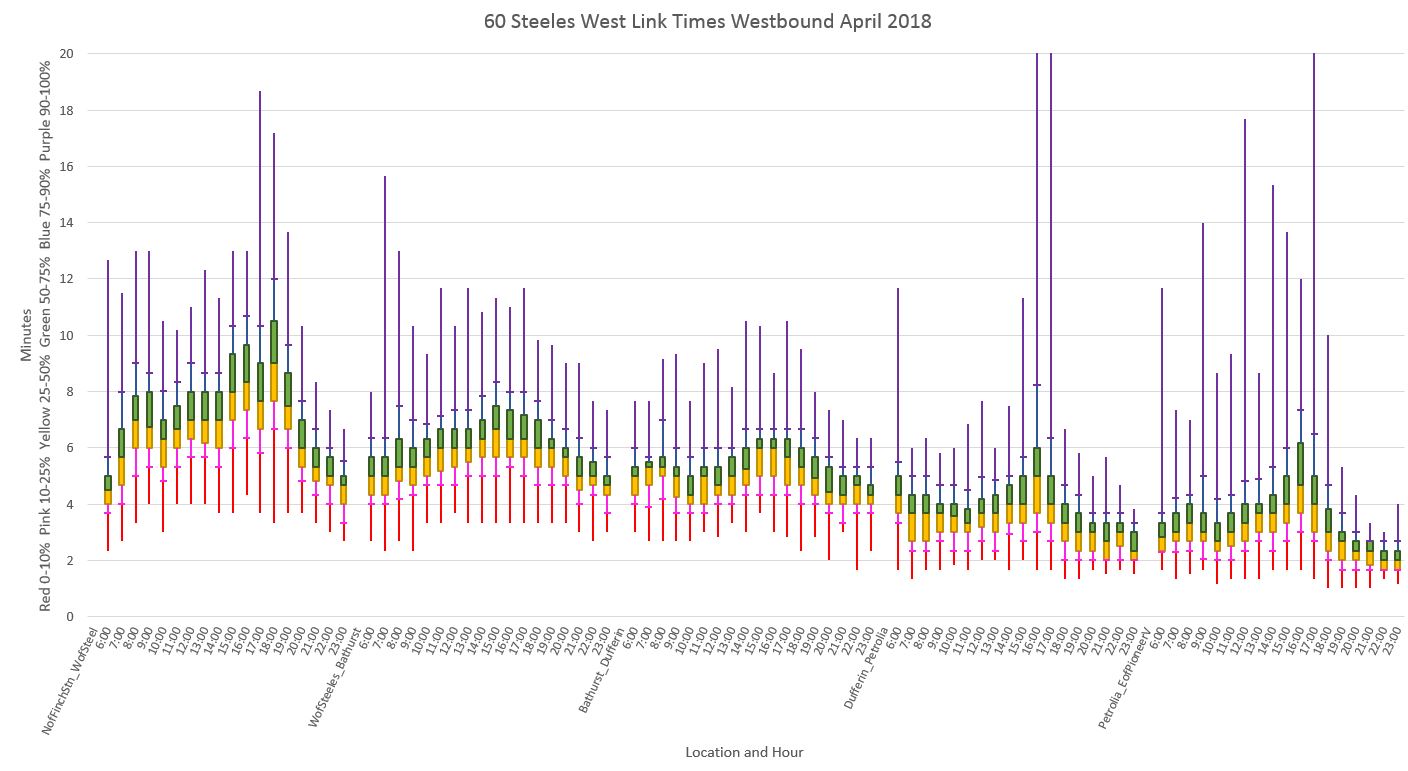
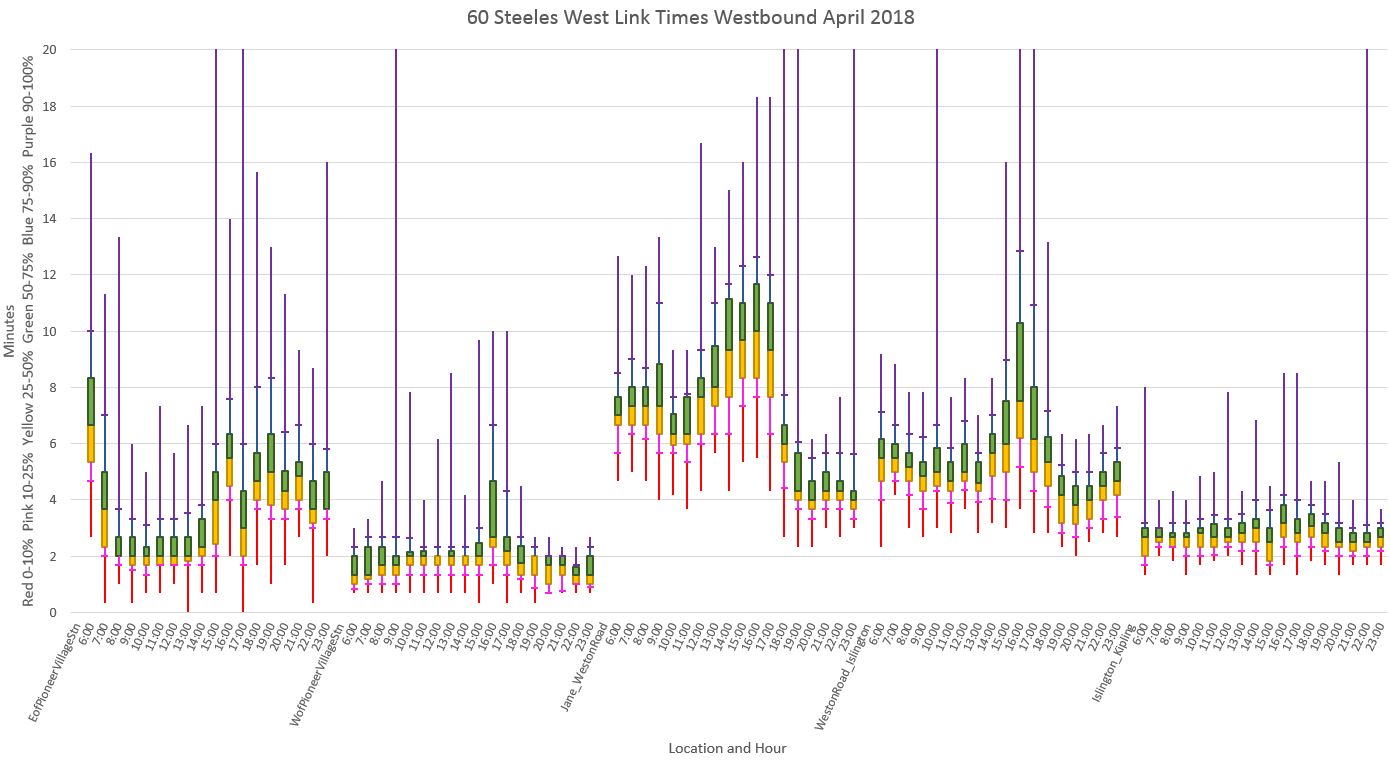
The purpose of this article is to delve into the data on the behaviour of King Street transit at an even more finely-grained detail than in past articles. The presentation here focuses on:

  • Hourly variations in travel times.
  • Daily variations based on the day of the week, including weekends.

The data are the same as those used for previous articles, but with changes in presentation to bring out different aspects of the “story” that they tell. In particular, it is important to examine the data at a level of detail sufficient to see where variations exist and where they do not. Averages over several days and over multi-hour periods simply do not reflect the way the line behaves.

A fundamental purpose of the King Street Pilot is to “shave off” the worst of the transit delays caused by congestion. For periods when traffic is free-flowing, there will be little or no change because nothing was “in the way” to begin with. Expectations of large savings in travel time can really only apply to periods when service was likely to be disrupted. This can vary from hour to hour, by day of week, due to special events, weather, and other factors. The whole point is that if the worst of the disruptions are eliminated, service will more reliably be at close to “best case” conditions.

The source data for this and all other studies of transit operations I have published come from the TTC’s vehicle tracking system. Subject to the caveat that some data must be discarded thanks to wonky GPS readings of vehicle location, this represents as close to a 100% sample as one is likely to achieve. The data are from January 2016 to February 2018, except for February 2016 which I do not have.

There are several sets of charts here, and this article is intended to take the reader through progressively more detailed views.

Complete chart sets are provided in linked PDFs, and only a few of these are presented as illustrations in the body of the article to save on space.

I leave exploration of the charts to readers with the hope that this shows the kind of detail that is available, and that a closer look is needed to see how the route behaves under various conditions. As the year goes on, I will update these charts periodically with additional data to examine whether better weather, more activity and special events disrupt what has been, so far, a clear improvement in transit’s performance on King Street.

Continue reading

501 Queen Returns to Humber Loop

On Sunday, April 1 (yes, April Fool’s Day), the streetcars will return to Humber Loop on the 501 Queen route. The service design for this was actually included in the current schedules from mid-February, but the infrastructure has only now reached the point where streetcars could operate west of Sunnyside Loop.

Although the track at Humber now permits streetcars, other work is not finished, and the loop will be used only as a streetcar terminal. Bus connections will continue to be made on the street, but at a revised location. Streetcars will serve all stops to South Kingsway.

501L buses from Long Branch will loop via Windermere, The Queensway and Ellis. Riders will transfer at Ellis rather than at Roncesvalles or further east as they have done for the past year. With the 501L shortened to its planned length, the TTC should be able to remove the extra buses added to extend this service east to Dufferin since mid-February when the new design was originally expected to go into operation.

The 66A Prince Edward bus will continue to loop east to Ellis until Humber Loop re-opens.

The 80 Queensway bus is scheduled to be cut back to Humber Loop from Keele Station late evenings on all days, and all day on Sunday. There are no details on the TTC’s website about how this will actually operate given that Humber Loop will still be closed, and it is not clear whether the 80B Humber service will loop at Ellis like the other bus routes, or if an extra bus will be provided to  maintain the link to Keele Station.

To add to the upheavals on April 1st, two parades will cause 501 service to be removed from parts of the route during the day:

  • The annual Beach Easter Parade will close Queen Street east of Woodbine Loop from 2:00 to 4:30 pm. 501 Queen cars will turn back at the loop. 92 Woodbine South buses will divert via Kingston Road and Eastern to Coxwell. 64 Main buses will turn back at Kingston Road.
  • The Sidh Shakti parade will close Lake Shore Boulevard from 12:30 to 5:00 pm. 501L Queen buses will divert via Dwight, New Toronto and Kipling. 110C Islington South buses will divert via New Toronto and Kipling to Kipling Loop.

A date has not been announced yet for the reopening of Humber Loop. Streetcar service to Long Branch is expected to resume on Sunday, June 24 with the summer schedule change.

Service on 501 Queen at Neville Loop

This is a companion piece to my review of service at Long Branch Loop which, for over two years, has been provided by a bus shuttle west of Humber Loop.

Apologies in advance. This is a long read intended for those who are interested in the fine detail of service behaviour over a period when there were many changes in the service design, and where there is a wide variety of reasons for irregular service.

One might assume that with the 501 Queen route shortened, and at times with a separate bus shuttle operating on the east end of the route, service at Neville Loop would be better than with streetcars running all the way from Neville to Long Branch. This is not entirely true, and even some periods of bus service were quite unreliable. There are many days when shuttles ran with vehicles missing or in bunches with no apparent efforts to manage and space the service.

As on the west end of the route, the TTC’s abdication of line management brought irregular headways, large gaps and bunching. A common situation is for a group of cars to leave Roncesvalles eastbound closely spaced, and to continue as a parade across the city. Sometimes, short turns in the east end partly correct this problem, but sometimes the parade simply echoes back across the line. This is not caused by “congestion”, but by the failure to maintain service spacing.

Continue reading

New SmartTrack/GO Station Designs (III)

In two previous articles I review new station plans for the Weston and Stouffville corridors that are part of the SmartTrack scheme. This article turns to stations on the Lakeshore East corridor at Gerrard/Carlaw and at East Harbour.

At a public meeting on March 21, 2018, there was a large crowd who raised many of the same issues from residents along other parts of the corridor.

Cost: Capital, Operating and Future Fare Integration

Metrolinx’ recent report on new stations included a capital cost estimate of $1.195 billion for the construction of six SmartTrack stations. A report on the overall financing of SmartTrack, which also includes the proposed Eglinton West LRT extension, is expected to be on the April 2018 Executive Committee agenda.

However, there is no information yet on an operating agreement for SmartTrack service or for the cost to Toronto of “fare integration” between the TTC and GO/SmartTrack services. Metrolinx representatives tend to be evasive when pressed on these issues for the simple reason that they don’t have any answers. If there are concrete proposals on the table between Metrolinx and the City, there has been no indication of any details. This is likely to be a very delicate matter heading into an election at both levels of government and a possible change in provincial transit policies.

If fare integration requires additional subsidies, this will probably be substantially at Toronto’s cost, and could represent a diversion of transit operating dollars from other needed improvements to the wider TTC system. There is also the question of whether integrated pricing will eventually extend to all GO services within Toronto, and the potential for cost increases if the amount of service is expanded from planned GO/RER levels to the claims made for SmartTrack at recent public meetings.

The current peak service levels planned for parts of the corridor, as described on the Metrolinx website are:

  • Weston corridor: Four trains/hour between Bramalea and Union overlaid by four trains/hour to Mount Pleasant of which two/hour in the peak direction would extend to Kitchener. The Bramlea trains would provide the “local” service stopping at the new SmartTrack stations.
  • Stouffville corridor: Four trains/hour between Unionville and Union overlaid by three trains/hour to Lincolnville in the peak direction. The Unionville trains would provide the “local” service.
  • Lakeshore East corridor: Four trains/hour between Oshawa and Union.

If express trains on either corridor, including the Oshawa service, stop at any of the new stations, this would be at East Harbour given the projected demand.

The original service design proposed in June 2016 was for all trains to run local, but Metrolinx has revised this to a mix of local and express trains. The claim of 6-10 trains/hour (corresponding to headways of 10 to 6 minutes) at SmartTrack stations which has been made at all three of the public meeting simply does not line up with current Metrolinx plans. It is misleading to claim that SmartTrack will in any way be “subway like” at this service level except at the express stations, which do not even include all of the existing GO stations.

Metrolinx has talked of trying to increase the local service, but the infrastructure has not been designed for this. Moreover, it is unclear who would pay the cost of more local “SmartTrack” service and the added infrastructure this could require.

Noise and Pollution

A major issue for residents along the Lakeshore corridor west from Scarborough Junction is the potential for noise and pollution as the level of GO service increases. Metrolinx is less than honest in its discussion of this issue because the context of the new station studies takes a narrow view of the station effects, not of the wider issue of the accumulating increase in all types of service.

At the currently planned service levels, there will be the following trains on the Lakeshore corridor from East Harbour to Scarborough Junction:

  • Four trains/hour each way on the Oshawa service
  • An unspecified number of extra “express” trains in the peak direction to/from Oshwas
  • Four trains/hour each way on the Unionville service
  • Three trains/hour in the peak direction to/from Lincolnville
  • VIA service including possible future upgrades to train frequency

This gives in the range of 20 trains/hour in total, or one every three minutes. Some of these will eventually be electrified, but not necessarily all of them, and in any event Metrolinx is likely to improve service from existing levels before the electrification is in place. (There is also the possibility that a new regime at Queen’s Park will derail the electrification project.)

If SmartTrack service were provided every 6 minutes (10 trains/hour), and assuming that this would be achieved in part by having the “express” trains stop at SmartTrack stations, this would add a further three trains/hour each way. It is quite conceivable that the corridor could see combined service with a train passing every two minutes on average, and two trains passing at the same time is a likely event.

Any noise studies must take into account the cumulative effect of all services, their stopping patterns, the possible mix of propulsion technologies including a worst case all-diesel configuration, and the effect if service is improved beyond the planned levels to achieve the claimed SmartTrack frequency.

Metrolinx and the City owe us all a thorough, public discussion of service and technology plans, and the implications for the neighbourhoods through which GO/RER/SmartTrack will operate.

Continue reading

Service on 501L Queen to Long Branch

Apologies in advance to readers as this is a long post with a lot of charts both inline and linked. It is intended as a resource to show how the TTC has provided less than sterling service on the 501 Queen route west of Humber Loop over past years, and especially since mid-February 2018.

Updated March 19, 2018 at 7:30 am: The TTC has assigned 15 additional buses to the 501L service to deal with overcrowding and the route extension from Windermere (planned) to Dufferin (actual).

Updated March 20, 2018 at 9:15 am: A chart of the time spent by buses at Long Branch Loop for the first two months of 2018 has been added at the end of this article.

Riders on the western end of the 501 Queen route might be forgiven for thinking that the TTC really does not want their business. For many years, service west of Humber Loop has had the feeling of an afterthought, an unimportant outlying part of the TTC’s system.

Until 1995, the (507) Long Branch car was a separate route operating between Humber and Long Branch loops. This split was a vestige of the former zone boundary at Humber when the service further west was outside of the City of Toronto, and a recognition that demand on Lake Shore Boulevard was not at the same level as on the principal route as (501) Queen further east. The forced transfer was a mixed blessing in that service west of Humber was immune to disruptions on Queen Street downtown, but riders bound to and from destinations east of Humber always faced an uncertain transfer connection thanks to the frequent short-turns of Queen cars at Sunnyside Loop. During off peak periods, demand west of Humber is more local between the residential and commercial areas, and a dedicated service gave rider some certainty that a car would show up reliably.

When the two routes were amalgamated, service on Lake Shore was always at the mercy of short turns on the Queen car and the inherently “gappy” nature of service arriving westbound after an hour or more crossing the city from Neville to Humber.

When the Long Branch route operated separately, it had strong ridership, almost 15,000 per day in 1976. This fell over the years for various factors including the declining industrial base on southern Etobicoke, a reorientation of traffic to north-south routes linking with the Bloor Subway, and a decline in service level. In the last year for which the TTC reported separate ridership numbers on the two routes, 1993, Long Branch was down to 7,000 riders per day. Over the same period, Queen fell from 66.5k to 49.4k partly due to riding losses brought on by less frequent and reliable service with the route’s conversion to the larger ALRV streetcars on wider headways. Daily car mileage on 501 Queen fell from 8,263 in 1976 to 4,300 by 1993. The early 1990s were also a period of recession when riding on the TTC as a whole fell back from historically higher levels in the 1980s.

Recent years brought a partial restoration of local service to Lake Shore thanks both to schedule tinkering and to complete shutdowns of streetcar service for track and road works. Buses operating on the “501L” service run much more frequently thanks to the TTC’s substitution for streetcars at a high ratio to compensate both for vehicle capacity and presumed requirements for extra construction-related running time. Riders tend to like these substitutions if only for the more frequent service. Reliability, however, is another matter and the TTC’s supervision of “temporary” construction routes tends to be even more “hands off” than for regular routes.

Service on 501L is further complicated by the lack of a proper turnaround at Roncesvalles where the streetcar route has ended for over a year, and the buses have, until recently, been scheduled to operate east on Queen and then south to Dufferin Loop which they shared with 29 Dufferin and 514 Cherry. This takes the route through a notoriously congested part of Queen Street.

From February 18, 2018 onward, the service design has been completely out of whack with actual operations because the 501L buses, scheduled to terminate at Windermere on the assumption that streetcar service to Humber would resume, are operating east to Dufferin.

Continue reading

PTIF Phase 2: The Lottery Win Is Not As Big As It Seems (Updated)

Updated March 16, 2018 at 5:15 pm: The Fire Ventillation Project which includes second exits from several stations was omitted from the list of major projects in the original version of this post. It has been added.

Updated March 16, 2018 at 3:25 pm: The Ontario Ministry of Infrastructure has clarified that the Ontario funding for the Scarborough Subway is separate from the $4 billion in matching dollars shown in the table below.

On March 14, 2018, the Federal and Provincial governments announced the scale of the second phase of the Public Transit Infrastructure Fund (PTIF) to be spent over the next decade. Some of the details are in a backgrounder.

Funding allocations for the Toronto area are summarized in the table below. The amounts are based on transit ridership, not on population, and so Toronto gets by far the largest share of the pie.

Source: Infrastructure Canada Backgrounder

If one believed the ecstatic response of politicians and some media, one might think that all our transit prayers have been answered.

Not quite.

An additional $9 billion is not exactly small change, but Toronto has a huge appetite for transit spending and a daunting project backlog. The new money will help, but with it comes the requirement that Toronto pony up about $3 billion for projects that are not in the city’s long-term budget.

Capital planning for many years understated the infrastructure deficit by hiding projects “below the line” outside of the budget, and even more by leaving important work off of the list completely. The infrastructure deficit is much larger than the TTC reports and city financial plans indicate.

That, in turn, affects the city’s financial planning, subject of a recent report from the City Manager. Despite assurances from city staff that all known TTC costs have been included in their projections, there is a long history of the TTC leaving significant projects out of funding lists to keep their total “ask” down to a politically acceptable number.

Much needed work is not the sexy, photo-op rich stuff of subway extensions, but the mundane business of buying new equipment to replace old cars and buses, and to increase system capacity.

The new plan is to run for ten years. The money will not all land in Toronto’s hands this year, but will be parceled out as projects are approved and actual spending occurs. There is no guarantee that a future government will stick to any commitments especially if the “funded” projects are not the subject of a binding agreement. Toronto has its share of cancelled projects including the Sheppard Subway, cut back to Don Mills, and the Eglinton West Subway (both victims of Mike Harris), not to mention Transit City and the pliable attitude of various governments to the worth of a subway in Scarborough.

Updated March 16, 2018 at 3:25 pm:

Before we even start into the possible projects to be funded, some money is lopped off the top based on a past commitment.

  • Ottawa will provide “up to $660 million for the Scarborough Subway extension project, pending submission and approval”.
  • It is unclear how much of the provincial commitment to the SSE of nearly $2 billion is included in the $4 billion under the new program.

This brings the available federal funding down to about $4.237 billion.

Whether the total available from Queen’s Park is $6 billion ($4b new plus $2b for the Scarborough Subway), we do no know. I have a question in to the Ontario Ministry of Infrastructure to clarify this. They have acknowledged the question, but have not replied as of 11:45 am, March 16.

Update: The Ministry of Infrastructure has clarified how the previous SSE funding fits with the newly announced program:

Ontario is committed to cost-matching federal funding for municipal projects at 33 percent. This equates to $4 billion from the province to match the City of Toronto’s $4.9 billion federal allocation. No previously committed funding for Toronto projects is included in this allocation.

Ontario’s commitment to match this new federal funding at a 33 per cent share is separate from and above the province’s previous commitment of $1.48 billion in 2010 to the Scarborough Subway. [Email from Alex Benac, Press Secretary to the Minister]

Continue reading