TTC Board Meeting Preview: September 26, 2023

The TTC Board will meet at Scarborough Council Chambers at 10:00 am on September 26, 2023. This will be the first meeting of the reconstituted Board under Mayor Chow’s administration. Among the reports on the agenda are:

The agenda also includes a report Update on TTC’s Partnership Approach to Community Safety, Security and Well-Being on Public Transit. I will address this in a separate article.

Continue reading

New Metrics for a New TTC

With the changing of the guard in the Mayor’s Office and a shift in the political balance of the TTC Board, it is time to blow the dust off of the metrics in the TTC CEO’s Report and elsewhere. I have written about aspects of this before, and will not belabour earlier arguments. However, in an era of recovery, we need to show what this is actually happening, and that we are getting good use out of the transit infrastructure, notably a large vehicle fleet, that we already own.

The areas of particular interest are:

  • Ridership, demand and crowding on routes
  • Service quantity and reliability
  • Fleet availability, usage and reliability

The CEO’s Report is replete with “Key Performance Indicators” (KPIs), a favourite tool of lazy managers to give the impression a complex organization and process can be reduced to a handful of simple numbers. Either “up” or “down” is considered “good”, and as long as the lines move in the correct direction, gold stars are handed out like confetti. Rarely, if ever, is the underlying process, the product, or the real meaning of the KPIs discussed.

A subtle, pervasive issue for TTC KPIs is the focus on top line numbers for ridership and revenue. This is akin to a restaurateur who counts the receipts and the number of meals sold without asking what brings diners to the door, or even worse, whether they will come back. The goal is to sell more meals, preferably at a low cost. Advertising, not word of mouth, generates new, if not lasting, trade.

Ridership is a rough measure of system use and a point of comparison for post-pandemic recovery, but it does not tell the whole story. Already we know that the bus network which is mainly based in the suburbs has recovered much of its pre-pandemic demand, although this is not distributed the same way with shifts in peak periods and in travel patterns. Off peak recovery is stronger than peak, in part because “work from home” affects less than half of the total demand, and non-work trips still occur.

Even “growth” can be misleading. In pre-pandemic times, the TTC routinely celebrated year-over-year riding growth even while the rate of growth slowed and eventually stalled. A problem flagged at the time was that growth occurred disproportionately in the off-peak where there was surplus capacity. That capacity filled up, but thanks to budget constraints service did not expand to match.

This shows the danger of looking at a single, simple number without understanding the detailed system behaviour, or even worse, of using the simple metric to hide a growing problem. Trimming capacity to demand can be a vicious cycle that prevents growth.

The phrase “subject to budget availability” is a standard caveat on any goals, and it has haunted TTC planning for years, well before the pandemic. That might be a basic part of corporate management, but over many years it has become the foundation of TTC reality. Aim low because aiming higher will cost too much.

This speaks to the split nature of TTC goals. It is supposed to provide transportation, and the motto “Service, Courtesy, Safety” is emblazoned on the TTC’s coat of arms. However, the TTC Board sees its primary role as serving its political masters at Council and especially the Mayor.

I wrote about TTC culture and that motto back in 2010. For context, this was before Andy Byford became CEO, let alone Rick Leary.

The common problem with many KPIs the TTC publishes is that they are one dimensional and report only average values of major variables. They do not necessarily reflect what riders see nor give a sense of the shortfall between what the system achieves and what could be possible.

I have said this before: riders do not experience “average” trips any more than diners in a restaurant experience an “average” meal. A four-star restaurant might outdo itself with a plateful of magic from the kitchen, but an off day could bring overcooked, lukewarm food and indifferent treatment by the wait staff. Getting it right most of the time doesn’t warrant four stars. Getting it right only some of the time doesn’t warrant any. The diners are paying for all four.

On occasion, I am asked how I would change the TTC’s KPIs to better show what is happening. My first response is that many aspects of a transit system cannot be reduced to one-dimensional metrics that compress all of the vital details into simplistic averages.

TTC needs to focus its performance metrics on service-related factors, direct measures of what riders experience. Average values will not do, and the Board needs to understand what these numbers mean. Providing tolerable service on most routes a good deal of the time is not an advertisement for “the better way”. Provide attractive, reliable service and riders will follow.

Continue reading

TTC Hillcrest Changes for New Streetcars

The first of the 60 additional streetcars for Toronto’s fleet arrived at the Hillcrest Shops on August 9, 2023. Based on the budgeted cash flow over coming years, delivery of these cars is expected to complete in 2025.

  • 2023: $58.434 million
  • 2024: $193.248
  • 2025: $82.644
  • 2026: $5.759
  • Total: $340.265 million
Car 4604 at Harvey Shops on August 9, 2023 [Photo from a reader]

The currently active streetcar yards at Leslie, Russell and Roncesvalles can absorb 35 of these cars, but the remaining 25 will need additional storage and servicing facilities elsewhere. The TTC plans to adapt part of their Hillcrest site as a small carhouse that will serve the 512 St. Clair and possibly 511 Bathurst lines. Aside from providing space, this will also reduce dead-head costs for cars that now come to St. Clair from Leslie Barns.

The presentation erroneously states that “New streetcars will begin arriving at TTC facilities by 2025” [p. 2] when quite obviously this will be late in the overall delivery scheme. However, as the first 35 can be accommodated elsewhere, it would make sense that Hillcrest changes do not have to be ready until the latter half of the order arrives.

Some of the project schedule, however, extends into 2027 and this begs the question of why the work will take so long.

Aerial view of Hillcrest from the northeast. [TTC photo]

The TTC plans consultation sessions in the neighbourhood in August, although they have not yet announced dates or locations. Links:

Continue reading

TTC Board Meeting July 12, 2023

The TTC Board met on July 12 with a variety of items on their agenda. I have already addressed the presentation of pending service changes as well as a discussion of short turns in previous articles.

Topics discussed here include:

  • The CEO’s Report for July 2023
  • Elevator and Escalator Overhauls
  • Wheel-Trans Transformation 2023 Program Update
Continue reading

TTC Cancels RFP For New Subway Trains (Updated)

A Request for Proposals for new subway trains has been cancelled due to lack of funding. The following notice was sent to all vendors on Friday, June 23:

The Toronto Transit Commission issued a Request for Proposals (RFP) on October 13, 2022 for the procurement of New Subway Trains.

The RFP indicated that the TTC was in the process of actively pursuing additional funding from other orders of government (Provincial and Federal), and that contract award was subject to receiving full funding commitments by early 2023. As detailed in item 1.2.2 – Funding Status of Part 1 – Invitation and Submission Instructions of the RFP document: “Timelines associated with this RFP have been communicated to potential funding partners, and a request for confirmation of funding by early 2023 has been requested. In order to receive the NST deliveries in time for the legacy fleet replacement and to meet growth needs, the TTC has elected to commence the procurement at this time, however, contract award is subject to receiving full funding commitments.”

Unfortunately, the additional funding required has not been secured and as such, TTC is cancelling the RFP effective immediately, and the Bonfire Portal will be closed.

The TTC will continue to have discussions with the Provincial and Federal governments on funding requirements for New Subway Trains and evaluate the requirements for issuance of a future Request for Pre-Qualification and Request for Proposals in the future.

Where this leaves future projects for enhancement of Line 2 Bloor-Danforth, conversion to Automatic Train Control and provision of full service on the Scarborough Subway Extension is anyone’s guess.

This is a project which was initially delayed by CEO Rick Leary in favour of a fleet rebuild, then reactivated as his attitude to the worth of ATC warmed with the success of the Line 1 conversion, a project very much the work of his predecessor Andy Byford and his team. The focus on spending for new lines has left major state of good repair such as fleet renewal high and dry, and this RFP cancellation show where that shortsighted policy has brought us.

I have reached out to TTC Media Relations for comment. This post will be updated as more information becomes available.

Updated June 26, 2023 at 3:45 pm

The TTC replied to my query for comment with the following:

As the posting says (or should), the purchase of the cars is contingent on funding being secured.

That has not yet happened, although discussions are ongoing.

This was about being transparent with bidders and letting them know that once funding is secure, we would re-post.

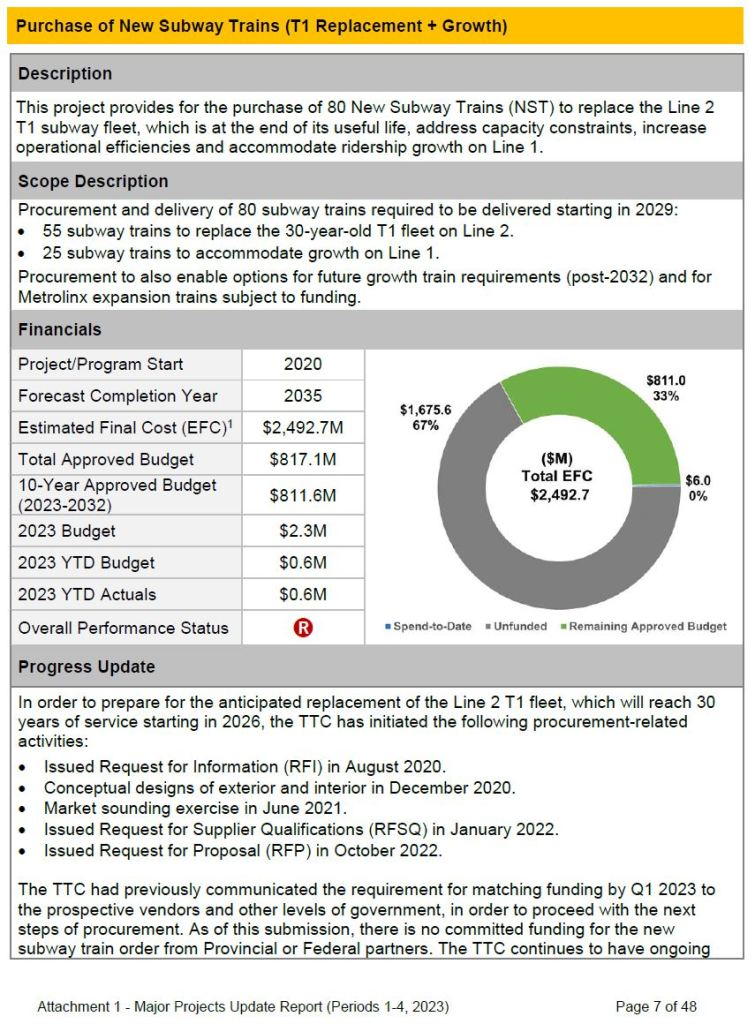
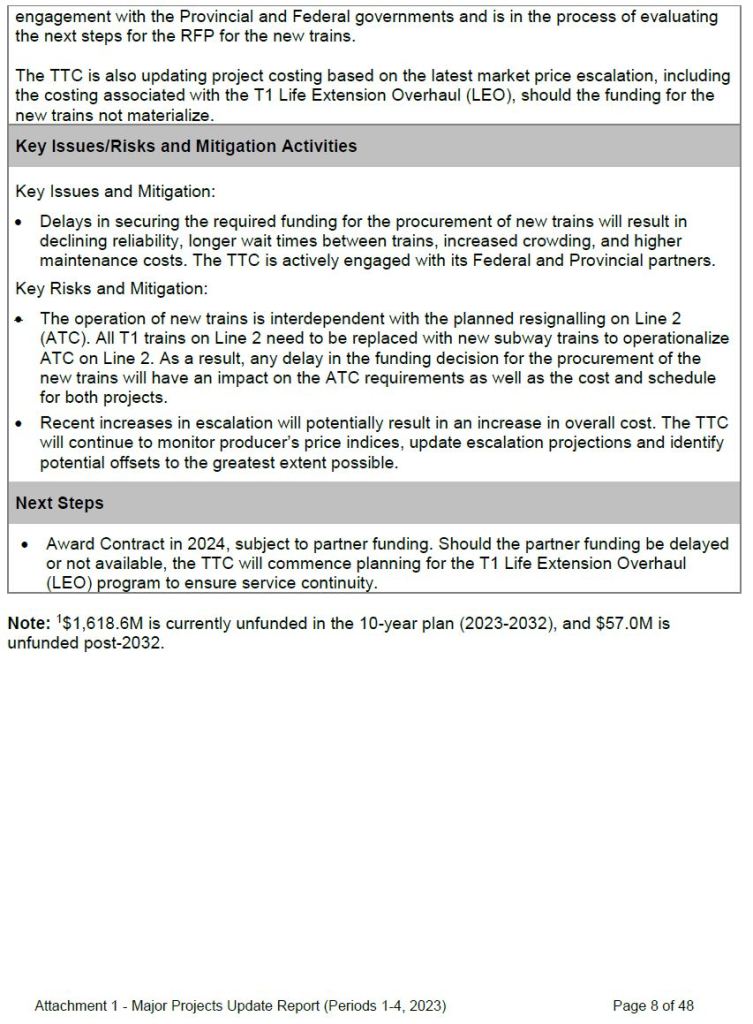
It is worth noting that as recently as the TTC Board meeting of June 12, 2023, there was no mention in the public session that this action was imminent. Here are the relevant pages from the Major Projects Update.

Updated June 26, 2023 at 5:00 pm

How many trains will the Scarborough Subway Extension require?

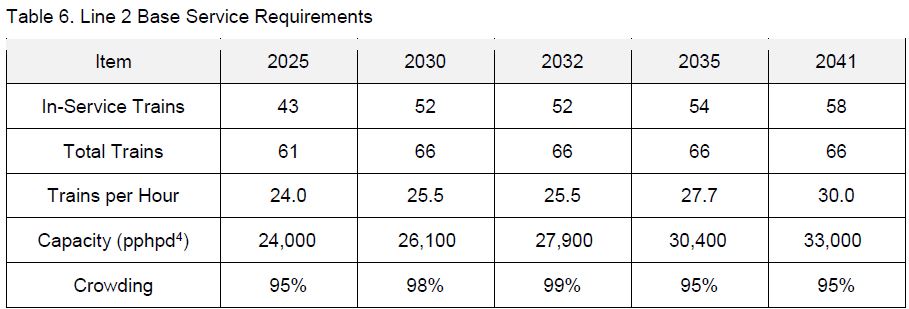
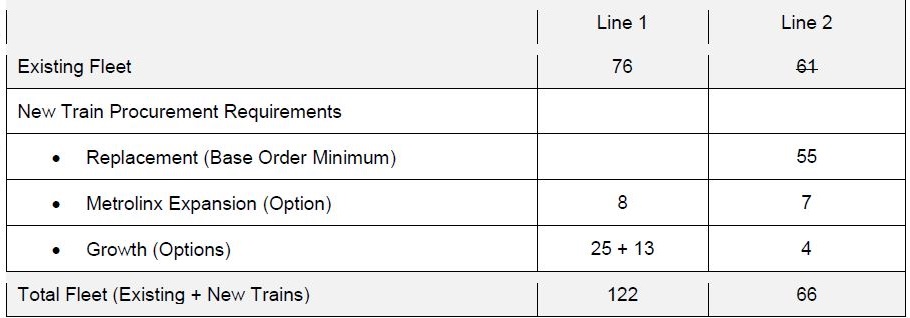
The TTC owns 370 cars in the T1 fleet which operates Line 2. That is equivalent to 61 6-car trains plus four spare cars.

The scheduled AM peak round trip time on the existing Line 2 is 105 minutes. For the maximum service possible with the existing signal and train control system, one train every 140 seconds, requires 45 trains. That was the AM Peak scheduled service in January 2020 before the pandemic-related service cuts. One additional train was on standby as a “gap” train for a total of 46. Allowing for spares at 20%, this requires a fleet of about 55 trains leaving only 6 spare for expansion.

The Scarborough extension is only marginally longer than the Line 1 extension from Eglinton to Finch with similar station spacing. A one-way trip on that part of Line 1 takes about 12 minutes, or 24 for the round trip. By analogy, that would make the round trip on the extended Line 2 about 129 minutes, and would required 55 trains with nothing left over for extras. Including spares at 20% would require a fleet larger than the TTC now owns.

Alternately, if every second train short turns at Kennedy Station leaving a 280 second service (4’40”) to Sheppard East, the line could probably operate with 50 trains which just fits within what is available.

One might argue that with a new fleet and the benefits of Automatic Train Control, overall speed could be improved and with that the fleet needed for full service to Sheppard could be reduced. But that is moot if TTC maintains the existing fleet.

When the SSE was planned, it had a pocket track east of Kennedy Station, but this was cut to save money, then it was restored. I wonder if someone is counting trains, or just hedging their bets on service levels beyond the existing terminus?

In any event, a failure to buy new trains has the double effect that it will condemn Line 2 to manual operation with an aging signal system for the foreseeable future, and will prevent the operation of full service beyond Kennedy in peak periods unless the Bloor-Danforth line never returns to the pre-pandemic peak service level.

Tunnels And Track But No Trains

At the TTC Board meeting on June 12, 2023, key reports presented the current and future challenges our transit system faces:

This article reviews the Major Projects Update and more generally the TTC’s Capital Program and funding shortfall. In future articles, I will turn to the Operating Budget, subsidies and the changing environment for transit in 2024 and beyond.

A related report from a past meeting presents the entire Capital Plan, not just the “major projects”, and I have consolidated information from it to provide a complete view.

TTC Capital Plans are presented with three separate timelines:

  • The current year,
  • A ten year window, and
  • Fifteen years and beyond.

The fifteen year view is comparatively recent, but it was a vital addition to the transit outlook. Until this version was introduced, a growing list of needed projects simply did not exist in the published TTC plans nor, more importantly, in the minds of Councillors and financial planners at all three levels of government. Magically, the ten year view always managed to fit within money the City had available from its own revenues or provincial and federal commitments.

That fifteen year view was a huge shock to the City, but it was no secret to anyone who looked through the budget and found gaping holes. This situation was a financial convenience to make future City capital needs appear smaller than they actually were. Funding problems were “fixed” year after year by failing to acknowledge key projects, or by pushing them beyond the City’s ten year capital planning window.

Doug Ford arrived on the scene with his subway plans and billions in provincial spending, but much of this was for projects that were not already part of the City’s plans, or at least not at the scale the City contemplated. The province gave the impression of taking a load off of Toronto, but much of the planned provincial spending was never in Toronto’s plans to start with.

Then came the pandemic and severe doubts about the sustainability of the City’s spending.

For his part, former Mayor Tory’s SmartTrack brand was still on the books, even if it was a shadow of its original plan. Despite going over budget, it lives on as five new GO stations thanks to an infusion of $226 million by the provincial government.

At the TTC, CEO Rick Leary was initially distrustful of Automatic Train Control and the new Line 2 fleet it would require. For a time, the projects to resignal the Bloor-Danforth line, buy a new fleet and build a carhouse at Kipling were put on hold. The TTC would make do through another decade with “life extended” trains which would be at least 40 years old by their retirement. Leary has since changed his tune, but this brought the cost of ATC, new trains and, possibly, the carhouse back onto the table.

The situation is complicated by the Scarborough Subway Extension which would require more trains to provide full peak service to Sheppard than the existing fleet. Half of the peak service would short turn at Kennedy to fit the service within the existing Line 2 fleet.

The already-expensive extension does not include ATC signalling because Metrolinx does not know whether the TTC will have an ATC-capable fleet by the opening date. Only the construction delays due to Ford’s intervention in the project give the TTC enough time, and then only barely, to bring Line 2 up to modern standards.

Another related issue is the emerging demand for Platform Edge Doors (PEDs) for which ATC is a pre-requisite. Without new trains and signals, there will be no PEDs on Line 2.

Toronto is in the unhappy position that we are building miles of tunnels, but may not have trains to run in them when they are finished. The self-contained Ontario Line has a fleet, and the Crosstown has its LRVs, but the subway extensions and planned service improvements are another matter. Moreover, if the Line 2 fleet’s life is pushed out to 40 years, there is no guarantee it will provide reliable service.

Award of the contract for new subway cars has already been delayed into 2024 and costs rise thanks to inflation while we await a funding decision. The Major Projects Report notes that:

  • Delays in securing the required funding for the procurement of new trains will result in declining reliability, longer wait times between trains, increased crowding, and higher maintenance costs. The TTC is actively engaged with its Federal and Provincial partners.
  • The operation of new trains is interdependent with the planned resignalling on Line 2 (ATC). All T1 trains on Line 2 need to be replaced with new subway trains to operationalize ATC on Line 2. As a result, any delay in the funding decision for the procurement of the new trains will have an impact on the ATC requirements as well as the cost and schedule for both projects.
  • Recent increases in escalation will potentially result in an increase in overall cost. The TTC will continue to monitor producer’s price indices, update escalation projections and identify potential offsets to the greatest extent possible.
  • Award Contract in 2024, subject to partner funding. Should the partner funding be delayed or not available, the TTC will commence planning for the T1 Life Extension Overhaul (LEO) program to ensure service continuity.

Meanwhile, on Line 1 Yonge-University, the fleet is in its youth, but more trains are needed to increase service and to provide for the Richmond Hill extension. A new maintenance facility will be required to hold the larger fleet, and it will most likely be built north of the new extension. There has been no word on whether York Region will contribute to any of the cost their subway extension will add to the TTC’s budget woes.

The Major Projects Report notes:

This program includes the accommodation of train storage and maintenance requirements, and other infrastructure enhancements, to expand capacity and improve circulation on Line 1, reduce overcrowding, increase the frequency of trains and reduce travel times, which will result in improved customer service.

[…]

Train Maintenance and Storage Facility (TMSF), which includes:

  • Storage for 34 trains, including a test track, and access track to the site;
  • Carhouse with five Bays for Preventative and Corrective Maintenance to support daily service;
  • Operations and Infrastructure (O&I) facility to support maintenance activities (small shop building, outdoor and indoor storage tracks for work cars, material storage, and staging area);
  • Ancillary facilities (Traction Power Substation (TPSS), Hostler platform).

More service adds to the electrical draw and in turn that will trigger upgrades to the subway’s power distribution system.

Without going into the many details, this illustrates how subway planning is not simply a question of drawing lines on a map and cutting ribbons when the tunnel boring machines arrive.

Continue reading

TTC eBus Contract Goes to New Flyer and Nova Bus

With the federal announcement of funding for the TTC’s eBus project, the bid award has been posted on the MERX website as of May 2, 2023.

The bid closed on April 18, 2022, but was not awarded until late January 2023, likely subject to receipt of funding.

The dollar value of the awards are $343.5 million to New Flyer and $220.2 million to Nova Bus. Vehicle quantities are not included in the MERX information, and I await a press release from the TTC with more details.

The total of $563.7 million is split roughly 60/40 between the two builders. This implies that neither of them scored in the highest possible echelon on product evaluation. This would have led to a much higher proportion going to one of two, or even to a single bidder, based on the scoring system in the RFP.

By implication, BYD, the only other bidder, fell even lower in the scoring. This is not surprising considering the quality and reliability problems the TTC has encountered with their vehicles.

I will update this article with additional information as I receive it.

How Many Buses Does The TTC Use?

In recent articles, I commented on the size of the bus fleet claimed in the CEO’s Report, the number of buses actually shown as active in the Scheduled Service Summary, and the ratio of spares to scheduled service.

See:

Updated April 24, 2023 at 6:30pm: The chart of average daily mileage by each bus has been amended to show the garage assignments of each vehicle.

An underlying issue for a transit system with a large proportion of spare vehicles is that the active vehicle count can be lower than the total count. Poor-performing vehicles, be they near retirement or simply lemons that cannot travel far without a breakdown, can be sidelined with no effect on service.

However, this can create two key problems:

  • A culture of indifferent maintenance while keeping only the best buses on the road can minimize repair costs and keeps service quality up, at the expense of garage space and the capital value of the unused vehicles.
  • The headroom to improve service is lower than it would appear from the raw vehicle count if vehicles shown on the active roster are there in name only. If they were actually needed, they might not be reliable enough to provide service.

To determine the actual usage of the bus fleet, I obtained a summary of tracking data from Darwin O’Connor, proprietor of the TransSee website, for the period from March 1 to April 21, 2023. This allowed me to plot actual usage of the fleet in various ways. Many thanks to Darwin for this assistance.

First is a simple plot of active vehicles by day. The chart below shows the number of buses with non-zero mileage by day over the period. There are several interesting features of this chart:

  • The regular pattern of weekdays, Saturdays and Sundays is clear. Note the three-day weekend for Easter in early April.
  • Although scheduled service cuts were implemented on March 27, there was no change in the count of active buses which, if anything, rose slightly. There is a drop in the following week.
  • The number of active buses exceeds the peak scheduled service by about a hundred vehicles. These are not necessarily extra “run as directed” buses, but rather vehicles that only operate for part of the day and are replaced by others (for example, AM and PM peak trips).
  • The spike on March 13 appears to have been caused by a single day on which buses that were otherwise inactive were sent out in service. Looking at the detailed tracking data, they did not stay in service for long. However, this spike distorts the apparent number of active buses if one looks only over a wider range of dates.

Another way to look at the data is to plot the number of days buses were active over the 51-day period. The chart below shows the number of buses with non-zero mileage and the count of days active. For example, the high point shows that 141 buses were active on 47 of the 51 days. By contrast, 72 buses were active on only one day, and a further 43 for 2 to 10 days.

This means that 115 buses did not venture into service much during the period. In addition to these are buses still counted as active, but which did not operate at all. The TTC might nominally have a fleet of about 2,040 buses (although they claim 2,114 in an outdated chart in the CEO’s report), but the number actually available for service is likely below 1,900.

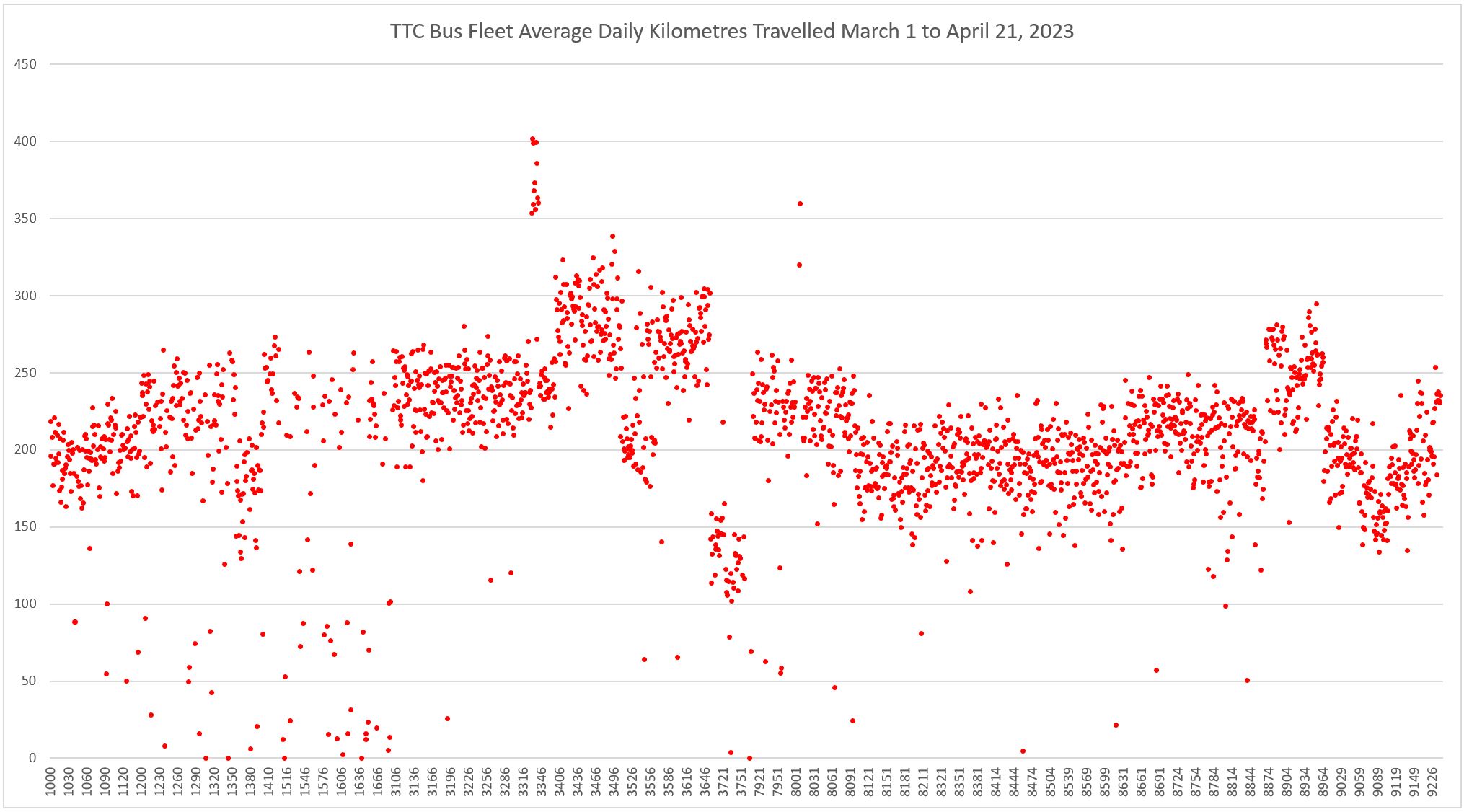
Yet another way to look at the data is to plot the daily average distance traveled by each vehicle considering only the days on which it was active. In other words, if the bus went out in service, how long did it stay there?

In the chart below, buses with no tracked mileage are not plotted. Note that the horizontal axis skips over breaks in fleet numbering. For example, there are no buses in the 2000, 4000, 5000 and 6000 ranges.

Items of interest here include:

  • A few buses sprang to life briefly, but have daily averages very close to zero.
  • Low average mileages are evident for older buses in the fleet:
    • 7900 to 7979: 2006 Orion VII Diesel
    • 8000 to 8099: 2007 Orion VII Diesel
    • 1000 to 1149: 2006 Orion VII Hybrid
    • 1200 to 1423: 2007-2008 Orion VII Next Gen Hybrid
    • 1500 to 1689: 2008 Orion VII Next Gen Hybrid
  • The battery buses 3700 to 3759 stick out with consistently lower average mileage than other parts of the fleet. Some eBuses were completely inactive during the 51-day period:
    • New Flyer: 3705, 3706, 3715, 3720, 3724 (5 of 25 buses)
    • Proterra: 3729, 3732, 3736, 3739, 3744 (5 of 25 buses)
    • BYD: 3750, 3751, 3752, 3754, 3757, 3758, 3759 (7 of 10 buses)
  • Buses assigned to 900 Airport Express have higher daily mileages (3330-3341, 8007, 8008) because they run on a very fast route.
  • Blocks of buses have higher daily mileage than others because they operate from garages with faster routes.

The TTC has just started to take delivery of over 300 new hybrid buses, and hopes to buy a comparable number of eBuses starting in 2024, subject to federal funding. If these displace the little used older fleet and increase the number available for sustained, all day service, this will be a significant contribution to what the TTC could achieve.

There will be a jump in service requirements in November 2023 when the SRT Line 3 is replaced by a bus shuttle from STC to Kennedy Station. That new fleet is arriving just in time. A budgetary oddity is that this service will be paid for from the Capital Budget as part of the cost of the Scarborough Subway Extension, and so it does not represent a net new cost to the TTC. Meanwhile, Queen’s Park is foot-dragging on paying for conversion of the SRT right-of-way as a bus roadway that would speed travel and reduce bus requirements.

Having more, working active buses to provide better service requires more operators and mechanics. A bus that sits in the yard costs next to nothing to “operate”. If hundreds of new buses sit idle (or allow middle-aged buses to be sidelined) this would be both a waste of capital and a betrayal of the promise of better service with a rejuvenated fleet.

The TTC has not produced a public fleet plan in years, and especially not one showing the effect of various scenarios for service growth or retrenchment. Current plans see only a 1% growth and this translates to small expansion of the bus fleet, especially considering that some bus services will convert to LRT when and if Lines 5 and 6 ever open.

Council’s goal to “green” the fleet may reduce diesel emissions, but the much larger target and goal is to move riders from private autos to transit. This cannot happen without better service and a working, fully available fleet.

Updated April 24, 2023

The chart below contains the same data as the scatter chart above showing average daily mileage for each vehicle, but with the dots colour coded to show the division to which the bus was assigned as of January 2023. The variation due to service characteristics in different parts of the city show up particularly for buses operating on faster suburban routes.

TTC Bus Fleet 2013 to 2023

The Star’s Matt Elliott has reported on the issue of surplus vehicles beyond reasonable spare requirements in the Toronto Star:

First off, I must report an error in my previous article which includes a table showing that the TTC has 551 spare buses. The actual number turns out to be 478.

The reason for the error is that a chart in the CEO’s report incorrectly shows the total bus count at 2,114. That was the value when this chart was originally used back in early 2021, but it has not been updated to reflect retirements of old vehicles. The actual number of active vehicles, according to the TTC’s Scheduled Service Summary for March 26, 2023, is 2,041. (This number does not appear as a total, but is obtained by adding up the number of active buses for each group in the fleet. See the last page of the summary for details.)

This still leaves the TTC with more buses on their hands than they strictly require for scheduled service plus maintenance, or to put it another way, with headroom to run more service without buying more buses.

The TTC has three new bus orders in the works for delivery in 2023-24:

  • 135 40′ hybrids from New Flyer
  • 68 60′ hybrids from New Flyer
  • 134 40′ hybrids from Nova Bus

It is not clear how many existing buses these will replace and what the resulting fleet mix will be by the end of 2024.

Separately from these will be a new fleet of over 300 battery electric buses. This contract (or possibly contracts) has not been awarded yet while the TTC awaits confirmation of federal funding for “green” buses.

Continue reading