TTC Cancels RFP For New Subway Trains (Updated)

A Request for Proposals for new subway trains has been cancelled due to lack of funding. The following notice was sent to all vendors on Friday, June 23:

The Toronto Transit Commission issued a Request for Proposals (RFP) on October 13, 2022 for the procurement of New Subway Trains.

The RFP indicated that the TTC was in the process of actively pursuing additional funding from other orders of government (Provincial and Federal), and that contract award was subject to receiving full funding commitments by early 2023. As detailed in item 1.2.2 – Funding Status of Part 1 – Invitation and Submission Instructions of the RFP document: “Timelines associated with this RFP have been communicated to potential funding partners, and a request for confirmation of funding by early 2023 has been requested. In order to receive the NST deliveries in time for the legacy fleet replacement and to meet growth needs, the TTC has elected to commence the procurement at this time, however, contract award is subject to receiving full funding commitments.”

Unfortunately, the additional funding required has not been secured and as such, TTC is cancelling the RFP effective immediately, and the Bonfire Portal will be closed.

The TTC will continue to have discussions with the Provincial and Federal governments on funding requirements for New Subway Trains and evaluate the requirements for issuance of a future Request for Pre-Qualification and Request for Proposals in the future.

Where this leaves future projects for enhancement of Line 2 Bloor-Danforth, conversion to Automatic Train Control and provision of full service on the Scarborough Subway Extension is anyone’s guess.

This is a project which was initially delayed by CEO Rick Leary in favour of a fleet rebuild, then reactivated as his attitude to the worth of ATC warmed with the success of the Line 1 conversion, a project very much the work of his predecessor Andy Byford and his team. The focus on spending for new lines has left major state of good repair such as fleet renewal high and dry, and this RFP cancellation show where that shortsighted policy has brought us.

I have reached out to TTC Media Relations for comment. This post will be updated as more information becomes available.

Updated June 26, 2023 at 3:45 pm

The TTC replied to my query for comment with the following:

As the posting says (or should), the purchase of the cars is contingent on funding being secured.

That has not yet happened, although discussions are ongoing.

This was about being transparent with bidders and letting them know that once funding is secure, we would re-post.

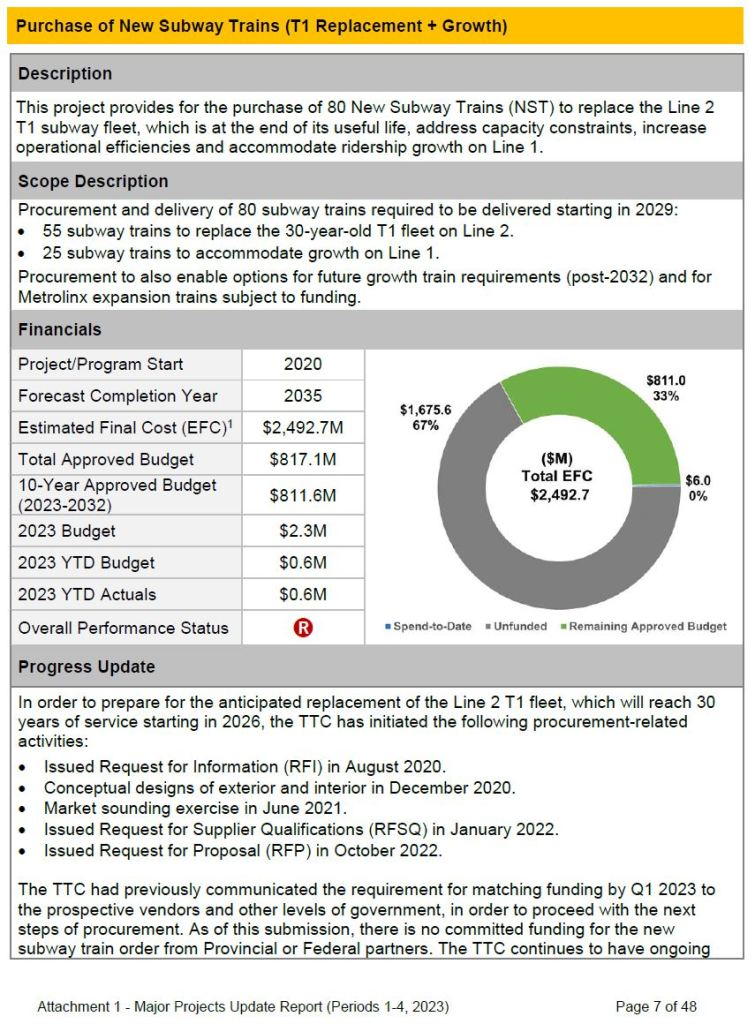
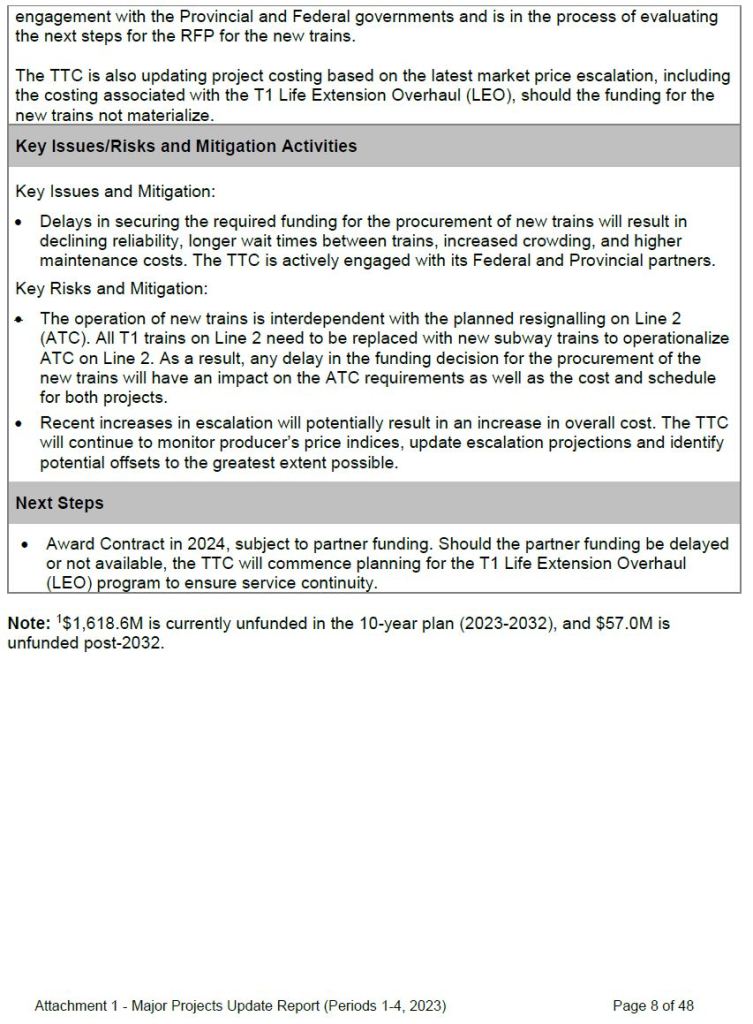
It is worth noting that as recently as the TTC Board meeting of June 12, 2023, there was no mention in the public session that this action was imminent. Here are the relevant pages from the Major Projects Update.

Updated June 26, 2023 at 5:00 pm

How many trains will the Scarborough Subway Extension require?

The TTC owns 370 cars in the T1 fleet which operates Line 2. That is equivalent to 61 6-car trains plus four spare cars.

The scheduled AM peak round trip time on the existing Line 2 is 105 minutes. For the maximum service possible with the existing signal and train control system, one train every 140 seconds, requires 45 trains. That was the AM Peak scheduled service in January 2020 before the pandemic-related service cuts. One additional train was on standby as a “gap” train for a total of 46. Allowing for spares at 20%, this requires a fleet of about 55 trains leaving only 6 spare for expansion.

The Scarborough extension is only marginally longer than the Line 1 extension from Eglinton to Finch with similar station spacing. A one-way trip on that part of Line 1 takes about 12 minutes, or 24 for the round trip. By analogy, that would make the round trip on the extended Line 2 about 129 minutes, and would required 55 trains with nothing left over for extras. Including spares at 20% would require a fleet larger than the TTC now owns.

Alternately, if every second train short turns at Kennedy Station leaving a 280 second service (4’40”) to Sheppard East, the line could probably operate with 50 trains which just fits within what is available.

One might argue that with a new fleet and the benefits of Automatic Train Control, overall speed could be improved and with that the fleet needed for full service to Sheppard could be reduced. But that is moot if TTC maintains the existing fleet.

When the SSE was planned, it had a pocket track east of Kennedy Station, but this was cut to save money, then it was restored. I wonder if someone is counting trains, or just hedging their bets on service levels beyond the existing terminus?

In any event, a failure to buy new trains has the double effect that it will condemn Line 2 to manual operation with an aging signal system for the foreseeable future, and will prevent the operation of full service beyond Kennedy in peak periods unless the Bloor-Danforth line never returns to the pre-pandemic peak service level.

Tunnels And Track But No Trains

At the TTC Board meeting on June 12, 2023, key reports presented the current and future challenges our transit system faces:

This article reviews the Major Projects Update and more generally the TTC’s Capital Program and funding shortfall. In future articles, I will turn to the Operating Budget, subsidies and the changing environment for transit in 2024 and beyond.

A related report from a past meeting presents the entire Capital Plan, not just the “major projects”, and I have consolidated information from it to provide a complete view.

TTC Capital Plans are presented with three separate timelines:

  • The current year,
  • A ten year window, and
  • Fifteen years and beyond.

The fifteen year view is comparatively recent, but it was a vital addition to the transit outlook. Until this version was introduced, a growing list of needed projects simply did not exist in the published TTC plans nor, more importantly, in the minds of Councillors and financial planners at all three levels of government. Magically, the ten year view always managed to fit within money the City had available from its own revenues or provincial and federal commitments.

That fifteen year view was a huge shock to the City, but it was no secret to anyone who looked through the budget and found gaping holes. This situation was a financial convenience to make future City capital needs appear smaller than they actually were. Funding problems were “fixed” year after year by failing to acknowledge key projects, or by pushing them beyond the City’s ten year capital planning window.

Doug Ford arrived on the scene with his subway plans and billions in provincial spending, but much of this was for projects that were not already part of the City’s plans, or at least not at the scale the City contemplated. The province gave the impression of taking a load off of Toronto, but much of the planned provincial spending was never in Toronto’s plans to start with.

Then came the pandemic and severe doubts about the sustainability of the City’s spending.

For his part, former Mayor Tory’s SmartTrack brand was still on the books, even if it was a shadow of its original plan. Despite going over budget, it lives on as five new GO stations thanks to an infusion of $226 million by the provincial government.

At the TTC, CEO Rick Leary was initially distrustful of Automatic Train Control and the new Line 2 fleet it would require. For a time, the projects to resignal the Bloor-Danforth line, buy a new fleet and build a carhouse at Kipling were put on hold. The TTC would make do through another decade with “life extended” trains which would be at least 40 years old by their retirement. Leary has since changed his tune, but this brought the cost of ATC, new trains and, possibly, the carhouse back onto the table.

The situation is complicated by the Scarborough Subway Extension which would require more trains to provide full peak service to Sheppard than the existing fleet. Half of the peak service would short turn at Kennedy to fit the service within the existing Line 2 fleet.

The already-expensive extension does not include ATC signalling because Metrolinx does not know whether the TTC will have an ATC-capable fleet by the opening date. Only the construction delays due to Ford’s intervention in the project give the TTC enough time, and then only barely, to bring Line 2 up to modern standards.

Another related issue is the emerging demand for Platform Edge Doors (PEDs) for which ATC is a pre-requisite. Without new trains and signals, there will be no PEDs on Line 2.

Toronto is in the unhappy position that we are building miles of tunnels, but may not have trains to run in them when they are finished. The self-contained Ontario Line has a fleet, and the Crosstown has its LRVs, but the subway extensions and planned service improvements are another matter. Moreover, if the Line 2 fleet’s life is pushed out to 40 years, there is no guarantee it will provide reliable service.

Award of the contract for new subway cars has already been delayed into 2024 and costs rise thanks to inflation while we await a funding decision. The Major Projects Report notes that:

  • Delays in securing the required funding for the procurement of new trains will result in declining reliability, longer wait times between trains, increased crowding, and higher maintenance costs. The TTC is actively engaged with its Federal and Provincial partners.
  • The operation of new trains is interdependent with the planned resignalling on Line 2 (ATC). All T1 trains on Line 2 need to be replaced with new subway trains to operationalize ATC on Line 2. As a result, any delay in the funding decision for the procurement of the new trains will have an impact on the ATC requirements as well as the cost and schedule for both projects.
  • Recent increases in escalation will potentially result in an increase in overall cost. The TTC will continue to monitor producer’s price indices, update escalation projections and identify potential offsets to the greatest extent possible.
  • Award Contract in 2024, subject to partner funding. Should the partner funding be delayed or not available, the TTC will commence planning for the T1 Life Extension Overhaul (LEO) program to ensure service continuity.

Meanwhile, on Line 1 Yonge-University, the fleet is in its youth, but more trains are needed to increase service and to provide for the Richmond Hill extension. A new maintenance facility will be required to hold the larger fleet, and it will most likely be built north of the new extension. There has been no word on whether York Region will contribute to any of the cost their subway extension will add to the TTC’s budget woes.

The Major Projects Report notes:

This program includes the accommodation of train storage and maintenance requirements, and other infrastructure enhancements, to expand capacity and improve circulation on Line 1, reduce overcrowding, increase the frequency of trains and reduce travel times, which will result in improved customer service.

[…]

Train Maintenance and Storage Facility (TMSF), which includes:

  • Storage for 34 trains, including a test track, and access track to the site;
  • Carhouse with five Bays for Preventative and Corrective Maintenance to support daily service;
  • Operations and Infrastructure (O&I) facility to support maintenance activities (small shop building, outdoor and indoor storage tracks for work cars, material storage, and staging area);
  • Ancillary facilities (Traction Power Substation (TPSS), Hostler platform).

More service adds to the electrical draw and in turn that will trigger upgrades to the subway’s power distribution system.

Without going into the many details, this illustrates how subway planning is not simply a question of drawing lines on a map and cutting ribbons when the tunnel boring machines arrive.

Continue reading

TTC eBus Contract Goes to New Flyer and Nova Bus

With the federal announcement of funding for the TTC’s eBus project, the bid award has been posted on the MERX website as of May 2, 2023.

The bid closed on April 18, 2022, but was not awarded until late January 2023, likely subject to receipt of funding.

The dollar value of the awards are $343.5 million to New Flyer and $220.2 million to Nova Bus. Vehicle quantities are not included in the MERX information, and I await a press release from the TTC with more details.

The total of $563.7 million is split roughly 60/40 between the two builders. This implies that neither of them scored in the highest possible echelon on product evaluation. This would have led to a much higher proportion going to one of two, or even to a single bidder, based on the scoring system in the RFP.

By implication, BYD, the only other bidder, fell even lower in the scoring. This is not surprising considering the quality and reliability problems the TTC has encountered with their vehicles.

I will update this article with additional information as I receive it.

How Many Buses Does The TTC Use?

In recent articles, I commented on the size of the bus fleet claimed in the CEO’s Report, the number of buses actually shown as active in the Scheduled Service Summary, and the ratio of spares to scheduled service.

See:

Updated April 24, 2023 at 6:30pm: The chart of average daily mileage by each bus has been amended to show the garage assignments of each vehicle.

An underlying issue for a transit system with a large proportion of spare vehicles is that the active vehicle count can be lower than the total count. Poor-performing vehicles, be they near retirement or simply lemons that cannot travel far without a breakdown, can be sidelined with no effect on service.

However, this can create two key problems:

  • A culture of indifferent maintenance while keeping only the best buses on the road can minimize repair costs and keeps service quality up, at the expense of garage space and the capital value of the unused vehicles.
  • The headroom to improve service is lower than it would appear from the raw vehicle count if vehicles shown on the active roster are there in name only. If they were actually needed, they might not be reliable enough to provide service.

To determine the actual usage of the bus fleet, I obtained a summary of tracking data from Darwin O’Connor, proprietor of the TransSee website, for the period from March 1 to April 21, 2023. This allowed me to plot actual usage of the fleet in various ways. Many thanks to Darwin for this assistance.

First is a simple plot of active vehicles by day. The chart below shows the number of buses with non-zero mileage by day over the period. There are several interesting features of this chart:

  • The regular pattern of weekdays, Saturdays and Sundays is clear. Note the three-day weekend for Easter in early April.
  • Although scheduled service cuts were implemented on March 27, there was no change in the count of active buses which, if anything, rose slightly. There is a drop in the following week.
  • The number of active buses exceeds the peak scheduled service by about a hundred vehicles. These are not necessarily extra “run as directed” buses, but rather vehicles that only operate for part of the day and are replaced by others (for example, AM and PM peak trips).
  • The spike on March 13 appears to have been caused by a single day on which buses that were otherwise inactive were sent out in service. Looking at the detailed tracking data, they did not stay in service for long. However, this spike distorts the apparent number of active buses if one looks only over a wider range of dates.

Another way to look at the data is to plot the number of days buses were active over the 51-day period. The chart below shows the number of buses with non-zero mileage and the count of days active. For example, the high point shows that 141 buses were active on 47 of the 51 days. By contrast, 72 buses were active on only one day, and a further 43 for 2 to 10 days.

This means that 115 buses did not venture into service much during the period. In addition to these are buses still counted as active, but which did not operate at all. The TTC might nominally have a fleet of about 2,040 buses (although they claim 2,114 in an outdated chart in the CEO’s report), but the number actually available for service is likely below 1,900.

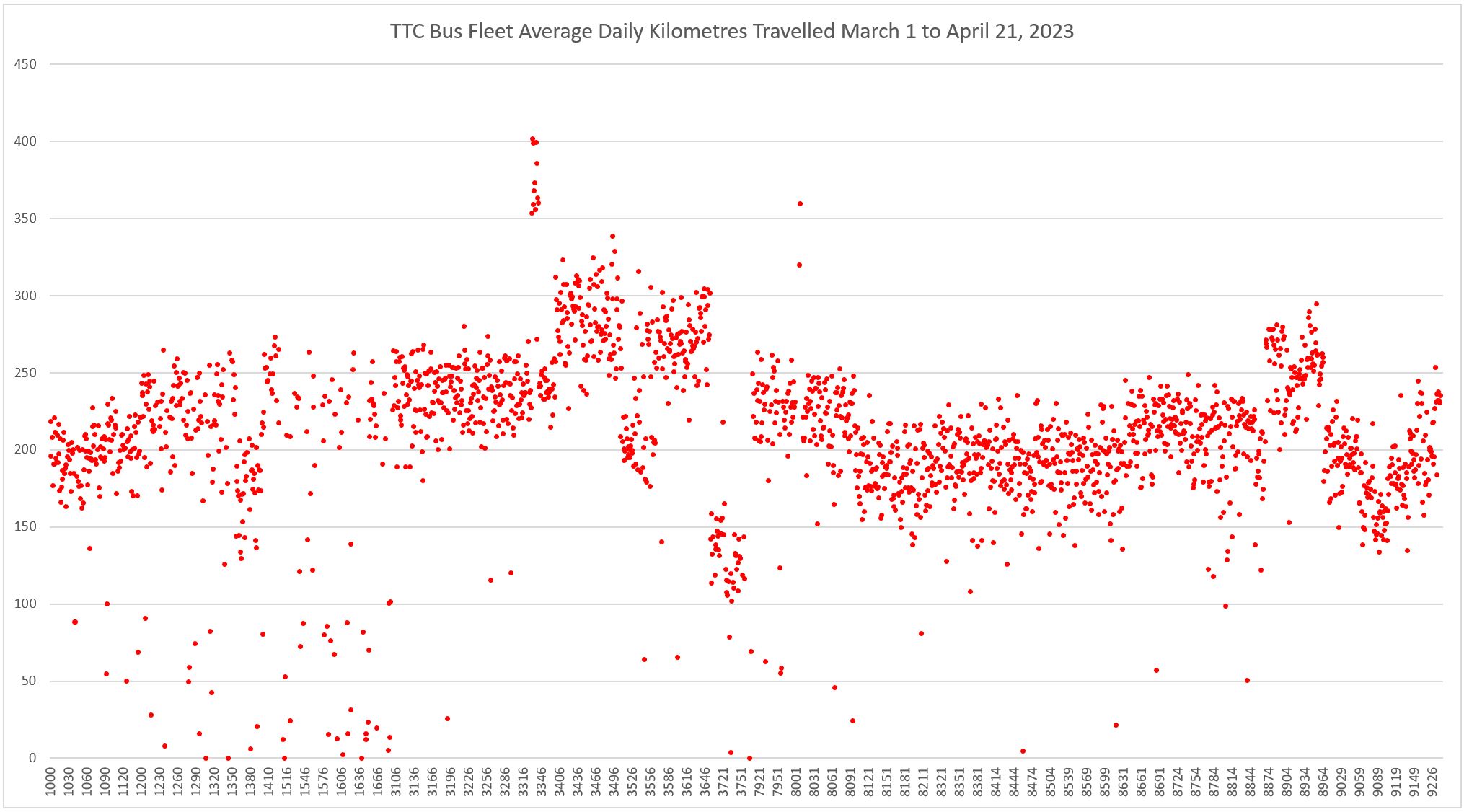
Yet another way to look at the data is to plot the daily average distance traveled by each vehicle considering only the days on which it was active. In other words, if the bus went out in service, how long did it stay there?

In the chart below, buses with no tracked mileage are not plotted. Note that the horizontal axis skips over breaks in fleet numbering. For example, there are no buses in the 2000, 4000, 5000 and 6000 ranges.

Items of interest here include:

  • A few buses sprang to life briefly, but have daily averages very close to zero.
  • Low average mileages are evident for older buses in the fleet:
    • 7900 to 7979: 2006 Orion VII Diesel
    • 8000 to 8099: 2007 Orion VII Diesel
    • 1000 to 1149: 2006 Orion VII Hybrid
    • 1200 to 1423: 2007-2008 Orion VII Next Gen Hybrid
    • 1500 to 1689: 2008 Orion VII Next Gen Hybrid
  • The battery buses 3700 to 3759 stick out with consistently lower average mileage than other parts of the fleet. Some eBuses were completely inactive during the 51-day period:
    • New Flyer: 3705, 3706, 3715, 3720, 3724 (5 of 25 buses)
    • Proterra: 3729, 3732, 3736, 3739, 3744 (5 of 25 buses)
    • BYD: 3750, 3751, 3752, 3754, 3757, 3758, 3759 (7 of 10 buses)
  • Buses assigned to 900 Airport Express have higher daily mileages (3330-3341, 8007, 8008) because they run on a very fast route.
  • Blocks of buses have higher daily mileage than others because they operate from garages with faster routes.

The TTC has just started to take delivery of over 300 new hybrid buses, and hopes to buy a comparable number of eBuses starting in 2024, subject to federal funding. If these displace the little used older fleet and increase the number available for sustained, all day service, this will be a significant contribution to what the TTC could achieve.

There will be a jump in service requirements in November 2023 when the SRT Line 3 is replaced by a bus shuttle from STC to Kennedy Station. That new fleet is arriving just in time. A budgetary oddity is that this service will be paid for from the Capital Budget as part of the cost of the Scarborough Subway Extension, and so it does not represent a net new cost to the TTC. Meanwhile, Queen’s Park is foot-dragging on paying for conversion of the SRT right-of-way as a bus roadway that would speed travel and reduce bus requirements.

Having more, working active buses to provide better service requires more operators and mechanics. A bus that sits in the yard costs next to nothing to “operate”. If hundreds of new buses sit idle (or allow middle-aged buses to be sidelined) this would be both a waste of capital and a betrayal of the promise of better service with a rejuvenated fleet.

The TTC has not produced a public fleet plan in years, and especially not one showing the effect of various scenarios for service growth or retrenchment. Current plans see only a 1% growth and this translates to small expansion of the bus fleet, especially considering that some bus services will convert to LRT when and if Lines 5 and 6 ever open.

Council’s goal to “green” the fleet may reduce diesel emissions, but the much larger target and goal is to move riders from private autos to transit. This cannot happen without better service and a working, fully available fleet.

Updated April 24, 2023

The chart below contains the same data as the scatter chart above showing average daily mileage for each vehicle, but with the dots colour coded to show the division to which the bus was assigned as of January 2023. The variation due to service characteristics in different parts of the city show up particularly for buses operating on faster suburban routes.

TTC Bus Fleet 2013 to 2023

The Star’s Matt Elliott has reported on the issue of surplus vehicles beyond reasonable spare requirements in the Toronto Star:

First off, I must report an error in my previous article which includes a table showing that the TTC has 551 spare buses. The actual number turns out to be 478.

The reason for the error is that a chart in the CEO’s report incorrectly shows the total bus count at 2,114. That was the value when this chart was originally used back in early 2021, but it has not been updated to reflect retirements of old vehicles. The actual number of active vehicles, according to the TTC’s Scheduled Service Summary for March 26, 2023, is 2,041. (This number does not appear as a total, but is obtained by adding up the number of active buses for each group in the fleet. See the last page of the summary for details.)

This still leaves the TTC with more buses on their hands than they strictly require for scheduled service plus maintenance, or to put it another way, with headroom to run more service without buying more buses.

The TTC has three new bus orders in the works for delivery in 2023-24:

  • 135 40′ hybrids from New Flyer
  • 68 60′ hybrids from New Flyer
  • 134 40′ hybrids from Nova Bus

It is not clear how many existing buses these will replace and what the resulting fleet mix will be by the end of 2024.

Separately from these will be a new fleet of over 300 battery electric buses. This contract (or possibly contracts) has not been awarded yet while the TTC awaits confirmation of federal funding for “green” buses.

Continue reading

TTC April 13, 2023 Board Meeting Follow-Up

The TTC Board met on April 13 with an agenda that did not give any indication that there would be lengthy debate on any item. I previewed the major issues in a previous article and will not repeat those comments here.

In this article:

  • Rogers Wireless Service
  • Eglinton Crosstown LRT (A very brief mention)
  • Safety on the TTC
  • Spare Buses and Service Reliability
  • Grasping at Straws for New Revenue
Continue reading

TTC Board Meeting April 13, 2023

The TTC Board will meet on April 13, and the agenda for their meeting is rather small. Notable by its absence is any reference to the service cuts planned for May 7, 2023.

The big items in the public portion of the agenda are the monthly CEO’s Report and an update on TTC’s finances and major capital projects to the end of 2022.

There are also two reports on collective agreements and non-union salaries. Although the details lie in confidential attachments, the public reports give an overview of the various labour contracts and salary drivers across the organization. I leave perusal of these to interested readers.

Finally there are a few references to the TTC’s eBus program scattered through reports. I will consolidate this info in its own section at the end of the article.

Correction April 18, 2023: It turns out that the size of the bus fleet shown in the graphic below is wrong. There are only 2041 buses, not 2114, in service as of March 2023. The article has been amended to reflect this.

Continue reading

So You Want To Be A TTC Commissioner (2023 Edition)

Our brand new City Council meets this week. After the requisite speechifying and back-patting typical of the inaugural gathering, they will get into the business of appointing members of various Committees and Boards, including the one that runs the Toronto Transit Commission.

There are two sets of Board members: Councillors and citizens, a.k.a. civilians who (in theory) are not politicians. Only the first group will be appointed at this meeting, and the citizen members will come up for review in the new year once the City goes through the motions of soliciting applications.

The choice of a TTC Chair is up to Council, although it’s hard to believe that a nod from the Mayor, even without any new powers, would be ignored.

On the past Board, the Council members were: Jaye Robinson (chair), Brad Bradford, Shelley Carroll, Cynthia Lai, Jennifer McKelvie and Denzil Minnan-Wong. Of these, Councillor Lai died just before the election, and Minnan-Wong chose not to run. The Chair’s job should go to someone with experience and a strong commitment both to transit and to making something of the position, not just being a seat warmer.

Oddly enough, none of the existing Councillor/Commissioners has asked to be reappointed. This could lead to turnover (good, maybe) but also the loss of institutional memory at the Board level. That works to management’s advantage, but an organization as large as the TTC needs experience at the top for policy and oversight, not just ribbon cutting.

The new Board, to be confirmed by Council today, will have Councillor Burnside as Chair, with Councillors Mantas, Holyday, Moise and Ainslie as members. The citizen positions will be filled separately in the new year, and current members remain in office until that occurs. I cannot say that I am enthusiastic abouy Burnside as Chair, and do not expect much advocacy from that quarter beyond a knife aimed at the budget, and hence the quality of transit service.

The new Board will face very, very serious problems affecting transit’s future in Toronto. As pandemic-era financial supports wind down, the TTC will simply not be able to afford to operate service without new revenues through fares or subsidies. Moreover, their capital plans vastly exceed available resources.

Since 2020, the struggle has been to just get past the crisis, but the TTC faced a bleak outlook even before the pandemic. I have no crystal ball or magical insights, but offer this article as advice to the new Board.

Continue reading

TTC Issues RFP For New Subway Trains

On October 13, 2022, the TTC issued a Request for Proposals for a new fleet of subway trains. The submission deadline is July 28, 2023, and the anticipated contract award date is December 22, 2023.

This article is not an exhaustive review of the specification which is over 1,200 pages long, but an attempt to pick up major points including differences between the new fleet and the existing TR trains. The information has been organized for easy reading with related points grouped together, not necessarily the sequence in which they appear in the RFP.

Updated October 21, 2022 at 9:10 am:

  • A section has been added with information on car ventilation as it relates to health concerns and air quality.
  • A section has been added with more details of the emergency detrainment at the cab ends of the train.

Click here to jump to these updates.

The initial order would be for 480 cars (80 6-car trains) to replace the existing T1 fleet which operates on Line 2 Bloor-Danforth and to provide both for ridership growth and added trains for the Scarborough and Yonge North extensions. The delivery window is 2027-2033.

The trains are intended to be operated as much as possible like the existing TR fleet on Line 1 to minimize retraining requirements.

Although it is buried in an appendix, the TTC proposes a new exterior livery for the trains bringing the red from surface vehicles back into subway territory.

The requested design life for the cars is 35 years, somewhat longer than the 30 year span usually associated with a new fleet, but not unreasonable given the usual lag in replacement orders. For example, the T1 fleet of 370 cars was delivered between 1995 and 2001, and so the first of them will be 33 years old when the first new trains arrive.

Pre-pandemic service on Line 2 was provided at peak by 46 trains (January 2020 schedules). Allowing for spares at 20 per cent, this makes the peak requirement 55 trains compared to the present T1 fleet of 61 trains. (The extra T1s were displaced from Line 4 Sheppard when it converted to 4-car TR sets.)

The initial round of industry consultation took place in 2021 and resulted in pre-qualification of four potential suppliers:

  • Alstom Transport Canada Inc.
  • CRRC Qingdao Sifang Co., Ltd.
  • Hyundai Rotem Company
  • Kawasaki Rail Car, Inc

The next round of vendor consultations and proposals will only occur with these four companies.

A key issue here is funding. The RFP states:

The TTC has secured commitment to date of $624 million from the municipal government and is actively pursuing additional funding from the other orders of government (Provincial and Federal) towards the full estimated cost of the project. Timelines associated with this RFP have been communicated to potential funding partners, and a request for confirmation of funding by early 2023 has been requested. In order to receive the NST [“New Subway Train”] deliveries in time for the legacy fleet replacement and to meet growth needs, the TTC has elected to commence the procurement at this time, however, contract award is subject to receiving full funding commitments.

TTC RFP, Page 4, Section 1.2.2

There is a 25 per cent Canadian content requirement in the RFP.

There is an ironic leftover in the specification that the trains should be capable of operation on existing lines, new extensions and a new “Relief Line”. This spec has been around for a while. [Technical Specification section 1.1.1]

In past financial plans, TTC management warned about due dates for funding needed to acquire trains in a timeframe that would fit with earlier proposals for a Line 2 Renewal project. That timeline has now passed, and it is clear that delivery of the new fleet might not be completed in time for the Scarborough and Yonge North proposed opening dates in 2030. This could leave more of the old T1 fleet in operation until enough trains are available to provide full service on extended Lines 1 and 2. That, in turn, has implications for the full transition to ATC signalling on Line 2.

It is possible that the total train requirement will be reduced from pre-pandemic levels by operation of both lines at a higher average speed taking advantage of Automatic Train Control and of the “high rate” available but not used. However, that option comes with caveats about the timing of ATC installation on Line 2 as well as the effect of higher speeds on track maintenance and power consumption.

The proposed delivery schedule is shown in the table below. The first two trains are planned for 2027 to allow acceptance testing and tweaking of the specification should problems arise before the main production run. Cars will be delivered to Wilson Carhouse by flatbed truck.

The 32 optional trains are allocated as below:

  • 7 for the new Scarborough Subway Extension
  • 8 for the new Yonge North Extension
  • 5 for the headway improvement on Line 1
  • 8 for the maturity service on the new Yonge North Extension
  • 4 for the maturity service on the new Scarborough Subway Extension

Delivery schedule relative to Notice to Proceed:

  • 40 months: Availability of first train at Wilson Carhouse for testing and commissioning
  • 42 months: Availability of second train at Wilson Carhouse for testing and commissioning
  • 52 months: Trains 3 to 10
  • 60 months: Trains 11 to 20
  • 66 months: Trains 21 to 30
  • 72 months: Trains 31 to 40
  • 77 months: Trains 41 to 50
  • 81 months: Trains 51 to 60
  • 85 months: Trains 61 to 70
  • 89 months: Trains 71 to 80

Availability for service is one month later. To put it another way, when a train arrives, it is expected to work more or less “out of the box” without months of testing and fixes.

Continue reading