TTC Will Take Legal Action Against Bombardier, Demands Explanation

At its meeting of October 28, 2015, the TTC Board unanimously passed the following motion regarding the order for Flexity streetcars from Bombardier:

  1. Authorize the TTC General Counsel to immediately commence a claim or legal action against Bombardier for all damages sustained by the TTC relating to or arising from the schedule delays in the delivery of the streetcars and any other non-performance related issues.
  2. Direct the Chair to write to the CEO Bombardier requesting he appear before the Board at its November Commission meeting to explain Bombardier’s failure to meet past deadlines and its delivery commitments for streetcars going forward.
  3. Request TTC management to consult with alternative suppliers for delivery of the remaining TTC streetcars, should Bombardier be unable for whatever reason to fulfill this order within contractual timelines.
  4. Request TTC staff to report back on the financial and operational impacts on the TTC should Bombardier not be able to fulfill their contractual obligations to deliver streetcars.
  5. Request TTC staff to seek the advice of an outside business analyst to present to the Board on their assessment of Bombardier’s corporate outlook.
  6. Request TTC staff, in any negotiations on damages, liquidated or otherwise, to consider as a priority additional LRV’s as compensation.
  7. Direct the Chair to write to the Premier of Ontario requesting the Province’s support in facilitating the completion of the City of Toronto’s order for streetcars from Bombardier.

This motion came out of a confidential session of the Board which led to the text approved here. Point 1 was the staff recommendation in the report on the agenda, and the remaining points were added.

The story of constantly shifting delivery timelines and excuses from Bombardier has gone on for a very long time, and they have exhausted the TTC’s patience. Several comments in public session suggested that if Bombardier expects ever to be awarded work by the TTC in the future, they will have to try very, very hard to win their trust.

This is something of an empty threat, at least in the short term, because the TTC will not be ordering more subway cars until the early 2020s. Moreover, Bombardier has long been Queen’s Park’s vendor of choice for rail car orders that receive provincial funding, and it would take a major upheaval to dislodge them from this position.

Whether the Bombardier CEO actually shows up at the November 23, 2015, meeting remains to be seen. Indeed, it would be an odd situation should the TTC action have already been commenced to make such a presentation, let alone subject himself to questions he could not reasonably answer without compromising his own company’s position.

Chair Josh Colle noted that clause 7 recognizes the fact that he has already been contacted by the head of Bombardier Transportation in Germany, three Cabinet Ministers, the Mayor of Thunder Bay, and others, and that this is a politically high profile file. It will be interesting to see whether the union representing Thunder Bay workers shows up with tales of incompetence at their plant, or at least first hand descriptions of the quality problems with material received from Bombardier’s plant in Mexico. Such a move would be to establish their own credibility and fight for their jobs, a situation akin to what happened during the Canadian content debates when the contract was awarded.

Queen’s Park also has an interest through Metrolinx where concern about on time delivery of cars for the Kitchener-Waterloo ION line (whose cars will come from the Metrolinx share of teh Toronto order), and there are effects further down the line for other LRT projects if the contract completely collapses.

No doubt there will be updates on this story in the regular media in coming days.

TTC Proposes Major Changes to Bus Fleet Plans (Updated)

Updated October 29, 2015 at 7:00 pm: Additional material based on the presentation and debate at the TTC Board meeting has been added at the end of this article.

At its meeting on October 28, 2015, the TTC Board will receive a presentation about bus fleet and garage planning. This combines many threads that have been discussed separately in the past into one overview and co-ordinated long-range planning, something missing from Board-level debates at the TTC for many years.

Four important changes in the TTC’s fleet planning lead to one common goal: an increase in bus reliability.

  • Steady-state procurement. TTC bus purchase quantities fluctuated wildly over past decades. In the late 1960s, there was a major system expansion into the suburbs concurrent with the subway extensions to Kennedy and Kipling, and later north to Finch. This produced a big spike in bus purchases which echoed through the system every 18 years or so as this generation of vehicles (and its successors) came due for replacement. Other ebbs and flows arose from political decisions such as service increases beyond “typical” requirements, or service freezes imposed through declining standards. This plays havoc with maintenance planning and with the City’s capital plans.
  • Increase the spare ratio. Historically, transit spare ratios have been set at about 12% (even lower values can be found decades ago on the TTC), but this only worked when vehicles were considerably simpler than they are today. It is worth noting that the PCC streetcar was designed from the outset to be a low-maintenance vehicle with roughly a monthly trip into the shops for preventative maintenance. The onset of vehicles with much more complex technology, and especially with technology at the “bleeding edge” of implementation, did nothing to improve transit maintenance costs. Higher spare ratios also require more capital to be tied up in buses under repair. Higher failure rates affect service.
  • Early retirement of the hybrid bus fleet. The hybrids were one of those nice “green” ideas where the technology simply did not perform as expected, but for a time government policy forced the TTC into buying nothing else. The fleet is less reliable than the diesels it supplanted, and the extra capital cost is not offset by lower operating cost.
  • Re-align diesel bus overhaul schedule. Various subsystems on a bus go through major overhauls or replacement on a planned cycle through the vehicle’s life. The schedule for this work will be adjusted to better match needs and to fit well with a planned 18-year bus lifespan. Equally important will be a change in the approach to routine maintenance with a shift from “fix on fail” that accounts for 80% of work today to a proactive, preventative replacement of parts before their expected in service failure disrupts service.

An additional issue still under study is the question of just how long a bus should stay in service. The 18-year span typical in Toronto (and previously in many other cities) arose from a combination of vehicle quality (the GM New Looks lasted forever) and of limited subsidy funding. However, a longer lifespan demands that transit systems have the capability to perform major overhauls that will keep a bus running that long, and this is not practical for smaller systems. Long ago, the USA standard dropped to 12 years as the funding cycle for federal subsidies to bus purchases. A still unanswered question is whether this should be Toronto’s policy.

Finally, there is the matter of garage space for a fleet that will continue to grow before the combined effect of subway and LRT line openings will see a drop in total fleet requirements.

Continue reading

TTC Board Meeting July 29, 2015 (Updated August 3, 2015)

The TTC Board will meet on July 29, 2015, and various items of interest are on the agenda. These include:

  • The monthly CEO’s Report (Updated August 2, 2015)
  • A presentation by Toronto’s Chief Planner Jennifer Keesmaat (Updated August 3, 2015)
  • Faregates for PRESTO implementation
  • Purchase of new buses and implications for service growth (Updated August 1, 2015)
  • Improved service standards for off peak service on “frequent” routes
  • Proposed split operation of 504 King during TIFF opening weekend (Updated August 2, 2015)
  • An update on Leslie Barns
  • Excluding Bombardier from eligibility for future contracts (Deferred to September Board meeting)
  • Council requests related to Lake Shore West streetcar service (Referred to TTC Budget Committee)

Continue reading

The State of TTC Streetcar Track Switches (Updated)

Updated June 28, 2015: Additional historical information from TTC Budgets has been added to the end of this article.

Ever since the introduction of the articulated streetcars back when the earth was still cooling, automatic track switches have been plagued with less-than-ideal reliability of the new system that was installed to operate them. This was triggered by the different lengths of ALRVs and, hence, the different distance from the front of the car to the point where the trolley pole sits on the overhead. A system based on a contactor on the overhead simply would not work with the ALRVs. The new system uses antennae at the front and rear of each car together with antennae in the pavement. This system allows the “front” of the car (rather than the rear) to signal the direction it wants to turn, and also provides a lock-unlock logic based on the rear end antenna passing the switch.

A project to replace this system has been on the books for years, but with little progress. Meanwhile, many switches that should be automatic (and through that automation interface with traffic signals) are manual. At the newly opened Queens Quay and Spadina, a pointman operates the switches.

I wrote to the TTC about this situation. Here are my questions and their replies.

Q: With the Queens Quay project finishing, an issue has shown up (again) that the switches at Queens Quay and Spadina are still being manually operated usually by a point duty operator, sometimes by the streetcar ops themself.

A: We are in the process of prioritizing restoration of a number of out-of-service switches in the network. Resources will be made available to restore the four (4) switches on Spadina and Queens Quay as a top priority.

Q: This delays service and also means that the transit priority signals cannot work as intended because they don’t “know” where a car intends to go.  Two points:

For years there has been a budgeted project to update the switch electronics because the old equipment has never been reliable.

A: We would not characterize the equipment in those terms. We are short of replacement parts due to the OEM changing ownership, losing interest in supplying parts, and that the original design files were lost in a major fire.

Q: If I remember correctly, this was one of the projects sloughed off to 2016 due to budget cuts. Is this correct?

A: We are still working on a new equivalent design and taking steps to secure its safety certification. Our objective is to create a controller with identical functionalities and a design that we own and take control.

Q: A commenter on my blog claims that there are long delays because Hydro must to an inspection when a switch is activated. Switches that are ready to be energized sit for months in manual mode. Is this correct?

A: New installation of wiring and controller must be performed in accordance with Hydro’s electrical safety code. Safety inspection by Hydro can indeed be a lengthy process. We would normally submit our application for inspection partway through the Work to reduce wait time gap.

There really is only one obvious question left here: if this were a subway signal system, would the problem have been left outstanding this long?

Updated June 28, 2015:

On the afternoon of June 27, an eastbound streetcar on Queens Quay at the entrance to Queens Quay Loop took an open switch and turned into the side of a westbound car. As luck would have it, this was one of the new LRVs, 4404. The story was covered in brief by CBC and several photos appeared on Twitter including this overhead view. The Star also has an article.

Continue reading

TTC Subway and Streetcar Plan Updates

At its meeting on June 22, 2015, the TTC Board will consider two reports affecting the future subway and streetcar fleets in Toronto.

In the case of the subway fleet, plans have been updated to provide for implementation of four-car Toronto Rocket (TR) train operation on the 4 Sheppard subway line.

For the streetcar fleet, there is an update, albeit with some doubts on the TTC’s part, regarding delivery of the new Flexity fleet by Bombardier.

Continue reading

TTC Board Meeting Wrapup: May 27, 2015

The TTC Board met on May 27, 2015 with an unusually rich agenda that took the public session straight through from 1:00 to 7:30pm, except for a break of roughly half an hour to discuss some items in camera. Rather than the relentlessly cheery, swift, but vapid meetings of the ancien régime, this one had some substance.

Reports on the Scarborough Subway, and on the surface route improvements are discussed in separate articles.

This article deals with:

  • TTC Governance
  • TTC and City Joint Transportation Initiatives
  • Draft Financial Statements
  • CEO’s Report

Continue reading

Russell Carhouse: Eastern Avenue Reconstruction (Updated November 20, 2015)

Updated Noveber 20, 2015 at 3:00 pm: Track construction at Russell Carhouse is now complete and overhead installation is in progress.

Updated July 28, 2015 at 12:20 pm: Photos of construction work in progress.

Updated July 3, 2015 at 5:40 pm: Photos of construction work in progress.

Updated June 24, 2015 at 5:00 pm: Photos of construction work in progress.

Updated June 6, 2015 at 10:00 am: Photos of Eastern Avenue construction from 1928 provided by John F. Bromley from his collection have been added to this article.

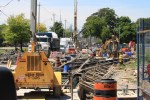
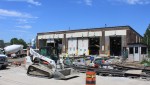
The ladder track at the south end of Russell Carhouse is being completely regraded and replaced in a project that will consume a few months. This is a joint project with the City of Toronto who are replacing a storm sewer that runs along the northern side of Eastern Avenue.

The track will not only be replaced, but it will be separated from a new sidewalk, and the track elevation will be changed to reduce the effect of turning and climbing at the same time into the tracks at the carhouse.

Eastern Avenue will be one lane each way in the new configuration. Because parking is allowed in curb lanes east and west of this area, a two-lane road is all that is needed to handle typical traffic volumes.

EasternAveDesign201506

[Image from the City of Toronto Construction Notice]

Removal of the existing track is, as of June 2, complete. Carhouse operations are more complex than usual with cars having to back into their storage and maintenance locations. Originally, the TTC would have had Leslie Barns at least partly available for storage, but that site and its access track are still under construction.

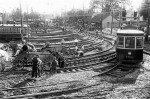
The original ladder track on Eastern Avenue was further south. The change is visible in these construction photos from 1928 provided by John F. Bromley from his collection.

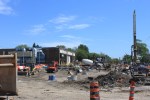
Updated June 24: Construction work in progress

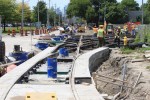
Updated July 3: Construction work in progress

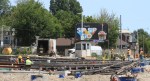
Updated July 28: Construction work in progress

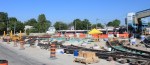
Updated November 20: Overhead installation in progress

Another Delay For Leslie Street (Updated August 7, 2015)

Updated August 7, 2015 at 6:00 pm: Leslie Street will reopen to traffic using the completed streetcar lanes and the west curb lane on August 8. Work will continue to rebuild the east curb lane and sidewalk.

Updated July 28, 2015 at 12:30 pm: Recent construction photos added.

Updated July 17, 2015 at 2:10 pm: Recent construction photos added.

Updated June 24, 2015 at 5:00 pm: Recent construction photos added.

Updated May 28, 2015 at 2:00 pm: Further information about the design of the track support structure has been added at the end of the article along with historical links.

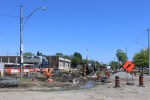
The seemingly endless work to rebuild Leslie Street south of Queen as the access route to the new Leslie Barns hit another setback with the discovery that a section of track was installed at the wrong elevation. This affects the road profile, drainage patterns and the access to an adjacent condo where residents had expected they would be free of side effects beyond the nuisance of construction.

A surveying error by the contractor, Pomerlau Construction, who have responsibility for the entire Leslie Barns project, caused about 60m of track just north of Eastern Avenue to be installed roughly 9cm above the correct level.

To explain a bit about the structures involved, here are photos from the Leslie Street project.

Continue reading

Bombardier Recalls Workers, Staffs Up For Production at Thunder Bay

tbnewswatch reports that Bombardier has recalled all employees temporarily laid off earlier in 2015 (more than 80), and hired 50 additional to work on its Light Rail Vehicle and Bi-Level car production. Both of these have been delayed with supply-chain woes.

I look forward to an updated delivery schedule for the TTC’s Flexitys, and will report on this as soon as news is available.

Leslie Street Update

Track work on Leslie Street linking from Queen Street south to the new Leslie Barns is finally underway on the last remaining blocks of this project.

For a gallery of construction photos from 2014, please visit Building The Connection To Leslie Barns.