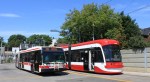
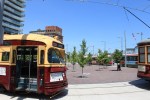
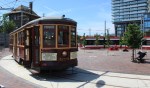
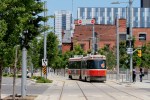
514 Cherry Opening Ceremonies

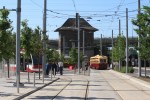
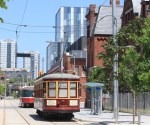
The 514 Cherry streetcar had its official opening on June 18, 2016, although regular service will begin on June 19 at 7:45 am. The route will operate between the new Distillery Loop near Cherry and Mill Streets in the Distillery District and Dufferin Loop at the western entrance of the Canadian National Exhibition grounds.

20160619Map514Changes

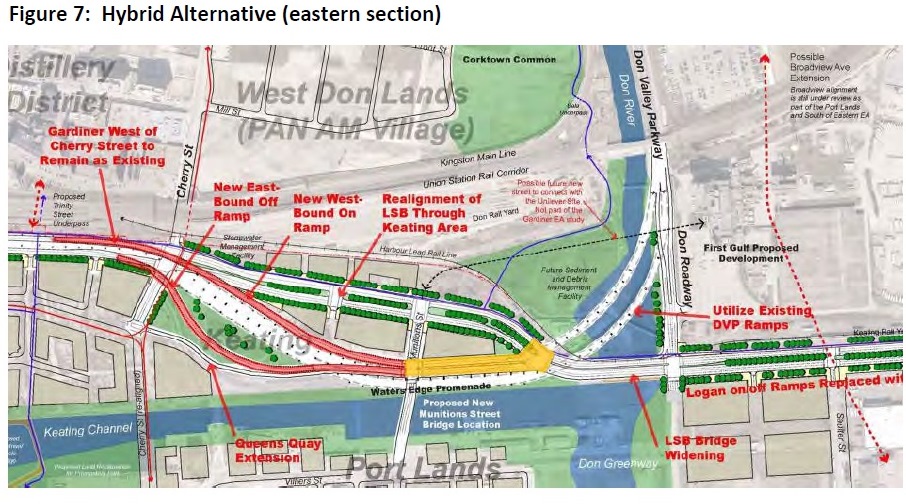
This is only the beginning of what should be a much larger network in the eastern waterfront, but work on that stalled thanks to the previous administration at City Hall. The impetus to restart on a serious basis will be funding of the Don River realignment and the active development of the land south of the railway corridor. Some idea of the potential network is shown in the following illustration from the Gardiner Expressway realignment study.

Cherry Street will be realigned south of the railway and will cross the Keating Channel on a new bridge including provision for streetcar track. New track along a realigned Queens Quay East will meet up at Cherry and provide the link to Union Station. Also shown (dotted) below is the proposed southerly extension of Broadview Avenue including streetcar track from Queen to Commissioners Street (out of frame below this illustration). Track on Commissioners would link east from New Cherry Street at least to Broadview and thence to Leslie Street and the southwest corner of Leslie Barns.

GardinerFig7HybridAlternative

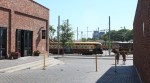
For the occasion, five streetcars were on hand:

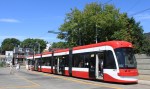
  • Flexity 4421, the newest of the cars in service
  • ALRV 4225
  • CLRV 4140
  • PCC 4500
  • Peter Witt 2766

4421 laden with many passengers and a few politicians set off from Distillery Loop after the usual speechifying such occasions bring, and made a round trip to Dufferin Loop. On its return, the original four cars were still waiting, but in due course the whole parade set off back to the carhouse.

An amusing note from our journey was that the car stopped at (and even announced) most of the stops along King Street that are scheduled to be taken out of service on June 19. This will be the only time that a 514 Cherry car served those stops. No, we did not have a photo op at each one to mark its passage.

Already there is word that operators are displeased with the absence of a loo at Distillery Loop. It’s a shame the Canary Restaurant isn’t still in business at Front Street where streetcars stop right at the door. I suspect this would have been a favourite layover point.

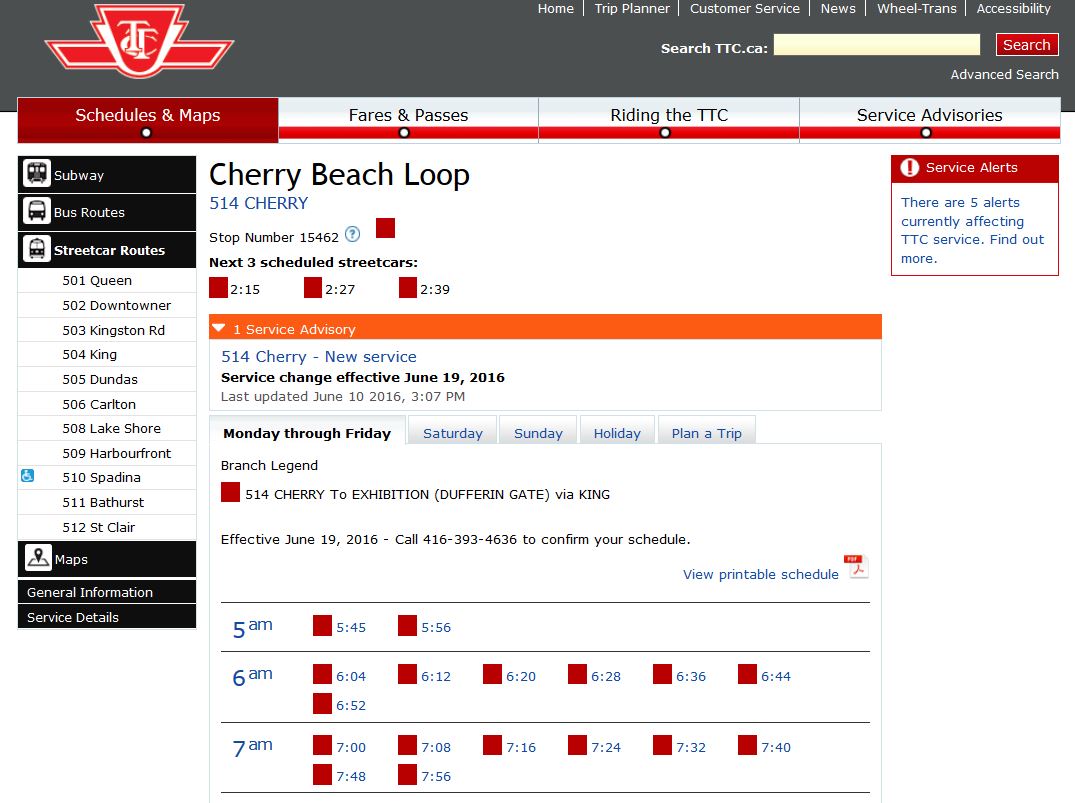
The TTC appears to be slightly confused about the location of the eastern terminus of 514 Cherry. According to the schedule website, this would be Cherry Beach Loop which is somewhat further south across both the Keating Channel and the Ship Channel, a lot sandier, and notably without any track. Not even any Swan Boats.

20160619_514_CherryBeachLoop


King Street Service Update: June 2016

The City of Toronto is about to launch its review of how King Street “works”, and Chief Planner Jennifer Keesmaat has an op-ed in the Star, It’s time to reimagine Toronto’s streetcar ‘King’.

Both for personal interest and as part of my work for the TTC and City of Toronto on the behaviour of streetcar routes, I have been following the 504 King route for some time using TTC vehicle tracking data. This article updates the consolidated stats in anticipation of the King Street project with data to May 2016, and looks in detail at some of the current information from that month including vehicle speed profiles.

For information about the creation of these charts, please see Methodology for Analysis of TTC’s Vehicle Tracking Data.

Continue reading

Analysis of Services on Wilson Avenue (Part I)

Wilson Avenue is served by many bus routes and branches, and this arrangement has been through two major reorganizations since fall 2015. In these articles, I will review the changes and the quality of service provided at various locations along the route.

Until March 27, 2016, service on Wilson Avenue was provided by 96 Wilson and 165 Weston Road North with most trips originating at York Mills Station.

In October and November 2015, both routes became part of the 10-minute network, and their schedules were reorganized accordingly. Blended service is provided in off-peak periods on the common section of the routes on Wilson Avenue between Weston Road and Yonge Street.

In March, this was changed to split off routes 118 Thistle Down, 119 Torbarrie and 186 Wilson Rocket as separate entities but on the same routes as the original branches of 96.

  Before                                      After

  96A Wilson YMS to Carrier Drive             Unchanged
  96B Wilson YMS to Claireville               Unchanged
  96C Wilson YMS/WS to Thistle Down           118 Thistle Down from WS
  96E Wilson WS to Humber College Express     186 Wilson Rocket from YMS
  96G Wilson YMS to Sheppard & Torbarrie      119 Torbarrie from WS
  165A Weston Road N YMS to Steeles & Weston  Unchanged

  YMS: York Mills Station
  WS:  Wilson Station
  • The 186 Wilson Rocket operates weekday peak and midday periods from York Mills Station whereas its predecessor 96E was peak only from Wilson Station.
  • All Thistle Down trips are now to/from Wilson Station only.
  • Service to Torbarrie remains peak only and its eastern terminus is now Wilson Station, not York Mills Station.
  • Additional 165 services operate into York Region with various destinations including seasonal service to Canada’s Wonderland.
  • The 96A and 96B services are identical over most of the route branching primarily at their outer ends just beyond Humber College, terminal for the 96E/186. The 96C/118 service branches off at Albion Road, and the 96G/119 west of Jane Street.

An obvious question here is whether all of this shuffling made any difference in the service beyond giving the various sub-routes their own numbers.

For those who want the short version, the service is a bit better, but still not very good, and it certainly does not meet the TTC’s goal of providing reliable service at terminals, let alone along the way. Wilson provides a good example of inferior service for riders notably when there is an attempt to blend multiple routes and branches. There is no individual location or time to point at, but rather an overall lack of rigour in provision of service throughout all of the routes at all times and days of the week.

There is no sign through any of the data here of an attempt to manage headways (or equivalently, to keep buses “on time”). In some periods and locations, many overlapping services could usually guarantee a bus to somewhere a rider is going. Inbound on Wilson, any bus will take you at least to Wilson Station, and most will go beyond to York Mills. However, for individual branches, simply letting the service operate as it might produces a much less satisfactory result with unreliable service, wide gaps and bunching.

These are services that would benefit from explicit “time point” dispatching with vehicles expected to leave points enroute, notably those where services merge as well as points where an enroute layover to achieve an even headway could easily be handled. A range of +1 to -5 minutes relative to the schedule on this route gives far too much latitude.

In Part II of this article I will examine running times in comparison with schedules for these services if only to deal with the usual “if only we had more running time” argument that has become the standard response to unreliable service.

The schedule summaries for these routes and periods are at the end of this article for reference.

Continue reading

TTC Service Changes Effective June 19, 2016

Many changes will affect TTC operations with the onset of summer schedules for 2016. These include both the usual seasonal changes to service levels, several construction projects affecting routes, and the restructuring of routes serving the waterfront.

Updated May 24, 2016 at 7:30 pm: Preliminary information on construction diversions at Broadview Station has been added to this article.

2016.06.19 Service Changes

The information in the spreadsheet linked here is organized into three sections:

  • Routine, mainly seasonal, changes
  • Groups of changes related to specific projects and route reorganization
  • Construction project calendar

20160619Map514Changes

The 514 Cherry streetcar route begins operation running via a short spur south from King to Distillery Loop. Initially this will run with a mix of Flexities and CLRVs pending an increase in the fleet of new cars. Eventually track on Cherry will extend under the rail corridor and south into the Port Lands, but that is a project still years away and subject to the usual wrangling at Council about capital spending priorities.

In the 2016 Budget, the TTC Board and Council chose not to fund the new service with additional money, and so this operation will be implemented by cutting service on the outer ends of the 504 King route. Peak service will operate every 8-9 minutes, and off-peak periods, the line will operate on a 15 minute headway with five cars. A blended service on King is impractical given the large difference in frequencies between the 514 and 504 routes. Whether the Cherry cars actually pull out onto King into gaps and carry passengers, or merely slip in behind King cars and let them do the work remains to be seen.

The 172 Cherry Street bus has been replaced by an extended 72 Pape over a new route serving Queen Quay East, and by a new 121 Fort York – Esplanade bus that will operate on, at most, 15 minute headways, a considerable improvement over the former 172 Cherry.

Sunday Stops

The TTC continues its program to remove Sunday Stops from the system with removal of stops at the following locations.

20160619SundayStops

Streetcars Return due to Bus Shortage

With the onset of construction season, and despite the summer service cuts, several streetcar routes will be partly or completely replaced by buses: 512 St. Clair, 511 Bathurst, 506 Carlton. This will be offset by the return of streetcar service to the 502 Downtowner and 503 Kingston Road Tripper lines, as well as full streetcar service on 504 King with no bus trippers. Service will likely revert to combined streetcar/bus operation in September thanks to the late deliveries of new Flexity streetcars by Bombardier.

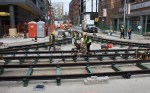
Construction Work on College Street

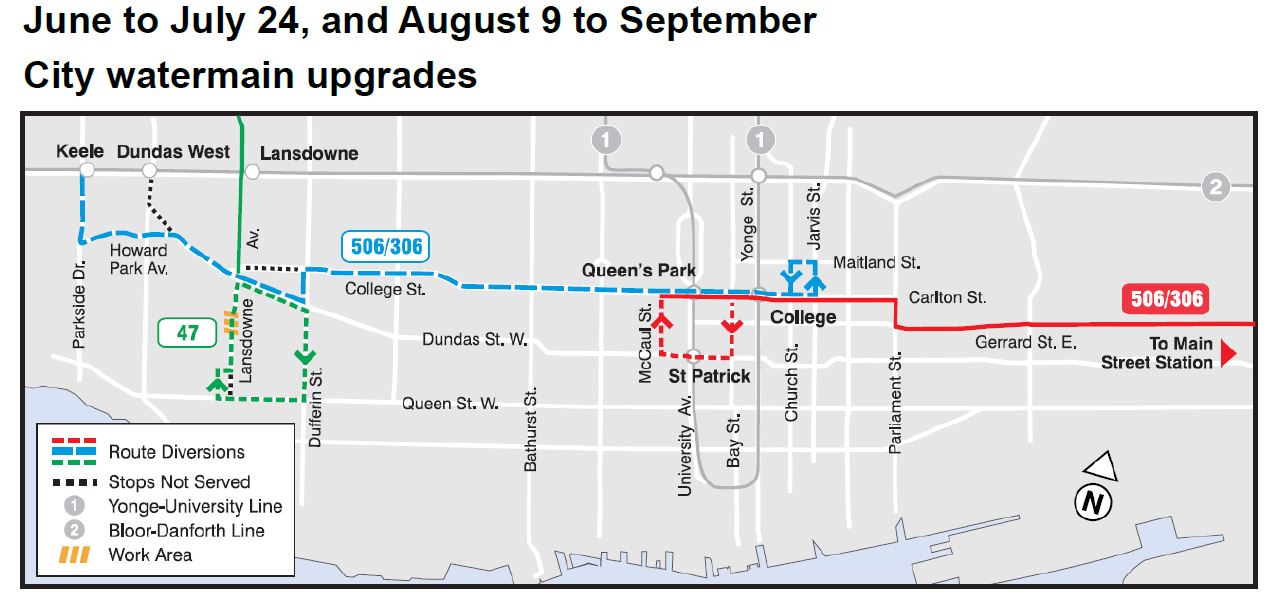
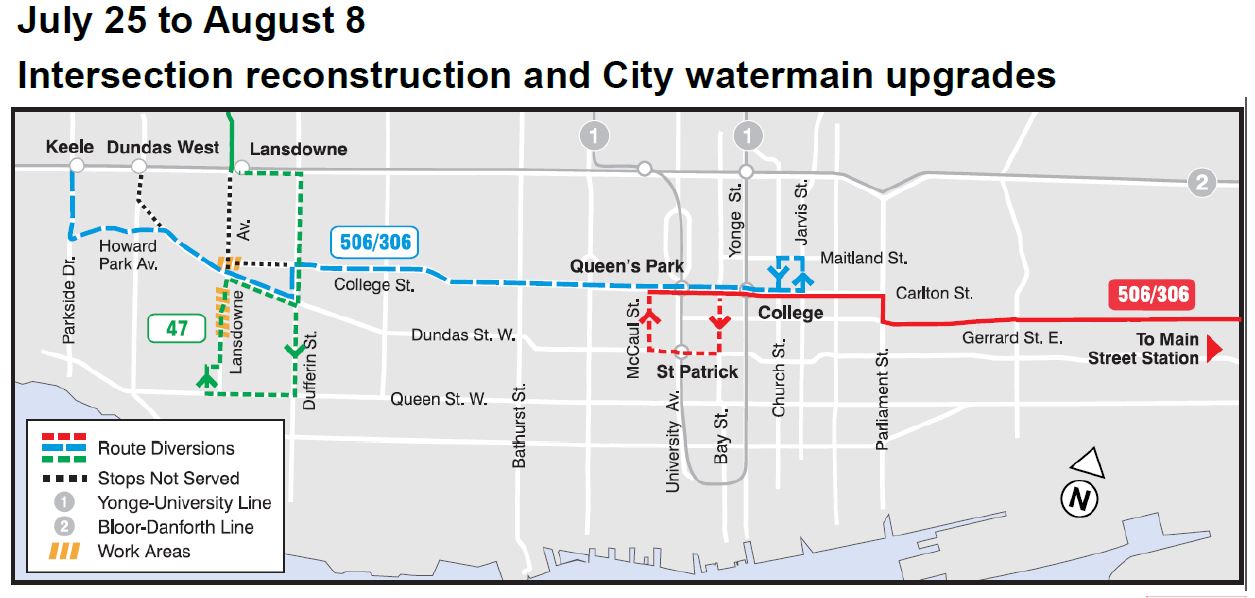
Several projects on College Street West have been timed to occur over the summer of 2016.

  • Special track work replacement at Bathurst and at Lansdowne
  • Removal of safety islands at Bathurst eastbound and at Bay Street both ways
  • Expansion of the safety island westbound at Bathurst
  • Water main upgrades on College and on Lansdowne
  • Streetscape improvements on College

The effects of these will be:

  • 506 Carlton will operate with buses in the west and streetcars in the east on weekdays, and with buses over the entire route on weekends. The weekday services will overlap between Church and Bay. This will continue throughout the summer.
  • 47 Lansdowne will divert around the construction area via Dufferin Street.
  • 511 Bathurst will be operated by buses until the next schedule change at the end of July diverting around construction via Spadina between Harbord and Dundas.
  • The 509/511 bus shuttle on Fleet Street will be replaced by the 511 bus service.

Details of the service diversions are in a separate article.

When streetcar service returns to Bathurst Street, the cars will operate into Exhibition Loop so that through service is provided until the Labour Day weekend. In September/October, service will be cut back again to Fleet Loop for a track replacement project in Exhibition Loop.

St. Clair Construction

Major construction work at St. Clair and St. Clair West Stations will require removal of streetcar service over the summer and early fall. The approach ramps at St. Clair West were not rebuilt during the line’s reconstruction, and the track must be replaced. The entire 512 route will be operated with buses through the summer, and streetcars will return from St. Clair West to Keele in September. Full streetcar service will resume on the Thanksgiving weekend in October.

Buses will not be able to enter either station during this project. At St. Clair Station, all bus service will loop on street via Avoca, Pleasant Boulevard, Yonge and St. Clair with transfer connections at the Pleasant Boulevard entrance. At St. Clair West Station, the 90 Vaughan bus will be extended south to Bathurst Station, and routes 33 Forest Hill and 126 Christie will be interlined. All buses will make an on street transfer connection at St. Clair West.

Broadview Station Construction

The bus loop at Broadview Station will be rebuilt over the summer and all bus services will loop on street via Erindale, Ellerbeck, Danforth and Broadview using an on street transfer. Given the frequent congestion of streetcars on Broadview awaiting entry to the station, the bus service will add to the congestion at Danforth northbound. The arrangement of on street stops for the four bus routes affected here has not yet been announced. Running time has been added to allow for the around-the-block loop except in cases where there was already enough recovery time in the existing schedule.

Updated May 24, 2016: Brad Ross at the TTC has provided the preliminary construction notice for the service and street changes. In addition, the Brick Works shuttle bus which normally loads on Erindale outside of Broadview Station will be relocated to Chester Station.

Bayview Services Reorganized

Peak period frequent service on 11 Bayview now ends at Davisville & Bayview, but this will be extended to Sunnybrook Hospital with every second bus running through to Steeles.

The 28 Bayview South route serving the Brick Works now operates only on weekend daytime hours, but will provide service during all periods.

Victoria Park North

Service in York Region on Victoria Park will now be provided by York Region Transit. The 24D Victoria Park branch to Major Mackenzie will be dropped and all service will turn back at Steeles Avenue. The 224 Victoria Park North route will cease operation.

Richmond Street Construction

All Downtown Express services will divert westbound from Church to Peter while Richmond Street is rebuilt from Victoria to York. Whether there will be any provision to assist the left turns west-to-south at Peter that will block 501 Queen Service (itself forced to divert and turn south at Spadina for water main construction) remains to be seen.

Streetcar Track Construction Update: Spring 2016 (Update 2))

Several projects sprang up with the warm weather in Toronto, and more are to come.

Updated May 13, 2016: Details of diversions and replacement services for College Street projects have been added to the end of this article.

Updated May 13, 2016 at 3:00 pm: Details of diversions and replacements updated for 506 Carlton and 512 St. Clair.

First off was the replacement of special work on Charlotte Street at Adelaide and at King including removal of the never-used lead to Adelaide Street eastbound.

Next was the replacement of the southwest ladder track at Roncesvalles Carhouse. Because of the odd shape of the property, this carhouse has many interesting twists and turns in its layout.

A short section of Bay Street south from Elm has been in rough shape with a slow order for a few years. Now the track has been replaced.

Pending work for the construction season includes:

  • Richmond Street tangent track from east of Yonge to York. This is part of an overall reconstruction of the street previously begun by Toronto Water.
  • College at Bathurst (June 20 to July 22) and at Lansdowne (July 11 to 22). This is part of a set of projects affecting College Street described in detail on the City’s website. See below for details of service diversions and bus replacements.
  • A shutdown of 512 St. Clair will be required for the reconstruction at both St. Clair West and St. Clair Stations. This will begin concurrently with the reconstruction of Bathurst & College.

As of May 9, the 501 Queen service is diverting around Toronto Water construction via Spadina, King and Shaw. This will be in place until Thanksgiving weekend unless the work is finished early.

Diversions for College Street Projects (Added May 13, 2016)

Illustrations here are taken from display panels for a public meeting earlier this year.

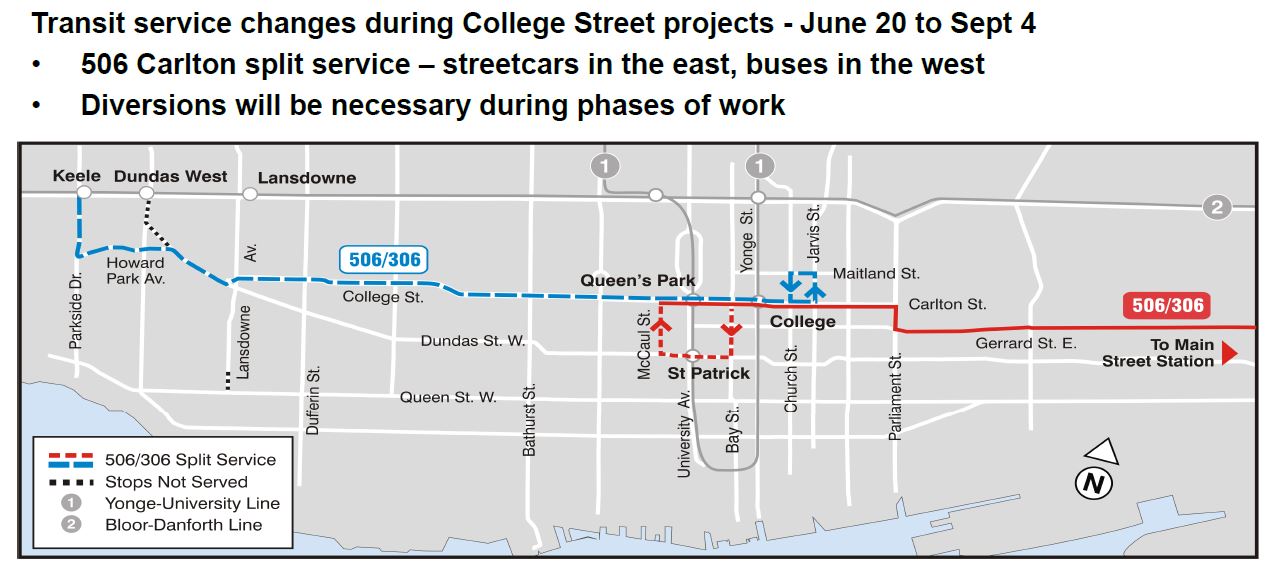
Through the summer to the Labour Day weekend, the 506 Carlton route will operate with streetcars on the eastern portion of the route looping downtown via Bay, Dundas and McCaul. This route stays the same throughout the period because it is not affected by construction projects further west.

The western end of the route will operate with buses whose location will vary from phase-to-phase of the work. The service will loop east of Yonge Street via Jarvis, Maitland and Church. Note that the section between Dufferin and Lansdowne will be affected by construction work that will take place for some or all of the summer (see later maps below).

Updated May 13 at 3:00 pm: The split service shown below will operate on weekdays. On weekends, buses will provide service over the entire route diverting as necessary between Spadina and Lansdowne.

201606_506Diversion_1_CarltonSplit

While College and Bathurst is under construction, services will be modified as shown below.

The 506 west bus will divert via Spadina, Harbord and Ossington. The 511 Bathurst car will be replaced with buses diverting via Dundas, Spadina and Harbord.

201606_506Diversion_2_CollegeBathurst

During a considerable portion of the project, water main work between Dufferin and Lansdowne will require the 506 west bus to divert via Dufferin and Dundas.

201606_506Diversion_3_DufferinLansdowne

While the intersection of College and Lansdowne is under construction, the 47 Lansdowne bus will divert via Dufferin Street from Bloor to Queen southbound, and will operate northbound via Lansdowne only to Dundas Street, then via Dundas and Dufferin to Bloor.

201606_506Diversion_4_CollegeLansdowne

Updated May 13 at 3:00 pm: 512 St. Clair will be converted to bus operation during construction work at St. Clair West and St. Clair Stations throughout the summer. Buses will serve St. Clair West at on-street stops. During the September-October schedule period, construction work at St. Clair Station will require bus operation from St. Clair West Station to St. Clair Station.

Analysis of 510 Spadina for December-January 2015-6

On January 3, 2016, the schedule for route 510 Spadina changed from one based on the use of standard-sized streetcars (the CLRVs) to the new longer low-floor cars (Flexitys or LFLRVs). This article reviews the operation of the line before and after the new schedule.

The revised service provided an increase in capacity with a replacement ratio of new cars for old on a ratio considerably lower than 2:1, and during periods of infrequent service (early weekend mornings, late evenings), the replacement was 1:1.

510_20151122_ScheduleSummary

510_20160103_ScheduleSummary

In brief, the service actually operated on 510 Spadina bears little resemblance to the advertised schedule. Headways (the time between cars) are erratic and often wider than the scheduled values for both the “old” and “new” service designs. The proportion of service operated to the three destinations (King, Queens Quay and Union Station) do not always match the schedule, and indeed during January (when only two destinations are supposed to be in use at any time), service to all three persists just as in December.

However, padding the schedule, a tactic used on other routes to eliminate the need for short turns, is impractical here because terminal congestion with queued vehicles would severely interfere both with passenger travel times and with terminal operations. Unlike a route such as 501 Queen where most riders depart from vehicles before the terminal, 510 Spadina has very strong demand to its destinations at subway stations.

Line management consists of dispatching cars and operators as available, and the service levels on each branch do not match the actual design, notably the proportion of service that should operate on each section of the route. This particularly affects riders south of King and on Queens Quay whose service is erratic and below the advertised level even though the area has a large and growing population.

Continue reading

6 Bay and 94 Wellesley Service Analysis for January 2016 (Part II)

In previous articles, I reviewed the operation of 6 Bay and 94 Wellesley for the month of January 2016. This post updates that review with a different way of looking at headway statistics over the route and by time of day. The new chart format consolidates information previously shown only in separate chart sets.

In earlier analyses, I presented information for headways (the time interval between vehicles) at a point over a month in charts like this:

6 Bay Headways at Charles St. Southbound

This set of charts includes several pages of detail showing individual vehicle headways, day-by-day, with statistics for the entire month at the end. This is useful for looking at behaviour at a point, but another way to summarize the data is to bring the stats for all timepoints on the route onto a single set of charts.

The new charts use the data shown on the weekday, Saturday and Sunday statistics pages from each timepoint set (such as the one linked above) and merge them on a single chart for each direction and type of day.

6_201601_MonthHeadways_TPSummary

94_201601_MonthHeadways_TPSummary

On each chart, the average headways are shown as solid lines while the standard deviation values are dotted and use a lighter version of the same colour as the corresponding averages.

The first page for 6 Bay shows weekday statistics from the south end of the route at Jarvis & Queens Quay to the north end at Bedford & Davenport. The line for Bedford (purple) breaks away from the other values because half of the service is scheduled to short turn at Yorkville during the peak periods. Generally speaking, the averages for each timepoint will stay close to each other except during transitional periods between service levels (the change does not necessarily complete within the same hour over the entire route) and in the case of major disruptions or diversions.

What the charts show, however, is the magnitude and evolution of the standard deviation in headways along the route. This is a value that measures the degree to which data values are close to or scattered around the average value. If the SD is low, then most of the individual values are close to the average, and therefore the headways are all close to the average value. If the SD is high, then headways are erratic. The average may be well-behaved and fit the schedule, but times between individual vehicles can vary considerably. Typically, about 2/3 of the data points will lie within one SD either way of the average. Therefore, if the average is 5 minutes, and the SD is 8 minutes, 2/3 of the data points lie between 2 and 8 minutes. The rest are beyond this range.

This has some relation to the TTC’s own goals for headway reliability. Until fairly recently, vehicles were considered to be “on time” if they were within 3 minutes of their scheduled time. On occasion, the TTC would report this value relative to scheduled headway, rather than to the timetable, to acknowledge that riders care more about reliability than the “on time performance” of individual vehicles. This measure has been replaced with a new target in which vehicles should leave terminals no more than 1 minute early and no more than 5 minutes late. This is ostensibly the same 6 minute window, but with three important differences:

  • The measure is always to timetable values, not to headways. Service can be operating on a regular spacing, but be off schedule, and therefore rank poorly. However, “on time” performance is a TTC goal because it minimizes overtime payments.
  • The measure is only at the terminal point on the assumption that if service begins its trip in good shape, this guarantees reliable service further down the line.
  • Measurement at the terminal will expose excessive short turning because vehicles that do not reach the terminal cannot be counted as part of the “on time” metric.

This sounds good in theory, but the idea runs aground on two important factors.

Continue reading

Analysis of Service on Route 94 Wellesley Bus for January 2016

This is the second of two articles reviewing the operation of a comparatively short downtown bus route to see how it behaves in comparison to longer and busier routes. The first article covered 6 Bay for the same period.

The schedule for 94 Wellesley was adjusted in September 2015 to provide added running time, and to improve service so that the eastern part of the route was in the “10 Minute Network”.

Continue reading

Analysis of Service on Route 6 Bay Bus for January 2016

In previous articles reviewing the quality of service on various routes, I have concentrated on long, major lines such as Queen, Dufferin, Finch West and Lawrence East. However, a review of a few shorter routes has been on my “to do” list for a while because the problems that beset longer routes should not be present.

This brings me to routes 6 Bay and 94 Wellesley (the subject of a future article). Both of these routes are quite short, and they operate in the “old” city of Toronto mostly south of Bloor Street.

6 Bay went through the travails of construction at Union Station and, to a lesser extent, on Queens Quay, but that is now finished. 94 Wellesley didn’t have construction to deal with, but until September 2015, it had an old schedule which the bus operators could not meet.

How are these routes running today?

Continue reading

New Service for the Waterfront and King Street

At its meeting on March 23, 2016, the TTC Board will consider two reports on major revisions to transit service in the Waterfront and on King Street.

The changes will address a backlog of route and service issues in one package:

  • Through routing of the 72 Pape bus from Pape Station, suspended during construction at Union Station, will be restored, albeit on a different route.
  • Additional service will be provided on Queens Quay East by the 72C Pape to Union Station branch, although this is likely to be infrequent.
  • A new route, 121 Fort York – Esplanade will be created composed of the former Esplanade portion of the 72 Pape (later 172 Cherry) bus route plus an extension serving the Railway Lands and Fort York.
  • A new streetcar route, 514 Cherry, will operate as an overlay to the 504 King car replacing some or all of the supplementary bus service between Dufferin Loop and the new Distillery Loop on Cherry Street south of Mill Street. This service will operate with Flexity streetcars, subject to availability.
  • The conversion of 511 Bathurst to low floor operation will be delayed by about three months.

The changes will be implemented on June 19, 2016. The detailed service plans have not yet been published, but there is some information in the staff reports.

Continue reading