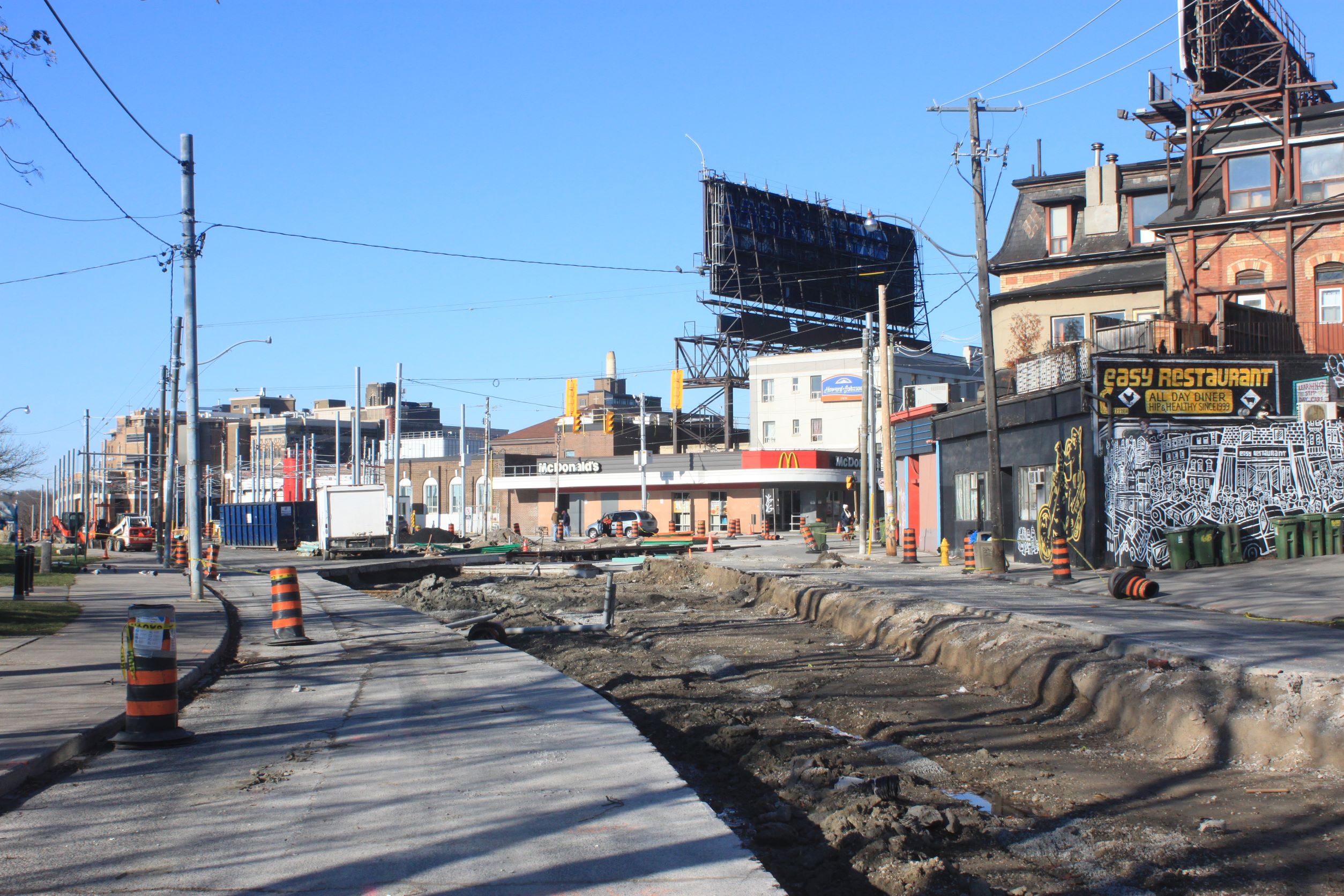
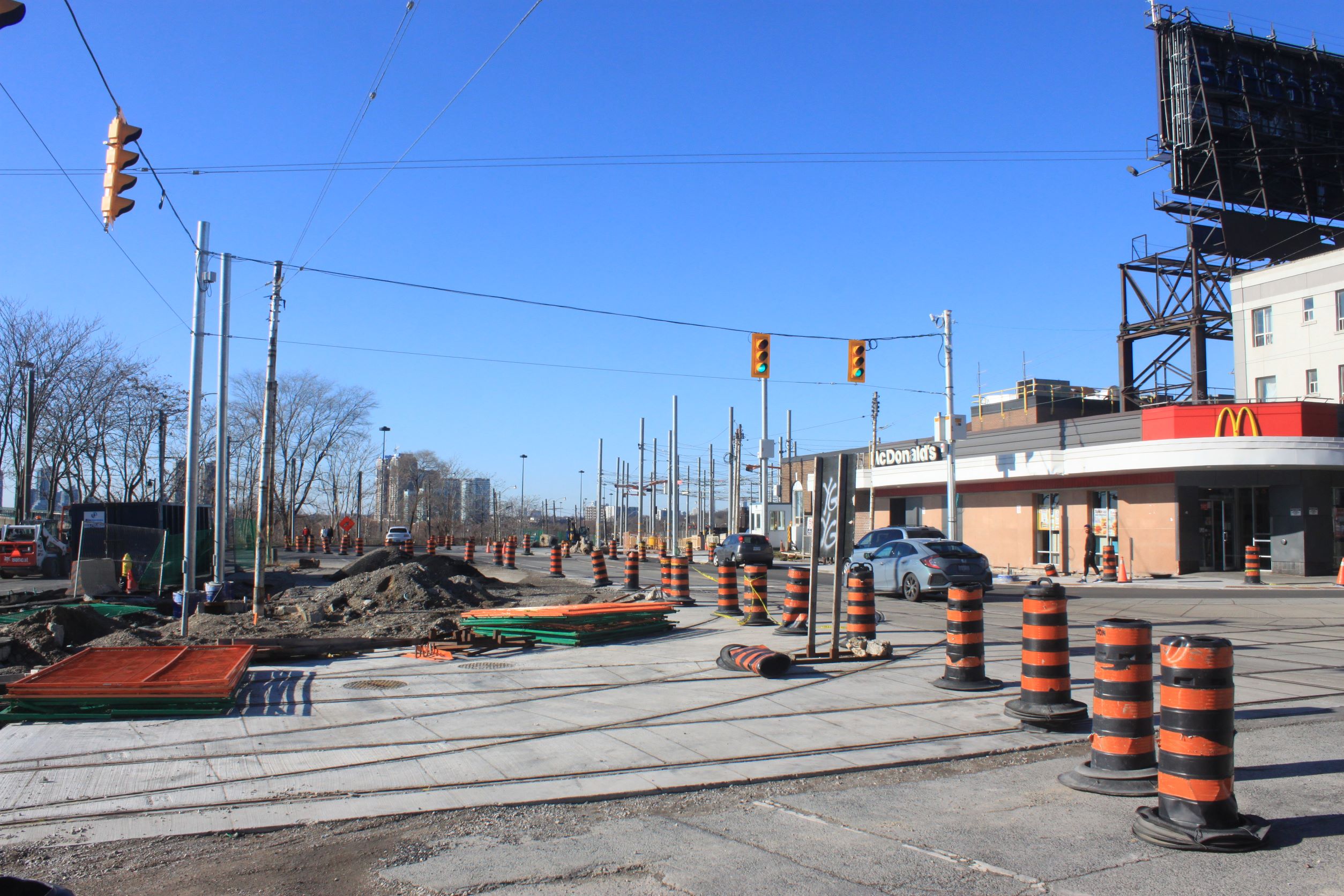
Construction has resumed, although not exactly at a “breakneck” pace, at the complex junction of King, Queen, The Queensway and Roncesvalles. Here are photos showing the current state of things.
Slip Lane Removal
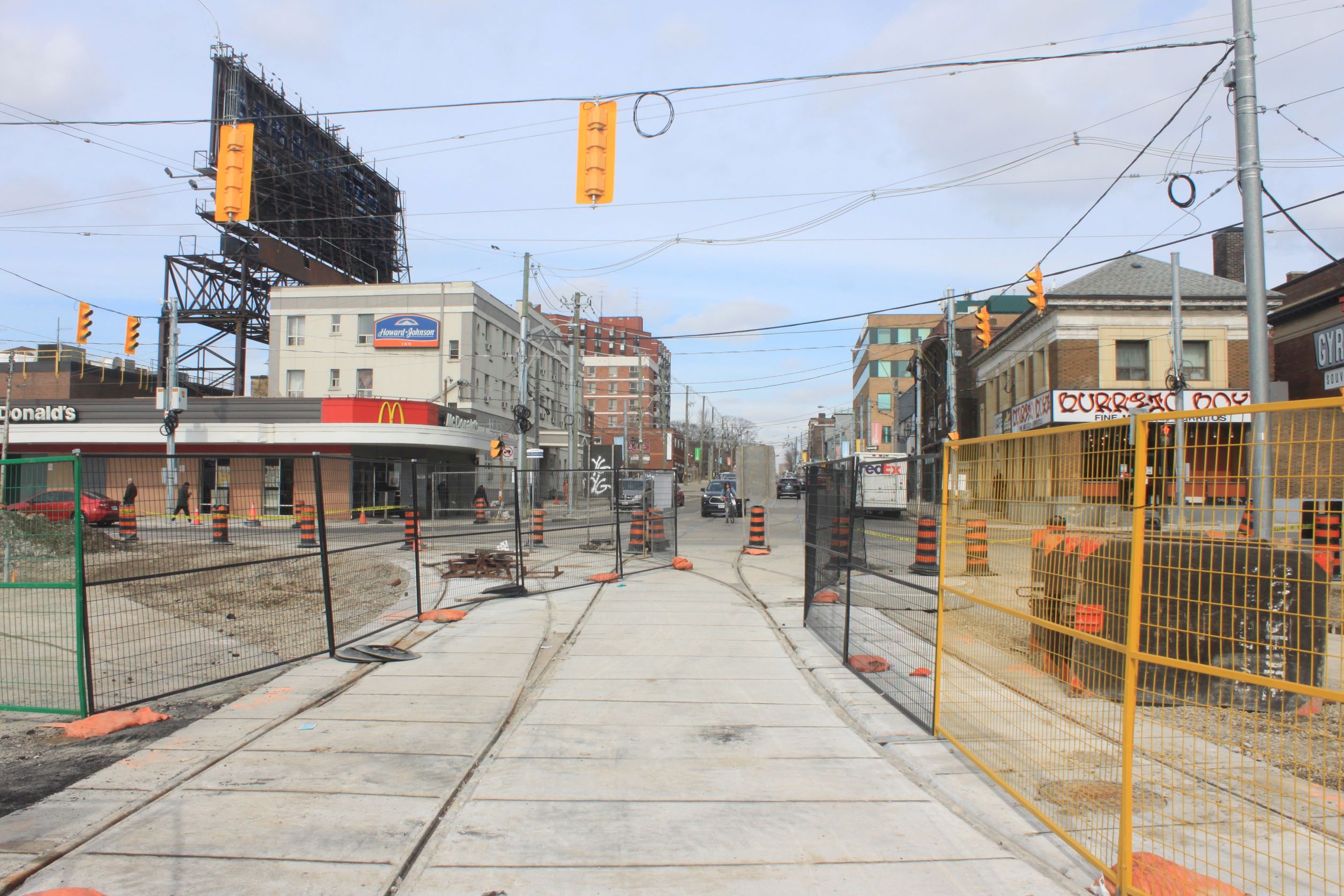
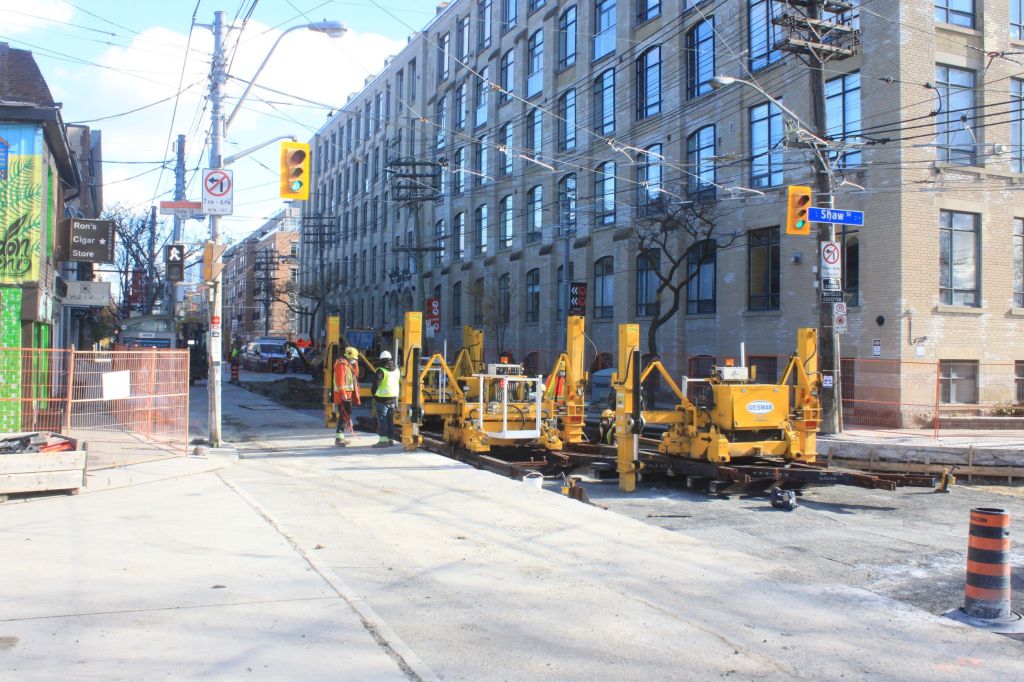
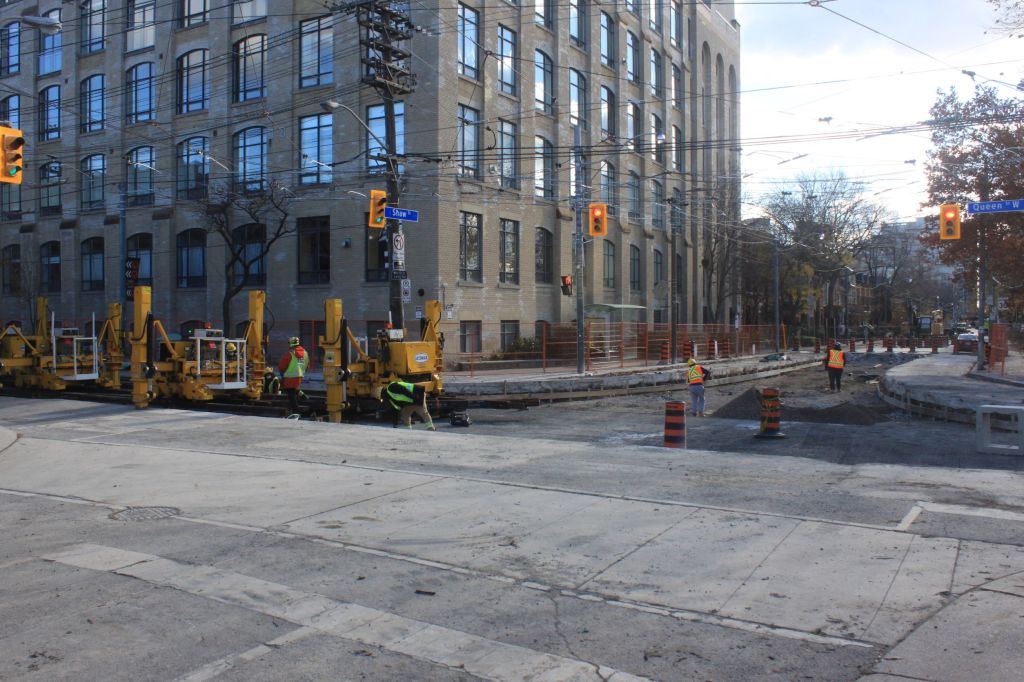
On the southwest corner of the intersection, there used to be a “slip lane” that allowed eastbound traffic veering from The Queensway to King Street to bypass the signalled intersection. This was fine for motorists, but a danger to pedestrians. In the new intersection layout, this lane has been removed and the sidewalk will be expanded to make this a conventional 90-degree junction.
Looking NELooking NWLooking SE
King Street Realignment
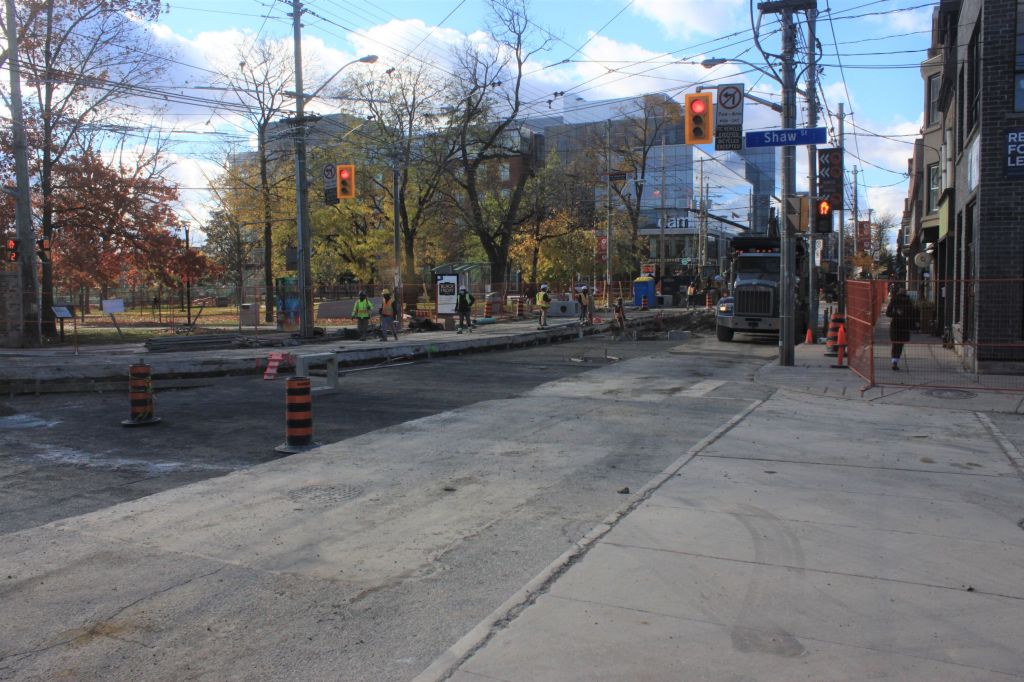
King Street formerly met Queen at an angle, but this has now been straightened out. With the new intersection geometry, the two streetcar lanes split apart east of the intersection. This will align the future tracks on the north side with sidewalk “bumpouts” for the northbound and southbound carstops.
Looking N from KingLooking E along King
Track and Overhead Construction
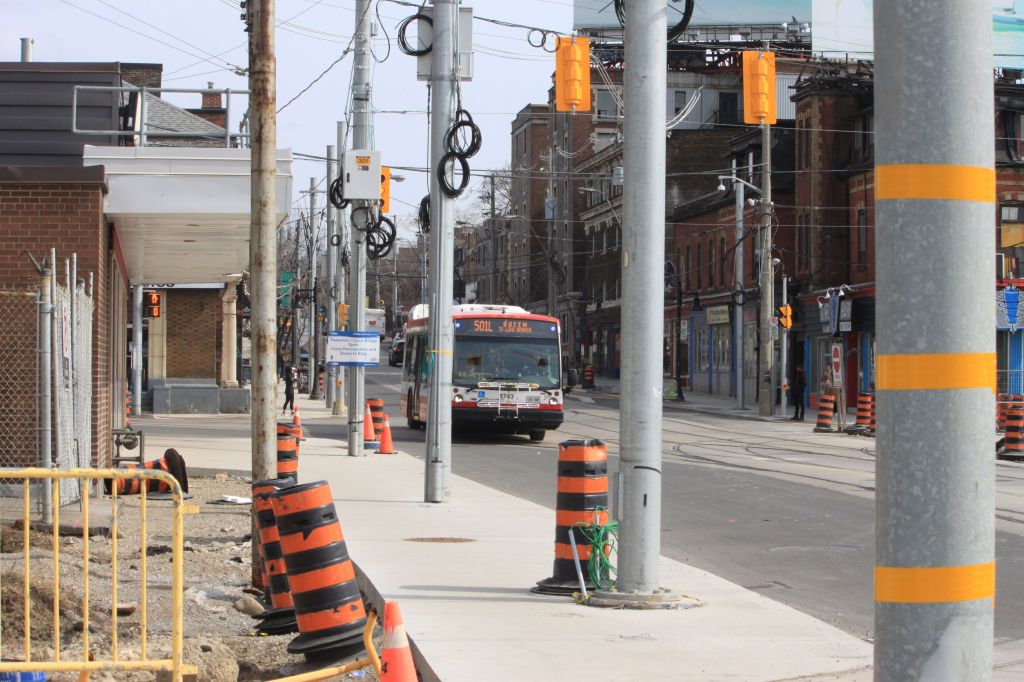
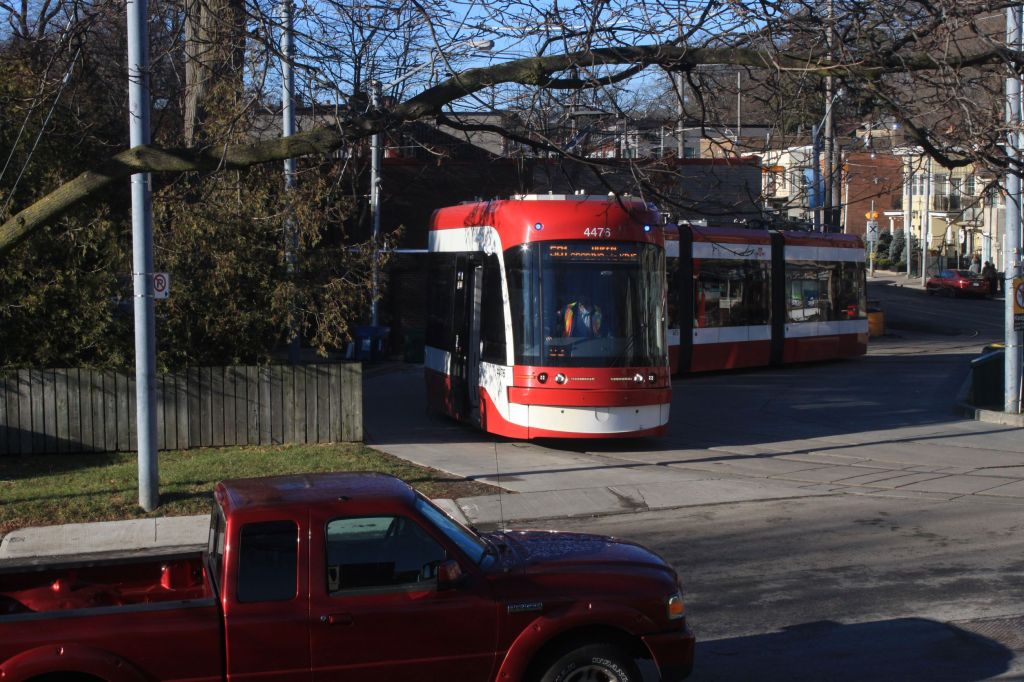
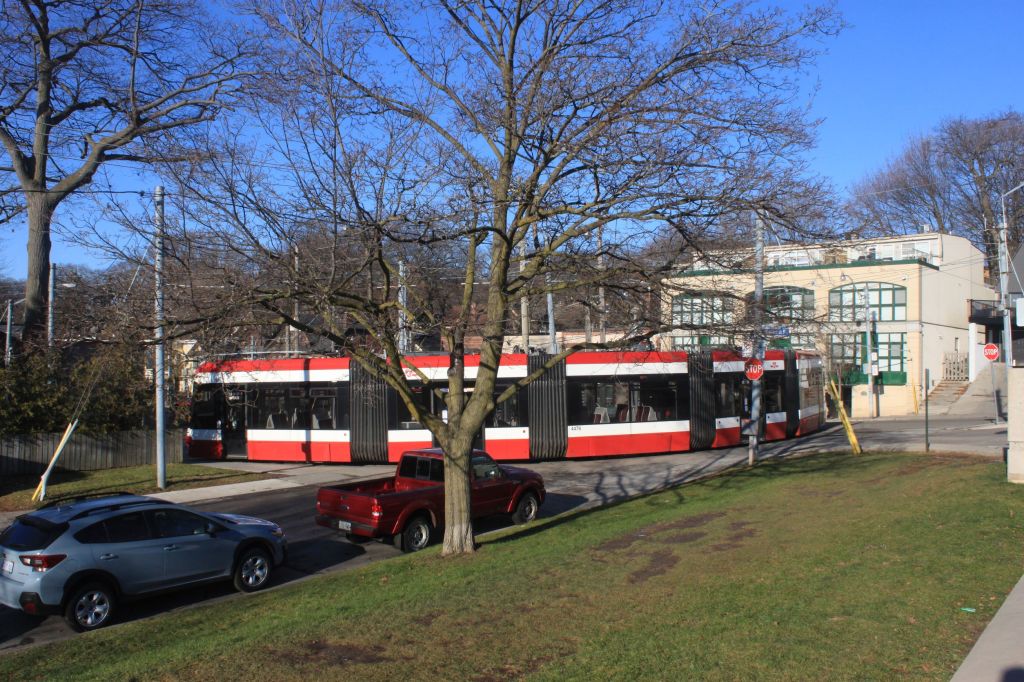
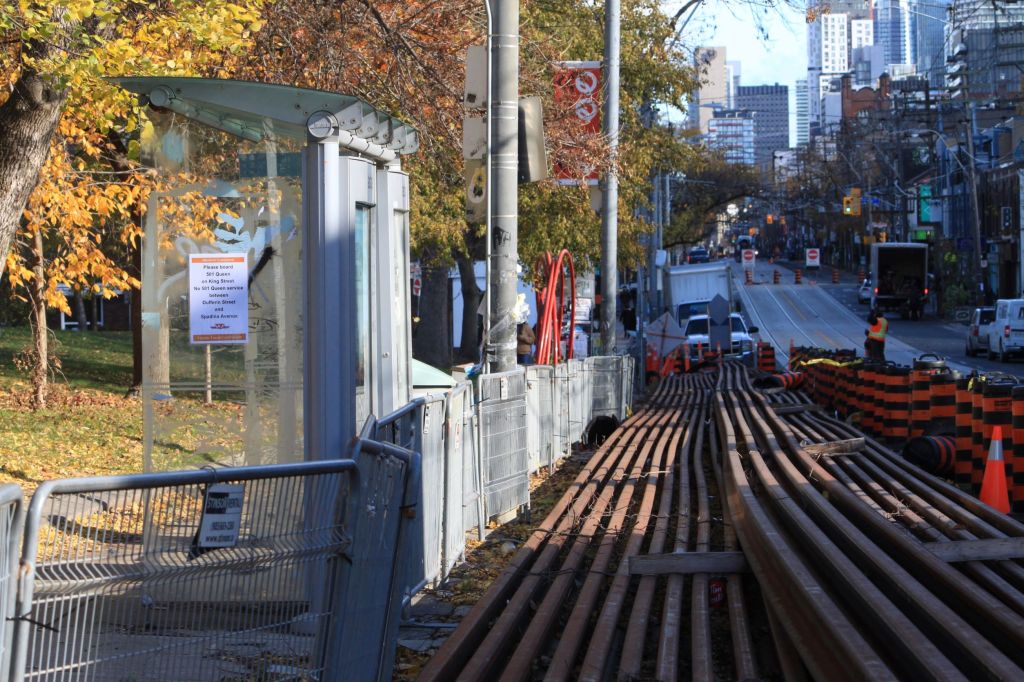
Many new overhead support poles have been installed around the intersection, and they are festooned with coils of future span wires. West of Sunnyside Loop, excavation of the trackbed has started together with construction of foundations for centre support poles.
Looking W across RoncesvallesLooking E across RoncesvallesLooking W on The QueenswayLooking W at SunnysideLooking E at GlendaleLooking W at Glendale
Planned Restoration of Streetcar Service
In the announcement of February 2022 service changes, the TTC anticipated that 501 streetcar service would be restored to Sunnyside Loop in the May 2022 changes.
In May, the 501 bus shuttle will be shortened from Broadview to University, but streetcars will continue to operate only to Bathurst Street (Wolseley Loop). I have asked the TTC for an update on streetcar service restoration and await a reply.
Please see that article for general comments about route behaviour.
The short version:
Like 64 Main, 92 Woodbine South is one of the shortest routes in the system, and it serves a nearby neighbourhood.
Unlike 64 Main, there does not appear to be any problem with the adequacy of scheduled travel times, and buses routinely have time for terminal layovers. These occur frequently because a one-way trip is 12 minutes or less during most periods including scheduled recovery time.
The schedule was unchanged during the entire three month period.
During some periods, notably the am peak and late mornings, service is well-behaved almost all of the time.
There is a peculiar behaviour at about 1:30pm on most weekdays, more prevalent later in the year, when both buses take extended layovers at each terminal causing a gap in service.
Traffic congestion is rare on this route, and occurs most commonly northbound toward Kingston Road in the mid-afternoon possibly due to traffic backed up on Kingston Road itself where parking restrictions do not take effect until 4pm.
Some bunching occurs primarily in the pm peak, but not to the degree seen on other routes. There were cases when all three buses travelled in a pack over a round trip.
Missing buses contribute to irregular headways especially after mid-November when the TTC began routinely cancelling crews. This does not happen every day.
Where one or two buses are missing, those remaining in service might, or might not, adjust their schedules to even out headways. In some cases, notably when only one bus is in service, longer-than-normal terminal layovers contribute to the already widened headways. Half-hour gaps occurred where scheduled service was every 12 minutes on several early evenings.
Service on weekends is generally more reliable than on weekdays.
Service on some holidays operates much more frequently than at any other time, probably a leftover from summer schedules.
This article continues the series on service reliability on short routes. The common theme is that the routes in question have short trips, and recovery to scheduled times should be simply achieved. Most of them also have little traffic congestion, and that cannot be cited as the root of all problems.
On some occasions, particularly later in the year when staffing shortages hit the TTC, some buses might be missing. However, this does not explain irregular headways when all of the scheduled vehicles are in service.
When one bus is missing on a short route, this can have a big effect on the service level especially when there were only two or three to begin with.
The TTC claims that some of the gaps are actually filled by “Run as Directed” (RAD) buses, but there are problems with that explanation:
There are far too few RADs in service at any time to fill the missing service seen on many routes across the system.
If a RAD operator takes over an open, scheduled crew, then the bus should run with the proper route identification and show up in the tracking logs. “Route 600” RAD buses only make selected trips on routes and do not appear in route-specific tracking logs.
If all of the scheduled buses are in service, but they are running erratically, notably with two or more buses running together, this is an issue line management and service spacing.
In this mini-series, I will review the following routes:
64 Main
92 Woodbine South
121 Esplanade-River (formerly Front-Esplanade)
124 Sunnybrook
(For those who are wondering, the next group on my radar will be many of the major routes in Scarborough.)
Note that due to the cyber-attack on the TTC and the recover efforts that followed, there are no data for the following periods:
Friday, October 29 to Saturday, November 6
Sunday, November 7 data begin after 10am
Friday, November 12 through Monday, November 15
Saturday-Sunday, November 20-21.
There are also no data for:
Friday, October 15 to Sunday, October 17 at about 2pm.
Saturday, October 23 from about 10pm to 11pm.
Despite these gaps, plenty of data remains to show how the route behaves.
The short version:
Scheduled running times were too tight on 64 Main until mid-November. This was “fixed” by buses dropping trips to get back on time, and less service was provided than advertised.
Ongoing problems with missing buses and bunching compounded the schedule issue, and persisted into December.
Weekend service was particularly bad when only one bus was operating.
With very rare exceptions, there are no problems with traffic congestion as a stock excuse for irregularity in service.
In the February 2022 service changes, the TTC will begin to restore some of the pandemic-era service cuts. Many of the affected routes are comparatively short and operate on headways where the removal of one or two buses made a big change in the level of service. At the same time, running times on some routes will be adjusted for reliability including some cases where service is improved by reducing round times.
The total amount of service remains below the budgeted level by 1.8 per cent in light of reduced operator availability.
About 20 crews remain open at each division, and they would be staffed using spare operators or overtime.
Vehicle occupancy standards will be changing for the purpose of planning service levels. I will discuss the TTC’s plans for the timing of service improvements in a separate budget update article to be published soon.
The TTC will be modifying the vehicle occupancy standard in the February board period in preparation for projected increases in ridership in Q2 2022 (50% of pre-pandemic levels) and Q3 2022 (70% of pre-pandemic levels). The vehicle occupancy standard will be adjusted to 80% of pre-pandemic levels or approximately 40 customers per bus in the AM and PM peak periods (measured at the peak point, peak direction, peak hour for each period). In addition, to accommodate this increase in customer demand, service hours are also budgeted to increase in Q2 2022 to 100% of pre-pandemic levels.
Subway
There is only one change on the subway. The step-back crewing for One Person Train Operation (aka OPTO) on the Spadina Subway at St. George Station will be changed to a double step-back to give operators more time between trains and reduce delays.
Streetcar
The following changes will occur on streetcar routes:
501 Queen:
Streetcar service is restored via Queen to Wolseley Loop at Bathurst Street. It will be further extended to Sunnyside Loop in May.
The travel times on the bus service between Broadview and Humber/Long Branch will be reduced. No buses will be removed from the schedule, and headways will improve.
505 Dundas:
The temporary extension to Woodbine Loop has been removed.
Four AM bus trippers from Broadview Station that originate from 100 Flemingdon Park have been restored.
Service to Broadview Station will resume with the schedule change in late June. (Presumably this will also see 504 King return to Broadview Station as well, although it is not explicitly mentioned in the TTC’s service change memo.)
506 Carlton:
Streetcar service is restored over the full route following sewer construction on Coxwell Avenue.
Four AM peak bus trippers from Main Station that originate on 23 Dawes, 24 Victoria Park and 67 Pharmacy have been restored.
The total number of buses operating on streetcar routes has been reduced:
AM peak: From 88 to 83 (net of 8 restored trippers on 505 and 506)
PM peak: From 81 to 66
The TOInview infrastructure project map now includes the reconstruction of streetcar track on Adelaide from Charlotte Street to Yonge Street as a 2022-23 project. This is part of the Ontario Line diversion, but it also will give eastbound service a bypass for events on King and Queen between Spadina and Church. The addition of a southbound track on York Street is not yet listed on TOInview.
Buses
The following routes will see changes, most of which are service restorations to fall 2021 levels.
8 Broadview: Schedules changed for reliability. Late evening headway increases from 20 to 30 minutes on all days.
9 Bellamy: Service improvement weekdays during the peaks, midday and early evening.
11 Bayview: An AM peak tripper removed in error in December has been restored.
12 Kingston Road: Service improvements during weekday peaks, Saturday morning, Sunday morning and afternoon.
20 Cliffside: Service improvements during all periods except Monday to Saturday late evening, and Sunday evenings.
22 Coxwell: Running times increased and service reduced during most periods.
23 Dawes, 24 Victoria Park and 67 Pharmacy: Trippers interlined with 506 Carlton restored.
25 Don Mills: AM peak trippers removed. School trips restored.
42 Cummer: Peak period service improvement. 42C Victoria Park service restored.
45 Kipling: Service rebalanced between Steeles and Belfield branches so that matching headways operate on each branch.
50 Burnhamthorpe: Service improvements during all daytime periods and weekday early evenings.
57 Midland: Service improvements weekdays all day except midday, Saturdays except late evening and Sunday daytime.
61 Avenue Road North: Service improvements weekday peak periods and midday.
76 Royal York South: School trips restored.
78 St. Andrew’s: Service improvement during weekday peaks.
100 Flemingdon Park: Four AM peak trippers interlined with 505 Dundas restored.
161 Rogers Road: Service improved during all periods on weekdays, offset by service reductions in some periods on weekends.
168 Symington: Service improved during all periods on weekdays, offset by service reductions in some periods on weekends.
925 Don Mills Express: Weekend operation restored.
600 Run as Directed: Weekday crews reduced. Weekend crews substantially increased. Although this is not explicitly mentioned, weekend subway shutdowns for maintenance and construction will resume in February.
300 Bloor-Danforth Night Bus: Several trippers have been added, especially on Sundays, to deal with crowding on trips in the period before the subway opens.
Details of these changes are in the spreadsheet linked below.
2021 has not been a good year for transit service and riders on Queen Street with the combined effect of projects stretching from Neville to Roncesvalles and beyond. Some projects have moved at a glacial pace, when they move at all, because of unexpected conditions discovered during construction, and a sense that fixing them was not exactly the City’s top priority.
This is precisely the kind of situation that leads to eye rolling whenever an agency says that it will close parts of downtown “only” for seven years.
Here, running from east to west, is a review of the current status.
Updated December 15 at 6:30 pm: The 63 Ossington bus resumed its normal route today.
Updated December 21 at 11:45 pm: I have been remiss in not mentioning that no sooner had the Ossington bus resumed its normal route via Ossington, Queen and Shaw, than it was diverted again via Dundas-Bathurst-King thanks to the closure of the Queen/Ossington intersection.
Updated December 22 at 11:15 am: As of this morning, Queen and Ossington has reopened, and the 63 Ossington is on its regular route. However, the underlying map used by service prediction apps still has the King-Dufferin-Queen layout, and service predictions at the south end of the route will be missing or inaccurate until this is changed.
The East End
Conversion of the overhead wiring system for pantograph operation was somewhat spotty east of Queen and Leslie where streetcars from pan-ready routes turned south to the carhouse. Some of the conversion was done under service, and other work was done with the streetcars replaced by buses.
Streetcar service to Neville returned on December 6 replacing a shuttle bus that had operated between Coxwell and Neville Loop. On a quiet Sunday morning (December 12), there were plenty of cars at Neville, but this is not always the case depending on conditions along the route.
Service earlier in the week was very spotty with large gaps from downtown, and an inability for riders to know when service might appear because the streetcar operation to Neville is not part of the “official” schedule transit apps use to make predictions of service at stops.
The overhead within Russell Carhouse is still trolley pole-only. The westernmost tracks have no overhead at all.
Downtown
Officially, the 501 Queen car is still diverting to King via Parliament Street. However, thanks to traffic signals at Richmond and Adelaide that prioritize traffic to/from the DVP over transit, there can be severe congestion in what should be a small link between Queen and King. Some Queen cars travel via King to the Don Bridge to escape from this.
The 501 bus services (one to Humber, the other to Long Branch) continue to operate east to Broadview looping, officially, via Broadview, Gerrard and River to Queen. In practice, some of these buses operate north to Broadview Station although whether they carry passengers is a sometimes thing. This could help to supplement capacity on what has again become a busy link that the 504/504 shuttle bus cannot always handle, but the arrangement seems to be ad hoc, not a formal part of the service.
On King, the 501 Queen cars operate west to Spadina looping via Adelaide and Charlotte Streets.
The current plan is for streetcar service to resume on Queen between Neville Loop and Bathurst Street (using Wolseley Loop north of Queen) with the January schedules.
Conversion of overhead to pan-friendly mode is substantially complete over this section, and at one location, Victoria, is pantograph-only with junctions for curves that have no frogs, only a pair of contact wires.
Queen West
The track replacement project from Bay to Fennings (east of Dovercourt) continues, much to the dismay of local merchants on a street that, by the original schedule, would have been clear of construction two months ago.
According to the City’s project site, the segments of work are being taken slightly out of sequence both for TTC operations and to suit affected merchants.
Queen is fully open to Bathurst Street. From there to Dufferin, buses divert both ways via King.
Track work and repaving is completed to Niagara Street (between Bathurst and Shaw).
Work is in progress between Niagara and Shaw except for the block between Gore Vale and Strachan which has a row of businesses. This will be done last in the project .
At Queen and Shaw, the intersection should re-open on December 13.
Track between Shaw and east of Ossington has been replaced and been concreted.
Track replacement from east of Ossington to Fennings is in progress. The intersection at Ossington is expected to close on December 14. The TTC has not yet announced what will happen to the 63 Ossington bus during this closure, but once the entire section from Ossington to Shaw opens again, the Ossington bus can resume its normal route.
63 Ossington resumed its normal route on December 15.
Despite delays on this project, it is worth noting how fast track can be replaced and the roadway re-opened when all that is necessary is removal of the top pavement layer and track, and installing new track attached to the steel ties embedded in the road. Decades of rebuilding streetcar track to this standard are now paying off.
The biggest delays inevitably occur where other utilities are involved, or where the road geometry is changed triggering utility relocations. Intersections are more complex because the TTC started to build these on new foundations several years after adopting new construction for the tangent (straight) track, and the city has not yet been through a complete round of intersection replacements where new track can be installed on a pre-existing foundation. Even so, the entire Queen/Shaw project from demolition through new foundation and new track installation took only three weeks.
There are construction photos and videos on the City’s web page linked above.
King/Queen/Queensway/Roncesvalles
This project drags along and is at the opposite end of “speedy” projects compared to work further east on Queen.
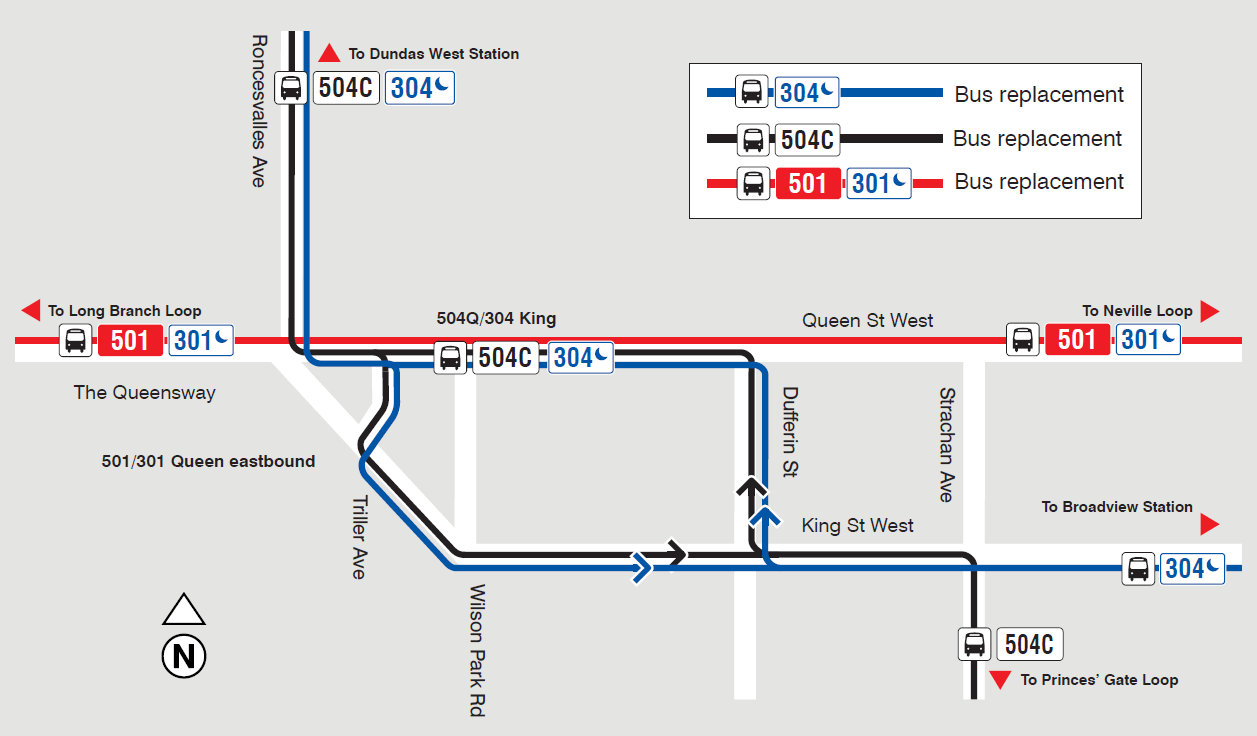
With the move into “Stage 2” some weeks ago, Queen Street has re-opened for east-west traffic. The 501 bus operates straight through the intersection, and the 504 King/Roncesvalles bus dodges the intersection. Eastbound 504 and 304 (night) buses operate via Queen and Triller to King, while westbound service diverts via Dufferin and Queen.
The south leg, King Street, at the intersection is closed and has been excavated for installation of new curves linking to the special work at Queen. With the change in intersection geometry, the curve will now occur before the switches rather than after, and the intersection itself will be a conventional 90 degree layout on all four legs.
How well this will handle the substantial volume of westbound traffic from King to The Queensway, especially given Toronto’s chronic inability to provide true transit priority, remains to be seen. This was already a source of much congestion especially when construction or special events caused traffic to spill off of the Gardiner Expressway.
This view looks west on The Queensway from Roncesvalles from the west end of the new eastbound loading platform. The mound of dirt west of the intersection was formerly a small pedestrian island that was a refuge, of sorts, for pedestrians crossing to the southwest corner and the bridge to Sunnyside Beach.
A mixture of new and old overhead poles remains here and at some point all traffic will be shifted into curb lanes so that work on the streetcar track and new reserved lanes can occur from Sunnyside Loop west to Parkside Drive.
The paving at Glendale (St. Joseph’s Hospital) remains incomplete, and there are still some Hydro/TTC poles within the curb lane that have not been removed or shifted to new locations.
This entire project is a textbook example of both what can go wrong and of the extended period when road and transit users must endure the shortcomings of project planning and management.
In 2022 the area north of the intersection including the carhouse entrance will be rebuilt. Concurrently, the loading zones on Roncesvalles will be modified to work with the accessibility ramps on the Flexity streetcars. This work is planned for the Spring-Summer construction season, but I will believe that when I see shovels in the ground. Other utility upgrades are included in this project, and that always seems to be a recipe for delay rather than the supposed effect of concurrent, co-ordinated work. See the City’s KQQR construction page for more information.
All photographs in this article are by the author. The diversion map for 504 King is by TTC.
The TTC has posted several notices on its website detailing recent and planned service changes on several streetcar routes.
Updated November 21, 2021: Modified to pick up new and replacement pages on the TTC’s website.
King-Queen-Queensway-Roncesvalles Project
The TTC’s KQQR page has been updated to reflect the new routings implemented over the November 13-14 weekend.
With the south leg of the intersection now closed and Queen Street open for east-west traffic, the 501/301 Queen bus service now operates straight along Queen Street.
The 504/304 King bus service diverts westbound via Dufferin and Queen as it has done for many months, but now runs through to Dundas West Station. The eastbound service from Dundas West heads east on Queen to Triller and south to King.
This map does not show the diversion implemented for the track work at Queen and Shaw Streets that requires the 501/301 services to divert both ways via Strachan, King and Dufferin. That project also requires a diversion of 63 Ossington via Queen, Dufferin and King.
The 501 Queen Streetcar currently operates as far east as Russell Carhouse (east of Greenwood) during overhead upgrades on the east end of the route. The 503 Kingston Road car continues to operate over its full route to Bingham Loop. A 501N shuttle provides service between Leslie Street and Neville Loop.
On November 21, this arrangement will change, and the 501 Queen cars will be extended to Woodbine Loop at Kingston Road. The 501N shuttle bus will loop via Eastern and Coxwell Avenues. The 503 service will remain as is.
This change will remain until January 2, 2022 when streetcar service to Neville Loop should be restored.
Other 501 Queen Diversions
Two diversions are in progress for the ongoing track replacement project on the central part of the Queen route:
501 buses divert between Bathurst and Spadina via the Richmond/Adelaide pair.
501 buses divert between Dufferin and Strachan via King during track replacement at Shaw & Queen.
501 streetcar service will be restored to Queen Street between Neville Loop and Wolseley Loop (at Bathurst) on January 2, 2022.
The map for the diversions is in this notice. That page is now partly out of date due to the extension of the 501 streetcars to Woodbine Loop on November 21, 2021.
Photo by Raymond Lee
506/306 Carlton / 505 Dundas Changes for Sewer Work on Coxwell Avenue
From November 21 until mid-February 2022, the Carlton streetcars will turn back at Broadview via Broadview, Dundas and Parliament. This loop is currently used by the 505 Dundas car due to water main work on Broadview north of Gerrard.
The 505 Dundas service will be diverted and extended to Woodbine Loop via Broadview and Queen Street while the Carlton car is looping at Broadview.
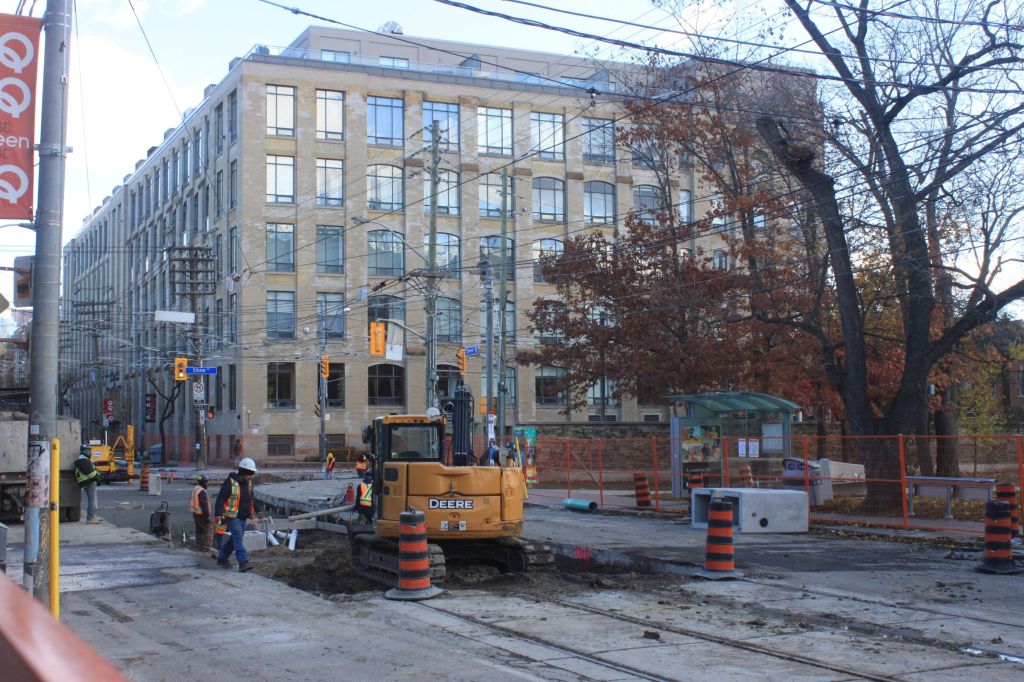
Work began on November 15, 2021 on the replacement of special work at the intersection of Queen and Shaw. Based on past experience with similar projects, this should last about three weeks.
Updated November 19, 2021 at 2:45 pm: Track replacement has begun with the eastern leg of the intersection, and foundation work is in progress for the other two legs.
Updated November 21, 2021 at 1:40 pm: Links to TTC diversion notices added.
The service diversion now embraces changes for multiple works along Queen Street West:
501 Queen Bus: Initially, the diversion was via Dufferin, King and Strachan both ways. However, extension of the tangent track replacement west of Bathurst now requires buses to divert both ways via Dufferin, King, Bathurst, Richmond/Adelaide, and Spadina. (Updated November 19)
63 Ossington Bus: Diverts both ways via Queen, Dufferin and King. The buses loop through Liberty Village on their normal route via Strachan southbound and Atlantic northbound, but then turn west onto King for the northbound diversion.
Elsewhere on Queen, there are diversions and bus replacements. (Updated November 19)
Streetcar service runs between Russell Carhouse (east of Greenwood) and King & Spadina (via Parliament) due to track and overhead work on the central section of Queen, and overhead work in The Beach. It will be extended east to Woodbine Loop on November 21.
A bus shuttle runs between Neville Loop and Leslie/Commissioners. This will change on November 21 to operate between Neville Loop and Coxwell.
The 503 Kingston Road car continues to operate between King & Spadina and Bingham Loop at Victoria Park.
Photos on November 19, 2021
Looking E on Queen at ShawThe Fassetta track cranes make light work of moving track panels.Looking south on ShawLooking west across ShawLooking west to ShawTrack for the ongoing renewal of Queen west has awaited installation since May.
After a long delay thanks to construction issues and utilities that were not located where they were expected to be, the King-Queen-Queensway-Roncesvalles project has moved into its second phase over three months later than planned.
This affects routes 501 Queen and 504 King.
The 501 Queen bus service was formerly diverted via Dufferin and King to Roncesvalles. It now operates both ways via Queen Street following the normal streetcar route in the west end. Separate diversions remain in place elsewhere on the route for track work east of Bathurst, and for overhead work in the east end.
The 504 King shuttle bus had been operating in two sections. One ran on Roncesvalles Avenue between Dundas West Station and Roncesvalles Carhouse. The other ran from the eastern entrance of the Exhibition via Strachan to King, and then over a large counterclockwise loop formed by Dufferin, Queen, Triller and King.
The 504 bus now operates between Dundas West Station and the Exhibition as one route with the two former segments now connected at Queen and Roncesvalles. Westbound buses continue to operate via Dufferin and Queen, while eastbound buses run via Queen, Triller and King as shown below.
Note that this arrangement means that there are no westbound buses on King west of Dufferin, just as there have been no eastbound buses on Queen since this project began. Queen Street now has two-way service.
At the time I write this (7:00 pm, November 14), the TTC has not updated its website to reflect the new routings.
This article continues a series reviewing service quality on some of the TTC’s shorter routes.
Apologies to my regular readers who must be saying “Oh No! Not More Charts!” My intent here has been to show that poor service quality affects many routes and time periods, and occurs even on relatively simple shorter routes in the network.
When the TTC’s IT systems all come back online, I plan to continue with another (smaller) group of short routes: 12 Kingston Road, 62 Mortimer, 64 Main, 87 Cosburn, 92 Woodbine South, 121 Esplanade/River and 124 Sunnybrook. Later in the year I will return to major routes including some I have not reviewed recently or at all including: 7 Bathurst, 41/941 Keele, 43/943 Kennedy, 68/968 Warden, 89/989 Weston and 95/995 York Mills.
Overview
Route 94 Wellesley operates with both a short and long version:
The 94A operates over the full route between Castle Frank and Ossington Stations.
The 94B operates on the eastern half of the route between Castle Frank and Wellesley Stations except during evening periods on all days.
September 5 brought new schedules and improved service during many time periods.
When there are two branches, they have a common headway and are supposed to be blended. During certain periods, buses are scheduled to alternate between the branches (any time in the table above where there are “half buses” allocated to a branch). This makes both services vulnerable to disruption when there is a missing bus, or a delay/interruption on the western branch throws buses there off schedule.
All of the problems we have seen on other routes are present on 94 Wellesley including:
Buses missing from the scheduled service leaving gaps.
Traffic congestion that is sometimes predictable, but sometimes much worse than usual, with schedules that cannot accommodate the disruption.
Headways that are dispersed widely beyond the target range implied by the TTC’s Service Standards.
Buses running in pairs (or worse) for extended periods on a route that does not have many vehicles overall.
Irregular headways caused by two services that are scheduled to blend, but which do not do so reliably at many times.
This article continues a series reviewing service quality on some of the TTC’s shorter routes.
Overview
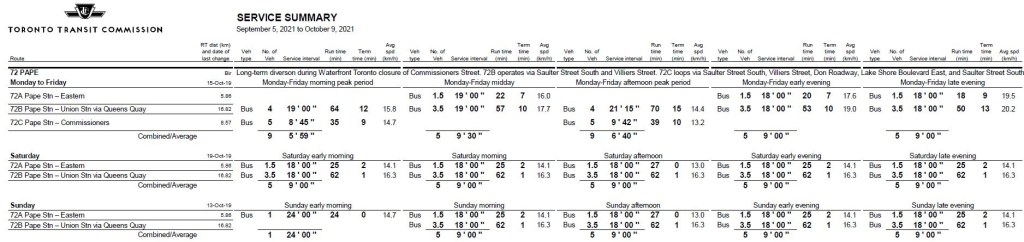
The Pape bus operates two branches one of which has a peak period extension:
The 72A operates from Pape Station to Eastern Avenue during all periods except the weekday peaks.
During the peak periods, the 72A is extended south and west as 72C to the Don Roadway via Commissioners Street.
The 72B operates during all periods except early Sunday morning to Union Station via Queens Quay and Yonge.
Except for peak periods, the A and B branches operate on a common headway and should in theory provide a blended service on the common portion of the route between Eastern Avenue and Pape Station. This does not occur, and the service is a mixture of wide gaps and very short headways at almost all times.
During the peaks, the 72C Commissioners headway is almost but not half of the headway of the 72B Union. This makes it impossible to schedule a one-bus-in-three blended service even assuming that the 72B could stay on time and merge gracefully into the 72C service. The result is scheduled gaps and bunching on the common portion of the route under even the best conditions during peak periods.
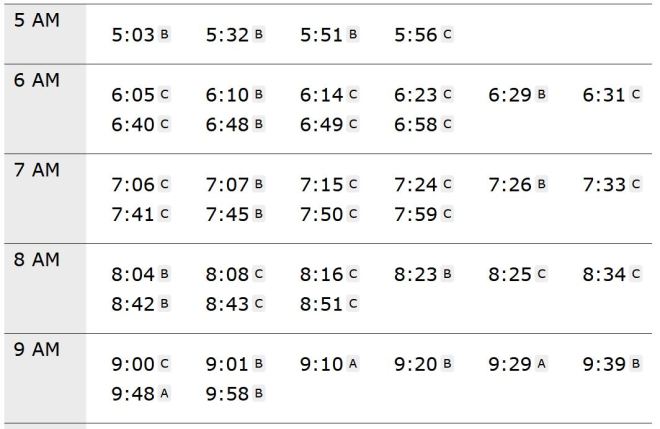
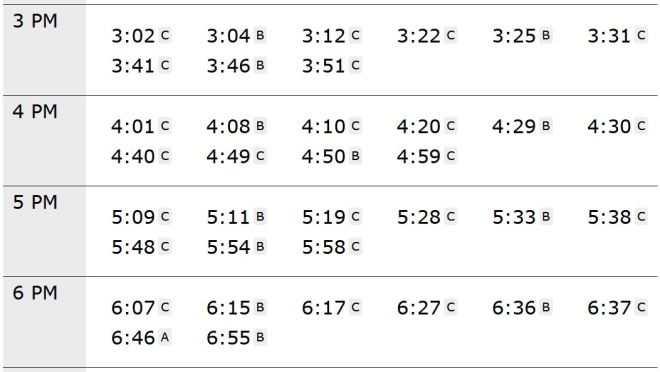
Here is the scheduled service southbound from Pape Station in the AM and PM peak periods in early November 2021. Note the scheduled headways of only one or two minutes between “B” Union Station and “C” Commissioners buses.














 Steve Munro