The priority transit lanes and other traffic measures have been in place on King Street between Jarvis and Bathurst Streets since the fall of 2017, five years ago. This article updates past charts and observations with data to October 2022.
There are three quite separate areas on these charts:
2016 to fall 2017: This is the pre-priority era in which travel times were longer and, during parts of the day, quite unpredictable.
Fall 2017 to March 2020: This is the era of transit priority pre-pandemic. There is a marked reduction in both the length and variation in average travel times during most periods.
March 2020 to October 2022: This is the pandemic era. A further drop in travel times occurred almost immediately as this period began, and values have only begun to climb upward in recent months.
A troubling question, difficult to answer this early in the “recovery” period, is how far up both average trip times and the variation in these values will climb. Motorist have had free rein on King Street for two and a half years, and the “priority” scheme is a shadow of its former self.
The situation will be further complicated when Queen Street closes for Ontario Line construction and traffic diverts onto Richmond and Adelaide with, no doubt, some spillover to King. There is no sense that robust priority measures will be in place for transit, but instead that the focus will be on moving traffic generally through downtown. Transit will benefit, to the extent it might, from the “rising tides lift all boats” philosophy that sees any benefit to auto traffic as having a spin-off value to transit. That is a false but commonly used analogy.
In the charts below, there two galleries, one with westbound and one with eastbound data. This allows a reader to open the gallery and step back and forth through different hours of the day to see how the data change.
All of the charts have the same layout.
The x-axis gives the date over the past five years.
The y-axis is time in minutes with the bottom of the axis at 10 and the top at 40. This gives more “breathing room” for the variations as there are “zero” values in the chart only where there are no data due to a diversion or missing data in the TTC feed. The upper value of 40 clips some of the very high peaks, but these are rare.
There are two lines showing the 50th percentile (mean, blue) and 85th percentile (yellow) for the travel times.
There are various vertical bars marking significant events including the start of the King Street pilot (green), the onset of Covid (brown) and the annual film festival (red, omitted for 2020 and 2021).
Updated November 20, 2022: Information regarding diversions for 504 King and 503 Kingston Road has been updated with current details.
The TTC is making a few service changes for the November board period affecting mainly streetcars and the Yonge subway (Line 1).
1 Yonge-University-Spadina
With the complete implementation of Automatic Train Control on Line 1, the full route will switch to one person train operation (aka “OPTO”). Service will be improved during peak periods as well as some off-peak. Some running times will be reduced.
The peak service improvement is achieved through a combination of running time reduction and the conversion of two of the “gap” trains in each peak to regular service trains.
501 Queen
The originally announced service for 501 Queen in October would have seen the route extended to Roncesvalles from Dufferin. This proved impractical, and the route continued as it had been in September. The official schedule now reverts to September’s version for both the streetcar and bus services. There is almost no change to scheduled headways.
503 Kingston Road
The 503 Kingston Road car will be converted to bus operation until March 2023 to allow overhead conversion on Kingston Road. The buses will operate to the “standard” downtown route 503 destination at King & York via Wellington.
Update: The downtown loop of the 503 buses will be via King to York Street, north to Richmond, west to University, south to King and returning east.
504 King
The intersection of King & Shaw is expected to reopen in early December for streetcars and buses. In anticipation, the November schedules are based on the service plan after the reopening.
Update: The TTC has posted a service change notice dated December 1, 2022 stating that the reopening will occur in “early December”. December 1st is a Thursday, and so it is not clear exactly when this change will take place. There is no comparable notice for 63 Ossington which is also diverting around King & Shaw.
Before reopening:
All 504 King cars will operate to Exhibition Loop, but they will not serve stops on Bathurst or Fleet Streets.
In practice, much of the 504 King service has not reached Exhibition Loop in recent weeks short turning either at Fleet Loop or at Charlotte Loop (King/Spadina).
After reopening:
504A Distillery cars will operate to Dufferin Loop.
504B Broadview Station cars will operate to Wolseley Loop (at Queen & Bathurst).
This arrangement reduces the number of transit vehicles attempting to use Dufferin Loop while this is still the western terminus for 501 Queen streetcars.
The 504C King shuttle bus was originally scheduled to operate to Exhibition via Strachan, but instead it will run east to Bathurst and King looping via Bathurst, Adelaide and Portland. Additional service will be provided if necessary from the run-as-directed pool.
929 Dufferin Express
All trips will terminate at Dufferin Loop.
Seasonal Changes
86 Scarborough service on Saturdays to the Zoo for Terra Lumina will now end at 9:20 pm to match the planned earlier closing time.
172 Cherry Beach weekday service will be discontinued for the winter (typically until May).
The changes are summarized in the spreadsheet linked below.
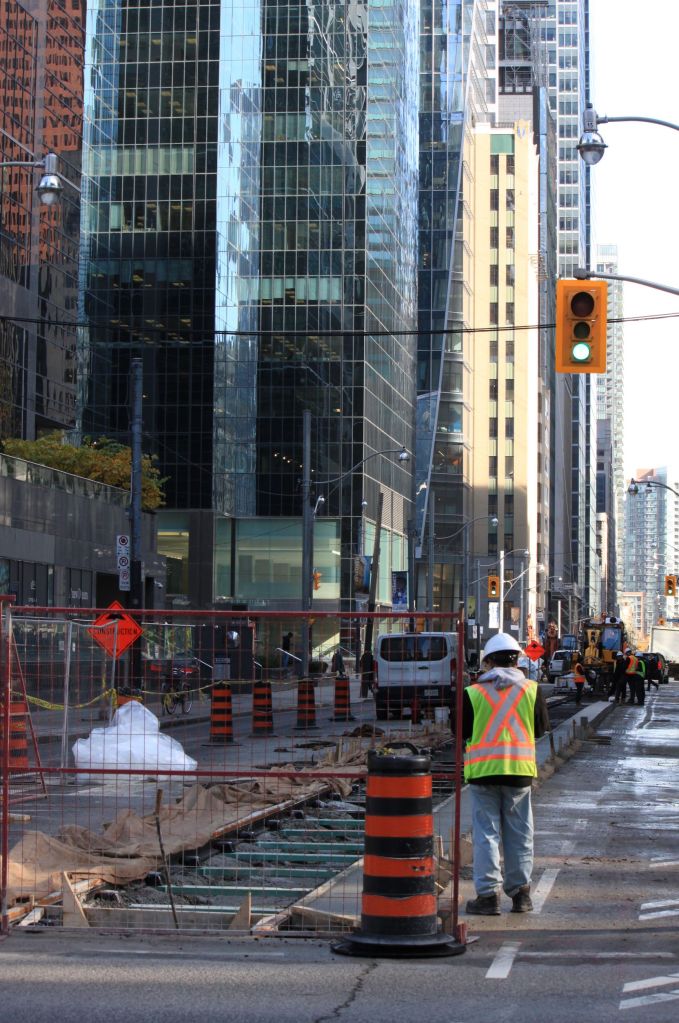
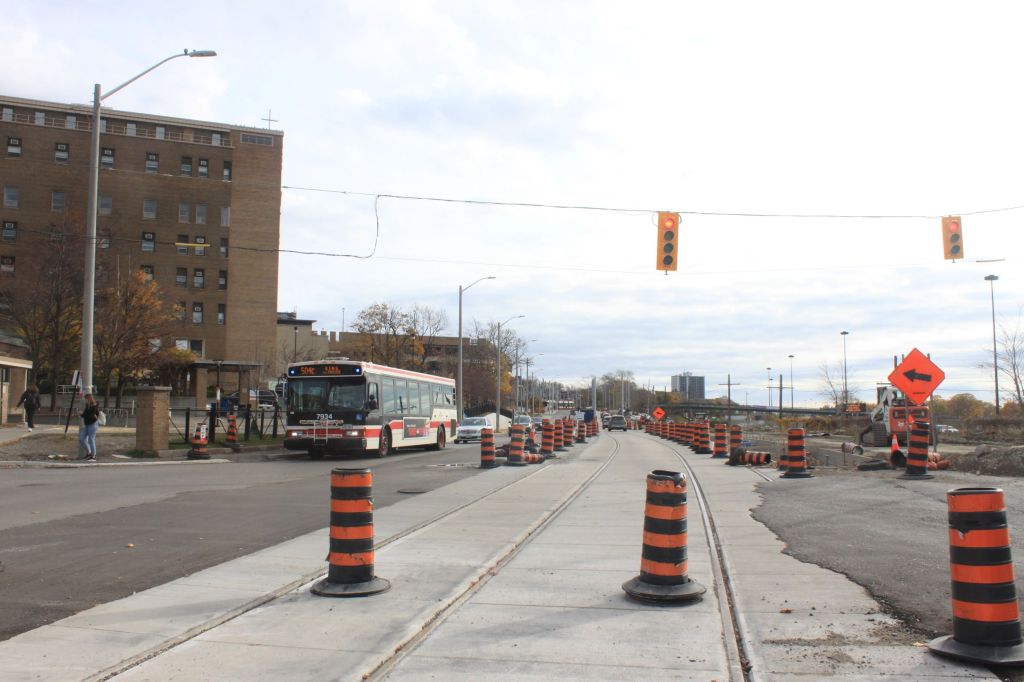
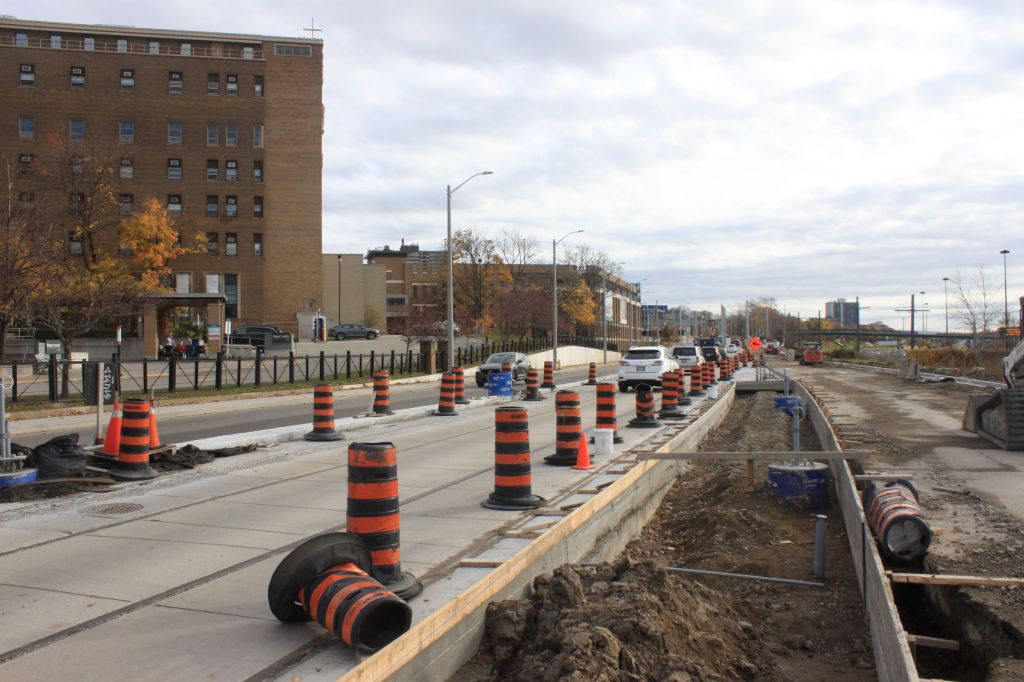
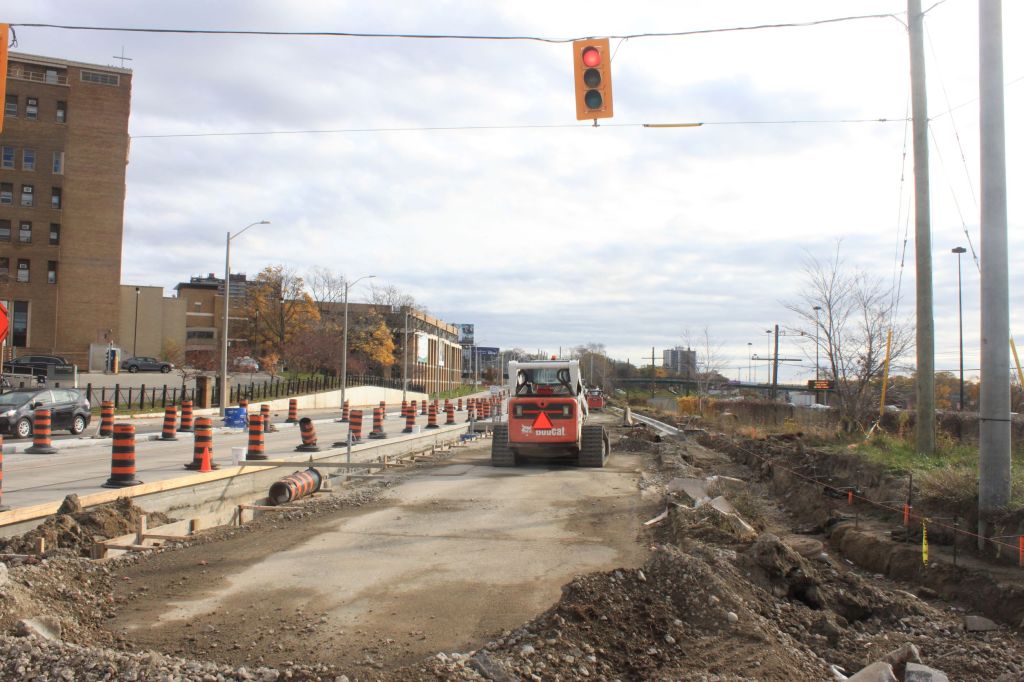
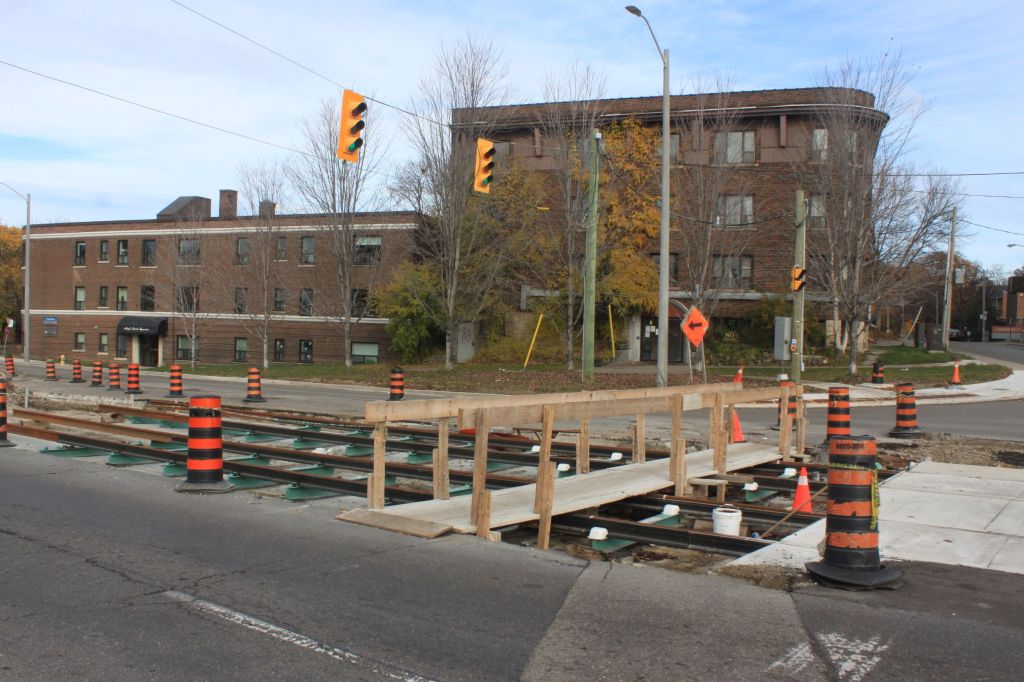
Various track construction projects continue into November, but there are signs of progress at some locations.
Updated November 6, 2022 at Noon: Photos of the current state of the King-Queen-Queensway-Roncesvalles project added.
College/Carlton Reconstruction and Diversion
Effective November 2, the intersection of Carlton and Church reopened for streetcars after a long delaty. This had been caused by an unexpected hydro vault under the intersection that conflicted with the new, deeper foundation that is placed under streetcar track.
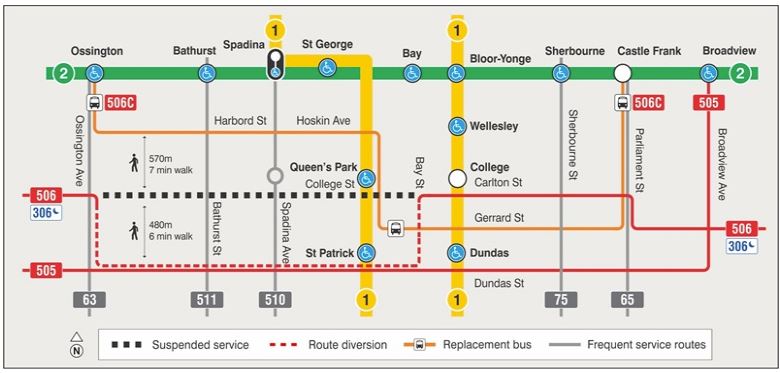
The 506 Carlton service now operates on the originally planned Dundas Street diversion from Bay to Ossington while College Street is under construction. Here is the updated diversion map from the TTC’s Service Advisory.
The replacement 506C bus continues to operate via Harbord and Hoskin from University to Ossington, and via Gerrard from University to Parliament.
This configuration is expected to last to the end of 2022.
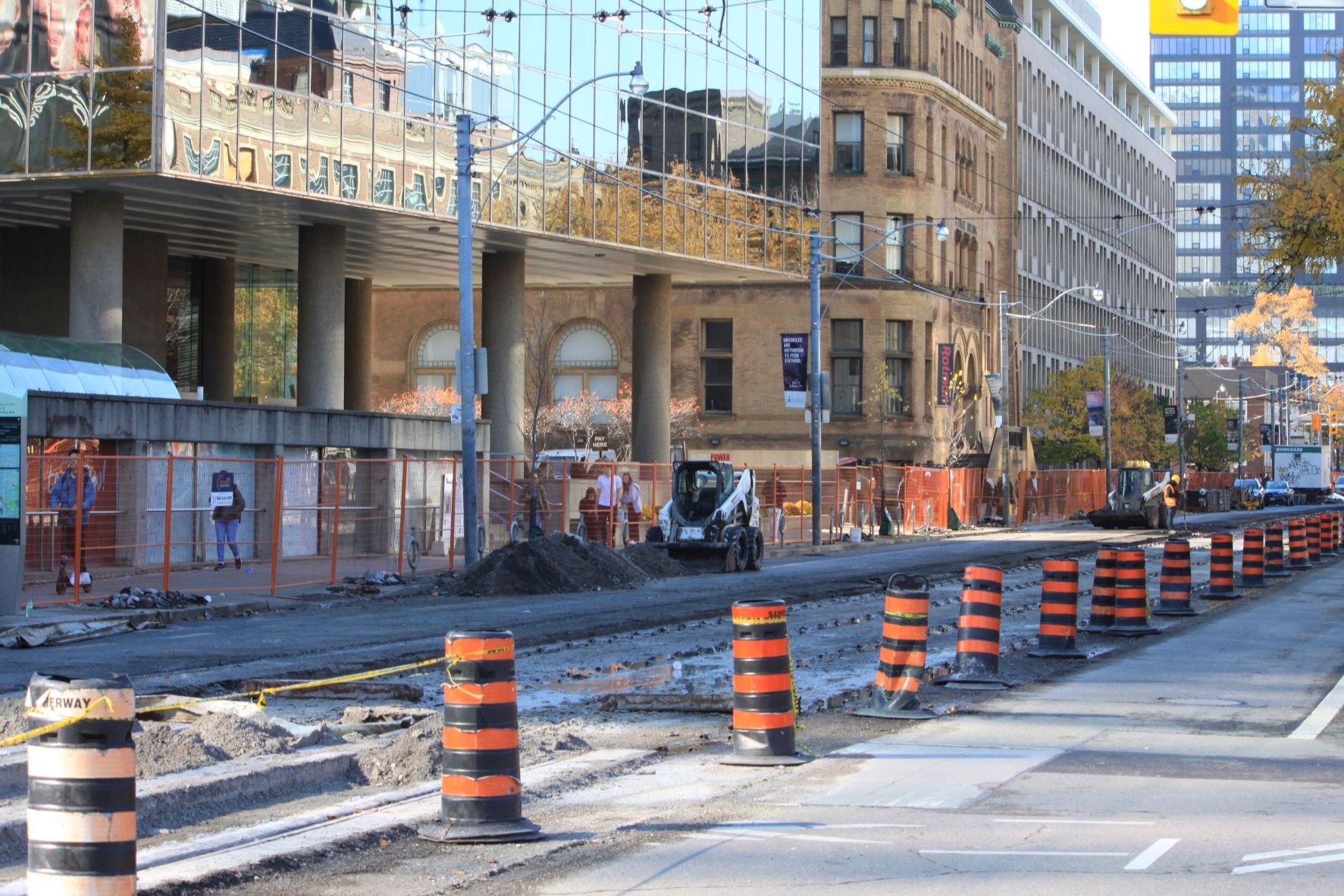
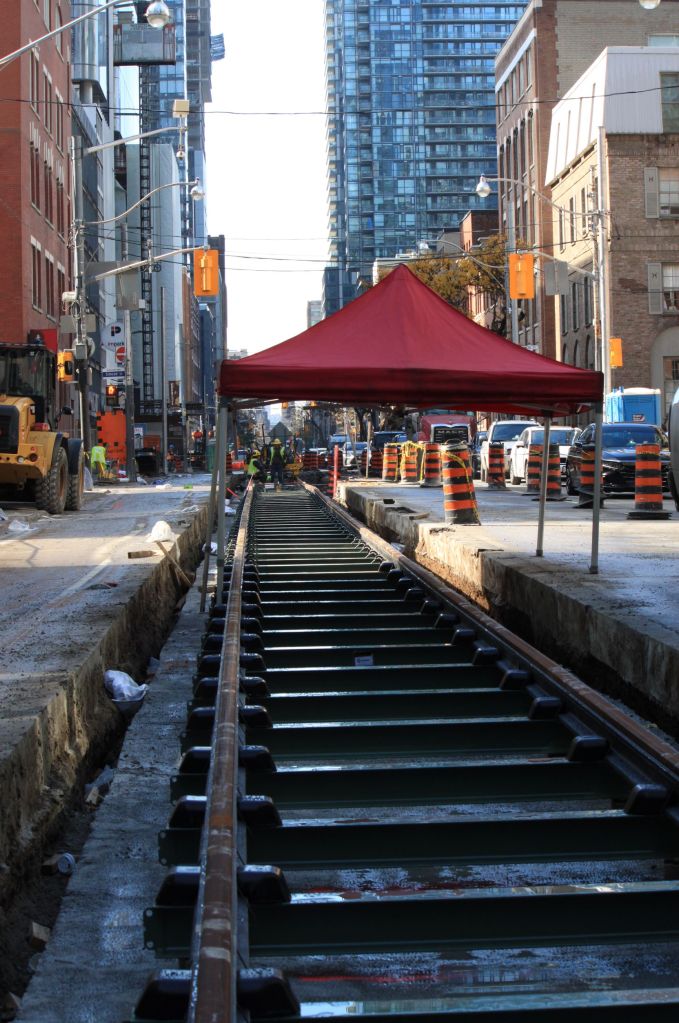
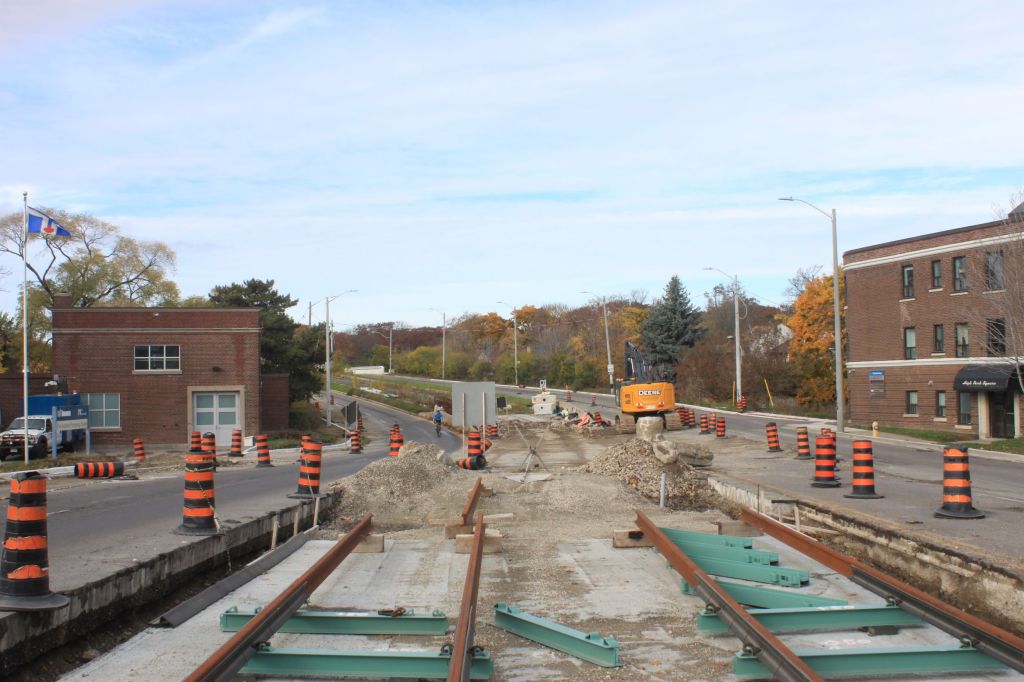
Track reconstruction has shifted east into its second phase between St. George and Bay Streets. Here is a view west on College from University showing the track structure with the old rails removed. The steel ties and attachment points for Pandrol clips are ready to receive new rails.
The City of Toronto’s project webpage contains more information about this status and details of the planned road reconfiguration.
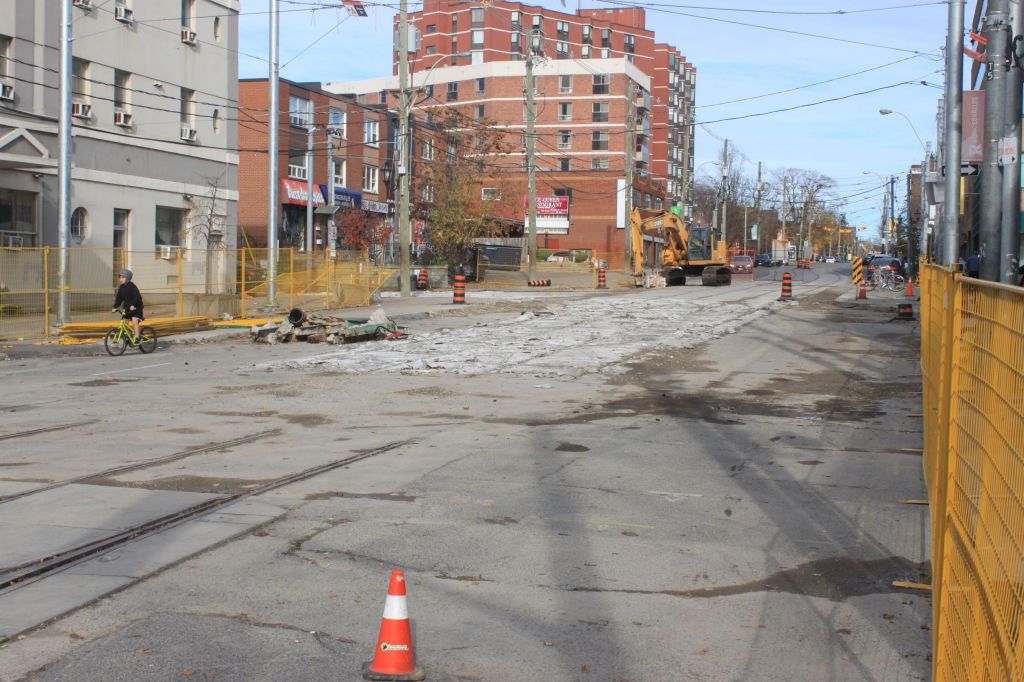
King & Shaw
Construction continues at King and Shaw, but should be finished in time for service restoration on 504 King and 63 Ossington for the next schedule period on November 22. This has not yet been confirmed.
The service alert on the TTC’s website shows the correct routing for 504 services in the west end, but still includes the Queen/Parliament diversion to the east which ended a few weeks ago.
Queen & Carroll
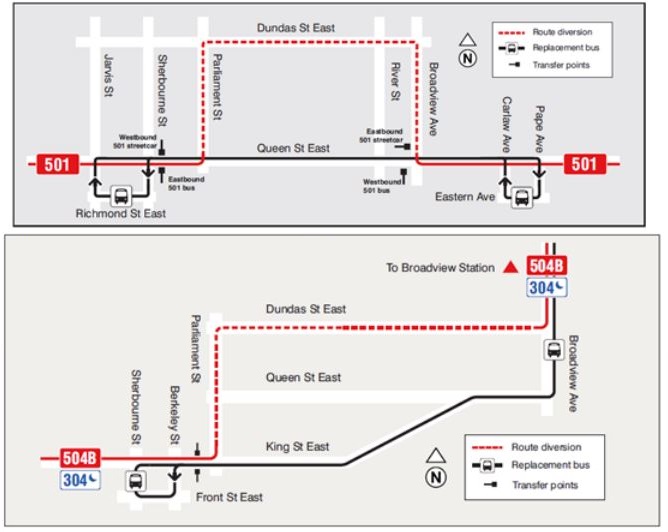
Stop rail replacement on Queen east of the Don Bridge will occur over the weekend of November 4-7. 501 Queen and 504B King/Broadview Station services will divert via Parliament, Dundas and Broadview as shown below.
Although the map does not show this, the 504A King/Distillery service will continue to run on its normal route.
Wellington Street
Installation of new overhead is underway on Wellington, and the 503 Kingston Road car is supposed to resume its loop via Church, Wellington and York with the November 22 schedule changes. This has not yet been confirmed.
Adelaide Street
Track construction has begun on Adelaide Street to restore the link between Spadina and Victoria that has been inactive and unusable for decades. This will provide the eastbound diversion from York to Church for 501 Queen service during Ontario Line construction at Queen & Yonge. The track west to Spadina was included in the project as it will be useful for other diversions including the 504 King car during the film festival which typically closes King Street from Simcoe to west of John.
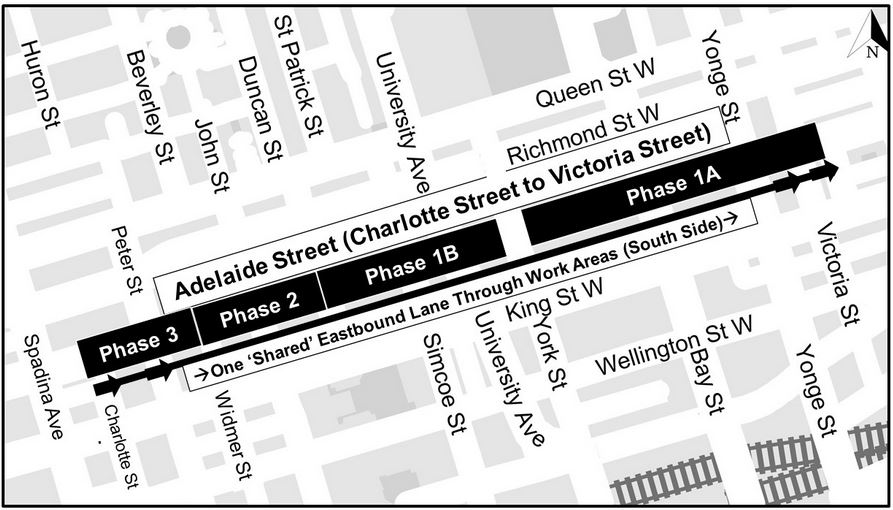
The construction work will occur in phases as described in the City of Toronto’s project page.
Phase 1A runs east from York to Victoria. This involves the replacement of an old watermain, work that is necessary before the tracks can be rebuilt. This is now in progress.
Phase 1B runs west from York to Simcoe. This is the first phase of track replacement. Initially only the eastbound track area will be excavated. The westbound track will be removed later.
Phase 2 will begin after phase 1B completes. It runs west from Simcoe to Widmer, and is expected to begin on November 7 subject to completion of work further east.
Phase 3 will begin after phase 2 completes. It runs west from Widmer to Charlotte where it will connect with existing track.
Once all of this work is finished, phase 4 will see the pavement marked for a revised configuration with the bicycle track relocated to the north curb lane from Bathurst to Parliament.
In 2023, a separate project will see new southbound track installed on York between Queen and Adelaide, and installation of new track from York to Victoria. The date for this work has not yet been announced.
In the map below, a shared lane is shown on the south side of Adelaide through the construction zone. The lane is actually on the north side of the street, at least as of November 2.
Adelaide Street looking east (on the left) and west (on the right) at University.
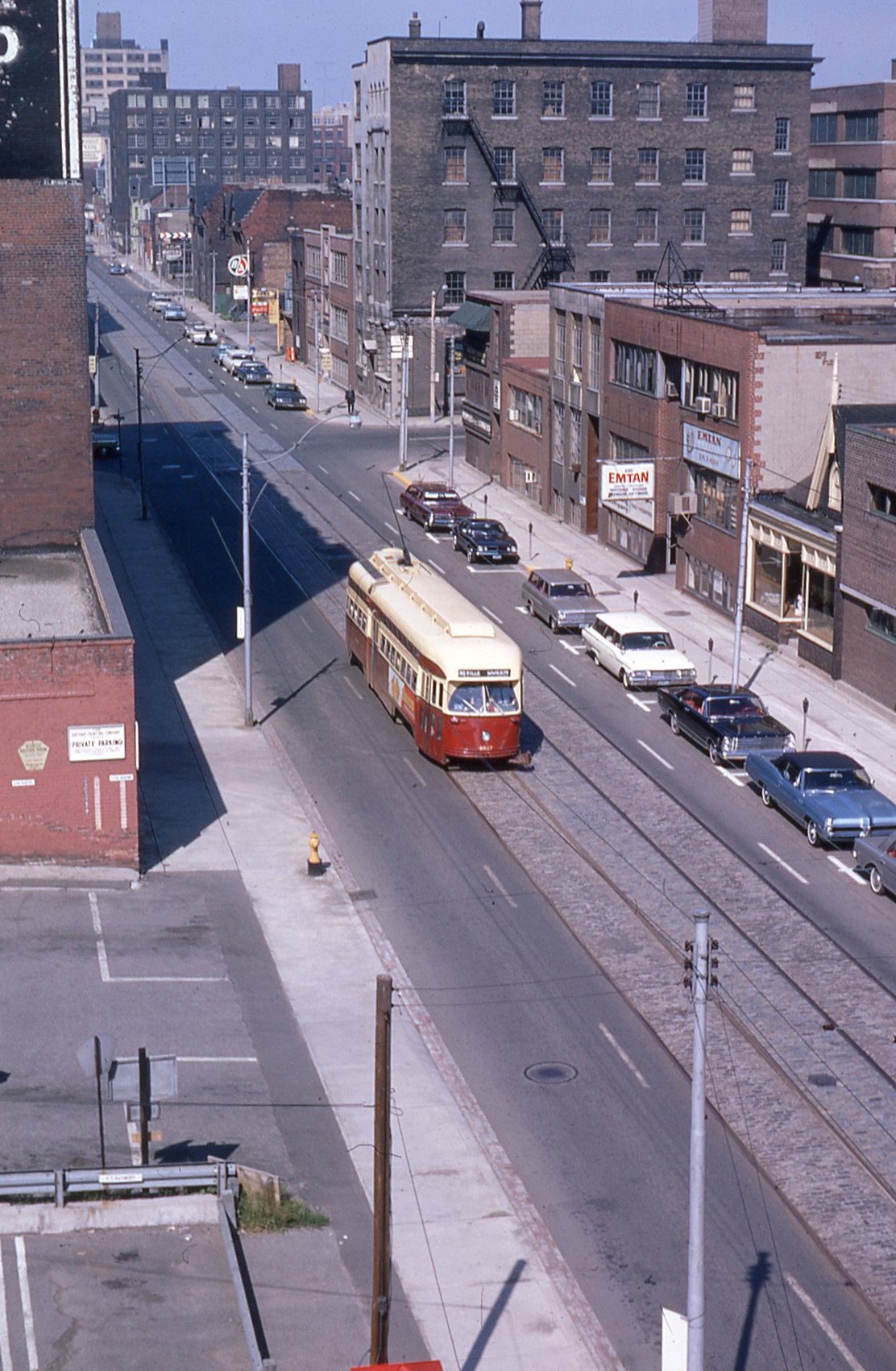
Here is a view looking west on Adelaide on July 1, 1967, west of Simcoe. The neighbourhood has changed quite a bit in 55 years.
King/Queen/Queensway/Roncesvalles
Due to persistent fog, I have not visited KQQR but plan to do so soon. I will update this article with the current status and photos in the next few days.
Updated November 6, 2022 at Noon
Here is a gallery showing the current state of the KQQR project.
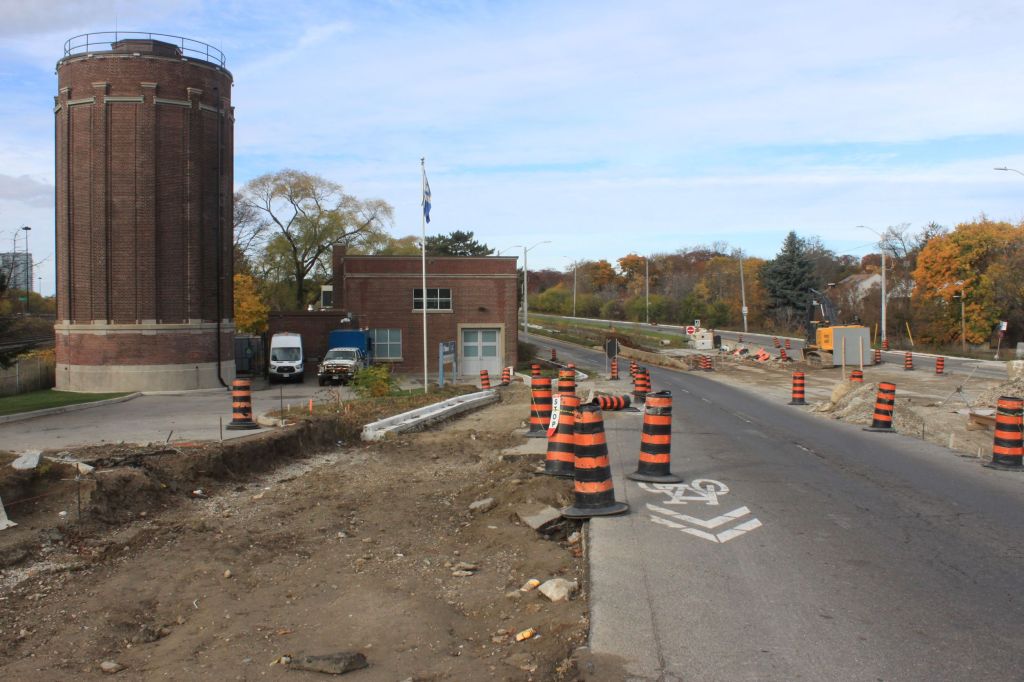
The watermain reconstruction on Roncesvalles north of Queen completed recently. Concrete around the old track at the north gate has been broken up in preparation for removal of the special work.
At the Glendale stop (St. Joseph’s Hospital) formwork is in place for the new eastbound platform, but buses are still stopping beside an unmaintained dirt area on the south side of the street.
The walkway across the tracks to the eastbound stop has been repaired since my visit a few weeks ago and the handrail is now in place on the full length of both sides.
The new curb along the south side of The Queensway is progressing slowly.
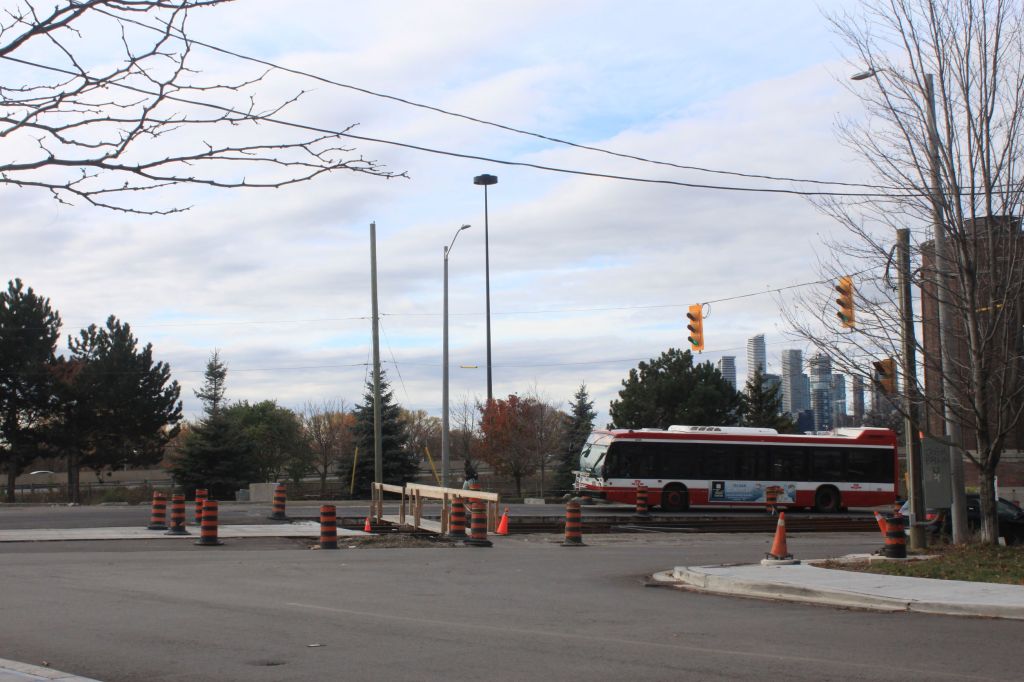
Work at Sunnyside Loop was delayed for construction of a Bell Canada manhole on the south side of The Queensway, but poles required to string the new loop overhead are not yet installed.
According to the most recent construction update from the City, the TTC is considering changing the route of the 504C replacement bus to provide some service on Roncesvalles south of Howard Park, but nothing has been decided yet.
I have often written here and on Twitter about the proliferation of service change cards and posters as the constant changes in streetcar routes occur. Combined with conflicting and out-of-date online information, it is common to find at least two different versions of notices at the same stop, not to mention “stop not in service” notices in locations where streetcars are actually running.
Without question, the constant shifts in the operating plan are challenging to keep up with, but the lack of attention to removal of out of date information, particularly when new notices go up at the same location, does not serve riders well at all. Operating staff, in good faith, give out incorrect info leading passengers astray, and I have rescued a few lost travellers over past weeks.
This is a very serious issue given the amount of construction that will affect TTC routes (and not just the streetcar network) in coming years. Riders have enough challenges with service quality without having to divine whatever route their service might be taking today. There is a clear fragmentation of responsibility for keeping route information up-to-date and consistent within the TTC. Even in a recently announced reorganization, the responsibility for “closures and diversions” is in a separate branch (Operations and Infrastructure) of the TTC from “service delivery” (Transportation and Vehicles).
The phrase “Beware of the leopard”, for those who know the reference, seems particularly apt for some TTC “communications”.
The TTC needs to figure out how communications about service plans and changes can be centrally accessed and administered so that all notices speak with the same voice and contain current, accurate information.
Updated October 9, 2022 at 11:40pm: It turns out that there are four pages within the TTC website where service information might be found. At last count, the list includes:
There is the parent Service Advisories which links three of the four above. Some but not all of the items in the Updates page are also displayed on the main page under “Latest News”.
Although the same topic might be found through different pages, the text is not always the same indicating that multiple versions of the information have been posted. In this situation it is easy for their content to drift thanks to selective updating.
Effective October 1, 2022, the 504A branch of the King car will return to Distillery Loop. The 504B branch will continue to operate to Broadview Station via Parliament and Queen as shown below.
This is a temporary arrangement pending completion of the re-electrification of switches at King and Sumach. Once that is completed, expected within a few days, the 504B will revert to the standard route via King between Parliament and the Don Bridge. If this situation lasts to Monday, October 3 or later, the 503 Kingston Road car will also continue to divert via Queen and Parliament.
This change will reduce streetcar congestion at Broadview Station because only half of the service will go that far east on the line. It will also eliminate some of the wheel squeal problems at King and Parliament, although not completely until the 504B service returns to its normal route.
Service will return to the Sumach and Cherry Streets that have been without reliable service since the beginning of August. The 504 shuttle bus was extremely erratic with very wide gaps in service, and it as cancelled completely on September 4 even though signs remained on transit shelters advertising its existence. The area is also served by the 121 Esplanade-River bus which has its own problems with reliability.
Updated October 1, 2022 at 7:10 am: The west end of the King car will divert to Wolseley Loop at Queen and Bathurst rather than operating to Exhibition Loop due to trackwork on Fleet Street. This also affects 511 Bathurst which diverts east to Charlotte Loop and 509 Harbourfront which short turns at Spadina and is replaced by a bus shuttle from the to the Exhibition. Normal service resumes on Monday, October 3.
Several construction projects are in various states of beginning, underway and completion on the streetcar system. Here is a round-up of their current status.
Unless otherwise noted, all photos in this article are by the author.
Updated September 17, 2022: Photos of King/Sumach added.
Back on August 20, when I was part of a Twitter thread about lousy service on 7 Bathurst, the day of the TTC’s birthday party at Hillcrest, one person said “I have the same problem on Highland Creek”. When I looked at the tracking data, the result was stunning, and not in a way anyone would like to see.
This article reviews 38 Highland Creek for the month of August 2022. The short version is that on weekdays, the route is somewhat unreliable and suffers at time from missing buses, but on weekends, the problems are worse than anything I have seen in my travels through operating stats.
The route originates at Rouge Hill GO Station, and travels west to Scarbourough Town Centre. There is a bit of a meander via Lawrence, Port Union and Lawson to get across the 401 to Kingston Road, thence via Military Trail and Ellesmere to STC.
Map credit: TTC
There is a 38B/938 split operation to the University of Toronto Scarborough Campus, but that is not currently running. Only the 38A to Rouge Hill GO is part of the scheduled service in August 2022.
The Short Read
Service on 38 Highland Creek can operate on fairly reliable headways, but is often disrupted, especially on weekends. The primary issues are:
Missing buses create service gaps that are not filled by re-spacing other vehicles.
Travel times on Saturday afternoons appear to be inadequate leaving no margin for recovery at terminals.
Bunching on weekends, and particularly on Saturdays, is chronic to the point that four or more buses operate in packs for extended periods with little apparent effort by line management to space out the service.
The 7 Bathurst bus is notorious for its irregular service, a rather comic situation considering it passes right by the TTC’s main shops and offices at Hillcrest including the building housing Transit Control.
During many periods, the scheduled service is every 10 minutes. Additional capacity is provided on weekdays by operating some runs with articulated buses. This has the effect that service is more frequent at times on weekends than on weekdays.
A common sight at Bathurst Station is at least one Bathurst bus taking an extended layover, or considerable periods where there is no bus to be seen. I have reviewed this route before, but a recent event triggered my return visit. On August 20, 2022, the TTC held its covid-delayed 100th anniversary public celebration at Hillcrest, and the Bathurst bus was the logical way to get there by transit for most people.
Alas, this was something of a challenge thanks to service gaps. When I left Hillcrest, I gave up waiting for a southbound bus due to crowding and walked north to Davenport and the infrequent, but also reliably uncrowded bus there. Was this a one-day problem, or was the Bathurst bus really that bad all of the time? This article reviews vehicle tracking data from August 2022 in an attempt to answer this question.
Something worth mentioning here is that if there is a very wide gap followed by multiple buses close together, the number of long headways is outnumbered by the short ones. However, most would-be riders see and are affected by that single long wait for a bus.
Stats that only count the long headways can give the erroneous impression that they don’t occur often enough to be a problem. Stats that only report average headways will not see a problem at all because all buses are present even if they are running in packs.
With a six-minute wide target for acceptable headways, a service that runs more often than every 10 minutes will only count the one very wide headway as being off-standard, while a parade of buses bunched behind it are considered to be “on time” for headway reliability. This is utter nonsense as any would-be rider will know.
These are fatal flaws in TTC service quality reporting.
TTC website and related services claim to provide riders with information about streetcar and bus routes so that riders have up-to-date information. This is critical not just for schedule changes, but many diversions and special services related to construction, street festivals, civic events, to name a few.
Alas, the actual structure and behaviour of the TTC’s website works against easy navigation. Information is scattered in different parts of the site. Some of it is out of date. Some of it is incorrect and contradictory. Some notices that should be there just don’t exist at all.
The current site is the product of a redesign that is now about a year old. There has been some tweaking along the way, but the site still leaves a lot to be desired. This article is an exploration of the TTC website structure as it relates to current service information and planned changes.
Updated September 13, 2022 at 12:50pm: Sundry typos and grammatical fixes.
The Short Read
The TTC Website has evolved since the current version went live. It was far from perfect then, and has since grown additional problems even as those from version one were fixed.
This article looks mainly at service information, probably the most common reason someone would go to the TTC site. There is a big problem that this information is scattered through many places and is rarely complete on one page. Attempts have been made to cross-link some pages, and more of the frequently used pages have gained banner links on the main page.
However, the whole thing has a feeling of being built and maintained by multiple people who do not talk to each other, and who do not explore the various places information might hide to ensure that “their” part of the site is consistent and complete.
This compounds problems that arise when the announced version of services do not match what is actually operating. You might or might not track down information about your route, or even worse be given wrong info. A related problem is that trip prediction and planning apps do not necessarily use the live configuration of routes and can mislead riders about how they might travel and where vehicles actually are.
The TTC really needs to do a thorough review of how it publishes service information and ensure that “one stop shopping” is available for information about routes, or where appropriate, areas of the city that are affected by multiple changes.
Routes in the Eglinton-Kingston corridor will be reviewed as part of a “red lane” update in the Fall.
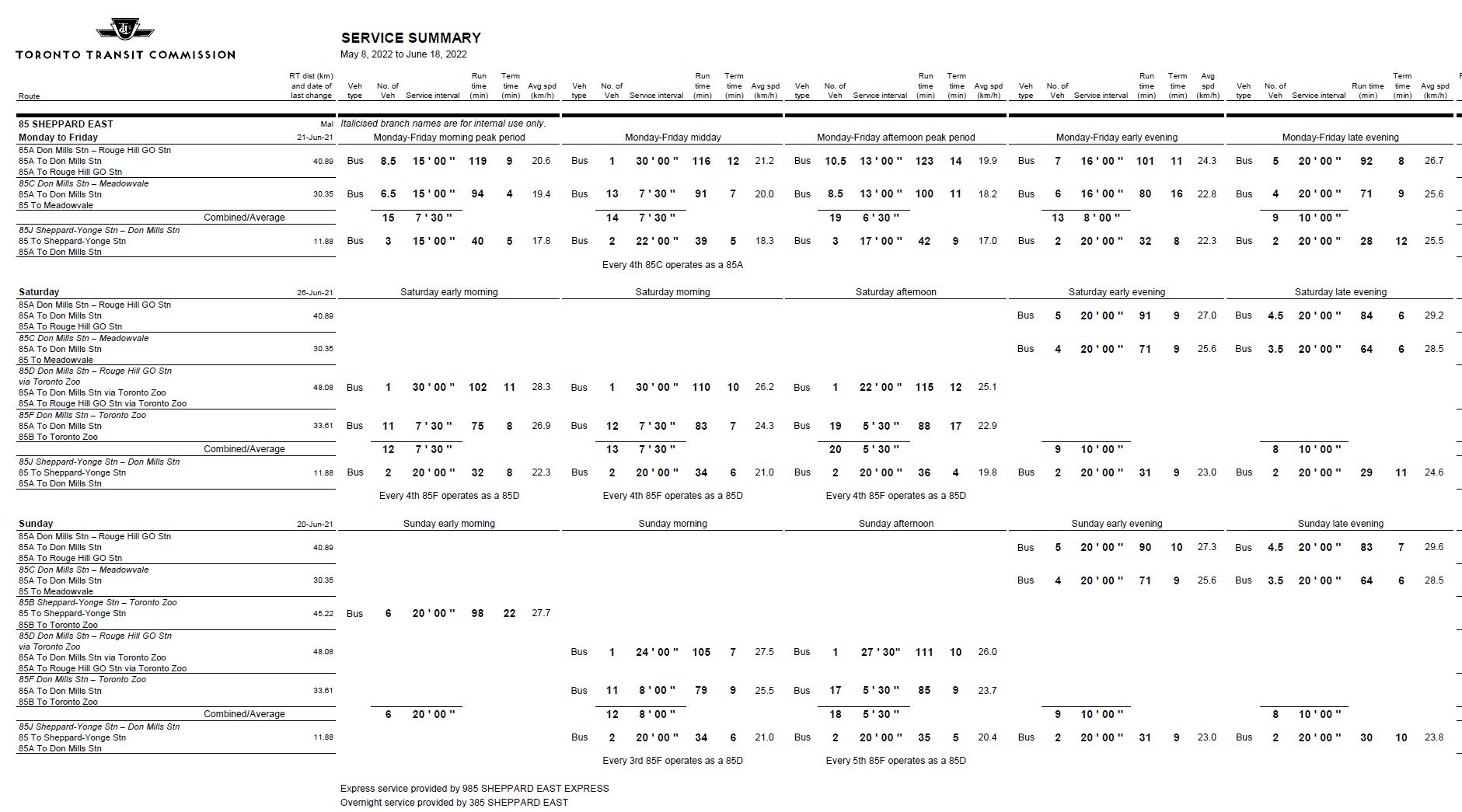
Service on Sheppard East has three distinct components:
The main 85 route operates from Don Mills Station to Rouge Hill GO Station with a short turn service to Meadowvale Loop and limited service on a branch to the Toronto Zoo.
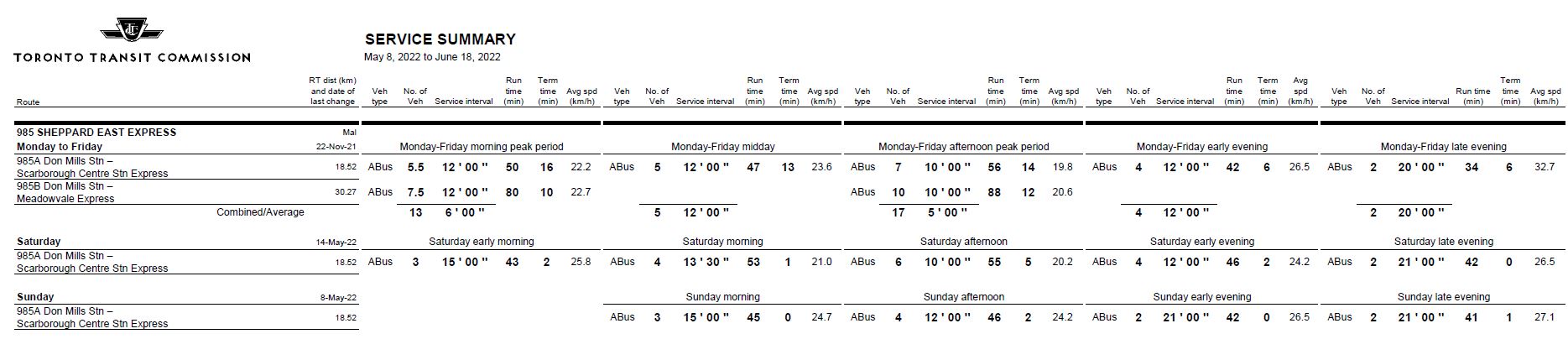
The express service operates two branches from Don Mills Station to Scarborough Town Centre (985A) and to Meadowvale (985B). Weekend service was restored on May 8, 2022. The express service is scheduled to operate with articulated buses.
A separate branch operates between Yonge-Sheppard and Don Mills Station providing a surface alternative to Line 4 Sheppard Subway.
Here is the summary information for schedules in effect during May and June 2022.
85 Sheppard East Local Service
985 Sheppard East Express
The service in effect until May 7 is shown below. Express service was suspended on weekends as part of the pandemic cuts. Sheppard East is an unusual route in that the “express” service runs more frequently than the “local” service. The express portion of the route extends east to Morningside Avenue during peak periods. During off-peak periods, the express service ends at Midland where the 985A branch turns south to Scarborough Town Centre.
On May 8, the weekend express service was restored. Note that there was no corresponding reduction in the local service, and so this was an improvement to the route.






 Steve Munro