TTC Service Changes Effective January 3, 2016 (Updated)

Updated December 8, 2015 at 12:30 pm: I checked with the TTC about the termination of both the 509 Harbourfront and 511 Bathurst routes at Fleet Loop rather than simply running one route between Bathurst and Union Stations. Here is the reply from TTC Service Planning:

We considered running a 511 (Bathurst Stn-Union Stn) service but ruled it out for two main reasons. Firstly, stop usage on Fleet west of Bathurst has greatly increased in the last year, and serving these stops only with the shuttle bus would introduce a transfer or longer walk for too many people. Secondly, because of the road configuration and traffic patterns, it is not possible to have a northbound stop for through 511 cars on Bathurst at Lake Shore. The nearest stop would be the existing 509 stop on Bathurst farside of Queens Quay. This adds to the walking distance for customers heading to Fleet Street, and requires customers to cross an inhospitable intersection.

The original article follows below:

The new year brings changes to some routes, mainly on the streetcar system, to deal with the shortage of new Flexitys and a construction project while improving service on 501 Queen, 502 Downtowner and 503 Kingston Road to better reflect actual conditions.

2016.01.03 Service Changes

Continue reading →

A “Reset” For Waterfront Transit Plans? (Updated)

Updated October 15, 2015 at 10:20 am:

Because the options for the Waterfront West line are not fully explained or explored in the City report, I have added the drawings of the options from the Environmental Assessment to the end of this article.

A few weeks ago, I reported on a presentation at the TTC Board meeting by Deputy City Manager John Livey on the status of various rapid transit plans and studies. This was by way of a preview of reports that were expected at the City’s Executive Committee meeting on October 20, 2015.

One of these reports has now surfaced on the subject of Waterfront Transit, while another on SmartTrack is still in preparation. (Reports on the Relief Line and Scarborough Subway studies are not expected until the new year pending results from the UofT’s new demand model.)

The new report proposes a “reset” in the status of the many waterfront studies and proposals given that many of them are incomplete or out of date. The area of study will be south of Queensway/Queen from Long Branch to Woodbine, although there is passing mention of Scarborough which has its own collection of transit problems in the Kingston Road corridor.

The fundamental problem along the waterfront and areas immediately to the north is that population and plans for development continue with no end in sight, while transit planning, such as it exists at all, looked much further afield for signature projects. Moreover, origins and destinations in the present and future waterfront are not conveniently located along a single line where one scheme will magically solve every problem. Transit “downtown” is not simply a matter of getting to King and Bay. There is a mix of short haul and long haul trips, and a line designed to serve the first group well almost certainly will not attract riders from the second.

There has been significant growth in many precincts along the waterfront, including South Etobicoke, Liberty Village, Fort York, King/Spadina, City Place, South Core, and King/Parliament.  Further, significant growth is planned for emerging precincts, including Lower Yonge, East Bayfront, West Don Lands, North Keating, Port Lands and the First Gulf site.  There is currently a latent demand for transit south of Front Street as witnessed by transit loading on the King and Harbourfront streetcar services.  King Street, for example, represents the most southerly continuous east/west transit line and is regularly experiencing near or at-capacity conditions through much of the weekday peak periods.  The extent of latent and anticipated future demand creates an imperative for defining a long-term transit solution as soon as possible. [pp 1-2]

Better transit on King and Queen, whatever form it might be, will address demand from redevelopment of the “old” city north of the rail corridor, but it cannot touch the “new” city south to the lake. Service on the rail corridors (Lake Shore and Weston) can address some longer trips, but with constraints on both line capacity and service frequency. Despite politically-motivated claims, the GO corridors will not be “surface subways” with service like the Bloor-Danforth line, and GO service is constrained to operate through some areas that are not well placed relative to the local transit system.

Continue reading →

Blue Night Service Expansion: Fall 2015

The overnight “Blue Night” network will see many changes and additions this fall. These will be rolled out in two waves: first with the September/October schedules on Labour Day weekend, and the remainder with the October/November schedules at Thanksgiving.

This is part of a more extensive expansion of service beginning in September that relates to the Ten Minute Network, All Day Every Day service, and improved crowding standards on routes with frequent service. Those and other changes will be described in a separate article.

Here are maps of the network as it exists now, and with the two stages of additions:

BlueNightMap_201507

BlueNightMap_201509_Delta

BlueNightMap_201510_Delta

Several of the routes will be renumbered so that the night services match the daytime routes except for the using “300” series. In the case of the King and Spadina night services, they will run, at least initially, with the daytime route numbers because there are no roll signs for “304 King” or “317 Spadina” in the CLRV/ALRV fleet. This problem will vanish as the routes convert to Flexity cars with programmable signs.

All services will operate on 30 minute headways.

This implementation is a work-in-progress, and Service Planning does not expect to turn to the question of timing points until the routes are in place. This is a vital piece of work for a network with wide headways where TTC performance stats show that headway (and, by implication, schedule) adherence is very weak. Riders of these routes should be able to depend on vehicles appearing at expected times and connections to work in a predictable way. This is as important a part of the new service as simply putting the buses and streetcars on the road. If service is not predictable in the middle of the night, riders cannot be expected to use it especially for trips that are time-sensitive such as early morning work shifts.

Continue reading →

504 King Cars Returning to King Street (Updated)

After a long absence courtesy of a shutdown of the King Street branch of the Queen/Don Bridge, streetcars will return to King east from Parliament to the Don on Friday, June 5. This will put the 504 King and 503 Kingston Road Tripper cars back on a route they have not seen since mid-2013.

Construction under the Don Bridge of infrastructure to support the development of West Don Lands undermined the bridge foundations which, as it turns out, are wooden piers. Infrastructure Ontario, the agency in charge of the overall project to build the Atheletes’ Village in the WDL, has claimed that King Street would reopen at several possible dates going back to fall 2014.

This will also mark the first streetcar traffic over the new intersection at Sumach Street that leads south to Cherry Street, the WDL and the Distillery District. That line is expected to begin service in Spring 2016 when new residents start moving in to the neighbourhood. The TTC has not yet announced what route structure will be used to serve Cherry south to the loop at the rail corridor (just north of the old Cherry Street Tower).

A comment left by a reader in another thread adds a few details:

503/504 service will be restored on King St. East between Parliament St. and Queen St. East at 5 AM June 05 2015. The city and its contractor (Aecon) have completed repairs and the TTC has replaced the trolley wire. Test streetcars have already been conducted with good results. The TTC will be posting at stops and on web site of changes, as well as having alternate duties employees at the affected Queen St. East stops to advise customers of the restoration of service. (nfitz will be very happy)

Updated June 5, 2015 With Photos

The century-old housing that provided a backdrop for diverting King cars on Parliament will soon disappear under yet more new condominiums.

Meanwhile, down on King, the landscape has changed a lot since the 504 last plied these rails. The black building is a new condo while the brown one across the street, with a Tim Horton’s that has been busy from the day it opened, is a new Toronto Community Housing building.

At Sumach, the new intersection leads south to track on Cherry that will be activated in Spring 2016 when new condo residents move in to what is now the Pan Am Games Athletes’ Village.

A New Way To Measure Service Quality?

At its recent Board Meeting, the TTC received a presentation [scroll to p. 3] from Chief Service Officer Richard Leary on plans to update management and measurement of surface route service quality.

The monthly CEO’s report includes a number of “Key Performance Indicators” (KPIs) intended to track various aspects of the transit system. However, the methodology behind some of the KPIs, notably those related to service quality, leaves a lot to be desired. Moreover, information that could track basic issues such as vehicle reliability is not included. This begs the question of whether the indicators exist more as a security blanket (“we have KPIs therefore we are good managers”) than as meaningful management tools, not to mention as reports to the politicians and public.

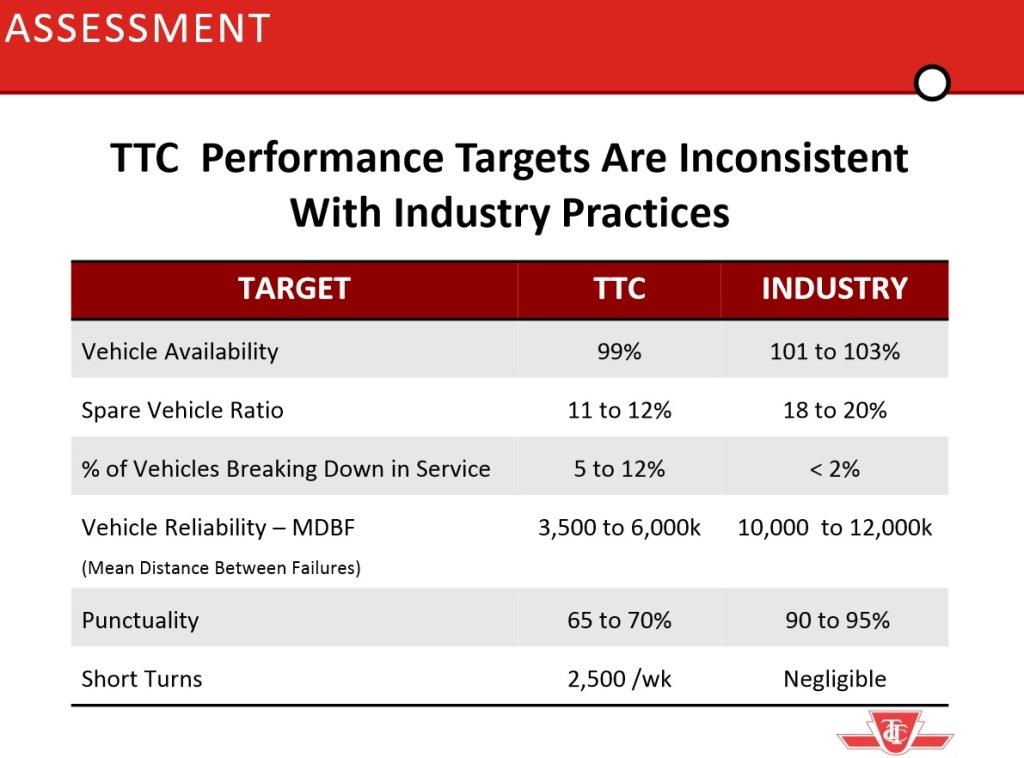
A telling chart on page 6 of the presentation shows how badly the TTC has drifted from transit industry norms:

ServiceKPIsAssessment

The TTC aims to have almost enough vehicles available for service relative to actual needs, and operates with a lower spare ratio than the industry overall. This has two effects.

  • When unusual demands for service arise, there is no cushion to roll out extras.
  • Vehicles are not maintained often enough to prevent in service breakdowns. This shows up in a mean distance between failures that is very much lower than the industry average.

The situation is actually compounded by an internal measure of service delivery: a garage counts a bus as “entering service” if it makes it across the property line onto the street. Whether the bus runs for an entire day or breaks down a block from the garage, it counts toward service provided. This is complete nonsense, but shows how the construction of a metric can induce behaviour that is counterproductive. Actually keeping the bus in the garage could allow it to be repaired and improve reliability, but that’s not what the garage is measured for.

Moving to a higher spare ratio and more frequent routine maintenance on vehicles is expected to yield better service with fewer in service breakdowns. Late in 2014, the TTC began this shift by slightly increasing spare ratios at each garage, and the MDBF for the bus fleet has risen to 7,000km. This will have to be tracked over a longer time, however, to ensure that the improvement is permanent and can be linked to further increases in spares and maintenance work.

This has a non-trivial cost for the TTC. With a total scheduled service of about 1,500 buses, a 6% increase in spares represents 90 vehicles, or a substantial portion of a typical yearly bus purchase, not to mention a fair amount of garage space.

Continue reading →

Where Should We Put A (Downtown) Relief Line?

The City of Toronto began a series of public meetings yesterday (March 3) to advance the cause of a a new subway line that would relief capacity constraints into downtown.  This round focuses on the question of station locations in the segment from the core area east and north to the Danforth Subway.

It is no secret that I have strongly supported the “Downtown Relief Line” (DRL) for a long time, and yet I could not help being disappointed by the structure of studies now underway and the public participation process. There is a sense of a process that is too low-key, that may give the impression of movement while failing to advance the cause.

In this article, I will review the presentation deck being used in these meetings, the questions being asked of participants, and the shortcomings in the advocacy for this new subway line.

Continue reading →

TTC Service Changes Effective March 29, 2015 (Update 2)

Updated February 6, 2015 at 6:10 pm:

A change to service on 1 Yonge-University on weekday evenings was missed in the original version of my condensed version of the changes. This has been corrected.

Updated February 3, 2015 at 11:30 am:

In response to questions raised by the planned changes, I asked the TTC for more details on specific work.

  • At College & Spadina, the platforms used by 506 Carlton will be lengthened, but not widened. They are already wide enough for boarding via the ramps on the Flexities.
  • The 509 Harbourfront route will convert to PoP operation when the Flexities move there at the end of March.
  • Transit signal priority has been or will be restored at various locations on St. Clair:
    • On December 23, 2014, it was restored at Yonge and at Avenue Road.
    • Before March 29, 2015, it will be restored at Deer Park, west of Dunvegan, Russell Hill, Bathurst, Wychwood, Arlington and Caledonia
    • To be completed, but not necessarily by March 29: Ferndale (St. Clair Stn. Loop exit), Christie, Old Weston, Keele/Weston)

The original article from January 31 follows below.

Continue reading →

Does The TTC Use “Safety” As An Excuse For Inept Management?

At the TTC Board meeting of January 21, there was a presentation based on the report Safe Service Action Plan that included several actions and proposals that are intended to improve the safety of TTC operations. The context for this report is that there have been a number of high profile incidents involving TTC vehicles in the recent past.

During 2014, two pedestrians died after being struck by streetcars. Then, in the latter half of 2014 several video recordings were made public of TTC bus operators running red lights. In response to these incidents, the CEO initiated a review of operator training, supervision and relicensing as well as a communications campaign to reinforce the need for operators to drive defensively and to adhere to the rules of the Highway Traffic Act.

Towards the end of 2014, an adult woman and a 14 year old girl died as a result of injuries in separate incidents after being struck by a TTC bus making a turn. Given the very serious nature of these tragic events, the CEO directed that the review already under way be expedited and that it include consultation with other operators for comparison and to seek out best practice. [pp 1-2]

Broadly speaking, the proposals can be grouped into three sets:

  • Operator training and recertification, including an emphasis on safe driving.
  • Monitoring systems to track and record road conditions with a view both to increase evidence when accidents occur, and potentially to monitor driver behaviour.
  • System review including issues such as stop placement, identification of accident “hot spots” and causes, and improved investigative techniques.

Continue reading →

TTC Service Changes for February 15, 2015

The February 2015 service changes are mainly a collection of housekeeping updates with no significant change in service levels.

41 Keele local service will change to artic buses, but the express service will continue to operate with 12m vehicles.

504 King continues to see buses substituting for streetcars during peak periods. Weekend running times will be extended to match actual conditions but no service will be added “because of a lack of budgeted operator hours”. Remember this line the next time the TTC tells you it has no spare vehicles. They are unable to add vehicles off-peak because there is no budget headroom to pay the drivers.

2015.02.15_Service_Changes

Updated: A reader has noted that the evening service proposed for Keele is shown as the 41B Petrolia/Steeles branch rather than the 41A Steeles service that operates now. The info in my table is based on the TTC’s service change memo, but I have sent a request that they clarify whether this is an error. Given the holidays, a reply probably won’t come in for a while.

Updated: The TTC has confirmed that the service design on the 41 Keele route has not been changed, and that the 41B evening service was shown in error. The table linked above has been updated to reflect this correction.