The Mythology of Service Recovery – November 2024 Update

Back in September, I wrote about the gap between the TTC’s claims of service coming back to pre-pandemic levels and the actual service riders face in their daily travels. See:

I will not repeat all of the information in that post, but we are coming into budget season and the most current info should be available for debate.

When the 2025 budget comes out, we will hear much about service recovery including the obligatory photo op with the Mayor, TTC Chair and other worthies. This will be a sham because actual service today has not been restored to early 2020 levels.

The fundamental problem with TTC claims is that they measure “service” by hours for the simple reason that the primary driver of costs is the labour associated with driving vehicles. Some costs don’t actually vary with driving time, but these are generally a smaller component of the total. (For example, some costs vary with mileage, and others such as garaging are per vehicle.) For budget purposes, the variable that counts is hours.

When comparing pre- to post-pandemic service levels, one hour of vehicle operation does not necessarily provide the same amount of service as in the past. The primary reasons for this are:

  • Buses and streetcars run more slowly today than in early 2020 due to a combination of traffic congestion and operating practices (notably the pervasive slow orders on the streetcar system).
  • More recovery time is included in schedules to reduce short turning. The premise is that if there is enough padding, vehicles will rarely be late enough that they must turn back before reaching their terminals.

The combined effect is that more vehicles (and hence vehicle hours) are required to provide the same service on many routes today compared with early 2020.

I have tracked the changes in operating speed on various routes in past articles, and will return to that subject to refresh the charts in coming months.

A related problem for riders is that thanks to uneven service (gaps and bunching), the average wait for a transit vehicle can be considerably higher than the advertised headway. TTC reports “on time performance” only at terminals where service tends to be (but is not necessarily) close to schedule. The information is averaged over many routes and all hours of the day, and bears little relevance to a rider at a specific bus stop at a specific time.

I will turn to the problem of experienced vs advertised wait times in a separate article now in preparation.

The remainder of this piece updates the September charts with planned service hours by mode to the end of 2024, and a comparison of service levels by route and time of day in January 2020 versus November 2024. PDF versions of the chart sets are provided at the end.

Continue reading

TTC Service Changes Effective November 17, 2024

This article details upcoming service changes on the TTC network, most of which will occur on Sunday, November 17.

Updated Nov 14 at 1:10pm: The section about supplementary service on many routes and the possible future for 2025 has been clarified based on additional info from the TTC.

Major changes include:

  • Re-opening of St. Clair West Station Loop. 512 St. Clair streetcars return there on Thursday, November 14, and bus service 33 Forest Hill, 90 Vaughan and 126 Christie on Sunday, November 17.
    • Note that routes 33 and 126 will return to independent operation and the buses will not interline.
    • Route 90 will no longer operate south of St. Clair to Bathurst Station.
  • The final stage of overhead reconstruction will occur on the western end of 509 Harbourfront and 511 Bathurst.
    • 509 cars will operate to Exhibition Loop until November 24 as part of the extra service for Taylor Swift concerts. After that, they will run only to the loop at Queens Quay and Spadina.
    • 511 Bathurst cars will be rerouted to Union Station effective November 14. A shuttle bus will operate from Queen & Bathurst to Exhibition Loop beginning November 17. (The 510D Spadina bus already serves Exhibition Loop.)
  • The 35 Jane bus will operate with split service on the regular 35A and the via Hullmar 35B branch at the north end of the route at all times, not just in peak periods.
  • Service in southwestern Scarborough will be modified:
    • The 12D Kingston Road service to UTSC will now operate weekday midday and early evenings in addition to the existing peak period service.
    • The 12C St. Clair branch will be removed
    • The 69 Warden South bus will operate to the Barkdene Hills area at all hours replacing the 12C Kingston Road branch.
    • A new route 117 Birchmount South will operate between Warden and Victoria Park Stations via Kingston Road.
    • Routes 69 and 117 will interline at Warden Station so that passengers can ride through between them.
  • The 110C Islington South branch to Kipling Loop is rerouted to better serve Lakeshore Village. Northbound buses will run north on Kipling, then east via Birmingham, Twelfth, Garnett James, Ninth and Birmingham to Islington. Northbound buses will no longer operate on Lake Shore and Thirteenth.
  • The stopping pattern for 54 Lawrence East, 954 Lawrence East Express and 154 Curran Hall will be standardized so that all Lawrence corridor services use the same stops in the SRT replacement corridor. Hours of service on 154 Curran Hall will be corrected to match the former 54B service which it replaced.
  • Service on 304 King Night and 305 Dundas Night cars will improve from every 20 to 15 minutes.

These and other changes are detailed in the full article.

Continue reading

TTC 2025 Annual Service Plan Consultation – Round 2

Earlier this year, the TTC conducted the first round of consultations on its 2025 Annual Service Plan. My comments on it include several maps and tables including an update on previously proposed changes that had not yet been implemented.

The following changes are in the second round of consultations:

  • The proposed removal of 87 Cosburn service to East York Acres has been withdrawn for further review.
  • The review of Community Bus routes now includes proposed extensions and restructuring, although the scope is limited by a lack of budget headroom. There is no discussion of where more routes might be added to the system but for a lack of resources to run them.
  • Proposals have been added for alternate service during some, but not all, major construction projects planned for 2025.
  • A proposal to review and consolidate mid-block bus stops has been added.

Except for the 87 Cosburn, all proposals from round one appear unchanged in round two.

The TTC’s survey is available here and will be open for feedback until November 11, 2024. If you have suggestions, please be sure to respond to the survey. Some TTC planning staff do read this site regularly, but feedback on the plan should go to them directly to be part of the record.

I participated in a recent stakeholder session on the plan, and was disappointed by its lack of ambition. There is no sense of a “Ridership Growth Strategy”, an aspirational statement of “here is what we could do”, as opposed to living within the existing budget. It’s almost as if John Tory and Rick Leary never left.

On an informational basis, the plan does not recap pending changes for the eventual opening of Lines 5 Eglinton-Crosstown and 6 Finch West, nor does it discuss past proposals that have not yet been implemented (see my article on round one for a list of these). This leaves riders to search through available background materials to get an overall sense of what will happen in 2025. There is no concrete discussion of general service improvements to attract ridership.

The remainder of this article details the proposals added in the round two consultation.

Continue reading

Wandering Streetcars: Fall 2024 (Updated Oct 21)

Updated October 21, 2024 at 11:30am: The end date for the 501 Queen diversion via Church, King and Spadina has been changed to “mid-November”.

Updated October 18, 2024 at 11:00am: Information on diversions that have finished has been moved to the end of the article to avoid confusion. A planned diversion on Queen west late evening and overnight service from October 21-24 has been added.

Effective October 13: (Don Bridge reopens two days earlier than the planned Oct. 15)

  • 501 Queen:
    • West end: Regular service.
    • Downtown: Streetcar Diversion via Church, King and Spadina both ways.
    • East end: Regular service restored at the Don Bridge.
    • Shuttle bus from Broadview & Gerrard to Queen & Bathurst:
      • Westbound via Church, Richmond and Bay
      • Eastbound via Bay, King and Church until 10pm daily
      • Eastbound via University, King and Church from 10pm to 5am daily
  • 503 Kingston Road: Regular service from Bingham Loop to King & York looping downtown via Church and Wellington Streets.
  • 504 King: Regular 504B routing restored between Broadview Station and Dufferin Loop. 504A has already been on its regular routing and does not change.
  • 508 Lake Shore: Regular route to Broadview Station via Queen and Broadview restored.

Effective October 21-24 Only

  • 501/301 Queen
    • October 21-24 only from 11pm to 4am: Streetcars divert between Shaw and Roncesvalles via King for trackwork at Queen & Brock. Shuttle buses to Neville Loop

Effective Mid-November:

  • 501 Queen: to be announced.
Continue reading

TTC Service Changes: October 6, 2024

The TTC will make several changes to their services on October 6.

One major construction diversion in Parkdale ends with restoration of normal routes on King and Queen Street West, and the downtown 501B bus shuttle will end with resumption of through streetcar service on 501 Queen.

Updated September 27 at 3:20: The TTC advises that although the schedules have been drawn up for a unified 501 Queen car service, the changeover will not take place on October 6, but at a later date. Service details from October 6 until eventual cutover have not yet been announced.

Service on the Bloor-Danforth subway, Line 2, will be improved to address crowding.

Several late night and early morning schedules will be adjusted to better integrate routes during the transition from regular daytime routes to the 300-series Blue Night Network.

Other changes adjust service for reliability and/or to reallocate service hours between routes.

Updated September 29 at 3:30: The spreadsheet showing the details of all service changes is now available.

Updated October 2 at 2:20 pm: Although the service change notice for October 6 showed a 30 minute headway would continue for the 303 Kingston Road night car, the electronic schedule published for this route shows a 20 minute headway from 1:40am onward. TTC has confirmed that the 20 minute headway will operate.

Service Changes 2024.10.06 V2

Continue reading

TTC CEO’s Report September 2024

With the arrival of an Interim CEO, Greg Percy, at the TTC, the CEO’s Report has been somewhat reformatted, although the overall content has not changed much. All of the performance metrics and associated commentary have moved to a separate file on the TTC’s CEO Report page.

The covering report is signed by Josh Colle, recently appointed as Chief – Strategy and Customer Experience Officer and by Percy. Further changes to format and content are in the works “to align with the new 2024-2028 Corporate Plan”.

In his introductory remarks, Greg Percy announces that there will be an open house and guided tour of the Hillcrest complex on Saturday, September 28. Details are available here.

Ridership Update

In the ridership update, the report notes that weekday boardings reached 2.6 million per day during the week ending September 7, a post-pandemic high since March. Note that this count is not the same as “rides” which are linked trips, in planning terms, from one point to another. “Boardings” are unlinked trips which count each transfer separately. Most ridership numbers cited by TTC, certainly from pre-pandemic times refer to daily trips, not boardings. Here is a sample trip:

  • Bus–Subway–Streetcar

That trip counts as one ride but as three boardings. When the fare structure was simpler, rides and fares tended to be the same thing because one fare bought one ride. However, with the arrival of passes and now with the two-hour fare, the distinction is much more vague. It is not clear how the TTC reconciles historical “riding” counts with the new fare structure.

This distinction has been misreported in the press where the terms are used interchangeably:

During the first week of September, the Toronto Transit Commission told CTV News Toronto that 2.66 million riders boarded local transit each day—a post-pandemic high since the last week of March 2024.

[…]

Out of all modes of public transportation, the TTC said weekday boardings were highest across its bus routes, with 1.30 million commuters per day. Comparatively, the streetcar saw 230,000 and the subway had 1.13 million riders.

Source: CP24

This misinformation has been repeated elsewhere.

Pre-pandemic, the TTC typically carried 1.6 million rides per day, with two record days being 2 million (Papal visit) and 2.7 million (Raptors win). The TTC is doing better in 2024 than past covid-era years, but it is most definitely not close to 100% ridership recovery across the board.

Bus, streetcar and subway demand are up 3%, 10% and 9% respectively compared to a year ago. The higher increase for the rail modes implies that the downtown area is starting to see a return of peak riding that had already bounced back in the areas served mainly by buses.

Boardings vary greatly depending on the mode and day of the week. Numbers in the metrics are from July which has typically lower demand due to vacations and the absence of student traffic. However, numbers in the main report are cited from early September. This can lead to confusion when monthly numbers are compared from the two sections.

Ridership and boardings are reported in detail in the metrics. Revenue rides to July 27 are reported as 237.6 million, 0.8 million above budget, 8% above 2023, and 79% of the pre-covid level.

Demand continued to vary across weekdays, with Tuesday to Thursday being the busiest, and Thursdays being 11% busier than Mondays. Compared to pre-pandemic levels, average weekday boardings in July were 84% for bus, 65% for streetcar, and 73% for subway. The busiest weekday, however, was 87% for bus, 68% for streetcar, and 77% for subway.

Weekday peak- and off-peak demand recovered to 67% and 79% of pre-pandemic levels in July, respectively; demand in AM and PM peak periods continue to make up about 52% of all-day weekday demand.

That 52% figure is extremely important. Although there is much focus on commuting travel, this is only slightly more than half of weekday demand. There are more off-peak and weekend hours, and so their demand is less concentrated, but these periods carry a lot of TTC’s riders.

Continue reading

The Mythology of Service Recovery

Every few months, the TTC brings the cheery news that service is pushing ever closer to pre-pandemic levels.

Approved as part of the TTC 2024 Operating Budget, service investment will increase to 97% of pre-pandemic levels this fall, from 95% at the end of 2023. The first 1% increase occurred in the spring of 2024 and additional investment of 1% will be made through the fall.

These changes will be implemented alongside continued adjustments and reallocation of service to match capacity to demand. Overall, the changes will increase frequency, improve reliability, and strengthen connections throughout the city.

[CEO’s Report, September 2024, p. 10]

Riders waiting for their bus, streetcar or subway train might beg to differ.

This is an example of the “good news” mentality that overplays the achievement of the TTC and its recently-departed CEO, and contributes to the gap between publicity and day-to-day rider experience.

The basic problem is that the TTC measures “recovery” based on the weekly hours of scheduled service. This is not the same as the service riders see which is most easily expressed in buses/hour or in the scheduled interval between vehicles. (A 6 minute headway of buses is equal to 10 buses/hour.)

Over the years, service hours have grown because of traffic congestion (more buses are needed to provide the same frequency), recovery time (time for breaks at terminals), padding to avoid the need for short turns, and system expansion. None of these contributes more service to existing routes. These changes can inflate total hours needed to operate the network or, conversely, they can spread existing budgeted hours more thinly across routes.

A meaningful comparison looking route-by-route, time period-by-period, shows that in many cases the level of service, measured by frequency, has declined since January 2020, and in some cases the service is substantially worse. Details are shown later in this article.

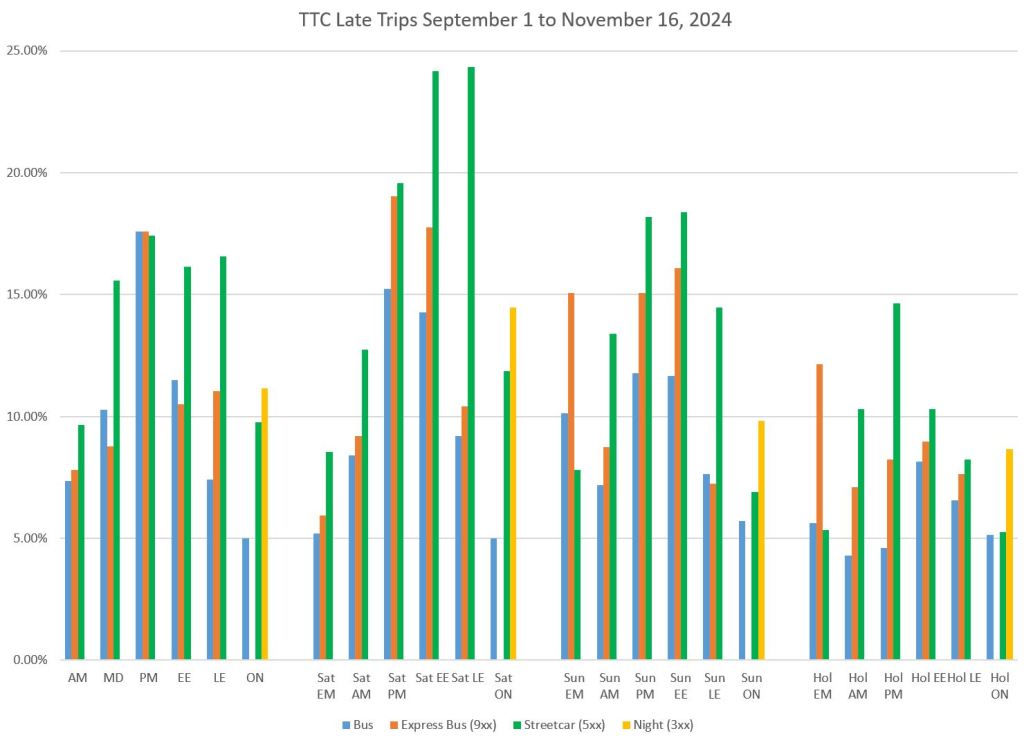
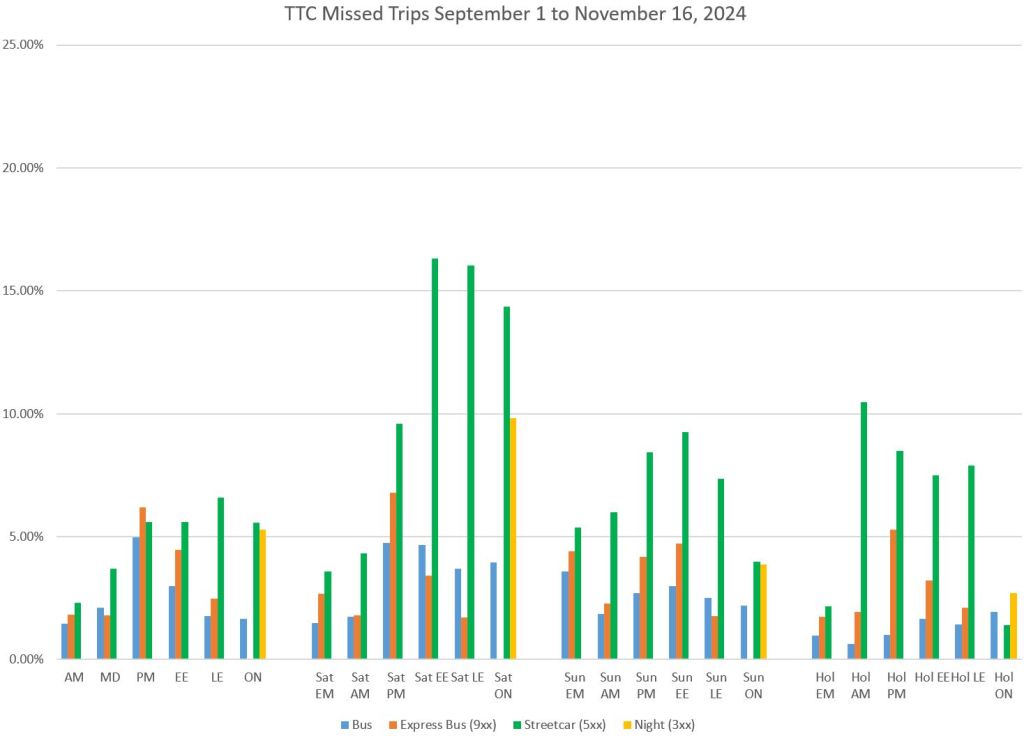
A compounding factor to service reductions is the unreliability of service. Bad enough that buses and streetcars come less often, but when their spacing is not regular, gaps add considerably to waiting time and to crowding. In theory a route might have a scheduled number of vehicles per hour, but in practice their spacing causes most riders to jam on the first of the duo or trio that shows up. The average rider experience is a packed bus even if the average load over an hour meets standards. Few riders experience the relatively empty second and third buses in a pack. TTC reports crowding based on hourly averages without showing the variation between vehicles.

In brief, it is time for the TTC to start reporting service quality on a basis that corresponds to what riders see day-to-day in their travels. The current scheme may allow feel-good media events, but the contrast with actual experience undercuts the credibility of announcements.

Continue reading

TTC Service Changes Effective September 1, 2024 (Update 3)

As I write this on August 29, the TTC has still not issued the usual memo detailing service changes for the coming schedule changes on September 1. Although information has been published on their website, this is incomplete, and in some cases possibly inaccurate. In particular, the details of travel times and vehicle allocations are only available in the detailed memo, and these allow better understanding of how fleet and staff resources are being shifted around on the system.

Updated August 30 at 12:30 pm: I have received the detailed memo of service changes from the TTC and will be updating this article in stages. Changes in this update:

  • The memo confirms that the originally proposed removal of 87 Cosburn service to East York Acres is not happening. Schedules on 87 Cosburn and 64 Main are revised to interline the routes during many time periods on a 10-minute headway.
  • Changes in subway gap trains on Lines 1 and 2.
  • Several maps added or updated.
  • Fleet and service summary tables added.
  • Construction project list added.

Updated August 31 at 9:45 am:

  • The full spreadsheet showing details of headway, running time and vehicle allocation changes has been added at the end of the article. Note that some of the information in the original version proved to be incorrect when compared with the TTC’s detailed memo due to discrepancies in the TTC’s service change web page.
  • A list of routes for which the Summer service cut was not restored in the Fall schedules has been added.

Updated September 1 at 4:25 pm:

  • Headway information for the Sheppard corridor revised to match the service implemented, and to reduce complexity of the description.

Updated September 3 at 2:30 pm:

  • A reader has pointed out that the TTC’s streetcar night service map incorrectly shows service on routes 303 and 304 heading straight west through Parkdale via King to Roncesvalles rather than via their Shaw/Queen diversion.

See:

At a recent press conference, Mayor Chow and the TTC announced that many changes were coming in September. Two key points were omitted:

  • When the TTC speaks of service restoration relative to pre-pandemic levels, this is based on vehicle hours operated. However, on many routes so-called reliability adjustments extend the travel times and slow the scheduled speeds of buses. The result is that service arrives less frequently, but there is no change in vehicle hours operated.
  • Many service increases in September are restorations after the Summer lull when service is normally reduced due to lighter demand, notably on routes serving post-secondary schools.
Continue reading

Greenwashing the TTC

The TTC seeks feedback on its Innovation and Sustainability Strategy. As I write this, the announcement has been posted on X/Twitter, but not on the main TTC page. Instead, it is well hidden, like so much on the TTC site, among many items on the “Riding the TTC” page under “Green Initiatives”. There is a link from the survey’s introductory page, but this is only available when launching the survey, not afterward. Within the Green Initiatives page is a link to the TTC’s 2024-2028 Draft Innovation and Sustainability Strategy, a 50-page document that puts the survey in a wider context, but which most readers are unlikely to access, let alone read.

The survey contains three sections addressing various aspects of a TTC strategy:

  • An “innovation pipeline”
  • Prioritizing climate actions
  • A culture of innovation and sustainability

Reading through the Draft Strategy, the overwhelming impression is of the creation of a bureaucracy within the TTC, not to mention a pervasive presence of an Innovation and Sustainability czar. Much of their work would focus on internal changes, only some of which actually address climate effects. This is not to say that innovation per se is a bad thing, but it is not defined. Moreover, it has been bundled with schemes to green the TTC that are really a separate project.

Continue reading

TTC Annual Service Plan 2025

The TTC has released the first draft of their 2025 Annual Service Plan for comment on their site. Readers with suggestions should use the TTC’s survey for input to the plan.

Updated August 9 at 5:20pm: The TTC has supplied new versions of maps for routes 49 and 405, as well as for the Etobicoke Blue Night service change proposals. On their behalf, thanks to readers who have flagged issues on the original versions.

The consultation looks at three areas of TTC service:

  • Proposed 2025 Changes
  • The One Fare Program
  • Community Bus Routes (4xx series)

There will also be pop-up consultations at various locations around the city.

DateTimeLocationRoutes
Aug 74:30 to 6:00 amBus ride-along395, 385 and other affected night routes
Aug 76:00 to 8:00 amKennedy Stn334
Aug 76:30 to 8:00 amRouge Hill GO385
Aug 9Noon to 2:30 pmDufferin Mall402
Aug 129:30 am to NoonNorth Park Plaza400
Aug 134:30 to 6:00 amBus ride-along337
Aug 136:00 to 8:00 amKiping Station45, 49, 337 and other affected night routes
Aug 1412:30 to 2:30 pmBus ride-along13B
Aug 19Noon to 2:00 pmCoxwell Station22, 70 and 404
Aug 19Noon to 2:00 pmMain Station87A

In a recent Stakeholders’ session which I attended, it became clear that some of the 2024 ASP proposals that had not yet shown up in service would be coming in fall 2024. I asked the TTC for details of the outstanding 2024 proposals, and this information is in a table at the end of the article.

A further problem is that the substantial changes already planned for the Line 5 and 6 openings cannot be implemented until Metrolinx actually begins service there.

One key item that is not addressed by this round of consultation is the matter of service frequency. Most of the routes TTC proposes to modify suffer from infrequent service, and the benefit of the route changes will be muted by the absence of buses as opposed to lines on the map.

Continue reading