Streetcar Stop Spacing

A recent X/Twitter thread began with a claim that the streetcar system suffers from slow operation because of closely spaced stops, specifically below 100 metres. I made a short reply showing the average spacing for each route, but have now generated charts showing all routes in detail.

There are only a handful of stops spaced closer to or below 100m, and so the claim that this is a source of much delay is easily disproved. The question then is what the typical spacings are, why, and how much “efficiency” could be obtained by eliminating some of them. I do not attempt to answer that question here, but simply present the actual stop spacing data so that there can be informed debate.

The TTC’s design goals for stops are set out in the Service Standards:

2.4 Surface Stop Spacing
Surface stops should be designed in accordance with the TTC’s Technical Criteria for the Placement of Transit Stops. When the locations of stops are being planned for a route, it is necessary to strike a balance between the competing objectives of passenger convenience, operating efficiency, safety and community impacts. In general, increasing the number of stops on a route results in shorter walking distances for passengers but it also slows down service. To achieve a proper balance, the TTC will place bus stops in accordance with the standard presented in Table 2 [below].

Service ClassificationStop Spacing Range
Streetcar300 – 400 metres
Bus – Local300 – 400 metres
Bus – Express (Tier 1)650 – 1,000 metres
Bus – Express (Tier 2, Limited Stop)650 – 1,000 metres
Bus – Express (Tier 2, Local/Express)650m for express portion;
300 – 400m for local portion
Bus – CommunityFlag stop

It’s important to remember that Toronto streets are not laid out on a repeating grid as in some cities, and one cannot simply stop at “every second street”, or whatever layout works. Existing pedestrian circulation patterns, transfer points, major origins/destinations all play a role in defining a “good” stop location. This is even more of a problem in suburban areas with longer blocks and poor opportunities to access transit stop from “nearby” (as the crow flies) neighbourhoods.

Methodology

The stop distances for each route have been taken from the GTFS versions of the schedules published regularly by the TTC. These are used by trip prediction and planning apps to understand the layout of the system. In a few cases where current operations do not match the historic route layout (e.g. 501 Queen, 504 King, 512 St. Clair), I have used older data sources from a period when routes operated normally.

Continue reading

TTC Service Changes: July 28, 2024

Only a few routes are changing at the end of July, although TTC has hinted that major service additions are coming in the fall. Given the state of the TTC’s budget, we will see in roughly a month just what that entails.

Rapid Transit Changes

2 Bloor-Danforth

Gap trains are removed from the weekday schedule due to a shortage of operators. This eliminates two trains in the AM and PM peaks, and five trains through the early and late evening periods. Four midday gap trains remain.

Night Service Changes

504/304 King

Three mid-evening trips eastbound from Humber Loop are added to provide a better transition between the 504B King and 501 Queen services west of Roncesvalles. There is no change to the 501 Queen nor to the 507 Long Branch schedule.

Schedules for the 304 King Night Car will be adjusted for reliability. Cars will continue on their present 20′ headway, but some driving time has been converted to terminal layover time.

305 Dundas

All-night service will be provided on Dundas over the same route as the daytime 505 with cars on a 30′ headway.

306 Carlton

Because Dundas is now a 24 hour route, the 306 Carlton Night Car will operate to High Park Loop, and will continue on a 20′ headway. (Note that although this is generally advertised as a 20′ headway, it actually widens to 30′ after 3am.)

332 Eglinton West, 334 Eglinton East & 354 Lawrence East

These routes will be changed to enter Eglinton Station via Yonge and Berwick rather than via the western entrance at Duplex. Stops at the south entrance to the station and at Berwick to provide transfer connections between these routes.

363 Ossington

Buses will serve the stop at Strachan and Canniff to provide a transfer connection with 304 King, and to match the daytime service.

Bus Changes

36 Finch West

Additional trips will be added in the AM and PM peaks, and in weekday early evenings to provide more capacity on this route. These are factory trips deleted in error in the June schedule change.

114 Queens Quay East

The 114 Queens Quay East bus has been using Lake Shore Garage as its eastern terminal since early July. This change is now formally in the schedule.

Buses run out of service east of Carlaw, but serve the Logan, Lake Shore, Carlaw loop in both directions.

123 Sherway

A trip from Kipling Station on the 123D East Mall service will shift from 6:11 to 6:12am to even out departures.

203 High Park

The 203 High Park shuttle operated with a Wheel Trans bus will now run east to Keele Station which provides an accessible connection to the subway. Buses will loop through High Park Station enroute. The headway is changed from every 20 to every 30 minutes.

937 Islington Express

Stops added at Dundas and at Rathburn to provide transfers to 40 Junction and 48 Rathburn.

945 Kipling Express

Stops added at Burnhamthorpe and at Rathburn to provide transfers to 46 Martin Grove, 48 Rathburn and 50 Burnhamthorpe.

Continue reading

Spadina Replacement Bus Shifts to St. George Station

The City of Toronto will be closing the intersection of Spadina and Bloor to all traffic from 5am Monday, July 15 to 5am Monday, July 22 for complete reconstruction. This is the west end of a project that has been working its way along Bloor Street for months.

TTC bus service will divert to St. George Station. Whether this will alleviate the bus congestion at the north end of the route remains to be seen.

Because this is a non-standard route, transit prediction apps will not work for locations off of Spadina, and southbound predictions will only work for stops and buses that are south of Harbord.

Yet Another Streetcar Diversion

The TTC will be making repairs to the track at Church & King, a location that has needed serious tender loving care for some years. This project will run from 11pm Friday July 12 to 4am Wednesday July 17.

This event and the confusion it will add for downtown travellers is a direct result of delays in complete replacement of the intersection, compounded by the Queen Street closure for the Ontario Line and the still-incomplete work on the Richmond/Adelaide diversion around Queen and Yonge that limps along with a vague “fall” completion date.

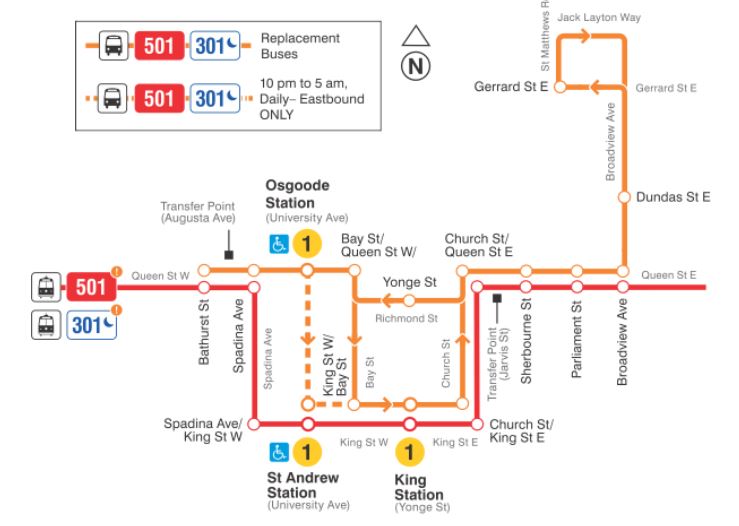
501/301 Queen:

  • Streetcars in the east end will operate only to Parliament Street and will loop back via Dundas and Broadview.
  • The 501B shuttle buses will operate westbound via Richmond and eastbound via King between Church and University.
  • Night service will be provided via streetcars diverting onto Dundas as shown in the map below, and night service on the 301 bus covering the central part of the route on the same path as the 501B daytime service.

503 Kingston Road:

  • 503 Kingston Road cars will operate as far west as King & Sumach, and then turn south to Distillery Loop.

504 King:

  • 504A King Dundas West to Distillery: Cars will divert both ways via Spadina, Queen, McCaul, Dundas, Broadview, Queen, King and Sumach/Cherry to Distillery Loop.
  • 504B King Humber to Broadview Station: Cars will divert on the same route as 504A to Broadview, then run north to Broadview Station.
  • 504 buses will operate from Broadview Station to Bathurst over the regular King route.

508 Lake Shore:

  • 508 Lake Shore cars will divert via the same route as the 504B King cars.

How well any of these services will operate remains to be seen especially the 504A route that will be much longer than normal.

Reserved Bus Lanes for Spadina?

Updated July 11 at 4:20 pm: The TTC has confirmed that planned overhead replacement on Bathurst shown on TOInview will not occur. They also confirmed that 2025 work on the west half of 506 Carlton will be done in stages, but have no further details at this point.

In response to the snafu with Spadina bus operations and traffic backlogs for the Gardiner Expressway, Toronto & East York Council has approved a proposal to implement a reserved bus lane between Queen Street and Queens Quay southbound. This must go to the full Toronto Council at its meeting of July 24.

The west curb lane would have all parking and cabstand space removed south of Queen. It would be reserved for transit vehicle and bicycles except for areas 30.5 metres north of King Street, Front Street and Fort York Boulevard which would be south-to-west right turn lanes. Between Richmond and Queen, stopping would be permitted outside of peak periods.

Speaking on CBC’s Metro Morning, Deputy Mayor Malik, sponsor of the motion, noted that planning for this type of event must substantially improve. The TTC was clearly caught out by the level of congestion on Spadina, something anyone who ventures downtown would know about. This did not appear overnight. A further question about the reserved lane proposal, which will be in effect at all hours, not just for the PM peak period, is how it will be enforced and what effect it will have on traffic feeding into this area.

A larger problem remains with the TTC’s planning for construction projects, and especially for streetcar replacements. In recent years, they have seemed quite willing to suspend service for extended periods in the interest of getting a lot of work done with a single closure. In practice, some of these have gone on far longer than they should have, and there have lengthy periods without any visible work.

The work on Spadina between King and Queens Quay, and later between College and Bloor, involves rebuilding the streetcar overhead to be fully pantograph compliant, as opposed to a hybrid pole/panto system. Some streetcar track repairs are likely during the streetcar replacement. This work should not take six months, the planned Spadina closure. This was originally announced as running only to October, but now to December. At Spadina Station the first stage of streetcar platform extension will occur taking advantage of excavation for a nearby condo project.

The City’s infrastructure plan viewer, TOInview, shows two other pending overhead replacement projects.

  • In 2024, Bathurst Street from Fleet to St. Clair
  • In 2025, College Street from Dundas to Yonge

Updated July 11 at 4:20 pm:

I asked the TTC if/when these projects will occur, and they advised that Bathurst will not be done in 2024. TOinview will be updated. College will be done in sections in 2025, but no further details are available yet.

It is not clear why at least the north end of Bathurst was not rebuilt while the St. Clair line was shut down for its own conversion and other projects along that route. This would have allowed streetcars to be based at Hillcrest as they were during previous roadworks on Bathurst. Do riders on St. Clair face another round of bus substitution?

College Street went through its own gyrations with substitute bus service during track replacement not long ago.

Many years have passed since the TTC streetcar system was entirely operating with streetcars, and the TTC seems to be happy to have some part of the network out of service almost all of the time. It certainly is not a question of vehicle availability, although their staffing is probably at a level where they could not field full streetcar service. This has implications for streetcar service levels generally, and for the resources more-or-less permanently “borrowed” from the bus network.

Consultation for the TTC’s 2025 Service Plan is about to get underway, and one topic planned for this is “construction”. Indeed, “doing diversions differently” is one goal of the current plan. On Spadina, that looks like an “own goal”.

512 St. Clair Streetcars vs Buses: June 2024

With the June 23, 2024 schedule change, buses were replaced with streetcars running from St. Clair Station at Yonge to Gunn’s Loop west of Keele Street. Buses operated mostly in the regular traffic lanes, not on the streetcar right-of-way.

This article reviews the travel times on the 512 St. Clair bus and streetcar services to compare travel times over the route.

Although the streetcars in week 4 of June (beginning on June 23) are overall faster than the buses they replaced, the degree of this advantage varies by location and direction.

This is a companion piece to my review of the streetcar-to-bus change on 510 Spadina that happened at the same time.

The overall observation here is that although travel times are now shorter for many riders, headway reliability is very poor and gaps can undo the benefit of a faster trip.

Continue reading

510 Streetcars vs Buses: June 2024

With the June 23, 2024 schedule change, streetcars were replaced with buses running from Spadina Station at Bloor to Queens Quay. Buses operated in the regular traffic lanes, not on the streetcar right-of-way.

To no surprise, during periods when Spadina Avenue is congested, primarily with traffic queued for the westbound Gardiner Expressway ramp at Lake Shore, the buses made glacial progress. This was not, however, the only place where buses were delayed by traffic.

The TTC has announced that it will change the south end loop in an attempt to speed service during the PM peak. No buses will operate between Blue Jays Way and Queens Quay, but instead they will loop via Front eastbound, then south and west via Blue Jays Way to Spadina. Traffic Wardens will assist with the turn at Front Street.

However, the congestion on the south end of Spadina can extend north to King and sometimes beyond Queen Street. It is not clear whether the new loop will address much of the problem. Buses will not be using the streetcar right-of-way, even though it has no centre poles north of Bremner Blvd. to bypass the traffic jam.

The TTC advises that this is an interim arrangement, and that they are working with the City on further, unspecified, changes to the bus operation.

It’s Not Just the Gardiner

An effect unexpected by some, I am sure, was that at uncongested parts and times, the buses make faster trips than the streetcars had only a week before the changeover. Anyone who rides the 510 Spadina car will know of their glacial progress through intersections thanks to the system wide slow order on all special trackwork. Spadina has many intersections. This type of pervasive delay is seen all over the streetcar system, but is worst on rights-of-way where one would expect streetcars to operate as quickly as possible.

Buses have a further advantage in that they are stopping nearside, and therefore can serve stops while awaiting a green signal, and then leave without a second farside stop.

The absence of priority with extended green phases for Spadina transit service affects the modes differently because an extended green would allow streetcars to reach their stops before a signal turns against them. Even if bus is caught on the nearside of an intersection, it will be stopping to serve passengers.

The left turn phase for auto traffic that blocks streetcars also blocks buses, and so this particular delay is common to both modes.

In addition to congestion at the south end of the route, buses also encounter problems during some periods approaching Bloor Street northbound.

The remainder of this article reviews travel times and service reliability on the main part of the 510 Spadina route over June 2024. (There is a companion article about the return of streetcars replacing buses on 512 St. Clair.)

Continue reading

TTC Service Changes Effective June 23, 2024

The detailed list of changes arrived from the TTC quite late compared to normal practice, only a few days before they went into effect. Hence the delay in my regular detailed post here.

Many summer service reductions occur with the June 23 schedules. These are common, and the only question will be which of them will be fully reversed in the fall.

Construction

Ongoing construction projects continue to require diversions and bus replacements for streetcars. The timing and duration of these leaves a lot to be desired, but that is a topic for a separate article.

In previous articles, I covered the resumption of streetcar service on St. Clair and the suspension of service on Spadina. See:

Streetcar Network Configuration

The streetcar route layout is shown in the maps below for daytime and overnight service.

Jane Station Construction

Reconstruction of Jane Station Loop will shift the terminus of all services to Old Mill and Runnymede Stations. The work was planned to start with the new schedule period, but has been delayed, and so there will be interim arrangements. The route plan during this work is shown below:

The 35/935 Jane services will dead head to Old Mill Station and will not pick up or drop off passengers there. The 26 Dupont and 55 Warren Park will remain in service to Runnymede Station to provide an accessible connection.

The 71 Runnymede and 77 Swansea routes will be interlined and they will be interlined to free up platform space at Runnymede Station for other routes. The arrangements for Jane, Runnymede and Old Mill Stations are shown below.

The TTC’s construction page for Jane Station is on their “Updates” page and the information is not linked to the affected routes as a service advisory. This is a standard problem with the TTC’s website.

Bus Service to High Park

Although the TTC had planned to cancel the 203 High Park bus in 2024, it has been reinstated through efforts by the City. The route will operate with a Wheel-Trans bus from High Park Station providing accessibility to the park even though it is closed to regular vehicular traffic. The bus will run every 20 minutes on weekends from 8am to 7pm until Labour Day, Monday, September 2.

Continue reading

Moving Forward With Transit

Just before midnight on June 6, the Toronto Transit Commission and the Amalgamated Transit Union Local 113 announced that they had a tentative agreement for a new three-year contract. Further work continued beyond the midnight deadline to reach a proposal the union executive could support.

No information has been released, and the deal is described as a “framework” with details to be finalized before the package goes to union members and the TTC Board for ratification. However, both union leadership and TTC management sound hopeful for a settlement.

This was not the situation only days earlier when Local 113 stated that there was little progress on major issues, notably job security, and transit riders braced for a possible strike.

By comparison with previous TTC labour negotiations, this round did not spill over into public rounds of finger-pointing. At the political level, pressure was not overt, although behind the scenes guidance must have affected bargaining. This bodes well for a less contentious relationship than would exist with polarizing, blowhard media statements that can undermine whatever trust might exist between negotiators.

On CBC’s Metro Morning, Local 113 President Marvin Alfred noted a shift in TTC negotiating posture to remove management conditions attached to some union proposals that would have limited their benefit. This led to a tentative agreement. What triggered this change is not public, but that was key to unlocking the negotiations.

Assuming that the framework evolves quickly into an approved contract, the focus now must turn to the future of transit in Toronto. The TTC faces major financial problems, but lurking behind these are issues with service quality, maintenance and TTC management culture.

On the financial side, common discussions focus on the Capital budget including the backlog of “state of good repair” funding, notably for a new Line 2 fleet of trains. However, the more pressing challenge lies with the Operating budget that is funded primarily by the City of Toronto and fares. Through the pandemic, special federal and provincial funding allowed service to remain frequent, but this revenue has ended. Any policy to maintain, let alone improve service falls to the City and to riders.

The options are not fully understood, but with 2025 budget planning now underway, it is vital that any debate be well-informed. For many years, the TTC budget landed with a thud on the Board’s public agenda in December or January with all significant decisions about funding, service and maintenance solidly baked in. After the annual charade of public consultation, Board and Council tweaks, the budget sailed through. At best, one might see requests for options going into the the next year’s process.

TTC has been without a Budget Committee of any significance for years. Now is the time to create one and to ensure that it actually meets for substantive debate. There must be open discussion of options. The TTC’s Five Year Service Plan includes some costed proposals, but other issues such as fare structure, service quality and reliability need review at the same time. The Board has a bad habit of cherry-picking items for debate in isolation from the larger context.

Major issues for the union are wages, understandably, and job security. On the wage side, the recently published TTC 2023 draft annual report includes a table showing the hourly cost of wages and benefits from 2014 to 2023. Over that period, this value rose from $49.01 to $61.67, a ten-year increase of almost 26%. Individual annual changes varied considerably with some years seeing values well under 2%.

From a system cost point of view, the wage and benefit rate does not tell the whole story because the combined effect of traffic congestion and more generous terminal recovery times in schedules push down the amount of service delivered per vehicle hour. Putting it simply, if the average speed of buses goes down by 1%, then 1% more vehicle hours are needed just to maintain the same service. Unless there are offsetting service cuts, this adds to service costs beyond the basic hourly rates and benefits. Management can claim an improvement in service operated, measured in hours, while scheduled frequency and capacity can actually decline.

Job security is also important because of creeping outsourcing of work from formerly union jobs to outside contractors. This began with some of the simpler tasks such as bus cleaning, but more recently regional service integration schemes raise the question of which transit operators (and their respective staff) will provide service in Toronto. Current proposals involve minor parts of the system, but the clear intent is to shift TTC costs to other providers.

Service quality is a big issue for riders, and this is an area where both management and the union must co-operate for improvement. There is a need for honesty in reporting about crowding levels and reliability about which I have written many times before. Management cites all-day averages and uses a measure of reliability that does not reflect real-world rider experience. Crowding is directly related because bunching produces uneven vehicle loads with most riders on crowded buses. Management must accept the need to manage service and report on its actual quality. “On time” performance metrics disguise actual quality problems including vehicles running in groups for extended periods.

Options for increasing service must recognize the large pool of spare trains, buses and streetcars available to provide more frequent service today. “We don’t have enough resources” is a common response to calls for better service, and years ago this applied to vehicles and garage space. Today it applies mainly to budget constraints, not physical fleet and infrastructure. Toronto might not be able to afford to run all of the vehicles it owns, but that decision should be made openly recognizing implications for the attractiveness and future growth of the transit option.

Maintenance is a big issue both for the fleet and infrastructure. This affects both reliability and safety. Many factors are at work including budget limits and an extended period when the TTC did not have to field full service during the pandemic. Some maintenance can be put off for a short term, in a pinch, but when the new, lower quality becomes normal, climbing back to a once-demanded level can be hard. An organization can forget its standards, or adjust them to fit available funding and hope for the best.

There is no question that system inspection and maintenance are not keeping up with current conditions as we have seen in reviews of the Scarborough RT, subway track and streetcar overhead areas. What we do not know is how pervasive these issues are in other parts of the transit system, nor what other problems will threaten rider confidence in the TTC’s ability to provide safe, dependable service.

Finally, there is the long-standing matter of TTC culture. It is no secret that the top-down management style has hurt the organization, cost the system in lost expertise and corporate memory, and fostered a climate where appearance of success takes priority. TTC messaging overstates the progress in post-pandemic service recovery without acknowledging the decline in service riders actually experience. Maintenance problems are hidden until events force them into the open.

The Board, after years of ceding power to management, must now shift to a more hands-on role if only to ensure that the City and transit riders are not blind-sided, that key issues are not downplayed. This could work against a political incentive to get “back on track” and report good news as soon and as often as possible. The Board needs management it can trust, but also the political support to be open and honest about what the transit system needs.

With labour issues more-or-less settled, Toronto must turn to rebuilding and expanding its transit system. Speeches and plans about improvements are worthless without honesty, transparency, funding and sustained commitment. Plans for subway lines in the 2030s make for good press, at least among those who only look for the photos ops, but they don’t carry riders today, let alone address issues with changing travel demands where suburban travel is as important as trips downtown.

Does Toronto really want better transit?

The State of Disrepair (II)

The extended shutdown of Line 2 on May 13 brought the TTC’s work car fleet into the spotlight thanks to multiple equipment failures leading to hydraulic fluid leaks.

In the management presentation, the average age of that fleet was cited as 17 years, but these cars vary greatly in age. Here are the affected cars.

VehicleBuiltFunctionLeak Incident Dates
RT-411993Tie TamperApr. 2/24 & May 16/24
RT-171996Tunnel WasherJan. 17/24
RT-71998LocomotiveFeb. 10/24
RT-562006Vacuum & Drain CleaningJan. 14/24 & May 13/24
RT-842011Vacuum CarMay 15/24

Replacement of RT-41 with a new car was proposed in the 2018 Capital Budget along with several other new and replacement cars. The intent was to refresh the fleet and increase capacity to perform more work on the expanding subway network. Most of this program was deferred under CEO Rick Leary, although a second Tie Tamper, RT-21, does now appear in the illustrated list of work cars. RT-41 is well overdue for replacement.

Inspection of all work cars began a few days after the May 13 incident. Sources indicate that fewer than one third of the three dozen cars reviewed in the first two days passed inspection.

Planned work on Line 1 on the May 18-19 weekend was deferred, and it is unclear how the sidelining of RT-41 and other cars might affect planned track repairs.

Questions for the TTC

On May 22, I wrote a series of questions to TTC Media Relations attempting to get an official version of what I had heard from sources. Here are the questions.

  1. Can you confirm the failure rate for inspections (over 2/3)?
  2. Has all of the fleet been inspected now and what are the results?
  3. Will further adjustments be required in maintenance plans?
  4. A key vehicle that was not available last weekend was RT-41 the tamper car. According to the fleet diagram included in the board presentation there is another tamper car RT-21. What is its status?
  5. In 2018 the capital budget included a multi-year program to replace elderly work cars and expand the fleet including [replacement of] RT-41, but this program was repeatedly pushed into future years. What is its status?
  6. Since the pandemic the budget blue books have not been available, although there was talk of an e-version of them. What is the current status?

The TTC’s response on the afternoon of May 22 was not very revealing:

As you know from the Board meeting, we’ve already started the deep dive with external consultants AND our own staff have enhanced our proactive inspections on the workcar fleet.

The results, outcomes and findings will first be shared with our Board when they are known.

I can say that your source has misinformed you in as much as we have not yet inspected the entire fleet as this is a time-consuming process that sometimes requires workcars being shunted from one location to another.

As deficiencies are identified, they are corrected before being the work cars are put into service.

The TTC’s response was less than helpful for all questions:

  1. The TTC did not address the failure rate for cars that had been inspected.
  2. The TTC claimed my source was incorrect, but misrepresented the question. In fact I asked whether the inspections had been completed, and indirectly they confirmed that the answer is “no”.
  3. Not answered.
  4. Not answered. Tamper RT-21 is a comparatively new vehicle (it does not appear in 2018 fleet lists). It is not clear why it was unavailable when tamper RT-41 was sidelined.
  5. Not answered. The repeated deferral of this project is a matter of record within the budget papers from 2017-2024.
  6. Not answered. The significance of the “blue books” (so named because of the colour of the binders that held them) is that they included detailed descriptions of all capital projects and their status well beyond information in budgets or quarterly financial reports. Before the pandemic, these were routinely provided on request, but I have not been able to obtain them since 2019.

Most of the questions have nothing to do with the “deep dive” into fleet condition, but the TTC has used a simplistic response to dismiss all questions whether they relate to the deep dive or not. The one “answer” attempted to discredit a statement I did not make, and by extension the entire sequence.

Maybe, somewhere, there is a Board member who will demand answers.

Reduced Speed Zones

The tables below track the Reduced Speed Zones where track is awaiting repair. This is an updated version since the previous article. Depending on how your browser presents the tables, you may have to scroll to the right to see the most recent entries.

Although many of the entries from early 2024 have cleared off, others appear suggesting that inspections are uncovering new problem areas and adding them to the list. Little has changed through the month of May.

Source: TTC Reduced Speed Zones Page

Line 1Jan 18Feb 2Feb 12Mar 7Mar 12Mar 14Mar 21Apr 29May 8May 17May 22
Hwy 407 to VaughanNB
Sheppard W to WilsonNBNBNB
Wilson to YorkdaleSBSBSBSB
Yorkdale to Lawrence WSBSBSBSB
Eglinton W to St. Clair WNBNBNB
St. Clair W to DupontNBSBSBSBSB
Spadina to St. GeorgeBWBWBW
St. George to MuseumNBNBNB
St. Andrew to UnionBWBWSBSBSBSBSB
Union to KingNBBWNBNBNBNBSBSBSBSB
College to WellesleyBWBWBW
Bloor to RosedaleNBNBNBNBNBNBNBNB
Summerhill to St. ClairBWBWNB
St. Clair to DavisvilleBWBWBWBWBWSB
Davisville to EglintonBWSB
Lawrence to York MillsNBNBNBNBNB
York Mills to SheppardNBNBNBNBNBNBNB
North York Centre to FinchNBNB
NB = Northbound SB = Southbound BW = Both Ways
Line 2Jan 18Feb 2Feb 12Mar 7Mar 12Mar 14Mar 21Apr 29May 8May 17May 22
Royal York to JaneBWBW
Runnymede to High ParkWB
Keele to Dundas WestBWBWEBEBEB
Sherbourne to Castle FrankEBEB
Castle Frank to ChesterEBEBEBEBEBEBEB
Chester to BroadviewWB
Greenwood to CoxwellEB
Coxwell to WoodbineEBEBEB
Woodbine to Main StreetEB
Victoria Park to WardenEBBW
Warden to KennedyWB
EB = Eastbound WB = Westbound BW = Both Ways