Effective Monday, May 8, the TTC has restored late night service on Lines 1 Yonge-University-Spadina and 2 Bloor-Danforth to every six minutes, seven days/week. This will be done with extra trains to supplement the scheduled service. The change will be formally scheduled in a future update.
Also, with the disappearance of the 503 Kingston Road car and its temporary replacement by the 505 Dundas, the TTC is now operating a supplementary bus service from Queen & Kingston Road to downtown via Queen and King from 7am to 7pm weekdays.
A direct streetcar service will not be possible until work on the Queen Street Don Bridge finishes sometime this summer, but there is another wrinkle. In the summer, Queen east of Broadview will close for Metrolinx bridge work at the future Riverside Station on the Lake Shore East Rail Corridor forcing all streetcars to operate via Gerrard. In turn that cannot begin until water main and track work at Coxwell & Lower Gerrard completes.
The additional subway service is made possible by an unexpectedly lower absentee rate among operators compared to budget. The TTC made a larger provision for covid-related sickness and finds itself with more available staff.
Although month after month of service reductions to fit the available budget dominate transit debates, the TTC forges ahead with their “5-Year Service Plan & Customer Experience Action Plan”. The intent is to develop priorities and strategies for the 2024-2028 period.
Also underway is work on the 2024 Service Plan. This will focus on issues arising from many construction projects.
The work will take place until October 2023 in various stages beginning with a survey available online (it is also available by mail on request).
The elephant in the room through all this is, of course, the future funding status of the TTC and the level of service they can hope to operate with whatever money comes their way. Part of the survey asks which aspects of service should be enhanced or trimmed depending on the availability of funds.
The objectives of the plan are described with this text:
“We consider two major objectives when planning transit services in Toronto:
Maximize mobility and satisfy changing travel needs by ensuring public transit is provided in the right places, at the right times; and
Ensure all TTC transit services are efficient and cost-effective (and therefore affordable).
As we work towards these objectives, we strive to balance the benefits of transit services with the cost of providing them.”
This says quite clearly that money will rule the planning, but what has consistently been missing in TTC plans is a sense of advocacy. “Cost effective” is a term that depends very much on the frame of reference. Service convenience, speed, reliability and comfort all have a value as part of an overall push to move people to transit from cars. It is pointless to trumpet a move to greener buses if those buses provide poor service, or worse, sit in the garage because there is no money to operate them.
“We can’t afford that” is a common response when people ask for better service, but too often we are not told what improvements might cost. We might not have the money today, but good political debate should be informed on the options.
Twenty years ago, an essential part of David Miller’s Ridership Growth Strategy was to say “don’t tell us that we cannot do anything, tell us what our options are and what they will cost”. The decision should be up to politicians and their constituents, not pre-empted by management. Of course, if plans are built under direction to avoid spending more money, then management does what they are told.
Parts of the survey could use more granularity. For example, the response to construction and diversion requirements is very different depending on which part of the city one talks about. Where there is a fine-grained street grid, it is much easier to keep service near its normal route than in areas where through streets are widely spaced.
There is no recognition that service reliability interacts with service frequency and speed. There is no point in spending great effort on transit priority schemes only to reduce service and ignore reliability. Travel time savings on paper can be offset by unpredictable wait times, not to mention longer walks to stops.
The survey recognizes the importance of communications. I wrote recently about problems in navigating the TTC’s website and confusion in presentation of updates. A related problem is that that riders have different needs for accessing information. In some cases, it will be “what should I do tomorrow” planning, but a lot of access is for “where is my bus right now”. Finding accurate info quickly is vital whether this is via a smartphone app, an in-shelter next vehicle display or a poster hanging by a string from a stop pole.
The challenge is to get from recognition to implementation, a big problem in an organization that has too many information silos and no apparent single point of responsibility.
“Customer experience” is a slippery term that has, in the past, revealed a lot about how some at the TTC regard what might entice riders to the system. The emphasis has been on nice-to-haves like WiFi (only recently elevated as a safety issue), elaborate waiting stations at transfer points and shops in subway stations. The most basic part of the experience – the wait for and crowding on board vehicles – is rarely discussed. As extra service for the pandemic era winds down, this is the central debate.
Updated May 4, 2023: The High Park bus service erroneously mentioned in the media release below is supposed to go into service on June 18 according to the Seasonal Services page on the TTC’s website.
The TTC has issued a press release as a general announcement of the planned changes on May 7, 2023. It puts a rather generous spin on what is about to happen. First, here is the unedited text.
Starting this Sun., May 7, the TTC is introducing new schedules on some routes to improve reliability along busy corridors, add seasonal service to key city attractions, better align capacity with ridership demand and accommodate construction across the city.
“We are investing more than ever before as a City government in the TTC to continue to support transit service as it comes back from the unprecedented impact of the pandemic. The TTC is continuing to provide more service than ridership and to increase service on the busiest routes at the busiest times,” said Deputy Mayor Jennifer McKelvie. “Thank you to all TTC workers for continuing to provide safe and reliable service across our city for residents and visitors.”
“These service adjustments are a direct result of extensive consultation with communities and customers,” said TTC Chair Jon Burnside. “On behalf of the TTC Board, I commend the TTC for their focus on service improvements to important City corridors, including Markham Rd., Finch Ave., Wilson Ave., and Jane St.”
“The TTC is continuing to focus on delivering more frequent service to the areas across the city that need it most. This is all part of our strategy to match service to demand and ensure that we are meeting the needs of our riders,” said TTC CEO Rick Leary. “I’d like to thank everyone who engaged with us and provided feedback as we developed this latest schedule, and we look forward to continued feedback from our customers.”
Among the adjustments being made:
• Reduced wait times on overnight routes along Finch Ave., Jane St., and Wilson Ave., to every 20 minutes from 30 minutes. • Enhancing reliability on the Markham Rd. corridor – one of the TTC’s busiest – by extending service on the 902 Markham Rd Express to connect to busy employment areas at Morningside and Steeles avenues. • Launching seasonal routes to popular parks and attractions such as Cherry Beach, Bluffer’s Park, High Park and the Toronto Zoo.
The TTC will also continue to monitor service in real time and have additional, unscheduled vehicles available across all modes to fill gaps in service when and where possible.
TTC Media Release May 3, 2023
Let’s take these points in order.
… better align capacity with ridership demand …
That sound very productive, but it hides the fact that many service cuts both in May and in March were made on this basis. A related change in crowding standards implemented by management enabled service cuts on many routes, particularly in off-peak periods.
The TTC is continuing to provide more service than ridership and to increase service on the busiest routes at the busiest times …
Riders on those “busiest routes” might choose to differ. TTC has cut service on several trunk routes over the past months.
In March:
Line 2 Bloor-Danforth
501 Queen weekdays
25 Don Mills
29/929 Dufferin
35 Jane
36 Finch West
41/941 Keele
943 Kennedy Express
905 Eglinton East Express
In May:
Line 1 Yonge-University
501 Queen (weekend afternoons)
512 St. Clair
52 Lawrence West
85/985 Sheppard East
“These service adjustments are a direct result of extensive consultation with communities and customers,” said TTC Chair Jon Burnside. “On behalf of the TTC Board, I commend the TTC for their focus on service improvements to important City corridors, including Markham Rd., Finch Ave., Wilson Ave., and Jane St.”
I suspect one would be hard pressed to describe what the TTC did as “consultation” considering that they actively withheld information on service changes from City Councillors during the budget debates. The information only came to light thanks to a Freedom of Information request by TTCRiders. The official version of the May 7 changes was only released on the afternoon of May 1, although this existed in draft months earlier.
As for service improvements listed by Chair Burnside, yes Markham Road sees better service. However, the only changes on Finch, Wilson and Jane are to overnight service. Two of these routes saw daytime service cuts in March.
Among the adjustments being made:
[…] • Launching seasonal routes to popular parks and attractions such as Cherry Beach, Bluffer’s Park, High Park and the Toronto Zoo.
The Cherry Beach, Bluffer’s Park and Zoo services run every summer. They are not additions to the network but simply revivals of regular seasonal services under new branding. As for High Park, there is nothing in the announced changes of summer service into the park previously provided by 30 Lambton. High Park Station is now served by 189 Stockyards and 30 High Park, and there is no mention of an extension in the service memo for May 7, nor is there any mention on the TTC’s website.
Updated May 4, 2023: It turns out that there are plans effective June 18 for a 203 High Park bus. The existing 30 High Park will be renamed High Park North
The TTC will also continue to monitor service in real time and have additional, unscheduled vehicles available across all modes to fill gaps in service when and where possible.
The TTC has cited its “Run as directed” buses as a catch-all fix for service irregularities, but is unable to show how these vehicles have actually been used. At its last meeting, the TTC Board was told that there would be a presentation to their May 8 meeting on the use of RAD buses, but nothing has appeared on the agenda. With luck it will be a “walk in” report presented as part of the CEO’s report.
The TTC would attract better regard from those who try to support their work by being less secretive and defensive. Providing timely information allows debates about the city’s priorities to occur in context rather than with only vague rumours.
The TTC’s job is to provide good transit service. If as an organization it turns into a good news mouthpiece for the Mayor, the Board members, the CEO, it has lost its way. Toronto needs open debates about the future of so many services, not self-serving puffery.
On May 1, 2023, the TTC released the final version of the service changes planned for May 7. These are substantially the same as the draft version obtained via a Freedom of Information request by TTCRiders. See Draft of TTC Service Changes Effective Sunday, May 7, 2023.
Back in January during budget debates, some Councillors asked for details of the service cuts that would be implemented due to increased crowding standards and financial constraints. TTC staff agreed that this information could be available within a week, but an unseen hand at a higher level (either the TTC CEO Leary or then-Mayor Tory’s office) blocked this. Actually admitting the effects of a budget before it was approved simply was not part of the TTC’s agenda.
The official, final version allows comparison with the draft version. Although the TTC suggested that TTCRiders publication of the draft could be misleading because of changes in the final version, in fact there is very little change.
This article includes only the updates since the draft version, and readers should look to the article linked above for the full list. The spreadsheet (linked later in the article) detailing all of the changes has been updated to reflect the differences between the draft and final versions.
Updated May 2, 2023 at 10:10 am: A overview of all routes showing which get more service and which get less has been added.
Two months from now, on June 26, Toronto will elect a new Mayor thanks to John Tory’s unexpected departure. There will be at least fifty candidates on the ballot, although most of them will garner only a handful of votes.
I am not one of them, and have no ambitions to high office. That said, I certainly have hopes that our new Mayor will have a strong pro-transit agenda and will actually care about the City rather than brown-nosing their way to small favours from Queen’s Park.
For those who are interested, here is the campaign-sized version of my advice and platform were I running:
Service is key. Run as much as possible, everywhere, and run it well.
Build budgets based on what you want to see, not on what you think you can afford. Just getting by is not a recipe for recovery and growth. If the money doesn’t come, then look to “Plan B” but aim for “Plan A”.
Fares are a central part of our transit system, but the question is who should pay and how much. Strive for simplicity. Give discounts where they are truly needed. Make the transit system worth riding so that small, regular increases are acceptable.
Focus on ease of use among transit systems in the GTA, but do not equate “integration” with amalgamated governance.
Transit property: parking or housing?
Foster a culture of advocacy in management and on the TTC Board.
Beware of lines on maps. A “my map vs your map” debate focuses all effort on a handful of corridors while the rest of the network rots.
Plan for achievements in your current term and make sure they actually happen. Longer term is important, but the transit ship is sinking. You are running for office in 2023. Vague promises for the 2030s are cold comfort to voters who have heard it all before.
That’s more than will fit comfortably on a leaflet, but, hey, I am the blogger who writes long form articles about transit. As a commentator, my biggest worry lies with those who say “TL,DR”. In the following sections I will expand on the bullets above. Thanks for reading.
How much would all this cost? In many cases the answer depends on the scale and speed of implementation. Although I have a sense of at least order of magnitude costs, I am not going to be foolish enough to put specific dollar figures here. For too long, City policy has started with a budget rather than a philosophy, an aspiration to be great, and settled for just good enough. We almost certainly cannot afford everything today, but we need to know what tomorrow we strive for.
If the 2003 Ridership Growth Strategy taught us anything, it was that we should first talk about aspirations, about what the transit system might be, rather than precluding debate with the classic “we can’t afford it” response. It’s amazing what monies can be found once information is out in the open. We commit tens of billions to construction, but are terrified, at least politically, by far lower costs to improve transit for everybody today.
I have deliberately omitted a discussion of security and related social services here. These are not just transit issues, but part of a city-wide, society-wide problem that will not be solved with a simple show of force. Recent trends both in public opinion and official responses at the City and TTC show an emphasis on providing support for those who need it: the homeless and the mentally unwell. This should continue and expand.
An inevitable question is who will I endorse? That will come later in the campaign as candidates flesh out their programs. Some make their beds with the provincial Tories. As enemies of the city, collaborators, they deserve only contempt. For others, we are in promising early days.
In recent articles, I commented on the size of the bus fleet claimed in the CEO’s Report, the number of buses actually shown as active in the Scheduled Service Summary, and the ratio of spares to scheduled service.
Updated April 24, 2023 at 6:30pm: The chart of average daily mileage by each bus has been amended to show the garage assignments of each vehicle.
An underlying issue for a transit system with a large proportion of spare vehicles is that the active vehicle count can be lower than the total count. Poor-performing vehicles, be they near retirement or simply lemons that cannot travel far without a breakdown, can be sidelined with no effect on service.
However, this can create two key problems:
A culture of indifferent maintenance while keeping only the best buses on the road can minimize repair costs and keeps service quality up, at the expense of garage space and the capital value of the unused vehicles.
The headroom to improve service is lower than it would appear from the raw vehicle count if vehicles shown on the active roster are there in name only. If they were actually needed, they might not be reliable enough to provide service.
To determine the actual usage of the bus fleet, I obtained a summary of tracking data from Darwin O’Connor, proprietor of the TransSee website, for the period from March 1 to April 21, 2023. This allowed me to plot actual usage of the fleet in various ways. Many thanks to Darwin for this assistance.
First is a simple plot of active vehicles by day. The chart below shows the number of buses with non-zero mileage by day over the period. There are several interesting features of this chart:
The regular pattern of weekdays, Saturdays and Sundays is clear. Note the three-day weekend for Easter in early April.
Although scheduled service cuts were implemented on March 27, there was no change in the count of active buses which, if anything, rose slightly. There is a drop in the following week.
The number of active buses exceeds the peak scheduled service by about a hundred vehicles. These are not necessarily extra “run as directed” buses, but rather vehicles that only operate for part of the day and are replaced by others (for example, AM and PM peak trips).
The spike on March 13 appears to have been caused by a single day on which buses that were otherwise inactive were sent out in service. Looking at the detailed tracking data, they did not stay in service for long. However, this spike distorts the apparent number of active buses if one looks only over a wider range of dates.
Another way to look at the data is to plot the number of days buses were active over the 51-day period. The chart below shows the number of buses with non-zero mileage and the count of days active. For example, the high point shows that 141 buses were active on 47 of the 51 days. By contrast, 72 buses were active on only one day, and a further 43 for 2 to 10 days.
This means that 115 buses did not venture into service much during the period. In addition to these are buses still counted as active, but which did not operate at all. The TTC might nominally have a fleet of about 2,040 buses (although they claim 2,114 in an outdated chart in the CEO’s report), but the number actually available for service is likely below 1,900.
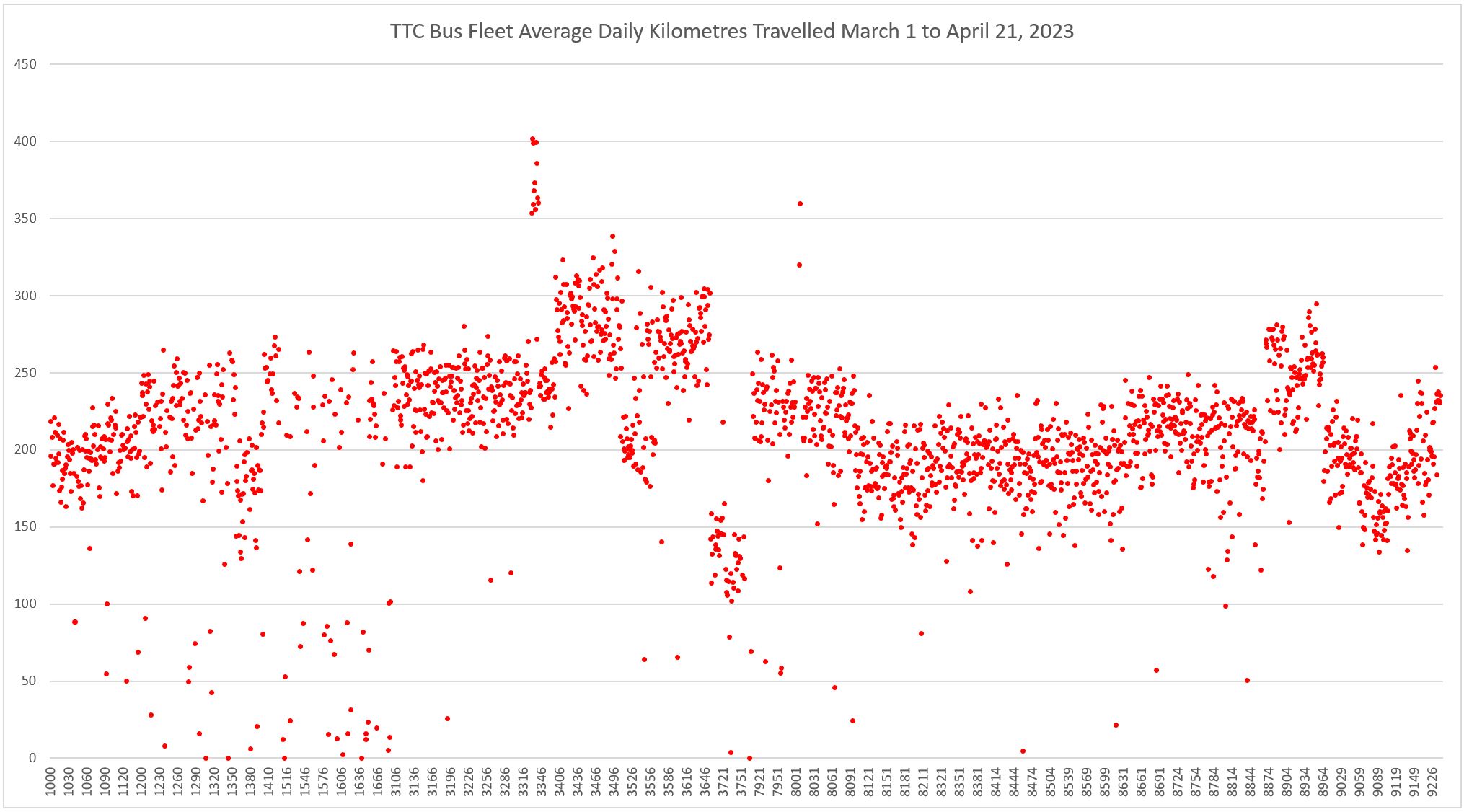
Yet another way to look at the data is to plot the daily average distance traveled by each vehicle considering only the days on which it was active. In other words, if the bus went out in service, how long did it stay there?
In the chart below, buses with no tracked mileage are not plotted. Note that the horizontal axis skips over breaks in fleet numbering. For example, there are no buses in the 2000, 4000, 5000 and 6000 ranges.
Items of interest here include:
A few buses sprang to life briefly, but have daily averages very close to zero.
Low average mileages are evident for older buses in the fleet:
7900 to 7979: 2006 Orion VII Diesel
8000 to 8099: 2007 Orion VII Diesel
1000 to 1149: 2006 Orion VII Hybrid
1200 to 1423: 2007-2008 Orion VII Next Gen Hybrid
1500 to 1689: 2008 Orion VII Next Gen Hybrid
The battery buses 3700 to 3759 stick out with consistently lower average mileage than other parts of the fleet. Some eBuses were completely inactive during the 51-day period:
New Flyer: 3705, 3706, 3715, 3720, 3724 (5 of 25 buses)
Proterra: 3729, 3732, 3736, 3739, 3744 (5 of 25 buses)
Buses assigned to 900 Airport Express have higher daily mileages (3330-3341, 8007, 8008) because they run on a very fast route.
Blocks of buses have higher daily mileage than others because they operate from garages with faster routes.
The TTC has just started to take delivery of over 300 new hybrid buses, and hopes to buy a comparable number of eBuses starting in 2024, subject to federal funding. If these displace the little used older fleet and increase the number available for sustained, all day service, this will be a significant contribution to what the TTC could achieve.
There will be a jump in service requirements in November 2023 when the SRT Line 3 is replaced by a bus shuttle from STC to Kennedy Station. That new fleet is arriving just in time. A budgetary oddity is that this service will be paid for from the Capital Budget as part of the cost of the Scarborough Subway Extension, and so it does not represent a net new cost to the TTC. Meanwhile, Queen’s Park is foot-dragging on paying for conversion of the SRT right-of-way as a bus roadway that would speed travel and reduce bus requirements.
Having more, working active buses to provide better service requires more operators and mechanics. A bus that sits in the yard costs next to nothing to “operate”. If hundreds of new buses sit idle (or allow middle-aged buses to be sidelined) this would be both a waste of capital and a betrayal of the promise of better service with a rejuvenated fleet.
The TTC has not produced a public fleet plan in years, and especially not one showing the effect of various scenarios for service growth or retrenchment. Current plans see only a 1% growth and this translates to small expansion of the bus fleet, especially considering that some bus services will convert to LRT when and if Lines 5 and 6 ever open.
Council’s goal to “green” the fleet may reduce diesel emissions, but the much larger target and goal is to move riders from private autos to transit. This cannot happen without better service and a working, fully available fleet.
Updated April 24, 2023
The chart below contains the same data as the scatter chart above showing average daily mileage for each vehicle, but with the dots colour coded to show the division to which the bus was assigned as of January 2023. The variation due to service characteristics in different parts of the city show up particularly for buses operating on faster suburban routes.
First off, I must report an error in my previous article which includes a table showing that the TTC has 551 spare buses. The actual number turns out to be 478.
The reason for the error is that a chart in the CEO’s report incorrectly shows the total bus count at 2,114. That was the value when this chart was originally used back in early 2021, but it has not been updated to reflect retirements of old vehicles. The actual number of active vehicles, according to the TTC’s Scheduled Service Summary for March 26, 2023, is 2,041. (This number does not appear as a total, but is obtained by adding up the number of active buses for each group in the fleet. See the last page of the summary for details.)
This still leaves the TTC with more buses on their hands than they strictly require for scheduled service plus maintenance, or to put it another way, with headroom to run more service without buying more buses.
The TTC has three new bus orders in the works for delivery in 2023-24:
135 40′ hybrids from New Flyer
68 60′ hybrids from New Flyer
134 40′ hybrids from Nova Bus
It is not clear how many existing buses these will replace and what the resulting fleet mix will be by the end of 2024.
Separately from these will be a new fleet of over 300 battery electric buses. This contract (or possibly contracts) has not been awarded yet while the TTC awaits confirmation of federal funding for “green” buses.
The TTC Board met on April 13 with an agenda that did not give any indication that there would be lengthy debate on any item. I previewed the major issues in a previous article and will not repeat those comments here.
The big items in the public portion of the agenda are the monthly CEO’s Report and an update on TTC’s finances and major capital projects to the end of 2022.
There are also two reports on collective agreements and non-union salaries. Although the details lie in confidential attachments, the public reports give an overview of the various labour contracts and salary drivers across the organization. I leave perusal of these to interested readers.
Finally there are a few references to the TTC’s eBus program scattered through reports. I will consolidate this info in its own section at the end of the article.
Correction April 18, 2023: It turns out that the size of the bus fleet shown in the graphic below is wrong. There are only 2041 buses, not 2114, in service as of March 2023. The article has been amended to reflect this.
Updated April 11, 2023 at 8:45pm: The TTC’s map of diversions for the 501 Queen car effective May 1 has been added to this article.
Updated April 21, 2023 at 11:20am: The 501 diversion map has been replaced with a higher resolution version.
During the City’s 2023 budget discussions, TTC staff offered to make information about the effect of budget cuts on service public. However, an unseen hand either at the TTC or City prevented this from happening before the budget was approved. In time, a list of changes for March 26, 2023 appeared on the TTC Board’s February 28 agenda, but there is no comparable briefing note for the May 7 changes on their April 13 agenda. The Board and City Council are still in the dark on the effects of service policies they blindly adopted with the budget.
Recently, the transit advocacy group TTCriders obtained the draft changes through a Freedom of Information request. This article is based on that draft version of the May 7 service changes dated January 27, 2023. That was after the City Budget Committee’s wrap-up meeting on January 24, but before the budget went to Council on February 15.
Although drafts fall into my lap from time to time, I do not normally publish them as they are subject to change, and there is enough misinformation circulating among the fans and Twitterati that I prefer to keep that sort of thing to myself.
This is the last Board meeting before the May schedules will come into effect, and it would have been an ideal chance for management to update the Board on what was about to happen as they did with the March service cuts. They have only themselves to blame for losing control of the message.
From a procedural point of view, the absence of a report on the agenda means that the topic of service cuts is not formally before the Board for debate or deputations. This is a classic way to stifle discussion.
City-TV’s Nick Westoll covered this story on April 6, and the TTC did confirm that the subway service cuts will occur as shown in the draft. He obtained the following statement from the TTC:
“All changes are designed to match capacity to demand and put the most service out at times and areas that it is most needed. All changes are also within the … established service standards. What TTCRiders has is an early draft that has already been revised since the version they have and is still not finalized. The final schedules will be … shared publicly later this month … We will monitor routes in real-time and deploy unscheduled service when we observe gaps or overcrowding.”
TTC’s Stuart Green as quoted by City-TV
A major problem with unscheduled service is that it is invisible to service tracking apps. Riders waiting for a bus will not know that there is an “extra” lurking just out of sight, and they might just give up in frustration. Moreover, there is no way for the TTC to demonstrate retroactively how it managed the service and we have to take it on faith that gaps shown in the data really didn’t happen. There are far more gaps than spare buses, and it does not take an Einstein to figure out that many gaps will not be filled. This is a convenient fiction that TTC management uses to fob off complaints about service.
As for the final schedules, by now operators have already signed up for their crews in May, and the service plans are more or less cast in stone.
An Overview of the Cuts
In the interests of transparency, here are the draft changes for May.
I cannot stress enough that this is a first draft dated January 27, 2023, and some of its proposals may have changed before the final version which has not yet been published. Readers should cite this information with caution pending the official version of the May service.
Cuts that began with the February and March schedules continue into the May proposals. Analysis of the ups and downs from route to route can be tricky because several events happen at the same time:
Many routes have running time adjustments to adjust for rising traffic congestion. Sometimes this is accomplished with added vehicles, but more commonly by widening existing headways and running the same (or fewer) vehicles further apart.
Some routes have service cuts to align capacity with the updated crowding standards. These cuts are sometimes combined with other changes.
Some routes have seasonal changes either because they serve academic sites or amusement areas (e.g. the Beach).
Several construction projects will begin in May:
Queen & Yonge will close until sometime in 2027 for Ontario Line construction. Various diversions will ensue.
The Queen Street bridge at the Don River will be under repair. Service that would normally travel along this route will divert to Dundas Street.
Main Street Station loop will close for paving. All service will be rerouted to Victoria Park Station, or will be operated with interlines between pairs of routes with on-street boarding.
The intersection of Lower Gerrard & Coxwell will be rebuilt.
Track on Broadview from Gerrard to Danforth will be rebuilt, and the streetcar loop at Broadview Station will be expanded.
The railway overpass west of St. Clair & Caledonia (GO Barrie corridor) will be under repair.
Further details are in the main part of the article.
An important point to remember when the TTC talks about service reductions is that an “X” percent service cut is not the same as an “X” percent saving in operating costs. There are two important reasons behind this:
There is a substantial fixed cost, especially for the subway, for infrastructure, management and maintenance, and this does not vary with changes in service.
If a service change leaves the same number of vehicles in service, but running further apart (typically to allow for traffic), there is no change in the vehicle hours operated. The same number of buses is on the road, only travelling more slowly (or spending more time in layovers). Only costs that are directly related to the distance travelled go down, not those such as operator wages that are related primarily to hours.
The result of these is that an edict to save “X” percent in costs will require more than “X” percent in cuts. This is a classic problem of marginal vs fully allocated costing and savings.
The usual spreadsheet showing old and new headways, running times and vehicle allocations is linked here:
Note to the fans: please do not send me queries about divisional allocation of bus routes as some of these were not settled in the draft plan. I will include this information when the final version comes out in late April.




 Steve Munro