Blue Night Service Expansion: Fall 2015

The overnight “Blue Night” network will see many changes and additions this fall. These will be rolled out in two waves: first with the September/October schedules on Labour Day weekend, and the remainder with the October/November schedules at Thanksgiving.

This is part of a more extensive expansion of service beginning in September that relates to the Ten Minute Network, All Day Every Day service, and improved crowding standards on routes with frequent service. Those and other changes will be described in a separate article.

Here are maps of the network as it exists now, and with the two stages of additions:

BlueNightMap_201507

BlueNightMap_201509_Delta

BlueNightMap_201510_Delta

Several of the routes will be renumbered so that the night services match the daytime routes except for the using “300” series. In the case of the King and Spadina night services, they will run, at least initially, with the daytime route numbers because there are no roll signs for “304 King” or “317 Spadina” in the CLRV/ALRV fleet. This problem will vanish as the routes convert to Flexity cars with programmable signs.

All services will operate on 30 minute headways.

This implementation is a work-in-progress, and Service Planning does not expect to turn to the question of timing points until the routes are in place. This is a vital piece of work for a network with wide headways where TTC performance stats show that headway (and, by implication, schedule) adherence is very weak. Riders of these routes should be able to depend on vehicles appearing at expected times and connections to work in a predictable way. This is as important a part of the new service as simply putting the buses and streetcars on the road. If service is not predictable in the middle of the night, riders cannot be expected to use it especially for trips that are time-sensitive such as early morning work shifts.

Continue reading

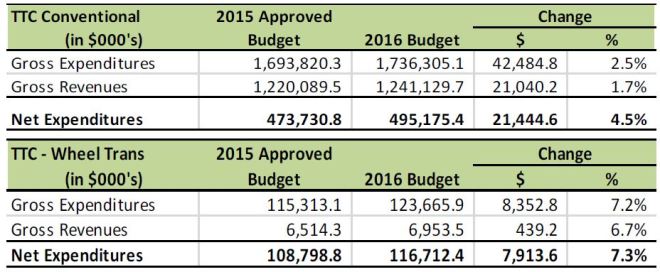
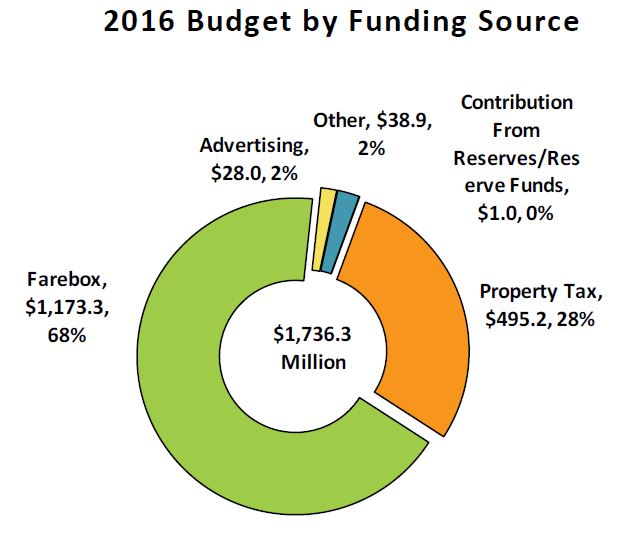
Preliminary TTC 2016 Operating Budget (Updated July 30, 2015)

Updated July 30, 2015: Comments on the discussion at today’s meeting have been added.

The Budget Committee met today and received the presentation linked from the main article. There was considerable debate, a welcome change from the Stintz/Ford years at the TTC where detailed knowledge of the budget was not of much interest to politicians. Now there actually is a Budget Committee, and its members take their job seriously. The idea is that by the time the budget hits Council, there will be a group of informed advocates beyond the senior staff who, in past years, have been left to fend as best they could as proponents of better transit in a hostile environment.

Among the topics that came up were:

  • the question of the “average fare” and the role of a monthly pass in the fare mix;
  • the future role of and arrangements for fare collection with Presto;
  • the implications of various possible fare schemes, including increases, and the resulting effect on the TTC budget and subsidy requirement;
  • the provision of improved service, its cost and its beneficiaries;
  • the staffing of TTC and especially the numbers of new staff and their cost for various functions.

Continue reading

TTC Board Meeting July 29, 2015 (Updated August 3, 2015)

The TTC Board will meet on July 29, 2015, and various items of interest are on the agenda. These include:

  • The monthly CEO’s Report (Updated August 2, 2015)
  • A presentation by Toronto’s Chief Planner Jennifer Keesmaat (Updated August 3, 2015)
  • Faregates for PRESTO implementation
  • Purchase of new buses and implications for service growth (Updated August 1, 2015)
  • Improved service standards for off peak service on “frequent” routes
  • Proposed split operation of 504 King during TIFF opening weekend (Updated August 2, 2015)
  • An update on Leslie Barns
  • Excluding Bombardier from eligibility for future contracts (Deferred to September Board meeting)
  • Council requests related to Lake Shore West streetcar service (Referred to TTC Budget Committee)

Continue reading

Coming Soon: July 2015

Since that blizzard of articles about TTC budgets and fares, it’s been rather quiet in here. Fear not! I actually have works in progress to tide us over the relatively quiet summer months until the political season heats up in the fall.

There will be a series of articles about the operation of the downtown streetcar lines looking at their behaviour over time, and reviewing how changes that have been made (or are planned) affected them. These include:

  • 501 Queen (including the effect of split operation with a bus shuttle on Lake Shore to Long Branch)
  • 502/503 Downtowner & Kingston Road (including the recent move to a 10-minute off-peak headway on 502)
  • 504 King (including the effect of additional running time on service levels and terminal operations)
  • 505 Dundas
  • 506 Carlton (including a look at the effects of the College/Spadina construction diversion)
  • 509 Harbourfront (including a review of the changes on Queens Quay)
  • 510 Spadina

The TTC plans additional meetings of its Budget Committee and these will, no doubt, produce more details about plans and options for 2016 and beyond. I will cover this material as it becomes available.

A Little Rant About Transit Fares

A recent article, The Flirtation With Fare By Distance, has sparked a debate in the comment thread about the relative merits of flat vs distance-based fares, and the whole issue of how we choose to subsidize some groups of riders versus others. In a recent reply, I took strong issue with some of the concepts advanced by writers, and the thread of my argument is strong enough that it deserves to be seen in an article of its own.

There are two related comments, and I will reproduce them here to set the stage:

Rishi (@PlanGinerd) wrote:

Fare-by-distance is a tricky one that I’m not yet firmly decided on. It clearly works on many large systems worldwide, and I have tons of friends and family who live in Zone 4 or Zone 6 in London who while they do complain the Tube is expensive, they still take it daily and never ever drive or take a cab or a regional train into the core. Perhaps it can only be coupled by changing the economics/costs of driving?

I am 100% sympathetic that FBD benefits those who can afford to live closer to the core, whilst disadvantaging those who live within the borders of Toronto but farther out. I haven’t done enough research yet, but I always think about why someone who lives so far from the City of TO core, would still choose to live within our borders vs. in Peel, York, or Durham regions. Is it really the cheap access to the TTC or is it other services? In other words, what incentives are there to convince them to live in “expensive” Toronto in the first place?

My friends deep within Metrolinx and TTC are also torn. They feel that it is not the role of the operator to handle the social equity, but the role of the province through transfers and tax breaks. I ask Steve and the community, if the province was to pair FBD for all GTA transit agencies and truly integrated fares, with a tax break to help those disadvantaged, would that change your mind?

It reminds me of a conversation I had last week on Twitter with Moaz RE how social programs that give out free TTC fares would cope without tokens. I see Presto tech. as enabling if done right, and it would be easy to give out cards with balances on them, or a periodic reload to help with fares, whilst also giving valuable O-D and usage data.

Maybe I’m too much of an optimist but things like this, and exiting fare gates are commonplace and the norm in cities everywhere. Yes local context is critically important, but I think we have to get away from the nay-saying that Toronto is always different and every other best practice could never work here.

Jonathan C wrote:

Flat fares are a very ineffective way to reduce inequality as the benefit is not well-targeted to those who need the help. There are plenty of people making long trips who could afford a higher distance based fare, and plenty who struggle to pay the flat fare for short trips or end up walking long distances because they can’t justify the cost. In most cases everyone would prefer better service. If you want to help those in need then push for an increase in the low income tax credits, don’t try to use the transit system as it is a very blunt instrument.

In a way the flat fare leads the poor to live further from the core as only those who are better off can afford higher housing costs plus the flat fare. The poor service to far-flung locales also pushes commuters into cars, while those who can’t afford to drive end up trading their time for a lower fare.

My replies:

This discussion seems to be taking place as if we were proposing to introduce flat fares as a net new subsidy that would benefit people who don’t need it. If that were the case, I could certainly understand arguments for targeted rather than broad-brush subsidies.

We are not. The discussion is of the potential effect on a wide range of transit users who now have a common fare no matter how far they travel compared to what they pay today. If you want to talk about actual need, then let’s expand the debate to free fares for all children, or reduced fares for all students and seniors. During the whole debate over cheaper fares for university students, I was struck by the absence of advocates for the truly poor saying “hey, what about us”, and the hand-wringing extended to a group that on the whole comes from relatively affluent backgrounds.

I have yet to hear a cogent argument for distance-based fares beyond “other people are doing it”. Well, no, throughout much of the GTHA, “local” fares are flat. Even London UK, that oft-cited bastion of fare-by-distance, uses flat fares for its surface system with time-based transfer privileges.

Correction: London does not have time-based transfers on its surface routes, with very limited exceptions. [July 2, 2015]

The question of flat fares vs fare by distance has nothing to do with “nay-saying” or “best practices”, it is a political and social choice the city has made. If we want to talk about fare collection technology, or the best way to operate a transit system, those are fair game for criticisms of the “not invented here” syndrome so common in Toronto.

“Equity” as Toronto defines it may well mean a flat fare. Don’t forget that the pesky border with the 905 is a comparatively recent phenomenon, and problems of low market share for transit within 905 systems (i.e. for local travel in York Region, or Durham, or Mississauga) have nothing to do with fare by distance, but with built form and the relative lack of competitive transit services. Fare by distance will only “solve” the problem for trips that are now cross-border by giving them a (presumed) discount. It won’t add better bus service unless there is a substantial jump in revenue to offset costs, net costs that are higher in the 905 because of the much richer per rider subsidies.

Where people choose to live is a product of many factors including income and service (broadly defined) availability. Try living without a car out in the 905 — the TTC for all its problems is a damn sight better, and it can certainly be argued that there is a stronger, longer history of community support services within Toronto than elsewhere even if these are stronger in the “old city” than in Toronto’s suburbs. Some of this is also historical — the 905 suburbs simply didn’t exist when many families moved to the outer 416, or they were aimed at a very different demographic. Markham is not noted for its large pool of social housing.

When we speak of transit discounts as a “social service”, this is usually in the context of truly disadvantaged groups who for mainly economic reasons are deemed worthy of additional social supports. There is a big problem with arguments that they should be funded through alternative means to transit fares such as tax rebates. Social subsidy programs are chronically underfunded and have exclusionary eligibility tests. Tax credits are a wonderful thing, but they are almost always structured to benefit those who have a taxable income in the first place, and can even disproportionately benefit the well off.

If we start talking of flat transit fares generally as a “social service”, we miss the whole point that encouraging people to use transit has an economic benefit for the city by avoiding pressure for more road construction, and a general benefit to all residents by reducing the need for one or more cars in their families. This is the sort of thing that would show up in any full accounting of costs and benefits. The hidden subsidies to motorists are not subject to the same scrutiny, nor are they regarded as some sort of social service. We also build roads for the economic benefit of the trucking industry and all of its clients. Maybe we should start thinking of that as a “social service” too because it is a form of job creation.

It is very easy to characterize things we don’t want to spend money on as “social service” or even worse “welfare”, while the things we prefer (often for political and ideological reasons) as “investments”.

Any scheme that discourages transit use relative to what is and has been in place for decades is the equivalent of a “disinvestment”, almost like asset stripping where dividends are more important than the health of a company.

If you want to call me a “nay-sayer” for that attitude, you have that right, but it’s a pejorative term, an artificial, ad hominem argument that does not engage in debate of the basic principles.

I would remind you that the “nay-sayer” epithet was used by John Tory during his campaign against those who criticized SmartTrack, and we now know what a bag of crap that proposal was.

The availability of vast amounts of travel data is routinely cited by those who would move us to fare by distance. Dare I remind readers that distance-based fares have existed for much, much longer than the ability to collect this data, and they are a product of political and business decisions about pricing service, not a means to collect O-D info.

The next time you go shopping and someone makes it harder for you to get through the store because they want detailed data about your buying habits, be sure to co-operate fully.

The TTC does not, repeat, not need a mountain of O-D data to provide better service. You can find out where the riders are simply by looking at the buses and streetcars, and broad network demands can come from O-D data in the TTS survey.

They already have a mountain of data documenting the behaviour of their vehicles, and after many decades are finally starting to analyze it in ways similar to the work I have published. Problems with vehicle bunching and poor headway management contribute a great deal to crowding on the TTC. Even with this documented in excruciating detail, little is done to fix problems of “TTC culture”. This is even a double-edged sword in that with all this data, some claim that all we need to do for more capacity is to improve management and schedules, not to actually operate more service. This is a variation on the “efficiency” argument that neatly avoids an actual commitment to better service.

Let us have a debate on fare structure by all means, but let it be a real debate, not simply a fait accompli that shows up because Andy Byford and Bruce McCuaig decide to impose fare-by-distance on us all as a matter of simplicity for Presto’s implementation. The technology should serve what we, collectively as cities and a region, want to help transit achieve, not get in the way or penalize riders who happen to live in the wrong place. Let’s talk about GO Transit’s uneven handling of short trip fares and the discount structure that makes travel from Kitchener to Union Station far cheaper, by distance, than travel from Rexdale. Let’s talk about what is needed to make transit service in the 905 truly attractive so that more people will want to use it, and transit will have political support for spending on more than a few subway extensions and GO improvements.

That would be a real debate. What we have today is an utter sham.

TTC 2016 Budget Intro: Part 2 – Capital Budget

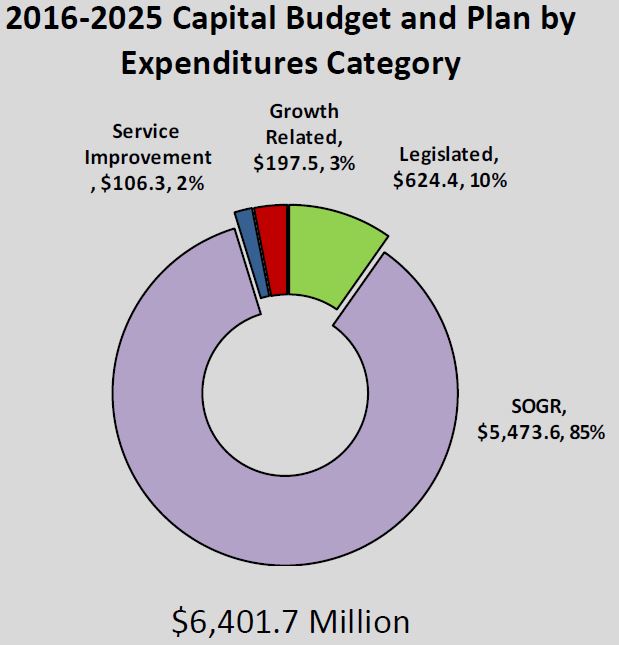
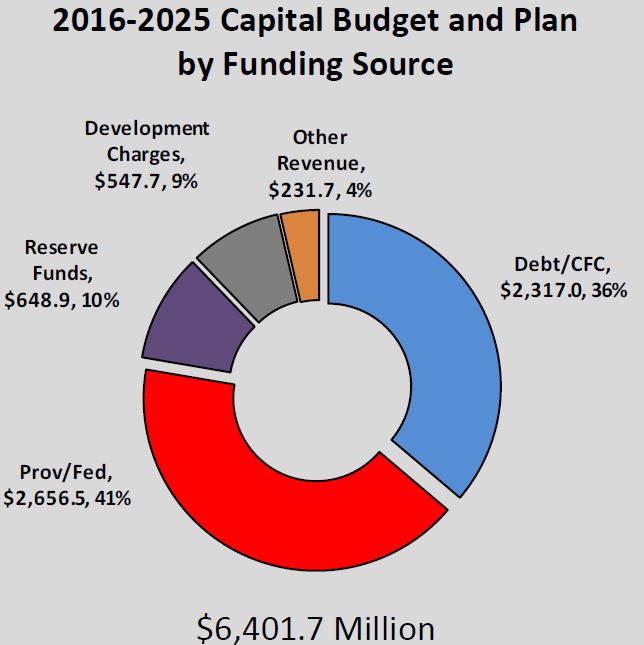
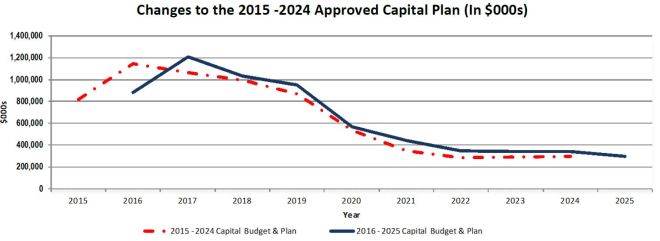
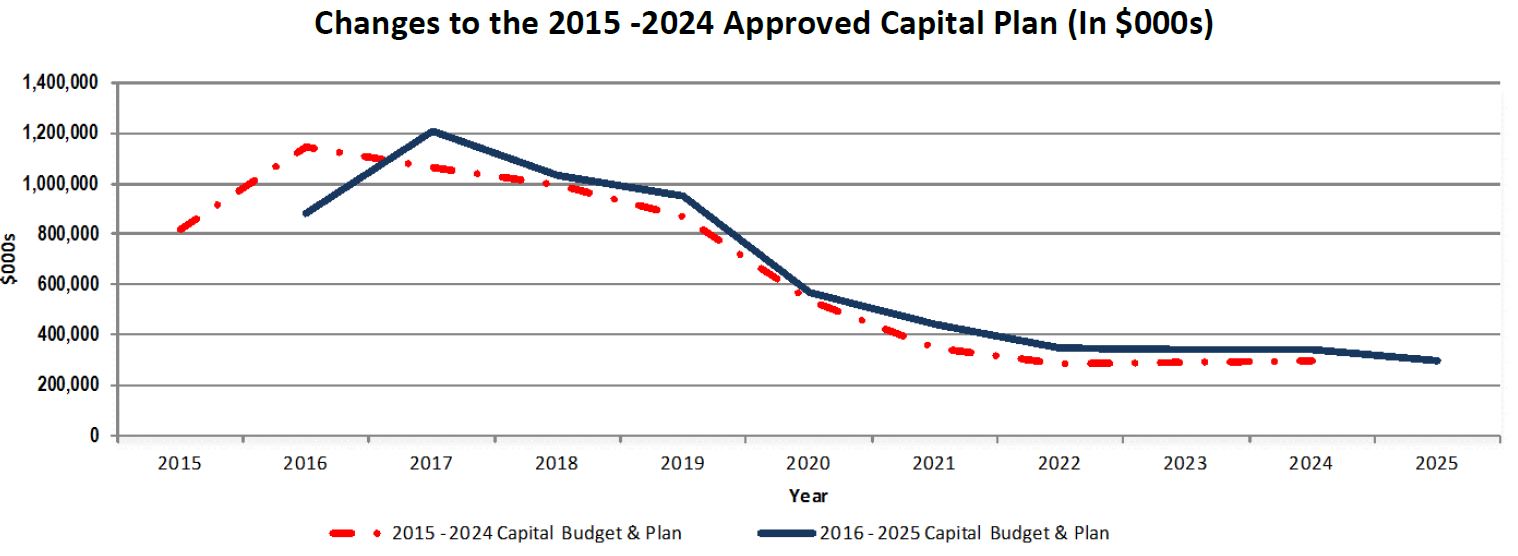
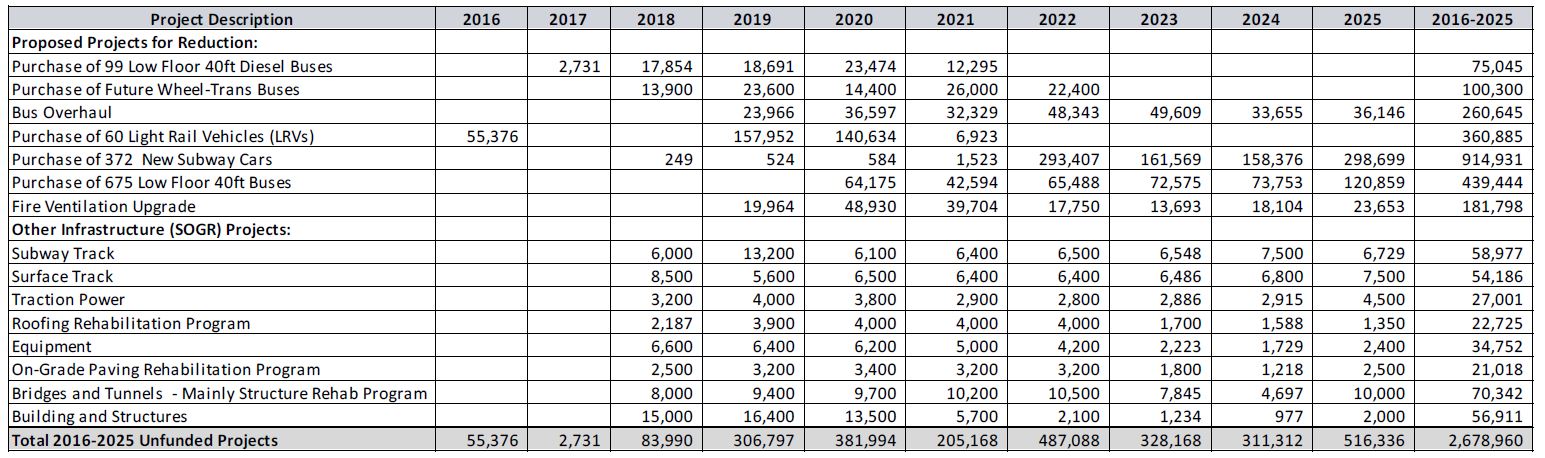
The TTC Budget Committee will meet on June 29, 2015 to consider a preview of the 2016-2025 ten year Capital Budget. This gives a sense of where the TTC is headed in its search for funding at the City of Toronto, Queen’s Park and Ottawa, as well as its priorities for future spending.

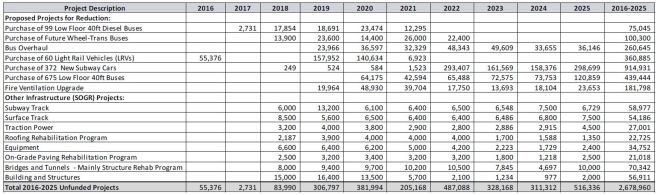
The Capital Budget often can be daunting both from its size (the detailed project description material fills two large binders), the complexity of its funding (many sources of money, one-time or ongoing schemes, and the fact that huge projects like subway extensions are mixed together with the more mundane work of routine repairs to refresh aging infrastructure.

This mix also shows the ongoing competition for attention between the megaprojects and the equally important job of keeping the TTC rolling.

The budget spans ten years, and each year brings updates to reflect planned work that now falls within the ten-year window, new projects that have not been included before, and changes to existing projects either in their scope or timing. For many years, the total budget has exceeded projected funding for the next decade, and many projects sit in limbo awaiting their own dedicated financing scheme, or the arrival of more money through increased subsidies. The balancing act the TTC faces is to keep the vital projects going in the short term while beating the drum for for better transit support in future budgets.

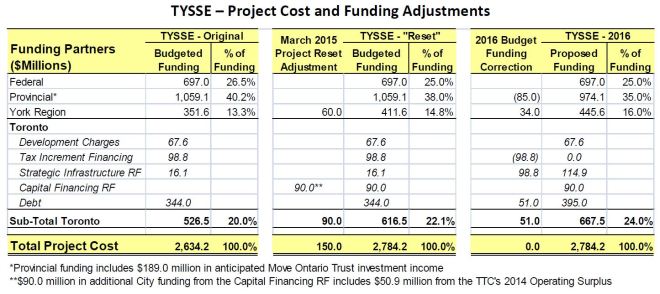
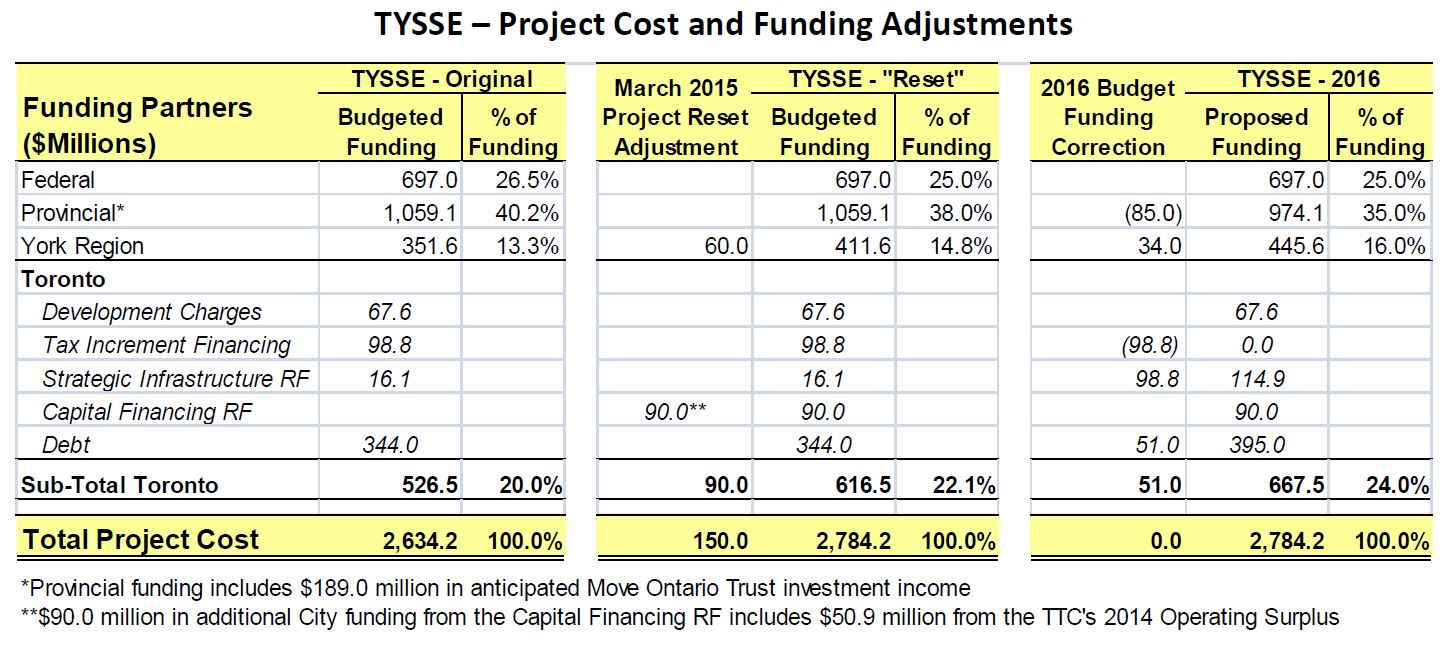
Funding from “senior” governments – Ontario and Canada – has declined considerably over the years. Although specific projects have large investments – notably the Spadina extension (TYSSE) and the Eglinton-Crosstown (which is now a Metrolinx project) – funding for basic capital maintenance is a hard sell. Toronto receives gas tax revenue from both governments, and in the case of the provincial stream, a bit over half is dedicated to operating subsidy, not to capital. The total gas tax capital flow each year from both Queen’s Park and Ottawa is about $220-million, less than one quarter of the typical annual spending. Almost all of the remainder comes from the City of Toronto.

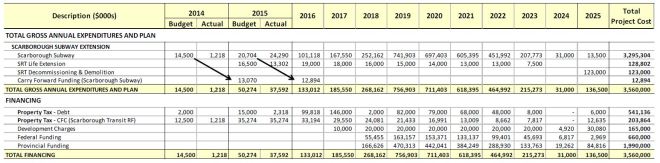
This, together with other City financial pressures, has created a very tight squeeze in coming years which is shown in a chart from a recent budget presentation.

20162025CapitalDebtTarget

Recent decisions by Council have eaten up all of the headroom that formerly existed in the City’s capital debt plan. In order to keep spending on debt service under control, the City sets a ceiling of 15% of property tax revenues for this expenditure. This is actually much less than 15% of the overall City budget because property tax covers only about 1/3 of the total (for example, transit fares are roughly 10% of total City revenues). However, the other revenue streams are spoken for because they are dedicated to specific purposes, not to general operations. Also, some of these are non-recurring such as special grants, “surpluses” (actually underspending from previous years), or proceeds from asset sales. Such revenue cannot be counted on in future years as a source for debt payments. In simple terms, you can only spend an inheritance, or lottery winnings, or money from selling your antique furniture, once.

By 2020, the anticipated debt payments bump into that 15% line and there is no headroom. Any new capital project, especially one that starts in the next five years, and which is financed by debt, would push the debt service cost beyond that 15% by 2020. For example, you may have spare cash today to cover a car purchase loan, but if you are facing another loan for a planned home renovation project in a few years, you won’t be able to carry both when the crunch comes. That is the situation the City finds itself in, and current budget guidelines call for no new debt-funded projects to be added for the next nine years until there is headroom once again for borrowing. (Note that the City’s projections allow for anticipated future changes in interest rates, although these take time to build into the debt service base because of long-term fixed interest rates on City debt.)

One obvious solution is to either raise the amount of tax revenue so that the 15% is measured against a higher income stream, or to get a new source of revenue to pay for capital costs without borrowing. Neither of these is palatable to City Council, and they look to other governments to increase funding.

Project-based grants can shift individual items off of the books (for example a new rapid transit line might be “free” because someone else pays for it), but these projects are not necessarily our top priority (we might value better accessibility in existing stations over a new subway through vote-rich ridings). Moreover, the completed projects could bring additional operating costs (the TYSSE will certainly do this) for which money must be found in the Operating budget.

The presentation includes a long list of funding programs created by various governments that have run their course (end dates in parentheses) [see pp. 41-45]:

  • Canada Ontario Infrastructure Program (2003)
  • Ontario Bus Replacement Program (2010)
  • Golden Horseshoe Transit Improvement Fund (2012)
  • Ontario Rolling Stock Infrastructure Fund (2012)
  • Canada Strategic Infrastructure Fund (near complete)
  • Metrolinx Quick Wins (near complete)
  • Transit Secure (2009)
  • Infrastructure Stimulus Fund (2011)

A few remain in place:

  • Light Rail Vehicle Procurement (to 2019)
  • TYSSE (to 2018)
  • Provincial Gas Tax (ongoing)
  • Federal Gas Tax (ongoing)

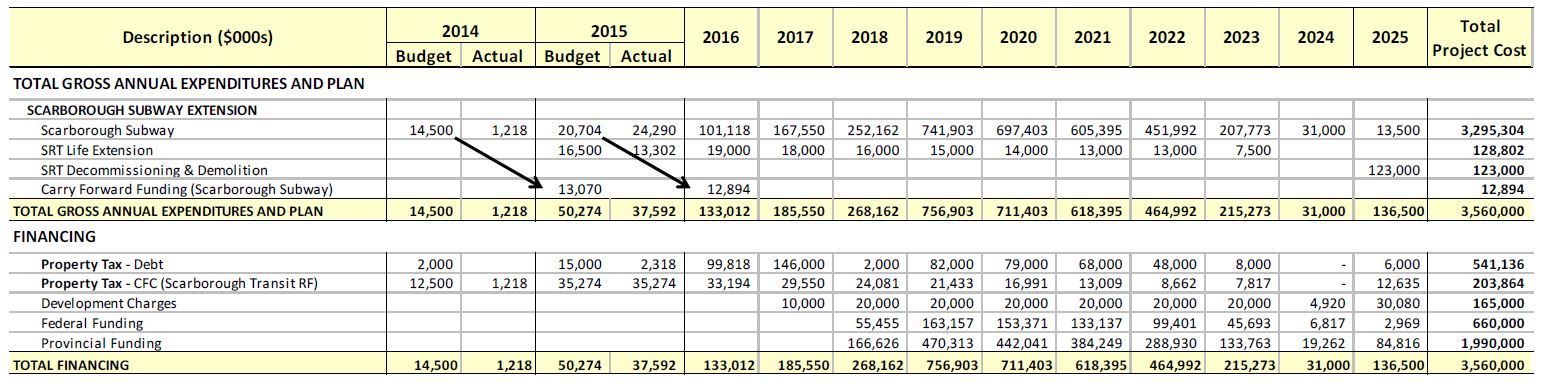
Promised funding for future projects such as the Scarborough Subway Extension (SSE) are not included in this list because they are not yet approved beyond preliminary planning and engineering. Metrolinx projects do not appear in this list because they are entirely handled at the provincial level and do not affect City capital requirements.

Continue reading

The Flirtation with Fare by Distance

Recent presentations by TTC CEO Andy Byford both to his own Board and at a recent Metrolinx Board meeting included an undercurrent of references to charging fares based on distance travelled or some form of zone system. This shows up in the description of new fare gates for subway stations that would be provisioned at the TTC’s expense as part of the Presto farecard rollout.

What, you ask, is this all about? Don’t we already have Presto readers on existing turnstiles? Well, yes, but they have two problems according to Byford:

  • The reader is not ideally located (“it is too low”) for customers, and
  • New fare gates can be designed with provision for future “tap out” capability that would be needed for a distance or zone based fare structure.

The cost of this change is projected to be $38.1-million, and this is a net addition to the TTC’s already bulging 10-year capital project list.

Oddly enough, the new fare equipment arises from a joint effort with Metrolinx/Presto and it would be no surprise if the same gates show up at stations on the Eglinton Crosstown line.

Continue reading

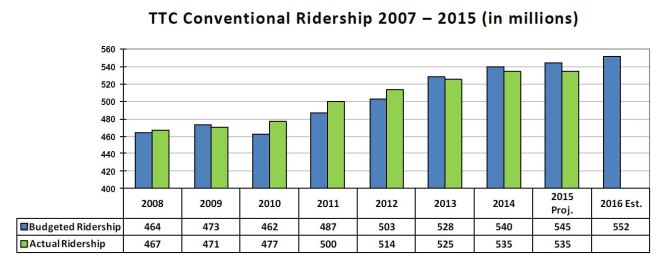
TTC 2016 Budget Intro: Part 1 – Ridership Forecasts & Service Planning

Recently, the TTC Board, a largely dormant entity during the era of Rob Ford and Karen Stintz, decided to take a more active role in oversight of the organization by striking new subcommittees. In addition to the already existing Audit Committee, there is now a Budget Committee with members Rick Byers, Councillor Shelley Carroll, Councillor John Campbell, Councillor/Chair Josh Colle, and Councillor Joe Mihevc.

Agenda materials for this Committee are available on the TTC’s website, but on a different location from the those for full Board meetings. The Budget Committee met on June 17, 2015, and its agenda included two reports related to ridership and service levels:

These are intended as introductory overviews for Commissioners who are not steeped in the details of TTC planning or policy, and they give a general sense of management’s focus as the TTC enters the 2016 round of budgets.

Note: The Service Standards document has most of its content in portrait format even though the pages are primarily in landscape. Save the document, open it with Adobe Reader, and then rotate the displayed images.

Continue reading

The State of TTC Streetcar Track Switches (Updated)

Updated June 28, 2015: Additional historical information from TTC Budgets has been added to the end of this article.

Ever since the introduction of the articulated streetcars back when the earth was still cooling, automatic track switches have been plagued with less-than-ideal reliability of the new system that was installed to operate them. This was triggered by the different lengths of ALRVs and, hence, the different distance from the front of the car to the point where the trolley pole sits on the overhead. A system based on a contactor on the overhead simply would not work with the ALRVs. The new system uses antennae at the front and rear of each car together with antennae in the pavement. This system allows the “front” of the car (rather than the rear) to signal the direction it wants to turn, and also provides a lock-unlock logic based on the rear end antenna passing the switch.

A project to replace this system has been on the books for years, but with little progress. Meanwhile, many switches that should be automatic (and through that automation interface with traffic signals) are manual. At the newly opened Queens Quay and Spadina, a pointman operates the switches.

I wrote to the TTC about this situation. Here are my questions and their replies.

Q: With the Queens Quay project finishing, an issue has shown up (again) that the switches at Queens Quay and Spadina are still being manually operated usually by a point duty operator, sometimes by the streetcar ops themself.

A: We are in the process of prioritizing restoration of a number of out-of-service switches in the network. Resources will be made available to restore the four (4) switches on Spadina and Queens Quay as a top priority.

Q: This delays service and also means that the transit priority signals cannot work as intended because they don’t “know” where a car intends to go.  Two points:

For years there has been a budgeted project to update the switch electronics because the old equipment has never been reliable.

A: We would not characterize the equipment in those terms. We are short of replacement parts due to the OEM changing ownership, losing interest in supplying parts, and that the original design files were lost in a major fire.

Q: If I remember correctly, this was one of the projects sloughed off to 2016 due to budget cuts. Is this correct?

A: We are still working on a new equivalent design and taking steps to secure its safety certification. Our objective is to create a controller with identical functionalities and a design that we own and take control.

Q: A commenter on my blog claims that there are long delays because Hydro must to an inspection when a switch is activated. Switches that are ready to be energized sit for months in manual mode. Is this correct?

A: New installation of wiring and controller must be performed in accordance with Hydro’s electrical safety code. Safety inspection by Hydro can indeed be a lengthy process. We would normally submit our application for inspection partway through the Work to reduce wait time gap.

There really is only one obvious question left here: if this were a subway signal system, would the problem have been left outstanding this long?

Updated June 28, 2015:

On the afternoon of June 27, an eastbound streetcar on Queens Quay at the entrance to Queens Quay Loop took an open switch and turned into the side of a westbound car. As luck would have it, this was one of the new LRVs, 4404. The story was covered in brief by CBC and several photos appeared on Twitter including this overhead view. The Star also has an article.

Continue reading