In response to budgetary limitations, the TTC will be modifying service on several routes in two waves of changes. The first will occur on Sunday, March 26 and the second on Sunday, May 6. Details of the second wave are not yet available.
The first wave is detailed in a report to the TTC Board for its meeting of February 28, 2023.
This report shows the changes in headways and service levels on affected routes. It is not as detailed as the Service Memo that will come out just before these schedules are implemented, nor as the Scheduled Service Summary. When the fine details including changes in travel time and vehicle allocations are available, I will publish the usual breakdown.
Updated February 23, 2023 at 9:00am: A table consolidating old and new headways where changes occur has been added. The times in this table is shown in “mm:ss” format rather than in decimal minutes as in the original tables. The new version is at the end of the article.
Updated February 23, 2023 at 10:00pm: The tables in this article have been consolidated for simplicity. All times are now shown in mm’ss” format. The new version is at the end of the article replacing the version that was added earlier.
My apologies for the constant reformatting. With the widespread desire to see what the changes would be, I pushed the original tables out faster than I might otherwise, and my readers got to watch as I tweaked the format. The intent is to have a standard chart that will be used for all future comparisons of service.
Changes of Special Note
Within the list of changes, there are a few worth highlighting:
Subway Services
Service on 2 Bloor-Danforth will improve slightly in the AM peak, but will drop in other periods notably late evenings when trains will operate every 8 rather than every 5 minutes on weekdays.
Service on 4 Sheppard will be cut from 4 trains at all times to 3 with a corresponding widening of headways from 5’30” to 7’20”.
Express Services
Service will be suspended on the following routes and periods:
935 Jane Express weekday evenings
941 Keele Express weekday midday
943 Kennedy Express peak periods
984 Sheppard West Express weekends
In most cases, the local service will not be improved to compensate, and indeed there are local service cuts as well.
501 Queen Streetcar
Weekday service on 501 Queen will be reduced considerably except late evenings.
60/960 Steeles West
The 60C peak period service west of Pioneer Village Station to Kipling will be suspended.
Service Improvements
The 128 Stanley Greene bus was approved by the Board in the 2021 Service Plan, but was not yet implemented. It will begin operation during peak periods on a half-hourly headway.
The 335 Jane Night Bus will operate every 20 minutes rather than half hourly Monday-Friday (which effectively means Tuesday to Saturday).
The 336 Finch West Night Bus will operate every 10 minutes rather than half hourly after 5am Monday-Friday.
These changes are presented in the context of improvements to Neighbourhood Improvement Areas. The same cannot be said for the many service cuts affecting NIAs.
A major question facing transit advocates today is the degree to which TTC service is less frequent than in the pre-pandemic era, and more recently how it will be changing on a month-to-month basis.
As I write this on February 15, 2023, service changes were introduced a few days ago, and many more are planned for March 26, 2023. The TTC plans to release details of the March changes in its agenda for their Board meeting on February 28 for which the agenda should be available about a week in advance.
For each schedule change, I have published a detailed table showing old and new headways (the interval between vehicles), the changes in scheduled trip times, and the number of vehicles assigned to each route. This information is important for seeing that detail, but for a general audience, a simpler representation of the changes is needed.
In mid 2022, I published a comparison of May 2022 service levels with January 2020 to illustrate the degree to which service had changed between the pre-pandemic period and what, at the time, was thought to be the start of a strong recovery through 2022. This article includes tables in the same format comparing:
January 2020 to January 2023 as an update to the previous article, and
January 2023 to February 2023 showing the changes, where they occurred, on February 12, 2023.
In future articles about service changes I will include both the usual detailed spreadsheet as well as a chart showing the changes in the consolidated view used here. This will allow readers to quickly see where major changes occur, or not.
Updated February 16, 2023 at 12:45am: The pdf chart sets and some pages within the article have been replaced to correct an error in 76 Royal York South.
Prologue: When I started to write this story, John Tory was still Mayor of Toronto and the dynamics of City-Province relations assumed he was in charge. The context for these discussions was soon to change.
The Toronto Region Board of Trade holds a yearly “transportation summit”, and on February 8, 2023, this focused on the Greater Toronto Area’s transit, plans for the future, and the aftermath of the covid pandemic.
The TRBoT is no wild-eyed radical institution. The regional economy and businesses are at the heart of causes it advocates.
Both in the introductory remarks and in comments by speakers sprinkled through the day, the economic effect of traffic congestion was a mantra. This sets the framework for the importance of both transit and road projects, depending on who is speaking. The latest factoid describing Toronto’s problems is that we have the third worst congestion in North America and the seventh worst in the world.
A problem with this hand-wringing is that there is little acknowledgement that some particularly bad locations are related to major infrastructure projects such as the Gardiner Expressway rebuild and various rapid transit lines. Moreover, goods movement has severe problems in areas that historically have poor transit and show little chance of seeing any in the near future. No single project will solve the problem of many-to-many trips patterns that now depend almost totally on roads and private vehicles.
Updated February 10 at 3:45pm: The TTC has advised that the 504C bus will not return to Roncesvalles south of Howard Park until mid-March.
The TTC has announced several service changes effective February 12. These are, generally speaking, not the changes pending due to revised Service Standards and the 2023 Budget which will not come to City Council until February 15. Those changes will begin to appear in late March schedules, although there is a good chance that that the details will be published soon.
Notwithstanding that, some routes will see service cuts in February “to match demand”, although the TTC sometimes masks this as a schedule adjustment for reliability. A headway (the time between buses) might be lengthened to provide more round trip with the same number of vehicles, but this also affects the level of service.
Details of the changes are available in the spreadsheet linked below.
The TTC Board met today to consider its 2023 Operating and Capital budget. To nobody’s surprise, they were adopted as written in spite of numerous public deputations and a few attempts by the Board to tweak the recommendations.
In the course of the meeting two fairly standard devices were used to limit debate, although one of them proved to be deeply out of order. I will come to that later in the article.
As is common for meetings where there are many pesky public deputations, the speaking time was limited to three minutes each. Questions were rarely asked for clarification or to draw out more information. Making a deputation at the TTC can be quite disheartening when almost nobody sitting around the table wants to hear you.
The Fare Increase
A thread running through many presentations, and indeed now part of the official line, is that transit is important for people who cannot afford to drive. This creates a political dynamic where transit is a service for the poor while roads are for everyone else. TTC has long benefited from strong “choice” ridership, but the shift to work-from-home has stripped a large population of riders who commute by choice out of their customer base.
Ironically, we are still building transit megaprojects for core-oriented commuting. That tap is very hard to turn off because of the many interests in construction and development. Buses in the poorer suburbs, not so much.
The proposed ten cent fare increase effective Monday, April 3, 2023 for single adult and youth fares was approved, as was a scheme to make about 50,000 more low income people eligible for the “Fair Pass”.
Several deputants as well as Board member Councillor Moise argued that the structure of the fare increase would hurt low income riders disproportionately because they are less likely to afford monthly passes for which there is no increase. This is certainly true for riders who do not travel enough to make a pass worth buying, or who cannot afford to lay out a month’s transit fare in a single payment. As to the Fair Pass, some members of the Board seemed unaware that there is a broad range of “low income” riders who are not poor enough to qualify for this pass.
The issue of fares as a social subsidy is a complicated one, along with the question of how much riders of any class should pay toward the cost of transit. There is supposed to be a Fare Policy Study coming to the TTC Board later in 2023, and this should be the context for a debate on all aspects of the issue. It should receive more than a perfunctory, dismissive debate for an already-decided fare increase.
The TTC’s capital plans cover a wide array of projects related to maintenance and enhancement of the transit system. For planning purposes, this is presented with a rolling 15-year window updated year-by-year. For budget purposes, a 10-year version is produced to feed into the City’s rolling plans.
Separate, but related, is the Real Estate Investment Plan which identifies property requirements for many projects. Some of these are well known, some are only at the “what if” stage for possible future inclusion in the capital plan. This raises awareness of potential needs so that property can be protected and acquired if necessary to keep future options open.
Major points in this article include:
The TTC 15-year capital plan now sits at $38 billion, and even that does not include possible projects such as the Waterfront LRT.
About two thirds of the capital plan is not funded, in the sense that the source of money to actually pay for projects is unknown. This affects some current projects such as replacement of subway cars that are partly funded, but cannot proceed until the TTC is certain it can pay for the entire contract.
Bus replacement and electrification plans run out of money in 2025.
A very large portion of the plan involves renewal and upgrading of subway infrastructure. Focus on the subway threatens to distract from need of the surface system which is essential to the network’s operation.
The scale of planned spending on system growth and improvement dwarfs the shortfall in the Operating Budget that will lead to service cuts in 2023. There is no reconciliation of the parsimony of the operating plans for transit service with the scope of capital plans for expansion and improvement.
Some future funding included in the budget assumes continuation of existing streams from other governments. This is not guaranteed.
Absent new funding, the State of Good Repair backlog is projected to rise to over $6 billion in the coming decade.
There is a growing problem that the TTC owns buses, streetcars and subway trains it cannot afford to operate.
Updated January 6, 2023 at 2:10pm: Of all the tables included in this article, I realized that I had not included the full budgets showing functional breakdowns, as opposed to individual line items. These have been added at the end.
The annual budget cycle is always a challenge because the document comes to the TTC Board at the last minute before it must be passed and forwarded to Council. This year, the situation was complicated by the election (normally we would see the budget reports in December, not January), and by the new “strong mayor” system in which the Mayor effectively dictates the budget by setting the City’s proposed subsidy ceiling. We have many new Board members most of whom have no experience with TTC budgets, and who will not know “which rocks to look under”.
Even worse, the Mayor’s press conference announcing the budget made no mention of planned service cuts coming in Spring 2023 and gave the impression that this “core service” was defended. That can, at best, be called “misdirection” in the hope that nobody would notice what was happening and focus on the “good news”.
Here, in much more detail than I had time for in the first article, is the budget information distilled from the TTC’s 55-page report.
Key points (the TL/DR version):
The City will give the TTC $53 million more in subsidy in 2023 than 2022. This is pitched as being in support of more security, safety and cleanliness on the system, although the cost of those changes is less than 10% of that amount.
The same argument is advanced for proceeds from a fare increase (10 cents on single fares for adults and youth/students) projected at roughly $16 million.
The effect is that new funding is advertised for a politically unassailable purpose even though it will mainly pay for other aspects of TTC operations.
The year-over-year increase in City subsidy is lower than in some past years and should not be seen as a generous windfall. This is in part possible because of underspending in 2022 which leaves headroom for 2023 without as much additional City money as would otherwise be required.
The cost of beginning operations on Lines 5 and 6 will eat up over $40 million in 2023 and even more in 2024. At the same time, the TTC proposes service cuts elsewhere that will save about $46 million nominally in the name of matching service to demand. What is actually happening is that most of the network is paying for two new rapid transit lines through service cuts.
Crowding standards for off-peak service will be substantially changed to permit more riders on buses, streetcars and subway trains. On buses, the off-peak standard will be only slightly less than the peak standard. Combined with chronic unreliability of service, this will lead to more full buses and will discourage riding during the period when recovery to pre-pandemic levels is strong.
Headway maxima will be raised so that rapid transit service could operate as infrequently as every 10 minutes during periods of light demand. For buses and streetcars, there is no guarantee that the existing Ten Minute Network will be preserved.
The changes to Service Standards (crowding and maximum headways) are notexplicitly listed in the report’s recommendations and would be missed by someone only browsing early pages, a not unusual situation for TTC Board members and Councillors.
The TTC has not published any details of planned service changes even though, for April 2023 implementation, they are certainly in the early stages of planning. The TTC and Council were clearly expected to approve the changes sight-unseen, possibly without even realizing they were buried in the budget. TTC management must be forced to reveal the details of what they plan.
The budget provides for additional operators who will be used to fill open crews to reduce or eliminate the incidence of service gaps caused by missing buses and streetcars. This is a change and improvement from using “run as directed” vehicles to the extent that operators are available to drive them.
Even this austerity service is possible only with additional subsidy of $336 million which the City/TTC will seek from the provincial and federal governments.
Ridership recovery is stronger on weekends, and among concession fare groups (seniors, youth, students). This type of riding is less affected by work-from-home.
Projections for future budgets in 2024 and 2025 include no provision for additional service beyond that which will be operated in 2023.
The TTC claims it will pursue a ridership recovery program, but its budgetary plans suggest that service will remain below 2022 levels for 2023 through 2025. This, coupled with chronic service reliability problems, is not a recipe for winning back riders.
Change in fares clarified to include 10 cent increase in Youth (Student) fares.
Comparative table of budgets amended to update 2022 budget and add 2023 budget numbers.
Overview of proposed service changes added.
Where there are substantial changes from the original version, I have retained the old text, but formatted it with strikethroughs so that readers can see what has changed.
There is much more to write about in the Budget Reports, both Operating and Capital, but I will leave that to separate articles.
Mayor John Tory announced increased funding of $53 million for the TTC in 2023. To put this in context, the total TTC budget for 2022 was $2.28 billion for the conventional and Wheel-Trans systems. The total TTC subsidy will rise from $905.7 to $958.7 million. This has been presented as a “big thing”, but it is comparable to (even somewhat below) past increases. The City has fairly regularly boosted TTC funding at above inflationary rates.
Tory’s announcement highlighted system safety with:
the proposed hiring of 50 more Special Constables adding to an existing complement of about 80, and
doubling of the Streets-To-Homes workers assigned to the TTC from 10 to 20.
The budget focuses on four areas:
System safety (as above).
Service improvements in priority Neighbourhood Improvement Areas and on lines that are overcrowded.
Increased cleaning of streetcars on busy routes to counter a rising problem of litter.
Fare changes (see below).
On the revenue side, fares will go up for some riders, down for others:
Single adult and youth (aka student) fares will go up by 10 cents.
Fares for pass holders and seniors will not change (there was no mention of student fares).
The “Fair Pass” discount program which allows low-income adults to pay at the senior’s rate will be expanded to make 50,000 more people eligible.
The announcement gave the impression that the $53 million was intended primarily for safety initiatives. However, the 70 new staff must be recruited and trained. Assuming they are on the budget for 9 months, this only eats up a small part of this even allowing for the very high salary of Special Constables. For example, at $100k each, this would only amount to $7 million.
The projected cost of the additional Special Constables, the Streets-to-Homes workers and the streetcar cleaning is $4.4 million. The projected cost of the expanded Fair Pass program is $2.0 million to be funded from the TTC’s budget rather than through the Social Development department.
As for service improvements, the TTC has a habit of putting them off as long as possible to minimize current year budget effects. We do not know whether planned improvements will occur as soon as possible (Spring 2023) or if we must wait until the Fall to see more buses on the street.
From the budget details, we now know that service cuts are coming during some periods on the streetcar, and particularly on the rapid transit network. The overall weekly hours of service will drop in Spring 2023 from the current 95% of pre-pandemic level to 91%.
Defending his record as Mayor, John Tory claimed responsibility for three key TTC initiatives: the Fair Pass, the Two Hour Transfer and Free Rides for Children. Of these, only the last was actually a Tory initiative. Both the Fair Pass and the time-based transfer arose from years of public advocacy that met the usual response “we can’t afford it”, at least until they were deemed politically worthwhile.
The TTC will modify many routes on January 8, 2023, although most of the changes are small tweaks rather than a significant overhaul of service. Current changes are achieved mainly by reallocation of vehicles, modification of running times and headway adjustments.
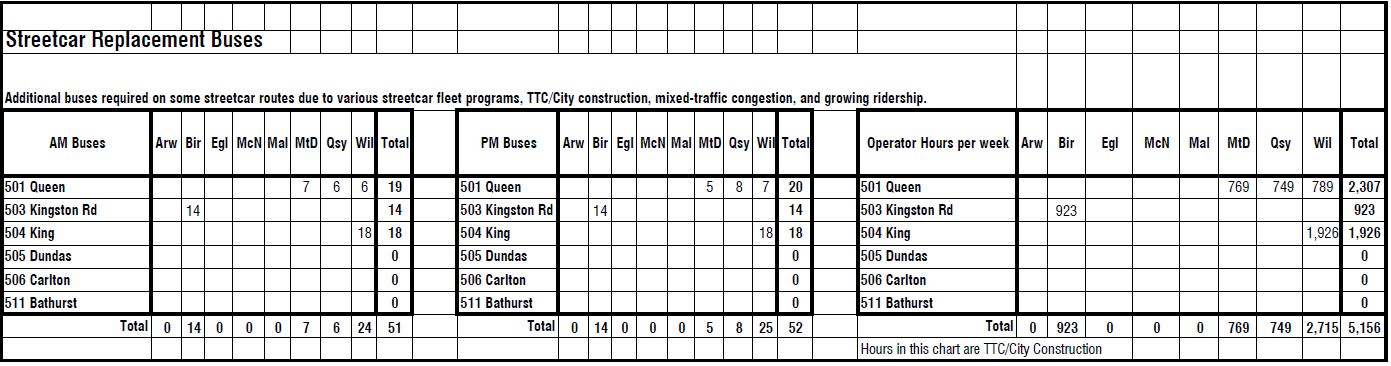
Updated January 3, 2023 at 4:35pm: A table showing the number of replacement buses on streetcar routes has been added.
In the January schedule period, the planned weekly service is down from November 2022 levels. That is the appropriate comparison because the “December” schedules only cover the holiday period when service is reduced. All of these reductions have been reversed in the January schedules, and some school trips have been added beyond the November level.
Service in the latter part of 2022 ran below budget because riding had not rebounded as quickly as originally hoped across the system. January 2023 continues at a similar level, and a service budget has not yet been published, let alone approved.
Hours/Week
Regular Service
Construction Service
Total
Nov 2022 Budget
182,016
4,492
186,508
Nov 2022 Planned
173,249
4,187
177,436
Dec 2022 Planned
170,708
3,779
174,387
Jan 2023 Planned
171,802
5,175
176,977
Source: TTC Service Change Memos for November/December 2022 and January 2023
Subway Service
There is no change in subway service for January 2023.
Streetcar Service
506 Carlton will return to its normal route over its entire length after an extended sojourn on Dundas Street. The 306 night service will return to streetcar operation. Construction of streetscape changes on College Street is not yet complete, but this will not require a diversion in 2023.
Some streetcar routes will have new schedules:
509 Harbourfront and 510 Spadina will be modified to reduce layover conflicts at Union and Spadina Stations.
Service on 509 Harbourfront will be reduced to match demand in some periods.
Sunday early evening service on 510 Spadina will be changed so that all cars operate as 510A to Union rather than a split service with 510B turning back at Queens Quay. This matches the Saturday service pattern.
512 St. Clair service will be reduced to match demand during some periods.
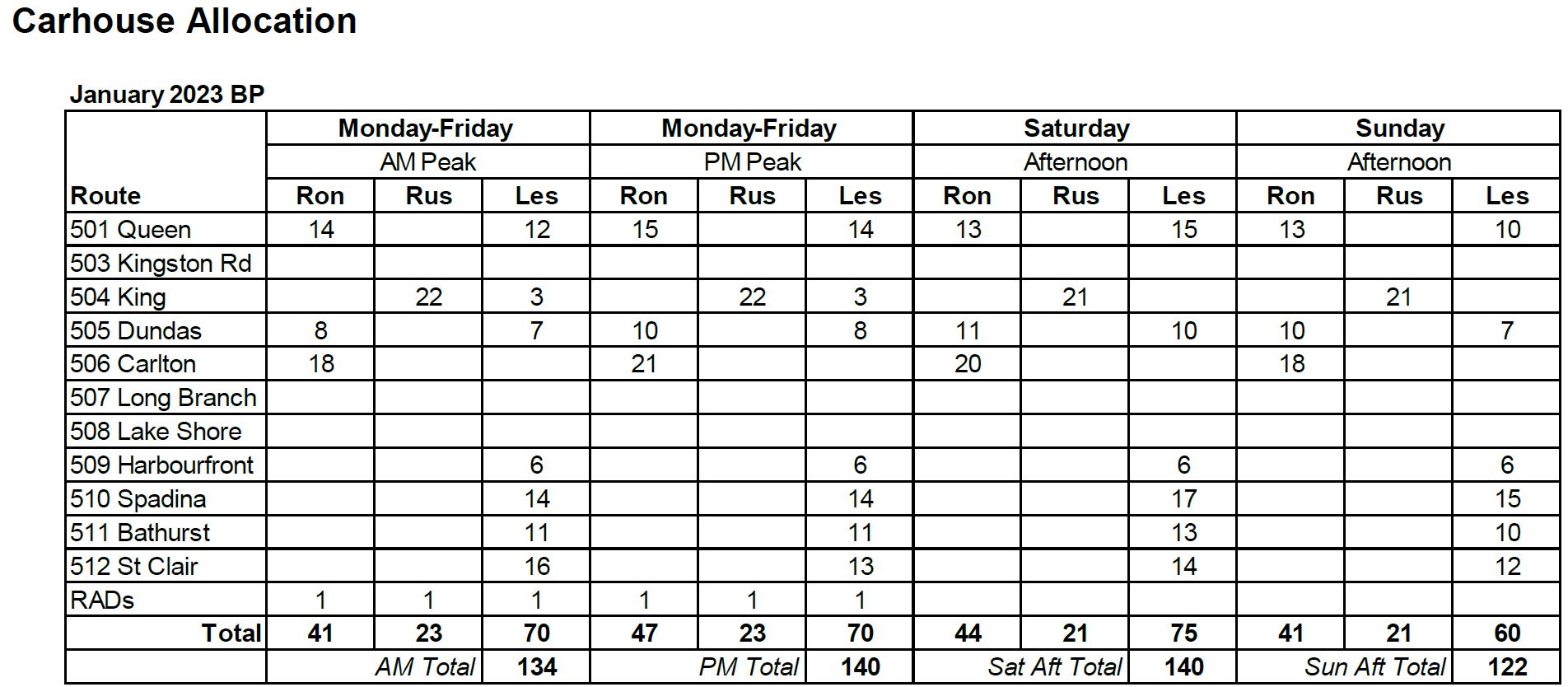
The allocation of routes to carhouses will change slightly to balance resources. The table below includes a long absent route “507 Long Branch” and the temporarily suspended “508 Lake Shore”, but not the “502 Downtowner”. Make of that what you will.
The number of buses operating on streetcar routes for construction projects is shown in the table below.
Bus Service
Routing Changes
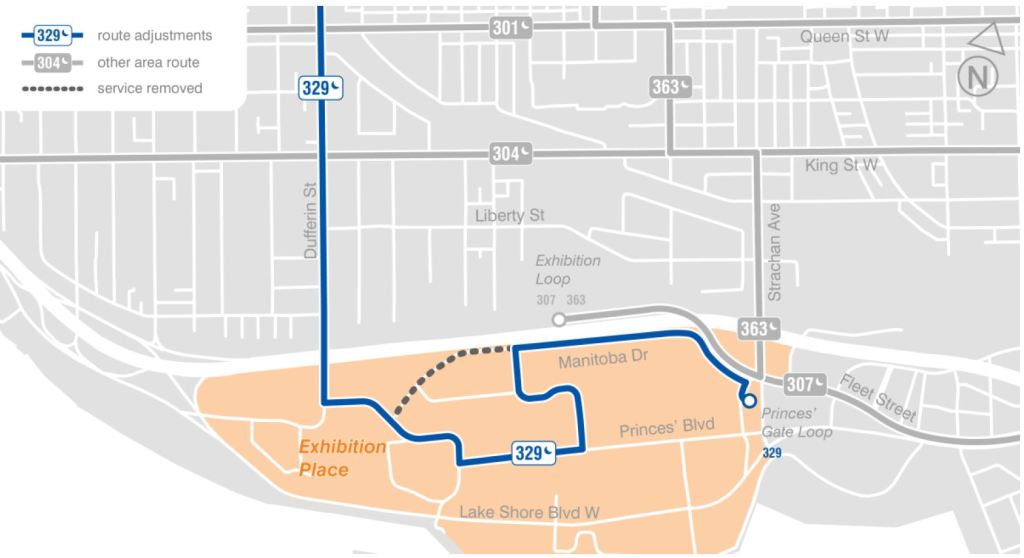
29/329 Dufferin
Due to construction for the Ontario Line’s Exhibition Station, the 29 and 329 Dufferin services will be rerouted as shown in the maps below.
43B Kennedy and 985A Sheppard STC Services
These routes will be modified to access Scarborough Town Centre via a different path in order to provide connecting stops with the temporary GO bus terminal.
95C York Mills and 996 Wilson Express Service to Ellesmere Station
The 95C York Mils branch will be dropped, and in its place the 996 Wilson Express will be extended east to Ellesmere Station.
The levels of service in the “before” and “after” configurations are compared below.
Buses/Hour
AM Pk Pre
AM Pk Post
Midday Pre
Midday Post
PM Pk Pre
PM Pk Post
95A Pt Union
7.5
6
3.3
6
5.5
6
95C Ellesmere Stn
7.5
3.3
5.5
995 UTSC
5.5
5
3.8
3.8
5.5
5
996 Ellesmere Stn
6.7
4.8
6
Total to Ellesmere Stn
20.5
17.7
10.4
14.6
16.5
17
Total to UTSC
13
11
7.1
10.8
11
11
Other affected bus routes
600 Run As Directed: The number of scheduled RAD buses is deeply reduced with only 6 weekday crews and none on weekends. Divisions will assign buses locally depending on operator availability.
19 Bay: An AM peak tripper to handle demand to the waterfront will be created by diverting one 503 Kingston Road bus to run eastbound as a Bay bus to Dockside Drive and Queens Quay, then deadhead to Broadview and Queen to resume service on the 503.
20 Cliffside and 113 Danforth: Headways will be standardized so that an evenly blended service can operate from Main Station on these overlapped routes.
25 Don Mills: The split branch structure north and south of Don Mills Station will be extended into the early evening on weekdays.
925 Don Mills Express: Trips added during peak periods to match demand.
939 Finch Express: Midday and PM peak service improved, evening service reduced.
41 Keele: Service reduced to match demand.
44/944 Kipling South: Some early express trips will be replaced with local buses. Two school trips from 44 Kipling South will interline with 76 Royal York South school trips.
945 Kipling Express: AM peak service improved.
48 Rathburn and 112 West Mall: PM school trips serving Michael Power Saint Joseph HS will be changed to match dismissal times.
52 Lawrence West: A new trip will be added from Westwood Mall at 6:52am to accommodate demand. A new trip will be added between Lawrence and Lawrence West Stations in the early PM peak. This is a hook-up with an existing school trip.
57 Midland: Service reductions to match demand.
60C/960 Steeles West: Service between Pioneer Village Station and Kipling on the 60C branch will be reduced in peak periods to match demand. This will be offset by improvement to the express service.
960 Steeles West Express: Early evening service reduced.
63 Ossington: Service modified for resiliency and to match demand (mainly reductions).
68/968 Warden: Schedules adjusted for reliability with less frequent service during many periods.
79 Scarlett Road: Service reduction weekdays in peak and midday periods.
86 Scarborough: Zoo shuttle will operate only on Saturday to serve Terra Lumina. Sunday service dropped.
95/995 York Mills an 96/996 Wilson: 996 Express service extended to Ellesmere Station replacing the 95C local service (see map above). Service changes during many periods to improve reliability with a mix of frequency changes.
102/902 Markham Road: New trips to serve school demand to R.H. King Academy and Centennial College.
116 Morningside: New PM school trips from Morningside & Ellesmere to serve Jack Milner PS and Sir Wilfrid Laurier CI.
122 Graydon Hall: All trips will now enter service eastbound at Don Mills.
130 Middlefield: New school trips to serve Henry Kelsey Senior PS.
165 Weston Road: Service reliability changes primarily through longer running times and additional buses.
168 Symington: Service reduced to match demand.
Peak bus service
The Details
Details of these changes are in the spreadsheet linked below.
This article arose from complaints I saw on Twitter about the poor service on the 63 Ossington bus during November and early December. The common thread is that service is extremely erratic, a common problem on many routes.
In the case of the Ossington bus, most trips are comparatively short because it extends only from Eglinton West Station to Liberty Village, and many trips are to or from the subway at Bloor. This means that wait times can form a substantial part of a journey on the route, sometimes more than half. Moreover, they are unpredictable and riders must allow time for this whether they will need it or not. This is not a formula for attracting demand back to the system from those who have a choice of travel some other way.
Service on 63 Ossington during November 2022 operated with schedules that had been in place for some time. The weekday schedules had been in effect since March 2022, and the weekend schedules since November 2021.
During peak periods, half of the service short turns at St. Clair via Oakwood Loop, but at all other times, all buses run over the entire route.
During November 2022, there was an enlarged south end loop to avoid construction at King & Shaw, but no additional running time was provided in the schedule to compensate for this.
The route has frequent opportunities to regulate headways with layovers at the terminals and at Ossington Station Loop. Note that recovery times are particularly large during weekday peak periods and midday. This is intended to deal with congestion due to Line 5 Crosstown construction at Eglinton West Station. Recovery times are more commonly only one headway or less.





 Steve Munro