TTC Bus Fleet 2013 to 2023

The Star’s Matt Elliott has reported on the issue of surplus vehicles beyond reasonable spare requirements in the Toronto Star:

First off, I must report an error in my previous article which includes a table showing that the TTC has 551 spare buses. The actual number turns out to be 478.

The reason for the error is that a chart in the CEO’s report incorrectly shows the total bus count at 2,114. That was the value when this chart was originally used back in early 2021, but it has not been updated to reflect retirements of old vehicles. The actual number of active vehicles, according to the TTC’s Scheduled Service Summary for March 26, 2023, is 2,041. (This number does not appear as a total, but is obtained by adding up the number of active buses for each group in the fleet. See the last page of the summary for details.)

This still leaves the TTC with more buses on their hands than they strictly require for scheduled service plus maintenance, or to put it another way, with headroom to run more service without buying more buses.

The TTC has three new bus orders in the works for delivery in 2023-24:

  • 135 40′ hybrids from New Flyer
  • 68 60′ hybrids from New Flyer
  • 134 40′ hybrids from Nova Bus

It is not clear how many existing buses these will replace and what the resulting fleet mix will be by the end of 2024.

Separately from these will be a new fleet of over 300 battery electric buses. This contract (or possibly contracts) has not been awarded yet while the TTC awaits confirmation of federal funding for “green” buses.

Continue reading

TTC April 13, 2023 Board Meeting Follow-Up

The TTC Board met on April 13 with an agenda that did not give any indication that there would be lengthy debate on any item. I previewed the major issues in a previous article and will not repeat those comments here.

In this article:

  • Rogers Wireless Service
  • Eglinton Crosstown LRT (A very brief mention)
  • Safety on the TTC
  • Spare Buses and Service Reliability
  • Grasping at Straws for New Revenue
Continue reading

TTC Board Meeting April 13, 2023

The TTC Board will meet on April 13, and the agenda for their meeting is rather small. Notable by its absence is any reference to the service cuts planned for May 7, 2023.

The big items in the public portion of the agenda are the monthly CEO’s Report and an update on TTC’s finances and major capital projects to the end of 2022.

There are also two reports on collective agreements and non-union salaries. Although the details lie in confidential attachments, the public reports give an overview of the various labour contracts and salary drivers across the organization. I leave perusal of these to interested readers.

Finally there are a few references to the TTC’s eBus program scattered through reports. I will consolidate this info in its own section at the end of the article.

Correction April 18, 2023: It turns out that the size of the bus fleet shown in the graphic below is wrong. There are only 2041 buses, not 2114, in service as of March 2023. The article has been amended to reflect this.

Continue reading

Draft of TTC Service Changes Effective Sunday, May 7, 2023

Updated April 11, 2023 at 8:45pm: The TTC’s map of diversions for the 501 Queen car effective May 1 has been added to this article.

Updated April 21, 2023 at 11:20am: The 501 diversion map has been replaced with a higher resolution version.

During the City’s 2023 budget discussions, TTC staff offered to make information about the effect of budget cuts on service public. However, an unseen hand either at the TTC or City prevented this from happening before the budget was approved. In time, a list of changes for March 26, 2023 appeared on the TTC Board’s February 28 agenda, but there is no comparable briefing note for the May 7 changes on their April 13 agenda. The Board and City Council are still in the dark on the effects of service policies they blindly adopted with the budget.

Recently, the transit advocacy group TTCriders obtained the draft changes through a Freedom of Information request. This article is based on that draft version of the May 7 service changes dated January 27, 2023. That was after the City Budget Committee’s wrap-up meeting on January 24, but before the budget went to Council on February 15.

Although drafts fall into my lap from time to time, I do not normally publish them as they are subject to change, and there is enough misinformation circulating among the fans and Twitterati that I prefer to keep that sort of thing to myself.

This is the last Board meeting before the May schedules will come into effect, and it would have been an ideal chance for management to update the Board on what was about to happen as they did with the March service cuts. They have only themselves to blame for losing control of the message.

From a procedural point of view, the absence of a report on the agenda means that the topic of service cuts is not formally before the Board for debate or deputations. This is a classic way to stifle discussion.

City-TV’s Nick Westoll covered this story on April 6, and the TTC did confirm that the subway service cuts will occur as shown in the draft. He obtained the following statement from the TTC:

“All changes are designed to match capacity to demand and put the most service out at times and areas that it is most needed. All changes are also within the … established service standards. What TTCRiders has is an early draft that has already been revised since the version they have and is still not finalized. The final schedules will be … shared publicly later this month … We will monitor routes in real-time and deploy unscheduled service when we observe gaps or overcrowding.”

TTC’s Stuart Green as quoted by City-TV

A major problem with unscheduled service is that it is invisible to service tracking apps. Riders waiting for a bus will not know that there is an “extra” lurking just out of sight, and they might just give up in frustration. Moreover, there is no way for the TTC to demonstrate retroactively how it managed the service and we have to take it on faith that gaps shown in the data really didn’t happen. There are far more gaps than spare buses, and it does not take an Einstein to figure out that many gaps will not be filled. This is a convenient fiction that TTC management uses to fob off complaints about service.

As for the final schedules, by now operators have already signed up for their crews in May, and the service plans are more or less cast in stone.

An Overview of the Cuts

In the interests of transparency, here are the draft changes for May.

I cannot stress enough that this is a first draft dated January 27, 2023, and some of its proposals may have changed before the final version which has not yet been published. Readers should cite this information with caution pending the official version of the May service.

Cuts that began with the February and March schedules continue into the May proposals. Analysis of the ups and downs from route to route can be tricky because several events happen at the same time:

  • Many routes have running time adjustments to adjust for rising traffic congestion. Sometimes this is accomplished with added vehicles, but more commonly by widening existing headways and running the same (or fewer) vehicles further apart.
  • Some routes have service cuts to align capacity with the updated crowding standards. These cuts are sometimes combined with other changes.
  • Some routes have seasonal changes either because they serve academic sites or amusement areas (e.g. the Beach).
  • Several construction projects will begin in May:
    • Queen & Yonge will close until sometime in 2027 for Ontario Line construction. Various diversions will ensue.
    • The Queen Street bridge at the Don River will be under repair. Service that would normally travel along this route will divert to Dundas Street.
    • Main Street Station loop will close for paving. All service will be rerouted to Victoria Park Station, or will be operated with interlines between pairs of routes with on-street boarding.
    • The intersection of Lower Gerrard & Coxwell will be rebuilt.
    • Track on Broadview from Gerrard to Danforth will be rebuilt, and the streetcar loop at Broadview Station will be expanded.
    • The railway overpass west of St. Clair & Caledonia (GO Barrie corridor) will be under repair.

Further details are in the main part of the article.

An important point to remember when the TTC talks about service reductions is that an “X” percent service cut is not the same as an “X” percent saving in operating costs. There are two important reasons behind this:

  • There is a substantial fixed cost, especially for the subway, for infrastructure, management and maintenance, and this does not vary with changes in service.
  • If a service change leaves the same number of vehicles in service, but running further apart (typically to allow for traffic), there is no change in the vehicle hours operated. The same number of buses is on the road, only travelling more slowly (or spending more time in layovers). Only costs that are directly related to the distance travelled go down, not those such as operator wages that are related primarily to hours.

The result of these is that an edict to save “X” percent in costs will require more than “X” percent in cuts. This is a classic problem of marginal vs fully allocated costing and savings.

The usual spreadsheet showing old and new headways, running times and vehicle allocations is linked here:

2023.05.07_ServiceChanges_Draft

Note to the fans: please do not send me queries about divisional allocation of bus routes as some of these were not settled in the draft plan. I will include this information when the final version comes out in late April.

Continue reading

A Single Fare For Cross-Border Travel, But …

The Ontario Budget announced on March 23, 2023, includes a commitment, sort of, to reducing cross-border fares for trips into Toronto.

And we are making transit more affordable by eliminating double fares for most local transit services in the Greater Golden Horseshoe when commuters also use GO Transit services. Our government is working to expand this initiative to support more people commuting into Toronto. [emphasis added]

Ontario Budget 2023, Minister’s Forward

In more detail, the main part of the budget states:

Making It Easier and More Affordable to Take Transit

As Ontario families continue to look at managing costs, the government is helping put more money in their pockets with affordable transit options. The government has made it more affordable, easier and more convenient for families and workers to travel across the Greater Golden Horseshoe by eliminating double fares for most local transit when using GO Transit services. This means that after riders pay their fare for a GO bus or train, they do not pay again when accessing most local transit services in the Greater Golden Horseshoe. The government has also increased PRESTO discounts for youth and postsecondary students and continues to provide more riders with more options and convenient ways to pay.

This GO Transit co‐fare discount applies to the following transit systems: Durham Region Transit, Milton Transit, Grand River Transit, Guelph Transit, Oakville Transit, MiWay (Mississauga Transit), Brampton Transit, Hamilton Street Railway, Burlington Transit, Bradford West Gwillimbury Transit, York Region Transit and Barrie Transit. The government is working to expand this initiative to support more people using public transit to come into Toronto. [emphasis added]

Ontario Budget 2023, p 77

Two examples are given of fare savings, but both of these refer to transfers between local transit systems outside of Toronto, not to the TTC.

In the legislature, the Minister of Finance said:

“We have eliminated double fares when taking GO Transit and local transit throughout much of the Greater Golden Horseshoe — and we are expanding this initiative to include Toronto, so a commuter coming into the city only pays on one fare per trip, saving them money each way.” [emphasis added]

As quoted in the Toronto Star

The operative words here are “for most local transit services” with the emphasis on “most”.

Eliminating double fares for most local transit services in the Greater Golden Horseshoe when commuters also use GO Transit services. The government is working to expand this initiative to support more people using public transit come in to Toronto. [emphasis added]

Budget Highlights backgrounder

It is unclear whether the added discounts will apply to all TTC fares including those for GO-TTC trips, or only to 905-416 cross-boundary trips, or even to any TTC leg of a journey. Notable by its absence is any reference to GO-TTC trips within Toronto.

This has all the makings of an announcement that is a lot less in practice than it appears on the surface. I have written to the Ministry of Transportation seeking clarification. Stay tuned for updates.

TTC Service Changes Effective March 26, 2023

Many changes will occur on the TTC’s network on March 26 primarily with adjustments to schedules in response to lower ridership. This issue was covered previously in:

This article presents more detail about new schedules as well as information on several service reorganizations and diversions.

Updated March 23, 2023 at 10:30 am: The TTC’s map showing the 504 route diversions has been added to this article. Note that it does not match the route description provided in their service change notice.

Updated March 23, 2023 at 11:45 pm: A map of new bus bay assignments at Kennedy Station recently posted by the TTC on Twitter has been added.

Updated March 24, 2023 at 6:30 am: Times of the transition to less frequent late evening service on Line 2 BD added.

Updated March 26m 2023 at 12:20: Construction project schedule added at the end of the article.

How Schedules Can Change

When a new schedule is implemented on a route, one or more changes might be happening, and the same changes might not occur in each affected time period. This can produce confusing results as well as communications from the TTC that do not quite represent what is actually happening.

In the simplest case, a route needs more or less service because ridership exceeds capacity or because it has fallen below the level where a reduction is warranted. In this case, the change simply adds or removes vehicles while leaving the travel time unchanged. For example, on a route with a one hour round trip, a 6 minute headway (the interval between buses) would be provided by 10 buses. If two buses were added, the headway would be every 5 minutes, and the route’s capacity would rise by 20 percent.

A variation on this which exists in the current budget tightening era is that the standard for what is a “full” bus has changed. Peak periods have gone back to 100% of pre-covid levels, and off-peak have gone even further, close to peak levels. That undoes the “seated load” standard of the Ridership Growth Strategy that goes back two decades. If the standards allow more crowding, then fewer vehicles are needed to provide the new target capacity.

Other changes can occur independently or at the same time. Most common are adjustments to travel and recovery times in response to changes in congestion and/or construction projects. If a route operates more slowly under new conditions, more buses are needed to maintain the same level of service, or fewer if things speed up. The change in travel time can occur at the same time as changes in crowding standards so that the existing, or even fewer, buses provide less frequent service.

Almost all routes have some recovery time built into the schedule, but this is not a fixed amount. Partly the recovery time deals with expected variations in day-to-day or trip-to-trip travel time, and partly it could simply be included to make schedules work out properly. This is particularly true of branching routes where the time taken by each branch must be such that they blend together, at least on paper. Branching routes with wide headways can have very long recovery times to make schedules “come out right”. Conversely, when such a route has a change, it is possible to accommodate some or all of the change by converting recovery time to driving time.

The TTC has a bad habit of referring to travel time changes as “service reliability improvements” on the assumption that buses are more likely to maintain regular spacing if they have more time for their journey. This is not always borne out by actual operations, and the main effect on riders is that buses show up less often than before the change.

In the lead up to the March 26 changes, changes in headways were listed for several branching routes. The change cited applied to the common part of the route. Beyond the branch point, the change would be double what was originally listed.

Finally, some changes involve route reorganizations that interact such as interlining where two infrequent routes share a pool of buses between them. Combining the two routes reduces the number of vehicles needed for the linked services, while the headways might go up or down as the individual routes are changed to a new common headway.

There is one case in this round where a night bus “service improvement” is really the shift of trips formerly provided by daytime service to the night bus route number, but on the daytime frequency. Looking at the corridor as one route, this might not be as big an improvement as it seems. The same issue can arise when the balance between express and local service on a route is changed. One of the two services might improve, but not necessarily the route as a whole.

I include these caveats in the hope that readers will look closely at their before and after schedules to see exactly what is happening.

For details of changes in specific route headways, travel times and vehicle allocations, please refer to the spreadsheet linked here.

Service Changes March 26, 2023

Continue reading

35/935 Jane Travel Time and Headway Reliability

This article is a companion to Red Lanes for Jane Street? with a review of the behaviour of local and express service both in travel time and in headway reliability. The area covered is that of the proposed RapidTO Red Lane implementation between Eglinton and Steeles, and the time period is late 2019 to February 2023.

This is a long read with many charts. My intent is to establish how the route operated over the past three years with a detailed look at recent data. This will provide a base level to compare with any changes when and if transit priority measures are implemented. More importantly, the data show how headway reliability, the uneven and unpredictable spacing of buses, is a severe problem contributing at least as much variation in total travel times as the in-vehicle portion of a rider’s experience.

The high points are:

Travel times:

  • Travel times on Jane between Eglinton and Steeles dropped by about 10 minutes in peak periods at the beginning of the covid pandemic in 2020, and by lesser amounts at other times. That saving gradually disappeared over three years and travel times grew beyond pre-pandemic levels thanks to construction projects on the route most recently in the second half of 2022.
  • The covid drop likely represents the greatest saving possible through red lanes that would eliminate or at least reduce traffic delays to transit.
  • Buses on the 935 Jane Express take about 5 minutes less to make the trip than the 35 Jane locals, but the amount varies day-to-day and during different time periods with the greatest saving during the pm peak and the smallest during the early evening.

Headways:

  • The median values of headways generally lie near the scheduled service level for 35 Jane local service indicating that most trips do operate. This is not true for 935 Jane express where the statistics indicate that, especially in the afternoon and pm peak, service is very erratic and some of the service does not operate.
  • During some periods, the 85th percentile of headways is very high, especially for the 935 express, showing that riders can encounter long waits for their bus to appear.
  • Service leaving terminals is not well spaced with pairs, or worse, departing together particularly later in the day. As buses progress along the route, gaps become wider and bunching tightens up, a common behaviour on transit routes.
  • Examples of service details in February 2023 show a generally laissez-faire approach to service management with little intervention to regulate bus spacing and break up bunching.
Continue reading

Red Lanes for Jane Street?

The TTC and City of Toronto work on the RapidTO proposal for Jane Street has reached the public consultation stage. There will be an online session on Wednesday, March 8, 2023 from 6-8 pm, and in person Drop Ins on March 22 and 28. Details are on the City’s RapidTO page for the project.

The proposed area for transit priority lies between Eglinton and Steeles Avenues with varying degrees of transit separation.

Options For Discussion

Stop Removals

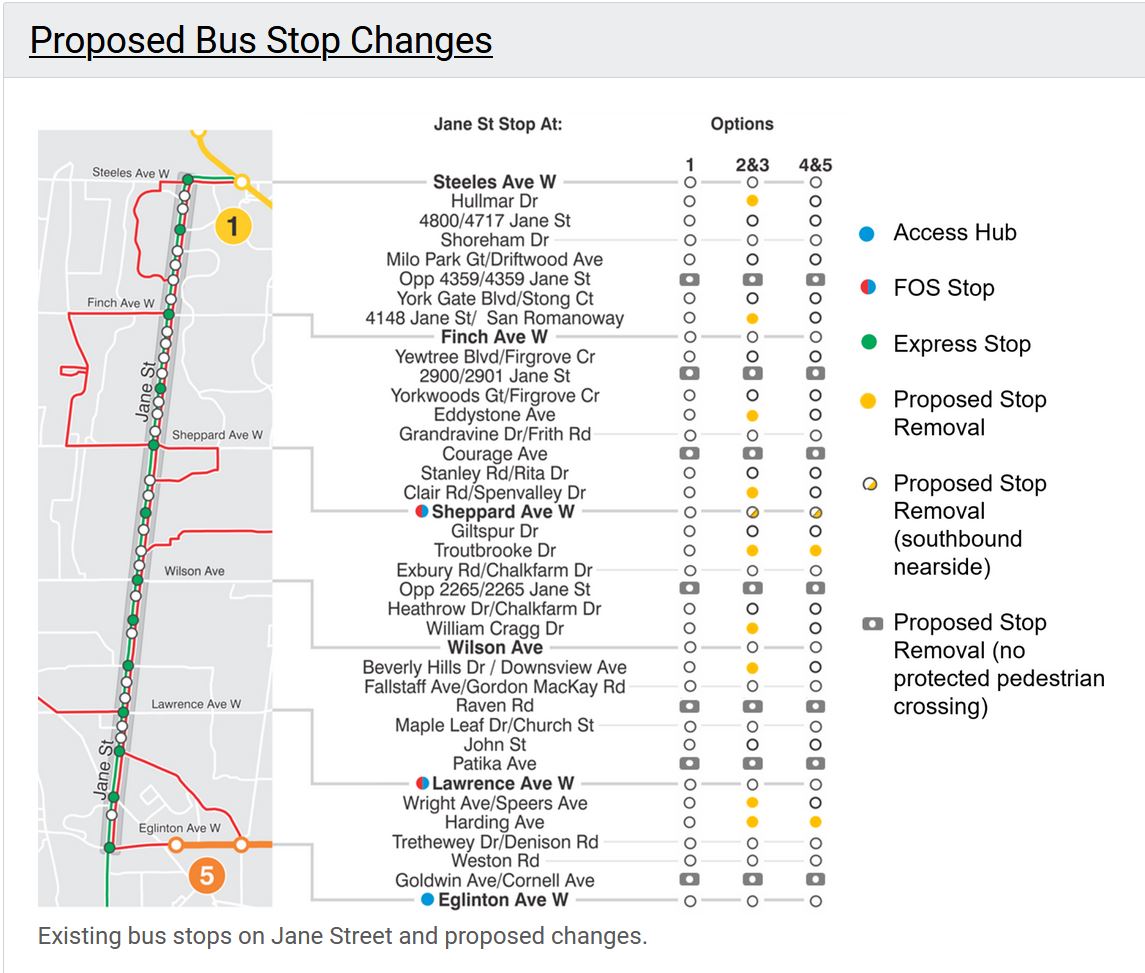
As with the Eglinton-Kingston-Morningside RapidTO lanes, the Jane Street proposal includes the removal of some bus stops in the name of speeding transit.

The TTC proposes removal of 7 of 38 stops (18%) even if no transit priority is implemented. For options 2 and 3 which provide a relatively high level of priority, there would be a total of 16 stops (42%) removed. For options 4 and 5 which provide a lesser degree of priority, 9 stops (24%) would be removed.

Of the 38 stops, 13 are shared by the local and express services and they are not affected. This means that there are 25 local stops, of which Options 2 and 3 would remove 16, or two-thirds of these stops.

The premise for the Option 1 locations is that these have no crossing protection and, therefore, create a risk for jaywalking pedestrians. The additional stop removals for Options 2 and 3 are justified as “optimizing” the spacing. The proposal changes the route substantially to the spacing of express stops.

The unanswered question is why these stops exist in the first place, and what local traffic pattern to they support. Should the change be to improve pedestrian protection and access rather than simply telling riders they must walk further to reach their bus?

Another important question here is how much of the supposed benefit of the project will be gained from stop removal as opposed to provision of an all-day reserved lane for transit. The TTC touts the travel time saving through transit priority, but does not net this out against increased walking distance to and from stops.

The City’s page includes maps showing the changes in the 4-minute walking distance catchment areas for transit stops. They do not include information about stop usage, population density or the effect on major traffic generators such as schools.

Revised Lane Allocation

Jane Street is different from the Scarborough RapidTO implementation in important ways:

  • Part of the Scarborough RapidTO area already had reserved bus lanes in peak periods.
  • Eglinton Avenue and Kingston Road are six lanes wide plus a median/left turn lane in places. Jane is generally a four-lane street with a shared left turn lane.

Here is the typical existing layout.

Options 2 and 3 reserve the curb lane for transit as well for vehicles turning onto and off of Jane Street.

Option 4 assigns the curb lane for high occupancy vehicles, and Option 5 leaves the street as is with selected widening for queue jump lanes where right turns delay traffic today.

How well any of this will be enforced is anyone’s guess, and the situation on King Street does not inspire confidence.

Travel Time Changes

The anticipated changes in travel time are summarized in the table below. Note that these are for trip over the full distance between Steeles and Eglinton.

The change in stop access times is averaged over the entire route. This dilutes the effect on riders at specific stops by including many riders whose access distance is unaffected. This understates the impact on those who are directly affected. (Note that at an assumed walking speed of 1m/sec the change in distance is equivalent to the change in walking time in seconds.)

The TTC has beaten the transit priority drum for queue jump lanes for years, with only a few examples to show for their efforts. In this case, the provision of such lanes is by far the most expensive option, the longest to implement because of road reconstruction, and the least beneficial to riders. This is really a tactic that should be reserved for key areas with very high transit vehicle congestion where there is very frequent service and a clear payback.

Option 1Option 2Option 3Option 4Option 5
Change in bus travel times (mins)0-5-4-2 to -3-2
Average change in stop access (m)None+55+55+45+44
Change in auto travel times (mins)0+3 to +4+2 to +3+2 to +3Minimal
Estimated Cost ($m)N/A$4.7$3.9$2.5$10.7
Time to Implement (years)N/A1 to 21 to 21 to 23 to 4

In a separate article, I will review the behaviour of the Jane 35/935 local and express services. A few key points from that review are worth making here:

  • The variation in headways (time between buses) can substantially exceed the travel time savings shown here. Operation of reliably-spaced service would improve the rider experience today with any priority savings coming as gravy on top. Conversely, if headway reliability is not improved, then the benefits of red lanes will be undermined by erratic service.
  • The difference in travel time for express and local buses over this section of Jane is comparable to the travel time saving foreseen in Option 2 (full bus priority). It is not clear whether this difference would persist especially in Options 2 and 3 where over 60% of the local stops are removed.

Service on 905 Eglinton East Express

Beginning March 26, 2023, the 905 Eglinton East Express bus will run less frequently due to a combination of the new TTC Service Standards and the route’s conversion from standard sized to articulated buses.

The vehicle change was not included in the information in the TTC’s overview report discussed at the February 28 Board Meeting, and service comparisons published by me and others were based on a reasonable assumption of equal vehicle capacity.

New Service Standards

The new standards were included in the 2023 Operating Budget [p. 26]:

Route adjustments will be based on ridership demand in the busiest portion of the route, in the busiest direction and hour within each time period of service.

The realigned service proposes to:

1) Resume pre-COVID vehicle crowding standards in peak periods, which were temporarily suspended during the pandemic to provide more physical distancing. (50 customers per bus, 130 customers per streetcar, 1000/1100 customers per train on average during the busiest hour)

2) Increase the pre-COVID vehicle crowding standard at off-peak periods with capacity for each route and time period planned based on the busiest hour for 45 customers per bus, 90 customers per streetcar, and 600-650 customers per train on average.

There is no reference to articulated bus capacities. In the previous service standards, the peak crowding value was 50% higher for artics, but the offpeak value was only 28% higher. The offpeak ratio was lower because the old standard was based on a seated load, and the artics have proportionately more standee space.

In the table below, the “new” values are based on the budget quotation above with the articulated bus values set at 50% higher than those for standard buses.

PeriodStandard OldStandard NewArtic OldArtic New
Peak51507775
Offpeak36454668

The TTC cites 50/bus peak and 45/bus offpeak in the quote above. Therefore the new artic standards would be 75/bus peak and 68/bus offpeak using a 50% capacity increase over standard buses.

The old and new hourly route capacities below are based on vehicle types and planned headways. Note that offpeak capacities generally go up because of the substantial increase in standees. Reductions in peak capacity are very small and could be due to assumptions I have made about the TTC’s vehicle capacity standards.

PeriodOld HdwyOld Bus/HrOld CapNew HdwyNew Bus/HrNew Cap
AM Peak9’15”6.529316’00”3.75281
Midday7’30”8.036810’30”5.7388
PM Peak8’00”7.533814’00”4.3322
Early Eve11’00”5.519814’00”4.3292
Sat Morning10’00”6.021614’00”4.3292
Sat Afternoon10’00”6.021617’00”3.5238
Sun Morning12’00”5.018017’30”3.4231
Sun Afternoon10’00”6.021615’30”3.9265

Service Reliability

However, the problem with 905 Eglinton East is not confined to the capacity, but to the reliability of the service. We hear a lot about the wonders of Red Lanes for service, but it does not take long to find examples of erratic spacing between buses.

The following sections review January and February 2023 headways in detail looking at service departing eastbound from Kennedy Station and southbound from Ellesmere. The vital point here is that headway reliability is already not good on this route (as on many others in the network), and past experience shows that when scheduled service is reduced problems like this only get worse. Laissez-faire approaches to service management might work tolerably (at least in management’s eyes) for frequent service, but they fail when service is less frequent.

Service standards accept a six minute window (from -1 to +5 minutes) of “on time” performance relative to the schedule. Combined with the new headways proposed above, this will allow gaps of 20 minutes and more to be counted as “on time”. This is a severe penalty for riders, and can undo much of the benefit of “express” operation.

In many of the charts showing individual headways (left column in the collections below), note how often the data points are spread over a range from 0 to at least 15 minutes or more. The TTC routinely fails to attain the quality of service it claims as a target.

As the TTC adjusts schedules to its new budget limitations, the biggest problem for riders will remain the quality of service as shown in reliable headways (or not). Service quality could deteriorate and further inflame riders who already complain about unpredictable waits for and crowding on buses, or the TTC could actually make good on its claims of better service management.

I will return to this in May after the new schedules have been in operation for six weeks.

The remainder of this article contains detailed charts showing service quality on 905 Eglinton East for those who love all of the details.

Continue reading

501 Queen Diversions and Shuttles for the Ontario Line

This article is a follow-up to my earlier piece about the TTC’s Rapid Transit Expansion report including the effect of Ontario Line construction on the 501 Queen service.

Updated March 1, 2023:

  • The reason that track installation on Adelaide, which by itself is relatively straightforward, cannot proceed immediately is that nine Toronto Hydro and Bell vaults must be relocated. Metrolinx opted not to do this work, but the City has taken over.
  • Streetcars will remain on 501 Queen but will divert both ways via Broadview, Dundas and McCaul from May 2023 to March 2024. A bus shuttle will operate over the central portion of the route.
  • The list of track construction projects for 2023-24 has been clarified.

Back in December 2021, the City approved a report with a very long list of proposed road closures for Ontario Line construction.

I wrote about this report beginning with this article:

The construction at Queen Station will entail a multi-year diversion of 501 Queen service, and the plan was for streetcars to operate:

  • Eastbound via York, Adelaide and Church
  • Westbound via Church, Richmond and York

Track already exists for the westbound route, but new track is required on York and on Adelaide for the eastbound diversion.

Much of this work was supposed to have been completed in 2022, with the intent that the diversion would be available in May 2023. Various factors combined to foul up this schedule.

  • The contract to install new track on York and on Adelaide east to Victoria was, for some reason, to be a Metrolinx responsibility separate from City work on utility upgrades and relocation. This lengthened the potential timespan with two separate procurements, and inevitable delays as one contractor waited for the the other to finish.
  • Metrolinx was supposed to build the new track on York Street in 2022. This did not happen. According to a recent City report (about which more below), Metrolinx has been preoccupied with the Ontario Line.
  • Construction on Adelaide west from York to Spadina was done by the City to restore track inactive for many decades and to provide more flexibility for downtown diversions. This went quickly through the fall, and was performed by Midome Construction who were also working on utilities east of York.
  • For various reasons, notably discovery of unexpected underground Toronto Hydro and Bell plant, the work east on Adelaide from York did not complete in 2022, although it was substantially finished from York to Bay. Some water main connections were incomplete with pipes blocking the curb lanes, and this complicated traffic and transit diversions around a major sinkhole at King and University.
  • The City proposes to expand the Midome contract to include track replacement from York to Victoria. Work on this can begin immediately where utility construction no longer occupies the eastbound track lane (second counting from the south side). See: Non-competitive Contract with Midome Construction Services Limited for the New Streetcar Tracks on Adelaide Street

Queen Streetcars or Shuttle Buses

Until quite recently, if one ignored the incomplete work on the diversion trackage, it was possible to think that the streetcars would simply divert as planned beginning in May. This is obviously not going to happen, and it must have been clear to the TTC for months that the 501 Queen service would have to be modified.

The first hint of this was buried in the report under discussion at today’s (February 28, 2023) TTC Board Meeting.

Metrolinx has identified that the potential delay to complete the streetcar detour work will result in approximately 20 months of shuttle bus service commencing in early May 2023. The TTC is still working closely with Metrolinx and the City on exploring options to optimize the construction schedule of the Adelaide civil and streetcar track construction work to reduce the duration of shuttle bus service.

TTC Transit Network Expansion Update at p. 14

The words “shuttle bus” will send hapless TTC riders screaming from the room. There is a long history, particularly in recent years, of the TTC’s incompetence in operating construction shuttles including changing routes with little or no notice, conflicting information online and at stops, and erratic service with shuttles running in packs and taking long layovers at terminals. This was compounded by the number of planned and unplanned construction projects and the overlapped periods of construction on what should have been distinct route and road closures.

The grand daddy of them all is the King-Queen-Queensway-Roncesvalles project where all manner of delays including pandemic effects on work, unexpected utility relocations, slow work by affected companies such as Toronto Hydro, Bell and others, pushed the completion date out to, with luck, July 2023.

The idea that Queen would see 20 months of shuttle buses before the streetcar diversion would be ready is a testament to fouled up planning. The work should never have been divided between Metrolinx and the City but consolidated as a single contract with a goal of completion as fast as possible.

We now know, courtesy of the Star’s reporting that the delay will be only ten months instead of twenty thanks to the City’s contract consolidation. That’s an improvement, but it should never have been necessary.

For the TTC’s part, this continues a sad tale of communications and consultation foul-ups. The need for shuttles would clearly have been known months ago. How exactly they will operate is totally unknown because the TTC has issued no guidance on this. Will there be shuttles downtown? Over the entire route? Will the route be split to make it more manageable and give different routing options for eastern and western legs?

This should have been a public discussion months ago even if some details were still to be nailed down rather than a surprise landing on already-suffering riders who have dealt with many disruptions on Queen and other routes.

There are several planned track and road construction projects on Queen and King Street in coming years, and I learned recently that several of these have been deferred to reduce overlaps and conflicts. The revised schedule has not been published, and yet this will be essential to any discussion of transit service through the Ontario Line’s construction period. These include:

  • Scheduled for 2023, but deferred:
    • King West from Close to Strachan.
    • Queen East from Parliament to River.
    • Queen East from Carlaw to Greenwood.
  • Queen at Degrassi. Revision to streetcar power distribution for Ontario Line. 2023, date TBA.
  • Scheduled for 2024:
    • Queen West from O’Hara to Triller. 2024.
    • Queen East from Davies to Carlaw. 2024 (likely during Metrolinx work at Degrassi underpass).
    • King West from Strachan to Spadina. 2024.
  • Bathurst Street from Queen to Front
  • Scheduled for 2024, but deferred:
    • King East at Church (intersection).

The City, TTC and Metrolinx owe everyone an apology for this cock-up, and a commitment to resolve conflicting schedules and publish credible plans as soon as possible.

I will add to this article as the story develops.