Council Approves Tory Transit Plan, Attempts Pet Project Revivals

Toronto Council has approved the transit plan for Toronto featuring Mayor John Tory’s SmartTrack line and the Scarborough Subway after a long debate on July 14, 2016. Notwithstanding severe problems with financial pressures and the blind faith needed to expect that the entire package can actually be funded, Council added a few pet projects that never quite fade from view thanks to the efforts of individual members.

LRT proposals for Eglinton East and West survived the vote largely because they are part of larger packages – SmartTrack in the west, and the Scarborough Subway Extension in the east. The subway debate has so polarized camps that “LRT” is synonymous with third class transit simply because it was the heart of the “non subway” option. Without the bitterness of the SSE that required subway advocates to paint LRT in the worst possible light, its potential role in Toronto’s future network might not have been so poisoned while other cities embrace this mode.

Staff recommendations in the report were amended in some respects, and a few new clauses were added, notably one asking for City staff to pursue a co-fare arrangement with GO Transit.

The Waterfront Transit Reset report is a separate agenda item and, at the time of writing, Council has not yet dealt with it.

The Finch West and Eglinton Crosstown LRT projects are under Metrolinx, and they are already underway to varying degrees.

Continue reading

Brimley: The Station That Never Was

In all the discussion about options for service to the Scarborough Town Centre, an important factor is the superiority of an east-west alignment through the area (which is itself an east-west rectangle). One subway station serves a node in the middle of the STC precinct, but an east-west line, especially with a technology where multiple stations are comparatively inexpensive, can do a better job of serving a future, developed town centre.

City Planning’s own reports say as much, but because discussion of the LRT option has been expunged from debates, we don’t hear how this might perform.

As a matter of historical interest, the original LRT proposal that predated the Scarborough RT by a decade included not only the three stations we have today – Midland, STC and McCowan – but also made provision for a future station at Brimley. The site would have been just east of the Bick’s pickle vats, for those who knew the area back when, on the west side of Brimley.

Some years later with the RT well established, local Councillors pressed for a Brimley Station. Council funded this and the TTC in due course produced a design. That’s as far as things ever got, and despite development near the station site, nothing more has ever come of the idea.

Brimley SRT Station Feasibility Study, January 2004:

Given its very light usage and difficulty of access, one might even argue that Ellesmere Station could be replaced by one at Brimley in any new design.

We will never know, because “LRT” in at least this corridor is a naughty word.

The Dwindling Capacity of the Yonge Subway

Yesterday’s launch by York Region of their Yonge Subway Now website brought to the fore the question of just how much room remains on the Yonge Subway for additional riders. Over many years, claims about capabilities of new subway technologies together with changing projections for future demand have left Toronto in a position where its subway is badly overloaded with little relief in sight.

This article traces the evolution of those claims and the reality of what can actually be provided to show that building a Relief Line is not a project for a future decade but one that must begin now.

Continue reading

York Region Wants a Subway, Overstates Available Capacity (Updated)

Updated July 6, 2016 at 5:10 pm: “Yonge Subway Now” has updated their website to remove the double counting of capacity improvements, and to clarify that their claims about subway capacity apply to the peak point south of Bloor Station. The revised text is included in the main article.

Although in theory there will remain 4% of free capacity on Yonge south of Bloor in 2031, this is hardly the sort of margin we should be planning for. The Relief Line’s demand projections show that it has a major effect if it runs north to Sheppard, and it will have to be in place sooner rather than later to avoid deadlock on the Yonge line.

A related problem is the question of station capacity to handle passengers with trains arriving about 30% more frequently than they do today.

York Region has wanted a subway to Richmond Hill for years, and there is even a completed Environmental Assessment and its Addendum for this project.

Today, July 5, 2016, a new website extolling the virtues of this project went live. It contains the usual things one would expect about the growing need for transportation and how a subway will improve the region’s future. Unfortunately, it also contains a misrepresentation of available and future subway capacity.

But what about overcrowding you say?

  • Metrolinx’s Yonge Relief Network Study analyzed options for crowding relief to the existing Yonge Subway line by examining new local and regional travel opportunities and improving mobility across the GTHA. Key findings include:
    • Significant relief to the Yonge Subway line will be achieved through already committed transit improvements, including:
      • TTC’s automatic train controls [adds 29% capacity];
      • New subway signals [adds 10% capacity];
      • New six-car subway trains [adds 10% capacity];
      • Toronto-York Spadina Subway Extension [adds 5% capacity]; and
      • Regional Express Rail/SmartTrack/DRL will add even more capacity.
    • With the above capacity improvements in place the Yonge Subway line will be running under capacity when it opens and beyond 2031.
    • The Yonge North Subway Extension only adds 9% demand at peak period.

Updated July 7: The text above was the original version. The page now reads:

But what about overcrowding you say?

  • Metrolinx’s Yonge Relief Network Study analyzed options for crowding relief to the existing Yonge Subway line by examining new local and regional travel opportunities and improving mobility across the GTHA. Key findings include:
    • Significant relief to the Yonge Subway line will be achieved through already committed transit improvements, including:
      • TTC’s automatic train controls [adds 29% capacity];
      • Toronto-York Spadina Subway Extension [diverts 1,300 riders to free up 5% capacity]; and
      • Regional Express Rail diverts 4,200 riders to free up 15% capacity.
    • With the above transit improvements in place the Yonge Subway line will be running under capacity when the extension opens in 2031.
    • The Yonge North Subway Extension has a projected ridership of 14,000 to 22,000, but is only expected to add 2,400 demand during the AM peak hour, at the peak point south of Bloor.

Let’s start off with the increased capacity for the Yonge Subway. The Metrolinx report cited here says (p 15) that the existing capacity is 28,000 passengers per hour per direction, and that by 2021 this will rise to 36,000.  That’s roughly a 29% increase, and is possible because of the new signal system which includes automatic train control. This will allow trains to run closer together, roughly every 110 seconds in place of the current 140 seconds.

Capacity of the new subway cars is already included in the 28k value as these trains have been exclusively providing service on the Yonge line for a few years. They no longer represent a marginal improvement that is still available. The design load for service planning (average loads over an hour, not peak loads on a train or car) for the new trains is 1,100 passengers. If trains run every 140 seconds, that is equivalent to 25.7 per hour or a capacity of about 28k/hour. Moving to a 110 second headway gives 32.7 trains/hour or a capacity of 36k/hour.

Traffic diverted to the TYSSE (Toronto York Spadina Subway Extension) at 5% of current capacity represents 1,400 per hour. This is in line with the value shown in the Metrolinx study (see chart below).

GO/RER has only a modest effect on the Yonge corridor because the Richmond Hill line is not part of the RER network, and other routes paralleling Yonge (the Barrie and Stouffville corridors) are too far away to have a meaningful impact. There is also the issue of the fare differential between GO/RER and the TTC which could discourage some riders from travelling on GO.

SmartTrack was originally claimed to be capable of subway-like service down to a 5 minute headway (12 trains/hour) that would serve Unionville and Milliken stations. However, we now know that “SmartTrack” will really be just a few more GO trains (part of the already planned RER improvement) stopping at a few more stations within Toronto, not the “subway like” operation some in York Region might have expected.

The Metrolinx study includes a chart showing the interaction of demand and capacity changes to 2031.

YongeNorthDemandProjection

The current 2015 demand is shown as higher than the actual capacity (31.2k vs 28.0k) based on the level of overcrowding now experienced on the line. The light blue dotted line shows the capacity before the new signal system is activated, and the solid blue line shows the added capacity. Even this will not be sufficient to handle the projected growth to 2031 absent other changes.

The TYSSE and other changes  are expected to shift 1,300 per hour from the Yonge line, and a further 4,200 would be attracted by GO/RER. This mostly, but not completely, offsets the anticipated growth so that by 2031 the “base case” demand is 32.3k, slightly higher than the demand today, but in less crowded conditions thanks to more trains/hour.

The Yonge North extension adds only 2,400 peak hour passengers and brings the line up to 96% capacity. Note that this is the peak hour average, and there will be some overcrowding due to variations over the hour.

This leaves no room for growth, but it also shows the paltry additional demand expected on a very expensive subway extension. Indeed, this makes the Scarborough extension to STC positively shine by comparison with 7,300 peak hour riders. The projected demand on the Richmond Hill line appears to be lower than the existing ridership of the SRT!

But things are really not that bad.

Those 2,400 are net new riders attracted by the subway in place of existing bus service. Total ridership will be a combination of then-current bus passengers feeding into Finch Station plus the 2,400 new riders.

Metrolinx shows that the “long” version of the Relief Line to Sheppard produces a sizeable reduction in projected demand on both the Yonge line and for the Bloor-Yonge transfer movements.

YongeReliefDemandEffects

If Metrolinx, Toronto and York Region are really serious about providing capacity for future extension and ridership growth on the Yonge Subway, then construction of a Relief Line is absolutely essential despite its cost.

Meanwhile, York Region should update its website to provide accurate claims about future changes to subway capacity. Blatant inaccuracy such as we see here are the marks of hucksterism designed to sell a project, not a professional representation of what is actually needed.

Update: The new version of the website addresses these issues, but I must wonder why the incorrect information appeared there in the first place.

Reviving the Scarborough LRT Proposal (Updated)

Updated July 5, 2016 at 8:00 am: Revised drawings for Kennedy Station have been added showing better detail of the the LRT lines and a temporary bus terminal. Minor textual changes have been made in the article including an observation that the scope of replacement costs for removing the existing SRT structures will vary depending on the timing of shutdown and the degree to which existing structures are adapted/recycled.

Updated at 8:45 am: The potential sources of cost overstatement for the updated LRT option have been summarized.

With the recently announced increase in the projected cost of the Scarborough Subway Extension, the question of reverting to the original LRT plan for Scarborough has surfaced again. It is no secret that I favour this plan, but the political environment has been so poisoned that discussion of the options is, mildly speaking, difficult. When the Mayor feels that he must imply racism in critics who are simply trying to advocate for their view of a better transit system, Toronto politics are at a new low. However, the implications of the LRT plan must be addressed on their merits, not on simplistic political comments unworthy of the Mayor’s office.

On June 29, the TTC issued a briefing note regarding the cost of the LRT option in the context of current events. The question here is whether the claims and assumptions behind this note are legitimate and represent what could be achieved with a “best effort”, as opposed to presenting a less attractive picture to give the impression that the LRT represents an unacceptable downside.

Continue reading

Property Taxes and Subway Financing

The financing of a new rapid transit project in Toronto is a complex business, and probably the most complex part of the whole thing is the effect this has on property taxes.

This article is intended as an introduction to how these taxes actually work. It is not an exhaustive review, and there are subtleties beyond my scope here.

This is an article for people who like the gory details, and so I will insert the break right here.

Continue reading

Toronto’s Network Plan 2031: Part IV, Relief Line

This is the fourth part of my review of the reports on the agendas of Toronto’s Executive Committee and the Metrolinx Board. The full list is in the first article.

This report reviewed here is the Relief Line Initial Business Case.

Following a series of public meetings and background reports over past months, the Relief Line study has settled on a proposed alignment from Pape Station south to Eastern Avenue, then west to the Don River (passing beside the Unilever/Great Gulf development site), jogging north back to Queen Street west of the river, and thence to University Avenue. This is referred to as Option 3. The other options were:

  • 1: Surface transit improvements on Queen and King, but no Relief subway line
  • 2: Relief line from Pape Station to downtown via Queen
  • 2A: Relief line from Pape Station to downtown running diagonally from Gerrard to Queen via the GO rail corridor.

Future extensions to the north and west are also contemplated, but this “Business Case” report deals only with the first phase.

As the route selection process evolved, so did the scoring system used to rank the options. For example, the employment benefits of the Unilever site were not considered in earlier schemes where a Queen Street alignment all the way from Pape to University ranked highest. By the time we get to the “final” ranking, the Pape/Eastern/Queen alignment clearly wins out. Some of the change is due to the use of the City’s “Feeling Congested” evaluation matrix that has been brought to many of the recent studies. The priorities of these evaluations are more weighted toward social and city building benefits, and less to raw travel-time saving.


ReliefLine_Alignments

Relief to the Bloor-Yonge interchange is projected, although the larger benefits occur when the line is extended north to Sheppard & Don Mills.

The first phase of the Relief Line is anticipated to provide a net reduction of 3,400 to 5,900 riders on Line 1 (Yonge) south of Bloor during the AM peak period. The subsequent extension of the Relief Line north to Sheppard Avenue is projected to provide even greater relief, with a net reduction of 6,500 to 9,900 riders relative to the Base Case in 2041. [p 3]

The future second phase is shown in this map:

ReliefLine_Phase2

The detailed ridership estimates have not been published, but the presumed network elements that would exist for the modelling are:

• Eglinton Crosstown LRT from Mt Dennis to Kennedy Station (currently under construction);
• Toronto-York- Spadina Subway Extension (currently under construction);
• Sheppard Avenue East LRT (funded);
• Scarborough Subway Extension (3 stop) (funded); and
• Connections to new subway stations from existing local bus and streetcar routes [p 16]

Notable by their absence are SmartTrack and the Crosstown East LRT to UTSC, and the Scarborough Subway is presumed to be the 3-stop version to Sheppard Avenue. Considering that the configuration of the “optimized” Scarborough network changed some months ago, the use of an out-of-date model is surprising.

The projected cost of the Relief Line has been widely reported as almost doubling. This is misleading because it contrasts current 2016 dollar estimates ($4.1 to $4.4 billion) with projected spending when the project is actually constructed sometime in the late 2020s or beyond. Earlier estimates have been quoted in older dollars at correspondingly lower projected total cost.

Of the increase, $300-400 million is due to the selection of the Pape/Eastern alignment which makes for a longer route. Roughly $2 billion is due to inflation between the 2016 estimates and the likely period of construction.

An interesting observation in the report is that the benefits case methodology confers a substantial value to reduction of travel time. However, the RL’s primary effect is not intended to speed riders from the outer suburbs to downtown, but to improve flows through the network, especially on the initial downtown-to-Pape phase. Therefore, a significant component of some “benefit” estimates – travel time savings – is not available to the Relief Line despite the major contribution it brings to network behaviour and the expansion potential it creates.

It is important to note that the focus in the Metrolinx business case guidance is on travel time savings benefits and benefits associated with reduction in auto-use. As a result, there are several key benefits associated with local transit and city building objectives that are not monetized in this economic evaluation. Further work is required in the development of the business case tool to ensure the economic evaluation includes the monetization of the types of benefits expected from transit expansion projects which provide a more local service. [p 33]

This begs the question of whether the traditional “benefit analysis” which does contain a travel time saving component truly presents the “value” of new transit lines, or if it is skewed to reward projects serving longer commuter-type trips and the infrastructure they require.

Continue reading

Toronto’s Network Plan 2031: Part II, Scarborough Subway Extension (Updated)

This article continues my examination of the mound of reports going to Toronto Executive Committee and to the Metrolinx Board on June 28, 2016. For a complete list, see Part I of this series.

The subject here is the Initial Business Case for the Scarborough Subway Extension.

A few central points underlie the study:

  • In a review of possible subway alignments through the Scarborough Town Centre, an east-west alignment comes out on top because it would better support future growth of the STC precinct via an eastern extension that is impossible with a north-south alignment.
  • Options that would produce an east-west alignment are eliminated from consideration before a full technical and financial evaluation because it is claimed that the SRT would have to be shut down for the entire period of construction.
  • The preferred alignment via McCowan includes technical challenges, and there are alternatives via Brimley, but these have not been studied in detail. There is no sense of the comparative cost of the alternatives.

Opening date for a Scarborough Subway is now pushed off to 2025 because various reviews, debates and studies have pushed back the start date for the project.

The report is completely silent on related capital projects that are pre-requisites to an SSE including:

  • Replacement of the existing fleet of cars serving the BD subway to allow automatic operation over the extension.
  • Provision of a new subway yard.
  • Launch, but not necessarily completion, of a project to re-signal the existing BD subway.

Updated June 25, 2016 at 10:30 pm:

In the evaluation of options that would require the shutdown of the SRT during construction of whatever might replace it, the report states:

Bus replacement for the SRT service during the construction period would require 63 additional buses and infrastructure requirements such as a bus facility to accommodate the additional bus fleet, and bus terminal expansions at Scarborough Centre and Kennedy Station. The cost of shutting down the SRT during the construction period would amount to approximately $171 million (YOE/Escalated $).

However, this makes no allowance for the following savings:

  • Avoiding the need to keep the existing SRT operating, a value estimated in July 2013 as $132 million including inflation. See Scarborough Rapid Transit Options at p 7.
  • Buses and garage space provisioned for the temporary shuttle would have a life beyond the end of the project, and indeed the TTC requires another new bus garage beyond McNicoll Garage in northern Scarborough. Only the cost of buying, building and operating these earlier than would otherwise occurs counts as a net cost against the project.

This is either an error in calculation, or a misrepresentation of the true cost of replacing SRT operation.

Given that the LRT option would require a shorter shutdown of the SRT than the subway options, the cost of the bus shuttle would be correspondingly lower.

[End of update]

Continue reading

Spinning a Tale in Scarborough

Brad Duguid, Ontario’s Minister of Economic Development & Growth, also the de facto spokesman for the Scarborough Liberal Caucus, was on CBC’s Metro Morning talking about the planned Scarborough Subway Extension (SSE) and its fast-inflating estimated cost.

Duguid had been quoted in the press a few days earlier as saying that downtown elitists have been opposed to the SSE from the start echoing the divisive us-versus-them context for so much of this debate. He likes to sound oh so reasonable, but his message is full of half-truths and puffery designed to support the “we don’t get our share” chorus so common from Scarborough pols and others.

The [subway] project has been on the books for 30 years.

Well, no, it hasn’t. The TTC’s original plan for Scarborough was that an LRT corridor would run northeast all the way to Malvern. (See Once Upon a Time in Scarborough and The Scarborough LRT That Wasn’t). More recently, the Transit City plan included an LRT network for Scarborough, and this received the endorsement of Council. Only when former Mayor Ford chose to use the potential of a subway as bait did Council change its mind.

If anyone has a plan for a subway from Kennedy to STC that has more status than the back of a napkin or a fantasy map, I’ll be happy to see and comment on it.

LRT was put in there as a political decision by the Davis government to promote UTDC globally.

The UTDC was a provincial agency that concocted the RT technology, and they couldn’t get a sale if Toronto wasn’t buying. This technology is most emphatically not LRT, no matter what Duguid and others like to call it, for the simple reason that it requires a completely segregated right-of-way. The true LRT line was already under construction when Queen’s Park pulled the plug, and there are remnants of the LRT design still visible in the RT structures.

Scarborough Town Centre is one of the fastest growing city centres in Canada.

Very little development, compared to the rest of Toronto, is planned for STC according to Toronto Planning’s own numbers. How many times must the following chart be published to drive home this fact?  [Source: How Does the City Grow, June 2015]

More generally, growth is not happening in the so-called centres which between them have less than 10% of the proposed development. The myth that the former “downtowns” of the old cities will become major nodes in their own right is neatly torpedoed here.

ProposedTorontoDevelopment_201506

Everyone is entitled to their views and opinions.

In a classic “yes, but” statement, Duguid tries to undo his slur against those who criticize the SSE project, but goes on to talk of how Scarborough residents have been fighting for a subway for years.

I [Duguid] have been involved in this debate for 30 years. All we’re asking for is that the fastest growing city centre be attached to higher order transit.

Fighting for “higher order rapid transit” (a phrase he uses a few times without recognizing that it actually includes LRT), maybe, but not specifically for a subway. The problem for years has been that subways and the rattletrap SRT are the only points of comparison Scarborough riders have, and it’s a no-brainer to choose one over the other. The LRT option has always been undersold, and then under Rob Ford, denigrated as “streetcars” (said with a pejorative sneer) when in fact the SLRT could be entirely on its own right-of-way.

The price came in over the estimate, but that was done a number of years ago. The price it’s come in at is the price it’s come in at.

No. The estimate was updated in 2016 for Council’s decision to go with the “optimized” Scarborough plan of a 1-stop subway and the LRT from Kennedy Station to UTSC. Does Duguid now claim that Council made a multi-billion dollar decision on a flimsy, unreliable estimate?

When challenged about insulting critics as a tactic to advance the SSE project:

Not everyone who has opposed this is from downtown, but generally critics are people who are less than 10 minutes to a subway station from their homes.

I don’t have the home addresses of the many SSE critics at my disposal, and there is no secret that I live within sight of Broadview Station. The point here is not where I live, but where people in Scarborough live, and most of them will not be within 10 minutes of the one remaining station on the SSE. Indeed, the “optimized” Scarborough plan does well on access not because of the subway, but because the LRT line to UTSC brings so many more people close to a station.

Scarborough people have been paying for the subway system for years. It is important to the entire city. We have to think about more than our ridings.

Duguid is getting too rich for words here implying that he’s not pushing the subway just to get votes even though his own party did just that, going along with Rob Ford’s fictional ideas about transit planning rather than opposing him. Yes, Scarborough has paid taxes for years into the pot, as has every other part of Toronto, including Etobicoke which is not exactly subway-rich. The SSE tax as well as development charges for new transit generally fall overwhelmingly on buildings nowhere near Scarborough, and the subway will be built mainly by funds raised outside Scarborough borders. That may be a fair trade, but not if the pricetag keeps going up and up, and not if other transit projects are cancelled to pay for it.

Yes, Scarborough too must think about more than itself, and stop acting like a brat who only wants the most expensive toy in the shop window.

Scarborough has been paying for years, but the minute something is going to SCC, such a big deal is made out of it. It’s easy for folks with higher order transit to oppose it, but it’s important to the people of Scarborough.

It is a flat out lie to say that people elsewhere in Toronto oppose “something going to SCC”. The problem here is that Duguid wants only a subway and will accept nothing else. We all need and want more and better transit, but we can’t have it when every penny is vacuumed up for one project.

Ridership numbers have to be put in perspective. STC is the first station in the system, and if the line were full here, people wouldn’t be able to get on elsewhere. It will be the 7th busiest station. If we had only looked at [terminal] ridership, we wouldn’t have built any of the subway lines.

Both the Yonge and Bloor subways were built in corridors where surface transit was already carrying thousands more riders than the RT is today, and where there was a concentrated demand to carry people from their homes to jobs downtown and on other parts of the (mainly) streetcar network. The same is not true for Scarborough, especially for transit carrying people to jobs at STC.

The Yonge extension was built to carry the very heavy demand pouring into Eglinton Station on buses from the north. The Spadina line was partly to relieve this, and partly to serve Yorkdale Mall not to mention sanitizing the proposed Spadina Expressway corridor. The extension through York University to Vaughan is well documented as a political creation, not the result of planning that would have independently justifed a line that far north.

This transcends politics.

That claim brought a guffaw from host Matt Galloway. The whole project has always been about politics, about being a “subway champion” for Scarborough and telling people how hard you are fighting for what they have been convinced they need.

The fact is that I’ve been supporting this since before I got into public office, for nearly 30 years. Scarborough residents take it very seriously. The subway will fulfill our full potential, and I fight strongly for it.

Actually, Scarborough has very substantial travel demands that have nothing to do with the Town Centre, and the subway won’t help them one bit. Moreover, most people who work at STC don’t originate from areas served by the subway network (or particularly well by transit) and they drive out of preference or because they have no choice.

Duguid and company have painted themselves into a corner by backing an option that is increasingly beyond the level where mutual back-scratching at Council and a hope for peace in the family will bring approval for the project. They’re now stuck having convinced voters that there is only one option, and that if Scarborough doesn’t get it, this will be the rich, elitist, downtown Toronto blocking their manifest destiny.

One might ask the same of City Councillors and the Mayor who short change transit at every opportunity and may even cut service rather than raise taxes and fares to pay the bills in 2017.

Our government already would have contributed 2/3 of the original cost estimate. We are the major contributor, and are unwavering in support. We will give the city the space to determine what the plans might be for the other part of the project – the line to UTSC – but we’re not in a position to commit more money.

In other words, don’t come to Queen’s Park looking for a handout, and if you have to raid the piggybank for the billion you thought you had for the UTSC LRT, then that’s Toronto’s decision. Needless to say, Duguid does not represent the ridings that the LRT would serve.

The real issue here is why a provincial Minister gets away with making such inflammatory statements about a decision which, in theory, is Toronto’s to make. Queen’s Park will spend the same dollars on Scarborough regardless of what is built, but they gingerly avoid commenting on which plan they prefer.

We’re getting almost an announcement a day from the Wynne government about transit expansion, even for some LRT funding, but Queen’s Park has stayed out of the Scarborough debate until now. When the bill comes due for the extra cost of a one-stop subway, when the hoped-for line to UTSC vanishes from the map, will Duguid or Wynne be anywhere to be found?

The Scarborough Subway Fiasco

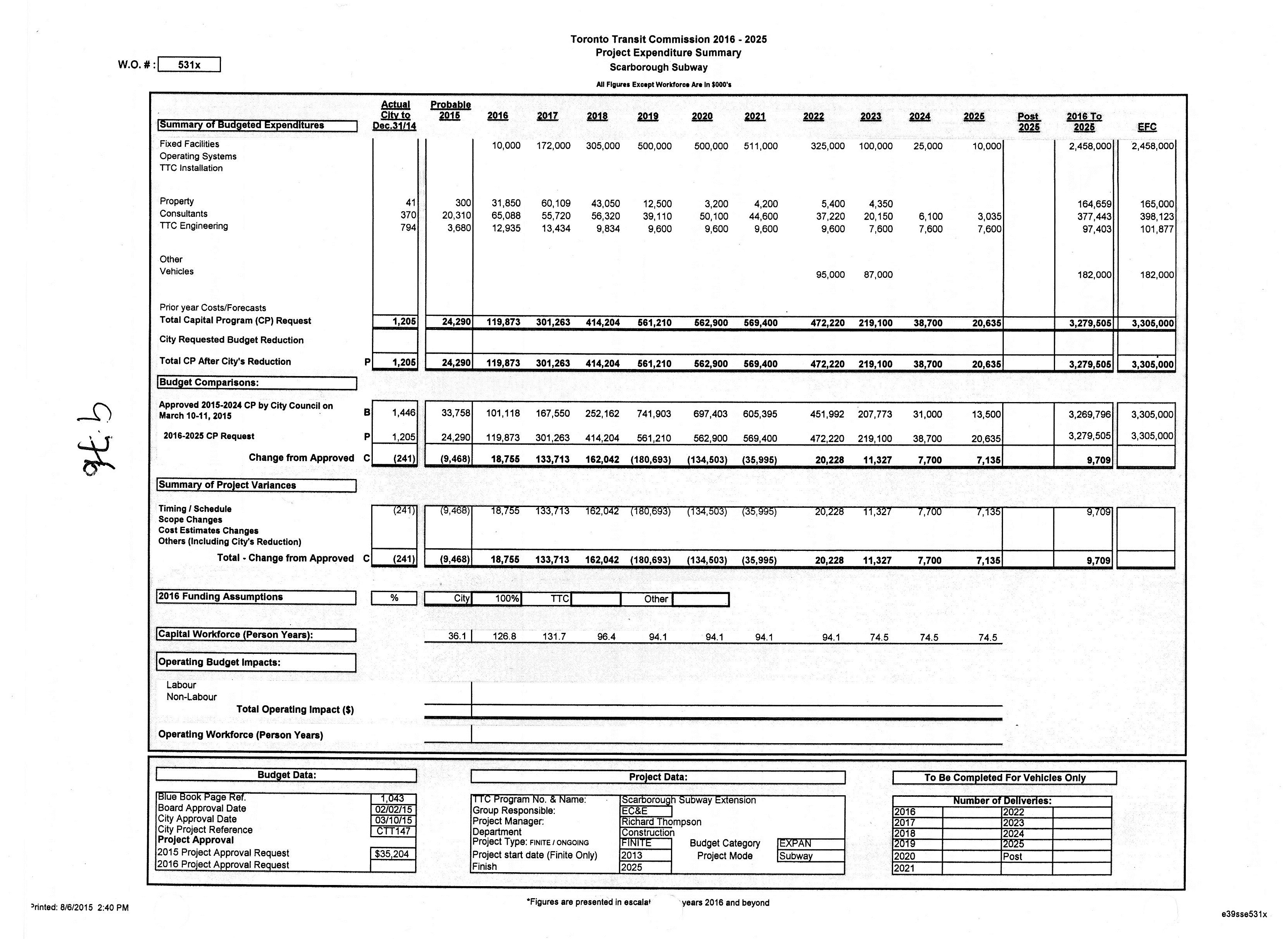
For the benefit of out-of-town readers who may not follow the moment-to-moment upheavals in Toronto politics, the lastest news about the Scarborough Subway is that it will cost $900 million more than originally forecast, and the Eglinton East LRT line has gone up by $600 million.

Updated 10:45pm June 17: The increase in the Eglinton LRT line’s cost may only be $100m, not $600m. Awaiting further details to confirm this.

No details of the components of these increases have been published yet, but here are the current (as of 6:45 pm on June 17) media reports:

  • The Star: Mayor John Tory accused of ‘political posturing’ as Scarborough transit plans balloon by $1 billion
  • The Globe & Mail: Scarborough subway cost rises by $900-million
  • Torontoist: The Bad Decision on the Scarborough Subway Extension Gets Worse

Earlier this year, the much-touted “optimized” plan for Scarborough changed the subway scheme from a Kennedy to Sheppard line stopping enroute at Lawrence and Scarborough Town Centre (STC), to a one stop extension whose terminus and only station was to be at STC. Money saved by shortening the subway would be directed to the Eglinton East LRT project linking Kennedy Station to University of Toronto Scarborough Campus. [See Scarborough Transit Planning Update]

At this point, the total project cost remained within the original 3-stop subway project’s estimate of $3.56 billion (as spent dollars including inflation) of which the City of Toronto’s share would be $910 million financed primarily by a 1.6% Scarborough Subway property tax over 30 years. The remainder would come from Queen’s Park and Ottawa, but their contributions are fixed and any overruns are on the City’s dime.

Material from this report reappeared in a March update on the overall transit network [see Developing Toronto’s Transit Network Plan: Phase 1] and in the May-June presentations to various public consultation meetings. At no time was the possibility of a cost overrun for the Scarborough network mentioned.

Meanwhile, ridership estimates for Scarborough were revised downward quite drastically with a projected AM peak hour demand of 7,300 inbound from STC station. About half of this would be existing SRT riders and the rest would be net new to the transit system. The May presentation makes a point of defending the lower numbers, but here is what City Planning staff said only a few months earlier in their March report:

Preliminary ridership forecasts … indicate:

  • The options are capable of capturing significant ridership. Daily users range from 115,000 to 147,000 in 2031. Morning peak hour, peak point, peak direction ridership ranges from 13,700 to 17,700.
  • Assuming the McCowan 3 option, the introduction of SmartTrack would reduce ridership on the subway extension to about 109,800 daily users and 12,600 peak hour, peak point, peak direction riders assuming 15-minute SmartTrack service in 2031. Assuming 5-minute SmartTrack service daily users would be about 88,200 and peak hour, peak direction, peak point ridership would be about 9,800 riders. In either case, the peak point ridership would be comparable or higher than that observed today near the terminal points of existing subway lines, with the exception of the Yonge line in the vicinity of Finch station. [p. 32]

During his election campaign, John Tory trumpeted SmartTrack as the one line that would solve every problem claiming very high peak and all day ridership based on service probably three times better than we will ever see. SmartTrack is now proposed with trains every 15 minutes, not every 5, and this has a huge effect on ridership both on ST and on neighbouring lines as the numbers above show.

Planners have been twisting themselves into pretzels trying to justify building a subway with the lower projected demand saying it wouldn’t really work at the higher level because there would be no capacity further downstream for existing riders (similar to the problem we now see south from Finch Station). That’s all very well, but the same planners sold Council with the subway concept by touting the much higher estimates that “justified” subway construction as ridership would be at the edge of what an LRT line could handle.

These two arguments cannot both be right, and it is quite clear that planning numbers either were gerrymandered or that they were simply the product of unreliable analysis. Either way, all future projections are suspect especially if they change conveniently to suit the political needs of the day.

Throughout all of this, there has been no change, until today, in the cost estimates, the other vital factor in deciding between transit options. To put this in context, other studies have turned on amounts in the low hundreds of millions to justify choice of a “cheaper” option, while other projects languish because they are “not affordable”. $1.5 billion is no small change.

Technical issues have now come to light that render the original cost estimates meaningless. According to the Globe:

An analysis in Scarborough showed that the topography would require deeper tunnels in some places. The stations themselves would have to be 45 to 90 per cent deeper than thought, raising their construction costs immensely. And the high water table of the area would require more concrete than expected.

This is not something that was discovered last week. Mayor Tory attempted to pirouette around the cost problems with the idea that somehow the “private sector and others” could find a better way to do things. However, the TTC’s CEO Andy Byford, in a restrained comment, demured. From the Star:

TTC CEO Andy Byford said a third-party already helped with the engineering estimates to look at creative solutions for tunnelling or station design.

“I welcome the suggestion of having a third party at least review our costs because we want to make sure that we’re being as efficient as possible,” Byford said, adding: “I want to deliver the Scarborough subway for the best possible price.”

But asked if it’s realistic to expect hundreds of millions of dollars could be shaved off the costs, Byford said: “I think that would be a challenge.”

Indeed, Byford is now in a difficult position because his political neutrality on the subway vs LRT question cannot survive. Any new money to build the more-expensive plan will have to come at the expense of something else. Already, the TTC Budget Committee meeting where a preliminary “wish list” of funding requests to Ottawa was to appear (Byford said as much during the announcement at Greenwood Yard of DRL funding) was cancelled, and we have no idea just what projects TTC management, let alone the Board, feel should vie for funds. At some point, Byford may have his “Gary Webster moment” at City Council where he should openly state a professional opinion. (The reference is to Byford’s predecessor who was sacked by Rob Ford for having the temerity to oppose the subway plan.)

Nothing has been published beyond the Mayor’s comments to the media, and if there was a prepared statement, it still is not available on his website.

The tunnelling issue noted above is one part of the cost, but there are likely to be others as I have already discussed on this site. The key point is that the TTC has many interlocking projects that must proceed before the Scarborough Subway can open.

There are five projects in the future on BD which have serious interdependencies:

  • T1 replacement
  • ATC
  • Scarborough extension
  • New storage facility
  • One-person train operation

Some are below the line and some are above the line. However, the dates and order of projects don’t align, so to minimize changes and maximize efficiencies the correct order should be:

  • New storage facility (ready for permanent 6 car consists)
  • New trains (ready for ATC)
  • ATC or OPTO (with ATC and OPTO ready trains)
  • ATC or OPTO
  • Scarborough extension

[Email from Mike Palmer (Deputy Chief Operating Officer, responsible for subway operations)]

The new storage facility will likely be near Kipling Station. It will be designed around the physical requirements of the new 6-car trainsets, and it will provide concurrent storage for the new and old fleets.

ATC (Automatic Train Control) is a prerequisite for the Scarborough extension which would be built using that technology. Conversion of the existing line to ATC would, strictly speaking, not be required before the SSE opens, but no T1 trains (the existing fleet) could operate on the extension without an expensive and short-lived retrofit. Hence the need for a new fleet sooner than might otherwise have occured.

OPTO is one person train operation. This cannot go into effect until the trains all have suitable cab equipment to allow an operator at the front of a train to monitor the entire train without assistance from a guard at the rear end.

That’s quite a shopping list as a pre-requisite to the SSE, and the TTC has yet to incorporate these projects fully in its capital budget “above the line” (ie: as funded projects). It is not clear whether the TTC Board or members of Council are aware in detail of these issues either, or how much they might contribute to the added cost for the extension.

As an historical note, in the days before the TTC contemplated a move to ATC, fleet planning was based on the premise that all cars for both lines were interchangeable. The result has been that because the YUS is now fully operated with TR trains and Sheppard is being converted, there is a surplus of the older T1 equipment whose only remaining use is on the BD line. With conventional signalling, the SSE could have opened using this equipment, but that’s not how it will be built, and the fleet plans are in disarray as a result.

Why the LRT line has grown in cost is a mystery. It is unclear whether this arises from design changes or estimating errors, although the scope for such error is much less with a surface route. Either way, the magnitude of the change is substantial, and as with the subway, threatens the credibility of a plan that was sold to Council only months ago. By extension, any other plan the City might put forward is also suspect.

Through all of the consultation, we have heard very little about SmartTrack beyond the probable location of its stations and the likely service level. What we do not know is how much it will cost to build the surviving chunk of the route from Mount Dennis to Unionville. Indeed, there is reason to question going beyond the Toronto border considering that the GO/RER plan will itself bring frequent service to the same area. What we do know about ST is that it will poach riders from parallel routes, and that service expansion beyond a basic 15-minute level involves expensive reconstruction of the rail corridor to provide more capacity. Contary to what Tory’s “experts” told us, the track is not just sitting there for the taking by his signature service.

Of the original $8-billion, some has been saved by discarding the Eglinton West segment, now proposed to be part of the Crosstown project, but we really do not know how much Toronto will have to pony up to implement the ST service.

If nothing else, this whole fiasco should be an object lesson to professional staff who tailor their plans and professional advice too closely to a political agenda. When that agenda is ill-advised, but pushed forward through sheer pig-headedness, the quality of planning cannot help but be tainted along with the credibility of the planner. This is a dangerous game.

Toronto, somehow, survived the Rob Ford era and there was some hope that a credible transit plan might be cobbled together under the new Tory regime. However, Mayor Tory has proved as intransigent about acknowledging he is wrong, that circumstances do not support his plan, as his predecessor. If Toronto had time and money to spare, we might say “this too shall pass”, but we have neither.

Propping up the egos of various politicians, including the notorious Scarborough crew at Council and Queen’s Park, is getting expensive. This is complicated by the fervour with which they exhort subway supporters to demand what Scarborough “deserves”. That too is a dangerous game as there are crazies out there with less than healthy wishes for those who advocate something other than a subway. It’s Trumpism on a local scale – giving license to treat subway critics as people who don’t matter.

During his election campaign, John Tory dismissed SmartTrack critics as naysayers who simply wanted to oppose things for the sake of it. That was bullshit then, and it is today with his comments about those who question his continued support for the subway plan.

On a personal note, I have been fighting for better rapid transit in Toronto suburbs, yes, with an LRT network, something all of the planners once supported, for over forty years. A lot got in the way including provincial interference in technology choice, and economic or political downturns that snuffed out hopes for good transit funding. A lot of Scarborough was farmland when this process started. They are still waiting.