Ontario Line Design Changes Again

Updated March 27, 2021: The reference to third rail power pickup for the Ontario Line was incorrect and has been changed. According to the December 2020 Preliminary Design Business Case the line will use 1500V DC overhead power supply.

As originally announced, the Ontario Line was intended to run along the GO Lake Shore East corridor between the Don River and Gerrard Street with the new rapid transit tracks straddling the GO transit line as shown in the map below.

Discussions with the Riverside and Leslieville neighbourhood have been fraught with concerns about the combined effect of the two new Ontario Line tracks, the stations, the expanded four-track GO corridor and the infrastructure needed for electrification. This has been the subject of previous articles and I will not rehash the issues here.

At a community meeting on March 25, 2021, an unexpected piece of news was revealed not by Metrolinx staff, but by City Councillor Paula Fletcher: Metrolinx has changed the design so that the Ontario Line tracks will run on the west side of the GO corridor.

I asked Metrolinx for their comment, and here is their reply:

As part of our planning, we have been exploring alternatives that will allow us to incorporate some of the feedback from the community. The updated plans are not yet final so it is too early to provide details or images.

One thing we are looking at is shifting both Ontario Line tracks to the west side in the corridor, rather than on either side of the GO tracks.

Once finalized, we will be sharing the updated plans related to the configuration with the community in the coming weeks at a public consultation.

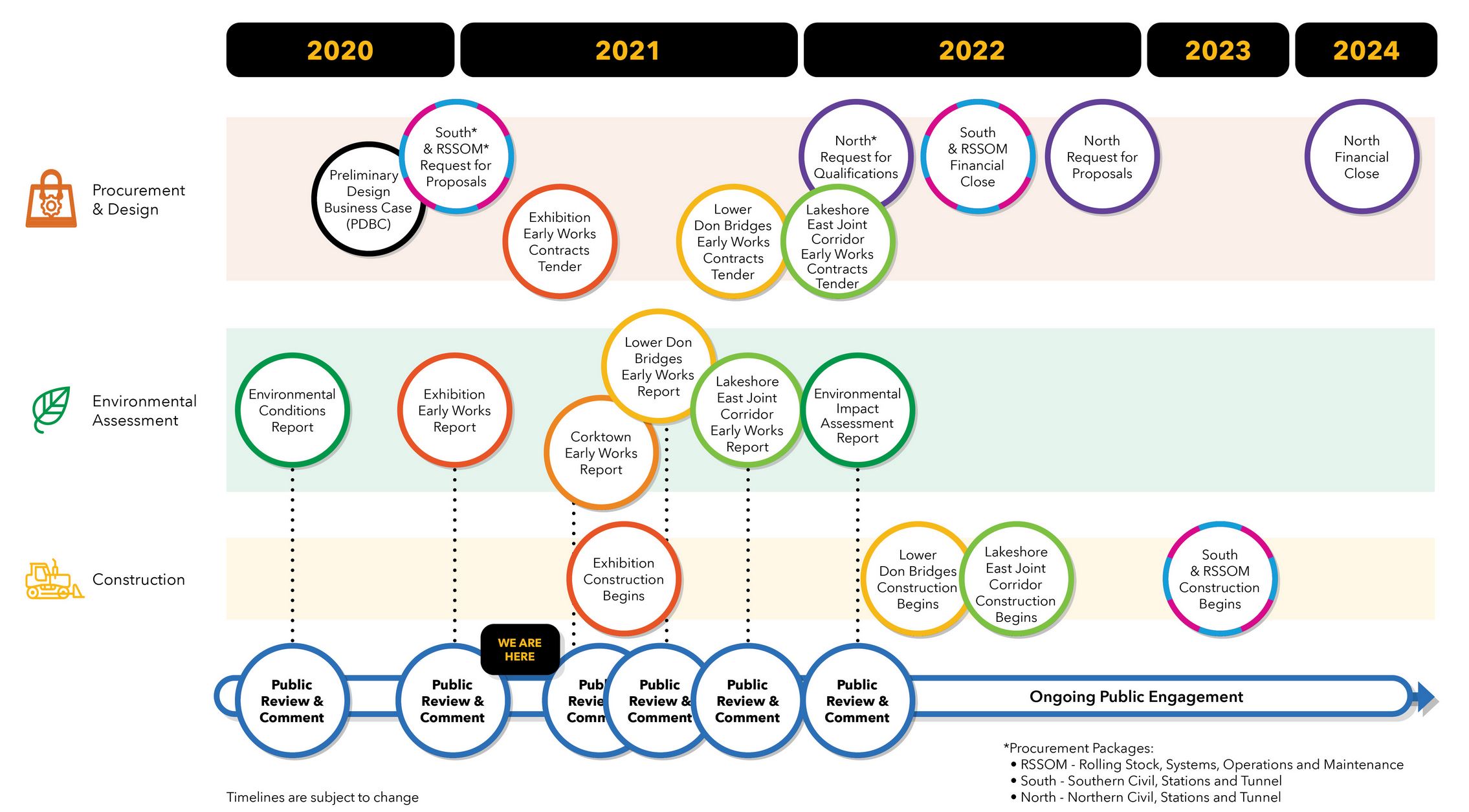
We are still conducting environmental assessments for the area, which include a Joint Corridor Early Works Report and an Environmental Impact Assessment Report for the whole line.

Email from Metrolinx Media Relations, March 26, 2021

This has many implications including the total space needed for the six-track corridor, the placement of electrification infrastructure, the effect of stations on their neighbourhoods, and transfer provisions at the key East Harbour Station.

From a construction point of view there are benefits to keeping the OL tracks together:

  • There is no longer any need to tunnel under the rail corridor so that the eastbound track can reach its position south-east of East Harbour Station, nor to tunnel again for the tracks to rejoin at Gerrard before heading up Pape.
  • Only a single shared bridge over the Don River will be needed.
  • The two directions of the OL can share a centre platform rather than requiring dedicated platforms, including access elements like escalators and elevators.
  • Structures for GO can be better separated from those for the OL which will now lie beside the GO tracks, not astride them.
  • Construction of the OL should have less effect on the adjacent GO operations.

The possible downsides or side-effects include:

  • The consolidated eastbound and westbound platforms and station structures are now all on one side of the GO corridor possibly affecting areas and buildings that were previously outside of the construction area.
  • The minimum clearances for GO electrification will have a greater effect on the east side of the corridor because the eastbound OL track will no longer provide some of the separation needed from nearby buildings and vegetation.
  • The claimed benefit of across-the-platform transfer between GO and OL services at East Harbour is now reduced. All transfers will have to go down to a concourse level to switch between trains.

At the March 25 Metrolinx Board meeting, management presented an overview of the Ontario Line and the benefits of above ground construction. This alignment change was not mentioned at all. Notable by its absence was any reference to the convenience of across-the-platform transfers, a major selling point for the OL as a potential way to offload demand from Union Station.

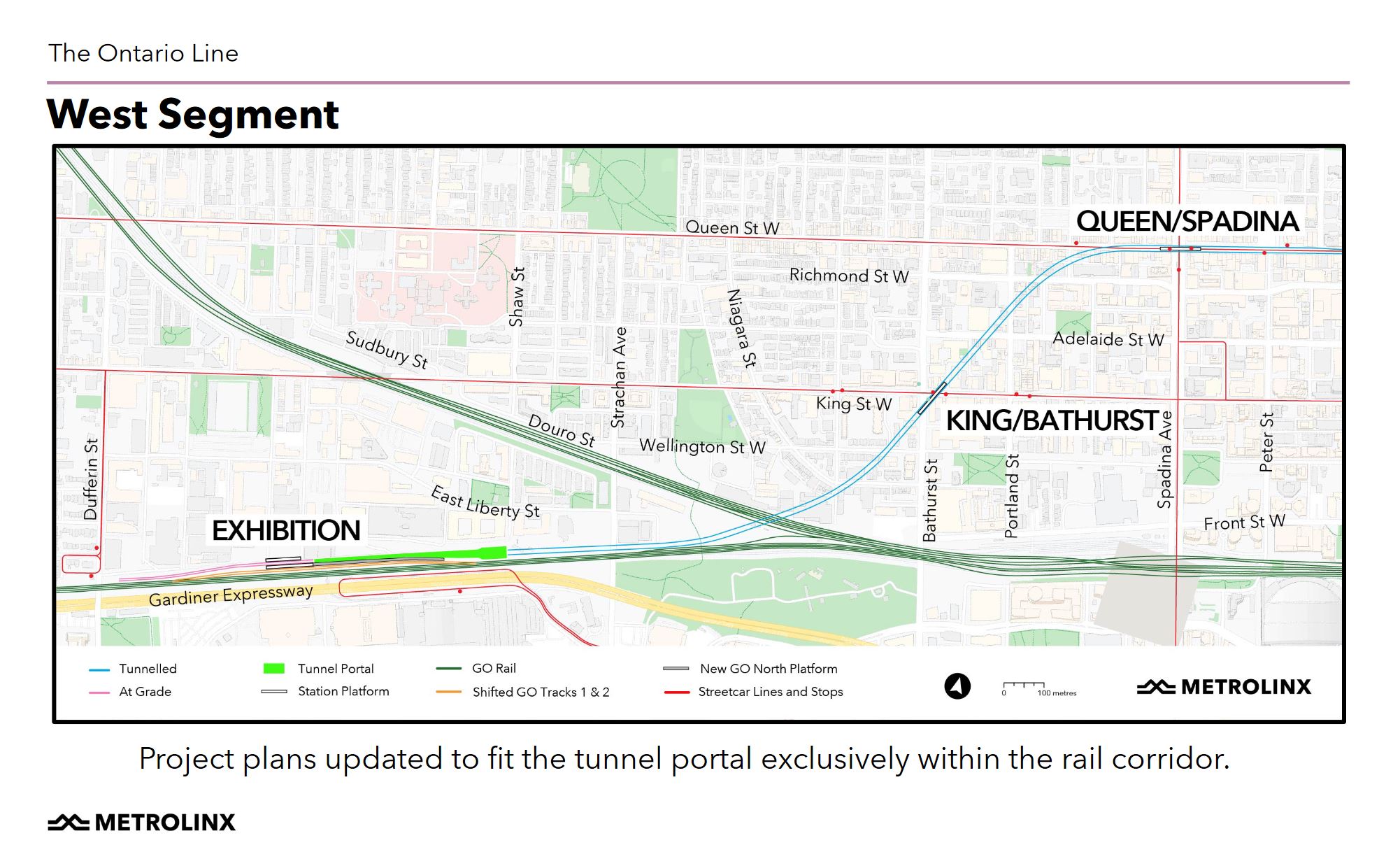
When originally announced, the Ontario Line would provide across-the-platform transfers with GO at both East Harbour and Exhibition Stations to redirect some GO traffic to the OL and offload Union Station. At Exhibition, this design has already proved to be impractical and the OL station will be entirely north of the rail corridor. We appear to be on the verge of seeing a comparable change at East Harbour. This was a major selling point for the OL design.

As I discussed in a previous article, aspects of that presentation put a better spin on Metrolinx plans than might actually be deserved. With the change in the track layout, a further issue pops up: the proximity of buildings or vegetation to the electrified GO trackage.

Here is a diagram showing the minimum clearances from adjacent vegetation (mainly trees) on an electrified GO corridor:

In a context where buildings are nearby, the diagram changes a bit, but the basics are similar.

These drawings show a two-track GO corridor, but Lake Shore East will have four tracks, plus the Ontario line tracks. If this view looked northeast, the OL tracks would be on the left side, probably to the left of the pole holding the overhead system.

In that configuration, the “no vegetation” zone to the left (west/north) would be occupied by the OL itself which should have much less restrictive requirements for nearby growth because it uses overhead power at a much lower voltage than GO trains. However, on the right (east/south), the outermost GO track is now at the edge of the corridor and clearance requirements for electrification apply. [Corrected March 28/21 to reflect overhead rather than third rail power supply.]

An illustration of a park on the line must be seen in this light. This shows a mature tree immediately beside the sound wall and the overhead support poles. As shown, it is within the clear zone required for electrification.

In the management presentation, Metrolinx claimed that the Ontario Line will actually make the neighbourhood quieter, although they did not explicitly say “quieter than today”. This is something of a stretch because there will still be more GO trains, and many of them (thanks to the Bowmanville extension of GO service) may well be diesel.

This is an example of a fundamental problem with Metrolinx planning for this corridor: they conduct separate studies and community sessions for the Ontario Line and for the GO Expansion and Electrification program rather than producing a consolidated plan showing the effect of all three changes planned over the coming decade.

A further exaggeration, intended to show how all of this work has a beneficial end even though it might affect the community, lies in claims of environmental and congestion benefits of the project (regardless of its alignment).

All of the new transit riders on the Ontario Line are assumed to represent avoided auto trips complete with their congestion and pollution. There is no guarantee that fewer auto trips will be taken in the future due to a backlog of demand for road space, and due to population growth.

A common remark Metrolinx has made about The Big Move regional plan is that it will at best keep things from getting worse. In areas where there is already heavy traffic and congestion, it is not realistic to assume that the day the OL opens, roads will suddenly empty of cars. This is a bogus position, and Metrolinx should know better.

The original Ontario Line scheme was sold on its benefits for GO interchange and because it was claimed to fit within existing Metrolinx lands, more or less. Gradually these claims are coming unglued, although many of the underlying issues were clear the day the line was announced.

Postscript: An Alternate Alignment from the Don River to Carlaw

In my previous article, I alluded to a possible alignment that would splice the Ontario Line into the Relief Line’s alignment running up Carlaw from Eastern. From East Harbour, the OL would have travelled east parallel to Eastern Avenue and descended below grade, then veer north to hook into the Relief Line route at about Logan Avenue.

This scheme depended on the Ontario Line being entirely on the south/east side of the rail corridor at East Harbour rather than astride it (as in the original OL plan) or on the north/west side as in the revised plan.

With the proposed shift of the Ontario Line to be entirely on the north/west side of the rail corridor, this scheme is no longer feasible.

Over or Under? Can Metrolinx Make Up Their Mind?

The Metrolinx Board meeting on March 25, 2021, brought two contrasting views of “good” rapid transit projects to the fore exposing inconsistencies in the “official story” about building above or below ground.

On the Capital Projects front, many works ranging from LRT lines to GO upgrades are on the surface although, of course, the central portion of the Eglinton line is underground. Progress on the surface LRT lines is swift thanks to the avoidance of underground work and complex tunnel structures.

But at the end of the presentation, the “big news” is that prime bidders for both the Scarborough Subway and Eglinton West LRT tunnels have been selected and negotiations are underway on contract details. Some early works such as construction of the tunnel boring launch site at Sheppard/McCowan Station will begin in April.

The long history of debates about Scarborough’s transit network do not bear repeating. Suffice it to say that the underground option is oft touted as the only way to provide good transit, albeit at substantial cost.

According to a Metrolinx Blog article, the line will be tunneled in one bore from Sheppard south and west to Kennedy Station rather than in two separate bores meeting at Lawrence East. This simplifies some of the construction staging and eliminates the potential for major upheaval for Scarborough General Hospital at Lawrence & McCowan. The line will be a single bore 10.7m diameter tunnel according to the Board presentation by Matt Clark.

On Eglinton West, despite the availability of land for a surface LRT right-of-way and demand projections well within the capacity of surface operations, the line will be buried from the Humber River westward as dictated by Premier Doug Ford in his transit plan.

In both cases there will be fewer stations that would have existed with surface LRT options, and on Eglinton ridership projections are lower as a result. (Scarborough is a more complex case because one subway has been substituted for two, if not three LRT lines in a network.) Access time between surface and subway routes – a key item Metrolinx always mentions about its surface alignments – is not mentioned when they enthuse about coming tunnel construction.

So let’s hear it for tunnels!

Ah … but not so fast …

Continue reading

Metrolinx Trims Yonge North Subway (Updated)

Updated March 24, 2021 at 10:00 am: In response to feedback about my remarks regarding the area around the “Bridge” station on the new Metrolinx alignment, I have added a section at the and reviewing the Langstaff Gateway Plan.

On March 18, 2021, Metrolinx released their Initial Business Case for the Yonge North Subway Extension (YNSE) to Richmond Hill together with a refinement, a Supplementary Analysis of their preferred option. There is also a short presentation deck on this subject on the agenda for the Metrolinx Board Meeting of March 25, 2021.

The IBC was originally completed in mid-2020 but it has not been public until now. Some aspects of it were reported at the time in the Toronto Star. (The report appears in the meeting agenda for September 10, 2020 in the private session.)

Updated March 21, 2021 at 9:20 am: A reference page linking to YNSE reports has been added for those interested in the proposal’s history.

The project chronology shows how long this extension has been in various planning stages. The Metrolinx Benefits Case Analysis was published over a decade ago in 2009, and it was updated in 2013. Options studied at the time had more to do with staging than with alignment choices:

  • Option 1: A six stop extension from Finch Station to Richmond Hill Centre with intermediate stations at Cummer, Steeles, Clark, Royal Orchard and Langstaff.
  • Option 2: A phased extension first to Steeles including Cummer Station, with the segment north to Richmond Hill to follow.
  • Option 2A: In addition to the shorter subway extension, service on the GO Richmond Hill line would be improved to every 20 minutes in the peak period.

Regional growth plans tilted the preference to Option 1 as a way to support a node in Richmond Hill.

The fundamental problem which the IBC and its supplement seek to address is that the cost of the extension had grown to $9 billion in 2019 from an original estimate in the 2007 approved plan of less than $3 billion. The project was taken over by the province as part of its rapid transit upload after preliminary design and engineering by TTC and YRRTC (York Region’s rapid transit agency) showed a substantial increase in the cost.

Part, but certainly not all, of that change is explained by inflation, and one must wonder whether the original estimate was low-balled to gain approval for a project with political appeal in York Region. Another problem is that “cost” is reported in different ways by municipal and provincial planners, and it is not clear that all of the increase is on an apples-to-apples comparative basis.

In the June 2020 IBC, Metrolinx evaluated three options as shown on the map below.

  • Option 1 (turquoise) is the original alignment that follows Yonge Street to a station at Langstaff, and then swings east to a terminal at Richmond Hill Centre.
  • Option 2 (blue) includes a new stop “Bridge-West” at Highway 407 and a station at High Tech Road.
  • Option 3 (pink) turns off of Yonge at Kirk Drive, cuts under the Holy Cross Cemetery and follows the CN Bala Subdivision with stations at “Bridge-Centre” and an High Tech Road. This was the preferred alignment in the IBC.

Here is a closer view of the north end of the line showing all three options.

Option 3 shown in pink above is the preferred one for reasons I will describe below, but there were concerns that it cut under the corner of Holy Cross Cemetery. This led to the alignment proposed in the Supplementary Analysis.

At the Don River crossing, the revised alignment swings west and then turns east following a route to the CN Bala Subdivision (GO’s Richmond Hill corridor) further south than in the original Option 3 shown above. The subway runs under the CN corridor where it passes under the cemetery, and then surfaces to run alongside the railway tracks.

Another major change in the design is that some stations have vanished, although depending on how the budget works out, they could gain a reprieve. The affected stops are Cummer/Drewry, Clark and Royal Orchard.

Continue reading

TTC Transit Expansion Update

At its February 10, 2021 meeting, the TTC Board receive a long report entitled Transit Network Expansion.

The raison-d’être for the report is to obtain the authorization to increase staffing by 34 positions that would be funded by Metrolinx, but would be part of the TTC’s stucture. Many aspects of projects underway by Metrolinx depend on TTC input and acceptance because they affect lines the TTC will operate and, at least partly, maintain. A new Transit Expansion Assurance Department within Engineering & Construction. The authorization include provision for temporary expansion beyond 34 should this be required.

This move is intriguing because it implies Metrolinx has accepted that it cannot build new lines completely on their own without TTC input, especially when they will operate as part of the TTC network.

The report also requests authorization for:

[…] the Chief Executive Officer, in consultation with the City Manager, City of Toronto where applicable, to negotiate a Master Agreement and/or other applicable Agreements with the Province and/or any other relevant provincial agency for the purposes of the planning, procurement, construction, operations, and maintenance of the Subway Program, in accordance with Board and City Council direction, and to report back to the Board on the results of such negotiations. [pp. 2-3]

There is a great deal more involved in building and operating transit projects than holding a press conference with little more than a nice map. Now comes the hard part of actually doing the work. Whether Metrolinx will negotiate in good faith remains to be seen, but the TTC and Toronto appear to be less willing to hide Metrolinx’ faults in light of the Presto screwups.

Another recommendation has a hint that all is not well with consultations, as that should be any surprise to those who deal regularly with Metrolinx.

Request Metrolinx to conduct meaningful engagement with the TTC’s Advisory Committee on Accessible Transit (ACAT) as part of the Project Specific Output Specification (PSOS) review and design review for all projects within the provincial programs. [p. 3]

The operative word here is “meaningful”. ACAT has already complained of difficulties with Metrolinx including such basics as poorly designed elevators on the Eglinton Crosstown line that cannot be “fixed” because they have already been ordered.

Right from the outset, the TTC claims to have a significant role, a very different situation from the days when Metrolinx claimed it would be easy for them to take over the subway system.

The TTC continues to play a key role in the planning, technical review, and implementation of all major transit expansion projects in Toronto and the region. These include the Toronto Light Rail Transit Program and the provincial priority subway projects, referred to collectively as the “Subways Program”: the Ontario Line; the Scarborough Subway Extension; the Yonge North Subway Extension; and the Eglinton Crosstown West Extension. [p. 1]

In support of the staffing request, the report goes into great detail on many projects:

Two projects are not listed among the group above, but there is a description buried in the section on Bloor-Yonge expansion.

  • Overall subway system capacity and service expansion
  • Any discussion of the Line 2 renewal project

There is no discussion at all about renewal and expansion of surface service. This is just as important as new lines, but it is not seen as “expansion” with the political interest and funding that brings. Yes, this is a “rapid transit” report, but the core network of subway lines dies without the surface feeder routes, and many trips do not lie conveniently along rapid transit corridors.

The map below shows the location of most of the projects, but there are some odd inclusions and omissions.

  • The RapidTO bus corridors are not included.
  • City-funded GO stations at St. Clair/Old Weston, Lansdowne, King/Liberty, East Harbour and Finch/Kennedy are shown.
  • GO funded stations at Woodbine Racetrack, Mount Dennis, Caledonia and Park Lawn are shown.
  • The planned improvement at between TTC’s Dundas West and GO’s Bloor station is not shown, nor is any potential link between Main and Danforth stations.
  • SmartTrack stations are shown, but there is no discussion of how GO or ST service would fit into the overall network.

The following two maps have attracted a lot of attention, although they do not tell the full story. Much as I am a streetcar/LRT advocate, the presence of the entire streetcar network here is misleading, especially in the absence of the RapidTO proposals. Some of the streetcar lines run in reserved lanes, although thanks to overly generous scheduling some of them are no faster than the mixed-traffic operations they replaced (notably St. Clair). However, most of these routes rank equivalently to the bus network in terms of transit priority. If we are going to show the streetcar lines, why not the 10-minute network of key bus route?

The map is also distorted by having different and uneven scales in both directions. The size of downtown is exaggerated while other areas are compressed.

For example, the distance from Queen to Bloor is, in reality, half that of Bloor to Eglinton and one quarter of Eglinton to Finch. It is also one quarter of the distance from Yonge west to Jane or east to Victoria Park. For comparison, the TTC System Map is to scale, and it shows the city in its actual rectangular form.

This map gives an impression of coverage, but masks the size of the gaps between routes as one moves away from the core. Bus riders know all about those gaps.

By 2031, the network is hoped to look something like this. No BRT proposals are shown, but we do see the waterfront extensions west to Dufferin, and east to Broadview (East Harbour). Also missing are the GO corridors which, by 2031, should have frequent service and (maybe) attractive fares. They are (or should be) as much a part of “Future Rapid Transit” as the TTC routes.

This map is trying to do too much and too little at the same time. It also reveals a quite selective view of “regional” transit.

I am not trying to argue for a map that shows every detail, but it should exist (a) in scale and (b) in formats with overlays showing major parts of the network and how they relate to the overall plan. When people concentrate on the pretty coloured lines, they tend to forget the other equally important parts of the network.

Continue reading

TTC Board Meeting: February 10, 2021

The TTC Board met on February 10 with a thicker-than-usual agenda including:

  • A review of the Five Year Corporate Plan Status & CEO’s Report
  • A report on liquidated damage provisions within the contract for additional streetcars
  • Proposed asbestos removal projects at St. Patrick and Queen’s Park Stations
  • An update on the Presto contract with Metrolinx, and on the TTC’s pursuit of information on a possible replacement system from other vendors
  • An update on the Fair Pass program

The Board spent considerable time on the proposed shutdown of the SRT. Please see my original article Bye, Bye Scarborough RT on this issue which has been updated to reflect their debate and decision.

The Transit Network Expansion report also deserves its own article and will be reviewed separately.

Continue reading

Recycling the SRT

The ink was barely dry on the TTC’s recent proposal that service on the SRT end in mid-2023 when the inevitable question was posed: what should be done with the infrastructure and right-of-way afterwards?

A scheme floated several years ago would have converted the elevated structure between McCowan and Midland Stations to something like the High Line park in New York City. That is certainly an option once the line is no longer needed to carry transit vehicles.

At the City Council meeting of February 3-5, 2021, Councillors Josh Matlow and Paul Ainslie, never fans of the Scarborough Subway, proposed the following motion. Council ran out of time and debate was deferred to a future meeting. However, the issues here deserve attention now, specifically at the TTC Board meeting planned for February 10, 2021.

Councillor Josh Matlow, seconded by Councillor Paul Ainslie, recommends that:

1. City Council request the City Manager to report to the June 1, 2021 meeting of Executive Committee on options for Scarborough transit that includes a:

a. technical assessment of moving forward with the Scarborough Light Rail Transit, including length of construction time and new platform location at Kennedy Station;

b. feasibility study and cost estimate of converting the elevated Scarborough Rapid Transit structure to an above-grade Bus Rapid Transit; and

c. feasibility study and cost estimate of removing the elevated Scarborough Rapid Transit structure and operating a Bus Rapid Transit at-grade.

2. City Council request the Toronto Transit Commission Board to release the “Integrity Assessment for Life Extension/Continued Operation” report by Bombardier, in partnership with WSP Canada Inc. and CH2MH, referenced in the Fleet Life Extension – Line 3 Scarborough report to the Toronto Transit Commission Board on May 8, 2018 to City of Toronto residents as a public attachment to the aforementioned item on the Toronto Transit Commission’s website.

The likelihood that Council would approve another study of the LRT option for this corridor is dim, at best. This is an extremely contentious issue debated many times under clouds of conflicting information about various technologies. While I have always supported the LRT option going right back to its origin fifty years ago, I have no illusions that we are about to see it emerge soon, if ever as a contender.

Doug Ford’s government took control of the Scarborough Subway Extension project and will bull through with it no matter what. According to the most recent Infrastructure Ontario update, the contract for tunneling will be awarded in spring 2021, and it is hard to think of anything that will derail this. Cost overruns and delays may be in the future, but far too much political ego is on the line to change course today barring a financial catastrophe that prevents the SSE (and many other projects) from going ahead.

At this point, a review of the work involved to reactivate the LRT proposal would be a diversion. That ship has sailed. Also, to be quite blunt, in the current political climate it is likely than any LRT study would be tweaked to present a worst case scenario.

However, the BRT proposal is worth study, and this should begin immediately to inform the plans for a bus replacement service. Conditions on segments of the line differ, and this should not be seen as an “all or nothing” situation.

Continue reading

Bye, Bye Scarborough RT

Updated February 15, 2021 at 1:00 pm: A section has been added at the end of this article including the decisions taken at the February 10 TTC Board meeting as well as a few additional diagrams from the staff presentation.

In a report to the TTC Board for its meeting of February 10, 2021, management recommend that the Scarborough RT line, long beset by problems through its initial design and advancing age, be closed in 2023. Buses would replace the RT until the subway extension to Sheppard & McCowan opens in 2030.

Staff would consult with the community and Council about plans for replacement services, but the fundamental decision to close the SRT would not be on the table.

The next report with a final recommendation would come to the Board in fall 2021.

This article does not contain any commentary on the political fallout from this recommendation. I will leave that for another time.

Early days of the SRT with a 2-car train north of Kennedy Station

Although the TTC planned to keep the SRT alive until 2026 when the Scarborough Subway was originally slated to open, this is not practical given the ongoing deterioration of the vehicles. Indeed, I suspect that 2023 is a “saw off” target that gives enough time to organize replacement service and infrastructure, but that “as soon as possible” would be the unvarnished shutdown date if management had their way.

To keep the SRT running would require a large amount of maintenance and retrofit work during which part of the fleet would not be available and a parallel bus service would be required. One of the key problems is the obsolescence of the signaling and on-board control systems which would have to be replaced at substantial cost for a limited lifespan. This would also incur the problems of signal systems co-existence with all of the testing and validation needed during the transition.

Several options were considered for operating the SRT over the coming decade:

  1. Hybrid SRT and bus service. This would include major reconstruction and ongoing maintenance including the installation of a new signaling and on-board control system. Buses would supplement SRT service because part of the fleet would be unavailable during the transitional period.
  2. SRT operation to 2023 with new buses procured for the replacement service from 2023 to 2030.
  3. SRT operation to 2023 with spare buses in the current fleet to 2026 and new buses thereafter.
  4. SRT life extension to 2026.
  5. Purchasing used vehicles from the Vancouver SkyTrain system.
  6. Replacing the SRT fleet with new Mark III ICTS vehicles.

Options 4-6 were dropped from consideration for various reasons discussed later in this article. Option 1 is not recommended because of its cost and complexity. This leaves options 2 and 3 for more detailed study.

Common to both surviving options is a 2023 shutdown of the SRT. Judging by the budget projections, this would occur mid-year, but no specific date has been recommended.

Beyond that date, the options depend a lot on fleet plans and capital spending. With constrained budgets in coming years, option 2 suffers from the need to advance capital spending into the near term (buses for 2023 would have to be ordered soon) compared to option 3 which has more elbow room. To put this in context, the TTC has fleet renewal requirements in all modes that are not fully funded for the coming decade.

Continue reading

TTC Service Changes Sunday, February 14, 2021

There will be few service changes in February 2021 in anticipation of the reassignment of bus services with the opening of McNicoll Garage at the end of March.

Weekday service will be trimmed in response to passenger demand on the following routes:

  • 2 Bloor-Danforth
  • 509 Harbourfront
  • 510 Spadina
  • 512 St. Clair

The 9 Bellamy and 913 Progress Express routes will be changed to operate via Progress Avenue. Bellamy buses will no longer serve stops on McCowan Road, Corporate Drive and Consilium Place (these are served by other routes).

The service changes are summarized in the table linked below.

2021.02.14 Service Changes (ver 3)

The project list has been updated to reflect construction on various parts of the streetcar system as announced by the TTC. This includes:

  • Overhead and station construction work on the east end of 506 Carlton.
  • Overhead reconstruction on various parts of 501 Queen.
  • The King-Queen-Queensway-Roncesvalles project.
  • Reconstruction of Dundas West Station Loop including expansion of streetcar platforms.

Between the construction projects and the reduced streetcar service, the peak scheduled streetcars now number only 126 (AM) and 127 (PM). Out of a fleet of 204 cars, this leaves a lot of room for “maintenance spares”. We must hope that when the TTC puts the entire network back together again late in 2021 that they will have enough working cars to operate it.

In spite of the considerable surplus of streetcars, there are still bus trippers scheduled on 505 Dundas and 506 Carlton.

The bus fleet will operate at less than capacity with a scheduled peak service of 1,520 vehicles compared to the garage capacity of 1,675 and a fleet size of over 2,000. Run-as-directed (RAD) buses are not included in this total, although there are fewer of them now that “regular” service levels have been restored on many routes.

The project list also includes some items for 2022 from the City of Toronto’s map of planned construction work, TOInview. This includes:

  • Completion of the KQQR project from Queen to Dundas (stop modifications).
  • Reconstruction of Broadview Station Loop. The status of a proposed expansion of streetcar platforms is not yet known.
  • Track construction on College from Yonge to Bathurst, and at the intersection of Church & Carlton. Whether the TTC will add curves in the southeast quadrant here to simplify diversions is not yet known. In a previous project at Broadview & Gerrard, the “institutional memory” forgot that there were plans to add a north-to-west curve, and a once in 25 year opportunity was missed.
  • Replacement of the intersection of King & Shaw.
  • Reconstruction of Adelaide Street from Charlotte to Yonge. It is not yet clear whether this will only involve the removal of long-inactive track or the restoration of Adelaide as an eastbound bypass for King and Queen service between Spadina and Church.

Eglinton East & Waterfront LRT Updates

Toronto’s Executive Committee considered a report on the current status of the Eglinton East LRT and Waterfront East LRT projects at its meeting on December 10, 2020.

The primary function of this report is to authorize continued study, not to set priorities nor to discuss funding schemes. As such, its recommendations passed easily because it preserves the convenient fiction of progress without actual commitment. The real battles come when there are $30 billion worth of transit projects and less than $10 billion to pay for them.

In a beautifully ironic touch, the same morning brought news from the Toronto Star’s Jennifer Pagliaro that the Scarborough RT would not last long enough to avoid a shutdown well before the Scarborough Subway could be completed. That announcement raises a raft of questions about Toronto’s transit future that go well beyond Scarborough itself, and I will turn to those issues in a separate article.

Continue reading

Plans for GO Expansion Omit Key Features

Metrolinx has launched another round of consultation for various projects that make up the GO Transit Expansion Plan. Information on these is scattered through various pages on their site.

The consultation runs until December 11, 2020.

There is an interactive map of locations where changes are proposed, although it can be tedious to navigate because the default map does not have street names. (You can change this by selecting a different base map from the options in the upper right of the display.)

This map shows roughly the location of the Ontario Line corridor, but gives no detail about extra space, although the map is not to be taken as definitive. Nothing is shown of potential stations for the OL, and there is no information at all in the map for the several proposed SmartTrack stations.

This means that the scope of the project review and the combined effect GO Expansion will have with other projects is not known. Moreover, it would be foolish to approve a project based on a spec that did not include two major additions that are somewhere in the Metrolinx pipeline.

Stations, be they for the Ontario Line or for GO/SmartTrack require platforms and circulation elements (stairs, elevators, roads) but there is no hint of the space these will take.

Continue reading