Yonge Subway Headway Study 1988 (Part 5)

In this section, we begin Chapter 4 of the study with a description of the centre platform option at Bloor-Yonge Station.

Some of the work needed for this scheme was built during construction of 33 Bloor Street East and the Toronto Parking Authority lot between Hayden and Charles Streets.  The TTC took advantage of the subway structure being uncovered to widen the station and replace the centre columns with a roof spanning both platforms and tracks.  As you can see from visiting the station, this work ends at the northern third of the station because this is physically inside the structure of The Bay.

The section on construction feasibility describes what is necessary to continue this layout further north and it involves, among other things, closing the Bay’s concourse during construction.  That entire passage is almost surreal because it details problem after problem with the construction, but forges bravely onward.  There’s also the small matter of closing Bloor-Yonge Station because the existing platforms must be removed before the tracks can be relocated.

Continue reading

Yonge Subway Headway Study 1988 (Part 4)

This installment completes Chapter 3 of the study with the evaluation of alternative signalling strategies.  The recommented alternative is Automatic Train Control, no surprise there, based on the premise that it provides the maximum benefit versus the expenditure.  Underlying this, however, is the goal of a 90-second headway and the increasing challenges to subway operations as the headway drops.  ATC is treated as a means to achieve this dubious goal rather than a worthwhile move in its own right.

Continue reading

Yonge Subway Headway Study 1988 (Part 3)

This section presents considerations for the vehicle fleet and yards required to house these cars.  An important consideration for any decrease in headway is that the number of trains in service goes up.  This generates added capital and operating costs for an expenditure that addresses only peak period demand.

A proper comparison of lines would look at what happens if the fleet is expanded (regardless of the technology) elsewhere so that new off-peak service is available in a corridor that does not now have rapid transit.

As we will see later, the additional vehicles are a substantial portion of the total project cost for peak headway improvements on an existing line.

Continue reading

Yonge Subway Headway Study 1988 (Part 2)

This thread began with an introduction to the “problem” of capacity at Bloor-Yonge Station which dates back to the 1980s, an era when all expansion of capacity for travel from the suburbs to downtown was assumed to be on the subway network.  If you accept that premise, then it follows that massive expansion of subway capacity is absolutely required.  However, as we have recently seen from demand projections by Metrolinx, when there are good alternatives to the existing subway, people may find other ways to get downtown.

In this section, I will present another chunk from the long Chapter 3 in the TTC’s 1988 study.  This part includes descriptions of four ways to achieve shorter headways on the Yonge line through signalling changes.

Continue reading

Yonge Subway Headway Study 1988 (Part 1)

Recently, there has been a lot of discussion here about the practicality and desirability of adding capacity to the Yonge-University subway.  My position is clear:  there is more to be gained by adding new capacity in other corridors that can, in addition to relieving pressure on the Yonge line, provide alternatives in the transportation network to what now exists.

For twenty years, the focus has always been on beefing up the Yonge line, and this reflects the TTC’s long-standing tradition of looking only at their network when planning transit capacity.  Earlier subway expansion schemes completely omitted the GO Transit network from calculating potential regional demand and modelled all growth in riding on the subway system.  The effect of this shows up in the Network 2011 proposal that projected large increases in subway demand.  Those increases triggered a study in 1988 of what could be done to add capacity to the Yonge line, and we are still living with some of the fallout from that study today.

When I dug the report out of my archives, I thought that I would only scan, edit and post a few chapters. However, I soon realized that the arguments of 20 years ago are worth reading today because they are instructive both for the basics of transit operations, and because they show the origins of some current thinking.

For convenience, I have chopped up the document into sections.  The text, which was originally doublespaced typewriter (Courier) format, has been converted to single spaced Times Roman (yes, I know some of you just hate Times Roman).  Some exhibits that didn’t lend themselves to text-based conversion have been scanned separately as jpegs.

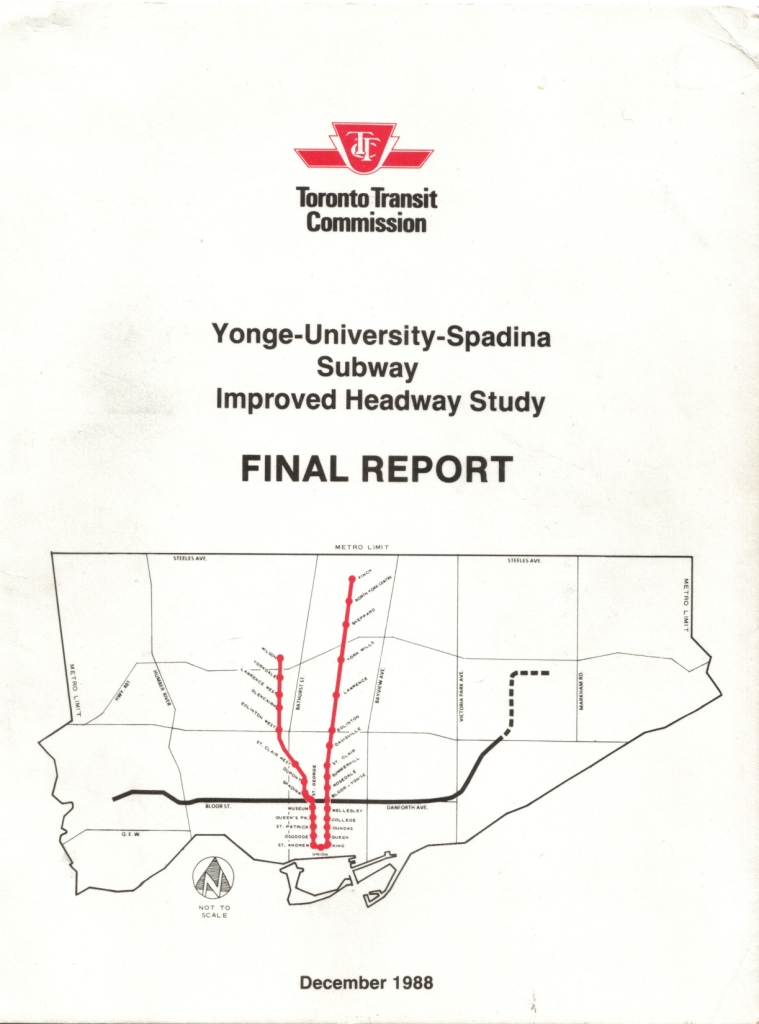
The first installment (this post) contains chapter 2 and the first parts of chapter 3 of the Final Report (chapter 1 was the Executive Summary) dealing with the problem of projected congestion and the various ways in which signal changes could be used to reduce headways.  In the next installments, we will see:

  • detailed descriptions of four schemes for signalling changes to achieve closer headways
  • a discussion of vehicle requirements
  • conclusions and recommendations for signalling
  • four schemes for a reconstructed Bloor-Yonge Station
  • evaluation of impacts at other stations and terminals, notably Finch and Wilson
  • options for the Yonge-Spadina loop
  • final summary and recommendations

Chapter 4 (the Bloor Yonge schemes) contains useful material to those of you who have been, figuratively speaking, drawing lines on maps for the past few weeks with possible alignments for additional tracks.  It helps to know the lay of the land both above and below ground.

Because we have already had quite a lot of discussion about routing alternatives, I will exercise my editorial prerogative to delete or severely cut repetitions of past discussions.  The main reason I am putting this material up is to show what was actually considered and how the history of past studies like this colours future projects.  That’s an important context for the current Regional Transportation Plan discussions — things that seem trivial today will take on the aura of historical received wisdom in less than a decade.  Maps drawn on stone tablets are hard to change.

Continue reading

Expanding Bloor-Yonge Station

[Comments are now closed on this item.  I am getting tired of repeating myself about the physical possibilities at Bloor/Yonge and the fact that this is not the only place we would need to look at expanding if we substantially increase subway capacity.  There is nothing more to add to this discussion.] 

Several people have left comments or sent emails on the subject of capacity at Bloor-Yonge.  Mark Dowling’s was the latest, and I thought it would be a good place to start a new thread.  (The poor-man’s diagram below has been corrected to match the actual station layout.  Thanks to Miroslav Glavic for pointing out this howler of an error.)

A letter writer to the Star this morning mentions the 1 Bloor East project as a way of expanding Bloor Line capacity – I am concerned about the possible effect of this building on peak crowding. Would it be possible to “stagger” a second platform so that it would be under the 1BE site? I guess the connection to the Yonge line would be tricky but this might be an opportunity we won’t get again.

====================   existing WB track
XXXXXXXXXXXXXXXXXX   existing centre platform
====================   existing EB track
XXXXXXXXXXXXXXXXXX   new EB platform

On the Bloor line, it is important to understand where the station sits physically.  All of the station is north of the 1 Bloor East site.  The west end of the station is inside the structure of the Hudson’s Bay Building at 2 Bloor East and is roughly under the east side of Yonge Street.  You can tell where it is quite easily from the location of the western exit from Yonge Station which comes up to street level between the Bay and Starbuck’s (formerly Britnell’s Book Shop).

The silver columns at Bloor Station on the Yonge line are directly under Bloor Street.  This used to be the entrance to the stairs up to the Bloor streetcar transferway.   Note that these columns lie south of the mezzanine area and the stairs down to the Bloor Subway.

The east end of Yonge Station lies under Bloor, and the turn into the tunnel is roughly under the intersection of Park Road and Bloor Street at the east end of 2 Bloor East.  The round tunnel runs east under Bloor to Sherbourne where the line turns south and runs parallel to Bloor east of Sherbourne before turning back to the north to cross the Rosedale Valley Road.

Many years ago, the TTC produced a plan for expanding Bloor-Yonge Station including a new eastbound platform as shown here, not to mention a new centre platform on the Yonge line.  Indeed, it was this scheme that was used to justify “phase 1” — the widening of the platforms at Bloor Station.

One big problem with adding such a platform is that you need to connect it with the station “upstairs”.  This is extremely difficult given that much of the structure would be inside of the existing 2 Bloor East building.  Indeed, the TTC’s own plans showed a large column directly conflicting with what would be the new eastbound platform.

The basic point is that 1 Bloor East may be adding more demand at this station, but I doubt that every resident will spill out onto the subway at the same time if only because there wouldn’t be enough elevator capacity for that.  Structurally, the site is completely separate from the Bloor subway line and offers no opportunities for expansion.

As for the Yonge line, the TTC did have a scheme to add a third centre platform, but building it would be extremely complex (again it is inside of existing buildings) and parts of the work would require that the station be closed (yes, closed) for at least half a year.  You don’t just shuffle platform space and track around as an overnight job.

Many capacity issues in transportation (and indeed in other systems) can be approached in two ways:  either we go into panic mode and desperately try to expand at the perceived site of the problem, of we figure out how to reduce demand at that point by directing traffic elsewhere.  As I have written in many other posts, this comes down to improving GO rail service so that the subway isn’t lumbered with all of the long-haul trips and adding capacity into the core to divert traffic off of the Yonge line itself.

Crowding at Bloor Yonge Station

I received the following note from James McArthur:

I  was just curious to hear your take on the need to significantly expand the capacity of Bloor/Yonge Stn. particularly because of the bottlenecks in the mezzanine and stair/escalator areas (these are really bad even outside rush hour).

I saw that Adam Giambrone mentioned renovating the lower level (for aethetic reasons I gather), but has any consideration been given to this problem?  How can you solve it w/o spending hundred’s of millions?ill the TTC even try?   Can the system carry more riders if they don’t?

Steve:  Years ago, the TTC had a plan for expanding the capacity of Bloor Yonge that was breathtaking in its scope.  Fortunately, the only part they actually built was the widened platforms on the upper level and the removal of the central pillars.  The whole scheme involved moving the Yonge line tracks further apart and adding a centre platform.  Vertical access was a real problem, not to mention construction at the north end where the station is physically inside of the Bay.

The scheme also involved new platforms outside of the existing tracks on the Bloor level.  Access between all of the platforms was complex, and construction issues, were very, very difficult.  The station sits in an old stream bed and much work would have to be done by hand in a pressurized environment. 

Oh yes — the station would close for at least six months.  Trains would run through without stopping and bus shuttles would take people from Rosedale to Wellesley.

Adding capacity to the Bloor line’s platform is very difficult because the station is inside of the Bay building including some of the structural columns that hold it up.  This is a major issue in any move to increase capacity on the Yonge line through resignalling.  If the Bloor line cannot take passengers away as fast as the Yonge line delivers them, then congestion will be worse than it is today.

Headways, as we have discussed here before, are constrained on the Bloor line by turnaround times at terminals.  Even if we had more platforms, escalators and stairways, we would not be able to have more trains.

The real issue with Bloor-Yonge is the number of people coming through it who could be taken to the core via an alternate route be that GO Transit or a “downtown relief line” of some flavour.  It may be cheaper and provide better service in a network sense to look at new capacity into the core rather than trying to pack more people through the Bloor-Yonge interchange.