The Hidden Cost of Subway Capacity Relief

Two studies are underway for the so-called Relief Line:

The alignment for the southern segment has been settled for some time, but the northern segment is still in the exploratory phase of deciding the best route. Planning for the northern segment is under Metrolinx, and all publicly visible work on this stopped for the provincial election in 2018.

Every time either of these lines comes up, the inevitable reaction is “sticker shock” from the very high cost of building a new subway into downtown.

What is missing from the debate is the high cost of retrofitting the existing subway to handle more riders.

When the TTC first advanced its ATC (Automatic Train Control) project, it was to be the solution to all problems. There have been a lot of bumps along the road including:

  • Failure to include ATC signals in the design for the Vaughan subway extension.
  • An unworkable plan to run a mixture of ATC (Toronto Rocket) and non-ATC trains (the T1s now on the BD line) on Line 1.
  • Piecemeal contracts for new signal systems resulting in overlapping and incompatible work.

This was all sorted out, more or less, a few years ago as one of Andy Byford’s big successes as TTC CEO. For a history of the signalling contracts, please read my article here.

However, there is much more to providing added capacity on the subway system, as the TTC gradually discovered and acknowledged through additions to its Capital Budget. Several projects, many of which are not funded, now sit as proposals in TTC plans.

  • Additional trains for Line 1 (for more frequent service and for the Richmond Hill extension)
  • Additional storage for more trains
  • Platform Edge Doors (PEDs)
  • Expansion of Bloor-Yonge Station
  • Expansion of busy stations to provide better circulation for increased volumes of riders to and from trains

Additional Trains and Storage

The subway fleet plan, which I reviewed in detail in another article, includes a provision for more trains to increase the level of service and capacity on Line 1 Yonge-University-Spadina.

Current peak service requires 65 trains of which 4 are “gap trains” used to fill in where a delay would otherwise create a gap in service. The 61 regular trains provide AM peak service every 141 seconds (2’21”) with half of the trains short-turning at Glencairn. According to the plan, by 2029 there will be 79 trains of which 2 will be gap trains. The 77 regular trains represent an increase of about 26% and would bring headways down to roughly 112 seconds (1’52”). Allowing for some trimming of running time expected with ATC, this would result in Line 1 operating a 1’50” headway which is considered the minimum possible given physical constraints at terminals and the effects of dwell times at very busy stations.

However, the fleet of 76 TR trains will only get the TTC through part of this improvement, and there will be a deficit of 9 trains by 2028 as shown above. A 68 train service (70 trains total less 2 gap trains) corresponds to a headway of about 126 seconds (2’06”), an improvement of about 11.4%, and this is the limit of what is possible without more trains.

The plan shows trains under the headings of “capacity” and “ridership growth”. However, only part of the proposed procurement (the 18 “capacity” trains) is necessary to get to the 79 train service shown in 2029. The remaining 26 trains, some of which are spares, would not physically fit on the line without extension of all service on the Spadina leg to Vaughan. Whether the north end of the Spadina leg would actually require a 110 second headway is another matter.

With the price of a subway train sitting at about $36.5 million (mid 2020s), the 44 new trains proposed here would be worth about $1.6 billion plus the cost of future operation. This project is not funded.

A project to expand storage at Wilson Yard is part of the budget, but there is a limit to how many trains will fit there. As the chart above shows, the TTC would run out of storage for trains before all of the proposed new trains are delivered. Future storage depends on a new yard that is part of the North Yonge extension to hold them.

There is a catch-22 here in that some might argue for advancing the Richmond Hill project so that its yard would be available sooner. However, this would also advance the point at which more capacity on both the existing Line 1 and the proposed Relief Line would be needed.

Station Capacity

Much of the TTC’s focus for capacity has been on the signal system and on trains needed to provide more service. However, more service means more riders, and specifically a larger rate for passengers arriving at and leaving stations, and for transfers between lines 1 and 2. There are already problems at some locations with the crush of passengers. Bloor Station is best known, but St. George also has difficulties, and some stations south of Bloor encounter problems with backlogs of passengers trying to leave the platform before the next train arrives. This is particularly severe at locations with limited platform access which can include escalators that are not always in service.

There are three projects in the Capital Budget to address these problems.

Bloor-Yonge Station

The expansion of Bloor-Yonge Station includes the addition of a second platform to Yonge Station on the Bloor line much like the second platform recently added at Union. This would split demand for eastbound and westbound trains between two platforms. The project also includes additional circulation space on the upper (Bloor Station) level for the connections to the new platform. While this addresses some station capacity issues, it will do nothing to increase service and capacity on Line 2 to carry passengers away from Yonge Station even though increased service on Line 1 will deliver them at a higher rate.

This project has a $1 billion price tag, and is budgeted for the first half of the 2020s with completion in 2025. This project is not funded.

There is currently no proposal to expand the capacity of St. George Station, and this location is hemmed in by buildings.

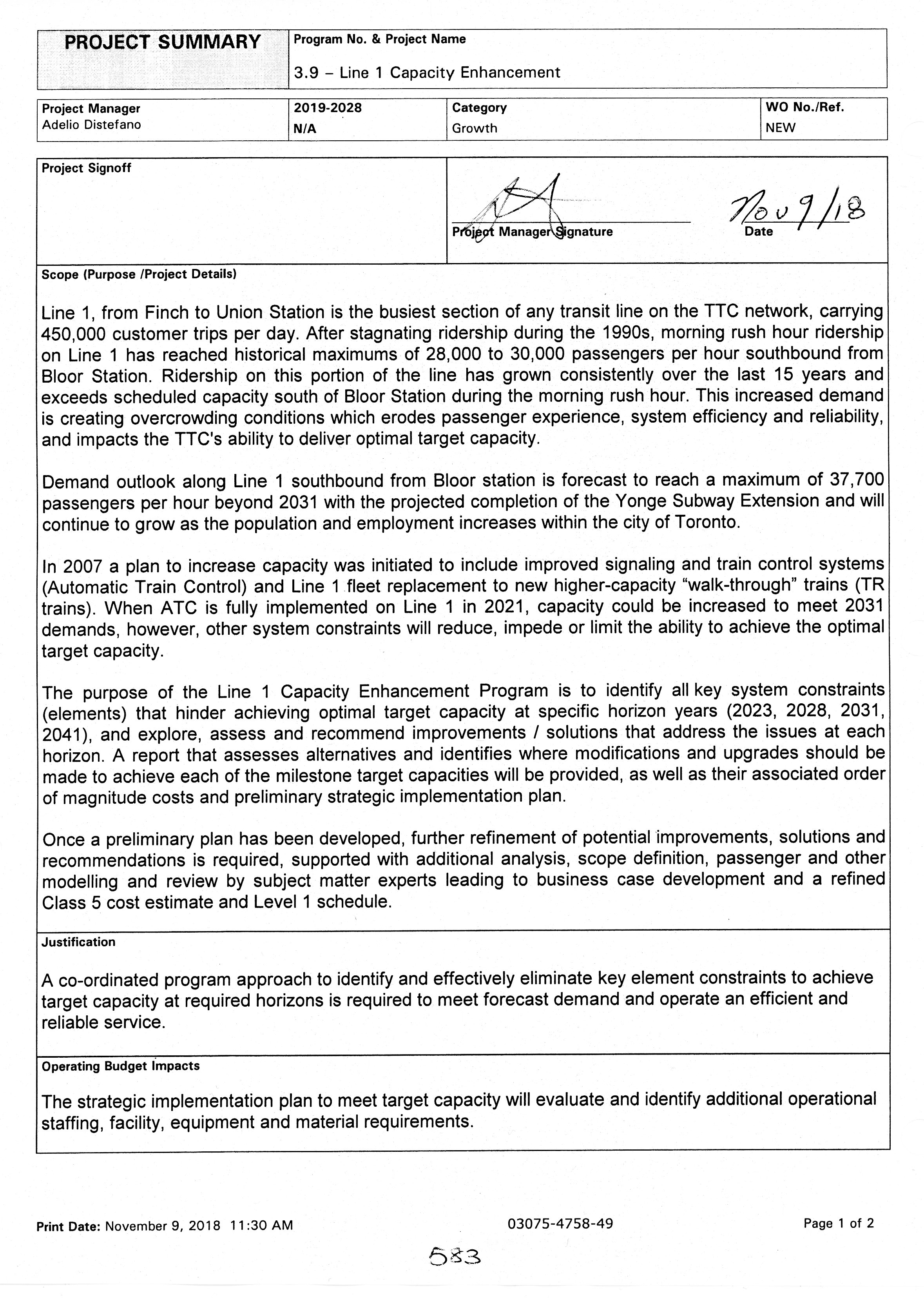
The project summary for the project is below.

Platform Edge Doors

Platform Edge Doors (PEDs) have been proposed for both Lines 1 and 2 for various reasons:

  • suicide prevention,
  • allowing trains to operate through stations without slowing to avoid passengers on crowded platforms, and
  • elimination of litter at track level which causes fire-related delays.

In various public statements, the TTC has been inconsistent about which of these goals is most important, and of course a decision to equip all stations, or only some, depends on what one is trying to achieve. Each is a noble cause in its own right, especially with respect to suicides, but the TTC needs to project a more consistent message on this.

Litter at track level varies with the station usage, and is worst at the very busy stations. Recently, a potato, or maybe it was a lemon, became notorious as it spent over a week wedged under the eastbound track at Yonge Station. Whatever it was, this was only part of an accumulation of debris that had built up over a month putting the lie to the TTC’s claim that it cleans stations frequently specifically to avoid the buildup of material which could cause “smoke at track level” incidents. Some problems do not require multi-million dollar solutions.

A more recent problem with passengers going to track level to retrieve lost objects, or possibly just as a stunt, is quite another matter.

Automatic Train Control (ATC) is an integral part of a PED roll out to provide precision stopping. For Line 1 YUS, the budgeted cost is $610 million with the project spanning the mid 2020s following the full cut over to ATC. In turn, the TTC argues that it will be difficult to achieve the planned 110 second headways with the expected crowding level at major stations unless trains are not slowed on their approach out of concern for hitting waiting passengers.

The cost of PEDs is budgeted at $651 million for Line 2 BD as a post-2028 project assuming that ATC will be in place by that time.

The PED projects are not funded.

The project description from the Capital Budget for the work on Line 1 is below. The Line 2 version is almost identical.

Proposed project schedule. In this chart “BTL” refers to “Below The Line”, that is to say, not included in the funded part of the budget.

Other Station Improvements

Big as many of the subway projects might be, the TTC now includes in its plans a $5.5 billion – yes, that’s billion – unfunded project for enhancement of its station capacity on Line 1. The timing of the proposed work is:

  • 2019: Preliminary strategic implementation plan, solutions and recommendations; business case and Class 5 cost estimate.
  • 2020: Program management plan and preliminary design.

The bulk of the spending for this project is shown in years 2023-2027, although some work might begin sooner depending on the timing of design, project approval and tendering.

The project description includes this warning:

Failure to identify and eliminate key element constraints to achieve target capacity at required horizons will result in increased overcrowding and congestion on Line 1 forgoing TTC’s ability to meet demand needs beyond our current capacity. [Capital Budget Blue Books, p. 584]

There is no indication of the scale of the problem of the locations to be tackled, but the price shows the cost of reworking station capacity in a busy and very constrained set of downtown stations.

And, no I am not making up the $5.5 billion estimated cost. Here is the page showing projected funding and cash flow. To put this in context, this one project is almost as big as the entire funded TTC Capital Budget for State of Good Repair. And of course, that $5.5 billion is unfunded.

Summary

The cost of providing more capacity on Line 1 Yonge-University-Spadina is far more than Toronto has been told in the past. When this all started, it was simply a matter of a new signal system, but that was only the first of many parts in this story. How much of the projected cost here can be trimmed is difficult to say, and that in turn would be affected by the capacity the TTC seeks to operate on Yonge Street. Moving to a full 37k/hour peak demand may not be practical, or could be quite challenging.

Meanwhile, the Relief Line project has, until comparatively recently in TTC history, been treated as something the city only needs as a last ditch effort, something to address a long-future problem, not a pressing need today.

Toronto has been ill-served by the attitude that the Relief Line is a project for another day, not to mention its characterization by some politicians that it is only a project for coddled downtowners. Tell that to people who cannot get on the Yonge Subway, many of whom live far north of Bloor Street.

The division of the RL planning into a south-of-Danforth segment separate from the northern extension means that the substantial benefit of intercepting riders east of Yonge well north of Bloor-Danforth is many years in the future.

The TTC owes Council a thorough discussion of capacity issues on the subway network including all of the interrelated projects needed to deal with present and future demand. For far too long, many projects have been discussed in isolation from each other, or simply have been ignored.

This is an issue for politicians at both Toronto and Queen’s Park who downplay the cost and complexity of a provincial takeover of responsibility for the subway and its funding. Even if the subway remains in Toronto’s hands, there are huge costs facing the TTC and its “funding partners”.

Nothing less than the credibility of transit as an engine for the city’s growth is at stake.

Crowding on the TTC

With recent events of major subway delays and discussions at the TTC Board about a “Ridership Growth Strategy”, the whole question of “what can we do” is swirling through the Toronto media and online. This article is an attempt to pull together threads from several reports and discussions.

This is a very long read and I salute those who stay the course to the end.

In brief, there is a capacity crisis on every part of the TTC system that is the product of years of pretending the problem is not as bad as it looks, and that a few magic bullets can solve everything. This is compounded by underinvestment in the bus network, by Bombardier’s sluggish delivery of new streetcars, and by subway planning that leaves major components either unfunded or missing from the long range capital plans.

There is no easy fix to any of this, but that is no reason to throw up our hands in hopeless resignation to further decline of our transit network. Recovery has to start somewhere even though the benefits will take time to appear. Politicians are afraid of spending money and driving up taxes. Staff act as enablers by concocting budgets that fit within available funding. The numbers “come out right” only because we ignore the full scope of our needs and how badly we have deferred addressing them.

This article does not propose specific remedies, but sets out the history of what has been done (or not done) over past years. Reading through all of it, I cannot help thinking that “Ridership Growth” is a laughable goal considering how hard Toronto has tried to stifle transit’s capacity and attractiveness. But at least the TTC Board is talking about trying to build more demand on its system. To do that, they must first acknowledge the accumulated shortfall between transit we think we would like and transit that is actually on the street.

For convenience, the documents referenced are all linked here:

  • TTC Ridership Growth Strategy (2003) Report
  • TTC Ridership Growth Strategy (2018) Report & Presentation
  • TTC Corporate Plan (2018-2022) Report and Presentation
  • TTC Crowding Standards (January 18, 2018) Presentation
  • TTC Subway Crowding (January 18, 2018) Report
  • TTC CEO’s Report (January 2018)
  • Toronto Budget Committee (January 23, 2018) 2018 Capital and Operating Budget Reports & Minutes
  • TTC Presentation to Budget Committee
  • TTC Briefing Note on Overcrowding
  • Yonge Subway Extension – Final Report on Transit Project Assessment Process and Future Actions (December 17, 2008) Report
  • Yonge Subway Extension – Recommended Concept/Project Issues (December 17, 2008) Presentation
  • Yonge Subway Extension Post Transit Project Assessment Process Technical Amendment (May 1, 2012) Report & Presentation
  • Yonge Subway Extension Conceptual Design (March 2012) Report [Large PDF]
  • VivaNext Yonge Subway Extension Page
  • Metrolinx Yonge Network Relief Study (June 25, 2015) Presentation
  • Amended 2012-2016 Capital Program and 10 Year Forecast – Shortfall Reduction Plans (September 16, 2011) Report

2003 Ridership Growth Strategy

Although the 2003 RGS was recently dismissed by current TTC Chair Josh Colle as if it were yesterday’s answer to transit problems, the context in which it was written is as fresh today as it was 15 years ago.

There is a growing expectation that transit in general, and the TTC in particular, must take on an increased role in providing travel for people in Toronto if the City is to grow and thrive economically and in an environmentally-sustainable way. Each level of government has recently announced plans and policy initiatives, that highlight the need for greater use of transit in urban areas – the City with its Official Plan, the Province of Ontario with its “Smart Growth Council” and “Gridlock Subcommittee”, and the Government of Canada with its approval of the Kyoto Accord. Achieving these policy objectives will require a fundamental shift in transit’s role in Toronto and the relative importance of automobile travel.

Unfortunately, these initiatives follow on the heels of a consistent lack of government support for the TTC in the past decade. Provincial funding was reduced a number of times in the mid-1990’s and is only now being partly restored. The TTC’s ridership and market share has fallen significantly during this period, to a large extent because of lack of government support. While there is no simple “magic answer” that will reverse this trend, government support for the TTC must be real and pronounced if the current widespread public and government expectations for improved transit are to be met.

The TTC’s mandate is to operate and maintain transit services that provide safe, fast, reliable, convenient, and comfortable travel in a cost-effective way. The TTC’s highest priorities are to our current passengers, and to maintain the existing system in a state-of- good-repair. The TTC needs a substantial, ongoing, funding commitment to meet these basic priorities and fulfill its role of providing transportation services to a large proportion of Toronto’s population. Once these needs are met, the TTC could attract more people out of their automobiles and onto transit with a stable source of increased funding and a commitment on the part of the City to implement policies that support efficient transit operations and transit-oriented development in Toronto. [Executive Summary, p. E-1]

Two points here cannot be made too strongly:

  • There is no magic answer, and
  • Looking after the system and riders we have today is essential to attracting new riders.

Investing in improved transit service makes sense for many reasons, but it must be done in a way that provides significant, measurable, and real returns on investment. If taxpayers’ funds are to be used to improve transit services, there needs to be a strong business case to prove that the money is well spent, and that any funding provided will generate significant additional ridership. There is no simple, low-cost solution to achieving increased transit ridership, or to reduce congestion and pollution. Attracting new riders to transit will require substantial increases in government policy commitments and subsidy, on a consistent basis, over a number of years. One-time funding arrangements and individual mega-projects will not result in significant changes in overall travel patterns over the long term or over a wide area. A consistent, long-term, staged program of providing priorities for, and investing in, expanded existing transit services, using proven technologies and operating strategies, provides the best opportunity to achieve sustained increases in transit ridership.

The underlying issue will continue to be the extent to which the City and senior levels of government will be willing to take the steps necessary to invest in transit to achieve their broader objectives. [p. 3]

There is a section titled “Why people choose to use transit” that is too long for me to quote in full here [see pp. 5-6], but a few excerpts are worth including:

The key factors governing mode choice are speed, reliability, comfort, convenience, and cost. Different segments of the market put differing values on these factors, and an understanding of market segments is critical to determining the potential for attracting transit riders. In addition, some modes of travel are simply not available or practical for some trips – few people will make very long walking trips for example – and people do not necessarily have an automobile available for any given trip. The availability and attractiveness of various modes is also very dependent on the location of both the origin and the destination of the trip being made.

The situations where transit can compete effectively with automobile travel are those where there is good pedestrian access to transit at both ends of the trip, and where transit can provide comparable speed to automobile travel when all factors are considered. Under these conditions, transit travel becomes attractive to many potential users. These conditions exist for travel to and from downtown Toronto in peak periods, where the roads are congested and rail lines (GO and subway) provide a comparable travel speed to automobile travel. There is also excellent pedestrian access from the downtown rail stations to destinations in the downtown. Transit achieves a 60%-to-70% mode split to transit in these favourable circumstances.

There is an obvious problem with this observation, and it applied even in 2003: much GTHA travel is not oriented to downtown and its concentrated destinations, and riders will not fall into transit’s lap simply because this is the obvious way to travel. Indeed, in many cases transit will be the last, not the first, choice. This begs the question of whether there are some trips for which making transit even grudgingly acceptable simply is not economic, but at the same time whether there are trips that are poorly served by a downtown focus on travel. This question is not new to transit debates.

If we abandon trips that are harder (or more expensive) to serve, or provide only minimal service to “show the flag” with a route map whose many lines hide less-than-ideal service, do we risk alienating potential riders especially in an era of population and density growth? Market conditions could evolve to give transit a greater role provided that it is there to establish credibility and a base of demand. This is not just an issue for the far suburbs in the 905, but for areas in both the outer 416 and in more central, redeveloping industrial neighbourhoods.

Continue reading

TTC Board “Discovers” Cost of Bloor-Danforth Subway Renovation

The TTC Board met on July 11, and the public agenda contained little that prompted extensive debate. The entire meeting was over in 75 minutes, a quite unusual situation reflecting the onset of the summer break at City Hall.

The status of the streetcar order from Bombardier prompted a spin-off discussion of the subway. CEO Andy Byford had noted that reliability on the Yonge line’s fleet of TR (Toronto Rocket) trains has reached a world-class level, and it is quite substantially better than that of the T1 trains operating on Bloor-Danforth, although their performance is reasonable for cars of their age (about 15 years) and technology.

This prompted a question from Vice Chair Alan Heisey who asked when the TTC should be making plans to replace the T1 fleet. Chief Operating Officer Mike Palmer replied that “we probably had to order the cars last week”. (See YouTube video of meeting.) This came as something of a surprise to the Board thanks to the way that planning for the Scarborough Subway Estension (SSE) and Line 2 BD in general have been handled, with information dribbling out bit by bit, and with plans in the TTC Capital Budget not fully reflecting future needs.

I wrote about this in a previous article, but as an update, here is the status of various projects related to the BD line’s future.

Summary

There are four major components to upgrades facing the TTC for subway expansion on Line 2 Bloor Danforth. Here is their status:

  • Replace T1 subway car fleet
    • Estimated cost: $1.737 billion
    • “Below the line” in the City Budget (i.e. not funded)
    • Current replacement schedule is out of step with plans for other projects
  • New subway yard at Kipling
    • Approximate cost: $500 million
    • Only $7m for planning work is included in the Capital Budget, but nothing for construction
    • Carhouse and yard are a prerequisite for the T1 replacement fleet
  • Automatic Train Control
    • Estimated cost: $431 million
    • Only about $250m currently allocated in the City’s approved Capital Budget
    • Current signal system dates from 1966-69 when the BD line was built and it uses obsolete technology
  • Bloor-Yonge Station capacity relief
    • Estimated cost: $1.117 billion
    • Only $6m for planning work is included in the Capital Budget, but nothing for construction
    • Scope of work and feasibility have not been published

This is not simply a matter of TTC management providing a rosy view of capital needs, or of the City choosing to ignore the scope of the problem. When projects of this scale don’t appear in the “to do list”, they are not considered any time another government comes calling with a funding offer. Many projects that will receive money from Ottawa’s infrastructure fund (PTIF) are on that list because they were acknowledged as part of the TTC’s outstanding requirements.

Keeping the full needs of the Bloor-Danforth subway out of view short-changes the TTC system and the riding public, and politicians are surprised to find that the “ask” for transit spending is a lot bigger than they thought. Meanwhile new projects make claims on “spending room” that might exist only because needs of the existing system have been downplayed.

TTC management plans to bring a consolidated report on the renewal of the Bloor-Danforth line to the Board in September 2017.

Continue reading

Honesty in Subway Planning

Toronto Council recently approved further study on both the “Relief” subway line, and the Yonge Subway Extension north to Richmond Hill. This approval came with several caveats about the timing of projects and the sharing of both capital and operating costs for the YSE.

Meanwhile riders who attempt to use the system as it is are expected to take hope from the fact that “Relief” might appear in only 15 years.

The entire debate about subway capacity in Toronto has, for many years, taken place in among incomplete information, policy directions that looked outward from the core to the suburbs, and in some cases blatant misrepresentation of the complexity of problems the City of Toronto faces.

A major issue throughout the debates has been that individual projects, or even components of projects, are discussed as if they are free-standing “solutions” to the problem when they are only one of many necessary components. Costs are low-balled by omission of critical parts of an overall plan, and the pressures on capital spending are understated by artificially planning major projects beyond the 10-year funding window used for City budgets. This gives the impression that money is “available” for other projects within the City’s financial capacity by stealing headroom in future plans to pay for things that, strictly speaking, should have a lower priority.

The situation is not helped one bit by the lack of strategic planning at the TTC and City where serving the political philosophy of the day often takes precedence over taking a wider view. Indeed the TTC Board, at times, almost prefers to be ignorant of the details because this would force a re-examination of cherished political stances. At Council, although Toronto now has its “Feeling Congested” study and an attempt at prioritization of projects, efforts continue to advance schemes near and dear to individual Councillors who simply will not accept that their wards are not the centre of the known universe.

What Toronto desperately needs is a thorough review of its rapid transit plans and the funding needed to achieve them. This must take into account, and modify where needed, the historical reasons we are in the current situation, and examine what can be done for the future, when this can be achieved and at what cost. The cost question must come second, in the sense that determining what the City needs is an essential first step. Only then can we examine possible alternative ways to address the issues, the cost this will bring and the funding mechanisms that might be used.

Continue reading

The Dwindling Capacity of the Yonge Subway

Yesterday’s launch by York Region of their Yonge Subway Now website brought to the fore the question of just how much room remains on the Yonge Subway for additional riders. Over many years, claims about capabilities of new subway technologies together with changing projections for future demand have left Toronto in a position where its subway is badly overloaded with little relief in sight.

This article traces the evolution of those claims and the reality of what can actually be provided to show that building a Relief Line is not a project for a future decade but one that must begin now.

Continue reading

Yonge Relief Network Study: June 2015 Update

At its board meeting on June 25, 2015, Metrolinx will consider an update on the study of capacity relief for the Yonge Street Corridor in Toronto.

The report states that projected demand on the Yonge line can be handled for the next 15 years:

1.a. Significant relief to the Yonge Subway will be achieved with currently committed transit improvements underway including:

i. TTC’s automatic train control and new subway trains;

ii. The Toronto-York Spadina Subway Extension; and

iii. GO Regional Express Rail

1.b. Based on [the] above, more rapid transit service and capacity that is currently funded and being implemented will meet the future 15 year demand, assuming current forecasts on the growth rate of downtown employment and the implementation of TTC automatic train control on the Yonge Subway.

Continued work is recommended:

2. Direct the Metrolinx CEO to work with the City of Toronto City Manager and the TTC CEO to develop an integrated approach to advance the Relief Line project planning and development, incorporating further business case analysis and the findings of the Yonge Relief Network Study to:

  • further assess the extension north to Sheppard Avenue East to identify a preferred project concept,
  • inform the planning underway by the City of Toronto and TTC to identify stations and an alignment for the Relief Line from Danforth to the Downtown area
  • continue to engage the public in this work as it develops

3. Direct staff to work in consultation with York Region, City of Toronto and the TTC to advance the project development of the Yonge North Subway Extension to 15% preliminary design and engineering.

The emergence of a variation on the Relief Line that would operate north to Sheppard is quite a change from days when even getting discussion of a line north of Eglinton was a challenge. The context for this emerges by looking at the alternatives for “relief” that were considered and how they performed.

The next report to the Metrolinx Board will be in Spring 2016. The challenge will be to keep planning for a Relief Line “on track” in the face of the excitement and political pressures for GO RER, SmartTrack and a Richmond Hill Subway.

Continue reading

The Bloor-Yonge Platform Experiment (Updated)

Updated November 27 at 10:00 am:

A section has been added at the end of this post with photographs of Bloor-Yonge station showing the crowd control measures.

During the AM peak, the TTC is experimenting with crowd control measures at Bloor Station, southbound with the intention of getting more trains down the line and increasing its peak capacity.

Media reports last week did not fully describe what is happening, and for the benefit of those who do not use the station in the morning rush, here is a short description.

  • The existing station before the change:
    • The southbound platform is double-width thanks to an enlargement of the station many years ago during construction of a new office tower.  There is the original platform plus a passageway of almost equal width separated from the main part of the platform by pillars, and at the north end, a wall with several openings.
    • To the west of the southbound platform is the concourse linking the Yonge and Bloor lines, and two sets of stairs and escalators down to the BD level (Yonge Station).  The set closer to the Yonge subway platform tends to be the more heavily used.
    • Passengers coming from the BD line would tend to congregate at the north end of the Bloor Station platform because (a) that’s where they came from the BD subway, and (b) many passengers want to go to the north end exits at College, Queen and King stations.
    • Yonge trains arriving southbound tended to be most crowded at the north end with passengers intending to transfer to the BD line.
  • Following the change:
    • In the west mezzanine, riders coming up the stairway closest to the Bloor Station platform meet a temporary set of barriers directing them into the passage along the wall side of the platform.  They do not actually get on the platform and cannot board trains until they are over two car-lengths down the platform.  If they really want a north end car, they must double back at that point.
    • Riders coming up the far stairway have the option of joining the flow into the southbound passageway, or swinging to the north either to leave via the station exit, or attempt an end-run onto the north end of the platform.
    • Riders leaving southbound trains are directed to walk north on the main part of the platform and then into the concourse.  This divides the traffic from Yonge-to-Bloor transferees who use the main part of the platform from the Bloor-to-Yonge transferees who use the passageway.
    • TTC staff are positioned at critical locations to ensure that people actually follow the correct path so that ideal flows are maintained.
    • TTC staff are at each of the train door positions to ensure passengers can first get out of the trains, and then to regulate boarding so that when the train is ready to leave (full or with another train nearby) passengers don’t rush the doors and try to jam on at the last moment.

For the first few days, it took time for passengers to get used to the new arrangements, and many are still seeing this setup for the first time.  From talks with TTC staff at the station, I learned that the confusion is falling off, and I saw few problems myself.

Continue reading

A Question of Station Capacity (Update 1)

Update 1:  December 28, 5:15 pm:

I have received a note pointing out that a second entrance program is in progress for various stations regardless of the building code requirement for a “trigger” condition (the addition of substantial load to the demand in the station).

The reports in question are from 2004 and 2005.  The 2005 report deals with College, Wellesley, Museum and Castle Frank.  The work at Castle Frank is underway now.  Museum was to get a second exit through the vent shaft at the south end of the station, but this work was put on hold because it was to be funded as part of the condo project on the Planetarium site that was cancalled.

Original post follows with amendments:

“James” sent in a comment in the Richmond Hill subway thread that deserves to start a discussion of its own.

Steve,

Perhaps this comment belongs back in your thread on Bloor-Yonge renovations….

But since that seems to be the dominant line of discussion here….

Your arguments are persuasive on the need to build a DRL (something I already supported); but further, to build it prior to either a major Yonge line extension, or a massive Bloor-Yonge overhaul.

However, I think everyone can accept that Bloor-Yonge, as it is today, requires more space, and improved passenger flows just to cope with existing traffic; and it will likely need that even if a DRL is built. Though, one hopes a less drastic solution might be feasible.

Which brings me to the Steve question of the day. Given the need for capacity/flow improvements and for the renovation for aesthetic and state-of-good-repair reasons of the Yonge portion of Bloor-Yonge…. What if any improvements could the TTC make to this station that would be of moderate expense, and less disruption, in the immediate future?

This post deals primarily with the south end of the Yonge line, but the topic is a generic one for both existing and future stations:  providing the ability for passengers to move around within the stations.  Stations exist to move people, not just trains. Continue reading

Yonge Subway Headway Study 1988 (Part 7)

This section includes the remainder of Chapter 4 covering three alternatives to the centre platform option at Bloor Yonge.

  • A double station with new platforms north of the existing Bloor Station
  • A bi-level station
  • Two versions of a diversionary route with a new southbound or northbound track and station

I commend these to the readers who have been proposing various alternative tunnel and platform arrangements here for a clear view of just where the structures actually lie.  Bear in mind that much has been built since these plans were drawn, and assumptions about available rights-of-way or the acquisition and demolition of buildings are probably no longer valid.

Continue reading