The Priority of Transit Corridors

Anyone who has watched the transit “planning” debates at Council or at the TTC will know that various schemes for higher order transit pop up from time to time, but they are rarely considered as a set, let alone compared to each other. The basic premise is “my ward deserves …” and there ends the detailed evaluation.

In the context of the Fords first at City Hall, and now at Queen’s Park, we got a whole map that was, at least allegedly, the Mayor’s or Premier’s own creation. Tunnels figured prominently regardless of the vehicle that might run through them.

The big plan may take some major projects out of discussion, but this leaves many more ideas competing for funding and attention. Which should be retained, added to or removed from the Official Plan (OP)?

A report at Toronto’s Executive Committee on February 29 makes a first, very rough attempt at answering this question.

Twenty four projects were evaluated to measure their contribution to the City’s various goals for transit spending, city improvement and equity. The actual scoring system attempts to provide a fair, if early, comparison, but the level of abstraction in the process will confuse more than it enlightens. (I will go into this in more detail later in the article.)

The list of projects was compiled from the existing OP, schemes that Councillors have promoted over the years, and a few busy bus corridors. An important product of the exercise will be to update the OP to match current priorities, and to adjust the map of target road widths to protect corridors where a surface right-of-way might be needed.

After the scores were brewed, the projects were sorted into quintiles with the highest being the most promising and the lowest likely to remain on the shelf. The report stresses that the rankings are relative and that a low score does not necessarily mean a project has no value, merely that others perform better.

This will not please advocates of the lower-ranked projects such as the Sheppard subway extensions east from Don Mills and west from Yonge, the Ontario Line extension to Dundas West, the Line 2 Sherway extension, and the Waterfront West LRT. Whether the affected Councillors will attempt to have the priorities, and hence the focus of further study, shuffled, and whether Council will approve, remains to be seen.

It is easy to vote for a request to look at a single project in isolation, some day, maybe. Much more difficult is to try juggling a priority list when the City has finite resources to study or build anything. Another problem is that development does not necessarily follow transit plans, and can be affected by access to expressways.

This map shows the location and status of the projects, and shows those that are not already in the OP:

Continue reading

The Unhappy State of SRT Track

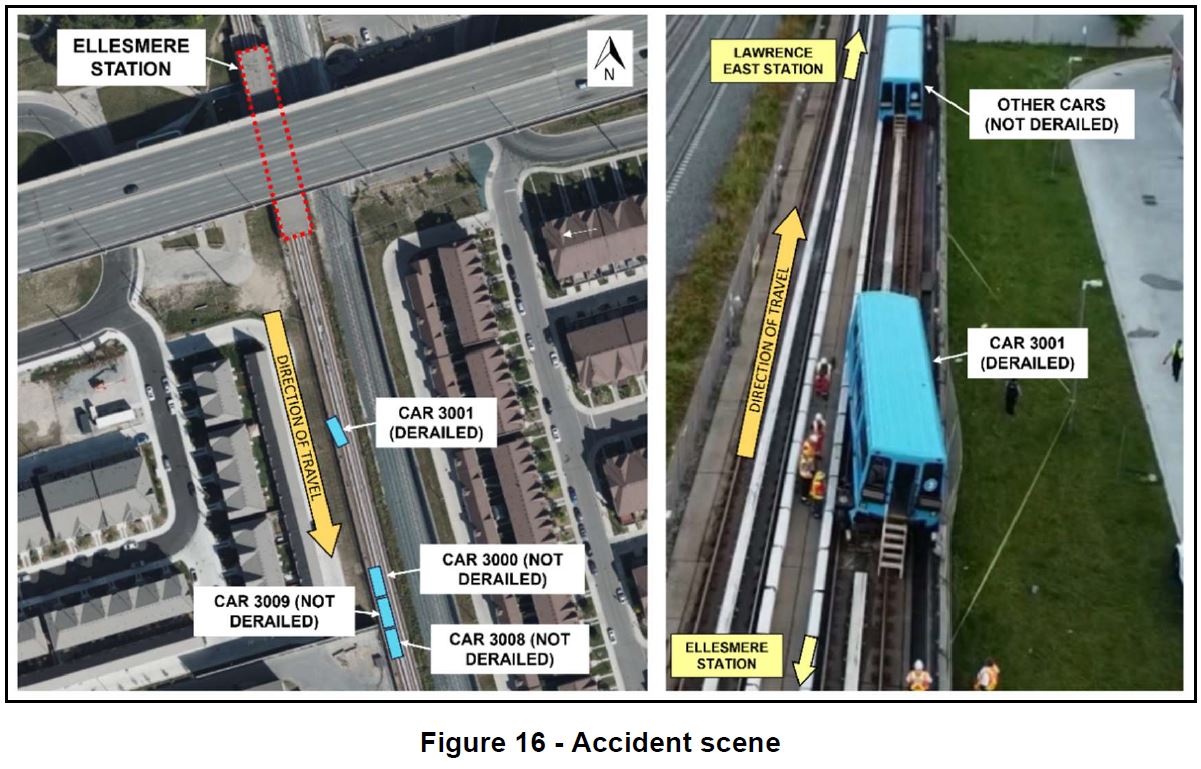
On July 24, 2023, at about 6:43 pm, a southbound SRT train derailed south of Ellesmere Station after snagging the reaction rail. This event lifted the rear truck of the car off of the track and also caused it to break away from the rest of the train.

The detailed investigation reports were quietly posted on the TTC’s website, and I wrote a summary of them at the end of January:

I filed a Freedom of Information (FOI) request with the TTC at the beginning of 2024 for “track inspection reports and work orders” for the SRT between June 1 and August 31, 2023. The reason for the extended cutoff date was to pick up any inspections and repairs that took place after the derailment.

Continue reading

A Ridership Growth Strategy for 2024

Introduction: Regular readers of this site will recognize threads and arguments from past articles here. Indeed some recent posts were intended as background to this overall article on our city’s transit direction. There is a new Mayor with Council support for change. However, we risk that momentum will be lost and content ourselves with “full service restoration” and a handful of RapidTO projects.

This is not exactly a manifesto, but we have been here before with hopes for new and improved transit seeking progress beyond “business as usual”. Will this round be any different?

Thanks to readers for tweaks in the text. This is a long article, and I have broken it into segments with hotlinks here so that you can jump to specific chapters.

Continue reading

The Vanishing Business Case for Regional Fare Structure

Anyone who deals with Metrolinx from the outside knows that getting information can be a real struggle, but every so often the veil of secrecy lifts, although not always intentionally.

The implementation of “regional fares” is supposed to happen in March 2024, but this will be on a fairly limited scale, at least according to anything published so far. The TTC will come into the same arrangement as the 905 systems with recognition of each other’s fares across the 416/905 boundary, and the reinstatement of a GO Transit cofare.

Like the elusive Toronto sun of recent weeks, a report appeared, and then disappeared on the Metrolinx website called Regional Fare Structure Initial Business Case Final April 2023. This is not a draft, but gives a sense of Metrolinx thinking on the subject and how little some of their fare objectives have changed over the years.

To be blunt, fare planning at Metrolinx has always eyed the Toronto subway as a “regional” facility and its riders as potential cash cows who will help fund other parts of the system. I wrote about this back in 2017-18.

A major problem with earlier proposals was that the Toronto subway was treated as a premium service, like GO, where riders should pay more for the speed and comfort compared to the surface system. This utterly ignored the fact that the TTC system is designed as a single network with subway lines as the backbone and feeder/distributor surface lines. The underlying reason for pushing up subway fares was to make the model revenue-neutral, in effect, to subsidize the elimination of extra fares for cross-border trips with more expensive subway rides.

That scheme would have seen any trip longer than 10km charged an extra fare, and that would have affected the vast majority of suburban commuters who already complained of long bus+subway trips to get to work and school. This idea appeared to die off, and with the ascension of the Ford government in 2018, nothing more was heard. Ford concentrated on large-scale capital projects, not on tinkering with fares.

In the Final version of the business case, the subway fare proposal has changed so that it would only apply to cross-border trips of 10km or more. This would have the effect of undoing part of the supposed benefit of the pending 905/416 fare boundary elimination where riders will not face an extra fare for the subway portion of their journey.

Future Richmond Hill riders look forward to a single fare to central Toronto, but this scheme might not be attractive as a 10km ride will only get them to roughly Yonge and Sheppard (8km for the Yonge extension, plus 2km on the existing subway). In the tariff modelled in the Final Report, the fare to Union Station would be $7.50. Similar issues face trips in other parts of the future rapid transit network.

Removing of the 416/905 fare boundary so that the TTC’s relationship with systems in the 905 and with GO becomes the same as every other system remains an option, but it is presented as the least attractive choice. The clear intent is to pave the way for higher subway fares for “regional” travellers while preserving the flat fare, for now, within Toronto. The political considerations are obvious, but so is Metrolinx’ intent to move forward in their implacable way. Both the Draft and Final versions of the report speak of a path from the current fare arrangements to a totally “integrated” future, albeit one that is not clearly defined.

Options with further levels of “integration” perform well as riding stimulants because they involve significant reduction in GO fares at a time when service will be increased through the GO Expansion program.

A major barrier to fare-by-distance on the subway is the need to “tap out” from the subway fare zone. This is not simply a question of putting Presto readers on the “inside” face of every fare gate, but of establishing fare lines between the surface and subway portions of stations. This has a substantial cost and creates a barrier to free flow for the vast majority of trips that would still pay a flat TTC fare, Moreover it would be a Trojan horse making future conversion of the subway within Toronto to a separate fare zone much simpler.

This is not a “fare integration” scheme, but rather a plan to increase GO rider subsidies while also setting the stage for subway fare increases. The idea of a revenue neutral change in the tariff has been abandoned, at least for now. The historic pattern emphasizing GO capacity for longer trips has been turned on its head to give GO rail a larger part in local travel within Toronto.

In order to sell this concept, Metrolinx now includes rebalancing the GO fare structure under the “integration” rubric. This is a completely separate issue and it should have been addressed years ago on GO independently from the cross border fare problems.

An intriguing caveat in all of this is that the Ministry of Transportation is listed as a “partner” in the study, and its conclusions will be referred to MTO for review. One has the sense of Metrolinx being on a short leash.

It is not surprising that this report was pulled from public view, but it is worth discussing because it reveals Metrolinx’ thinking. A document does not become a “Final” report, even if it is only a “Final Initial” version, without a lot of policy signoffs along the way.

Note: In this article, I use Draft and Final (capitalized) to refer to the two versions of the Initial Business Case.

Continue reading

Scarborough RT Busway Funded in Mayor’s Budget

On February 1, 2024, Mayor Olivia Chow announced her version of Toronto’s 2024 operating and capital budgets at Scarborough Town Centre Station. There are many parts to this budget, including a slight reduction in the proposed tax rate, but the location of the event was no accident.

After much hand-wringing, political gesturing and activism by would-be users, the uncertainty over the busway in the former Scarborough RT right-of-way is gone. Toronto will pay for the project, and the delaying tactic of waiting for provincial funding is over. The text below is from the Mayor’s proposed budget at pages 35-36.

This is a fairly common shuffle of funding allocations between projects, something that is relatively easy because:

  • the amounts involved are small on the scale of the overall capital budget,
  • some of the spending is beyond 2024, and
  • the primary source is a placeholder for future as-yet uncommitted work.

What is needed now is a sense of urgency by the TTC to make every possible change in their project timetable to get things moving now. This could include:

  • Identifying work that can proceed without the mini Environmental Assessment known as a “TPAP” that will consume six unexpected months. Obvious candidates for this are the removal of existing SRT infrastructure – track, power, lighting – and demolition work at Lawrence East Station so that buses can pass through the station.
  • Examining whether the project can be split into south and north stages with the Lawrence to Eglinton section opening first. This would give some of the busway’s benefit including direct access to Kennedy Station as early as possible.

A change in focus is needed from delay, a common tactic in the Tory era to sweep budget problems under the rug, to creating the most expeditious project plan.

Transit planning should be about ambition and what we can achieve, not endless excuses and the deadly words “Tomorrow and tomorrow and tomorrow …”.

The Scarborough RT Derailment Technical Reports

Back in September 2023, TTC management presented an overview of the investigation into the July 24, 2023 accident that marked the end of the SRT’s life. See also my article Line 3 SRT Replacement Service and Derailment Investigation.

At the time, detailed reports from the technical investigation were supposed to appear in “a few weeks”, but there has not been any public presentation of this material to the TTC Board.

To my surprise while hunting down reports about the Scarborough RT busway, I found the derailment investigation reports well hidden on the TTC’s site. To see them, you have to:

  • Go to the Projects and Plans page which is accessed through a footer menu on every TTC page. Yes, right down at the bottom.
  • Scroll down to The Future of of TTC’s Line 3 Scarborough (SRT).
  • Click on View Details.
  • Scroll down within that page to News Releases, Reports & Community Updates
  • Open that section and scroll down to November 16, 2023 (there is also one report listed under December 11, 2023)

Here you will find links to the following reports (which I provide here to save you the bother of chasing through the path above). The dates of the reports are shown together with those for earlier drafts in the change logs, where present.

There is a lot of reading here, but the reports are more thorough and informative than the brief TTC overview since the accident. An important distinction the reports reveal is the degree to which identified issues were not at the single derailment site, but common to other parts of the line and to TTC maintenance practices.

Various reviews concluded that the problem lay with the reaction rail mounts and the ability of segments of this rail to move due to forces from the linear induction motors (LIM) on the SRT trains. Several factors contributed to this including:

  • The inherent tight clearances of the LIM design,
  • variations and errors in the selection and installation of reaction rail supports and rail components,
  • an inspection scheme that underrated the severity of problems and the necessity for prompt repairs,
  • the difficulty of inspecting reaction rail mounting hardware, and
  • the need for training of inspection and maintenance staff so that they understand the behaviour of track systems and the failure modes that they must prevent.

Of particular concern is that a reaction rail defect was reported two weeks before the accident at the derailment site, but it was assigned a low priority in the maintenance hierarchy likely because the severity of the problem was not understood.

There are lessons here for maintenance practices in general and I cannot help thinking that the recent detailed review of subway track geometry, resulting slow orders and repairs is partly in response to the problems discovered on the SRT.

I know that readers will not have time to plough through the full reports, but they contain details beyond what I have included here for those who are interested. This article is a summary of the main points together with an introduction to the SRT propulsion technology to put the other material into context.

Source: Hatch LTK Report
Continue reading

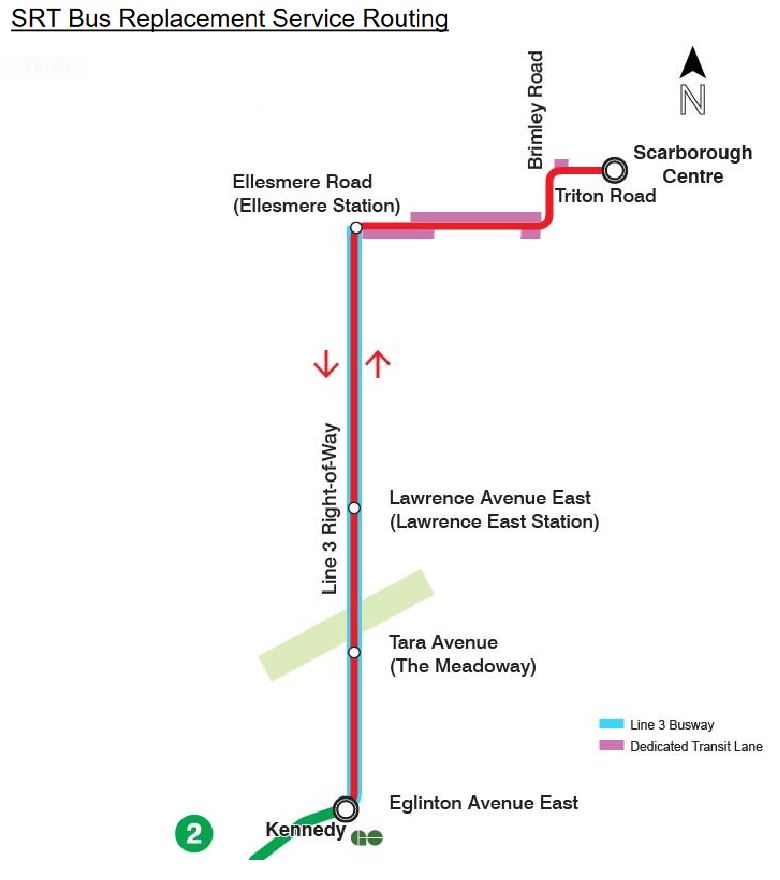
Will There Ever Be A Scarborough RT Busway?

At its meeting of January of January 25, 2024, the TTC Board received an update on the status of a busway in the former SRT corridor.

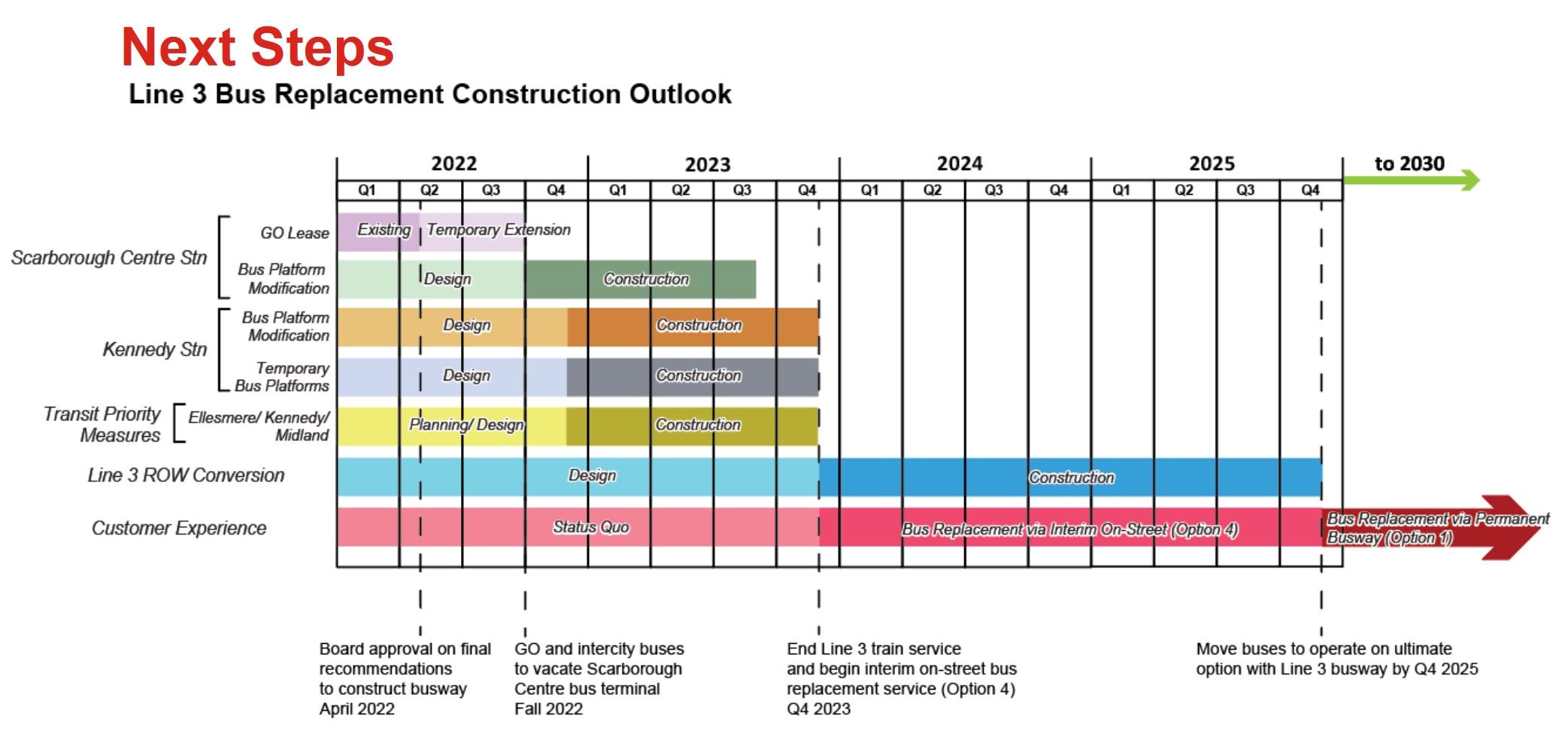
The news was not good. For various reasons, the opening date for this facility has slipped to 2Q2027. This is quite a change from the original plan for construction through 2024 and 2025 with a year-end opening, roughly 18 months sooner than the updated projection. Here was the plan back in April 2022 when the project was approved by the Board. At the time, the assumed shutdown date for the SRT was mid-November 2023.

TTC Project Chart for Line 3 Bus Replacement Construction, April 2022

The Board’s discussion was unusually heated, and much criticism fell on TTC Management for an unplanned delay required to conduct a Transit Project Assessment (aka TPAP) even though the corridor is not changing use. The problem lies with planned acquisition of new lands to provide station and corridor access, and they are subject to a review including for cultural/archeological purposes. (Detailed station plans appear later in this article.)

Construction will also require a barrier between the busway and the adjacent GO line because Metrolinx wants to protect from buses accidentally coming onto their corridor. This adds cost, but should not substantially affect the construction schedule.

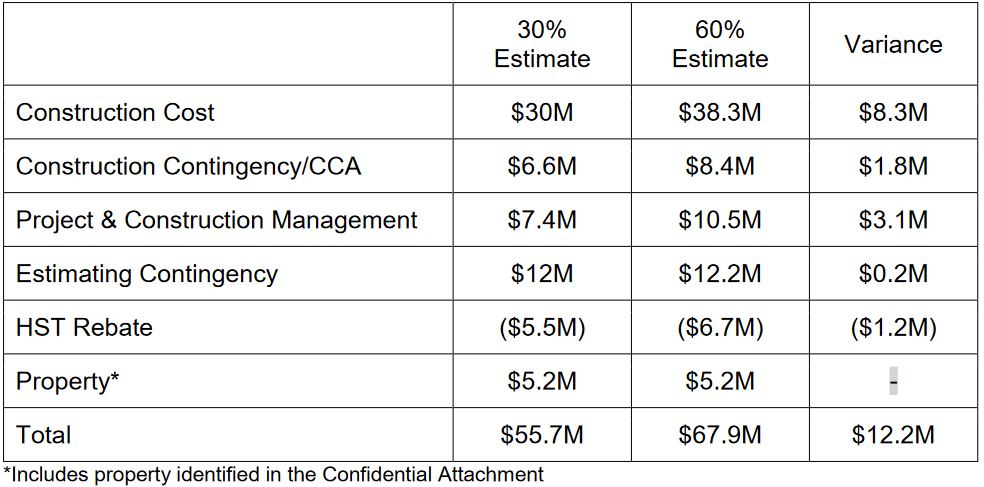
Total cost is now forecast at $67.9 million, up $12.2 million from the earlier estimate of $55.7 million which is part of the TTC’s 2024 Capital Budget. Of this, $4.3 million is due to the Metrolinx barrier, and $4 million goes for a grab-bag of items that appear to have been omitted in the original estimate. This increase is compounded by other cost lines which are calculated as a percentage of the base.

A far more important source of delay was the foot dragging by Council and the former Mayor about funding the design work which should have been finished by now, but sits at the 60% stage. Essentially Council sat on its hands crying out for Provincial money as part of the subway extension project, and the busway just sat waiting for aid that never arrived from Queen’s Park.

There has certainly been no sense of urgency to get design finished and construction underway as quickly as possible.

The delay, cost increase and a sense that travel time savings might be less than expected have combined to raise the question “why do it at all”. This can be a self-fulfilling prophecy if those responsible for the project, including the politicians, really did not have their hearts in the idea. There is no quicker way to sandbag a project than to deny critical funding, watch the price rise and the due date vanish into the misty future.

While awaiting a formal funding approval, the TTC will redirect $15.2 million from other capital projects to pay for enabling works and property acquisition. This can proceed in parallel with the remaining detailed design and TPAP.

Continue reading

Analysis of 903 STC Express: September-December 2023

This article is an update to my review of the 903 Express bus that replaced the Scarborough RT. The previous article here: Analysis of 903 STC Express: September-November 2023.

Additions in this round:

  • Data for December 2023
  • Performance of the 903 service to Centennial College east of STC (Scarborough Town Centre)
  • Travel times between STC and Ellesmere & Midland
  • A review of terminal layover times at Kennedy Station
  • The screenlines for arrivals and departures at Kennedy Station have been moved from Eglinton at Midland and at Kennedy to points on Eglinton just east and west of the loop entrances. This ensures that any delays at the intersections are counted in travel time, not in terminal time. The change has been applied retroactively to charts for September through November.

Correction: References to a 934 Progress Express should have been to route 913. This has been corrected. Thanks to a reader for pointing out this gaffe.

Continue reading

Fun With Figures: The Value of Transit Investment

A common, but troubling practice in talking about transit is the attempt to build a “business case” as if city’s transit network can be examined through a rather simplistic management school lens. Everything is reduced to a monetary value, be that direct spending, spinoffs, or the notional value of benefits.

Aside from basic errors in methodology, this approach assumes that the supposed value of transit spending can be gleaned from a one-dimensional view of its so-called worth in dollars and cents. Bad enough that this practice is entrenched in Metrolinx, an agency that sets priorities based on political, not financial, evaluations thereby undermining the credibility of financial analyses. The scheme has trickled down to the municipal level with a TTC/UofT study intended to show that money for transit has financial benefits and should be encouraged for the good of city and country.

You might ask why a transit advocate has misgivings about this exercise, but the answer lies in my long-standing conservatism (with a very small “c”) about public spending generally. Megaprojects bring press coverage, especially with the opportunity to announce over and over the latest step, no matter how trivial, as work inches along. This tactic works as long as there is success to report, and we just don’t talk about abject failures like Line 5 Crosstown any more often than needed.

A huge problem with the TTC’s gaping hole in Capital funding, and to a lesser extent on its Operating side, is that the cry “please, Sir, I want some more” for transit support wears thin with would-be partners. Moreover, everything on Toronto’s wish list does not necessarily align with political priorities elsewhere, and it must compete with demands from other cities and provinces. Thus the desire to show that transit spending has a great “payback”, but that number hides fundamental questions.

The problem with spending for its own sake is that one rarely hears the question “what else might we do with these billions” or “is this project really worth its cost compared to other demands on public funds”. How much is not built or operated because some other project took priority, or the growing cost of works already underway crowded other new schemes off of the table?

Into our political environment, one rife with patronage, cronyism and outright corruption, comes an attempt to justify spending on transit as an inherently good thing.

In 2022, the TTC launched a joint study with the University of Toronto Mobility Network which surfaced as part of the 2023 and 2024 Budgets. The goals of the study were “to identify and quantify the economic and other key benefits resulting from investment in transit and the TTC”:

  • Economic benefits realized from investments in transit services and capital works that enhance TTC’s existing transit network
  • Economic impact of the TTC on the local, regional, provincial and national economy
  • Qualitative and quantitative social, equity, health and environmental benefits and the economic spin off benefits derived from these other benefits
  • Impacts should the necessary service and capital investments not be made in the TTC
Continue reading

TTC 2024 Budget Preview: Part II – Capital

In the first article in this set, I reviewed the TTC’s Operating Budget for 2024. Now, I turn to the Capital Budget and Plan for the year 2024, the 10-year period out to 2033, and the 15-year period to 2038. Reports cited here include:

Capital budgets and plans exist in three formats, each with its own purpose:

  • The annual Capital Budget sets out spending for the coming year. For multi-year projects, only current year spending is included, plus any carry-overs from incomplete work in the previous year.
  • The ten year Capital Plan shows spending planned for the coming decade, and this feeds into a comparable plan at the City of Toronto. Only items for which funding can be reasonably expected are included, and this tends to make the plan lighter on the back end. In past years, some items have been carried “below the line” as unfunded, but desirable, usually major rapid transit projects.
  • The fifteen year Capital Investment Plan shows everything (or almost) that the TTC foresees as capital requirements in coming years. Over the years, it was quite evident that many, many items were not being reported even in the “below the line” portion of the Capital Plan.

The Capital Investment Plan (CIP) gave City politicians and managers a severe case of indigestion when it was first published in 2019 because the total involved, well over $30 billion, was more than three times the size of ten year Capital Plans normally presented by the TTC. This addressed a long-standing problem where capital requests would appear out of thin air because they had never been approved as part of the Capital Plan, and TTC long-range requirements were very different from the numbers usually cited.

Transparency is a double-edged sword because any new scheme will usually show up in the CIP complete with a cost. In the 2024 version, the effect is particularly substantial with a jump to a total of almost $48 billion. Later in the article, I will review the CIP’s evolution over recent years to show the origin of this increase.

A major problem with the various budgets is that they are huge, and the TTC Board has an aversion to long, complex reports. Moreover, there is no Budget Subcommittee of the Board to develop some expertise on the matter, and even when one existed, it met rarely, if ever.

The current Capital Budget was always of most concern because it was usually presented just before it had to be rolled up into the City’s budget, and there was no scope for tinkering. As long as enough money was found somewhere, the immediate financial crisis would pass, and long-range planning would be left for another day. That day rarely came, but it suited the former regime at City Hall not to have the TTC’s or City’s financial peril exposed to much scrutiny. Now that Toronto’s gaping budget hole is out in full view, we can see just how badly the city and transit system have been served by years of pretending our needs were “affordable”.

Continue reading