The TTC Board will meet on Tuesday, February 3, 2026 at 9:30am in North York Council Chamber. The agenda is rather thin, and there are several confidential issues that will trigger an in camera session. There is no formal item regarding Line 5 Eglinton, although one never knows what might come up in debate.
Of interest are the following items:
Updated February 2 at 10:10am: Slide decks for the invited presentations have been posted on the TTC site. Links to them are added below.
Narayan Donaldson on “Opportunities to improve Transit Signal Priority in Toronto”. According to the covering report “This presentation will discuss the strengths and weaknesses of the Transit Signal Priority (TSP) system used on Toronto’s streetcar, bus and LRT systems, compare it to a TSP system commonly used in the Netherlands, and suggest areas of improvement.”
Jonathan English on “Developing a Surface Transit Revitalization Plan” According to the covering report “This presentation will discuss steps that can be taken to improve speed and reliability of the streetcar network, as well as new LRT lines.”
After the meeting, I will write up the presentations in an update to this article.
Today, Ontario announced that it would raise the Canadian content in 55 new Line 2 trains from roughly 25 to 50 percent. The provincial capital subsidy for this purchase will rise from $758-million to $950-million, and the increase will be matched by the federal government who are also funding this purchase. There is no change in the Toronto share.
It is not clear whether the federal contribution is net new money, or merely a reallocation within Toronto’s share of the ten-year transit funding program.
Updated January 16, 2026: According to the federal government announcement, the funding will come from an existing allocation stream and is not net new money.
This project is part of the previously announced 10-year funding commitment under the Baseline stream of the Canada Public Transit Fund (CPTF). Beginning in April 2026, the Toronto Transit Commission will receive up to $1.2 billion in CPTF funding over 10 years from 2026 to 2036.
A related question is which government(s) will be on the hook for the extra CanCon in future transit vehicles including those for the Scarborough and Richmond Hill extensions, and for added capacity to deal with expected growth. Collectively these account for a potential 57 more trains, doubling the size of the eventual order.
What the announcement did not address is a list of questions about the Toronto subway fleet overall:
When will the cars be delivered, and how much work is needed to keep the old Line 2 trains operating in the interim?
When will Metrolinx place the add-on orders to provide trains for the Line 2 Scarborough and Line 1 Richmond Hill extensions?
How will delivery of the add-on trains affect opening dates for the extensions?
Will complete replacement of Line 2 trains be delayed because new trains are needed to provide service on these extensions?
Will the extensions have enough trains to provide full service to the new terminals, or will some trains have to short-turn in peak periods?
How soon does the TTC project it will require more trains to improve capacity on Lines 1 and 2, and how will these be funded?
What is the status of funding and timing for new maintenance facilities on Lines 1 and 2 to hold and service the additional trains?
Will the Automatic Train Control (ATC) technology for Line 2 be the same as the existing system on Line 1, or will the two lines (and their fleets) be limited to use only their “own” trains?
The TTC produces a quarterly report on all its major capital projects with the intent of showing all planned work, but it does not produce a unified chart or timetable showing how everything fits together and where critical links might be in the overall plan. The TTC has a “Strategic Planning Committee”, and this is a complex piece of strategy that badly needs detailed, public review.
The express busway linking Kennedy Station to Ellesmere Road along the former Line 3 Scarborough RT corridor will open in late September 2026 rather than in 2027 as originally planned. This was announced jointly by Mayor Chow, TTC Chair Myers and TTC CEO Lali.
The idea of repurposing the SRT corridor was approved well before the premature end of service with a derailment south of Ellesmere Station in July 2023. According to an April 2022 presentation, design work would begin in 2022, and construction to convert the corridor would begin immediately after the RT shutdown scheduled for November 2023, and the busway would open in Q4 2025.
Yes, it should be open already, but delays in funding the project, acquiring property, gaining Metrolinx approval for co-existence of a busway with their rail corridor, among other factors, pushed design completion out to mid-2024, and the target in-service date well into 2027.
A common factor in many delays was a lack of urgency, and the idea that Ontario should pay for this conversion as part of the Scarborough Subway project. Council approved its expected share of funding in February 2024, but time was lost waiting for provincial money that would never arrive. Eventually the City decided to just get on with the work.
The 100% Detailed Design of the Busway was completed in December 2024, along with the final cost estimates, which remain within the approved budget. The contract for the Busway was tendered in February 2025 and is expected to be awarded in Q2 2025 to commence the construction of the Busway.
The contract for the Busway was tendered in February 2025 and closed in April 2025. Delegated authority to award the contract was approved at the May 2025 Board meeting along with a motion to report back to the Board in July 2025 on an acceleration plan.
As the contract was awarded on June 5, 2025, and the first kick-off meeting was held with the Contractor on June 13, 2025, staff are anticipating receiving the Contractor’s baseline schedule in the first week of July. We, therefore, expect to start the discussion with the Contractor on the acceleration plan in July 2025. The Contractor will need time to line up their sub-contractors and suppliers to develop a comprehensive acceleration plan that demonstrates ways and means of achieving the acceleration goal. We anticipate finalizing the acceleration plan by end of the summer and reporting back to the Board in September/October 2025.
The contract for the Busway was tendered in February 2025. The contract for the Busway implementation was awarded in June 2025, and work commenced on July 22, 2025.
[…]
Awaiting an acceleration plan proposal from the contractor. Upon receipt of the proposal, negotiations to finalize the proposed plan will take place immediately over the following two to three weeks. A report will be provided to the Board at the October 2025 meeting.
“The contractor submitted a baseline construction schedule, and an acceleration plan to target an early revenue service is under negotiation.”
In other words, it was possible to get the busway open sooner, but that was not the original scheme nor was an acceleration plan required in the initial tender. No, it was not your imagination that this project could have run faster, it was actually planned to be long. As of a few days ago, a faster schedule was still only a possibility.
Now with political pressure, the Scarborough Bus Corridor project will speed up. However, the basic question is why was this option not on the table from day one especially after the time lost awaiting provincial funding.
The TTC’s Strategic Planning Committee met on November 25 for a presentation outlining major issues in the forthcoming Operating and Capital Budgets. These will be presented at the next meeting of the full Board on December 10.
When the Strategic Planning Committee was first proposed during 2025 budget debates, the idea was that it would have some input to the 2026 cycle through discussions of policy options, financial effects and tradeoffs. However, the committee’s actual formation dragged on for months almost as if there was a “fifth column” working to prevent its ability to function.
The committee will not meet again until March 2026, and hopes to plug into the 2027 budget cycle. This will be complicated by the municipal election and the sense that any policy debate sets the stage for candidate platforms. Still to come from management is an updated Ridership Growth Strategy that necessarily will inform budget plans for 2027 and beyond. It is not yet clear how work on various TTC plans will flow through the Strategic Planning Committee with meaningful input and opportunity to fine-tune proposals.
In that context, management presented an overview of issues facing the TTC going into the 2026 budget debates.
The stage is set with an overview of recent years and the situation in late 2025.
The 2025 budget aimed high anticipating riding growth from a return-to-office commuting trend. This has not materialized uniformly across the system, and it is compounded by a decline in student travel thanks to cuts in the international student visa program and reduced offerings at post-secondary schools.
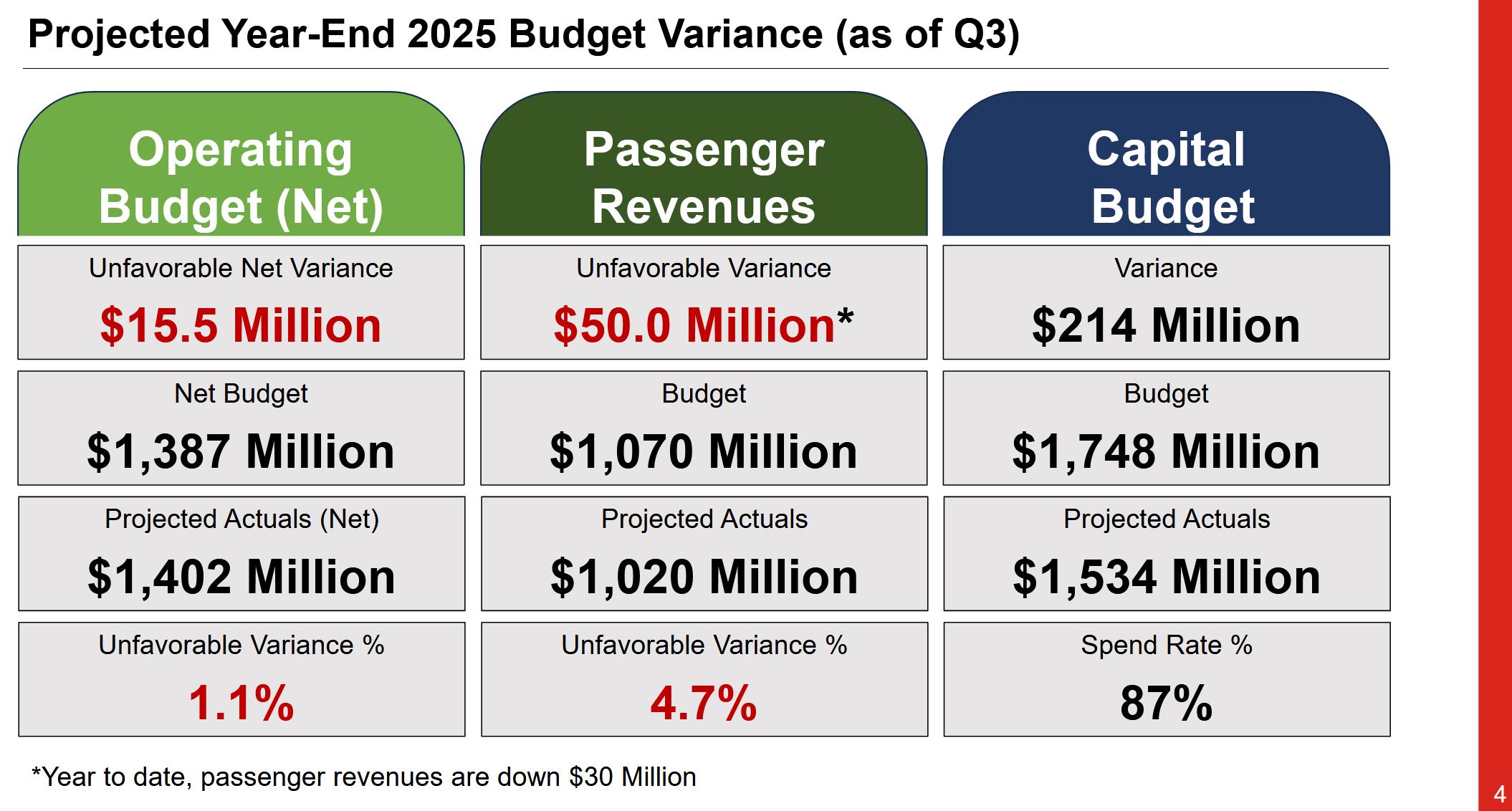
In the table below, note that the “Operating Budget (Net)” is effectively the budget as seen from the point of view of funders, primarily the City. The gross budget for 2025 is $2.9-billion.
On the Capital side, the TTC spent 87% of allocated budgets as of the third quarter end, and expects to hit 100% or more by year-end. Spend rates through the year are affected by peaking effects from project timing related to weather (construction delays) and major deliveries (new vehicle arrivals), for example.
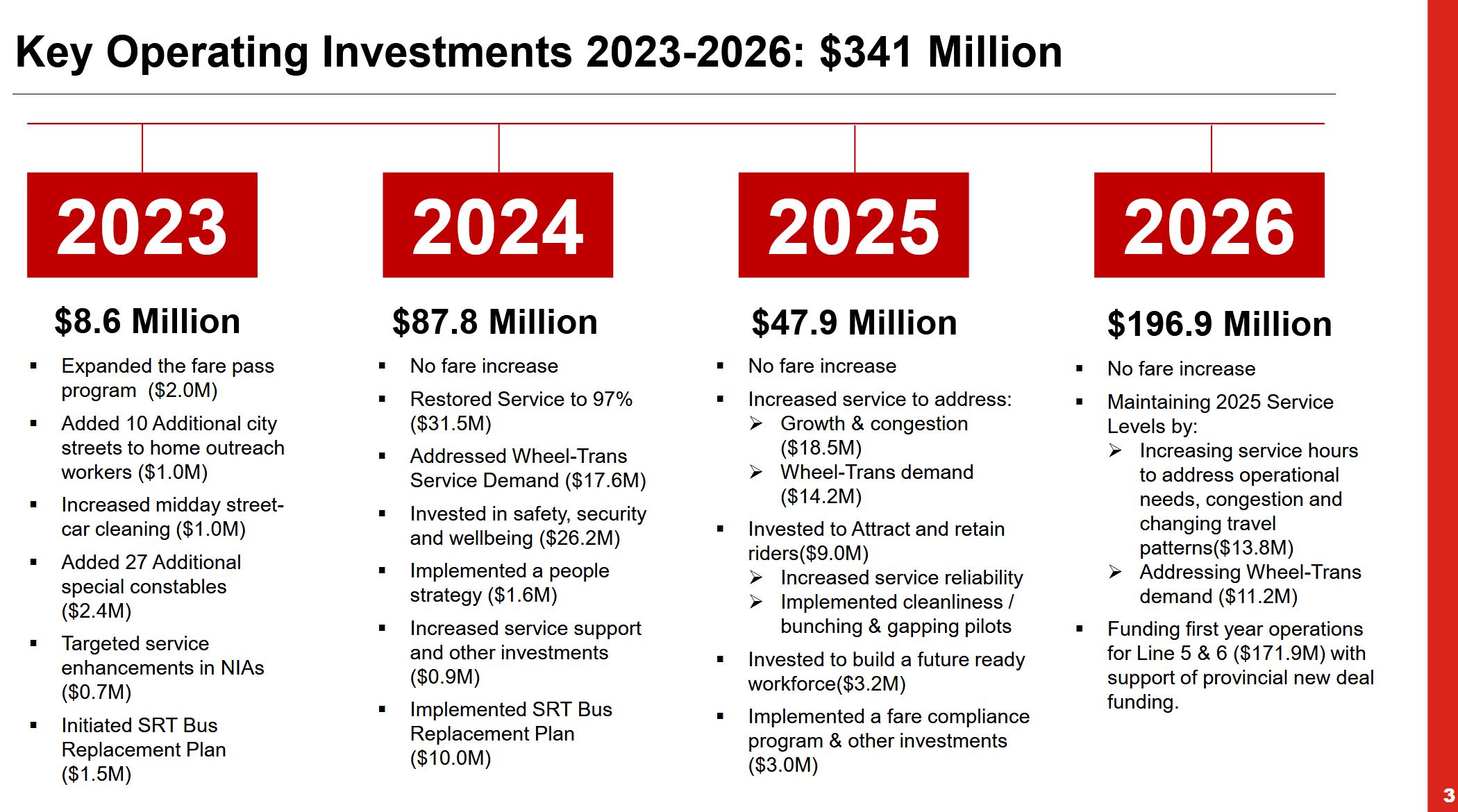
Although the bump proposed in 2026 spending is relatively large, almost $200-million, 87% of this goes to the extra cost of operating Lines 5 and 6, assuming both are open. Only $25-million goes to current service. Some of that will simply pay the full year cost of operating improvements made in 2025 such as restoration of subway service to near-2019 levels. As we will see later, improvements, such as they might be, will come by reallocation of service between routes, not from net new spending.
For the third year in a row, fares will be frozen. This has a cost, although it is not shown as a budget line item. A 10-cent increase in adult fares, about 3% at current levels, translates to about $30-million annually less the effect of any ridership loss an increase would cause. TTC management has always warned that small annual changes in fare levels are preferable to infrequent large jumps to make up for periods of fare freezes. There is nothing inherently wrong with keeping fares low and service good, but the City must go into that policy with its eyes open as subsidies make a larger part of total revenue, and any service increases bear an increasing effect on non-fare funding.
Debates will continue about changing the fare structure including rebalancing concession rates, introducing schemes to benefit frequent riders such as fare capping. However, any change is unlikely until at least mid-2026 when the TTC rolls out a new version of Presto that will provide more flexibility in tariff design.
This is not to say discussion about fares should halt, and indeed it should already be underway informed by the capabilities and restrictions of Presto. This should be a integral part of any Ridership Growth Strategy debate including the comparative value both in the business sense and as a matter of municipal policy. Why do we provide transit service, what constitutes good, attractive service, and what spending (or avoided revenue increase) would best address the City’s goals?
For 2026, the highlights are:
The fare freeze
A 2.2% increase in service hours
Added funding for a growing fleet of eBuses and streetcars (new vehicles delivered in 2025 will incur full-year maintenance costs in 2026)
Lines 5 and 6 operation (the net cost to be offset by a Provincial subsidy)
Of the total operating cost, 93% is “conventional” TTC service and 7% is for Wheel-Trans out of a projected total of $3-billion.
This was achieved while keeping the increase in City funding to $91-million and finding $87-million in budget reductions (some of which are due to accounting changes). We do not know most of the details of budget trimming, nor the foregone possibilities for improvement. Commissioner Saxe queried the lack of Board participation in this process which was to be part of the Strategic Planning Committee’s mandate. We will see in 2026 whether there actually is an open debate.
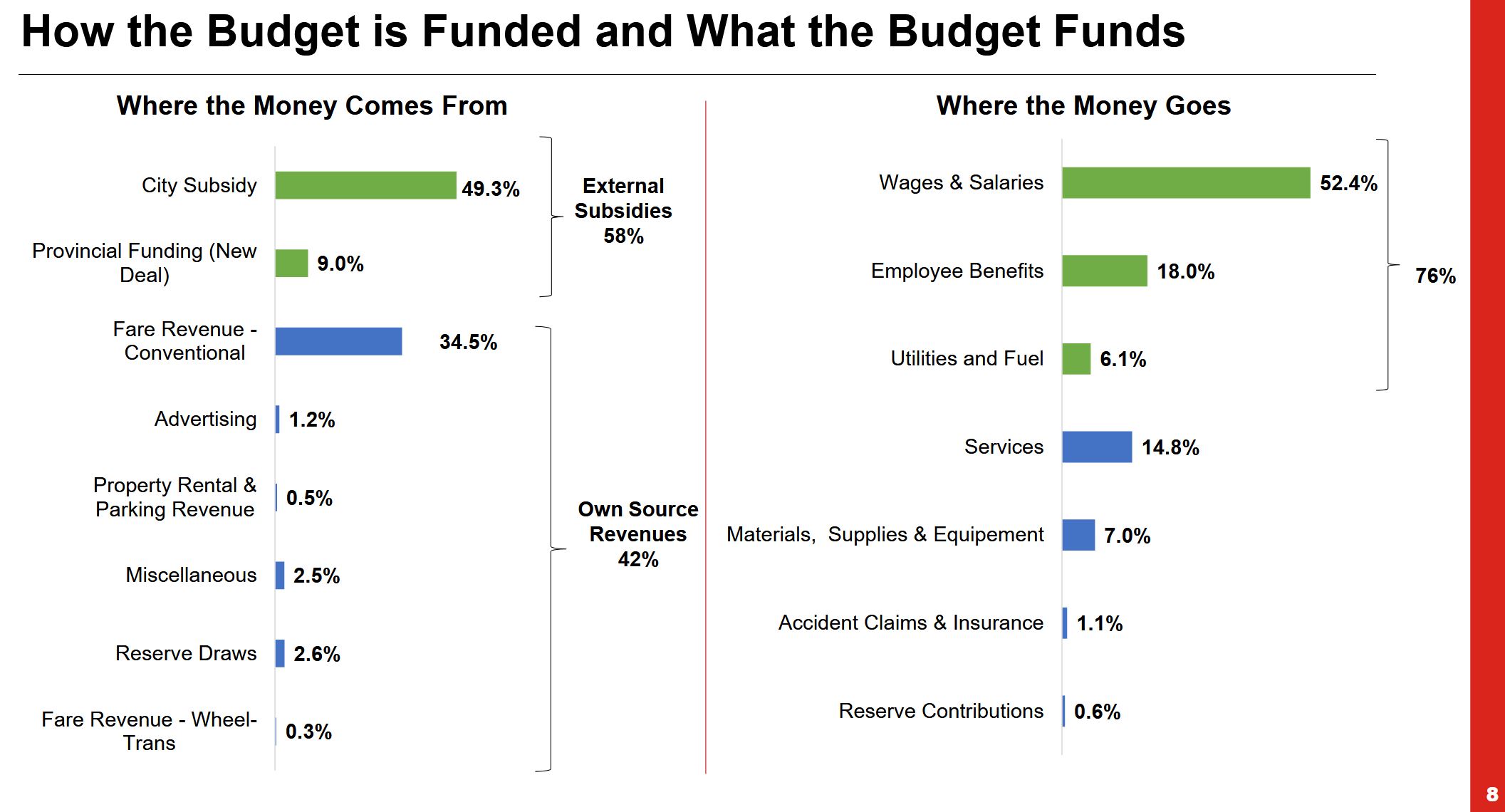
The revenue/cost ratio for the TTC is now 42%, and that number includes some ancillary revenue beyond the farebox. It is no longer possible to paint TTC as a woefully undersubsidized agency. Riders once paid 60% of costs with another 6% coming from sources such as advertising. Indeed, the City of Toronto will pay more in subsidy in 2026 than the TTC will receive from fares.
Note how small the ancillary revenues are in the table below. Budget debates spend excessive time on how the TTC could be so much better off if only there were more ads, or revenue generating schemes such as shops in stations. This is all very small change compared to overall funding needs, but fixating on minor revenue schemes avoids hard decisions about spending on quality service.
The TTC Board met on October 6, 2025. Many items on the agenda were confidential in whole or in part, and the meeting immediately recessed into private session. Four hours later, the public session resumed.
Extended private sessions have been a “feature” of recent Board meetings, and this is a major inconvenience for people who have taken the trouble to travel to City Hall for deputations, or remained available online. In years long past, the Board scheduled an in camera session before the public session so that, usually, the public part started on time. They should reconsider this practice, or at a minimum advertise a long, planned private session in the agenda so that public attendees can plan accordingly.
Items of interested included:
The CEO’s monthly report including an updated format for bus fleet and route performance metrics
The Peer Review of asset management by the International Association of Public Transport (UITP)
In the Major Projects Update on the TTC Board’s September 2025 agenda, there is a troubling reference under three subway maintenance projects in progress.
Rogers 5G Implementation
“The schedule may be impacted because of workcar and resource availability, which prioritizes state-of-good-repair activities. The TTC will co-ordinate with internal departments to prioritize Rogers work (where possible) so that workcars are available and assigned.” [p. 19]
Line 2 Capacity Expansion Program
“The unavailability of the TTC Operations workforce and workcars is a concern and is impacting the successful delivery of Line 2 Traction Power portfolio projects.” [p. 22]
Line 1 Capacity Expansion Program
“Negative reinforcing cables VMC to Sheppard West: Construction has slowed down due to the unavailability of the TTC Operations workforce and workcars … [p. 25]
“The unavailability of the TTC Operations workforce and workcars is a concern and is impacting the successful delivery of Line 1 Traction Power portfolio projects.” [p. 26]
Reading this, I could not help thinking back to the proposal for renewal and expansion of the TTC’s fleet in the latter years of Andy Byford’s term as CEO. Until 2019, the TTC published its Capital Plan in detail in two large binders commonly referred to as “the blue books”. This practice stopped in 2020, and it was not replaced by an electronic equivalent.
From the 2018 budget, I compiled a list of planned work car purchases. Also, I requested from the TTC a list of new vehicles since 2017. The table below merges this information.
Note 1: At the beginning of the work car plan, TTC owned two tie tampers, RT-21 and RT-41. Descriptions in the detailed plan speak of acquiring two additional units similar to RT-41. However, all that appears to have happened is that one unit, RT-21, was replaced. These units are essential to dealing with track problems that lead to slow orders.
Readers will recall the major interruption to subway service in 2024 thanks to an hydraulic oil spill from a work car. This incident triggered a review of maintenance practices revealing problems with the quality and frequency of inspection, and of the general state of the fleet. One issue is the age and condition of some cars which are not always fit for service.
From the table above, it is clear that many planned work car purchases in the 2018 plan have gone forward, but some have not. I asked the TTC about pending acquisitions, but received a generic answer.
The TTC Subway Workcar fleet undergoes a continuous program of growth, replacement, and overhauls, with another 10 vehicles targeted for overhaul/upgrade, or replacement between 2026 and 2032. The usual caveats around timing being dependent on the ability to procure would apply once they are put to tender. [TTC Media Relations email Septmber 8, 2025]
As the subway system grows and ages, the maintenance workload will go up, and with it the need for both specialized staff and work cars. The Major Projects report shows that the TTC is falling behind on both counts.
This is an aspect of “State of Good Repair” that is generally hidden from public view, but is key to maintaining reliability of the infrastructure and the revenue service it supports.
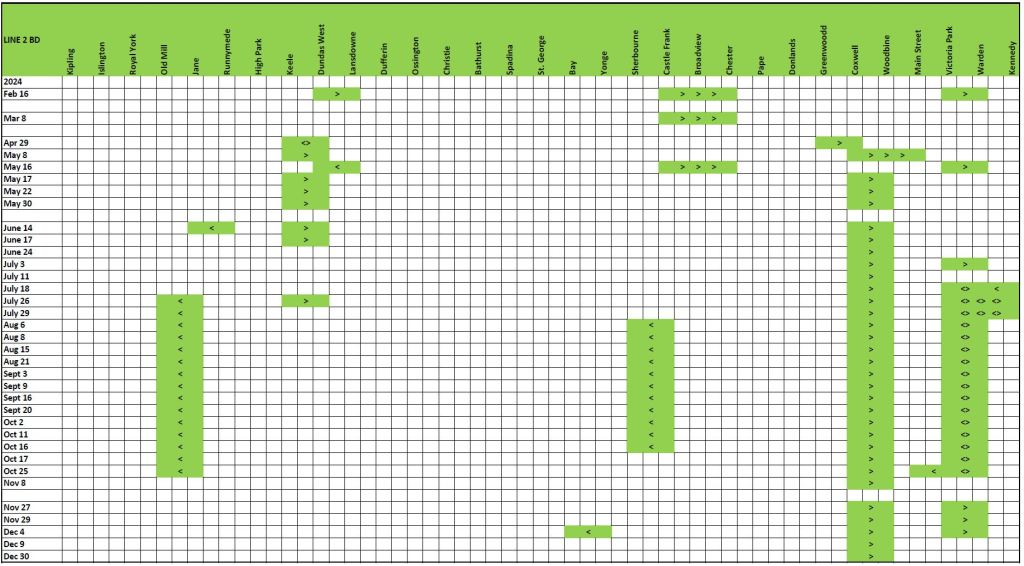
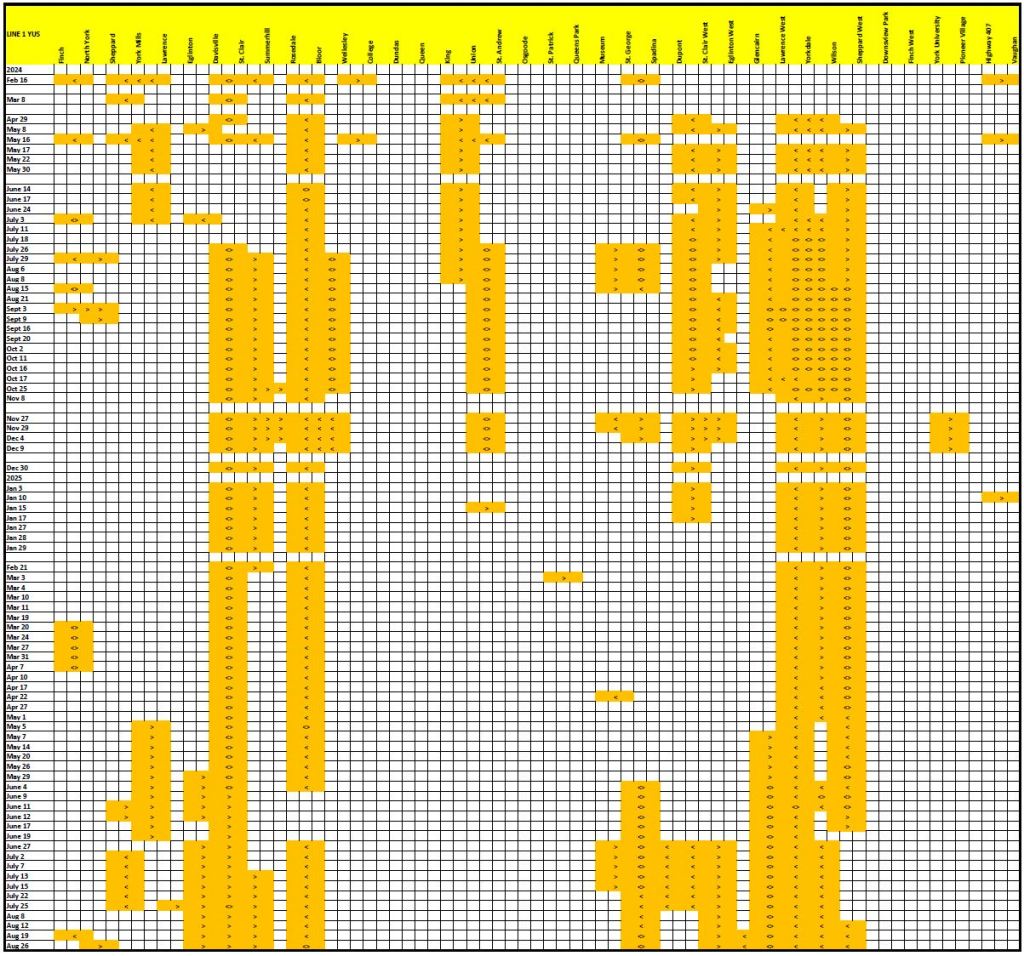
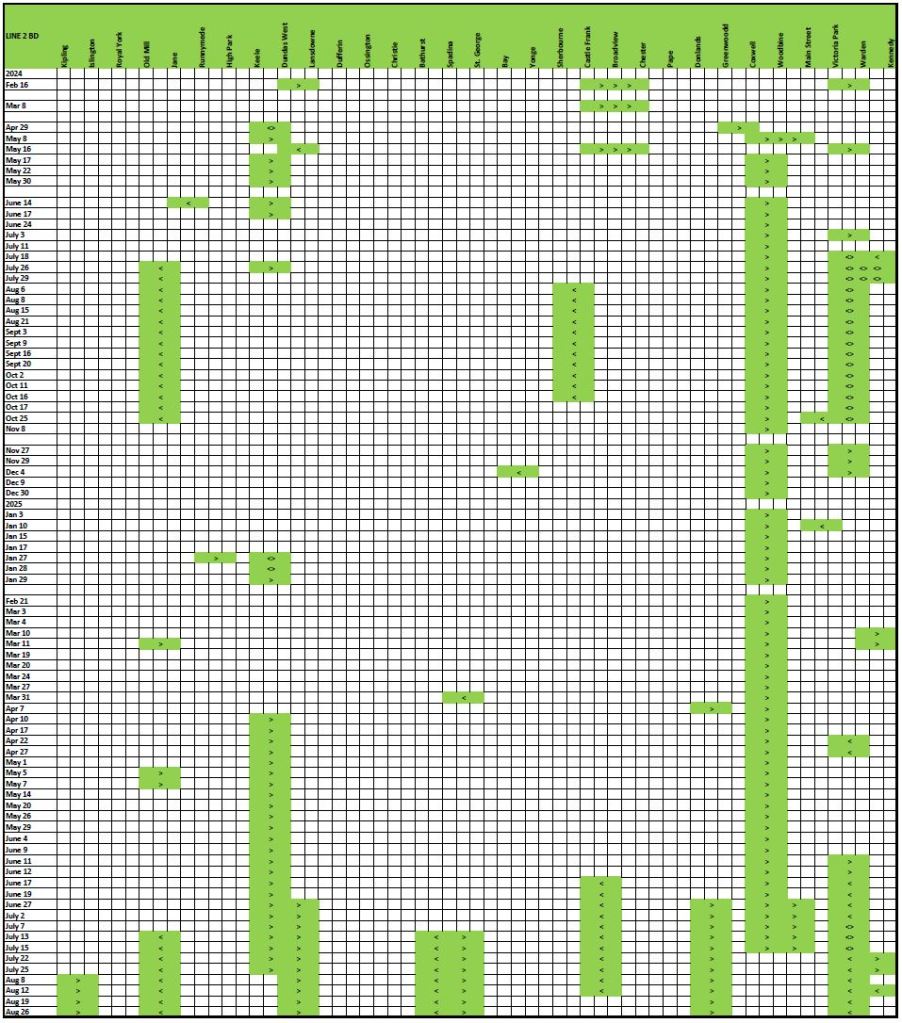
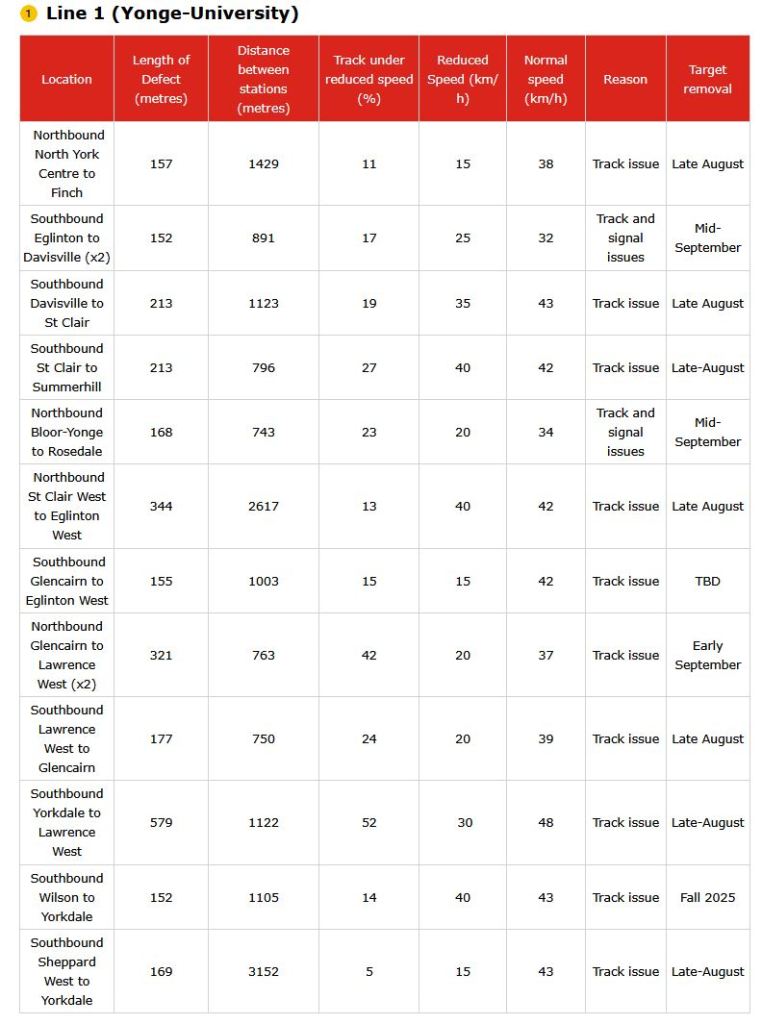
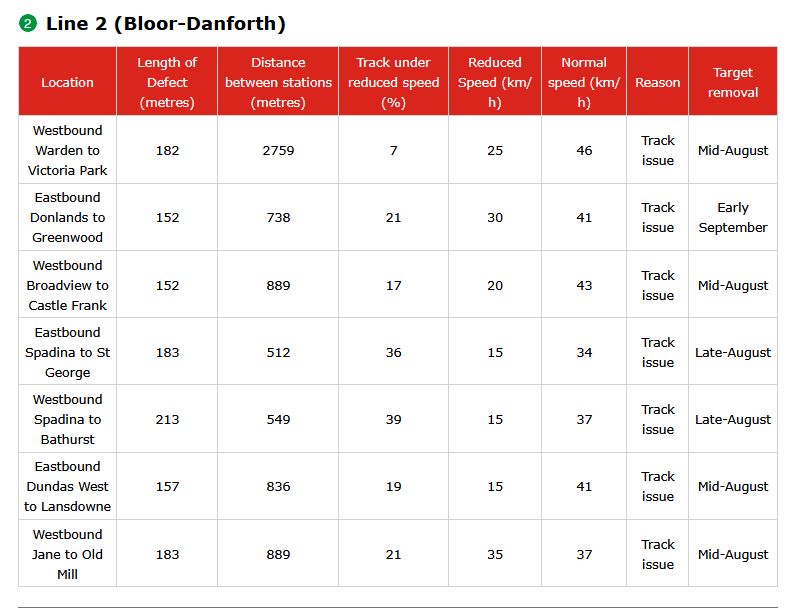
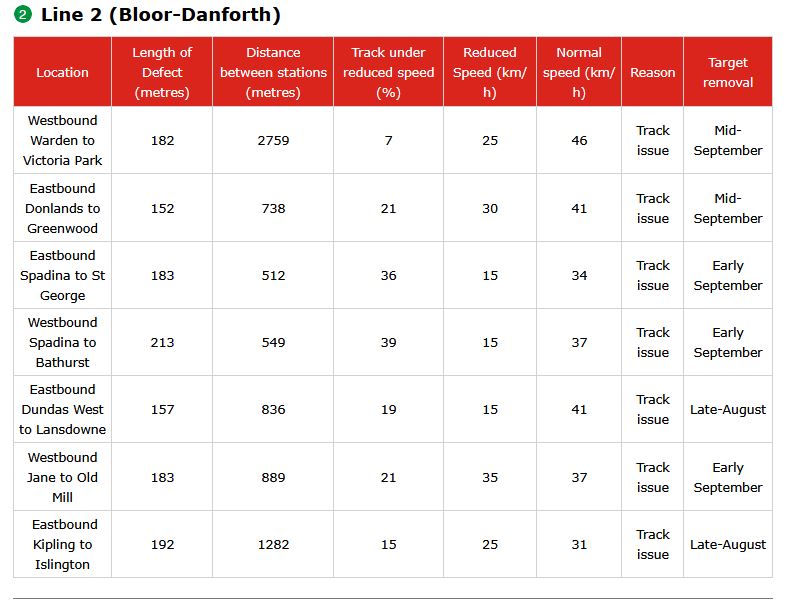
In previous articles, I have tracked the evolution of subway segments where Reduced Speed Zones (RSZs) are in place since February 2024. Recent comments in other articles suggest that readers have not been following this.
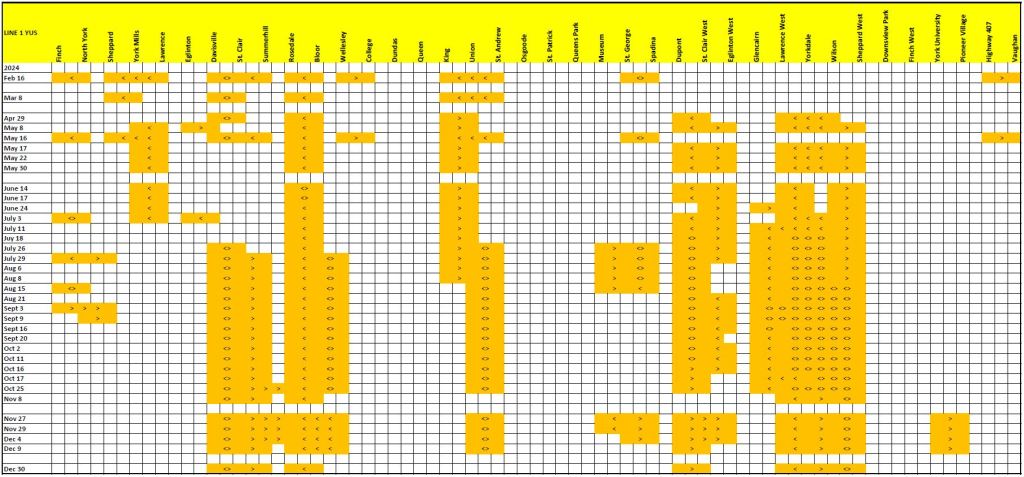
Here are updated charts showing areas where speeds are or have been restricted on Lines 1 and 2.
The charts on the left are for 2024, while those on the right show 2025 with a gap at the top where I did not check for about a month. The longevity of the RSZs can be clearly seen in the length of more or less continuous coloured vertical bars notably on Line 1 between Eglinton and Bloor, and north from Eglinton West to Sheppard West.
The coloured areas show where RSZs were located, and the arrows show the direction with “<>” meaning “both ways”.
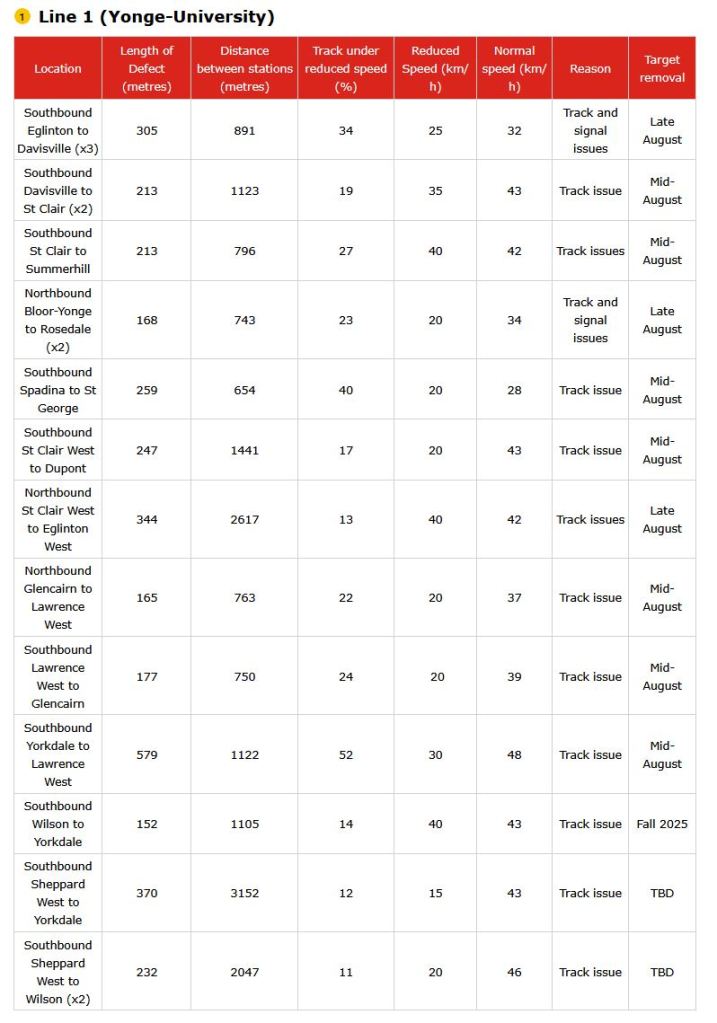
Tables with location details and expected times to repair taken from the TTC’s site are below. Note that in previous versions, many of these sites were expected to be repaired in August, but the target dates have been adjusted.
At the request of a reader, here are the Line 1 and 2 charts condensed onto a single page for each line so that the year-to-year continuity of problem areas is more obvious.
As a long-time transit activist, issues accumulate over the years and decades. Attempts to discuss “what needs to be done” quickly become a tangle of interlocking subjects. There is no simple solution to many problems.
Advocates for better transit run into comments like “you’re so smart, what would you do?” The intent is usually to shut down debate and prove that armchair criticism is a lot easier than the hard professional work of running a city and its transit system.
Recently, after a wide-ranging conversation about Toronto’s transit and the political history of the city, I was asked to boil down my feelings into three key issues about the TTC. This is the sort of question one might encounter in an interview to see how well a candidate knows their material and can focus on core items without rambling. I wasn’t interviewing for anything, but did not hesitate in my reply. This article grew from that discussion.
The intent is not to be exhaustive, but to sharpen debate to key issues. For every question there would be dozens of subsidiary issues, and always a chance that something would be missed. However, senior managers and politicians have limited attention spans, and they cannot deal with every issue at once. Neither can the organizations they lead. There is a “trees and forest” problem where many small details deserving of attention can obscure the larger picture.
Here are my three issues as a launching pad for debate about where the TTC should focus. There is a common theme: if you don’t know what’s broken, you cannot possibly fix it.
Honesty and transparency about service
The state of infrastructure
Headroom for short-term growth
I have not discussed transit funding, a perennial topic at the TTC and City Hall, and one we will hear much about as the 2026 budget season unfolds. This is a deliberate choice.
Funding debates consume vast amounts of time, usually to address a handful of key problems. The most recent example was the new Line 2 subway fleet, but there are many, many more budget lines both for state of good repair and system expansion, and many of these are interlinked. We rarely hear about any of them.
Even modest growth, a “business as usual” approach, has challenges, but aggressive transit growth as foreseen in Toronto’s TransformTO strategy adds very substantially to an already difficult situation. Council has not yet endorsed this plan fully, and the TTC has only produced an incomplete estimate of its implications.
If we hope to build a more robust transit system, we need to understand both the shortcomings of the existing one as a base and the challenges of accelerated growth. Toronto came through the Covid era with its transit system more-or-less intact, but we face a decision. Will we just muddle through, content with small improvements and a handful of future rapid transit lines, or will we launch into an era of real growth in transit across the entire system? Will we really make the TTC “The Better Way”?
Recently, the TTC added tables to its page mapping all reduced speed zones indicating the nature of each problem and the anticipated time to repair. Many of the dates were in August, and we’re well into that month already. Given past history, this seemed optimistic.
The table has now been revised with a number of dates pushed into September. A few items have vanished, but there are new entries too.
August 1 VersionAugust 19 VersionAugust 1 VersionAugust 19 Version