TTC Grounds Subway Work Car Fleet

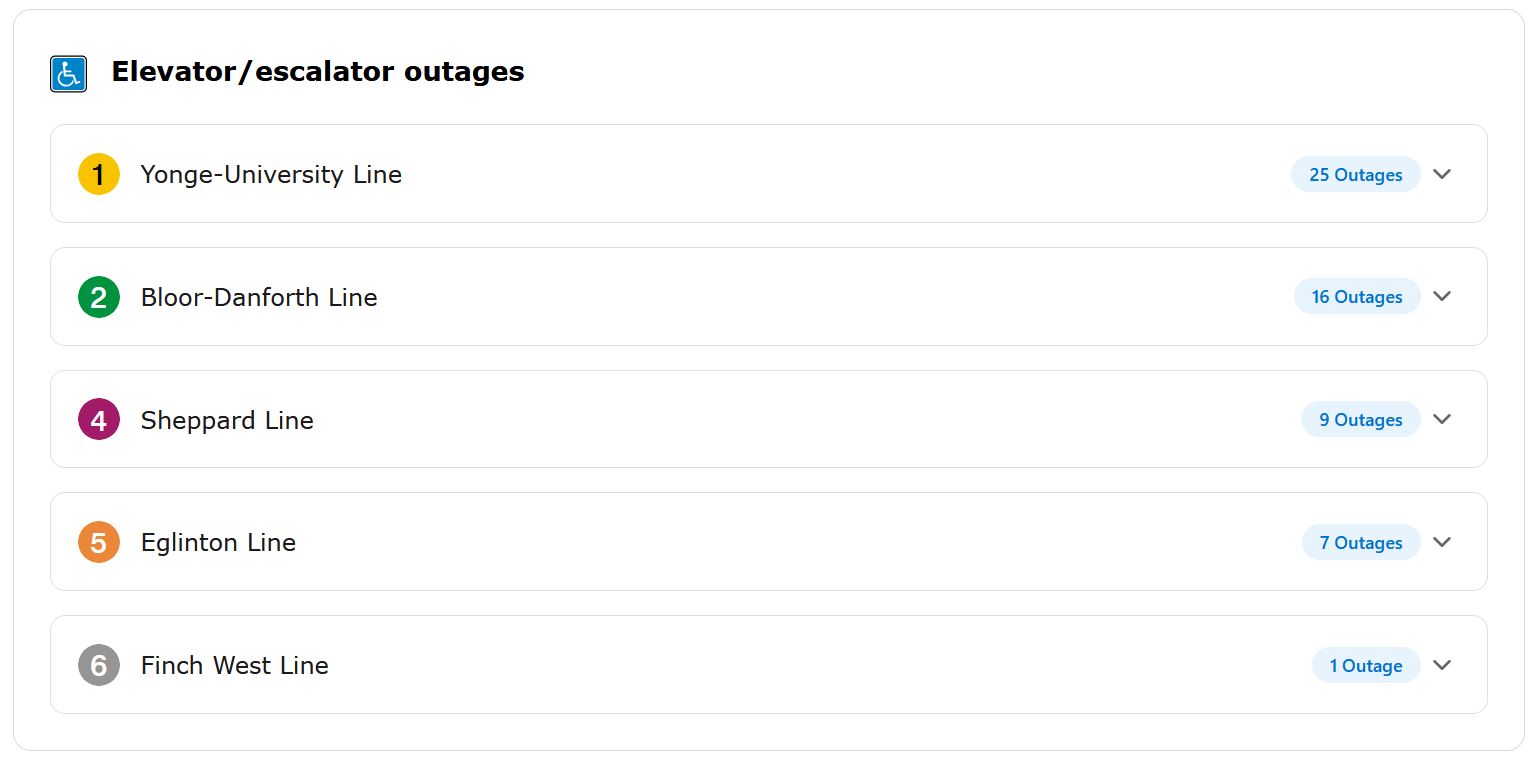
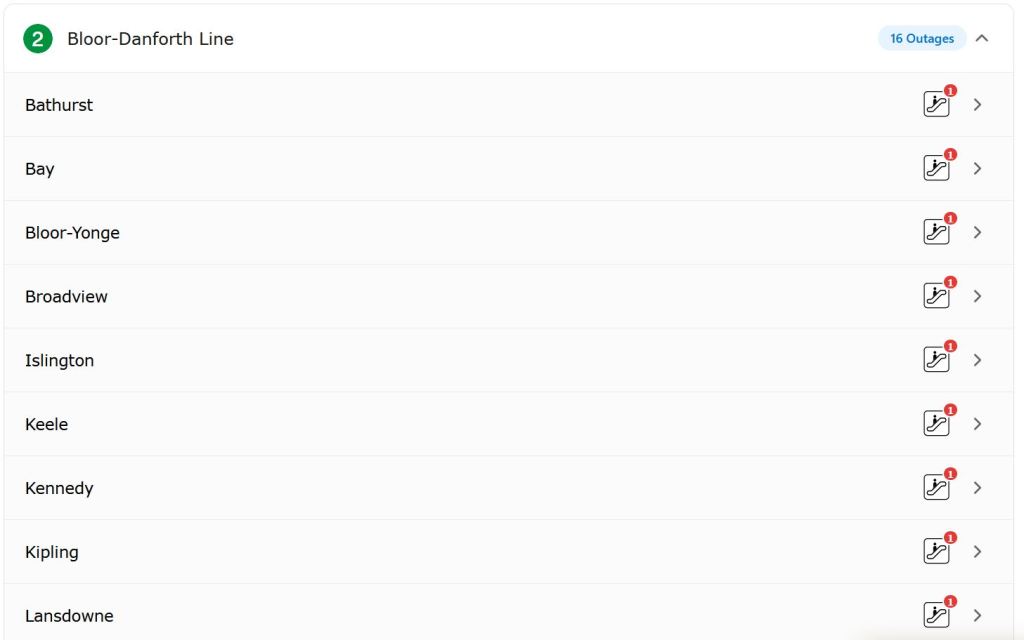
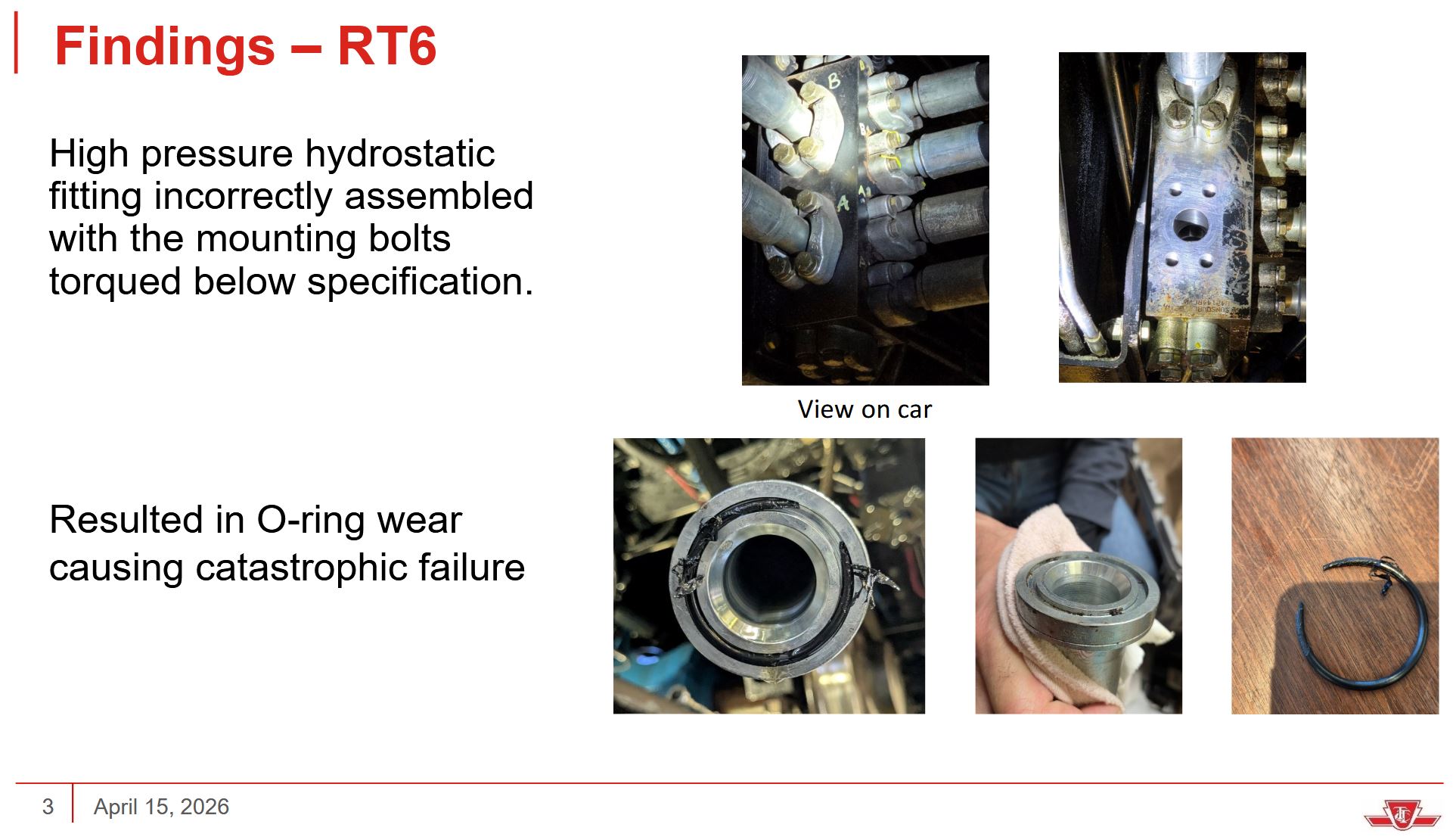
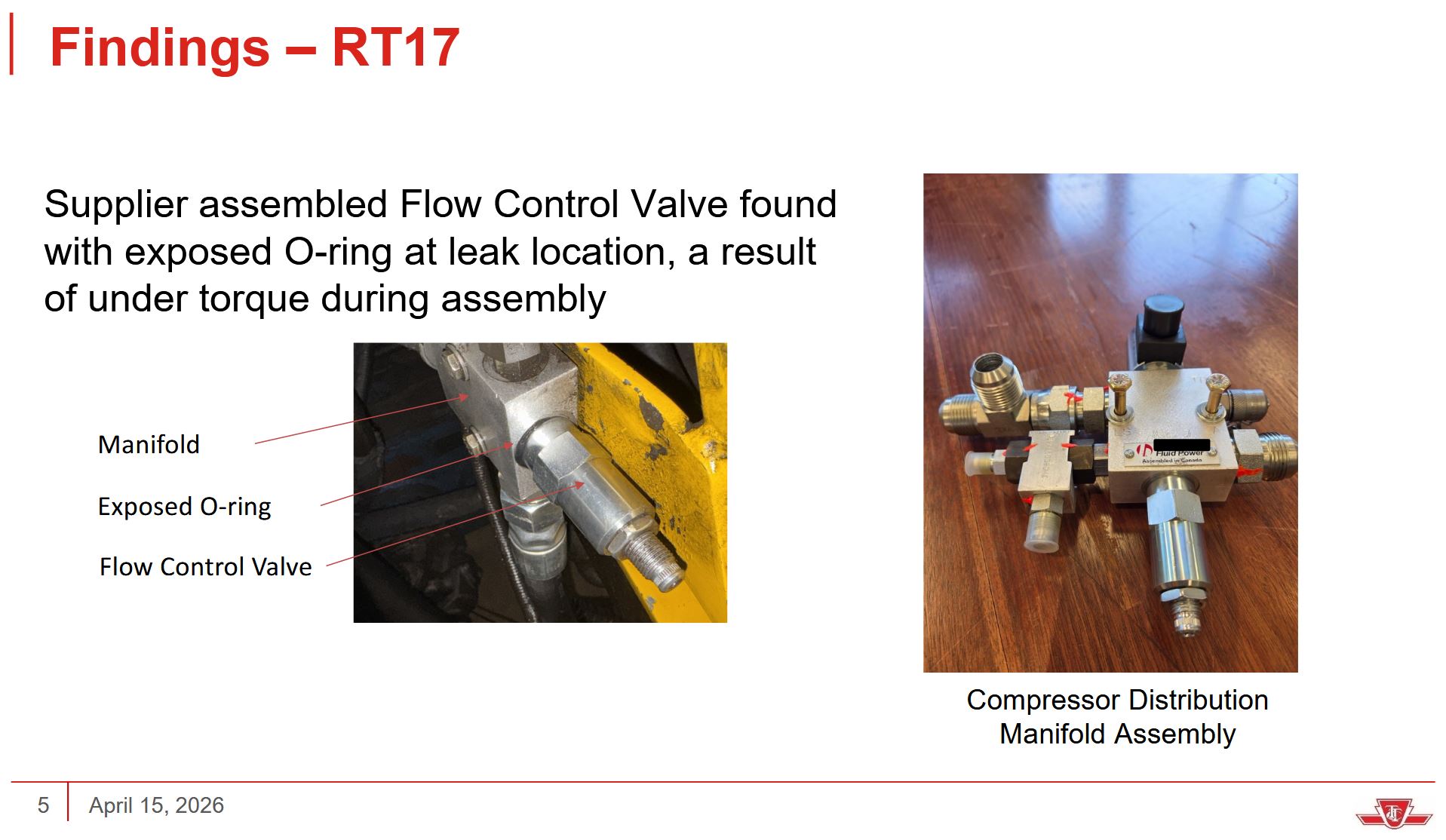
On April 7 and 10 two major outages on Line 2 Bloor-Danforth were caused by hydraulic fluid spills from work cars. The TTC has sidelined its entire fleet of work cars pending inspection and repair. This has placed much subway infrastructure work on hold at a time when there is already a backlog.

A previous leak incident in 2024 led to TTC Board reports, and the findings were not impressive. Some work cars were beyond their useful lives, and there were ongoing issues with inspection and maintenance of equipment.

A common thread in these delays has been a car leaking fluid onto the rails over an extended distance before this problem is discovered. That leads to extensive, manual cleanup work to ensure that revenue service trains can accelerate and brake without slipping.

Problems with these cars are not the only source of major disruptions, and failing signal systems requiring service suspensions are common.

The TTC has not published a list of signal failure incidents to give a sense of their frequency and severity, let alone any plan to improve reliability over the decade before a new ATC system can take over.

It is rather comical that TTC Board meetings can include extensive discussion of a new enterprise asset management system, but little info on actual condition, maintenance and plans for what we have. We should not have to wait for a large IT project to know what the issues are today.

Behind both the fleet and signals problems lie bad capital budget planning by TTC management in response to political pressure to trim spending. In past years, key interrelated projects were downplayed or sidelined including:

  • The need to refresh and expand the subway work car fleet
  • The need to convert Line 2 to Automatic Train Control
  • The need for a new Line 2 fleet

Under former CEO Rick Leary, in his early days, there was a sense that existing infrastructure and fleet could be stretched out to about 2040, fully ten years longer than the then-current target of 2030. In time, the ATC and new trains projects were restarted, but with much later delivery dates. According to the December 31, 2025 Major Projects Update Report, the delivery of 55 new trains will not complete until 2035, and the final cutover of ATC will not occur until 2037. Existing systems will have to last another decade.

Another factor is the timing of the Scarborough and North Yonge subway extensions which are planned to open in the early 2030s and will need new trains before the existing Line 2 fleet is retired. This is further complicated by demand projections showing the need for growth trains in the mid 2030s. Trains for new lines and extra service require production capacity that would otherwise go to a replacement fleet.

With ATC for Line 2 a decade away, the Scarborough extension will have to be built with conventional signals to tide it over until an ATC-capable fleet is running.

The TTC has not published a fleet plan showing how the various proposed deliveries of new trains will be staged. There is also the small matter of storage and maintenance space for the expanded fleets, and projects for new yards are not yet funded. The Province is happy to announce new subway lines, but conveniently omits the very large cost of the maintenance facilities.

This ties back to the work car reliability and fleet size issues because the volume of subway work will not decline, but will actually increase both thanks to aging infrastructure and system expansion. There are already severe scheduling problems for the work plans due to conflicting requirements for this fleet.

The focus at an upcoming TTC Board meeting will no doubt be on recent failures, but there are much larger issues affecting subway reliability for the coming decade and more. 2027 might seem a long time (and an election) away, but planning for that budget is already underway. The Board should demand a detailed review and plan to address the situation, and this should not be another “we’ll get back to you next year” report.

Ridership or Budget: What Should Drive TTC Strategy?

Long range strategic planning is not a common sight at the TTC. Yes, we see maps, we see service plans, we even have some nominally “bold” projects like RapidTO’s red lanes. But what we do not see is a focused debate about where Toronto and its transit system should be going, and how we will get there.

Pre-pandemic, the system was bulging with riders. Among other things, this launched the Bloor-Yonge station expansion project and deferred the Richmond Hill subway extension until we could be sure of having capacity to handle new riders from York Region.

Things changed in the early 20s with widespread ridership loss, especially downtown commuters. GO Transit was hit hard by this thanks to their long-standing commuter driven business model. On the TTC, although commuter traffic remains below 2019 levels, weekend demand has built higher. Demand does exist, although not always on the old model, but provided that there is service to handle the rides.

Since 2020, the overwhelming question has been where the money will come from to keep service running. A mixture of provincial and federal contributions got us through the worst of those years, and some special provincial subsidies still flow. The dollar value of the City’s share roughly doubled from 2019 (actual) to 2026 (budget) with the City now paying 49% of total operating costs (including WheelTrans). The Provincial share in 2026 is about 9% of the total of which about 3% is from gas tax and the rest from special subsidies which will soon end unless they are renegotiated.

Fare freezes under both the Tory and Chow administrations coupled with lost ridership limited revenue growth. Because fares now make up a much lower proportion of total revenue, a large fare increase would be required to restore the historic fares:subsidy ratio if that were the target.

The Capital Budget has an even worse situation with a long list of unfunded projects and no clear indication how much the Provincial or Federal governments have any appetite to fund them. In the short to medium term, the substantial Provincial spending will go to works in progress including Toronto subways and GO expansion.

With all of the focus on just finding money to keep the lights on, there has been little attention to service beyond preserving as much as can be afforded. TTC claims of service recovery use a metric, service hours, that appears to show recovery to 2019 levels, but does not allow for the effects of congestion. Actual service frequencies are down on many lines.

Back in 2018, the Ridership Growth Strategy proposed a tiered set of changes to drive growth at 1%, 2% or 5% annually. This was not pursued in any detail, and the pandemic overtook any thoughts of aggressive growth. The RGS was replaced by the Five Year Service Plan which, in its current version, covers years 2024-2028. It aims at modest growth, and yet even those goals are not fully funded.

What is needed to drive growth beyond business as usual levels? Is there a latent, unserved market for travel because transit is too inconvenient or simply not serving trips people need to make? Where is this market? Does the current network serve it well? Some growth can be achieved by making transit easier to use by existing riders, but what is needed for net new travel made by choice, not necessity?

Within this gloomy setting, the question of “where are we going” can turn into debates about funding without much thought to what might be possible, or what will be needed to encourage annual growth well above a few percent.

TTC’s Strategic Planning Committee meets on March 31. This will be their last chance to launch any discussion and study that can affect the 2027 budget cycle, and provide the basis for any post-election discussion of transit policy for 2028 and beyond.

Continue reading

TTC Subway Reduced Speed Zone Update March 2026

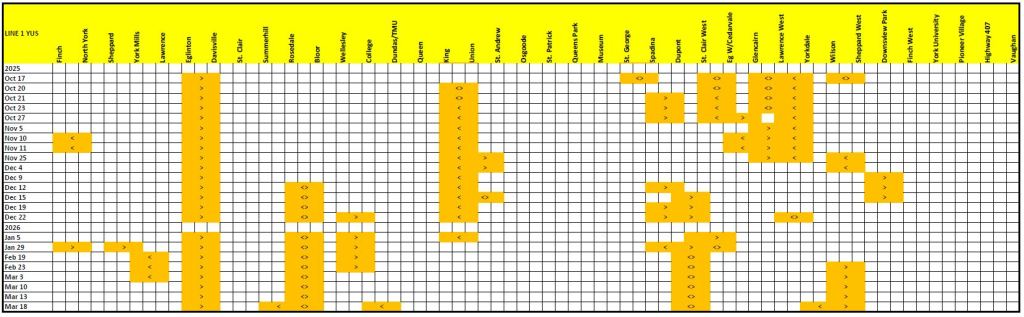
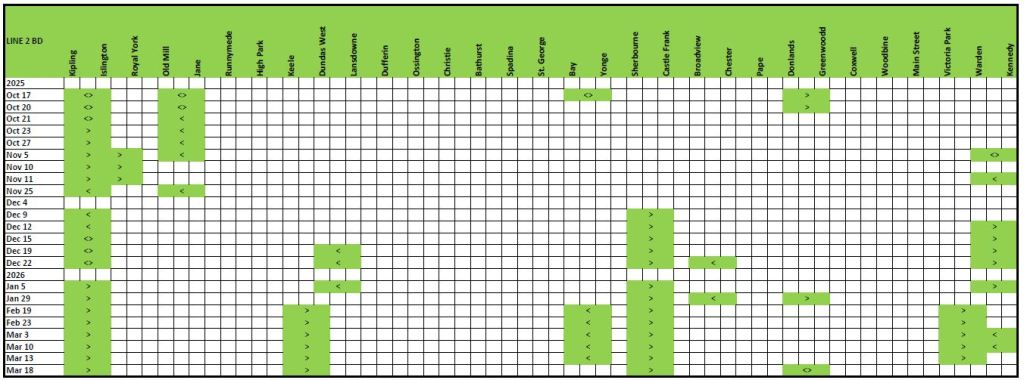
This post continues previous reviews of the map and lists of reduced speed zones (RSZ) on the TTC subway with snapshots of the status of Lines 1 and 2 from mid-October 2025 to mid-March 2026.

The charts below are adapted from maps that are updated regularly on the TTC’s Reduced Speed Zone page.

The total number of zones sits persistently at about a dozen. Although some disappear fairly quickly, others replace them. Some are long-standing zones that are more challenging to repair in winter weather.

In the coloured boxes, the arrows indicate the affected direction of travel with “<>” meaning both ways.

The TTC is working hard, I understand, to get the system in the best shape possible for the World Cup events from mid June to early July. Whether they will achieve this remains to be seen.

One issue is the timing of the usual Spring system inspection of rail condition and track geometry. Will the results of this inform current slow orders, or will this be carefully “parked” so that new slow orders do not appear until after the big event?

The current orders have target repair dates in March and April, with 4 of 14 showing “TBA” I will return to this topic in early June.

Updated March 20, 2026: Following the “more” break are comparisons of the detailed explanation of RSZs in effect at the start of this period (Oct 17) and end (Mar 18).

Continue reading

Tracking Metrolinx Project Costs

Tracking the costs of Metrolinx projects with publicly available data is not an easy task. They are a secretive organization, and present ongoing costs in a way that hides the eventual total cost of construction and operations. When anyone talks about “on budget”, there is no way to verify the claim because no overall budget figure is given for any project.

Instead, what we see are the cumulative value of contracts that have been awarded as well as spending to date. The rest, assuming that there even is a “budget”, is hidden on the grounds that telling would-be bidders how much money might be on the table will only encourage them to bid to that level. This is nonsense because, except for a few huge P3s, most projects are broken into many smaller contracts and knowing that there are billions available across a project’s allocation gives no hint of how much is earmarked for each component.

The situation is even more opaque in the case of contracts that mix design and construction (a finite capital cost) with operations and maintenance (an ongoing operating cost) over an extended period. Comparison with projects elsewhere is difficult because the components are not segregated.

With the Eglinton and Finch projects now shifting from construction to operation, there is a chance to see what the split would be with the building largely complete. There will be some ongoing capital costs for project cleanup, but costs to date should largely represent the amount spent on the construction phase.

Many other projects are also in flight and there is no way to know if all of their components have been awarded and the values included in the “baseline” cost shown in financial reports.

This article consolidates the reported budgets, later renamed as “baselines”, as well as actual spending in the quarterly Metrolinx Capital Projects reports.

Some projects actually had projected in-service dates, at least in the early years, but these vanished long ago. Metrolinx promised big things once upon a time, but has been much slower to deliver, and at much greater cost than anticipated.

Continue reading

Metrolinx Board Meeting: February 12, 2026

The Metrolinx Board met on February 12 with an extensive agenda, but as usual almost none of it was discussed in public. Of particular interest was an explanation of the derailment at Union Station that snarled GO Transit operations for much of the past week. Although a detailed review continues and a full report is promised, Metrolinx was unusually forthcoming with a description of the event.

The public portion of the meeting began with a “safety moment” that focused on problems with pedestrian, cyclist and auto intrusions into the Eglinton and Finch rights-of-way. This was discussed in a tone reminiscent of GO mainline rail corridors which the new LRT lines definitely are not. In the case of Finch, the right-of-way has less physical protection than on Eglinton, and no areas of open track or grass to signal that this is not part of the overall roadway.

The very nature of a surface route, regardless of technology, is that people and vehicles will cross the tracks. They have been doing it for over a century on the streetcar system, and it is odd that Metrolinx finds this an unusual behaviour. It is not clear, other than the presence of two separate P3s on these projects, why the Eglinton and Finch designs are so different. This also contributed to the switching problems on Finch because of inadequate heaters and drainage.

Reviewing the operation of Finch, Metrolinx CEO Michael Lindsay made no mention of equipment reliability, a major problem on that line compared to Eglinton. As revealed in TTC delay logs, at times there were not enough working cars to operate the scheduled service. Delays due to “mechanical problems” continue to appear in Line 6 service alerts. The logs in the City’s Open Data website do not yet include January 2026, but when they do, I will publish a review.

Speaking of Finch, Lindsay spoke of recent improvements. At Metrolinx’ urging, the P3 partner, Mosaic, took steps to improve infrastructure maintenance. The line is now into a stage of “perfection” of operations and maintenance protocols as opposed to building issues. The issue is the readiness of private sector partners to deal with climate effects, and more generally to bring their supposed expertise from other systems to Toronto. Only recently has Mosaic hired someone with expertise in cold weather operations.

Lindsay reported that all 55 switch heaters on Finch have been checked, and drainage at 40 sites is improving. Performance stats are better since the record snowstorm of January 25 with 95% availability, and TTC on time performance is 70-80% over past couple of weeks. This may sound impressive, but any stats are bound to look better as weather improved. As for OTP, TTC standards allow for erratic service as discussed here many times.

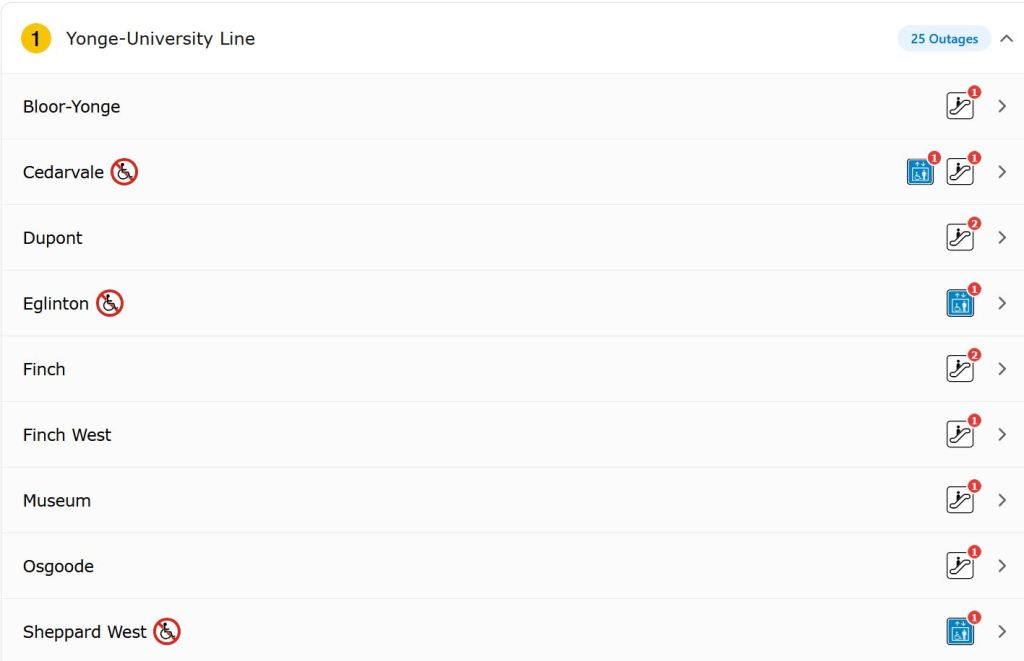
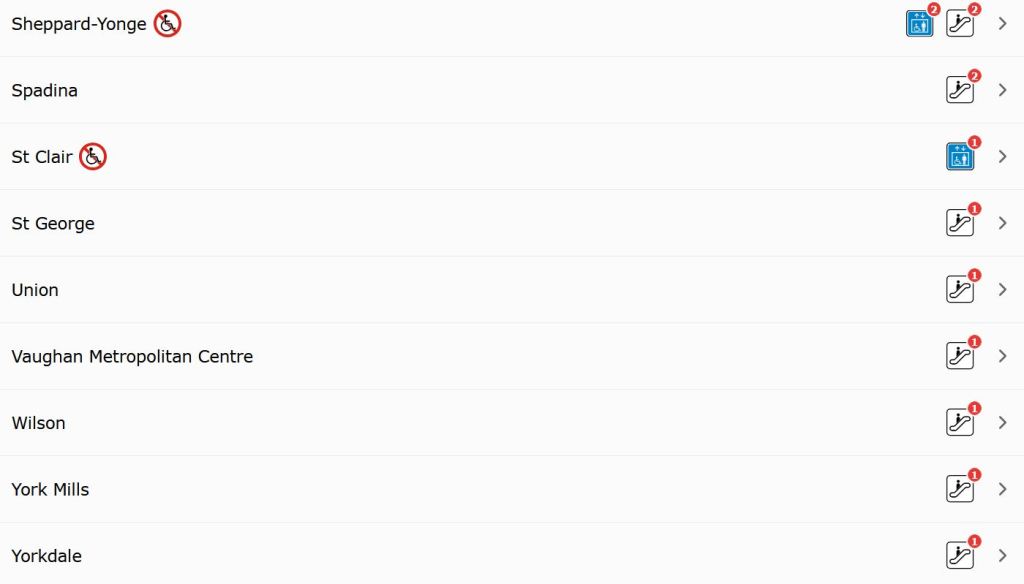
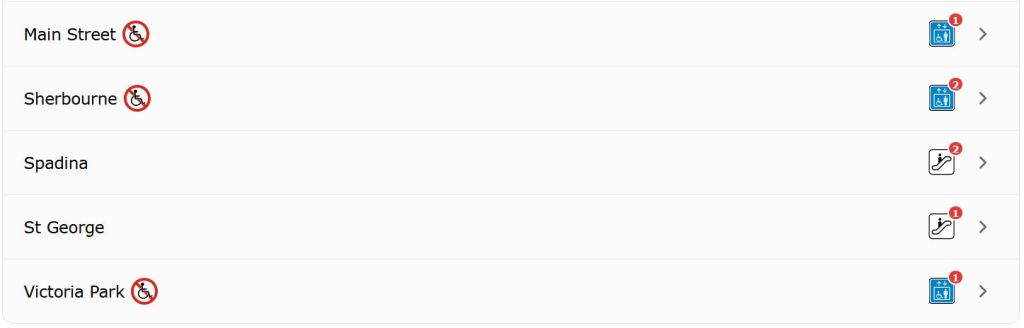
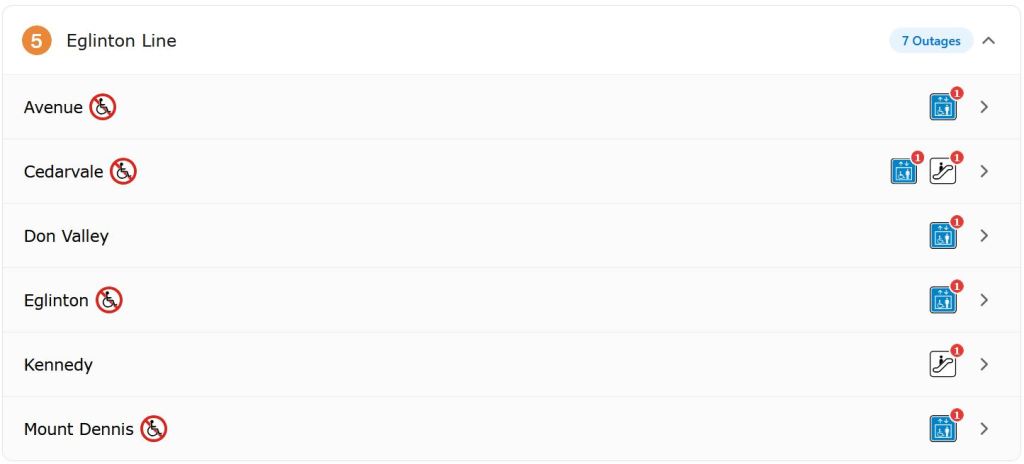
In all the celebration of Eglinton’s recent opening, Lindsay made no mention of accessibility issues with several elevators out of service including at key interchanges like Don Valley, Eglinton and Mount Dennis. Further problems include long walks to transfer between routes and less than adequate signage. Metrolinx is supposed to have design standards, but if these lines are any indication, they desperately need review. In many ways, this was the usual Metrolinx “good news” presentation which skated around problems, or presented them as past events no longer of concern.

On the subject of “lessons learned”, Lindsay claimed that private sector partners underestimated complexity, risk, and challenge of the projects, but gave no indication that Metrolinx or Infrastructure Ontario bore responsibility for assuming more expertise within the P3s than might actually have existed. There was a hint that things might have gone better. Lindsay noted that Metrolinx has changed processes, a reference to the shift to an “alliance” model where the P3 are treated as collaborators.

Lindsay hinted at problems with the Metrolinx regime and its confrontational nature saying that all parties need to remain focused on project completion, not commercial claims. They must do the right things for the good of a project even if this compromises legal or commercial strategies. Design review and acceptance must be much more efficient and less bureaucratic in all hands. When unexpected issues such as cavities in the original 1950s Eglinton Station box are encountered, a quick regulatory process to respond is needed.

Lindsay noted that there must be an early and insistent focus on systems integration — bricks and mortar are only one milestone. More important are testing, commissioning and interoperability. This should be no surprise to anyone with transit experience. Construction is a large and impressive part of a project, but without well integrated, reliable systems and vehicles, billions of dollars worth of tunnels are useless.

He remarked on another aspect of P3s that is rarely discussed: procurement must ensure that joint ventures have a collaborative relationship without their own contentious internal issues.

Better public communications on construction, cost estimates and timelines are needed.

These remarks, for those reading between the lines, are not a ringing endorsement of how Metrolinx operated on two major projects. They might have learned lessons from the experience, but the proof will show in how work now underway actually proceeds.

Continue reading

Elevators at Museum and Greenwood Stations

In the Toronto Star of February 10, columnist Jack Lakey wrote about the long-delayed completion of renovations at Museum Station including the installation of an elevator. The original target date for this work was mid-2025, but this has been pushed to Q3 2026 which could be as late as September 30.

The problem as described by the TTC is quoted in Lakey’s piece:

“In addition to installing elevators at Museum Station, the project involves rebuilding and expanding the concourse level, as well as relocating existing stairs and escalators.

“Throughout this work, the TTC must maintain the structural integrity of the original subway building while completing full-depth excavation directly adjacent to it.

“Work is done in stages so that stations remain open to the public. TTC elevator installation is also typically bundled in with other necessary work, in this case, significant repairs and adding waterproofing to Museum Station’s roof.”

What the TTC neglects to mention is that the delay arose from two other factors:

  • Underestimation of the complexity of the project.
  • The need to replace the elevator subcontractor for non-performance.

The same subcontractor was responsible for the delayed completion of elevators at Greenwood Station, and had to be replaced. Moreover, their work damaged a nearby house. Greenwood Station has just resumed normal operation including its new elevators.

The evolving situation at Museum is described in various TTC reports. It is a shame that TTC spokespeople don’t appear to have read them.

Continue reading

TTC Board Meeting: February 3, 2026

The TTC Board will meet on Tuesday, February 3, 2026 at 9:30am in North York Council Chamber. The agenda is rather thin, and there are several confidential issues that will trigger an in camera session. There is no formal item regarding Line 5 Eglinton, although one never knows what might come up in debate.

Of interest are the following items:

Updated February 2 at 10:10am: Slide decks for the invited presentations have been posted on the TTC site. Links to them are added below.

  • CEO’s Report
  • Invited presentations from:
    • Narayan Donaldson on “Opportunities to improve Transit Signal Priority in Toronto”. According to the covering report “This presentation will discuss the strengths and weaknesses of the Transit Signal Priority (TSP) system used on Toronto’s streetcar, bus and LRT systems, compare it to a TSP system commonly used in the Netherlands, and suggest areas of improvement.”
    • Jonathan English on “Developing a Surface Transit Revitalization Plan” According to the covering report “This presentation will discuss steps that can be taken to improve speed and reliability of the streetcar network, as well as new LRT lines.”

After the meeting, I will write up the presentations in an update to this article.

Continue reading

More Money For CanCon, Not For More Trains

Today, Ontario announced that it would raise the Canadian content in 55 new Line 2 trains from roughly 25 to 50 percent. The provincial capital subsidy for this purchase will rise from $758-million to $950-million, and the increase will be matched by the federal government who are also funding this purchase. There is no change in the Toronto share.

It is not clear whether the federal contribution is net new money, or merely a reallocation within Toronto’s share of the ten-year transit funding program.

Updated January 16, 2026: According to the federal government announcement, the funding will come from an existing allocation stream and is not net new money.

This project is part of the previously announced 10-year funding commitment under the Baseline stream of the Canada Public Transit Fund (CPTF). Beginning in April 2026, the Toronto Transit Commission will receive up to $1.2 billion in CPTF funding over 10 years from 2026 to 2036. 

A related question is which government(s) will be on the hook for the extra CanCon in future transit vehicles including those for the Scarborough and Richmond Hill extensions, and for added capacity to deal with expected growth. Collectively these account for a potential 57 more trains, doubling the size of the eventual order.

What the announcement did not address is a list of questions about the Toronto subway fleet overall:

  • When will the cars be delivered, and how much work is needed to keep the old Line 2 trains operating in the interim?
  • When will Metrolinx place the add-on orders to provide trains for the Line 2 Scarborough and Line 1 Richmond Hill extensions?
  • How will delivery of the add-on trains affect opening dates for the extensions?
  • Will complete replacement of Line 2 trains be delayed because new trains are needed to provide service on these extensions?
  • Will the extensions have enough trains to provide full service to the new terminals, or will some trains have to short-turn in peak periods?
  • How soon does the TTC project it will require more trains to improve capacity on Lines 1 and 2, and how will these be funded?
  • What is the status of funding and timing for new maintenance facilities on Lines 1 and 2 to hold and service the additional trains?
  • Will the Automatic Train Control (ATC) technology for Line 2 be the same as the existing system on Line 1, or will the two lines (and their fleets) be limited to use only their “own” trains?

The TTC produces a quarterly report on all its major capital projects with the intent of showing all planned work, but it does not produce a unified chart or timetable showing how everything fits together and where critical links might be in the overall plan. The TTC has a “Strategic Planning Committee”, and this is a complex piece of strategy that badly needs detailed, public review.

Continue reading

SRT Busway To Open A Year Early

The express busway linking Kennedy Station to Ellesmere Road along the former Line 3 Scarborough RT corridor will open in late September 2026 rather than in 2027 as originally planned. This was announced jointly by Mayor Chow, TTC Chair Myers and TTC CEO Lali.

The idea of repurposing the SRT corridor was approved well before the premature end of service with a derailment south of Ellesmere Station in July 2023. According to an April 2022 presentation, design work would begin in 2022, and construction to convert the corridor would begin immediately after the RT shutdown scheduled for November 2023, and the busway would open in Q4 2025.

Yes, it should be open already, but delays in funding the project, acquiring property, gaining Metrolinx approval for co-existence of a busway with their rail corridor, among other factors, pushed design completion out to mid-2024, and the target in-service date well into 2027.

A common factor in many delays was a lack of urgency, and the idea that Ontario should pay for this conversion as part of the Scarborough Subway project. Council approved its expected share of funding in February 2024, but time was lost waiting for provincial money that would never arrive. Eventually the City decided to just get on with the work.

Major Projects Update April 2025:

The 100% Detailed Design of the Busway was completed in December 2024, along with the final cost estimates, which remain within the approved budget. The contract for the Busway was tendered in February 2025 and is expected to be awarded in Q2 2025 to commence the construction of the Busway.

Major Projects Update June 2025:

The contract for the Busway was tendered in February 2025 and closed in April 2025. Delegated authority to award the contract was approved at the May 2025 Board meeting along with a motion to report back to the Board in July 2025 on an acceleration plan.

The July report included:

As the contract was awarded on June 5, 2025, and the first kick-off meeting was held with the Contractor on June 13, 2025, staff are anticipating receiving the Contractor’s baseline schedule in the first week of July. We, therefore, expect to start the discussion with the Contractor on the acceleration plan in July 2025. The Contractor will need time to line up their sub-contractors and suppliers to develop a comprehensive acceleration plan that demonstrates ways and means of achieving the acceleration goal. We anticipate finalizing the acceleration plan by end of the summer and reporting back to the Board in September/October 2025.

Major Projects Update September 2025:

The contract for the Busway was tendered in February 2025. The contract for the Busway implementation was awarded in June 2025, and work commenced on July 22, 2025.

[…]

Awaiting an acceleration plan proposal from the contractor. Upon receipt of the proposal, negotiations to finalize the proposed plan will take place immediately over the following two to three weeks. A report will be provided to the Board at the October 2025 meeting.

No report appeared in October or since.

Major Projects Update December 2025:

“The contractor submitted a baseline construction schedule, and an acceleration plan to target an early revenue service is under negotiation.”

In other words, it was possible to get the busway open sooner, but that was not the original scheme nor was an acceleration plan required in the initial tender. No, it was not your imagination that this project could have run faster, it was actually planned to be long. As of a few days ago, a faster schedule was still only a possibility.

Now with political pressure, the Scarborough Bus Corridor project will speed up. However, the basic question is why was this option not on the table from day one especially after the time lost awaiting provincial funding.

TTC 2026 Budget Preview

The TTC’s Strategic Planning Committee met on November 25 for a presentation outlining major issues in the forthcoming Operating and Capital Budgets. These will be presented at the next meeting of the full Board on December 10.

When the Strategic Planning Committee was first proposed during 2025 budget debates, the idea was that it would have some input to the 2026 cycle through discussions of policy options, financial effects and tradeoffs. However, the committee’s actual formation dragged on for months almost as if there was a “fifth column” working to prevent its ability to function.

The committee will not meet again until March 2026, and hopes to plug into the 2027 budget cycle. This will be complicated by the municipal election and the sense that any policy debate sets the stage for candidate platforms. Still to come from management is an updated Ridership Growth Strategy that necessarily will inform budget plans for 2027 and beyond. It is not yet clear how work on various TTC plans will flow through the Strategic Planning Committee with meaningful input and opportunity to fine-tune proposals.

In that context, management presented an overview of issues facing the TTC going into the 2026 budget debates.

The stage is set with an overview of recent years and the situation in late 2025.

The 2025 budget aimed high anticipating riding growth from a return-to-office commuting trend. This has not materialized uniformly across the system, and it is compounded by a decline in student travel thanks to cuts in the international student visa program and reduced offerings at post-secondary schools.

In the table below, note that the “Operating Budget (Net)” is effectively the budget as seen from the point of view of funders, primarily the City. The gross budget for 2025 is $2.9-billion.

On the Capital side, the TTC spent 87% of allocated budgets as of the third quarter end, and expects to hit 100% or more by year-end. Spend rates through the year are affected by peaking effects from project timing related to weather (construction delays) and major deliveries (new vehicle arrivals), for example.

Although the bump proposed in 2026 spending is relatively large, almost $200-million, 87% of this goes to the extra cost of operating Lines 5 and 6, assuming both are open. Only $25-million goes to current service. Some of that will simply pay the full year cost of operating improvements made in 2025 such as restoration of subway service to near-2019 levels. As we will see later, improvements, such as they might be, will come by reallocation of service between routes, not from net new spending.

For the third year in a row, fares will be frozen. This has a cost, although it is not shown as a budget line item. A 10-cent increase in adult fares, about 3% at current levels, translates to about $30-million annually less the effect of any ridership loss an increase would cause. TTC management has always warned that small annual changes in fare levels are preferable to infrequent large jumps to make up for periods of fare freezes. There is nothing inherently wrong with keeping fares low and service good, but the City must go into that policy with its eyes open as subsidies make a larger part of total revenue, and any service increases bear an increasing effect on non-fare funding.

Debates will continue about changing the fare structure including rebalancing concession rates, introducing schemes to benefit frequent riders such as fare capping. However, any change is unlikely until at least mid-2026 when the TTC rolls out a new version of Presto that will provide more flexibility in tariff design.

This is not to say discussion about fares should halt, and indeed it should already be underway informed by the capabilities and restrictions of Presto. This should be a integral part of any Ridership Growth Strategy debate including the comparative value both in the business sense and as a matter of municipal policy. Why do we provide transit service, what constitutes good, attractive service, and what spending (or avoided revenue increase) would best address the City’s goals?

For 2026, the highlights are:

  • The fare freeze
  • A 2.2% increase in service hours
  • Added funding for a growing fleet of eBuses and streetcars (new vehicles delivered in 2025 will incur full-year maintenance costs in 2026)
  • Lines 5 and 6 operation (the net cost to be offset by a Provincial subsidy)

Of the total operating cost, 93% is “conventional” TTC service and 7% is for Wheel-Trans out of a projected total of $3-billion.

This was achieved while keeping the increase in City funding to $91-million and finding $87-million in budget reductions (some of which are due to accounting changes). We do not know most of the details of budget trimming, nor the foregone possibilities for improvement. Commissioner Saxe queried the lack of Board participation in this process which was to be part of the Strategic Planning Committee’s mandate. We will see in 2026 whether there actually is an open debate.

The revenue/cost ratio for the TTC is now 42%, and that number includes some ancillary revenue beyond the farebox. It is no longer possible to paint TTC as a woefully undersubsidized agency. Riders once paid 60% of costs with another 6% coming from sources such as advertising. Indeed, the City of Toronto will pay more in subsidy in 2026 than the TTC will receive from fares.

Note how small the ancillary revenues are in the table below. Budget debates spend excessive time on how the TTC could be so much better off if only there were more ads, or revenue generating schemes such as shops in stations. This is all very small change compared to overall funding needs, but fixating on minor revenue schemes avoids hard decisions about spending on quality service.

Continue reading