TTC Announces Widespread Service Cuts Effective November 21, 2021

With no fanfare at all, the list of planned service changes for November 21, 2021 has appeared on the TTC’s website.

As a result of operator workforce shortages, Line 2 Bloor-Danforth, one streetcar route, and 57 bus routes will experience temporary service reductions and/or period of service suspensions. Provisions have been made to protect service on the busiest corridors in the system during the busiest periods. November schedules will continue into December, with some minor adjustments.

TTC Service Change Notice for November 21, 2021

As I have recently documented in a series about service reliability on short routes, the TTC has already been missing buses regularly on its service, and there would be problems even without the ongoing issue of service reliability and an abdication of headway management.

I do not yet have the detailed memo explaining service changes thanks to the TTC’s email system outage, and can only report at this time on the information in the TTC’s post. When I do get the memo, I will produce the usual detailed spreadsheet showing all of the changes.

Changes Unrelated to Service Cuts

A few changes are due to factors other than the need to cut back on service.

  • In September, the 60 Steeles West bus was cut back to Pioneer Village Station and the 960 Steeles West Express took over the western portion of the route during most periods. The service level west of Pioneer Village has proven too low, and the 60 Steeles will provide a 15 minute service west to Kipling on top of the 960 during weekday daytimes.
  • The 953 Steeles Express will now stop at Leslie Street both ways.

Construction Changes

  • 75 Sherbourne will divert via Jarvis street between King and Dundas Streets due to water main construction until late December.
  • 501 Queen, 504 King, 505 Dundas and 506 Carlton (together with related night services) are affected by various projects. Details are in a separate article.

Service Cuts

Service on many routes has been trimmed, and some express operations have been dropped. The details, to the extent that they have been published, are shown in the spreadsheet linked below.

In many cases, I have simply put “Reduced” against a time period until I know the specifics of the changes. This spreadsheet will act as a template to accumulate information as it becomes available.
TTC Announces Streetcar Diversions and Bus Replacements (Updated)

The TTC has posted several notices on its website detailing recent and planned service changes on several streetcar routes.

Updated November 21, 2021: Modified to pick up new and replacement pages on the TTC’s website.

King-Queen-Queensway-Roncesvalles Project

The TTC’s KQQR page has been updated to reflect the new routings implemented over the November 13-14 weekend.

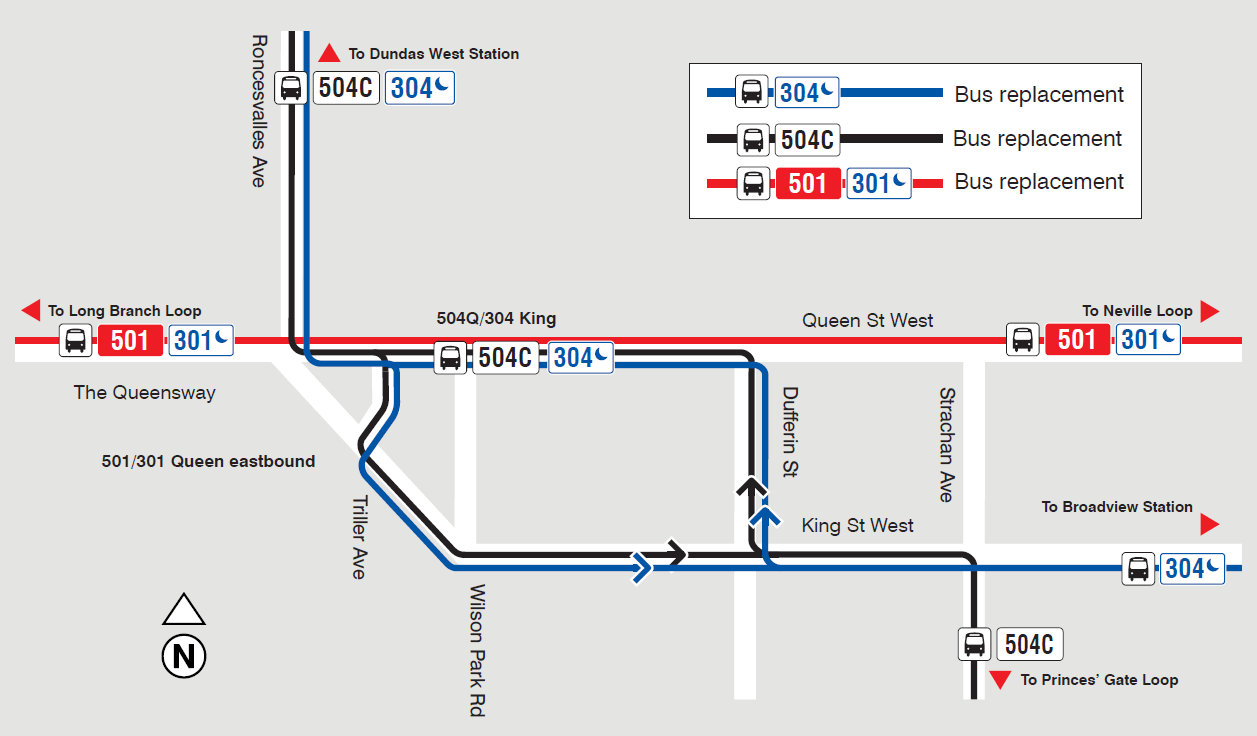
With the south leg of the intersection now closed and Queen Street open for east-west traffic, the 501/301 Queen bus service now operates straight along Queen Street.

The 504/304 King bus service diverts westbound via Dufferin and Queen as it has done for many months, but now runs through to Dundas West Station. The eastbound service from Dundas West heads east on Queen to Triller and south to King.

This map does not show the diversion implemented for the track work at Queen and Shaw Streets that requires the 501/301 services to divert both ways via Strachan, King and Dufferin. That project also requires a diversion of 63 Ossington via Queen, Dufferin and King.

There is also a TTC page under their Construction Notices (as opposed to Service Advisories) for the KQQR project. This page is extremely out of date.

Queen East Overhead Conversion for Pantographs

The 501 Queen Streetcar currently operates as far east as Russell Carhouse (east of Greenwood) during overhead upgrades on the east end of the route. The 503 Kingston Road car continues to operate over its full route to Bingham Loop. A 501N shuttle provides service between Leslie Street and Neville Loop.

On November 21, this arrangement will change, and the 501 Queen cars will be extended to Woodbine Loop at Kingston Road. The 501N shuttle bus will loop via Eastern and Coxwell Avenues. The 503 service will remain as is.

This change will remain until January 2, 2022 when streetcar service to Neville Loop should be restored.

Other 501 Queen Diversions

Two diversions are in progress for the ongoing track replacement project on the central part of the Queen route:

  • 501 buses divert between Bathurst and Spadina via the Richmond/Adelaide pair.
  • 501 buses divert between Dufferin and Strachan via King during track replacement at Shaw & Queen.

501 streetcar service will be restored to Queen Street between Neville Loop and Wolseley Loop (at Bathurst) on January 2, 2022.

The map for the diversions is in this notice. That page is now partly out of date due to the extension of the 501 streetcars to Woodbine Loop on November 21, 2021.

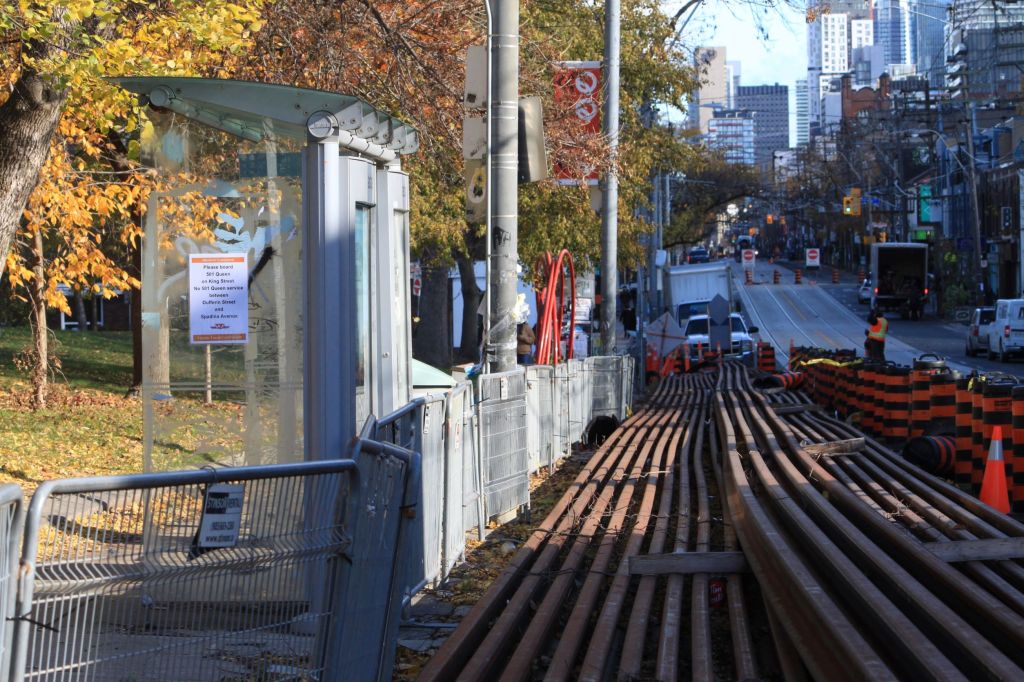
Photo by Raymond Lee

506/306 Carlton / 505 Dundas Changes for Sewer Work on Coxwell Avenue

From November 21 until mid-February 2022, the Carlton streetcars will turn back at Broadview via Broadview, Dundas and Parliament. This loop is currently used by the 505 Dundas car due to water main work on Broadview north of Gerrard.

The 505 Dundas service will be diverted and extended to Woodbine Loop via Broadview and Queen Street while the Carlton car is looping at Broadview.

Queen/Shaw Intersection Replacement Begins (Update 2)

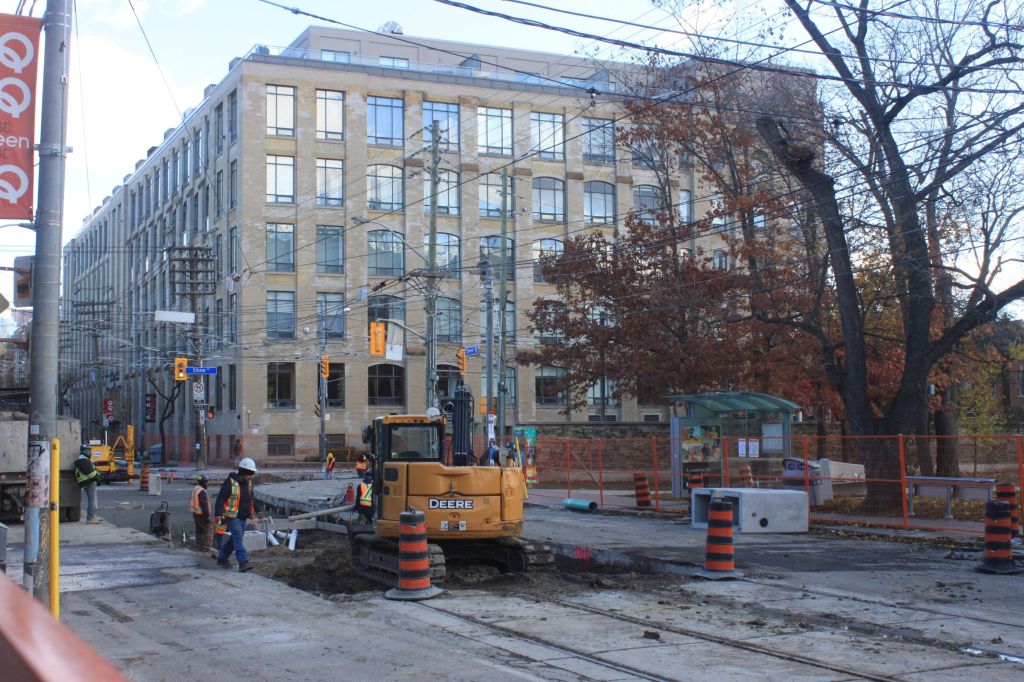
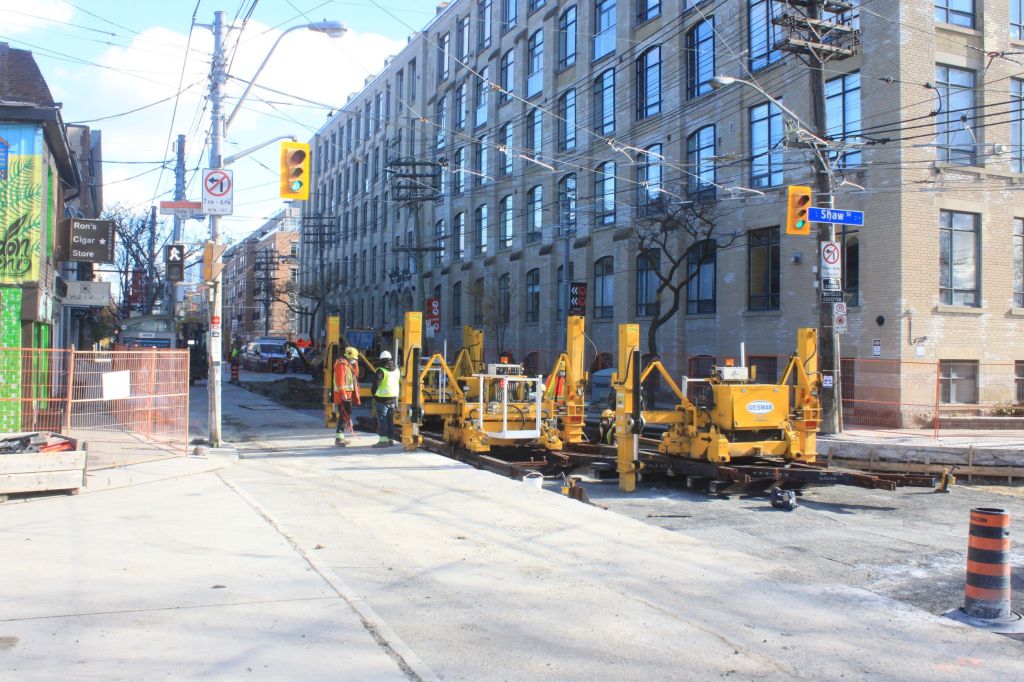
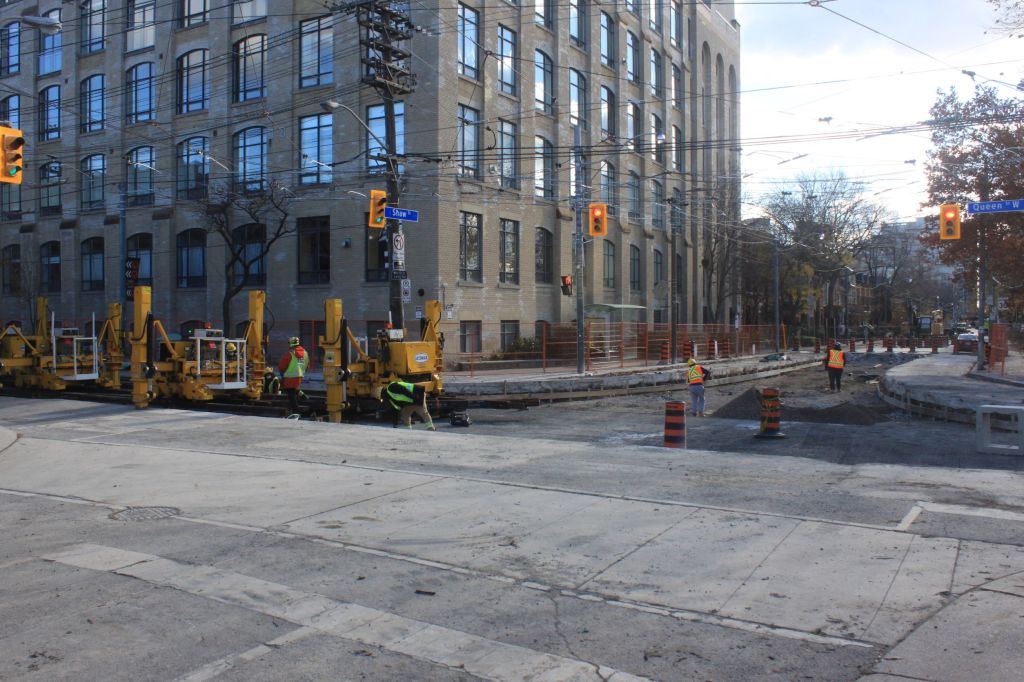
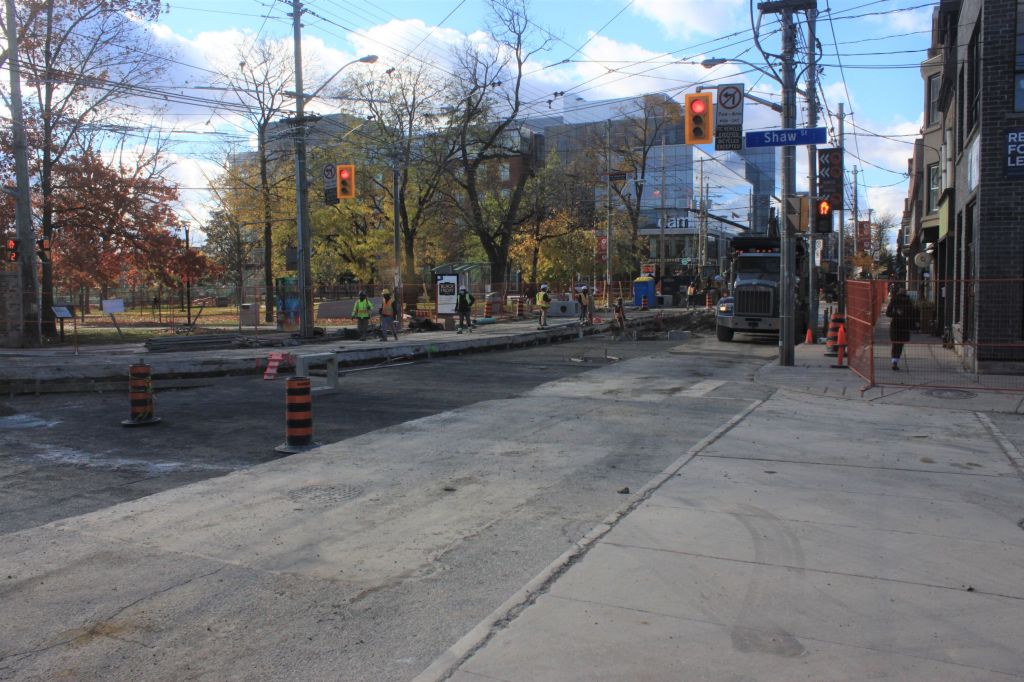
Work began on November 15, 2021 on the replacement of special work at the intersection of Queen and Shaw. Based on past experience with similar projects, this should last about three weeks.

Updated November 19, 2021 at 2:45 pm: Track replacement has begun with the eastern leg of the intersection, and foundation work is in progress for the other two legs.

Updated November 21, 2021 at 1:40 pm: Links to TTC diversion notices added.

The service diversion now embraces changes for multiple works along Queen Street West:

501 Queen Bus: Initially, the diversion was via Dufferin, King and Strachan both ways. However, extension of the tangent track replacement west of Bathurst now requires buses to divert both ways via Dufferin, King, Bathurst, Richmond/Adelaide, and Spadina. (Updated November 19)

63 Ossington Bus: Diverts both ways via Queen, Dufferin and King. The buses loop through Liberty Village on their normal route via Strachan southbound and Atlantic northbound, but then turn west onto King for the northbound diversion.

Elsewhere on Queen, there are diversions and bus replacements. (Updated November 19)

  • Streetcar service runs between Russell Carhouse (east of Greenwood) and King & Spadina (via Parliament) due to track and overhead work on the central section of Queen, and overhead work in The Beach. It will be extended east to Woodbine Loop on November 21.
  • A bus shuttle runs between Neville Loop and Leslie/Commissioners. This will change on November 21 to operate between Neville Loop and Coxwell.

The 503 Kingston Road car continues to operate between King & Spadina and Bingham Loop at Victoria Park.

Photos on November 19, 2021

King-Queen-Queensway-Roncesvalles Moves to Phase 2

After a long delay thanks to construction issues and utilities that were not located where they were expected to be, the King-Queen-Queensway-Roncesvalles project has moved into its second phase over three months later than planned.

This affects routes 501 Queen and 504 King.

The 501 Queen bus service was formerly diverted via Dufferin and King to Roncesvalles. It now operates both ways via Queen Street following the normal streetcar route in the west end. Separate diversions remain in place elsewhere on the route for track work east of Bathurst, and for overhead work in the east end.

The 504 King shuttle bus had been operating in two sections. One ran on Roncesvalles Avenue between Dundas West Station and Roncesvalles Carhouse. The other ran from the eastern entrance of the Exhibition via Strachan to King, and then over a large counterclockwise loop formed by Dufferin, Queen, Triller and King.

The 504 bus now operates between Dundas West Station and the Exhibition as one route with the two former segments now connected at Queen and Roncesvalles. Westbound buses continue to operate via Dufferin and Queen, while eastbound buses run via Queen, Triller and King as shown below.

Note that this arrangement means that there are no westbound buses on King west of Dufferin, just as there have been no eastbound buses on Queen since this project began. Queen Street now has two-way service.

At the time I write this (7:00 pm, November 14), the TTC has not updated its website to reflect the new routings.

Service Reliability on 94 Wellesley: September 2021

This article continues a series reviewing service quality on some of the TTC’s shorter routes.

Apologies to my regular readers who must be saying “Oh No! Not More Charts!” My intent here has been to show that poor service quality affects many routes and time periods, and occurs even on relatively simple shorter routes in the network.

When the TTC’s IT systems all come back online, I plan to continue with another (smaller) group of short routes: 12 Kingston Road, 62 Mortimer, 64 Main, 87 Cosburn, 92 Woodbine South, 121 Esplanade/River and 124 Sunnybrook. Later in the year I will return to major routes including some I have not reviewed recently or at all including: 7 Bathurst, 41/941 Keele, 43/943 Kennedy, 68/968 Warden, 89/989 Weston and 95/995 York Mills.

Overview

Route 94 Wellesley operates with both a short and long version:

  • The 94A operates over the full route between Castle Frank and Ossington Stations.
  • The 94B operates on the eastern half of the route between Castle Frank and Wellesley Stations except during evening periods on all days.

September 5 brought new schedules and improved service during many time periods.

When there are two branches, they have a common headway and are supposed to be blended. During certain periods, buses are scheduled to alternate between the branches (any time in the table above where there are “half buses” allocated to a branch). This makes both services vulnerable to disruption when there is a missing bus, or a delay/interruption on the western branch throws buses there off schedule.

All of the problems we have seen on other routes are present on 94 Wellesley including:

  • Buses missing from the scheduled service leaving gaps.
  • Traffic congestion that is sometimes predictable, but sometimes much worse than usual, with schedules that cannot accommodate the disruption.
  • Headways that are dispersed widely beyond the target range implied by the TTC’s Service Standards.
  • Buses running in pairs (or worse) for extended periods on a route that does not have many vehicles overall.
  • Irregular headways caused by two services that are scheduled to blend, but which do not do so reliably at many times.
Continue reading

Service Reliability on 72 Pape: September 2021

This article continues a series reviewing service quality on some of the TTC’s shorter routes.

Overview

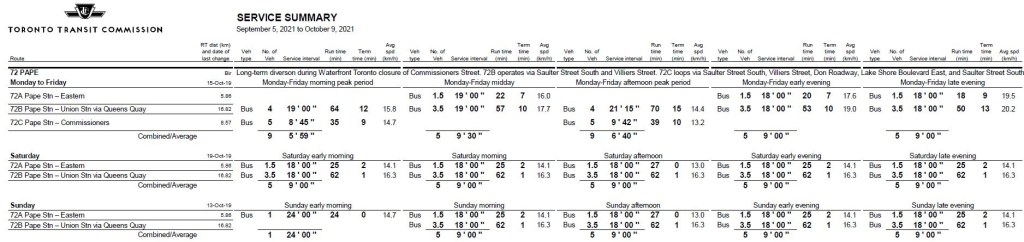
The Pape bus operates two branches one of which has a peak period extension:

  • The 72A operates from Pape Station to Eastern Avenue during all periods except the weekday peaks.
  • During the peak periods, the 72A is extended south and west as 72C to the Don Roadway via Commissioners Street.
  • The 72B operates during all periods except early Sunday morning to Union Station via Queens Quay and Yonge.

Except for peak periods, the A and B branches operate on a common headway and should in theory provide a blended service on the common portion of the route between Eastern Avenue and Pape Station. This does not occur, and the service is a mixture of wide gaps and very short headways at almost all times.

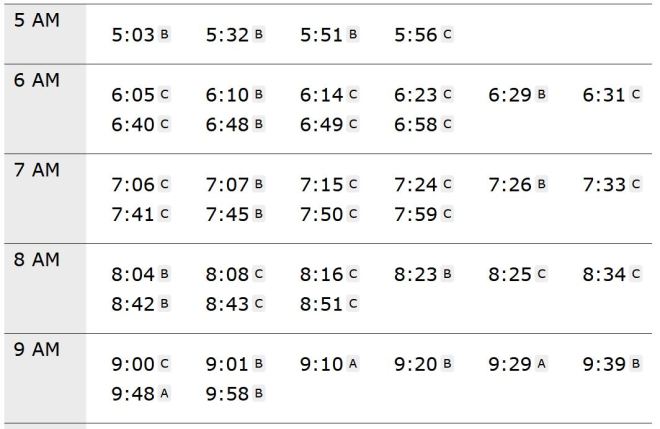
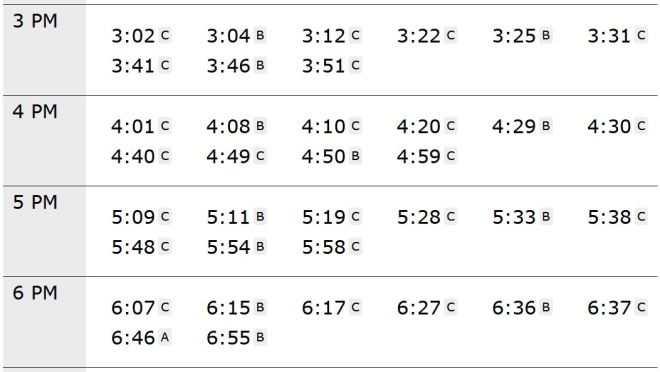
During the peaks, the 72C Commissioners headway is almost but not half of the headway of the 72B Union. This makes it impossible to schedule a one-bus-in-three blended service even assuming that the 72B could stay on time and merge gracefully into the 72C service. The result is scheduled gaps and bunching on the common portion of the route under even the best conditions during peak periods.

Here is the scheduled service southbound from Pape Station in the AM and PM peak periods in early November 2021. Note the scheduled headways of only one or two minutes between “B” Union Station and “C” Commissioners buses.

Continue reading

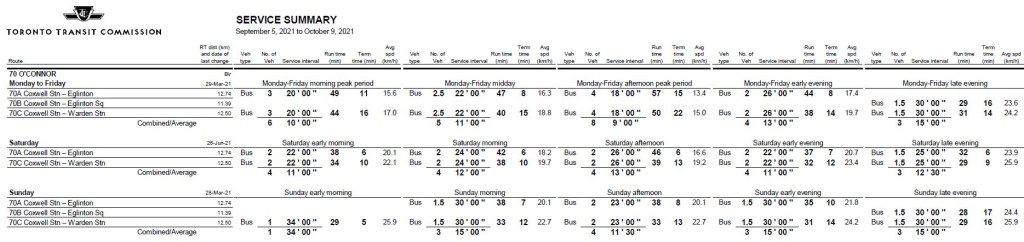
Service Reliability on 70 O’Connor: September 2021

This article continues a series reviewing service quality on some of the TTC’s shorter routes.

Overview

The O’Connor bus runs north from Coxwell Station and branches into a lopsided Y-shaped route. One branch, the 70A/B, goes north via O’Connor to Eglinton while the other, 70C, goes to Warden Station via St. Clair. The Eglinton service loops north of Eglinton except late evenings weekdays and Sundays.

This service design was changed in October so that all Eglinton trips operate as 70A, and the 70B Eglinton Square turnback has been dropped. However, for this analysis, it was still operating. For that reason, the screenline for southbound headways on this branch is set south of the common point for both the 70A and 70B services.

Two years ago, I reported on severe problems with bunching on 70 O’Connor.

At its meeting of December 12, 2019, the TTC Board endorsed a motion by Commissioner/Councillor Bradford whose ward includes the O’Connor bus:

Notice of Motion – Review of 70 O’Connor Bus Route

TTC Board Decision

The TTC Board, at its meeting on December 12, 2019 adopted the following:

That the Board directs staff to investigate and report back by Q1/2020 on the 70 O’Connor bus route reliability, in response to Steve Munro’s published analysis on his website stevemunro.ca on November 20, 2019.

The pandemic lockdown intervened, and the requested report did not appear. However, schedules on the route were changed to improve running times and a chronic problem of bus bunching ceased to be a problem as charts in this article will show.

In place of bunching O’Conner’s major problem in 2021 is that buses are frequently missing from service. Because of the branched nature of the route with headways ranging from 18 to 30 minutes on each branch, the effect of a missing vehicle can be quite severe. With few buses on the route, adjusting service by changing the spacing of remaining vehicles is not an option. In many cases, only one bus remains on a branch.

When all of the scheduled vehicles are in service, headways and travel times are fairly consistent, and buses often have generous layovers (considering the length of a one way trip) at both terminals.

Continue reading

Service Reliability on 75 Sherbourne: September 2021

This article continues a series reviewing service quality on some of the TTC’s shorter routes.

Overview

75 Sherbourne operates between Rosedale and Queens Quay. At the south end, it has an on street loop normally via Queens Quay, Jarvis and The Esplanade. At its north end, the loop reaches to the south end of the Glen Road bridge on South Drive.

For this analysis, the two screenlines used are located at:

  • Sherbourne just south of Bloor. This records the headways at the major subway connection point, Sherbourne Station.
  • Sherbourne just north of Front. This records headways north of the south-end loop.

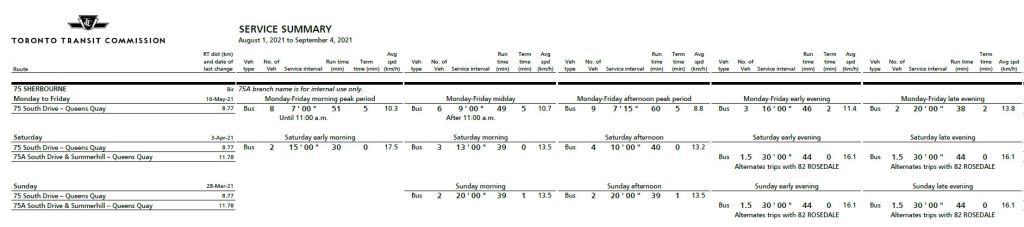
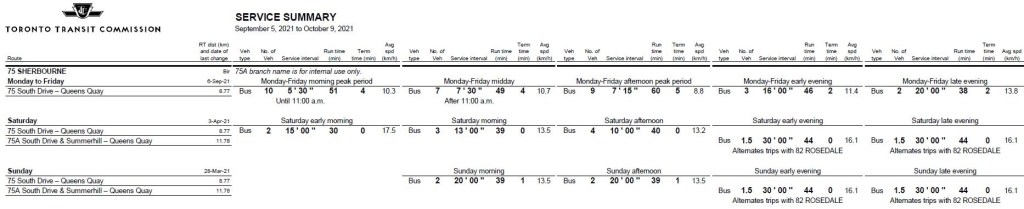
The service design during September 2021 is shown below. From September 1st to 3rd, the line operated on a summer schedule with less frequent service during the peaks and midday.

Weekend evenings the route is interlined with 82 Rosedale on a 30 minute headway using two buses over the combined route.

In these headway charts, the vertical scale is extended from the 0-30 minute range used in past articles to 0-60 minutes so that all data points will be visible.

75 Sherbourne shows all of the problems seen on other routes including missing vehicles and bunching, and, in some periods, a lack of sufficient running time to provide for recovery from minor incidents enroute. Service is often unreliable.

Continue reading

Transit and the Urban Form of Toronto

This article contains a deck with my presentation and speaking notes for a guest lecture to Professor George Baird’s class at the Faculty of Architecture, University of Toronto, “A History of Urban Form”.

It is not intended as a definitive document, but as an overview tailored to the course as a whole and to the time available.
Alas, you will not hear my dulcet tones. For some things you just had to be there.

The version linked here as of 7:00 pm, November 6, has minor corrections and typos fixed.

Service Reliability on 65 Parliament: September 2021

This article continues a series reviewing service quality on some of the TTC’s shorter routes that generally escape notice when buses like Dufferin and Finch come under fire for erratic operation.

Overview

65 Parliament is a very short route operating from Castle Frank Station on Line 2 BD south to The Esplanade. The 2022 Service Plan proposes extending the route south to Queens Quay to the loop at Corus Quay serving George Brown College.

The service design during September 2021 is shown below:

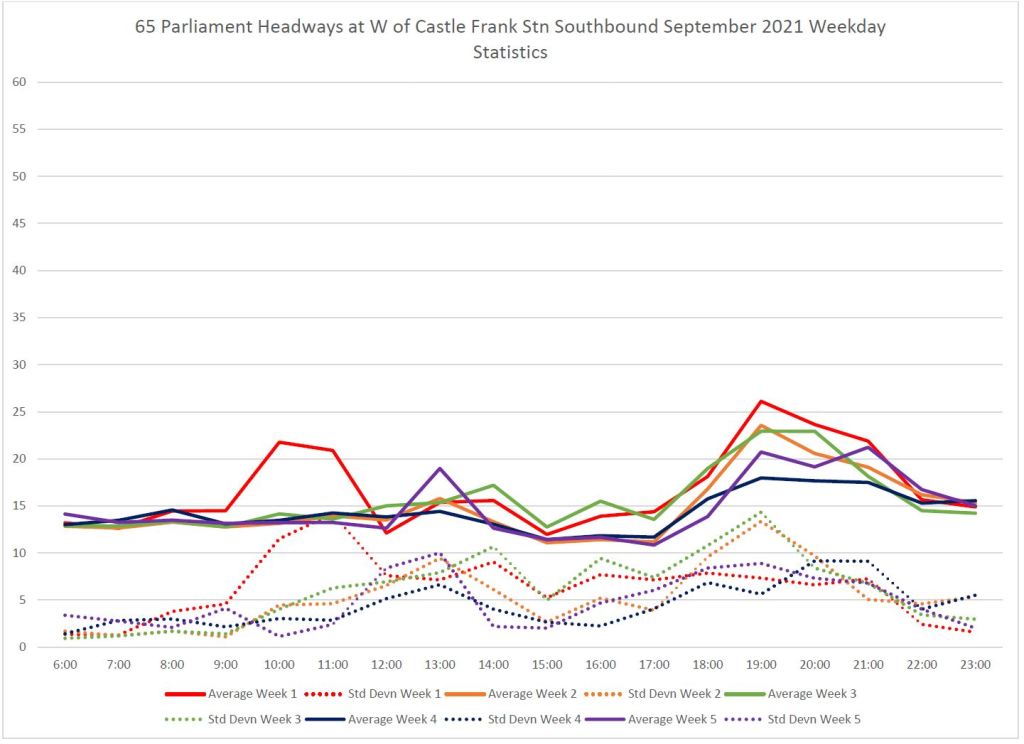
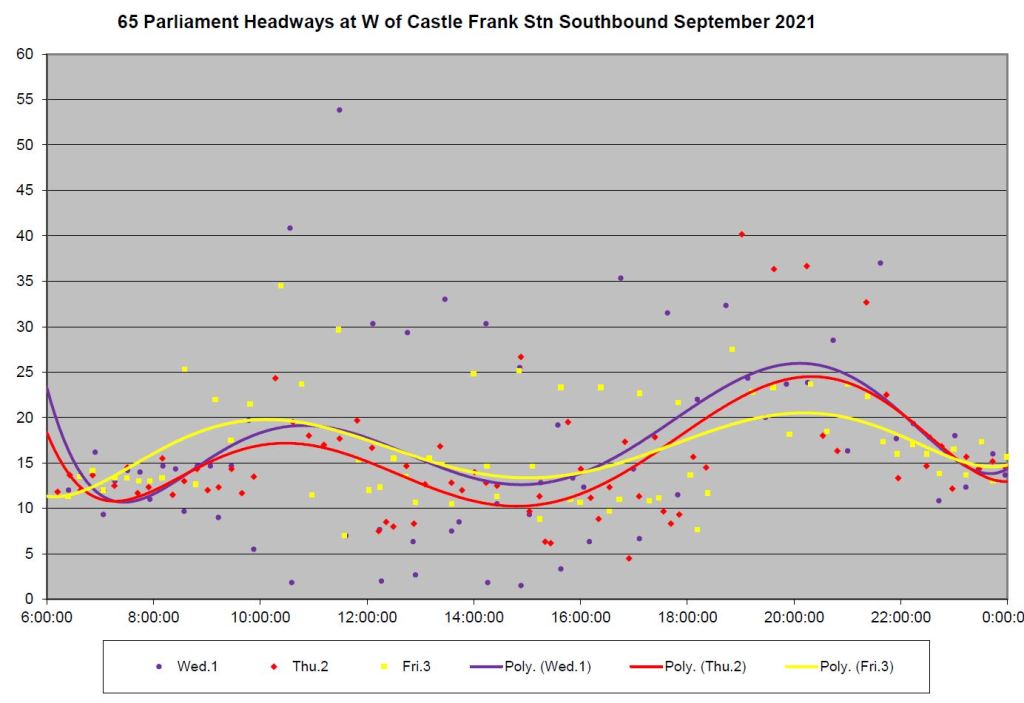
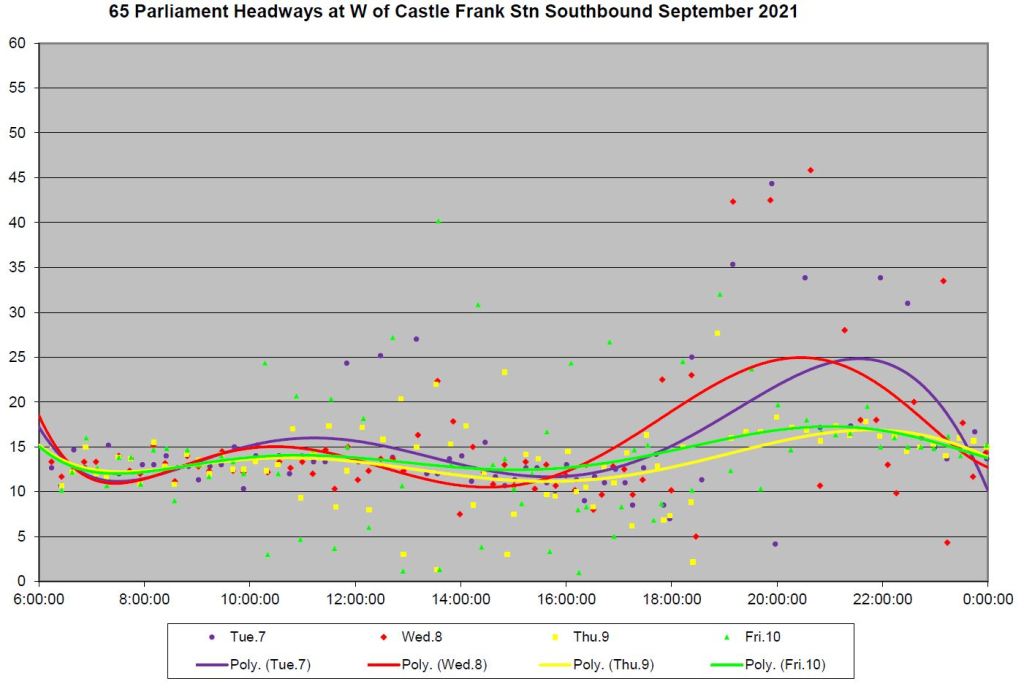
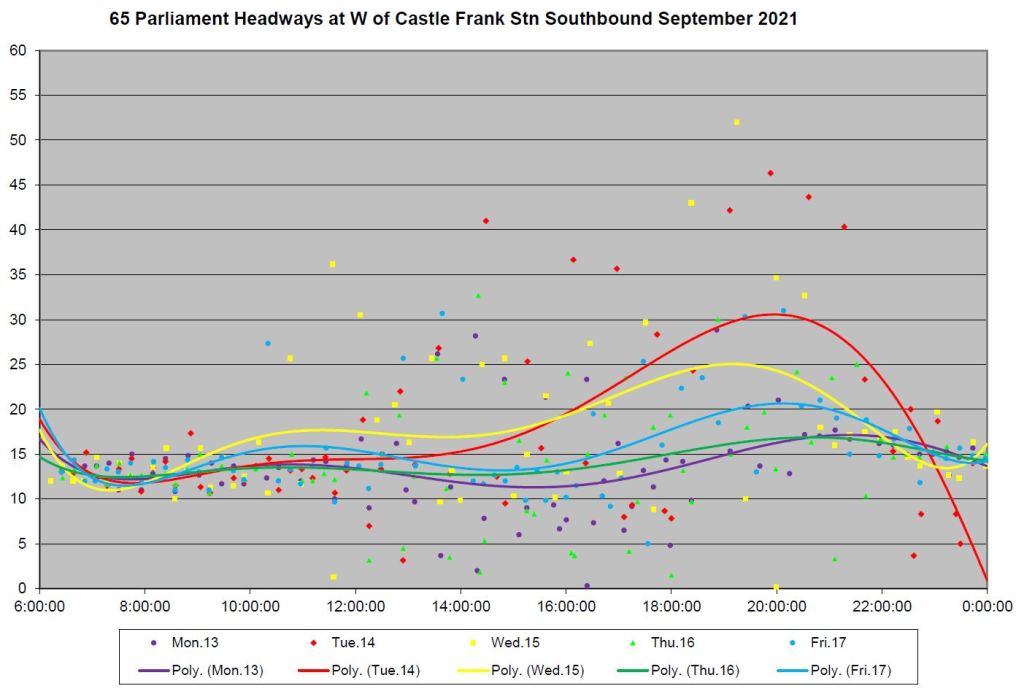
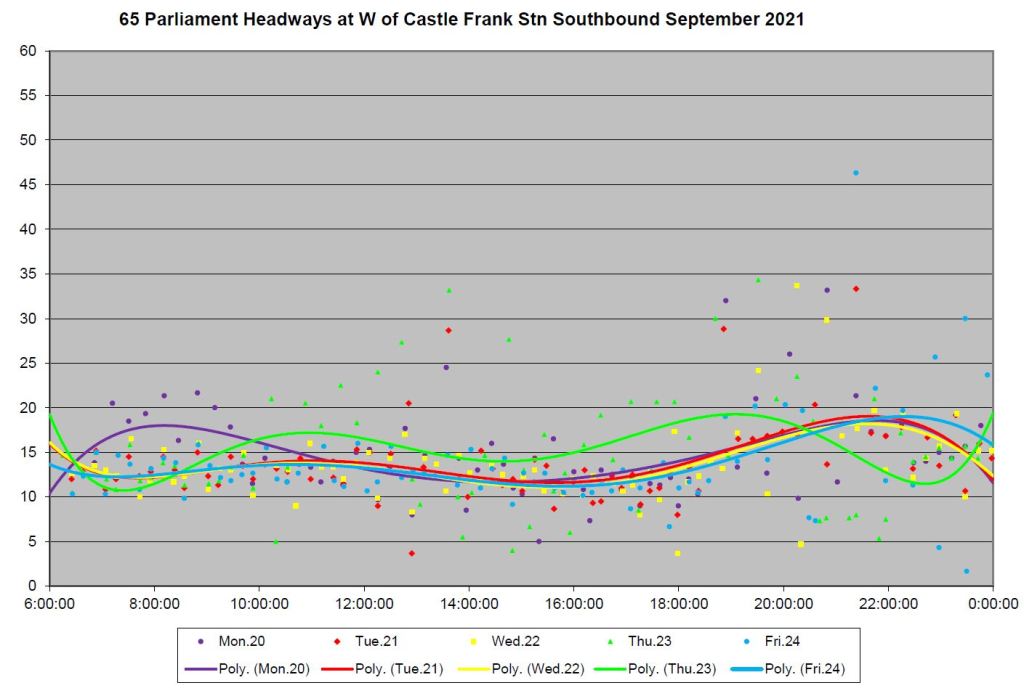
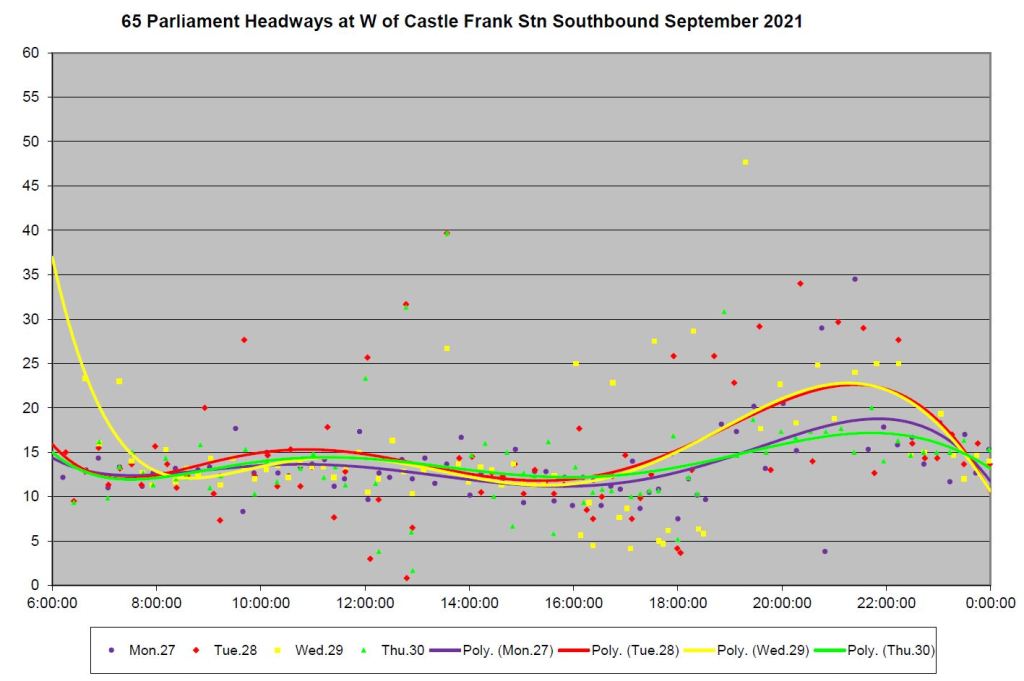
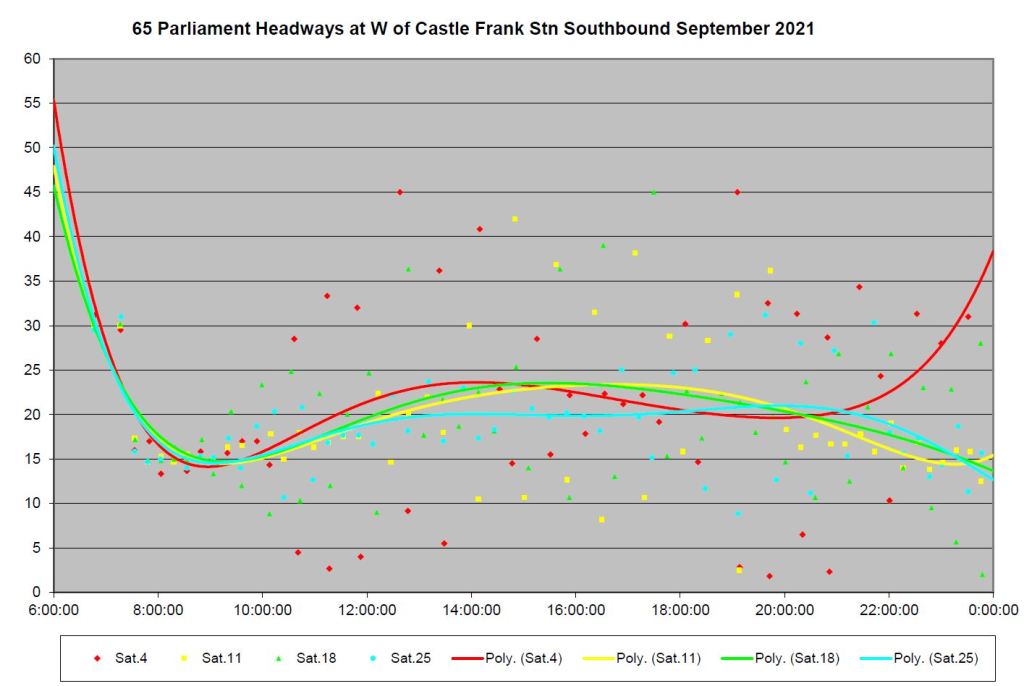
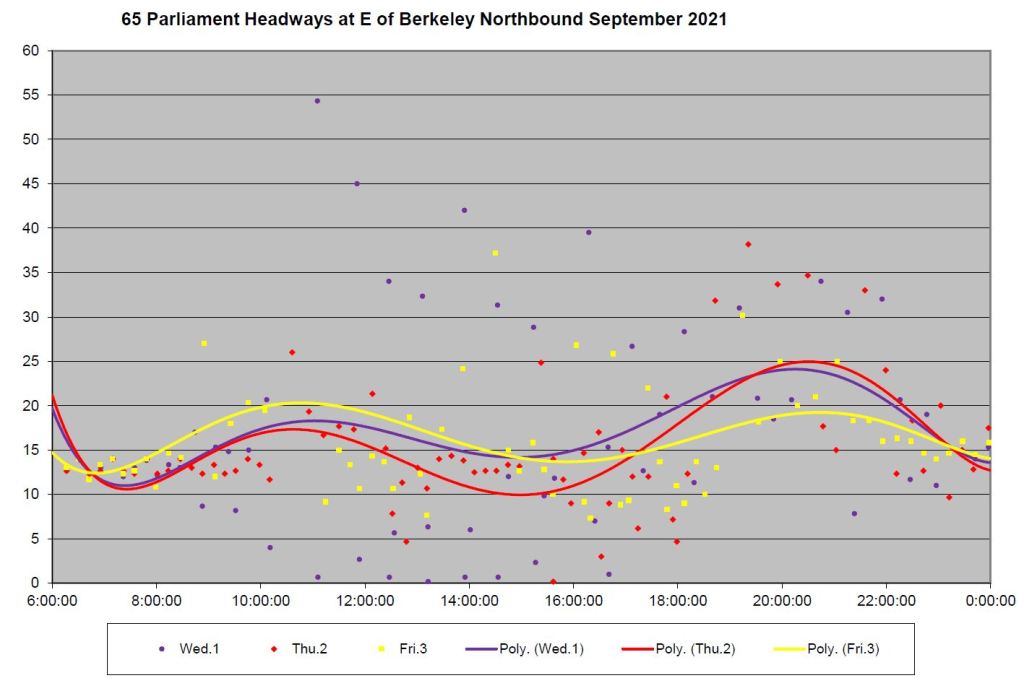
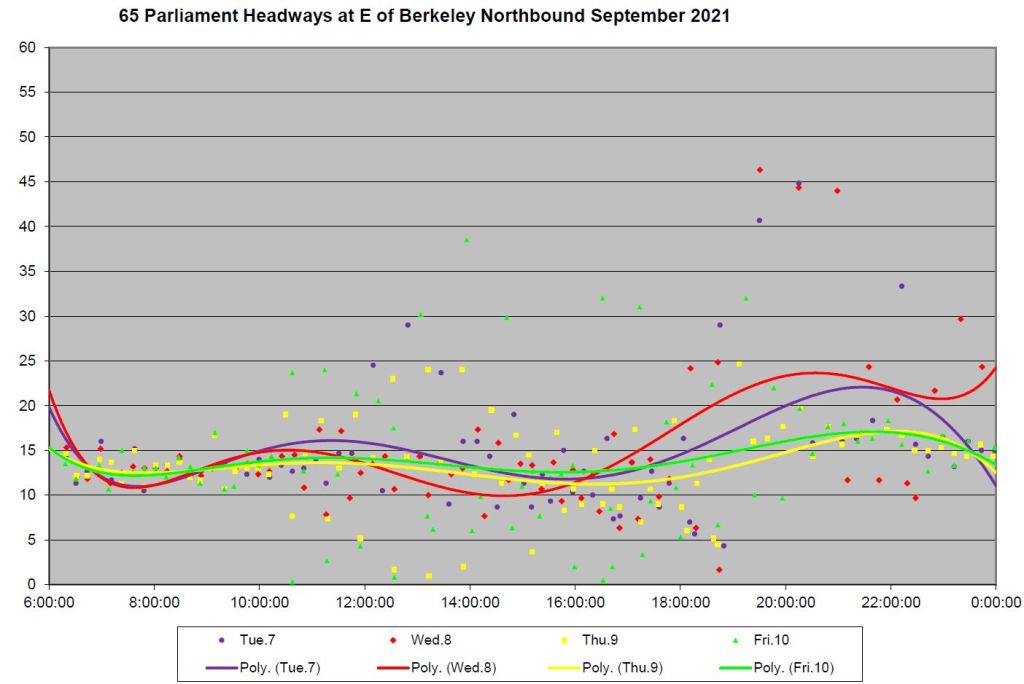
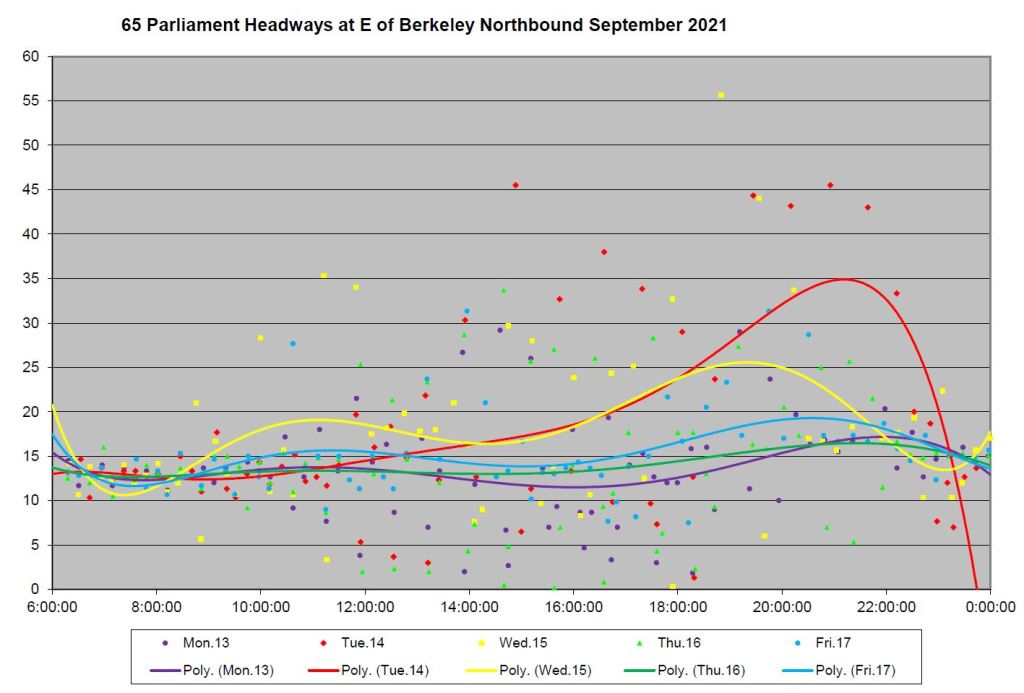
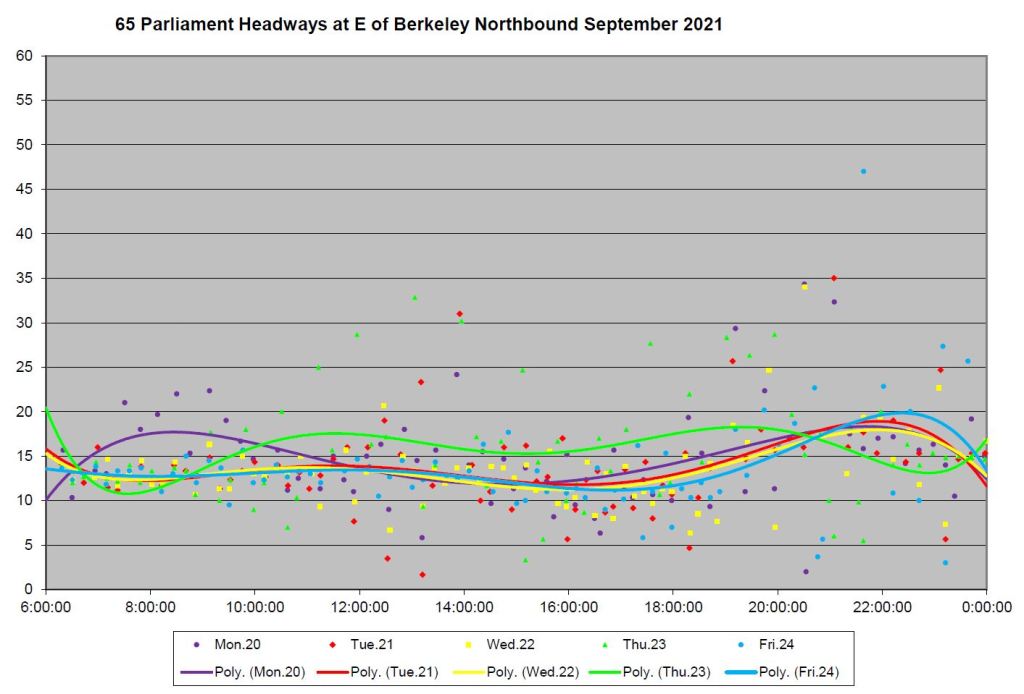
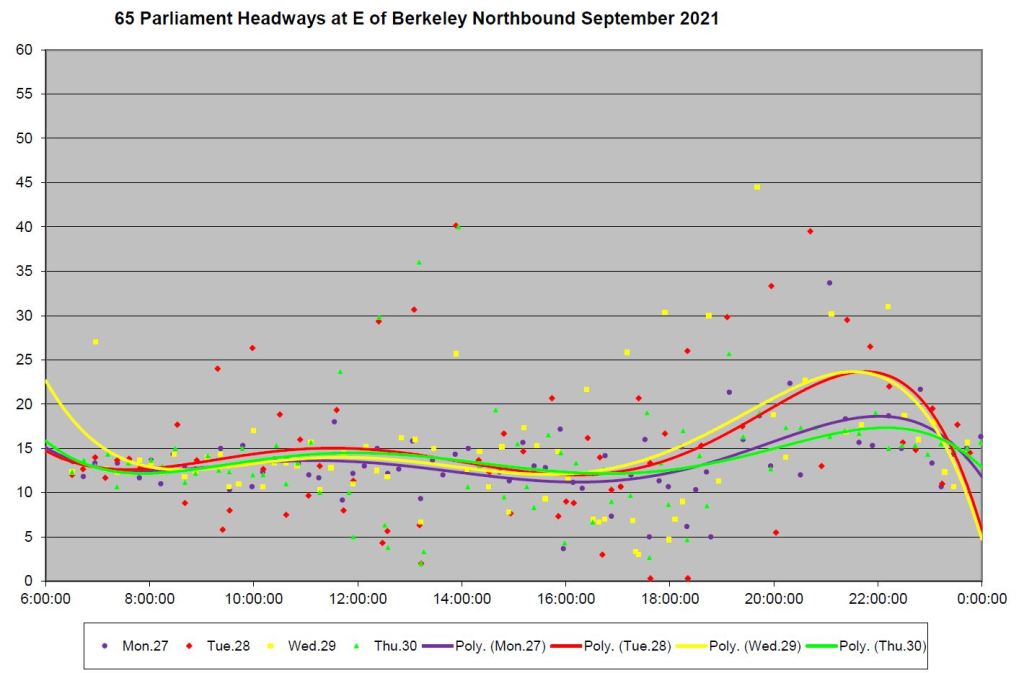
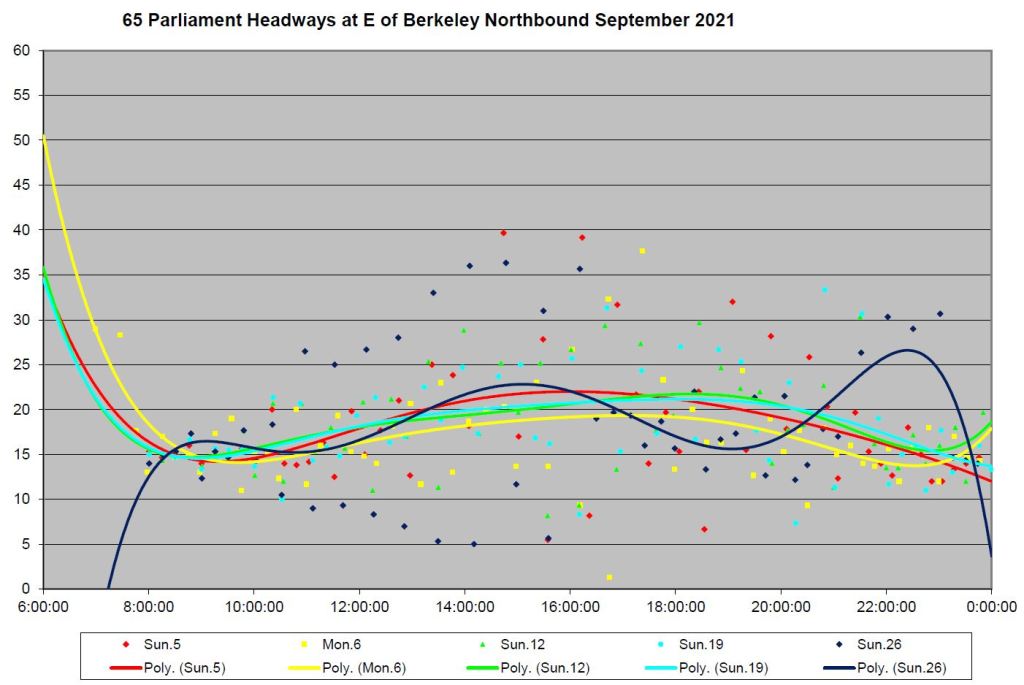
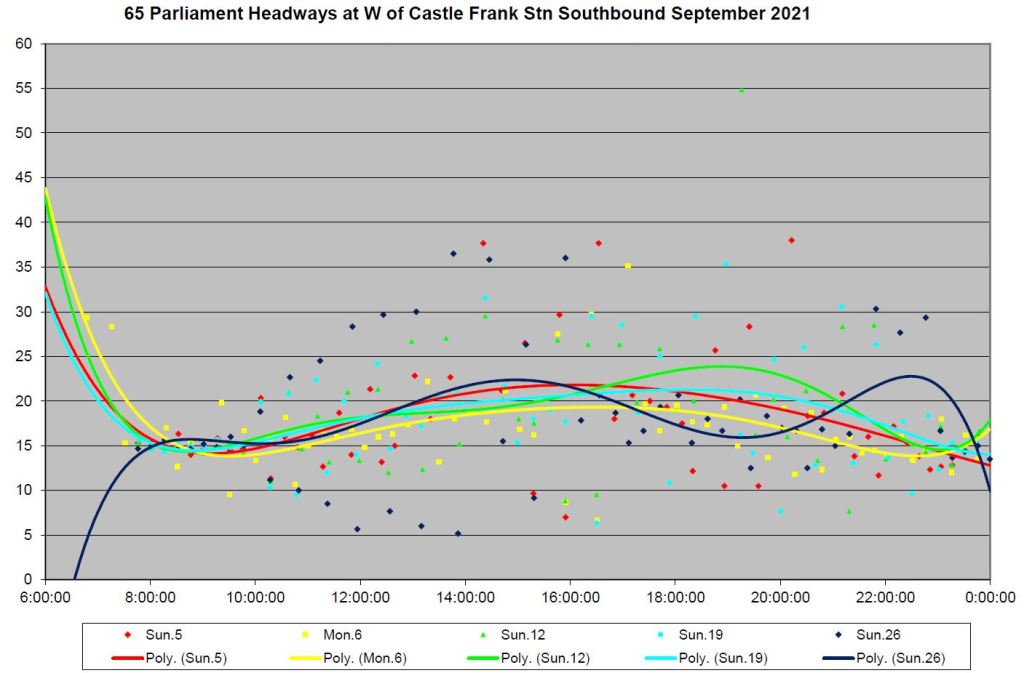
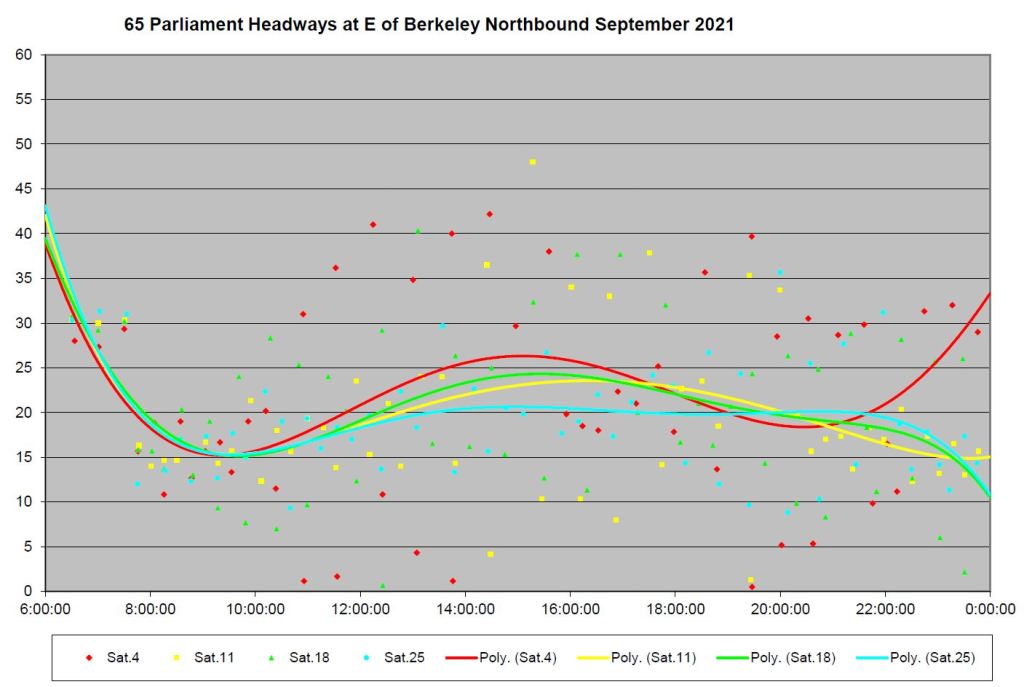
Although the scheduled headway varies from 11 to 20 minutes, the actual headway operated can at times be well over half an hour either because buses are missing from the route, or because the limited number of vehicles on the route are running in pairs.

In the headway charts below, I have extended the vertical scale from the 0-30 minute range used in past articles to 0-60 minutes so that the data points will be visible.
Southbound From Castle Frank Station

The screenline for the data here is on Bloor Street west of Castle Frank Station.

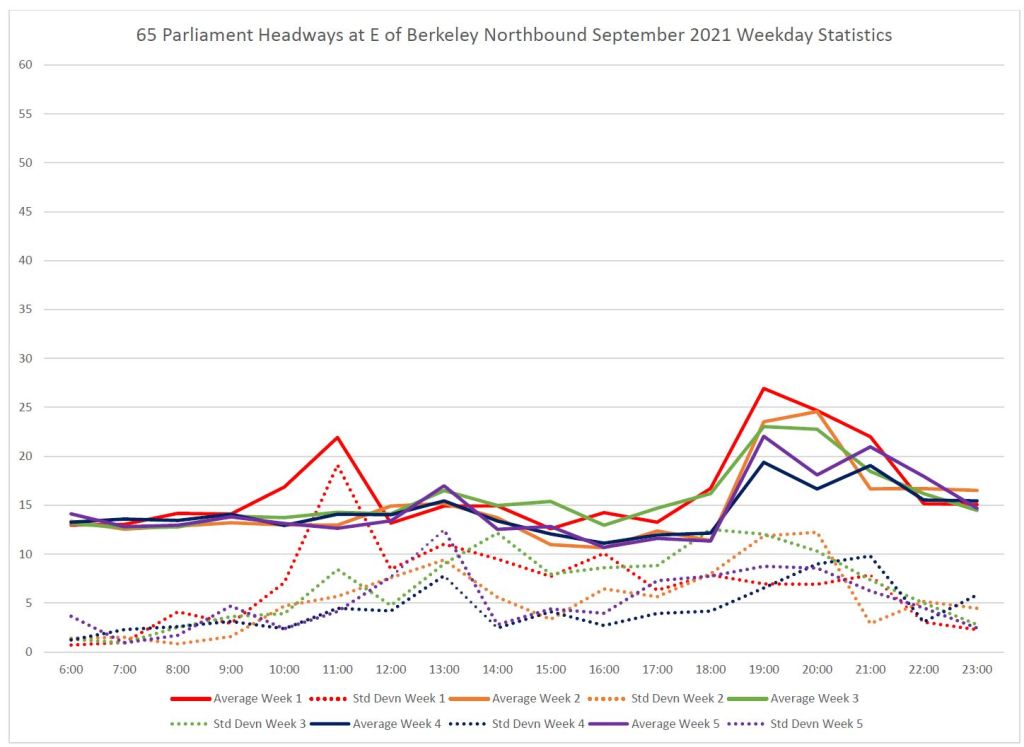
In spite of this route being short, there is a wide dispersion in headway values as the charts show. In a pattern seen on other routes, the standard deviation of the headways (dotted lines in the first chart) lie between 0 and 5 minutes for the first few hours of service, but rise substantially thereafter. This is a measure of the degree to which headways diverge from the mean value.

Those means show their own variation on a week-by-week basis indicating that the number of trips (and hence the average headway) was not consistent across the month. Day by day breakdowns are in the rest of the charts.

Days with very wide gaps and bunching are not rare oddities, but are a common situation on this route.

Northbound From Front

The screenline for the data here is on Front Street just east of Berkeley which is the start of the south end loop.

Continue reading