Draft of TTC Service Changes Effective Sunday, May 7, 2023

Updated April 11, 2023 at 8:45pm: The TTC’s map of diversions for the 501 Queen car effective May 1 has been added to this article.

Updated April 21, 2023 at 11:20am: The 501 diversion map has been replaced with a higher resolution version.

During the City’s 2023 budget discussions, TTC staff offered to make information about the effect of budget cuts on service public. However, an unseen hand either at the TTC or City prevented this from happening before the budget was approved. In time, a list of changes for March 26, 2023 appeared on the TTC Board’s February 28 agenda, but there is no comparable briefing note for the May 7 changes on their April 13 agenda. The Board and City Council are still in the dark on the effects of service policies they blindly adopted with the budget.

Recently, the transit advocacy group TTCriders obtained the draft changes through a Freedom of Information request. This article is based on that draft version of the May 7 service changes dated January 27, 2023. That was after the City Budget Committee’s wrap-up meeting on January 24, but before the budget went to Council on February 15.

Although drafts fall into my lap from time to time, I do not normally publish them as they are subject to change, and there is enough misinformation circulating among the fans and Twitterati that I prefer to keep that sort of thing to myself.

This is the last Board meeting before the May schedules will come into effect, and it would have been an ideal chance for management to update the Board on what was about to happen as they did with the March service cuts. They have only themselves to blame for losing control of the message.

From a procedural point of view, the absence of a report on the agenda means that the topic of service cuts is not formally before the Board for debate or deputations. This is a classic way to stifle discussion.

City-TV’s Nick Westoll covered this story on April 6, and the TTC did confirm that the subway service cuts will occur as shown in the draft. He obtained the following statement from the TTC:

“All changes are designed to match capacity to demand and put the most service out at times and areas that it is most needed. All changes are also within the … established service standards. What TTCRiders has is an early draft that has already been revised since the version they have and is still not finalized. The final schedules will be … shared publicly later this month … We will monitor routes in real-time and deploy unscheduled service when we observe gaps or overcrowding.”

TTC’s Stuart Green as quoted by City-TV

A major problem with unscheduled service is that it is invisible to service tracking apps. Riders waiting for a bus will not know that there is an “extra” lurking just out of sight, and they might just give up in frustration. Moreover, there is no way for the TTC to demonstrate retroactively how it managed the service and we have to take it on faith that gaps shown in the data really didn’t happen. There are far more gaps than spare buses, and it does not take an Einstein to figure out that many gaps will not be filled. This is a convenient fiction that TTC management uses to fob off complaints about service.

As for the final schedules, by now operators have already signed up for their crews in May, and the service plans are more or less cast in stone.

An Overview of the Cuts

In the interests of transparency, here are the draft changes for May.

I cannot stress enough that this is a first draft dated January 27, 2023, and some of its proposals may have changed before the final version which has not yet been published. Readers should cite this information with caution pending the official version of the May service.

Cuts that began with the February and March schedules continue into the May proposals. Analysis of the ups and downs from route to route can be tricky because several events happen at the same time:

  • Many routes have running time adjustments to adjust for rising traffic congestion. Sometimes this is accomplished with added vehicles, but more commonly by widening existing headways and running the same (or fewer) vehicles further apart.
  • Some routes have service cuts to align capacity with the updated crowding standards. These cuts are sometimes combined with other changes.
  • Some routes have seasonal changes either because they serve academic sites or amusement areas (e.g. the Beach).
  • Several construction projects will begin in May:
    • Queen & Yonge will close until sometime in 2027 for Ontario Line construction. Various diversions will ensue.
    • The Queen Street bridge at the Don River will be under repair. Service that would normally travel along this route will divert to Dundas Street.
    • Main Street Station loop will close for paving. All service will be rerouted to Victoria Park Station, or will be operated with interlines between pairs of routes with on-street boarding.
    • The intersection of Lower Gerrard & Coxwell will be rebuilt.
    • Track on Broadview from Gerrard to Danforth will be rebuilt, and the streetcar loop at Broadview Station will be expanded.
    • The railway overpass west of St. Clair & Caledonia (GO Barrie corridor) will be under repair.

Further details are in the main part of the article.

An important point to remember when the TTC talks about service reductions is that an “X” percent service cut is not the same as an “X” percent saving in operating costs. There are two important reasons behind this:

  • There is a substantial fixed cost, especially for the subway, for infrastructure, management and maintenance, and this does not vary with changes in service.
  • If a service change leaves the same number of vehicles in service, but running further apart (typically to allow for traffic), there is no change in the vehicle hours operated. The same number of buses is on the road, only travelling more slowly (or spending more time in layovers). Only costs that are directly related to the distance travelled go down, not those such as operator wages that are related primarily to hours.

The result of these is that an edict to save “X” percent in costs will require more than “X” percent in cuts. This is a classic problem of marginal vs fully allocated costing and savings.

The usual spreadsheet showing old and new headways, running times and vehicle allocations is linked here:

2023.05.07_ServiceChanges_Draft

Note to the fans: please do not send me queries about divisional allocation of bus routes as some of these were not settled in the draft plan. I will include this information when the final version comes out in late April.

Continue reading

Waterfront East LRT Update: April 2023

The City of Toronto, Waterfront Toronto and the TTC held an online open house on April 5 to present the current status of the Waterfront East LRT project.

The presentation video and slide deck are be available on the project website. All illustrations here are taken from that deck.

Updated April 9 at 8:15 am: There is also a FAQ addressing many questions about this project.

Because this session fell on the first day of Passover, there will be a second Q&A session on April 11, 2023.

There is an online survey available to provide feedback on the project. Please note that although members of the project team almost certainly read this blog, comments left here will not be part of the formal record and might be missed by the team. Do not treat the comments section here as an alternative to using the survey.

The WELRT project has taken an extraordinary amount of time to reach this point, and only part of that can be put down to the pandemic. Indeed the last public session was conducted in 2021. The biggest problem is that the waterfront is nobody’s top priority. Even former Mayor Tory, who talked a good line about waterfront development, did not push the project until quite recently, and his momentum, such as it might have been, has now vanished.

Recently, many on Council and in the wider community have worried that residential developments along Queens Quay East and on Villiers Island (the new island to be created as part of the Don River rerouting work now in progress) would all be for high-end buyers or investors, and would not address Toronto’s housing needs. With a move to increase planned densities in the eastern waterfront, there is an even stronger need for much better transit. The area is now served by the Bay, Sherbourne, Parliament and Pape buses, but service can be quite unpredictable.

For the record, the AM peak service planned for schedules coming into effect May 7, 2023, is:

  • every 20 minutes on 19 Bay,
  • every 7 minutes on 75 Sherbourne,
  • every 7 minutes on 65 Parliament, and
  • every 19 minutes on 72 Pape.

Each route serves a portion of the waterfront and, depending on your destination, not all of them might be useful. Notably the two which link to Union Station are infrequent and unreliable. This is hardly a “transit oriented” neighbourhood.

In spite of the poor transit service, the eastern waterfront is hardly at a standstill. Many condos as well as commercial and academic space have appeared, and much more is planned. How a projected 50,000 workers/students and 100,000 residents will get around for the next decade is a mystery.

This project has been underway for a very, very long time as the chart below shows.

The current study is subdivided into three segments, plus future extensions into the Port Lands east of the Don River (dotted blue lines below).

  • Segment 1 (red) includes the Bay Street tunnel and the portal area on Queens Quay.
  • Segment 2 (turquoise) runs from Bay Street to New Cherry Street (which will open later this year).
  • Segment three includes the link via Cherry from the Distillery District south to Commissioners Street and east to an around-the-block loop just west of the realigned river (yellow).
Continue reading

Buses and Streetcars Return to Dufferin Loop on April 1, 2023

No. This is not supposed to be an early April Fool’s joke.

TTC Customer Service has announced that the 504 King streetcar service western terminus will change on April 1 to its regularly scheduled location at Dufferin Loop. At the same time, the 29/929 Dufferin buses will also return to that loop.

Looking at tracking data (thanks to TransSee), it appears that some but not all 329 Night buses have already resumed their normal route south on Dufferin into Exhibition Place.

Currently, King cars loop from Queen south via Shaw to King, west to Dufferin and north to Queen without serving Dufferin Loop. In the revised routing, cars will operate both ways via Shaw, King and Dufferin to Dufferin Loop as shown below.

Because these are the routes published in the electronic version of schedules (GTFS), tracking apps should correctly predict behaviour of streetcars and buses in this area.

Bye, Bye TTC Tokens

Today, March 24, 2023, marks the end of TTC token sales. They have not been available from the TTC directly since 2019, but now are withdrawn from other outlets.

For organizations that give out transit fares, they have been replaced with the Presto “LUM”s (Limited Use Media), small cards that are preloaded with one or a few fares.

The token holders below date from the era of 6/$1 and 5/$1 fares, plus a special commemorative token holder issued for the opening of the Bloor-Danforth subway.

A Single Fare For Cross-Border Travel, But …

The Ontario Budget announced on March 23, 2023, includes a commitment, sort of, to reducing cross-border fares for trips into Toronto.

And we are making transit more affordable by eliminating double fares for most local transit services in the Greater Golden Horseshoe when commuters also use GO Transit services. Our government is working to expand this initiative to support more people commuting into Toronto. [emphasis added]

Ontario Budget 2023, Minister’s Forward

In more detail, the main part of the budget states:

Making It Easier and More Affordable to Take Transit

As Ontario families continue to look at managing costs, the government is helping put more money in their pockets with affordable transit options. The government has made it more affordable, easier and more convenient for families and workers to travel across the Greater Golden Horseshoe by eliminating double fares for most local transit when using GO Transit services. This means that after riders pay their fare for a GO bus or train, they do not pay again when accessing most local transit services in the Greater Golden Horseshoe. The government has also increased PRESTO discounts for youth and postsecondary students and continues to provide more riders with more options and convenient ways to pay.

This GO Transit co‐fare discount applies to the following transit systems: Durham Region Transit, Milton Transit, Grand River Transit, Guelph Transit, Oakville Transit, MiWay (Mississauga Transit), Brampton Transit, Hamilton Street Railway, Burlington Transit, Bradford West Gwillimbury Transit, York Region Transit and Barrie Transit. The government is working to expand this initiative to support more people using public transit to come into Toronto. [emphasis added]

Ontario Budget 2023, p 77

Two examples are given of fare savings, but both of these refer to transfers between local transit systems outside of Toronto, not to the TTC.

In the legislature, the Minister of Finance said:

“We have eliminated double fares when taking GO Transit and local transit throughout much of the Greater Golden Horseshoe — and we are expanding this initiative to include Toronto, so a commuter coming into the city only pays on one fare per trip, saving them money each way.” [emphasis added]

As quoted in the Toronto Star

The operative words here are “for most local transit services” with the emphasis on “most”.

Eliminating double fares for most local transit services in the Greater Golden Horseshoe when commuters also use GO Transit services. The government is working to expand this initiative to support more people using public transit come in to Toronto. [emphasis added]

Budget Highlights backgrounder

It is unclear whether the added discounts will apply to all TTC fares including those for GO-TTC trips, or only to 905-416 cross-boundary trips, or even to any TTC leg of a journey. Notable by its absence is any reference to GO-TTC trips within Toronto.

This has all the makings of an announcement that is a lot less in practice than it appears on the surface. I have written to the Ministry of Transportation seeking clarification. Stay tuned for updates.

Osgoode Hall Garden and University Park

Over past months, the Ontario Line’s effect on trees in various locations around Toronto has become something of a cause célèbre. Osgoode Hall was, in a way, the “poster child” for this because of its location and the historic buildings at Queen & University. However, this was far from the only affected location with tree felling on a massive scale elsewhere including Moss Park, Riverside, and now planned for the Don Valley at the Leaside Bridge and the crossing of Walmsley Brook north of Thorncliffe Park.

A common refrain from citizens along the Ontario Line and other corridors is that Metrolinx does not deal in good faith, but rather presents its positions as unchangeable and pressing. They look only for acquiescence so that “consultation” can be claimed for the record. There is no public record of these consultations, and no community is aware of what might be told to others except by information sharing among them.

I have written about the garden at Osgoode Hall before, most recently in a review of the report prepared for the City of Toronto by Parsons looking at various alternative configurations.

On February 23, 2023, Toronto and East York Community Council established a subcommittee composed of Councillors from Wards 10 Spadina-Fort York, 13 Toronto Centre and 14 Toronto-Danforth and “directed the Executive Director Transit Expansion Division to report to the first meeting in March 2023 regarding the current status of the Ontario Line, pedestrian and traffic management plans, and opportunities for City and resident involvement moving forward”.

That meeting will occur on March 22, 2023. The only report on the agenda is from the Executive Director, and a great deal of it is a rehash of information from earlier reports along with a claim that Metrolinx is engaging with communities along the corridor. The actual degree of consultation is a matter for some debate, and one cannot wonder whether the ED is parroting the official line from Metrolinx, hardly an appropriate tactic for a senior City official. I will address that report in more detail after the meeting, but turn here to a proposal for the new entrance to Osgoode Station.

Continue reading

TTC Service Changes Effective March 26, 2023

Many changes will occur on the TTC’s network on March 26 primarily with adjustments to schedules in response to lower ridership. This issue was covered previously in:

This article presents more detail about new schedules as well as information on several service reorganizations and diversions.

Updated March 23, 2023 at 10:30 am: The TTC’s map showing the 504 route diversions has been added to this article. Note that it does not match the route description provided in their service change notice.

Updated March 23, 2023 at 11:45 pm: A map of new bus bay assignments at Kennedy Station recently posted by the TTC on Twitter has been added.

Updated March 24, 2023 at 6:30 am: Times of the transition to less frequent late evening service on Line 2 BD added.

Updated March 26m 2023 at 12:20: Construction project schedule added at the end of the article.

How Schedules Can Change

When a new schedule is implemented on a route, one or more changes might be happening, and the same changes might not occur in each affected time period. This can produce confusing results as well as communications from the TTC that do not quite represent what is actually happening.

In the simplest case, a route needs more or less service because ridership exceeds capacity or because it has fallen below the level where a reduction is warranted. In this case, the change simply adds or removes vehicles while leaving the travel time unchanged. For example, on a route with a one hour round trip, a 6 minute headway (the interval between buses) would be provided by 10 buses. If two buses were added, the headway would be every 5 minutes, and the route’s capacity would rise by 20 percent.

A variation on this which exists in the current budget tightening era is that the standard for what is a “full” bus has changed. Peak periods have gone back to 100% of pre-covid levels, and off-peak have gone even further, close to peak levels. That undoes the “seated load” standard of the Ridership Growth Strategy that goes back two decades. If the standards allow more crowding, then fewer vehicles are needed to provide the new target capacity.

Other changes can occur independently or at the same time. Most common are adjustments to travel and recovery times in response to changes in congestion and/or construction projects. If a route operates more slowly under new conditions, more buses are needed to maintain the same level of service, or fewer if things speed up. The change in travel time can occur at the same time as changes in crowding standards so that the existing, or even fewer, buses provide less frequent service.

Almost all routes have some recovery time built into the schedule, but this is not a fixed amount. Partly the recovery time deals with expected variations in day-to-day or trip-to-trip travel time, and partly it could simply be included to make schedules work out properly. This is particularly true of branching routes where the time taken by each branch must be such that they blend together, at least on paper. Branching routes with wide headways can have very long recovery times to make schedules “come out right”. Conversely, when such a route has a change, it is possible to accommodate some or all of the change by converting recovery time to driving time.

The TTC has a bad habit of referring to travel time changes as “service reliability improvements” on the assumption that buses are more likely to maintain regular spacing if they have more time for their journey. This is not always borne out by actual operations, and the main effect on riders is that buses show up less often than before the change.

In the lead up to the March 26 changes, changes in headways were listed for several branching routes. The change cited applied to the common part of the route. Beyond the branch point, the change would be double what was originally listed.

Finally, some changes involve route reorganizations that interact such as interlining where two infrequent routes share a pool of buses between them. Combining the two routes reduces the number of vehicles needed for the linked services, while the headways might go up or down as the individual routes are changed to a new common headway.

There is one case in this round where a night bus “service improvement” is really the shift of trips formerly provided by daytime service to the night bus route number, but on the daytime frequency. Looking at the corridor as one route, this might not be as big an improvement as it seems. The same issue can arise when the balance between express and local service on a route is changed. One of the two services might improve, but not necessarily the route as a whole.

I include these caveats in the hope that readers will look closely at their before and after schedules to see exactly what is happening.

For details of changes in specific route headways, travel times and vehicle allocations, please refer to the spreadsheet linked here.

Service Changes March 26, 2023

Continue reading

SmartTrack: The Brand That Will Not Die

On Tuesday, March 21, 2023, Toronto’s Executive Committee will consider an update on the so-called Smart-Track Stations project.

Reports:

For comparisons with the previous, February 2021 update on the station designs, please see:

Updated March 17, 2023 at 7:15 pm: The Early Works list for East Harbour Station has been corrected. In the original version of the article that section was copied as a template from another station’s entry, but not changed to reflect the East Harbour site.

This project is the remnant of a scheme first proposed by mayoral candidate John Tory in May 2014 to overlay a frequent surface rapid transit service from Unionville to Pearson Airport using primarily GO Transit corridors.

The proposed route included a bizarre idea of running a mainline railway corridor along Eglinton Avenue West in lands originally reserved for the Richview Expressway, and later intended for the Eglinton Crosstown LRT line. SmartTrack itself descended from an idea to run a similar route whose western leg would use the GO Milton corridor rather than Eglinton Avenue. Both of these foresaw frequent service with the dual benefit of providing more capacity into the core and making office/industrial areas that were choked by gridlock on roads more accessible by transit.

Both ideas were deeply flawed, and the issues with SmartTrack are covered in detail in many other reviews. In fairly short order, pieces started to fall off of the proposal, but it remained a scheme to add stops to GO within the City of Toronto and use GO at least in part for urban rapid transit.

One fairly early casualty was the notion of a separate SmartTrack service. This was replaced by the idea that at least some GO trains would serve new stops, although the number of such trains was always hard to nail down as Metrolinx service plans changed. Getting a strait answer out of them proved almost impossible, and the best we can get today is a 15 minute service on all corridors with more if demand justifies this.

This is considerably poorer service than was envisioned in the SmartTrack hype and in the way it was presented to Council. Indeed, ST was seen to be so competitive in the Scarborough corridor that the Scarborough Subway Extension was shifted east to avoid the competition.

That is a far cry from SmartTrack’s original promise, but the brand lived on because it was Mayor Tory’s plan. Dropping the name would be suicidal for City and TTC planners, even though Tory suffered from an acute case of “the emperor’s new clothes”. Metrolinx simply humoured the Mayor by using his name for their new stops.

We have reached the point where only four of the original 22 stops on the ST line remain: Finch-Kennedy, East Harbour, King-Liberty and St. Clair-Old Weston. A station on the Barrie line, not the original ST corridor although the format of the map below disguises this, was added.

All five of the station projects are running later than the originally proposed opening dates. Details are given in each station’s section.

A sixth station was proposed at Front-Spadina, but there is no sign of it yet even though the City’s contribution to the station dates back to a $60 million payment toward GO expansion costs in 2017-2019. (See Revised Ontario-Toronto Agreement in Principle at page 9.)

Toronto’s SmartTrack Station costs are, under that agreement, deemed to be the City’s contribution to GO Transit Growth Capital for 2017-18 to 2024-25.

The anticipated cost of the five stations was $1.463 billion, a Metrolinx estimate, but costs have now risen by $234 million to a total of $1.697 billion. Of this, $585 million would come from the Government of Canada. Although the station-by-station breakdown is in a confidential attachment to the report, this means the average cost per station would be $339 million, a value that was once considered rich for an underground subway station.

Toronto is prepared to spend a lot of money for a handful of stations that might only see 4 trains/hour each way.

The report recommends that Council ask Metrolinx to pause the contract award for Bloor-Lansdowne station pending a guarantee from Queen’s Park that Ontario will pick up cost overrun. This is only one of many transit projects that faces problems with rising costs, not to mention projects under other portfolios.

City staff are seeking City Council direction to request the Province to pay all cost increases over the existing Program Budget of $1.463 billion to deliver the Program, which as of the date of this report is anticipated to be $234 million, as further detailed in Table 1 of Confidential Attachment 1.

A decision on the future of the Program is required urgently as the Design-Build (DB) procurement for the Bloor-Lansdowne Station contract is set to be awarded in early April. With a DB procurement, the City, through Metrolinx, would be committing to proceed to detailed design and construction. As such, there may be no opportunity for the City to reconsider or “off-ramp” its commitment to the station’s delivery once the contract is awarded. Metrolinx has secured an extension to the bid validity date with the proponent until April 5, 2023. Prior to making this commitment, City staff are seeking City Council’s direction to confirm to Metrolinx that the City will not proceed with the delivery of the Bloor-Lansdowne Station until the Province has committed the additional funding required to deliver the Program as set out above.

SmartTrack Stations Update pp 7-8.

What Should Stay? What Should Go?

City has sunk costs in design (listed in the confidential appendix), and contracts have been awarded for all but the Bloor-Lansdowne Station. It is very unlikely that Council would consider dropping any stations except for Bloor-Lansdowne, but should ask itself the question of whether proceeding with all of the stations actually makes sense. Metrolinx is unlikely to let them off the hook.

Meanwhile, conversion of the SRT corridor as a bus roadway is not yet funded because the City wants Metrolinx to pay for it. At $59 million this is small change and yet it will have a considerable benefit for both riders and for the TTC. If the work begins as soon after the SRT shutdown as possible, the bus roadway could be operational by Winter 2025, according to the TTC.

From the TTC Website:

In the event the city is unable to secure the outstanding $59M for the SRT busway, will the project run along Kennedy, Ellesmere and Midland until the SSE is completed? 

If the City is unable to secure funding from the province, it would ultimately have to find an alternate source if it wished to build the busway. The transit priority measures that will be implemented on Kennedy, Ellesmere, and Midland are planned to be designed as long-term solutions regardless of the busway construction; they could have legacy use for customers even beyond SSE is completed. 

This is an example of how funding for projects is discussed in isolation without looking at tradeoffs that might be possible or necessary. What we do not know is how much dropping Bloor-Lansdowne from the overall plan will save in total, only that there is a $234 million overrun for the five stations.

We are in an interregnum between Mayors, and there is no sense of whether any of the would-be candidates see SmartTrack spending as an issue to revisit.

Continue reading

Bloor-Yonge Station Expansion Update

The TTC has published a Major Projects page for its Bloor-Yonge station expansion with a few renderings of the platform level views.

Many more illustrations were available on the TTC’s bid site, and this article is based on documents there which go into considerably more detail.

There are a lot of images here, and so I will leave most of the article beyond the “more” line.

Project Scope

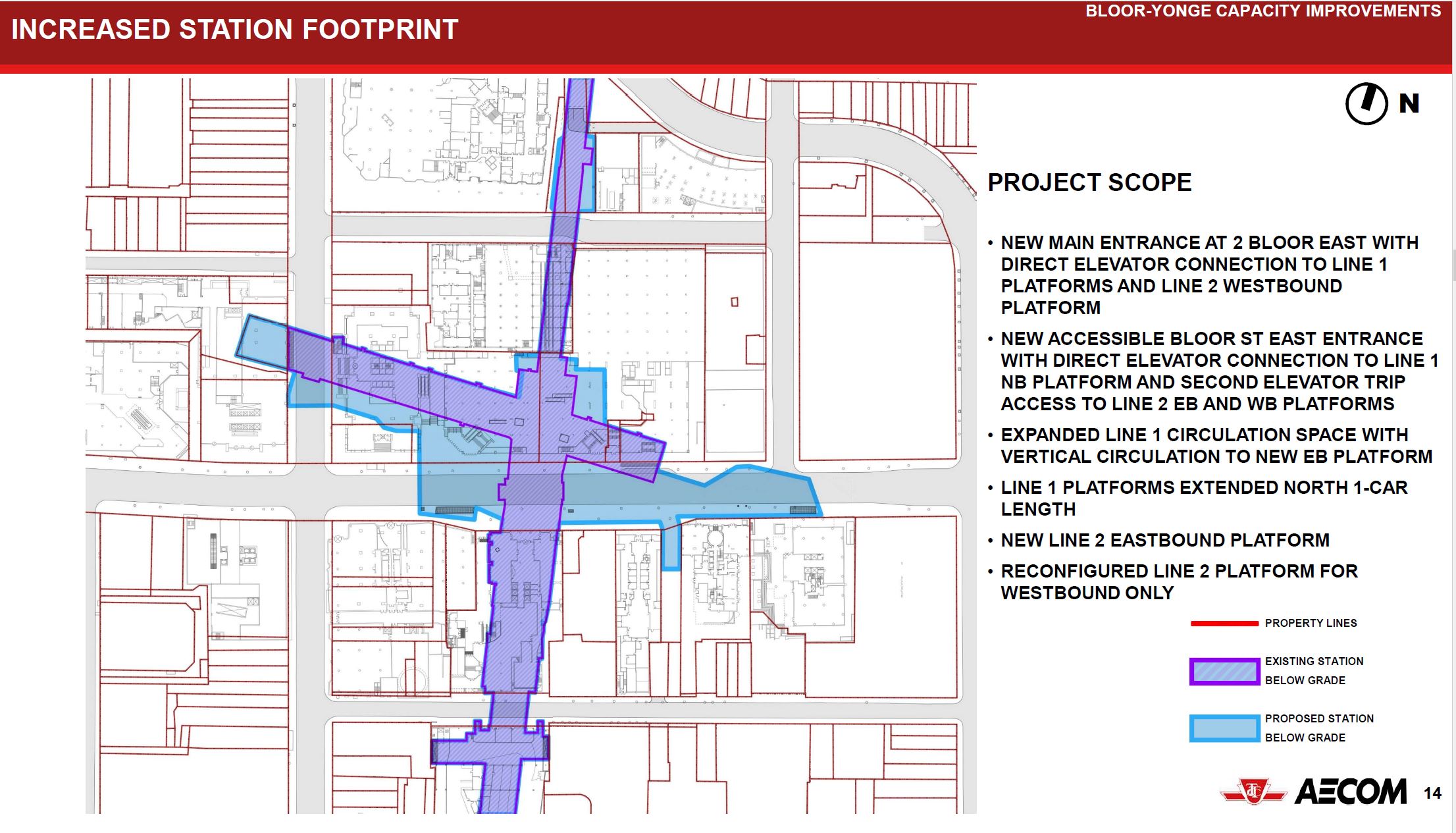
The project involves the creation of a separate eastbound platform for Line 2 Bloor-Danforth and the reconfiguration of the existing centre platform as westbound only. Circulation space between Line 1 Yonge and Line 2 will be expanded substantially.

At the north end of Bloor Station, both platforms will be extended about one car length to the north (the existing Bloor crossover is located a short distance north of the station) to open up circulation space .

A new main entrance will be built within 2 Bloor Street East.

On the south side, at 81 Bloor East, an entrance will be added within a building whose primary purpose is to house a substation for electrical power to the expanded station. Traction power will continue to be supplied through the TTC’s Asquith Substation.

Four new fan plants will be added to bring the expanded station to modern fire code, and the existing fan plant at the south end of Bloor Station will be refurbished.

The drawings show no provision for Platform Edge Doors.

This will be a Design-Build project with the successful bidder responsible for taking TTC plans now at about 30% completion to a full 100% design, followed by construction. The Request for Proposals is expected to close later in 2023.

Construction is planned to begin in 2024Q2 with the new Line 2 eastbound platform and new areas of Line 1 platforms in service by 2029Q2. This assumes that the Yonge North Subway Extension to York Region will open in 2030. The project would close out in 2031.

Support for the project is in place from all levels of government, but until the bids come in, we will not know whether the full scope of work will fit within available funding of $1.5 billion.

The footprint of the expanded station will be considerable, and the drawing below gives an idea of how much more territory the station will occupy.

Continue reading

Richard F. Glaze Film Digitization Project Phase 2

Normally, I would not post a fundraiser on this site, but this one is very special.

James Bow of Transit Toronto has launched a fundraiser for the second phase of digitizing a trove of 16mm film from the estate of Richard F. Glaze.

James writes:

We’ve raised enough that we’re definitely going to digitize the three remaining train-related 400-foot reels in the collection. These date from the late 1950s and offer around 9 minutes of footage from the last days of streetcar operation in Montreal, 2 minutes of footage from the last days of streetcar operation in Ottawa, footage from the last days of Rochester’s streetcar subway, and CN steam locomotive 6218 (I think that’s the number; I don’t have the canister at hand at the moment). On top of this, I’ll be able to digitize another 12 100-foot reels from Toronto and Ontario in the 1970s (some interesting Ontario Northlander footage is available).

That still leaves 68 100-foot reels. The good news is, since these cost about $150 per reel to digitize, and I can probably get these scanned over time. However, every $150 we raise between now and the end of the month puts another reel on the pile, so hopefully we can make a good push of this.

Any contribution is worthwhile, big or small, via the gofundme page for this project.