Coming Soon

There’s a lot to write about, and I’m hoping to push various articles out the door over the next week or so including:

  • Further details of the service changes for March 30, 2008
  • Further information about the tunnel repairs on the North Yonge subway
  • A review of operations on the 511 Bathurst car
  • Reviews of the Metrolinx Green Papers
  • A review of TTC capital funding in light of recent budget announcements

Although not necessarily in that order.

A Day on the TTC

Robert Wightman sent in the following comment about problems maintaining service on, mainly, the streetcar system on Tuesday, March 25.

I spent yesterday afternoon rush hour working at home and listening to the scanner for TTC surface operations and this is what I heard.

Russell could not send out all scheduled service because they did not have enough equipment available. A car on Carlton and one on Queen went disabled and had to be pushed to Russell. This took 4 cars out of service and screwed up the lines for awhile. The line inspectors must know that a Commissioner lives in the Beach because they turned two WB cars at Russell and sent them back to Neville.

A fight broke out on a WB Queen car in front of the City Hall so the WB service went along Richmond to York thus bypassing the delay and the subway.

A Spadina car went disabled in the Station and had to be pushed out. They decided to push it out to the street before locking out the brakes, bad move as it lost air on the curve and they had to crank the brakes off. They could not use the spare track as there was a car using it to “dry out”. It was waiting for the emergency truck as it had no fans and the windows were too steamed up to see out. This screwed up Spadina for a while.

Another car broke a bar under the front truck and had to be escorted back to Russell by the emergency truck. Again there was no vehicle available to replace it.

The emergency trucks were running all over the system making minor repairs to cars that were still in service but had no heat, one wiper missing, doors that wouldn’t open, lights that didn’t work.

The subway had a train with a pair of cars that went disabled so they drove it onto the tail track at Finch until they could fix it.

The system is broke and it isn’t getting fixed. The Inspectors managed to find enough cars that were to run in to replace the missing cars after the rush hour. How much of the service problems are caused by equipment failures each day? Yesterday was not good weather but this still seemd like a lot of problems for one rush hour.

Both equipment and operator shortages remain a big problem especially for the streetcar system. We need some honest answers from the TTC about just how many cars are really available for service and why so many are sitting in the shop. I don’t think the situation has been presented with as much urgency as it deserves, and we still face the impact of having the St. Clair line fully back in operation sometime this fall or winter. New cars won’t be here for years, assuming we somehow find a way to find them this fall when it’s time to place the order.

Metronauts on Mars

From the people who brought us Transit Camp comes Metronauts, an “unconference” aimed at provoking discussion of the Metrolinx Regional Transportation Plan. Here’s their press release:

Metronauts: Brainstorming Solutions for Transportation
Metronauts Transit Camp initiative looks to public for new perspectives on regional transportation plan

With the population of the Greater Toronto and Hamilton Area growing quickly, transportation issues in the region are moving to the forefront of public conversation. The Transit Camp community, with the sponsorship and active participation of Metrolinx (Greater Toronto Transportation Authority), is pleased to announce Metronauts, a project that aims to engage citizens to imagine the future and offer solutions for the region’s transportation plan.

The new initiative is made up of two parts: an online community and a series of community events held across the Greater Toronto and Hamilton region between April and September 2008.

Transit Camp began as a grass-roots event in Toronto in 2007, created without official support or sponsorship, and has since spread to other cities. The initial event was so successful that Metrolinx decided to sponsor this series of events and online activities by the Transit Camp community.

The first of such Metronauts Transit Camp events will take place on April 5, 2008, at the MaRS Centre in Toronto. The event will be organized as an unconference, where every participant will have the opportunity to suggest topics for discussion and share their knowledge and experiences with the group.

The event aims to attract transit riders, as well as drivers, pedestrians, cyclists, and anyone else concerned with how they get around the city.

Mark Kuznicki, steward of the Toronto Transit Camp community, stresses that, “this is not a complaints department, it is a solutions playground.” The event is not about airing grievances; it’s about working together to make things better.

Registration for the event will begin on March 25, 2008, at the newly-launched Metronauts.ca website. The website will provide event participants and interested citizens another avenue for discussion about transportation in the region, and will also facilitate individual and group projects for those looking to get involved directly.

Information on future events and initiatives will be listed on the Metronauts website as it becomes available.

Metronauts is a joint initiative between Metrolinx and the Transit Camp community. The project will include the online community site and a series of community events held across the Greater Toronto and Hamilton region between April and September 2008.

The broader scope of Metrolinx’ planned consultation process is found in a report for the March 28 board meeting.

How to Build a Subway — Let Me Count the Ways

As everyone knows, the public sector wastes huge amounts of money on overblown, out-of-control projects, or at least that’s the prevailing view in some quarters. One major side-effect of Ottawa’s participation in funding the York subway extension (or TYSSE: Toronto-York Spadina Subway Extension), in an insistence on value-for-money and the maximum participation by the private sector.

Leaving aside that the TTC doesn’t actually build anything itself, and contracts out a vast amount of the design/engineering work, there is a perception that (a) subway construction projects could be better run and (b) there is (even more) opportunity for private sector participation.

A report on this week’s TTC agenda discusses the various options for delivering this project and includes some revealing information about the pros and cons of various approaches. I will leave it to those who are interested to read the full text, but a few things caught my eye.

First off, there are many ways and degrees in which a private sector company or consortium can be involved in large projects like this all the way from complete design, finance, construction and operation down to a basic contractor who bids on a job, builds a box and leaves.

In the review of options, the variants where operation rested with a private entity were rejected outright because the TYSSE is part of an existing, operating, public-sector subway line. Experience elsewhere suggests that private operation tends to occur only when a new, free-standing line is built such as the Canada line in Vancouver.

Financing options are not discussed at length, but this issue always turns on the question of whether a private partner can provide capital at a lower cost than a public agency. This also involves some creative accounting. A privately owned line (and its associated capital debt) does not appear on the public books. This scheme is commonly used to hide debts (think Enron), although generally accepted accounting practices for governments make this more difficult to pull off. Even if a government is not technically exposed to the debt, the last thing any (well almost any) provincial government will do is to let a subway line close because its owner is bankrupt.

We have heard a lot lately about borrowing from large investment pools such as pension funds. Whether this is done on a government basis or by an arm’s length agency, somehow the interest and debt must be paid. Either this is a direct charge against current operations, or it is transferred to a government through a subsidy arrangement (no doubt with an appropriate management fee).

As for construction, the difference between the two main options depends on whether the TTC designs it all and contractors just build it, or if the TTC says “build me a subway station” and the contractors design to a general set of specs and deliver a finished product. A working group from the construction industry reported that their preference is to leave the design to the TTC for contracts under $100-million, or where there will be multiple contractors (possibly including the TTC itself) onsite. This relieves the contractor of having to manage (and assume risk of) portions of the work not under his control.

For large contracts, it may be worth a contractor’s while to bring the design work in house provided that the job is fairly generic and does not require skills in special systems peculiar to transit. For example, building an empty box that will become a subway station or tunnel structure is a fairly straightforward task while design and co-ordination of the many subsystems fitted within the structure are complex and outside of their regular scope of work.

One point not mentioned here is that the industry’s skill base depends strongly on what they do most of the time. An important observation about Madrid in recent studies is that their continuous program of system expansion allows the industry to develop expertise and continuity of staff that would not otherwise be possible. In Toronto, there are only so many subways to go around among the major players, and we don’t build them very often.

Finally, there is a breakdown of the TYSSE’s estimated cost — $2.09-billion in 2006 dollars, or $2.633-billion assuming completion by 2015. This date could slip if various governments spend time squabbling about whether the project passes a private sector sniff test, adding to the cost.

For all you readers who have wanted a subway station of your very own, we see station costs of $73-to-$100-million depending on the complexity. Of particular note is a 26% contingency. This rather generous $400-million slush fund (a cool half-billion with inflation) will allow considerable overruns while keeping the project “on budget”. At this point, I will be generous and hope that this is for “things we haven’t thought of in the preliminary design”, but at some point this needs to be nailed down. I doubt we will ever know how much contingency everyone builds into their estimates (public or private partner) and yet there is probably more money on the table in this one line than in any savings, real or imaginary, from increased private sector participation.

I should mention the rolling stock. The estimate shows 56 cars, although it is physically impossible to buy them in this quantity as they now come in married sets of 6. Even with these cars, the TTC will not have enough “Toronto Rockets” to completely replace the existing fleet on the Yonge-University-Spadina line, and another car order will be needed. Thunder Bay will be churning out cars for years.

The TYSSE will be interesting if, for nothing else, showing us whether there is money to be saved on subway projects with greater private sector know-how at work. Alas, we won’t have an answer to the question for about 7 years, and we will have spent $2.5-billion finding out.

Kingston Road LRT Update

The Environmental Assessment for the proposed Kingston Road LRT will hold three open houses on March 26, 27 and April 2.

The project’s March 2008 Newsletter includes the meeting locations, a map of various proposals and a breakdown of travel in the corridor.

There are two primary options depending on whether the line stays on Kingston Road all the way west to the existing streetcar network at Bingham Loop (Victoria Park & Kingston Rd.), or if it travels west along Danforth Avenue. Sub-options include connections to the subway at Victoria Park or Main Station.

At the risk of prejudging the evaluation, the route north from Kingston Road either to Main or to Victoria Park would be quite difficult. Victoria Park is a narrow, 3-lane residential street south of Gerrard. Main is a narrow, 4-lane residential street, and has a curved alignment (not shown on the map) and a grade down to Kingston Road. I believe that a connection north to either station from Kingston Road is not practical. (Anyone who wants to argue this point is urged to actually visit the neighbourhood or at least look at Google Maps before taking on this issue.)

The Danforth alignment is more straightforward, and also provides a better connection to the rapid transit network. In the origin-destination survey, only about 1/4 of the respondents showed their AM peak trip as going “downtown”.

Planning for the revised Victoria Park Station (warning – 10MB file) does not show a possible streetcar service, but could accommodate it.

Finally, the Walk 21 conference last fall included a paper about redesigning Kingston Road into a strong shopping and pedestrian community in the Cliffside area. This neighbourhood is now dominated by strip commercial and parking lots, but its transformation is supported by the business community with the new LRT line as a catalyst.

This project is in an odd state of existing in theory, but never appearing on maps showing our bold new Transit City network. This very strange situation makes many wonder whether there is any hope of the project actually being funded and built.

Fleet Street Overhead and Other News of Changing Streetcar Infrastructure

The TTC plans to resume streetcar service on Fleet west of Bathurst with the 509 Harbourfront and 511 Bathurst routes on March 30. Trackwork, except for Fleet Loop, is in place, and the overhead construction is underway working west from Bathurst Street.

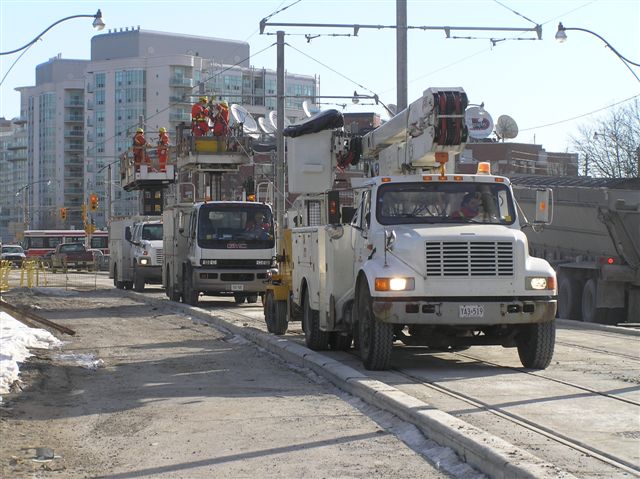
One of my regular readers, Harold McMann, sent me a few photos of overhead installation on Fleet Street and I am including one of them here because it shows a very recent change in the TTC’s standards for streetcar overhead.

Look closely at the hangers and you will see they are different from those commonly seen on Toronto’s system. These hangers are designed so that the contact wire will be held below the span wire and so that both pantographs and trolley poles can navigate them. If you look closely, you will see that hangers on alternate spans face in opposite directions so that there will be a slight meander to the overhead to avoid groove wear on pantographs.

Another change not as obvious from a photo is that the TTC is now using 4/0 gauge wire rather than 2/0. This is a larger cross section, but not twice as big even though the number might imply this. You can read about the arcane world of wire on Wikipedia. The larger cross section allows more current to be delivered by the wire in anticipation of the power demands of the new larger streetcars planned for Toronto.

The TTC Capital Budget contains a project to convert the entire overhead system by 2012, but it’s sad to note how long it took the TTC to accept that this would be necessary.

Further west on Fleet beyond the loop we find a forest of closely spaced poles marching down the centre of the right-of-way. These appear to be much closer together than the normal span wire spacing. This design leaves a lot to be desired if it is an indication of what we will see on future routes because the poles will dominate the visual landscape. I have already written here extensively about the shortcomings of centre poles on downtown streets and will not belabour the point.

Another project in the works is the complete replacement of the automatic track switch system. The current switch machines and their electronics date from the arrival of the ALRV fleet when the distance from the trolley shoe to the front of a car ceased to be constant. This meant that the old contactor-based switching had to be replaced, and a new system with pavement loops was installed.

This has been no end of trouble to the extent that some switches on the Spadina project have switch machines, but have never been activated. Many regularly used switches around the city sport “out of service” signs because they are no longer reliable or their parts have been raided for other more important locations. Because these switches are so unreliable, streetcars must come to a full stop at all facing point switches (including, amusingly, manual switches that cannot leap open in front of a car).

This practice makes for slow and jerky operation at intersections, and the TTC has not bothered to deal with this problem of reliability for quite a long time. Design of a new track switch system is underway and is expected to complete this year with procurement and installation to follow in future years.

Over the next four years, we will see a gradual transformation of the streetcar infrastructure in anticipation of the new fleet. Let’s hope the TTC gets it right this time. We cannot afford another fiasco like the CLRVs and their inability to deal with a system that PCCs had navigated for decades.

Victoria Park Station Re-Design

There is a report up on the TTC’s site showing the plans for renovation of Victoria Park Station. Note that this is a roughly 3.5MB document.

For those of you looking at the URL linked here, yes there is a spelling mistake in the TTC’s filename with “Vcitoria” Park station and terminal “Finsihes”. If they fix this, the link may break, and you will have to go to the general report site to get the document.

Listening to the Public

The Star reports today that the GO Transit Board rejected a call for fare rebates in compensation for poor service. This is no surprise, but that’s not my topic.

What fascinated me in the article was this:

[Pat] Eales was initially given five minutes to make her case to the board but GO Transit chairman Peter Smith said he would allow her to talk as long as she wanted.

Her presentation, along with questions and answers, went on for more than half an hour.

Meanwhile, over at the TTC, deputations have taken on a surreal air thanks to the Draconian new rules of procedure. We get five minutes, as always, but questions are rare and motions to extend speaking time are non-existent. I was used to being cut off back in the Lastman era, but Admiral Adam runs a tight ship and I’d better finish my speech in 5 minutes.

This reached an absurb height at the last meeting when John Cartwright of the Labour Council wanted to present information about shortcomings in the Buy Canadian study done for the current streetcar tender. Because the request to speak came in late, Chair Giambrone had to ask for the Commission’s indulgence just to get Cartwright on the agenda.

When the time to hear the material came up, they got five minutes. Full stop.

Meanwhile, TTC management gets to drone on at excruciating length about whatever project they have dropped onto the agenda often with little advance notice to those who might want to comment on it.

I suppose I shouldn’t complain. Metrolinx has yet to discover deputations and favours instead a complex process of public feedback through their website. No opportunity for irate members of the public to call politicians or management to task for their incompetence. Just remember this as and when they take over GO or even the TTC.

You won’t be able to complain about the Queen car because nobody will want to hear you.

Somehow the golden age of transit is looking a lot like the bad old days when pensioners got cigars, the Commissioners drank from bone china cups, and the public knew their place.

The Torontoist’s Million Dollar View

David Topping at the Torontoist has a good post about the need for people to embrace the TTC and work for positive changes rather than using the current labour situation, including the “million dollar” campaign, as an excuse to bash both the TTC and its employees indiscriminately.

As I’ve said in a preceding post, I think that the million dollar campaign is weak on details, and many have commented on how it makes the union (and its members) look bad by inflating their worth. One huge gap in the analysis is that it omits the value of the billions invested in transit infrastructure without which the ATU members would not have jobs and all of the economic activity they claim for themselves would, theoretically, never have happened. I and all of my readers helped pay for those investments through taxes at all levels, and if we’re going to shut down the TTC, I want my money back.

For its part, the TTC continues to struggle with low-balling the complexity of fixing long-standing problems with service and maintenance, or even of admitting that these problems exist. Politicians, even those who are strong supporters of transit, don’t want to hear that there is so much more to be done with money that isn’t in anyone’s budget.

This may sound like a broken record, but much of what has been achieved in the past decade came from pressure on the TTC to tell us what it could do, not what it couldn’t. The ideas of actually improving service, rebalancing fares and stimulating ridership came because we concentrated on improving the system.

We need more advocacy from within the TTC and City Council, detailed information on the actual state of the system and on what can be done to improve it. Some changes — better service for one — are finally on the street, but there’s a lot more to do. Let’s concentrate on making the transit system much, much better.

What A Million Dollars Buys You

I wasn’t going to comment on Marilyn Churley’s paper claiming that each TTC employee contributes $1-million to the local economy, but a remark buried in a long post at Blogto caught my eye. Specifically:

It can be a very useful source of information for pro-transit activists, and helps underscore transit’s importance (which makes sense given Steve Munro and Franz Hartmann were involved in it).

Since I seem to have been “outed” here, and am also thanked for input on page 3 of the report, I need to explain the context.

I cannot speak for Franz Hartmann (of the Toronto Environmental Alliance), but I was approached to review the document when it was in draft form. At that point, it needed a lot of work because of poorly thought out arguments. Some of my input found its way into the final version, some didn’t. I didn’t know the video existed until it appeared online. Finally, I don’t agree with all of the claimed economic benefits of the transit system’s existence — ie things that would simply disappear if there were no transit service.

That said, the problem lies more with the premise, rather than with the calculation. Personally, the TTC saves me a bundle because I can live without a car and my total transportation expense for 2007 was $1098 worth of passes (on subscription), the odd cab fare, and dinner/drinks for friends who provided chauffeur/cartage services.

Many families could not exist without one car given the problems of getting to work in transit-starved suburbia. However, a good transit system can reduce the need for every family to have two or more cars. Alas it won’t reduce road space because the highway system is so overcommitted by demand that any transit gains will only allow backfilling on the roads.

Scale up that sort of benefit across the city, and that’s money in every transit rider’s pocket.

Many of the comments on blogto are extremely one-sided being so directed at the union and the operators. Lousy service is a function of years of underinvestment in transit (new vehicles, more rapid transit) by politicians of every stripe. Lousy service is also caused by mismanagement of what’s there. Yes, some operators take advantage of this by playing games with their schedules, but they are far from the majority of the staff. Political decisions not to buy more buses, to downsize the fleet by 300 vehicles, had nothing to do with the ATU.

For decades, the TTC has claimed that it is powerless to provide better service due to traffic congestion. As reviews of their own vehicle monitoring data have shown here, congestion is only one factor, and the TTC’s solutions, aimed primarily at the core during peak periods, will not solve this problem. Huge gaps in service to the outer ends of lines are caused by bad operating practices in line management.

I agree that Local 113 has overstated its case with Churley’s report, but they don’t deserve the virtiolic remarks aimed at them by many writers. I open this post to comments with trepidation and will tell everyone in advance that I will ruthlessly expunge remarks that don’t address the larger issue of making transit better.