How Much Should the Eglinton Line Cost? (Update 1)

Update 1, April 15, 2009:  Although the original Transit City report gave Pearson Airport as the western terminus of the Eglinton line, the cost estimate only covered the portion to Renforth.  Approximately 3 km of additional construction are required to bring the line right into the airport, and the cost of this was not included in the 2007 estimate.

The underground section of the line was originally planned to lie between Keele and Laird Drive, but this may be expanded west to Jane and east to Don Mills (except for the river crossing).  This additional tunnelling is included in the recently announced cost estimate.

Original article:

Today’s Globe & Mail contains an article by Jeff Gray about the constantly escalating estimates for the Eglinton “LRT” line.  Gray cites the original estimate of $2.2-billion in 2007 compared with $4.6-billion figure included in the recent McGuinty funding announcement.  Nobody quite seems to know why the cost has doubled in two years. Continue reading

Metrolinx Cancels April Board Meeting

The planned April 24 meeting of the “old” Metrolinx Board has been cancelled.  A May meeting still appears in the events list on the Metrolinx website, but it’s anyone’s guess at this point which version of the Board will exist by then.

Among the long-awaited reports that were expected this month is the Benefits Case Analysis for the Eglinton line.  Meanwhile work continues on design work leading to Transit Environmental Assessments by the City of Toronto and TTC.

10,001 Comments

As I write this, there are now 10,001 approved comments on this site.

Congratulations to you, the readers and prolific writers (and even to those of you who only lurk most of the time) for making this site as good as it is.  If I only wrote articles hoping that someone read them, it would be a dull place.  The comments, both those supporting what I write and those of a differing slant, really make this a discussion, and the threads evolve very quickly.

So, as they used to say, keep those cards and letters coming!

GO Transit Contemplates Customer Satisfaction and Station Design

Today’s GO Transit board meeting (yes, that Board still exists) included presentations on two related items:

  • Customer Satisfaction and Loyalty Survey
  • Station Access Strategy

The link between these, although they were separate items on the agenda, is that people who cannot conveniently get to GO services won’t use them.

Board members were in a chatty mood, and asked many questions of the presenter, a Transportation Planner from GO’s staff who acquitted herself well on a variety of topics.  I could not help noticing how many questions with a direct relevance to customer experiences, to feelings people have about GO, to problems of convincing more people to use the system, came from the politicians on the Board.  These are members who have a direct relationship with GO customers and potential new riders.  Other members spoke too, but the preponderance of questions informed by a direct link to constituents and municipal issues was quite striking.

All of this will be lost on the new consolidated Metrolinx board where, we are told, politicians would just get in the way. Continue reading

Why Do Streetcars Bunch Up?

Over at torontoist, Adam Giambrone responds to a question about bunched service outbound from Mimico on the Lake Shore with a collection of the usual lame TTC excuses about irregular service.

This is getting tiresome, and it is distressing to see the TTC Chair spouting so much of the party line from TTC management.  The reasons for irregular service, according to Giambrone, are:

  • Bunching caused by minor variations in the time spent at stops and traffic lights.  This applies to frequent routes where the headway (as cited by Giambrone) is fairly close to the variation in delay times.  The last time I looked, the best scheduled service on Lake Shore is every 8’40” on Saturday afternoons, rather worse at other times including peak periods.  Minor delays at stops do not account for bunching.
  • Traffic congestion.  Yes we have heard this before.  The point, as we have seen in many of my analyses of route operations, is that congestion is manageable, and bunching should only occur when there is an actual blockage of service.  See below.
  • Traffic signal delays.  Yes, signals are being changed to give priority to transit vehicles, but this has already been done on much of the Queen route.  Major intersections, where traffic engineers feel that transit priority could be counter-productive by its effect on cross-street traffic, run on their regular cycle.
  • Surge loads.  Yes, they happen, but they don’t explain routine bunching.  Moreover, on Queen, the line uses all-door loading at major stops.
  • A shortage of supervision.  See “traffic congestion” above.  The TTC feels that if it can just put a small army of route supervisors in the field with better technology to let them know where the cars actually are (see Next Bus display at Spadina Station when it works), they can manage the service better.  As some comments in the Torontoist thread point out, there is a big problem with operators leaving terminals more or less when they feel like it causing ragged service, and little seems to be done to manage the gaps and bunches out of the service.  This happens on many routes.
  • Short turns, larger vehicles, more service.  This bullet in Giambrone’s presentation is, to say the least, unclear.  We know that busy routes have delays and need short turns, although changes in the management style for the 501 eliminate most of the need for this tactic (a point completely missed in the article).  Larger vehicles will help provided that the total capacity of the route is also increased.  Queen has suffered for decades with the effect of a reduced number of cars providing allegedly equivalent capacity.  Between cases where short cars are running in place of long ones (and they get late because they can’t handle the demand) and the larger impact on waiting times of missing cars, the change to wider headways has been a disaster for riding on the line.  There is no indication that the TTC understands this problem.

There are three fundamental problems with service on Queen and on Lake Shore (where the original reader comment arose):

  • The Long Branch 507 should never have been amalgamated with 501 Queen.  The route west of the Humber River has a large amount of local demand, but the decline in service quantity and reliability of the merged route has never been acknowledged.  The TTC just does not understand that service is important on the outer parts of lines, not just at Yonge Street.
  • The amount of service on Queen is insufficient to provide a reliable headway and capacity for demand.  The TTC may point to declining ridership over the years, but this is not reflected on other parallel routes like King or Dundas.  The irregular service drives away riders.
  • Route supervision leaves a great deal to be desired.  For clarity I don’t just mean the guys standing on the street corners making notes on their clipboards, but the whole strategy of how a line and its operators are scheduled and managed.  The TTC is working on this, but changes are slow to come.

I have begun detailed examination of Queen route operating records for December 2008 and January 2009, and will be publishing results from this work here soon.

GO Transit Buys CN Weston Subdivision

GO Transit announced today that it will purchase the CN Weston Subdivision for $160-million.  The line in question runs from roughly the Strachan Avenue grade crossing to the junction with the CN York Subdivision at Steeles Avenue.

CN and VIA run comparatively few trains (3 and 6 respectively) each day on the line, although VIA has planned improved service in this corridor for some time.  GO plans greatly expanded service both in frequency and in destination (extending to Kitchener), and this corridor will also host the Blue 22 Airport link should that line ever get beyond the drawing boards.

By purchasing the corridor, GO will not only have better control of train operations, it will be able to retain ownership of the substantial improvements needed to accommodate all of the new services.

The press release is silent on the matter of funding.

Metrolinx New Speak

Roger Brook passed on to me a formal reply from the Ministry of Transportation to various questions about the Metrolinx/GO merger.  In the quoted sections below, the questions are Roger’s, the answers are from Emna Dhahak, MTO Bilingual Senior Media Liaison Officer, Media and Issues Office.

Both Minister Bradley and Premier McGuinty have dug themselves into a rather deep hole with their convoluted explanations for the changes at GO and Metrolinx.  Rather than simply saying “Metrolinx and GO were always intended to merge and be governed by a board more like GO’s with few politicians”, we get bafflegab.  Not only that, it’s cut-and-paste bafflegab with the same paragraphs repeated in the answers. Continue reading

Understanding Union Station

Several reader comments recently talk about various design changes that might be made for Union Station Loop and surrounding areas.  My gut feeling from many of these is that the three-dimensional layout of existing and planned structures in this area is not well understood.

To assist, to the degree I can, this post includes some drawings from the past year and a discussion of how things fit together.  Some of these drawings are partly out of date and they must be read in connection with my notes here.  The intention is to give an overview, not a definitive set of plans.  The linked images have an aspect ratio wider than the thumbnails and more is visible in the large versions.
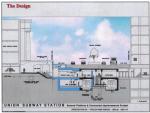
stationxsectionc

This is a cross section through the subway station looking west with the second platform (in blue) added.  Although not obvious on this drawing, a new glass wall will be added between the south edge of the existing platform and the northbound-to-Yonge track.  The escalator and stairway access to the northbound-to-University platform will be moved to the south edge of this platform giving more space for passengers between the University track and the vertical access paths to the mezzanine.

Also visible in this drawing is a stair up to the moat level from the mezzanine level of the station.  This design predates the “dig down” plans for the GO concourse.  The new lower concourse will be on the same level as the subway mezzanine with a straight access through a lowered moat between the two areas.

Note also that there is a sewer under the moat.  This must be lowered to permit the direct access across the moat.

The mezzanine of the subway station is immediately under street level.  There is no room here to insert an east-west Front Street LRT station below grade.

Note to the TTC:  When are they going to put current information and detailed plans up on the web page which has not been updated (only reformatted) since 2006?  This in an important project, but one needs a personal archive and other sites’ data to see what is going on here.

Continue reading

Sheppard LRT Will Go To Don Mills Station

Today’s TTC Commission Meeting was rather short, but it included a discussion of the current state of the Sheppard LRT project.

TTC staff reported that the EA document is now being considered by the Ministry of the Environment who had sought clarification on whether the Sheppard Subway was to be extended.  Staff will formally recommend later in April that the LRT line come into Don Mills Station rather than ending at Consumers Road.

This arrangement simplifies connections with the Finch to Don Mills LRT announced earlier this week.

No details on funding for the project are available, but the TTC is continuing with design, and the City of Toronto is carrying the cost on its own books.
