Weston Corridor GO/UPRL Approved, But With Conditions (Update 4)

Updated October 7 at 8:00 am:

Toronto Councillor Michael Thompson, who could not possibly be labelled part of Council’s left wing or a Miller loyalist, has written to George Smitherman, Minister of Energy and Infrastructure, urging that he pursue electrification immediately.  Many of the arguments in this letter echo those of critics of the Minister of the Environment’s approval of diesel operations in the Weston Corridor.

This places Smitherman, a possible mayoral candidate in Toronto, in an intriguing position.  Does he take a Queen’s Park view and parrot the standard line “clean diesels now, but electric maybe, someday”, or look to the election campaign and move to support Toronto Council’s view of the issue?  Thompson himself could be a mayoral candidate.

Updated October 6 at 10:35 am:

Interviews with Keith Brooks of the Clean Train Coalition are available online from CBC (select the item “Diesel Not Good Enough”) and from AM640 (select the item “Keith Brooks — October 5th”).

Updated October 6 at 10:10 am:

John Gerretsen, the Minister of the Environment, seems unable to stay “on message” when discussing electrification with the media.  On CBC and in the Globe, the Minister is quoted as saying that electrification is “too expensive”, and yet in a letter to Keith Brooks of the Clean Train Coalition, the Minister states:

“Many requests were made to require Metrolinx to electrify the Georgetown South Corridor. Metrolinx has committed to conducting a study to look at the best technology for the entire GO Transit rail network of the future, which is required before electrification of the corridor can be considered. I have reminded Metrolinx of its commitment to further study the possibility of electrification for the entire GO Transit rail line, which includes the Georgetown South Corridor. If the study results in information or recommendations that could have positive impacts on the environment, I expect Metrolinx to implement the recommendations as expeditiously as possible.”

Either electrification is too expensive, and should not be considered now, or it will magically become acceptable following the study.

If the Minister is making soothing statements to community groups, why doesn’t he make the same statements to the media?  Possibly because the “too expensive” excuse wouldn’t wash if there’s a study whose outcome may show that electrification is cheaper and better?

Updated October 6 at 6:55 am:

Brodie Fenlon at The Globe covers this story including comments from several of the community and government folks involved in this issue.

Tess Kalinowski at The Star has a short piece, and The CBC reports on the issue.  CBC radio coverage notes that John gerretsen, the Minister of the Environment says the approval will allow the diesel connection to the airport to open by 2015.  This is clearly in aid of the Pan Am Games bid, and an unanswered question is “what happens if we don’t get the bid”.  Has this project approval been railroaded [sorry about that] to sustain Toronto’s bid credibility?

The Minister is also quoted by the Star and CBC as saying that electrification is too expensive.  Does this prejudge the outcome of the very electrification study Metrolinx is about to undertake?  Why study a technology we have already rejected?  Are we seeing the real face of Queen’s Park’s “public consultation” here?

Original post: 

This evening, Ontario’s Ministry of the Environment announced that the Georgetown South GO project has been approved, but with conditions required to ensure that it meets claims for environmental improvements and mitigation, if needed, for any harmful effects.

The press release and detailed announcement of terms are available online.

In brief, the Minister requires that GO Transit and the Union-Pearson Rail Link abide by several conditions.  It is noteworthy that the UPRL is explicitly included because through much of the discussions, it has been treated as an off-limits deal between the federal and/or provincial governments and a private company, SNC-Lavalin, who would implement and operate the service. Continue reading
Will the RT become LRT? (Update 3)

Updated October 2 at 11:15 pm:

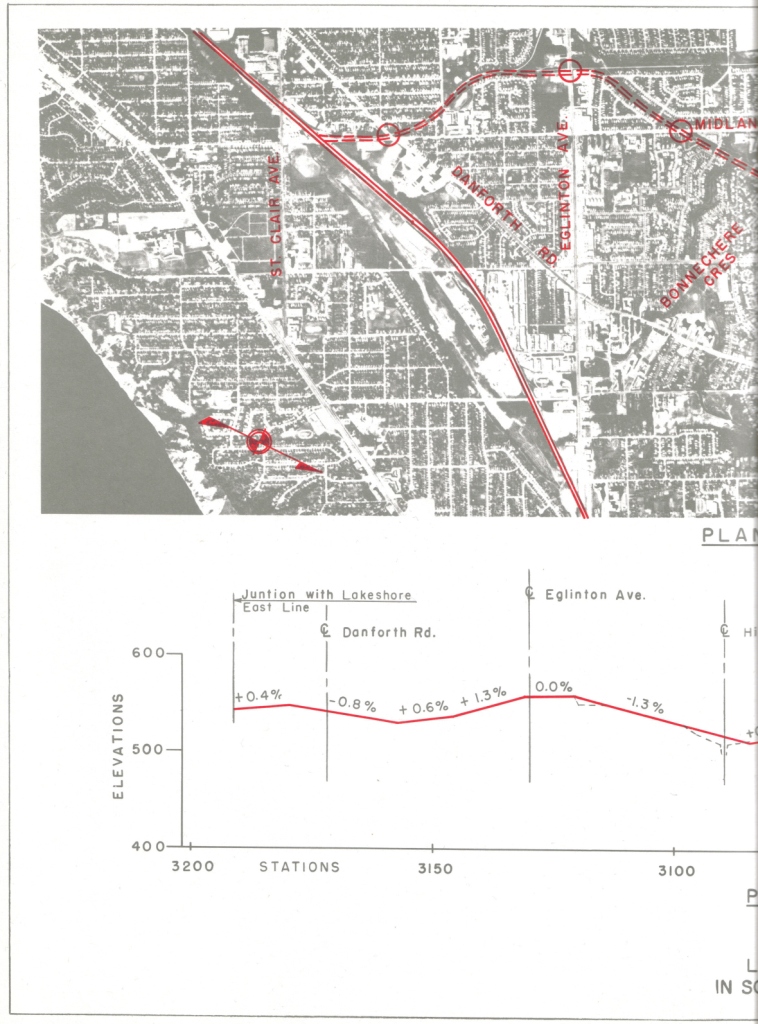
In the comments thread, a question has come up about the originally proposed alignment of the SLRT.  This dates back to the Metropolitan Toronto Transportation Plan Review (MTTPR) and a study of alternatives to the Scarborough Expressway.  One of these was an LRT line starting at roughly Queen & McCaul running east to the CNR Kingston Sub at Degrassi St., then northeast via the CN to Morningside Avenue.  A branch would run north from Scarborough Junction following mainly existing and abandoned rail corridors to the Scarborough Town Centre.

That branch eventually became the SRT, but was moved to follow the Uxbridge Subdivision because the old right-of-way used in the first proposal was very narrow.  As you will see from the maps, this is not the very wide Hydro corridor that crosses the SRT line, but a much tighter route.

To orient yourself, the Uxbridge Subdivision runs just below the top edge of these maps which have north to the right.

South Part
North Part

Updated September 30 at 4:50 pm:

Item SC 28.30, which requests the TTC and Metrolinx to report in November 2009 on an LRT implementation for the SRT, was passed today by Council.

Item SC28.20 was ruled out of order and withdrawn.

Updated September 30 at 12:45 pm:

This morning, in discussion of another Transit City matter on the Council Agenda, Councillor Thompson asked TTC Chief General Manager Gary Webster about the status of the Scarborough project.  Among other things, Webster replied that:

  • TTC now feels that LRT is the appropriate technology for the route and is working with Metrolinx to define the technology and scope for the Transit City projects generally.
  • The funding announced by Queen’s Park is not sufficient to carry the SRT north from Sheppard to Malvern.

The debate will continue this afternoon, but I suspect the items listed in my original post below will not be dealt with until tomorrow given their place on the agenda.

Original post:

Toronto Council’s agenda today, September 30, includes items of interest regarding the Scarborough RT (SRT) line.

Continue reading

Metrolinx Loves its Secrecy (Updated)

Updated September 30 at 4:30 pm:

This afternoon I received a note from the Project Director of the Electrification Study, Karen Pitre.  She concurs that the confidentiality agreement goes beyond what is necessary, and is preparing a revised version.

I hope to be free to report on the dialog at the workshop.

Original post:

Today, I received the agenda for an upcoming “stakeholders’ workshop” regarding the GO electrification study.  In the same email, there was a gentle reminder that I must sign a Conflict of Interest and Confidentiality Agreement to participate.  Continue reading

Metrolinx Fudges Clean Train Info

As I reported here recently, Toronto’s Medical Officer of Health, Dr. David McKeown, criticized the Metrolinx plans for substantial increased diesel train operation in the Weston corridor.

Subsequently, the MOH issued a revised critique in response to updated information from Metrolinx.  In this, he retracted three claims made in his original letter:

  • Unacceptable lukemia risks are no longer predicted.
  • Although local concentrations of some contaminants are predicted to rise, the MOH no longer feels that Metrolinx is underestimating the local outcomes.
  • Similarly, acute health risks are predicted to rise, but the increase is not underestimated my Metrolinx.

However, the MOH goes on to say:

Notwithstanding the above, I remain concerned about the air quality impacts and increased health risks predicted for the immediately adjacent communities as a result of the proposed diesel expansion.

In the “Information Clarification” Metrolinx has described potential air quality and health impact mitigation measures, including improvements to locomotive stock. While these mitigation measures would reduce emissions, it is not clear what level of reduction will be achieved in local ambient air concentrations of the respiratory irritants for which increased risk is predicted.

On its home page, Metrolinx lists the three bullets above, but without the qualification.  Metrolinx goes on to claim that the MOH’s revised opinion includes:

As an alternative to electrification, other mitigation measures proposed by Metrolinx may, subject to demonstration, be acceptable.

In fact, Dr. McKeown’s letter actually says:

In its additional information Metrolinx also indicates that it is exploring alternatives to diesel train technology, including electrification. In my view, electrification is the option that most clearly addresses the air quality and health impacts predicted from the proposed project for populations adjacent to the line by ensuring that any emissions (due to electrical power generation) are regional in nature. Whether other measures proposed as part of a comprehensive mitigation strategy could reduce the predicted air quality and health impacts to an acceptable level remains to be demonstrated.

Metrolinx not only misrepresented the MOH’s position, but blanketed the Weston Corridor with flyer reiterating the claims made on their website.

Today, as part of the Clean Train Coalition‘s protest march, Dr. McKeown took the unusual step of attending a public rally.  At that rally, he said:

What we know about air pollution in Toronto is that any proposal now should pass a very stringent test before it goes forward. This proposal has not passed that test in my view. The study, conducted by Metrolinx itself, indicates clearly that there will be impacts on air quality as well as health risks for those that live close to the line.

Additional information on the rally can be found at the Star’s website.

Metrolinx really needs to stop spinning this issue.  They have created an electrification study, an advisory committee to recommend terms of reference for that study, and are about to have a “stakeholder consultation” where folks like me can contribute their input to the advisory committee.  Electrification of the Lakeshore corridor is already part of the Premier’s announced plans for GO Transit.

Why is Metrolinx trying so desperately to win a battle between the community and the Minister of the Environment?

More Follies With Station Signage

The Cumberland Street entrance of Bay Station re-opened recently at long last.  Construction had been delayed by unexpected conflicting structures when the old entrance was demolished.

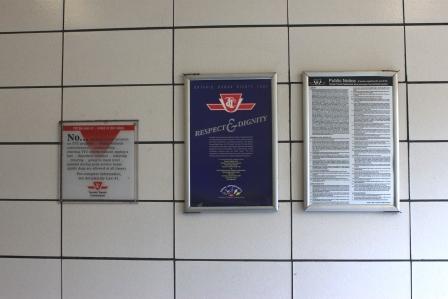
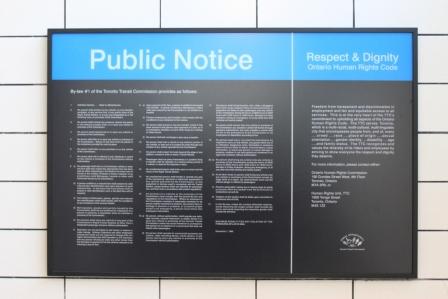
It’s a nice entrance, as TTC buildings go, but something very odd shows up in the decor.  At the bottom of the entrance stairway, we find not a beautiful mural, not an historic account of Yorkville, not even ad advertising frame, but a copy of TTC Bylaw No. 1 at very large scale.  This is no cardboard throwaway, but a metal sign built to last the ages.

IMG_0358C

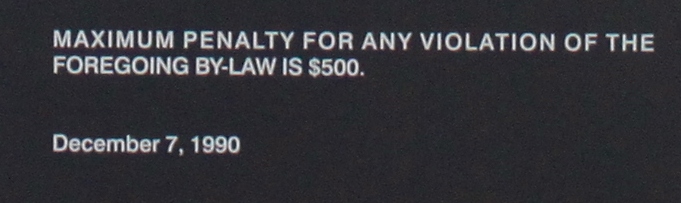
There’s only one tiny problem:  the date.

IMG_0358C2

In fact, the TTC Bylaw was updated in 2009 as we can see by visiting the Bellair Street entrance.

IMG_0362C

Here, we have the same info as on the Cumberland panel (the Human Rights statement and the Bylaw), plus a “here’s the bylaw stuff you really need” sign.  However, this is the new bylaw from January 2009.

IMG_0363C

I have been advised that the Cumberland panel will be replaced.  Why did this happen in the first place?  What is so important about the bylaw that it deserves pride of place on a wall that could have held a decoration appropriate to the neighbourhood?  Why was a sign installed with text that was replaced 8 months earlier by a new and substantially revised bylaw?

There is a move afoot to set up a website where people can report signage foul-ups.  It may be hosted here, or maybe elsewhere.  Once this is in place, I will publish the details.

Marathon Diversions

The war on transit riders continues with the Scotiabank marathon on Sunday, September 27.

The TTC’s contributes the service change notices which tell readers almost nothing.  For additional info, they refer people to the TTC website which has the same text as the printer notices.  (Thanks to David Fisher for the photo.)  All this really says is that there will be diversions and shuttle buses everywhere, but there’s no map.  How even those who are familiar with the city can expect to find their way anywhere is a mystery.

The first question one asks, of course, is “where is that marathon, anyhow”.  For that you have to go to the marathon site itself.  (One thing I will give them is that the map is at least accurate with streets, neighbourhoods and landmarks correctly named.)  Street closures have their own set of notices.

Meanwhile, as happens so often, The Beach will be completely closed to traffic east of Kingston Road.

A thorough set of route changes is available at the Transit Toronto site.   (Scroll down about 1/3 of the way in the post.  The GO and TTC diversion information consume almost the entire article from there on.)

Alas this isn’t mentioned in any of the TTC’s public information.  Why must this always be done by the transit afficionadoes and advocates rather than the people we pay to provide this service?

The Mayor of Transit City

Yesterday, David Miller announced that he would not seek a third term as Mayor of Toronto so that he can devote his attention to his family rather than to political battles.  In his announcement speech, the Mayor spoke of his many accomplishments including those which improve public transit.  Indeed, in today’s Globe, when asked to name one of his greatest accomplishments, Miller replied:

One of the things I passionately believe, and one of the reasons I ran for elected office to begin with, was about public transit.

Indeed, improving public transit to make Toronto a “World Class City” was part of Miller’s first, unsuccessful, bid for a Council seat in 1991.  The next election, in 1994, brought Miller to the old Metro Council.

(There are many articles in all media about Miller’s decision, and I leave it to readers to track them down.  A news compendium is available the spacing.ca website as of September 28.)

Continue reading

Streetcars Return to St. Clair

Streetcar service will return to route 512 St. Clair on December 20, 2009.

Streetcars will operate from St. Clair Station to Earlscourt Loop at Lansdowne, and buses will operate from Oakwood Loop to Keele (Gunn’s Loop).  Buses will run in the curb lanes except for the stop eastbound at Oakwood.

Service on the streetcar route will be improved relative to pre-bus operations (see detailed chart).  Headways at all times are more frequent than the April 2007 streetcar schedules, and the widest headway is 10 minutes.  That is operated only late evenings on weekends.

Round trip times between Yonge and Lansdowne were 60 minutes in the AM Peak 2007 schedules, but this has been reduced to 50 minutes in the new 2009/2010 schedules.  The longest running time in 2007, for Saturday afternoons, was 84 minutes (to Keele).  The time (to Lansdowne) has been reduced to 47 minutes in the new schedules.  (A round trip from Lansdowne to Keele likely took at most 16 minutes, not including layover time, in 2007.)

Work on the Bathurst Street underpass at Dupont will be completed before December 20, and streetcars will operate from Roncesvalles Carhouse rather than Hillcrest.

The service planned for St. Clair is clearly an improvement both in frequency and speed over that which operated on the route before it was rebuilt.  The new schedules go into effect during the winter months, an ideal time to show off improved service quality.  With luck, the traffic signals will actually speed streetcars across the route rather than contributing substantial delays.  This is a real test of the TTC’s and the City’s desire to show that transit priority and all of the disruption on St. Clair are worth the effort.

TTC Capital Budget 2010-2019

The TTC’s Capital Budget Report is now available online.  I will not comment on this in detail until after the staff presentation at the Commission meeting on September 24.

Of particular note, although it is not mentioned explicitly in the Capital Budget Report, the TTC now has an “SRT Conversion and Expansion project” that is mentioned on Page 6 of the July Chief General Manager’s Report.  Presumably there will be more information about this at Thursday’s meeting.

Such a change has long been rumoured by staff at the various community EA meetings, but we have never actually seen an LRT, as opposed to ICTS, design for the RT and its Malvern extension.

Those Too-Popular Metropasses (Update 2)

Update 2, 4:45 pm September 23:  The Chief General Manager’s Report for the period to the start of August 2009 is now online.  In this, we learn:

  • The change in average fare revenue is 2.32, not 3, cents per rider due both to higher pass sales and greater use of concession fares (children, students, seniors) (page 3).
  • Revenue loss due to ridership being below budget accounts for $3.4-million, while the lower average fare cointributes $7.6-million.  (Both of these are only for the seven months to the end of July.)
  • Yearend revenue shortfall from fares will lie between $15- and $19-million depending on ridership results through the fall.
  • Yearend revenue from advertising and other income (mainly interest) will be $3.6-million below budget.
  • Expenses are expected to be over budget due to the combined effect of:
    • Inglis building flood remediation ($1.4-million)
    • Higher service requirement from city construction ($2-million)
    • Higher overtime due to staff shortage (gapping), maintenance backlog and severe winter weather ($3.5-million)
    • Vehicle maintenance needs ($4-million)
    • Other changes ($0.3-million)
  • Savings on expenses include:
    • Lower energy rates and water consumption ($4.9-million)
    • Employee cost reductions ($2-million)
    • Planned service reductions ($1.9-million).  It is unclear whether these are reductions still to come, or if this is the saving versus budget of cuts imposed by availability problems with the bus fleet. 
  • The following actions will be taken to address the anticipated $17.4-million shortfall:
    • Some service improvements planned for fall 2009 will be deferred until mid-2010 (no list is given).
    • Overtime will be curtailed.  The effect on service availability is not addressed, but we do know that there were problems with fielding all service late in 2008 due to similar actions.
    • There will be a comprehensive review of hiring and training for operators.  This is intended to address a surge in retirements caused by demographics of the operator workforce.
    • All discretionary expenses in departments will be reviewed.
  • Page 6 mentions “the SRT Conversion and Expansion project”.  Although this is not explicitly mentioned in the Capital Budget report, we are about to see the TTC announce the conversion of the SRT to LRT technology.  This has long been rumoured, and finally has shown up in print.

Continue reading