TTC Riding Up, But Not Quite Enough

TTC’s Operating Budget results for the first eight months of 2009 were published in the Chief General Manager’s Report on the Commission Agenda for the meeting of October 29.

Although riding is up 1.9% over 2008, the budgetted expectation was 2.5% and, therefore, the TTC faces a shortfall in farebox revenue.  The drop came mainly in July and August which were affected by the civic workers’ strike and other employment losses.  Although September is beyond the scope of the report, preliminary data shows that ridership is climbing back up to the projected level, and full-year ridership is now projected at 471-million (compared to the budget figure of 473-million).

The average fare is expected to come in at $1.78, two cents below the budgetted value of $1.80, because Metropass and other concession fare use is above budget.  The combined effect of the lower average fare and ridership is $15.7-million less farebox revenue for 2009 that expected.  To put this in perspective, that is on a base of about $900-million in budgetted fares, or less than 2%.

Expenses for 2009 are expected to be almost on target due to a mix of overruns and savings that are roughly in balance.  These arise mainly from unexpected factors such as the severe winter and lower than projected utility costs.

Overall, the TTC projects a deficit $22-million higher than its original budget. 

Continue reading

Streetcar Track Replacement Plan 2010-2014

For those who are purists about their transit advocacy, listing all of the planned track replacements may seem just the sort of thing a railfan might do.  If that’s your attitude, you’re in the wrong article, probably the wrong site.

The streetcar track repairs planned for the next five years mark an important milestone in Toronto’s streetcar network.  For two decades after the TTC decided to keep streetcars in operation, they continued to build poor track, and the quality of construction actually deteriorated as time went on.  Some bright spark thought that unwelded rail, sitting on untreated wood ties, all poured in a slab of concrete, was a wonderfully modern way to built track.  It wasn’t, and we saw streets fall apart quickly, in some cases within a decade of construction.

Things changed in the early 1990s, and over the years the TTC has moved to use continuously welded rail (a practice abandoned in the late 1960s), steel ties and rubber insulation to keep the track from vibrating the roadbed like a gigantic sounding board.  At intersections, the change started later, but recent installations such as Church at Queen and at Adelaide are built to the same standards as the regular tangent track.  This is track built to last.

IMG_0444C

The photo above shows Church and Adelaide.  Visible here are:

  • steel ties where they can be used, otherwise treated wooden ties
  • welded rail
  • rubber matting around the rails, and rubber moulded around the special work
  • the machine used to move pre-assembled track panels into location

Within five years, presuming the gods of budget cutting don’t intervene, all of the track used by main routes in Toronto will have been rebuilt.  Intersections will take longer because there are so many, and the TTC settled on its current standard of construction for them only recently.

This list may be amended to stretch out spending and relieve pressure on the City’s capital budget.  However, even with some delays, this will see the streetcar track network back in first class condition over the coming decade.

Continue reading

Trial Split of 501 Queen Car (Updated)

Updated October 22 at 10:25 am:

Brad Ross, TTC’s Director of Corporate Communications, advises that effective 9:30 am today all Queen operators will carry passengers around the Shaw/Dufferin and Parliament/Broadview loops, and tell passengers of the layover that may occur.

Also, for those who like to know the internal trivia, the east and west ends of the route are known as “500” and “507” respectively so that they can be scheduled and managed independently.

Original post:

Today, the TTC begins a five-week test of operating the Queen car in two overlapping sections, weekdays only.

  • East end cars will operate between Neville and Shaw, looping via Shaw, King and Dufferin.
  • West end cars will operate between Long Branch or Humber (alternate cars) and Parliament, looping via Parliament, Dundas and Broadview.

Without rehashing many previous posts on this topic, here is a preliminary look at the issues:

  • The design of the overlapped routes may not be ideal, and I hope that it will work well enough that TTC staff don’t reject any alternative arrangements.  Part of the problem is a tradeoff between the number of cars and operators available and the amount of additional service on the route.  A long term arrangement may require a different route configuration and/or even more service.
  • Scheduled service to the outer ends of the line has been cut to provide for the overlap.  The premise is that with more reliable headways and fewer short turns, the actual service provided to Neville and Long Branch will be better than on the unified route.  However, the AM peak is not, for the most part, affected by congestion and short turns were comparatively rare.  Will the reduced service be able to handle demand outside of the overlapped section downtown?
  • Overlapped TTC services have a long history of badly managed integration.  This can be seen with the  behaviour of 502 Downtowner cars that often pull out from McCaul or Kingston Road right behind a 501 Queen and carry as few passengers as possible.  How many times will we see pairs of east and west end cars travel across the central part of Queen together?
  • Both turnbacks involve on-street loops.  Cars waiting for their scheduled departure times may be pushed out by other services, or may simply create congestion of their own while laying over in the middle of the street.
  • On the brighter side, both scheduled turnbacks are  far enough away from Yonge Street that even a short turn (say westbound at Bathurst or eastbound at Church) will maintain service in the heart of downtown.

With shorter routes, the need for recovery time should be reduced as operators won’t face a 90-minute more trip between termini.  For the east end service, recovery times are no more than 4 minutes (peak periods). 

In the west end, recovery times are longer, but these are mainly intended to make the schedule merge at Humber work properly — the difference between Humber and Long Branch trip times must always be a multiple of the headway.  For example, in the early evening, the Long Branch cars get 13 minutes “recovery” so that their round trips differ by one hour (four times the 15-minute headway) from the Humber cars.  Later in the evening, the difference in round trips is only 38 minutes (two times the 19-minute headway), and the Long Branch runs get only 4 minutes recovery.

This thread is intended as a repository for observations and comments about the split route operation, and I am particularly interested in hearing from regular users of the Queen car on their day-to-day experiences.

I have asked the TTC for their vehicle monitoring data for the months of October and November for the 501 and will publish an analyses of route behaviour comparing the unified and split operations.

Streetcars on the Waterfront (1968)

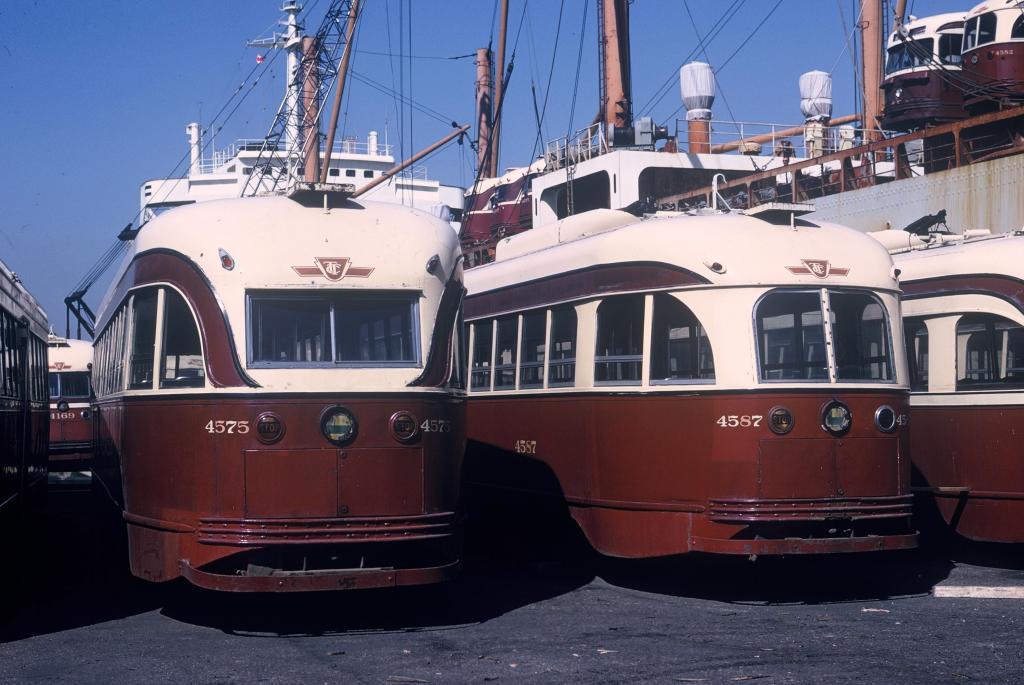
With all the discussion of waterfront transit, many people may forget (or never have seen) a previous visit of streetcars to the water’s edge.  Back in 1968, the TTC sold many of the PCC cars retired after the Bloor-Danforth Subway opened, and a batch of these went to Egypt.  On July 20, 1968, a much younger version of your faithful scribe was there along with many others to record the event.

All photos here were taken by me and I reserve copyright in them.

E010C

Sitting on the dock, here are two ex-Cincinnati PCCs including TTC 4575, a 1939-built  demonstration car for Cincinnati.  This car had many oddities including windows, marker lights and some interior features as befits a one-of vehicle.

Cars were loaded from both sides of the ship, the Mare Tranquillo.

Here, 4217 joins its mate 4222 on deck. A short turn destination right to the end!

A group of cars begins their sea voyage from a lighter. The railfans have obviously been busy with destination and route combinations that were already obsolete when these photos were taken. Parliament and Harbord vanished with the opening of the BD subway in 1966, and Dupont was a casualty of the University line in 1963.

A quartet of cars sits on deck seen from the dock.

The view from the bridge.

Looking out from the bridge to the Toronto Islands.

4007, one of Toronto’s first PCCs, meets the Island Ferry for the last time.

TTC Capital Budget 2010-2019 (2): Subway Fleet and Service Plans

The TTC Capital Budget contains many projects related to subway fleet, capacity and future operations.  Collectively, these projects amount to billions of dollars and many of them are not yet funded.

There are two major problems faced by subway planners:

  • Everything has a very long lead time, and plans made today need to balance between overspending on capacity we might not need and underspending that could produce future constraints on service.
  • Everything costs a lot of money, and unexpected additions to the budget can crowd out other necessary projects.

Large organizations and projects share issues familiar to many:

  • Left hand, right hand.  One department plans on the assumption that another project will actually happen in the announced manner and on a definite timescale.  Plans change, but co-ordination is less than perfect, and plans go out of sync.
  • In for a penny, in for a pound.  A project is “sold” politically on the basis of improvements it can bring.  However, actually achieving these improvements triggers the need for many follow-on works that are not budgeted.  Proponents of the first project in this chain innocently claim that they were simply creating the ability for some future enhancement.  Privately the attitude may be that the politicians would never approve something if they knew how much it would actually cost.  In a robust economy, the extra funding is always found somewhere, but when times are tight, budget surprises are unwelcome.

Both of these effects can be seen in the TTC’s subway fleet and service plans. Continue reading

Rethinking the Waterfront West LRT

The TTC’s 2010-2019 Capital Budget contains a project description for the WWLRT that throws the whole project into serious doubt.  Metrolinx funding has been deferred to 2022, and the schedule for the project now looks like this:

  • 2022 Construction starts; Park Lawn Loop is built
  • 2026 Service begins from Exhibition Loop to Dufferin
  • 2028 Service begins from Dufferin to Park Lawn
  • 2029 Service begins from Park Lawn to Long Branch

Most of the Lake Shore community residents who have attended EA meetings to discuss the design and effect on their neighbourhoods will have to wait two decades to see the project implemented.  Whatever happened to Toronto’s “Transit First” model for the waterfront?  Must we wait for the complete condoization of Lake Shore before anything happens with transit service?  How relevant will 2009 studies be if the project isn’t actually in operation until 2029?

This project has been gerrymandered throughout its history to suit whatever pet project (pro or con transit) happened to be on the front pages, and the idea that the line might actually have some useful transit function often appeared secondary.  Indeed, the original 1990 study describes a line that is unrecognizable in today’s plans which have been updated by amendment without any formal public participation or any sense of overall direction for the project. Continue reading

Metrolinx Electrification Study Terms of Reference

Metrolinx will seek a consultant to undertake a system-wide study of GO electrification with the intent of completing a report by December 2010.  A Request for Proposals (RFP) will be issued with the intention of award in November, and commencement of work in December 2009.  This is an aggressive timeframe for a project of this scope.

The proposed Terms of Reference (ToR) for this study are now available online.  They will be discussed at a meeting of the Metrolinx Board on Tuesday, October 20 at 11:45 am.  If approved, they will form the basis for the RFP.

My comments about the ToR were added here at about 6:30 pm on October 15.

Overall, the Terms of Reference are thorough and address many of the issues raised by the community.  Indeed, it is odd that Metrolinx was so defensive about its Georgetown South EA and associated claims regarding emissions considering the breadth of issues that will face the electrification study.

[Note that some remarks here duplicate replies in the comments thread which were posted before I updated the main article.]

The document linked here includes a covering report and the recommendations of the Community Advisory Committee created to advise Metrolinx on the ToR.  That Committee received input from, among other places, a “stakeholders meeting” in which I participated.  Some, but not all, of the issues raised by participants at that meeting have found their way into the ToR, or were already present.

I cannot help being amused (ROTFLMAO), but also dismayed by the following comment:

The GO System Electrification Study is a critical next step in the implementation of the Metrolinx regional transportation plan. It is a timely and important step in advancing the expansion of the GTHA regional transit network. In the continuing Metrolinx tradition that values community and stakeholder input, the Community Advisory Committee enhanced and enriched the quality of the work.  [Page 3]

There are a few community groups who would beg to differ with the claim that Metrolinx has a tradition of valuing community input.  This insults the many people who worked to raise important issues on the Georgetown South study, but for their pains were dismissed as NIMBYs while Metrolinx spun the issues to favour its own position.  Metrolinx is better known for secrecy and isolation than for community involvement.

The ToR are quite clear in requiring input from a broad range of interested and affected parties, and this will be a welcome change if there is no attempt to manage responses to fit a pre-determined conclusion.

A few broad issues are worth mentioning before I review specific sections of the proposal.

  • The study will review diesel and electric options, as well as two as yet unnamed alternative technologies.  Such alternatives have to be possible, realistic and viable, although how a study ending in 2010 would establish that capability for, say, a decade in the future is beyond me.  The last thing we need is another proposal based on a technology that’s just out of reach, or one where the GTA would become the guinea pig to demonstrate a new system. 
  • The distinction between the Union-Pearson Rail Link (UPRL) and Metrolinx/GO is becoming ever more difficult to discern.  For all practical purposes this service is being designed by GO, its infrastructure is built and paid for by GO, and all of the legal processes including Environmental Assessments are handled by GO.  There is little or no public participation by the so-called private partner, SNC-Lavalin, and recent press reports confirmed that a contract does not yet exist with that partner.  Given the level of public investment and involvement, the time is long past that SNC-Lavalin should abandon this scheme so that it can be properly integrated with GO’s plans and operations.
  • The methodology for evaluating environmental effects is much changed from the system used in the Metrolinx EA.  Rather than considering the airshed as a whole and trading off alleged reductions in pollution on the 401 for increases in Parkdale, the study must look at local effects related to distance from the rail corridor.  Of course, when the alternatives under comparison are trains-vs-trains, the concept of displaced trips fades in importance except for situations where technology “A” can carry and attract more riders than technology “B”.

Comments below are keyed to specific numbered sections within the ToR which form Appendix A of the linked document. Continue reading

Will Diesels Roar Through Minister’s Loophole?

Ever since Ontario’s Minister of the Environment, John Gerretsen, announced that the Georgetown South expansion of GO services, plus the link to Pearson Airport, would be allowed to proceed subject to a number of conditions, there has been much spin in the press by both side of the argument.

My position is quite clear in two previous posts:  the numbers used by Metrolinx to substantiate their claims about comparative pollution of auto and train travel are seriously flawed to the point that claims made by Metrolinx and the govenment are simply not true.

One additional problem came to light earlier today.

On its website, Metrolinx characterizes the decision as follows:

Trains operated by GO Transit on the Georgetown rail corridor and the Union Pearson Rail Link service must use Tier 4 state of the art engines when the service expansion begins or as soon as the technology is commercially available.

However, the order actually reads:

2. All trains utilized for GO Transit that travel to, from or through Georgetown along the Georgetown South Corridor shall be Tier 4 compliant when service begins or when Tier 4 compliant technology becomes commercially available.

3. All trains utilized for the Union-Pearson Rail Link in the Georgetown South Corridor shall be Tier 4 compliant when service begins or when Tier 4 compliant technology becomes commercially available.

The wording of item 2 above is curious.  Only trains that “to, from or through Georgetown” are subject to the order.  This omits the following services from the scope of the order:

  • Proposed frequent short-turn service to Brampton,
  • Trains to Milton which use the corridor south of West Toronto diamond,
  • Trains to Barrie which use the corridor south of Dundas Street, and run parallel to it for some distance to the north,
  • Trains to Bolton, a proposed new peak period GO line, which uses the corridor to the point where it turns west over the Humber River.

However, Metrolinx has no compunctions about including these trains in its calculations of diverted trips, saved emissions and, of course, the benefits of Tier 4 diesel technology.

Either the order is oddly and badly drafted, or there is a deliberate attempt to limit its scope while giving the impression that all new trains will have the latest in pollution controls.  The former would be mere incompetence.  The latter casts both Metrolinx and the Government’s position in a much darker light.

The Minister of the Environment owes everyone a clear statement regarding the intent of his order.  If it applies to all trains that will operate on the rail corridor beginning roughly at the Strachan Avenue grade crossing and ending at Georgetown, then say so.  If not, then explain why the frequent services planned for the heavy Milton (future Cambridge) and Barrie routes will operate with Tier 2 diesels.

Fun With Figures at Metrolinx (2)

Yesterday, I wrote about the Metrolinx calculations purporting to show improvements in pollution due to all the new diesel trains that will run in the corridor.  In that article, I concentrated on the GO services and the off-the-scale error in estimates of trips that would be taken.

This error — assuming all trains would be completely full, all day, both ways — dilutes the pollution per trip assigned to each passenger, and also inflates the pollution “saved” by auto trips that are diverted to transit.

A comment in that thread came in from John Galeazza:

Re. Pearson traffic growth.

Come now are we saying that Pearson has not seen a 4 fold increase in traffic over the past 20 odd years? Take a look at Pearson’s reports (they’re available on the GTAA’s website) in both passenger volume and aircraft movements there has been a steady increase.

To say that we shouldn’t use a piece of infrastructure because it has steadily fallen into disuse is farcical in my humble opininion. If that were the case GO would never have gotten started on the old freight/passenger lines that became “useless” with the arrival of the airplane and the car.

In my original reply (which has been hidden from the thread), I questioned the estimated ridership in the corridor for the air-rail link. Thanks to an arithmetic error (yes, even I make them, but at least I admit it when they happen), my comment would up addressing a false premise. That’s why I pulled it. Continue reading

Fun With Figures at Metrolinx

Monday’s approval of Metrolinx’ plans to run diesel trains on the Weston/Georgetown corridor stirred up lots of discussion here, in the mainstream media and at City Hall.  If this approval rested on solid data and projections, we could simply argue the fine points and debate rollout plans.  However, the claims made by Metrolinx for emissions from the project, comparisons with auto travel and supposed reductions by redirected auto travel depend on calculations that are transparently wrong.

In brief, Metrolinx assumes that every GO train trip, both ways, every day, all day in the corridor will be completely full of passengers, all 1,900 of them (a fully seated load on a 12-car train).  This absurd premise overstates the likely ridership by a factor of at least 4, probably greater (details follow later in this article) with the following effects:

  • Pollution caused by the trains is a fixed number determined by how many trips they make.  If there are fewer passengers, the pollution per passenger trip is much larger than claimed by Metrolinx.
  • If there are fewer passengers, then fewer auto trips are diverted to rail.  This does not affect the pollution saving per trip (presuming that one even agrees with this premise), but the total saving is greatly reduced because so many fewer trips are diverted.

Opening day (2015) traffic projected for the corridor is 184 GO trains and 140 UPRL (Airport) trains.  The total trips calculated by Metrolinx for the corridor GO services is 349,600 per weekday.  To put this in context, the entire GO rail system carries about 180,000 passengers per day today.

In practice, the trains will carry nowhere near 1,900 per trip on average.  Peak travel will be heavily inbound in the AM and outbound in the PM, with lightly loaded trains in the counterpeak.  During the off-peak, loads will be much lower than at peak, and some trips (notably inbound late evening runs) will be almost empty.  The same patterns can be seen on the Toronto subway system.

I am inserting the break here for those who don’t want to read the gory details, although the conclusions are down at the end. Continue reading