St. Clair Follies Fall 2009 Update

Word reached me this morning that plans for the St. Clair car continue to fall short of announcements, and that design screwups are still with us.

Opening to Keele

Although service will be extended to Earlscourt Loop at Lansdowne on December 20, service to Gunn’s loop is not expected to resume until August 2010.  The reason for this is that construction delays and design changes have pushed work well into the winter, when it is impractical and/or very expensive, and the west end of the line won’t be finished until good weather returns in the spring.

Oakwood Loop

This loop will not be available for streetcars because the overhead fittings are not available.  The TTC has been building the overhead on St. Clair to be fully pantograph compliant.  Why?  Because at some distant future time, they actually think St. Clair will become part of the Transit City network operating with Transit City cars from Black Creek Carhouse.

There is no connection between St. Clair and Eglinton, but this would be included in the Jane LRT.  There are two small problems:

  • The Jane LRT is not yet funded, and is unlikely to open before 2020.  Current plans show 2016, but that date assumed a more generous ongoing source of transit capital than we now have.  Moreover, it is unclear whether the southern part of the Jane route will be underground, and this would affect an interchange with an extended St. Clair route.  Indeed, the Jane route may never extend south of Eglinton and could operate as a branch off of the Eglinton LRT. 
  • There is a strong possibility that the Transit City network will be built to standard gauge.  If so, its cars will not be able to operate over the TTC gauge St. Clair route.

It is unclear whether the TTC is attempting to sever the St. Clair route from the rest of the “legacy” system to avoid operations on the Bathurst Street hill.

Dufferin & St. Clair

This intersection was the source of much debate during design.  At one point, the eastbound stop was going to be nearside due to constraints on the sidewalk a farside stop would entail.  However, the desire for a left turn lane east-to-north prevailed, and the stop was built farside.

There is a small problem.  The platform is wide enough (it was built extra-wide in anticipation of heavy use at this stop) and the roadway narrow enough that large vehicles cannot easily make the north-to-east turn.  The brand new stop will be rebuilt and narrowed so that the intersection can work properly.

A similar problem lurks in the design for St. Clair and Old Weston Road where the farside westbound island will constrain the ability of Keele buses to make the south-to-west turn.  Why the 41 Keele is not permanently rerouted via Rogers and Weston Road is a mystery (the express branch uses this route already, and there have been construction diversions of the local service).  The 168 Symington would continue to provide frequent service on Old Weston Road.

TTC Capital Budget 2010-2019 (5): A Question of Accuracy

Yesterday, I was interviewed on CIUT about the TTC’s Capital Budget, and was on the air right after TTC Chair Adam Giambrone.  An issue raised for both of us was my claim that the TTC has just discovered that it has nearly a billion dollars worth of projects that are not only “below the line” (unfunded) but not even in the budget.

(See the previous article in this series, and scroll down to Surprise Projects.)

Giambrone replied that, yes, the TTC knew about these costs and they were in the budget.  Well, no, they are not.  I spent a few hours this morning combing through the budget books, again, checking on these and other items. Continue reading

The War on Metropasses (2)

The TTC’s November Commission meeting has been moved up from the planned November 25th date to the 17th, and an item sure to be on the agenda will be a fare increase for 2010.

There are two questions:

  • How big an increase will the TTC need?
  • How evenly will the increase be applied to different fare types?

As I already reported, TTC management has been up to its usual tricks of blaming heavy use of Metropasses for its financial woes.  For months, they have been preparing us (and priming Commissioners) to tell us how we are losing too much money on passes, and their value, relative to tokens, must go up.

We have heard this song for years, but through a period when lowering pass pricing was an integral part of the Ridership Growth Strategy, it was ignored.  Now, the TTC wants more money, and Metropass holders are convenient, dedicated transit users who can be counted on to cough up almost any increase.

What would, what should a fare increase look like? Continue reading

The War On Metropasses (1)

The National Post reports that the TTC is going to spend $1.5-million to install fare validation equipment in stations and vehicles.

The devices will be similar to the metropass slide readers currently in use at subway stations and will be mounted on top of fare boxes. If a fake pass or token is swiped or dropped in, the devices will beep and a screen will tell operators that a counterfeit has been detected, said TTC Chair Adam Giambrone. The machines will spit fake tokens, he said.  [Full article]

The TTC never rests in finding new ways to slow down service.  One huge advantage of the Metropass is that one simply waves it in the general direction of an operator.  They may nod or say “thanks” or just go about their business, but people can pile onto a vehicle.  Imagine if each pass holder has to swipe their card on entry.  Pay-as-you-enter slows TTC service enough, but Metropass validation?

What will they do for all door-loading at busy stops?  What will they do once streetcars board at all doors and fare handling is self-service?

By the way, the project cost according to the Capital Budget (page 1,179) is $5.368-million, of which a smaller amount is budgeted for 2010.

The TTC may save money on counterfeits, but how much will they lose in service delays?  Do they even care?

If the TTC is looking for cuts in their Capital Budget, this is a prime example.

Coming Soon

Welcome to the department of Best Intentions.  I’m still working on the backlog of ideas for articles while leading a life that does not include staring at the Word Press Edit screen.

Ideas in the pipeline, not necessarily in this order, include:

  • TTC streetcar fleet planning for the “legacy” system
  • Review of the Metrolinx Benefits Case Analysis for the Yonge Subway Richmond Hill Extension
  • Transit City update
  • Steeles West Station design
  • Queen Car Split operational review (pending arrival of the TTC vehicle monitoring data for October)
  • A discussion of TTC fares

TTC Capital Budget 2010-2019 (4): Trimming to Fit

In response to long-term funding constraints at the City of Toronto, the TTC has amended its Capital Budget  to remove about $548-million from the 2010-2019 plan.

“Remove” is not quite the right word, but to explain what is going on, I will first give a short tutorial on how TTC capital planning works.

Above and Below the Line

Capital projects are classified into major groups with the following hierarchy:

  • State of Good Repair & Safety
  • Legislated Requirements
  • Capacity Enhancement
  • Improvement
  • Expansion

In theory, expansion comes last, at least if it has to compete with funding for groups that rank higher in the list.  However, much of the provincial and federal funding is project-based, and this tends to focus on major expansion projects.

“Below the Line” projects are those without funding.  Originally, this category was reserved for large projects, such as the Richmond Hill Subway, that were a gleam in someone’s eye, but for which funding had not yet been committed.  However, this clear distinction has blurred, particularly starting in 2010.

There is a major problem with the term “State of Good Repair and Safety” because, in some cases, a project may be a “nice to do”, not a “need to do”.  If everything is lumped into this category, we are back to the old budgeting style where there is really no distinction made, everything is “top priority”, and funding cutbacks require politicians to perform line-by-line budget surgery.

Continue reading

Metrolinx Publishes Full Richmond Hill Subway Study

The full version of the Benefits Case Analysis for the Yonge Subway extension to Richmond Hill is now available online.  I will comment on it at greater length when I have the time to do so.

Notable in this report is the acknowledgement of the effect of this extension on the existing subway system and especially Bloor-Yonge Station.  There are conflicting remerks in the BCA regarding the degree to which improved service on GO Transit to Richmond Hill can divert riding from the subway line.  A major issue here is that the implementation of very frequent all-day “Express Rail” GO service to Richmond Hill is not contemplated in the Metrolinx plan until 2031, long after a subway extension would open.

Detailed work on a number of related proposals will continue, and Metrolinx expects that a full evaluation will be available in late 2010.

TTC Capital Budget 2010-2019 (3): Bus Fleet Plan (Update 3)

Updated October 28 at 12:45 pm:  A revised fleet plan appears on the Supplementary Agenda for the TTC meeting on October 29 as an appendix to a report regarding the purchase of new buses for 2011 and 2012 delivery.  This version differs from its predecessors mainly in the removal of vehicles for the Transit City Bus Plan, offset by the additional vehicles required due to deferral of the Transit Signal Priority project for the bus network.  Accounting for maintenance spares and contingency buses has also changed.

The net effect is that bus purchases originally planned have been scaled back by 50 and the remainder are rescheduled:

  • from 40 to 35 in 2011,
  • from 105 to 60 in 2012,
  • from 35 to 60 in 2013,
  • from 85 to 40 in 2014,
  • from 55 to 75 in 2015

An order already placed for 120 buses for 2010 is not affected.

I will comment on this in detail after the Capital Budget Update report also on the October 29 agenda is available.

Updated October 24 at 10:00 pm:  A postscript has been added with notes about other known or possible events affecting the bus fleet.

Updated October 24 at 3:45 pm:  Provision for bus route changes triggered by the Spadina Subway Extension have been added to the projection.

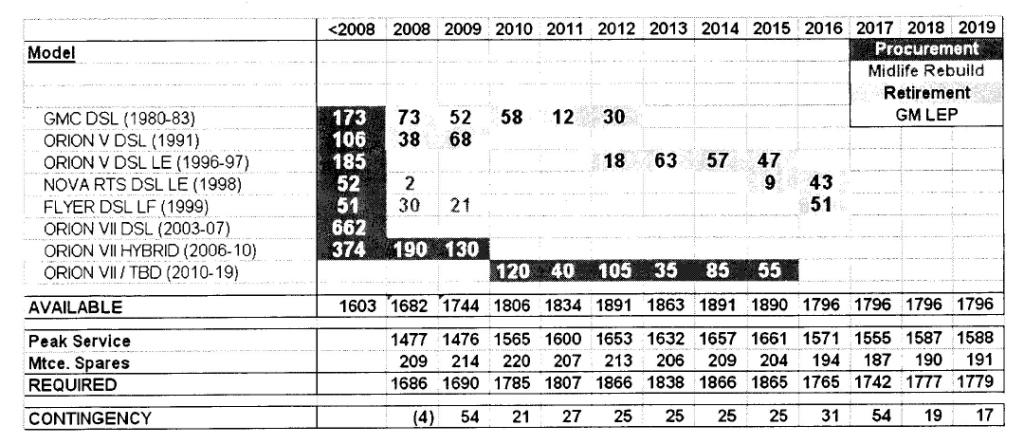
The TTC’s proposed 2010-19 Capital Budget includes an ongoing plan to rejuvenate and expand the bus fleet.  While these may seem to be laudable goals, the actual plans leave much to be desired.

The Bus Fleet Plan is a marvellous document that changes in every iteration.  Barely is the ink dry on one version when it is revised again.  There are three different versions of this plan within the Capital Budget documents alone, and these are a substantial revision from the version shown in the 2009 Capital Budget.

Bus Fleet Plan [From Appendix E of TTC Capital Budget Report, September 24, 2009]

However, two different sets of numbers appear in the version of the plan in the Capital Budget “Blue Books” (the detailed report of all capital projects).  One is in the project covering purchase of new buses, and another in a project for temporary accommodation of an enlarged bus fleet (about which more later).

A major change in the TTC’s fleet planning came earlier in 2009 when, with little fanfare, the TTC decided to get out of the Hybrid Bus business for new purchases starting in 2010.  The special subsidies available to “encourage” hybrid purchases are no longer available, and at the time of the decision, the hybrids were problem children in the fleet.  A project to replace the original lead-acid batteries with lithium-ion batteries will complete within the next half year, but TTC staff have not yet reported on the improved reliability and performance, if any, of vehicles with the new batteries.

Rather than paring the capital cost of future purchases down, the Capital Budget now uses this money to purchase more buses than originally planned.  This can be seen in comparing the projected fleet size in 2018 for different versions of the fleet plan.

  • 2009 plan:  1549
  • 2010 plan (as seen in the Commission Report, Appendix E):  1796
  • 2010 plan (as seen in the project description for bus purchases, Blue Books Page 954):  1793
  • 2010 plan (as seen in the project description for temporary bus storage, Page 927):  1748

In short, the TTC now aims for its 2018 fleet to be roughly 250 buses larger than what it projected only a year ago.  What generates this additional requirement? Continue reading

The TTC Responds: TTC Times 2 / Riding Around Loops

Recent comments in the thread regarding the split operations on 501 Queen, as well as a reported incident where an operator was unaware that GO Transit could be used as a “bridge” between two TTC routes, led me to send questions for clarification to the TTC’s Director of Corporate Communications, Brad Ross. 

Here, with my comments, are the replies.  The questions have been slightly reformatted so that they can stand outside of the context in which they were written. Continue reading

GO Transit’s Service Plans: Small Changes Now, More Later

After a brief public session at last week’s Metrolinx Board meeting, there was a press scrum with GO Transit’s Gary McNeil.  Many questions focussed on GO’s plans to conform with the recent order from the Minister of the Environment that service in the Georgetown Corridor would have to meet Tier 4 diesel standards in 2015.  McNeil stated that GO’s goal was to have its entire locomotive fleet at Tier 4 by 2017 thanks to a planned overhaul.

To clarify what was said, I sent followup questions to GO/Metrolinx.

Continue reading