Toronto’s Core Services Review Contemplates Transit Cuts

This morning, while TTC Chair Karen Stintz, Mayor Ford and other luminaries were dedicating the inaugural run in service of a Toronto Rocket subway train, the agenda for the July 28th Toronto Executive came out.  The city’s “core services review” has reached its agencies, including the TTC, and the consultant’s findings can be found starting on pdf page 161 of their report.

The premise of the city-wide review is that there is some sort of “standard” above or below which services are provided.  In some cases, reference is made to other cities, but in the case of the TTC, the “standards” appear to be pre- and post- David Miller’s mayoralty.  If something was done in the “Ridership Growth Strategy”, it is by definition “above standard” and up for elimination.

This is a strange way to evaluate services especially in the North American city lauded for the quality of its transit system and the economic benefits this brings.  Never does the consultant address the value of good service, only its cost.

The consultant, KPMG, show their colours on the title page with the double-entendre corporate motto “cutting through complexity”. Continue reading

How Many Riders Will Use The Crosstown?

[See also Part 2 of this discussion.]

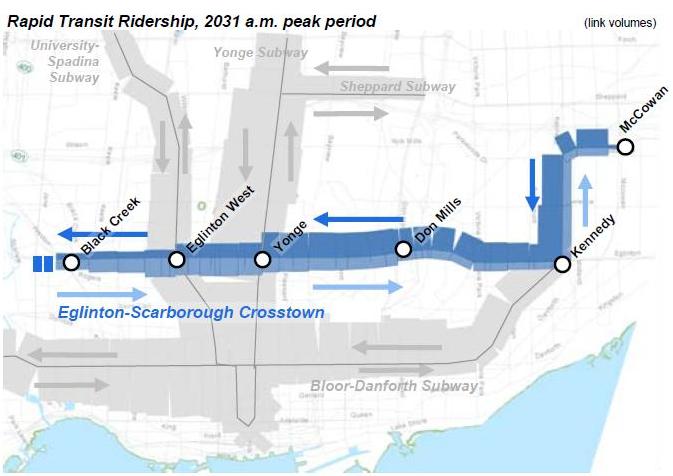
In a previous article and its long comment thread, readers and I have discussed the question of demand for the Eglinton-Crosstown LRT subway.  After the Metrolinx board meeting in June that started all this, I asked Metrolinx for more information about their projected ridership for the underground line.  In particular, I was interested in the numbers behind not just Eglinton, but the other routes on the demand map below.

Here is Metrolinx’ reply:

Under the previous Transit City plan, most morning Scarborough RT passengers arriving at Kennedy would transfer to the Bloor-Danforth subway. However, a small number of them would transfer to the Eglinton LRT, and bus riders would also transfer to the Eglinton LRT

Under the current Toronto transit plan agreement, many morning Eglinton – Scarborough Crosstown passengers arriving at Kennedy are not expected to transfer to the Bloor-Danforth line. Instead, we expect those passengers to stay on board the Eglinton – Scarborough Crosstown and continue west along Eglinton Ave.

It is important to note that the Eglinton – Scarborough Crosstown morning morning peak hour westbound ridership leaving from Kennedy station is roughly 6,500 higher than the Transit City plan forecast. In the Transit City plan, the forecasted behaviour of these 6,500 new Eglinton-Scarborough Crosstown passengers was as follows:

  • 60% rode the Bloor-Danforth subway out of Kennedy station.
  • 40% rode parallel bus routes or used different modes

We also expect an increase of ridership at the other stations along the Bloor-Danforth Eglinton-Scarborough line, but passenger behaviour at Kennedy is the dominant factor distinguishing the two plans.

Finally, below is a comparison of the anticipated 2031 morning peak demand points for the two plans:

SRT section (southbound into Kennedy)

  • Transit City (5 in 10 plan):  10,000 pphpd
  • Eglinton-Crosstown:  11,000 pphpd

Eglinton section:

  • Transit City:  5,000 pphpd eastbound into Eglinton West
  • Eglinton-Crosstown:  12,000 pphpd westbound into Eglinton/Yonge

[Corrections to the original text provided by Metrolinx July 26, 2011]

This is the entire reply, and there is no information on the following issues:

  • What are the numbers for other lines on the demand chart both for 2011 and 2031?  In particular, to what extent does the model show growth in demand on the existing subway system?
  • What other elements of a regional network exist in the 2031 model that could alter the growth pattern and future ridership flows?  In particular, there is no Downtown Relief Line even though it is part of The Big Move, and there is no indication of what GO services might also be in place.

My ongoing complaint about regional planning, both by the TTC and by Metrolinx, is that we talk a good line about networks, but we plan lines in isolation.  It is trivially simple to produce a huge demand on a new route simply by making it the only addition to an existing network — that’s how the TTC “justified” the Sheppard subway.

Ontario is spending $8-billion keeping Rob Ford happy by burying the Eglinton line, and they desperately need to justify this investment.  A 12k demand at the peak point is just the ticket!  Where else might the extra $4b have been spent to better overall effect?  We don’t know because Metrolinx has reverted from network planning to the traditional one-at-a-time methodology it was set up to avoid.

Metrolinx needs to be much more transparent about the way it projects ridership and the underlying assumptions of its models.  What routes are in the model network?  What frequency of service operates on them?  What is the fare structure?  What is the presumed future cost or practicality of using an automobile?  Where are the capacity constraints in the road and transit neworks?  How do these factors interact to shift projected demands?

This is the heart of regional planning, and Metrolinx is utterly silent on these issues.  Instead, they prefer to show us fully built-out networks decades in the future, networks we already know will be different thanks to various short-term changes and likely funding constraints, networks we will never see in actual operation.  We see simulations of the impossible, not the practical or the likely conditions we will have to live with.

This may serve short-term political needs, but the approach evades, no ignores, the vital debate we must have about what we might (or might not) build with the limited funding that our parsimonious, if not bankrupt, governments are likely to devote to transit.

How Many Trains Will Fit Through Union Station?

During the Metrolinx Electrification Study, those of us who attended various workshops became aware that there was a parallel study of capacity issues at Union Station.  The electrification plans are, among other things, in support of operating better service on GO generally, but if that service won’t physically fit through Union Station and its approach corridors, there’s a big problem.

That problem is independent of electrification per se because The Big Move from Metrolinx depends on substantially improved commuter rail service.  No capacity, no additional service.

At the recent Metrolinx Board meeting, GO’s President, Gary McNeil, presented an update on GO operations and construction activity.

GO President’s Report & Presentation Deck

The report includes a reference to Union Station capacity:

… Retaining wall construction is well underway to allow for an additional track in this corridor. The Union Station capacity study has been completed, with the result that in the near term, there is capacity at this station to meet needs. With the start of design of double berthing and new south platform, this will provide access required for service expansions. This work is anticipated to be completed in the next five years.  [Page 8]

After the meeting, I requested a copy of the study to learn what conclusions it might have reached. Various working papers from the study had been leaked, but they were neither definitive nor entirely coherent on how to deal with the problem.

Metrolinx has now replied that:

At this time, a detailed public component of the Union Station study is premature as we are undertaking on-going research. Specific information will most likely be available for the public when future potential projects develop from this study.

The purpose of the study is to assess the Union Station Rail Corridor (USRC) train capacity at four time points:

  • existing;
  • completion of planned infrastructure in 2015 and implementation for service improvements, including the ARL;
  • Electrification Reference Case (ERC);
  • and 2031 (Big Move planning document).

In doing so, we hope to identify opportunities to increase capacity by making more effective use of existing and planned infrastructure.  We also hope to identify the infrastructure needed to address any capacity shortfalls.  This study provided only a technical analysis, and Metrolinx will consider its opportunities after further assessment.

However, there is a good deal of material to get started on.

Continue reading

The TTC’s 1991 Operating Budget

In my article about David Gunn’s opinion of what’s wrong with the TTC, I mentioned the 1991 Budget introduced as the TTC was having its record year of ridership in 1990, but was on the brink of a recession and unprecedented cutbacks.

The major objective of the proposed TTC operating budget for 1991 is to provide a better product and thereby to attract more riders to the TTC.  This will not be an easy task at a time when other demands on the taxpayers’ dollars are escalating, and with the economy headed into a recession.  The proposed budget is best summarized in one word:  balance — a balance among the needs of TTC riders and the taxpayers of Metro Toronto and the Province of Ontario.

[From Proposed 1991 Operating Budget, November 14, 1990]

This budget was introduced by TTC Chair Lois Griffin, a Councillor from the then Rexdale-Thistletown ward of Etobicoke which took in the northwest corner of the city down to Highway 401.  The south half of this ward is Mayor Ford’s home turf.  Al Leach, who would later preside over the amalgamation of Toronto as part of the Harris government, was Chief General Manager.  Neither of them could be called radicals.

David Miller was not yet a member of Council having lost on his first try to the incumbent in 1991.  He was successful on a second try in 1994.  Adam Giambrone was 13 years old and had not yet become active in the NDP.

In the face of economic difficulties, a conservative Commission was advocating service improvements as the best way to gain and hold ridership, and none of the ills that might have afflicted transit could be blamed on a previous administration’s misguided policies.

November 1990 Proposal For 1991 Operating Budget

By March 26, 1991, staff recommended that the budget be trimmed to compensate for falling ridership and for flatlining of the Metro Toronto subsidy contribution.  This flatline was relative to the budget submission, but the drop in riding was hitting revenue and would have triggered a greater subsidy need without offsetting changes.  This led to proposals for service and staffing cuts, although some additions stayed in the budget for safety and reliability reasons.

In reading the 1991 proposal, it’s notable that even before the heart of the recession, there were concerns that some TTC practices needed improvement.  In the years to follow, we would see just how badly the cumulative effect of putting off repairs would hit the TTC.

By July 1991, the projected budget, including cuts requested by Council, was back at the TTC.  Total expenses had dropped from the original $686.1-million proposed in November 1990 to $675.1m.

A few excerpts from my deputation at the time:

Transit riders expect a lot more from the TTC than their counterparts in New York, Philadelphia or Chicago, and we must work to meet Toronto’s expectations.  Simply being better than everyone else is not good enough.

No matter how good the subway service, if someone cannot get to and from the subway reliably, they will not use it.  If someone’s trip is not served by the subway, they will not attempt it by an unreliable or overcrowded surface route. … The fine-grained surface network will never be duplicated by the subway network.

The common complaints about crowding suggest that the average rider does not see the “average” loading conditions which may meet the service standards.  The empty space in buses at the back of a platoon is of little use to the riders crammed into the first vehicle. … providing better service with your existing fleet improves your productivity, makes your service more attractive and defers the need for additional vehicles.

I have often spoken of the need for the Commission to be advocates for the transit system. … Cities become “world class” because people living there care about all the parts that make up the whole.  Your job is to care about the transit system and to tell all of us how we can get it back not merely to “the better way”, but “the best way”.

[Letter to the TTC, November 20, 1990]

The TTC’s decline in the early 90s was so severe that the proposed budget for 1996 was $673.5-million, almost the same as the approved budget in 1991, and ridership was projected at 376-million.  When David Gunn talks of Toronto achieving only a 15% increase in riding, he forgets those dark days and the system he inherited when he joined the TTC in 1995.

David Gunn Slams Toronto’s Transit (Updated)

In the July 5th Globe and Mail, Stephen Wickens has a full-page article in which David Gunn slams the TTC, Metrolinx, and just about anyone else in sight for the looming disaster that passes for transit planning in Toronto.  I agree with much he says, although we will obviously differ on the future of the streetcar system which Gunn would replace with a fleet of articulated buses.

What most interests me about this article will be the fallout, the debate, if any, at City Hall, and the degree to which Gunn’s advice is cherry-picked to support whatever argument anyone wants to make.

It’s also rather sad that this much-needed broadside against the state of planning in the GTA has taken so long to appear.  Many of the issues have been debated on this blog and others, whatever our opinions on individual topics, while critical coverage in the mainstream press is hard to find.

Updated July 10, 2011 a 8:00 am:

While I concur with some of David Gunn’s comments, there are issues where he misses the mark, sometimes quite badly.  Many have already weighed in through the comments thread, and here’s my take.

Continue reading

Spadina Subway Extension Update

The presentation from the Spadina update given at the TTC meeting on July 6 is now available online.

There’s nothing very surprising, but a few points are worth noting:

Station Names (p 3): There are still discussions in progress about station names.  The ones in the presentation are the working names that have been used for the project, but the final selection will occur probably in October.  Among the proposals in various stages of consideration are:

  • Sheppard West:  There are some who would rename this Downsview, or Downsview Park, although this would create a conflict with the existing Downsview Station which, just to spice things up, is actually at Sheppard.
  • Finch West:  There was a proposal to call this University Heights, although that is a neighbourhood name that doesn’t appear to have much currency among the local residents.
  • Steeles West:  This might become “Black Creek — Pioneer Village” to mark the nearby historical site.
  • Vaughan Corporate Centre:  Aside from being a name that would only inspire an accountant, it’s a rather long name that will be hard to fit on signage, literature, etc.  However, Vaughan wants it “Vaughan Metropolitan Centre” which is still rather long.  York Region is paying the municipal share for this part of the line, and I suspect that a long name will prevail, even if it’s rather pretentious.

Whatever names stations do eventually get, I hope that the major street names survive with a local neighbourhood name as a subtitle rather like “Bay Yorkville”.  Of course if we sell the station names to the highest bidder, neighbourhood and street names might vanish completely.

Budget (pp 4-5): The project is “fully funded”, but this has to be taken with a grain or two of salt.  First off, all of the project contingency has already been consumed in the design phase, and we still have four years of construction to get through.  The TTC hopes to make up any deficiencies through a combination of cost controls and the interest earned on the trust fund holding the provincial contribution to the project.

The project has repeatedly been described as “on time and on budget”, but whether this condition will hold through the remaining 4.5 years to opening remains to be seen.

Construction Schedule (pp 10-13): The schedule shows that the line will open at the end of 2015 taking us beyond one municipal election and two provincial elections.  Who knows which politicians will actually get to cut the ribbon.  Although the physical construction will finish in early 2015, commissioning of the line will take several months.  There has been no discussion of an early opening to York U or to Steeles West to serve the Pan Am Games.

Just as with the budget contingency, all of the “float” time in the project has already been consumed.

Automatic Train Control (p 14): When this project started, the TTC had not yet launched into an ATC conversion project, and the extra cost of ATC over a conventional signal system was not included in the approved, shared budget.  Strictly speaking, this is not required to open the line provided that a headway shorter than a conventional system can handle is not operated into non-ATC territory.

Earlier in the design stage, the TTC dropped Platform Edge Doors from the extension to save money.  At one station, this triggered a redesign because the wall containing the doors was planned as a structural element holding up the roof.

Presto! Pay Now, or Pay Later (Updated)

Updated July 8, 2011 at 10:00 am:

[Readers new to this item should read the original post, and then come back to the top of the item for the update.]

At the Commission meeting, I presented this deputation.

In the discussion that followed, it became clear that there are aspects of the deal between the TTC and Presto that the parties would prefer to hide from public view.  Some of the details are up to Metrolinx to release, not the TTC.

On the matter of the recapture of the provincial loan for the cost overrun on the project, TTC’s Chief General Manager Gary Webster explained that Metrolinx had agreed to “hold the TTC harmless”, to use the legal phrase, against extra costs beyond what fare collection now costs the system.  Apparently the payback of capital is very similar to the proposed arrangement with the proponent of the Open Payment system.

There would be no payment to Presto before savings in fare collection costs begin to accrue, although the detail on these payments remains to be worked out.  The intent is that the sum of the cost of Presto service and the loan repayment will not exceed current costs.

Questions remaining unanswered include:

  • If the load is to be repaid over 10 years, but if there has not been enough cumulative saving in fare collection costs by then, what happens with the outstanding debt?
  • Is Queen’s Park contributing anything additional to the Presto project, or is the entire cost overrun entirely on Toronto’s back?
  • How aggressively will the TTC have to migrate riders from the current system to Presto in order to generate the hoped-for savings?
  • What is the status of Presto on the bus system given that the report proposing the financing scheme does not mention buses at all?

During the debate, Chair Karen Stintz stated that any regional integration would not occur until after 2015, presumably when Presto was fully rolled out.  Indeed, it is not practical to restructure fares before the fare collection system can handle whatever new tariff is in place.  Again, this begs the question of the status of the bus fleet which handles a great deal of cross-border travel.

Commissioner Minnan-Wong, unsatisfied with the level of detail in the discussion, moved deferral of the item, but this was voted down with only him in favour.

A update report on the status of negotiations with Presto will come back to the Commission in October or November 2011.

Continue reading

The Route to Ashbridge Carhouse (Updated)

Updated July 7, 2011 at 1:15 pm:

At its meeting on July 6, the TTC board accepted the staff recommendation that the access route to Ashbridges Bay Maintenance & Storage Facility remain on Leslie Street.  The presentations accompanying the discussion were more extensive than those in the online version and I have reproduced selected pages below.

My deputation to the meeting argued that the TTC should keep open the Knox/Russell routing option in case problems with the Leslie option are even worse than are now known.

Several others appeared in support of various options and alternatives.  Neighbouring businesses and residents on Leslie are generally opposed, while Canada Post maintains its strong dislike of the Knox route.

Continue reading

Service Changes in July 2011

In a previous post, I described the diversions that will begin on July 11 around the reconstruction of the King/Bathurst grand union.

Beginning July 18 and continuing until early September, the 506 Carlton diversion around the Gerrard Street bridge, originally announced for June 19, will actually get underway.  Trackwork on the bridge has been in rough shape with slow orders for some time.  The planned date for return of streetcars to Gerrard Street is September 11.

Westbound service will run via Broadview, Dundas and Parliament.  Eastbound service will run via Parliament, Queen and Broadview.  Cars have been added to the schedule to compensate for the added mileage.

Effective July 31:

192 Airport Rocket: On the northbound trip, buses will serve the upper level bus stop at Jetliner first, then the arrival level at Terminal 1 and the arrival level at Terminal 3.  On the southbound trip, buses will exit the Airport via the ramp to southbound Hwy 427.  These changes are intended to free up running time to improve service reliability.

504 King: Streetcar service will return to Roncesvalles Avenue, although King cars will continue their diversion around the track and overhead work in Parkdale via Shaw and Queen.  There are only minor changes to some off-peak headways so that the running times work out.  However, I suspect with the traffic congestion on Queen and the inevitable streetcar short turns, service on Roncesvalles will not be as good as what is now provided by a dedicated bus shuttle.

Runnymede Station: The construction at Runnymede Station is supposed to be officially completed now, and 71 Runnymede, 77 Swansea and 79 Scarlett Road will return to their normal routings.

512 St. Clair: Overhead between St. Clair and St. Clair West stations will be retrofitted for pantograph compatibility.  Buses will replace streetcars on this section of the route after 10:00 pm weekdays, and all day on weekends.  The TTC claims that there will be timed transfers at St. Clair West.  Regular service resumes on September 4.