Why Toronto Needs A Fare Increase

Back on August 19, The Star’s Tess Kalinowski ran an article about TTC fares including remarks from me advocating an increase.

Let’s get this straight: Pro-car Mayor Rob Ford has told the TTC it can’t hike fares to solve its budget problems. Meantime the city’s leading transit advocate is calling a fare freeze “madness” given the system’s operating challenges.

Streetcar crusader and transit blogger Steve Munro believes predictable, moderate fare increases are preferable to service cuts, given that the TTC is facing an $85 million operating shortfall next year.

“If they have a fare freeze this year on top of other cuts they’re contemplating, it will be disastrous … just at the time the system is doing so well,” he said, referring to the 15 million more riders the TTC is anticipating next year.

Politicians of all stripes are spooked by fare hikes, says Munro. By holding down transit prices, Ford is just repeating the actions of his predecessor, David Miller, who also pledged a fare freeze in 2009.

The article set off a storm of comments divided between those who feel that going to riders for more money is the wrong approach; those who take a hard line attitude that the problem lies entirely with inefficiency, poor management and union contracts; and those who agree, one way or another, with my position.

Heather Mallick picked up the topic in her column on August 22 arguing that fare increases hurt the poor who are more likely to pay using the most expensive fare medium, the single cash fare.

My position on fares has been quite consistent for years.  Service is the most important “product” the TTC has to sell, and if we compromise the ability to give good service to riders, we might as well shut down the system.  Fares are one component of the revenue tools available to the TTC, and by contrast with many other cities, Toronto’s fares are the main funding for day-to-day operations.

While we might play around with fare structures and subsidies, transit costs overall will rise through a combination of inflation, wage increases and system expansion.  Unless there is an endless supply of new money, or a decision to cap the scale and scope of transit service, fares cannot be frozen forever.

Politically we lurch from regime to regime with policy changes on funding for and the role of transit.  Many decisions take place in the context of improvements or cutbacks in previous administrations.  Reports going back decades recommend modest annual fare increases at roughly the level of inflation, but we never see this implemented.  Multi-year freezes alternate with big jumps in fares, and these are especially hard to sell when subsidy cutbacks force more of the load onto the farebox. Continue reading

Service Changes for September 4, 2011

Many service changes are coming in September 2011 including additional service on routes that are now overcrowded.  However, the TTC will be considering lower standards for crowding (the “there’s still room on the roof” school of service planning), and many of these changes could be short lived.  (I will turn to budgetary issues in my next article.)

The service improvements are the upshot of the bargain trading little used periods of service on some routes effective May 2011 for better service where it is needed.  The budgetary headroom from the May cuts is not enough to pay for all the needed additions, and many improvements that would other be justified by current standards will not be implemented.  That justification may vanish if the standards are lowered. Continue reading

What Mayor Ford Should Have Asked For

Wednesday, August 17, saw Rob Ford going up to Queen’s Park in a time-honoured Toronto tradition asking for money for the transit system.  I won’t go into much detail on this as you can (and already may have) read all about it in other media:

Marcus Gee in The Globe

Karen Howlett and Patrick White in The Globe

Daniel Dale in The Star (with a wonderful photo in which Ford appears to be channeling the subway gods)

Martin Cohn in The Star

Chris Selley in The Post

Natalie Alcoba in The Post

Mayor Ford’s dream of a subway paid for entirely by the private sector has evaporated.  Brother Doug Ford claimed on CBC’s Metro Morning in February that developers were just waiting to invest $5-billion in the line, but they’re not queuing up chequebooks in hand.  Desperation set in a few months back when even Ford’s hand-picked transit fixer, Gordon Chong, openly questioned the proposed financing.  Since then, any public sector funding that Ford could scrape together was thrown in the pot so that the private sector “ask” would drop by a billion or two.

Back in March, Mayor Ford signed an agreement with Queen’s Park (a document that has not yet been ratified by Council) in which Ontario takes over responsibility for an underground Eglinton line (at a cost of $8-billion or so, using up almost every penny of the Transit City money), and Toronto is on the hook for the Sheppard subway.  If there’s money left over on Eglinton, up to $650-million will be given by Ontario to Toronto.  Ford wants that money now, and fears that a Federal contribution of $330-million to the Sheppard LRT project will be lost if the Sheppard project doesn’t get on the rails soon.  He has also been after money from “PPP Canada”, a federal agency, but they’re a pesky bunch and want to see a business plan.

The Mayor came away from Queen’s Park empty handed, and Premier McGuinty made it quite clear that Ontario is in no position to advance funding for the City’s project until the true cost of the Eglinton line is known.

This has to be the biggest waste of a bilateral meeting in quite a long time. Continue reading

King/Bathurst Reconstruction Project (Update 8)

Update 8:  August 10, 2011 at 7:40 am:

Construction of the new safety islands has completed early, and the 511 is back to its normal routing.

Update 7:  July 26, 2011 at 8:00 am:

The TTC has revised dates for resumption of service through the intersection:

  • Wednesday July 27:  504 King and 508 Lake Shore routes return to King Street
  • Saturday July 30:  511 Bathurst route returns temporarily for Caribana
  • Tuesday August 2:  511 Bathurst route resumes diversion via Spadina
  • Monday August 15:  511 Bathurst route diversion ends

Update 6:  July 24, 2011 at 5:00 am:

An excellent overhead view of the completed intersection dated July 17 is available on Flickr.

Service on King Street through the intersection resumes on Monday, July 25.

Continue reading

Budget Cuts Threaten Transit, Not Just Streetcars

The Toronto Star reported on July 30 that the TTC may defer its order for new streetcars in a move to free up room in the capital budget.

As I have often written here, the TTC’s capital plans badly strain the ability of the City of Toronto to carry the ongoing spending, and constant cutbacks in funding from Queen’s Park are a major problem.  Every chance they get, provincial Ministers tell us about billions “committed” to transit in the GTA.  The problem is that much of the actual spending won’t happen for many years, if ever, while current spending is a major problem.

Many programs that funded parts of the TTC capital budget have wound down, and the only provincial funding stream the TTC can actually count on is the gas tax.  That brings in about $150-million annually, and even this is partly split with the operating budget.  Meanwhile, the TTC has reached a point where it classifies almost every project as “state of good repair”.  That incantation, brought to us by former Chief General Manager David Gunn, is supposed to indicate the scope of work and funding needed just to keep the lights on and the trains rolling.

However, it has been abused in TTC budgets to include projects such as provisions for additional capacity on the subway.  This is not to say the capacity isn’t needed, but that’s a different class of spending, certainly one that should include regional, not just local funding.

The order for 200 new low floor light rail vehicles (LFLRVs) for the “legacy” streetcar system has a pricetag of about $1.2-billion including inflation, spare parts and warranty coverage.  Toronto gambled when it put this deal together that Ottawa would come in for 1/3, but they chose not to participate.  Indeed, Ottawa has always been selective in its spending on transit across the country preferring to drop money where there is a time limit to the spending, where funding is project-specific and doesn’t imply or create an ongoing commitment to all cities.  Ottawa’s only standing funding is from the federal gas tax, and even that falls in relative value over time because it is not indexed.

Toronto’s and TTC’s budgeting practices have not helped.  In a bid to keep the potential draw on the City’s borrowing capacity under control, at least on paper, TTC projects have been either shuffled off beyond the 10-year planning window, or simply ignored as a potential pressure.  Confusion about where and when funding might actually arrive adds to the problem.

Although the TTC produces multi-year capital and operating budget projections, there is never any explanation or discussion about the options that would shape future funding.  Every year, more projects appear on the list, some the inevitable result of decisions already taken (e.g. if you increase the size of the subway fleet, you need more carhouse space to store the trains, and more staff to operate and maintain them).

Adding to this mess is the Mayor’s desire to extend the Sheppard Subway.  Although funding for this might somehow arrive from the private sector or through links to future property tax revenue, if the project is going to launch, a considerable portion will be in public sector budgets.

In this context, the new streetcars are an easy and obvious target especially as they are not loved by the Mayor’s office.  The Star mentions a $1.5-billion shortfall in available capital over the next ten years.  Whether stretching out or delaying spending on new streetcars will make a big dent in this is hard to say.  A scheme for Metrolinx to pick up the cost and lease the cars back to the city is only an accounting trick — one way or another, we have to pay for them just as we will for anything purchased with borrowed money.  (The proposed financing of Presto is a similar piece of sleight-of-hand.)

The fundamental problem is that the revenue stream (be it operating or capital) dedicated to transit in Toronto and in the GTA is far too small for the region’s demands.  Queen’s Park refuses to address new “revenue tools” even though several analyses of the situation by such radical lefties as the Toronto Board of Trade flag the urgency of more spending on transit.

Once upon a time, we had a plan, no an announcement, called MoveOntario 2020.  It had lots of goodies in it including a network of LRT lines in Toronto.  That’s gone, replaced now by a single $8-billion project for an “LRT” subway across Eglinton and replacing the Scarborough RT.  Planned improvements of GO included electrification of the Lake Shore corridor, but what we actually get are small scale extensions dribbling out one announcement at a time.  Even as and when Metrolinx does produce its “Investment Strategy” with recommendations for revenue sources, along with “The Big Move 2.0”, the likelihood any government will have the stomach to raise new taxes is very low.

Meanwhile in Toronto, despite an $85-million hole in the TTC’s operating budget, Mayor Ford wants yet another freeze of transit fares.  This is madness.  Fare revenue totals about $1-billion and we know that the combination of strong riding demand and good service will minimize the negative effect of a fare hike.  The TTC projects a 10% increase (to $2.75 per adult token, with other fares adjusted proportionately) would bring $50-60m, but this is conservative.  It includes a considerable allowance for “elasticity”, the degree to which a price increase leads to a drop in demand.

Service cuts alone will not address that $85-million, and that approach would ignore both the overall growth in demand on the TTC and the close linkage between service quality and the system’s attractiveness.  Moreover, the $85m does not include the $25-$30m cost of an arbitrated labour settlement TTC workers will likely receive.

While it is tempting to blame everything on Mayor Ford, this is a case where many others must share the burden.  TTC financing has occupied a never-never land in Toronto and Ontario budgets for years.  Toronto is badly served when an agency appears to have an unlimited appetite for money, but a financial plan consisting of “let’s hope for better next year”.  The City is also badly served by doctrinaire budgeting that decrees funding and service cuts with no regard to their effect on system users, on the viability of an essential part of the City’s transportation network, and on the ability of Toronto to attract and serve its businesses and residents.

A 2012 TTC budget will probably show up on the agenda for the board meeting of September 20, although I suspect details will continue to leak out in coming weeks.  How many decisions will be made behind closed doors before those budgets formally appear?  What options will citizens or Council have to examine the details, to debate the options for the future of our transit system?

Instead of that debate, we have far too much focus on what we can do without, on what we can cut.  That is not city building, and certainly is not city leadership.

How Many Riders Will Use The Crosstown (2)

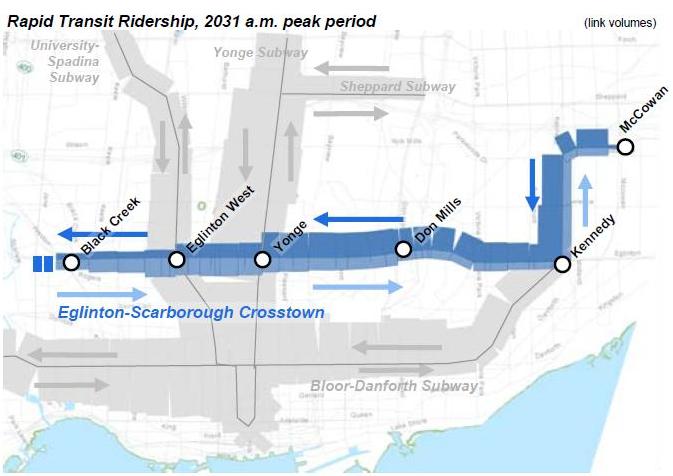
In a previous article, I discussed the Eglinton-Crosstown LRT subway and the issues raised by demand projections for it.  On July 26, I met with staff from Metrolinx to explore the subject in detail, and this post summarizes our discussion.

What Network and Land Use Drove the Demand Model?

Before we can understand the numbers generated from any model, it is important to know the assumptions behind it.  Is the network a realistic view of services that will actually be in place?  What residential and work locations and densities are used to generate the travel demand flowing through the model?

Notable by their absence from the map of passenger flows are any extension of the Sheppard subway, the proposed Richmond Hill extension of the Yonge subway and any reference to GO Transit routes or demand.

Metrolinx replied that their model includes only those routes and services for which funding is committed.  This means that only the Spadina Extension, the Eglinton line, and the GO improvements in GO’s 2020 plan are part of the model.  In effect, this takes the transportation network to roughly a 2020 state.

However, the underlying land use represents 2031 population and job projections with growth concentrated in major nodes such as Yonge-Eglinton and Scarborough Town Centre. Continue reading

Roncesvalles Renewed Celebration (Updated)

Updated July 24, 2011 at 11:00 pm:  Links to archival photos of Roncesvalles Avenue from the City Archives have been added to the end of this article.

Apologies to those who expected to find the PCCs running on Ronces.  In turned out that one car had already been hired out for another event, and the second PCC was in the shop for repairs.  Two CLRVs don’t have quite the same effect.

Continue reading

Will Nobody Stop Fords’ Folly?

The Toronto Star and Globe & Mail report that TTC Chief General Manager Gary Webster’s days may be numbered thanks to his failure to support the Sheppard Subway proposal.  Not only might we lose Webster, but we might gain a Ford cohort, a politician with no real transit experience, as his replacement.

I will leave readers to peruse the full articles, but here is a key section in the Star:

The plan to get rid of Webster “is in play now,” said former TTC vice-chair Joe Mihevc.

“(The Fords) are so committed to Sheppard they are actively contemplating getting rid of the entire streetcar system in Toronto,” he said, adding that the cost of the new streetcars could be applied to the subway.

“If Doug Ford bullies his way through on this, it truly will be the victory of extreme authoritarian ideology over good public transit policy and good business management,” Mihevc said.

Elsewhere, we learn that TTC Chair Karen Stintz who, as recently as yesterday morning praised Mayor Ford’s support for TTC customer service initiatives, is actually frustrated with the speed of implementation of changes.  The fact that there isn’t a penny for this program in the budget, and that the TTC faces a 10% cut in city funding for 2012, shows what the real level of commitment is in Toronto.

Meanwhile, the only project of any importance to the Brothers Ford is the Sheppard Subway whose “private sector” financing is a bubble of their imagination that burst months ago.  Every penny that can be scrounged from other projects, plus tax revenue from developments miles away on Eglinton, would be used to finance Sheppard and minimize the level of private sector participation needed to top up the budget.  This is financial trickery of the worst kind.

According to the Globe’s story, Stintz appears to be splitting from Ford’s all-or-nothing approach to the Sheppard line preferring instead to build to Victoria Park as a first step using money originally earmarked for the Sheppard LRT.

Queen’s Park struck a deal with the devil to preserve the Eglinton LRT as a subway while leaving Ford free to work his financial magic on Sheppard.  The streetcar system appeared safe if only because replacing it would be a long-term, difficult proposal.  However, the Liberals’ hold on power is tenuous, and a Ford-favouring Tory government would no doubt be happy to cancel the streetcar order (and probably the LRVs for Eglinton as well) with Bombardier, and the voters of Thunder Bay be damned.

In ten years, we would have a much reduced quality of transit service in the central city, we would choke streets with clouds of buses and limit the growth of major areas served by the present and proposed streetcar system.  In return, Sheppard Avenue would have its subway, and what started as Lastman’s folly and a Liberal campaign promise by former Premier David Peterson would become a full-blown monument to the stupidity of transit planning and politics in Toronto.

Has any of Rob Ford’s transit scheme gone to Council for review?  No.  Council, especially its “mushy middle”, is too busy currying favour with the Mayor to rein in his actions, leaving the Fords to dictate policy on the transit file and so many others.

Toronto’s Core Services Review Contemplates Transit Cuts

This morning, while TTC Chair Karen Stintz, Mayor Ford and other luminaries were dedicating the inaugural run in service of a Toronto Rocket subway train, the agenda for the July 28th Toronto Executive came out.  The city’s “core services review” has reached its agencies, including the TTC, and the consultant’s findings can be found starting on pdf page 161 of their report.

The premise of the city-wide review is that there is some sort of “standard” above or below which services are provided.  In some cases, reference is made to other cities, but in the case of the TTC, the “standards” appear to be pre- and post- David Miller’s mayoralty.  If something was done in the “Ridership Growth Strategy”, it is by definition “above standard” and up for elimination.

This is a strange way to evaluate services especially in the North American city lauded for the quality of its transit system and the economic benefits this brings.  Never does the consultant address the value of good service, only its cost.

The consultant, KPMG, show their colours on the title page with the double-entendre corporate motto “cutting through complexity”. Continue reading

How Many Riders Will Use The Crosstown?

[See also Part 2 of this discussion.]

In a previous article and its long comment thread, readers and I have discussed the question of demand for the Eglinton-Crosstown LRT subway.  After the Metrolinx board meeting in June that started all this, I asked Metrolinx for more information about their projected ridership for the underground line.  In particular, I was interested in the numbers behind not just Eglinton, but the other routes on the demand map below.

Here is Metrolinx’ reply:

Under the previous Transit City plan, most morning Scarborough RT passengers arriving at Kennedy would transfer to the Bloor-Danforth subway. However, a small number of them would transfer to the Eglinton LRT, and bus riders would also transfer to the Eglinton LRT

Under the current Toronto transit plan agreement, many morning Eglinton – Scarborough Crosstown passengers arriving at Kennedy are not expected to transfer to the Bloor-Danforth line. Instead, we expect those passengers to stay on board the Eglinton – Scarborough Crosstown and continue west along Eglinton Ave.

It is important to note that the Eglinton – Scarborough Crosstown morning morning peak hour westbound ridership leaving from Kennedy station is roughly 6,500 higher than the Transit City plan forecast. In the Transit City plan, the forecasted behaviour of these 6,500 new Eglinton-Scarborough Crosstown passengers was as follows:

  • 60% rode the Bloor-Danforth subway out of Kennedy station.
  • 40% rode parallel bus routes or used different modes

We also expect an increase of ridership at the other stations along the Bloor-Danforth Eglinton-Scarborough line, but passenger behaviour at Kennedy is the dominant factor distinguishing the two plans.

Finally, below is a comparison of the anticipated 2031 morning peak demand points for the two plans:

SRT section (southbound into Kennedy)

  • Transit City (5 in 10 plan):  10,000 pphpd
  • Eglinton-Crosstown:  11,000 pphpd

Eglinton section:

  • Transit City:  5,000 pphpd eastbound into Eglinton West
  • Eglinton-Crosstown:  12,000 pphpd westbound into Eglinton/Yonge

[Corrections to the original text provided by Metrolinx July 26, 2011]

This is the entire reply, and there is no information on the following issues:

  • What are the numbers for other lines on the demand chart both for 2011 and 2031?  In particular, to what extent does the model show growth in demand on the existing subway system?
  • What other elements of a regional network exist in the 2031 model that could alter the growth pattern and future ridership flows?  In particular, there is no Downtown Relief Line even though it is part of The Big Move, and there is no indication of what GO services might also be in place.

My ongoing complaint about regional planning, both by the TTC and by Metrolinx, is that we talk a good line about networks, but we plan lines in isolation.  It is trivially simple to produce a huge demand on a new route simply by making it the only addition to an existing network — that’s how the TTC “justified” the Sheppard subway.

Ontario is spending $8-billion keeping Rob Ford happy by burying the Eglinton line, and they desperately need to justify this investment.  A 12k demand at the peak point is just the ticket!  Where else might the extra $4b have been spent to better overall effect?  We don’t know because Metrolinx has reverted from network planning to the traditional one-at-a-time methodology it was set up to avoid.

Metrolinx needs to be much more transparent about the way it projects ridership and the underlying assumptions of its models.  What routes are in the model network?  What frequency of service operates on them?  What is the fare structure?  What is the presumed future cost or practicality of using an automobile?  Where are the capacity constraints in the road and transit neworks?  How do these factors interact to shift projected demands?

This is the heart of regional planning, and Metrolinx is utterly silent on these issues.  Instead, they prefer to show us fully built-out networks decades in the future, networks we already know will be different thanks to various short-term changes and likely funding constraints, networks we will never see in actual operation.  We see simulations of the impossible, not the practical or the likely conditions we will have to live with.

This may serve short-term political needs, but the approach evades, no ignores, the vital debate we must have about what we might (or might not) build with the limited funding that our parsimonious, if not bankrupt, governments are likely to devote to transit.