This is the first of three articles about TTC services on Dufferin Street, the 29 Dufferin local bus and its 929 Dufferin Express counterpart.
This article reviews headway performance at the terminals and along Dufferin during the month of April.
Part II will review travel times over the same area.
Part III will review historical data back to January 2024 to see whether there have been changes in the route’s behaviour over the past 16 months.
Major points worth noting:
Other than the restoration of the 29C service to Princes’ Gate in Fall 2024, there was no change in the scheduled level of service or travel times over the period studied here.
Headways are not well-regulated on either the local or express services from either terminal during the entire day.
At the point where buses would enter the proposed RapidTO red lanes, the service is already disorganized. Travel times might improve, but the irregular headways will not.
Weekend service is even more disorganized than on weekdays.
Congestion is evident at some locations and times along the route, but it is not pervasive. Some problem locations are within the proposed transit priority area (south of Eglinton), but some are not (notably near Yorkdale northbound).
Recent newspaper articles and editorials extol the virtues of the RapidTO projects on Bathurst and Dufferin Street, and portray those who object in a less than flattering light.
The urgency of transit priority action for the 2026 FIFA games combines with portrayal of transit priority as an absolute good before which all objections must fall. The word “NIMBY” is thrown about to denigrate residents and businesses in the affected areas, but this is no substitute for hard data proving, or not, that the RapidTO proposal really is “the better way”.
For decades, I have advocated for better transit service in Toronto. Transit priority measures are one, but not the only, factor that can improve transit for riders. Quality and quantity of service are also key, and yet the TTC has a tendency to place most blame for their shortcomings on external factors. To be sure traffic congestion is an issue, and Toronto is already at a point where in some locations and times there simply is not enough capacity to go around. This is not a case of some omniscient transit god or AI bot “parting the waters”, but of a recognition that this can only happen by restricting or eliminating competing demands for road space and time.
Another major factor is financial. Even pre-covid, the TTC faced limits on its operating funds and only grudgingly added service on routes. Recent announcements of “improvements” often hid the fact that the added vehicle hours left scheduled frequencies unchanged, but only offset the effects of congestion.
Service reliability and vehicle loading are key factors from a rider’s perspective, but the TTC uses metrics that bury day-to-day conditions in averages and give a generous interpretation to the concept of reliable vehicle spacing. It is no secret that TTC service management leaves a lot to be desired, and some transit “priority” schemes are are really more about keeping transit out of motorists’ way than they are to speed rider journeys.
The problem is compounded by motorists who regard attempts to corral them as an affront to their virility, but whose actions only recently have been reined in through the use of Traffic Wardens.
The City Transportation Department’s outlook is that if they make cars move faster, transit benefits too – a rising tide lifts all boats. This model collapses when there simply isn’t enough room or time for all vehicles. Some must be able to go first, and some will simply have to go away.
The King/Church construction diversions illustrate another aspect here: the concentration of transit service and traffic in locations that cannot sustain it, especially when transit, running in bunches, overwhelms intersection capacities with many closely-spaced arrivals and turns. TTC has redirected part of the diverting service (504 King) away from Spadina to Shaw so that left turns are spread out, and King/Spadina will further improve on its own when the 511 Bathurst cars return to their usual southern terminus at Exhibition Loop in late June. The east end of the diversion, at Church, does not have the same options for spreading out routes and turning issues.
In the FIFA context, we do not yet know what sort of service the TTC plans to operate, and how it will manage both the vehicle and passenger volumes at major transfer points including not just Dufferin and Bathurst but at other locations such as Union Station and major intersections enroute.
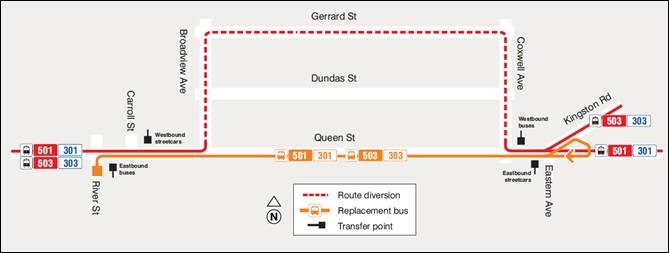
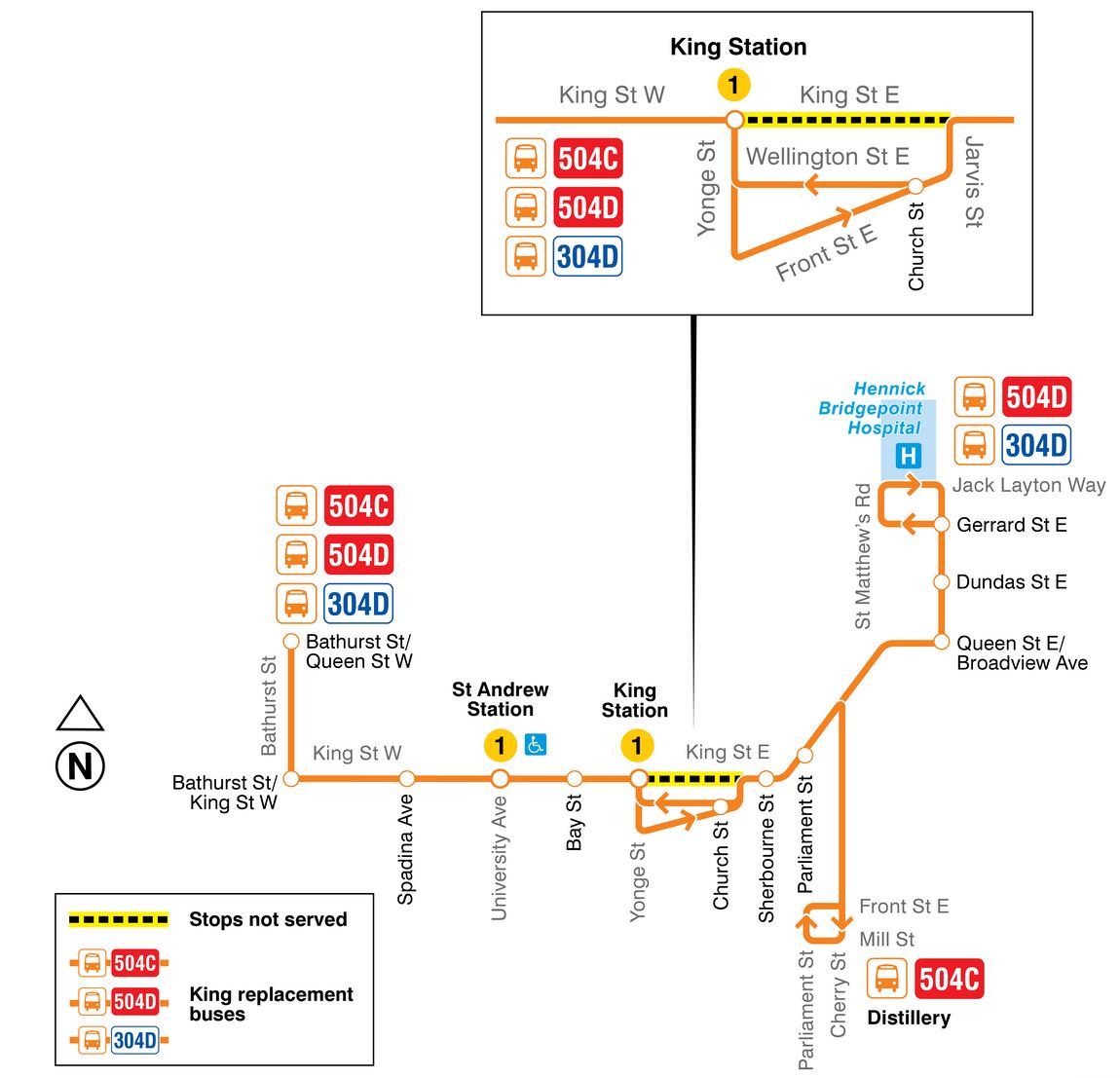
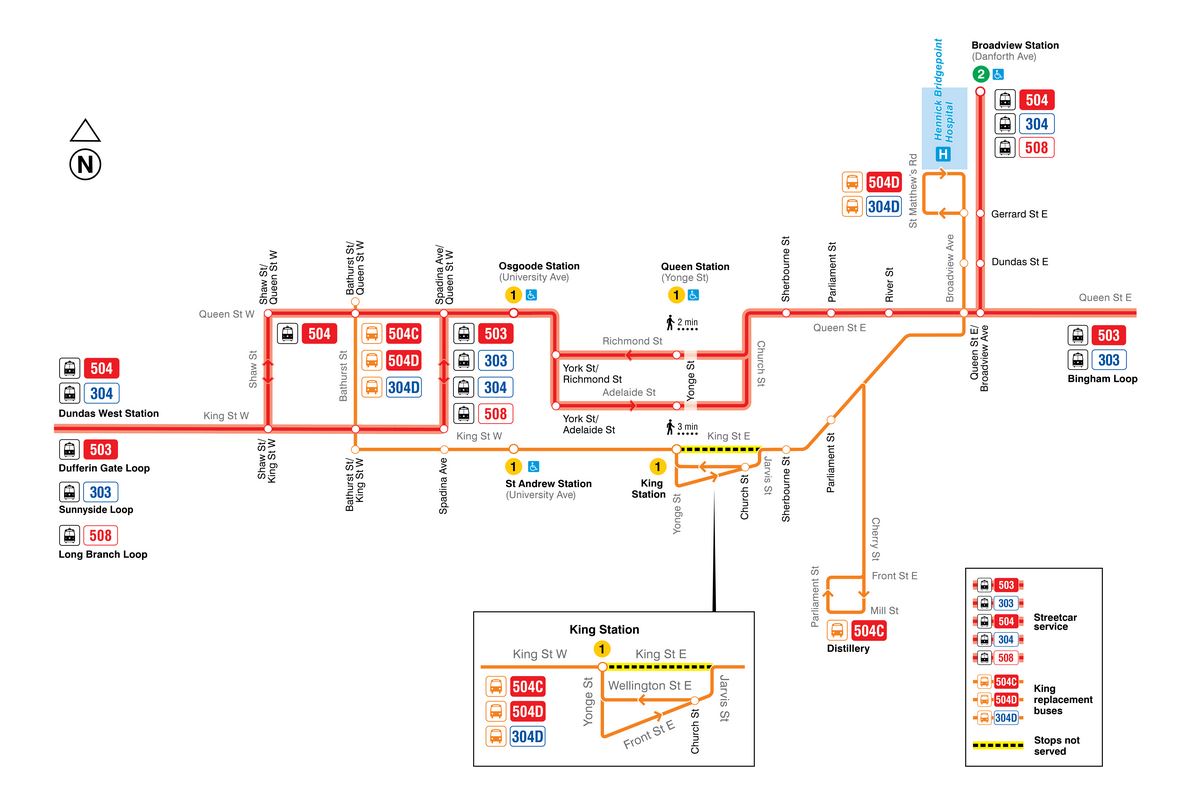
Updated May 16, 2025 at 3:50pm: The TTC has now published a map of the revised diversion routes.
In response to congestion problems for streetcars turning on and off of King and Queen Streets at Spadina, the TTC has modified the route of 504 King.
Instead of running west via Queen, Spadina and King, the 504 will now divert via Queen, Shaw and King. The 503 Kingston Road car will continue to operate via Spadina and King to Dufferin Loop.
The TTC has not yet updated the information on its King-Church diversion page as of 1:30pm May 16, but plans to do so. On-street signage will also be changed. The diversion map and information appear on several different pages, and it will be interesting to see if the TTC changes all of them.
Updated 3:50pm with revised diversion map for routes 504/304, 503/303 and 508. Not shown are routes 501 Queen and 511 Bathurst.
This reduces the peak streetcars/hour attempting to turn east-to-north at King and Spadina from 23 to 17, and west-to-south at Queen and Spadina from 13.5 to 7.5 (plus occasional 508 Lake Shore cars). Off-peak service is almost the same as peak service and so these numbers do not change much during those hours.
Numbers eastbound at King will be further reduced in late June when the 511 Bathurst cars, 6.5/hour, resume their normal route to Exhibition Loop, and 508 Lake Shore cars, 3/hour at peak, are suspended for the summer.
Updated: Now that the map has been published, it is clear that the 504C/D buses will continue to loop at Bathurst, and service on King from Bathurst to Shaw will only be provided by the 503 car.
Problems remain further east on the diversion with all of the 501 Queen, 503 Kingston Road, 504 King and 508 Lake Shore cars making turns to and from Church, Richmond, Adelaide and York, a total of about 23 per hour. There is also severe traffic congestion on Adelaide, but it is not clear how much of this is caused by queuing streetcars, and how much due to traffic volume and road capacity.
The option of using Victoria Street for the link between Queen and Richmond/Adelaide is not available because of Ontario Line construction, even though this would have separated the streetcar diversion from the busier Church Street.
Ontario unveiled its 2025 budget on May 15. Although it speaks of “Approximately $61 billion over 10 years for public transit”, by far the lion’s share of this spending is for projects already underway in the construction and design stages.
All of this is for capital expansion and renewal, and nothing has been announced for day-to-day improvement of transit service.
GO Transit
The budget cites:
The Hamilton-Niagara through service connection at West Harbour Station which is already in service.
The proposed Bowmanville extension which has been announced before, but is only barely underway at the “early works” stage. This extension has physical alignment issues.
GO 2.0 includes “delivering all-day, two-way service to Kitchener and Milton, building new GO stations across the region and advancing planning to unlock potential new rail corridors through midtown Toronto, Etobicoke, York Region and Bolton.” There are no dates attached, and some of these have been on maps for a very long time. Notable by its absence is any mention of electrification.
A total of $850 million to refurbish GO Transit rail coaches at the Thunder Bay Alstom the North Bay ONR facility. This work is already announced. The cars may receive convenience upgrades such as “charging plug ports, cup holders and improved Wi-Fi”, but the long-term retention of these cars indicates that the operating model for GO electrification, if and when it occurs, will have a large component of locomotive-hauled trains rather than electric multiple units.
Subways
Subway projects in the budget are:
Ontario Line (under construction).
Eglinton-Crosstown Western Extension (under construction).
Yonge North to Richmond Hill (procurement underway).
Sheppard Subway Extension (planning, consultation and business case preparation underway). Notable in the map below is the absence of a line east of McCowan where there is a conflict with the City’s Eglinton East LRT project and with maintenance yard property requirements.
New subway cars for Line 2. Provincial funding for these trains has been in place for some time. What is not yet funded are trains for service expansion beyond pre-covid 2019 levels. Trains for the Yonge North and Scarborough extensions are included in those projects. The TTC is in the Request for Proposals process for new trains, but this has been skewed by provincial statements that the work should go to Alstom’s Thunder Bay plant.
Yes, they seem to have forgotten the Scarborough Subway Extension (now under construction) in the text although it is included in the map below..
East Harbour Transit Hub
The hub at East Harbour Station, near the point where the Lakeshore East GO line crosses the Don River, will eventually serve GO Transit, the Ontario Line, and the local streetcar/LRT system via the Broadview Avenue Extension and a link west via Commissioners Street.
A substantial portion of this project is funded by the City of Toronto as a remnant of John Tory’s “SmartTrack” plan.
Light Rail Projects
Hamilton LRT: This is in early states with procurement underway for Civil Works and Utilities.
Hazel McCallion (Mississauga) LRT: Construction is well underway for the initial phase of this project, and the Province is studying whether the extension into downtown Brampton should be tunneled.
Ottawa LRT: The Province is studying a potential upload of the Ottawa LRT “to help reduce costs for Ottawa taxpayers”. What implications this might have for future network operation and expansion is not clear.
Eglinton Crosstown and Finch West LRTs: “Major construction for both projects is now complete. Metrolinx continues to focus on safety and operational readiness testing, as the projects advance toward revenue service.” There is still no commitment to opening dates, and we are getting close to the three-month lead-time required for a go/no-go decision for an early fall 2025 start of service. Meanwhile, TTC has begun the process to update subway train announcements and maps to reflect the new lines.’
There is no mention of the Eglinton East or Waterfront East projects. In a recent letter, Mayor Chow asked the Federal government to contribute 1/3 to these schemes, but there is no indication of support in the Provincial budget.
This article is the final part of a review of route 7 Bathurst where the City of Toronto and TTC are currently studying the implementation of reserved bus lanes from Eglinton to Bathurst Station north of Bloor Street.
Data presented here are from all weekdays from January 2024 to April 2025 for three screenlines on Bathurst:
Barton Street just north of Bathurst Station
Just north of Eglinton Avenue
Just south of Steeles Avenue
These show headway behaviour at terminals and at the dividing line between the portion of Bathurst proposed for RapidTO bus lanes (south of Eglinton) and the portion that will not change. Travel time behaviour is shown for the entire route, as well as for the segments north and south of Eglinton.
In each chart, both the median value (50th percentile) and 85th percentile are shown. The latter value shows, generally, the degree to which the peaks lie above the median, while filtering out the worse case values in the top 15 percentiles.
Median headways over the 16 months are fairly consistent and lie near 10 minutes, the scheduled level of service. There value drops only in the period from November 2024 to March 2025 when additional unscheduled service operated during the morning.
The 85th percentile of headways stays close to the median during most off peak-periods and at terminals, but it drifts higher at Eglinton both ways showing how small variations leaving the terminals can grow enroute. In peak periods and directions, the 85th percentile is often well above the median value showing erratic departures from terminals.
Travel times along the route vary substantially from about 35 minutes in late evenings to over an hour in the peak periods. Although the length of the trip varies a lot by time of day, the 85th and 50th percentiles stay close to each other indicating that the travel times are consistent within each period. There is a day-of-week effect visible in repeating peaks in the values on midweek days. This is seen on several routes across the system, and shows how a formal schedule does not face the same conditions every day.
Not included here are the weekend data which, as shown in Parts I and II, are not as “well behaved” because of schedule shortcomings, very wide variation in the spacing of departures from both terminals, and a high level of short turning in an attempt to keep buses on time.
Although Toronto proposes reserved lanes on part of this route, this will not improve behaviour outside of the target area. Travel time savings would occur in the peak period primarily south of St. Clair.
Updated May 14, 2025 at 6pm: A section is added at the end of the article showing the time spent at both the Steeles and Bathurst Station terminals.
In Part I of this series, I reviewed headway reliability on 7 Bathurst during April 2025. This article turns to travel times along the route, an important issue relative to claims made for the potential benefit of reserved bus lanes.
Today was the first weekday of the King/Church construction diversions. I watch things evolve via NextBus through the morning peak, and then visited King/Spadina during the PM peak. A caveat: Mondays are light traffic days. There was no Gardiner backlog at all on Spadina. Later in the week will likely be more challenging.
During the AM peak, the service on 504 King and 503 Kingston Road did not load properly, and many vehicles were clumped together. This took quite a while to unscramble, and there were big service gaps. The 504 buses also ran in packs and huddled together at Wolseley Loop, at one point six of them representing about 20 minutes worth of service at the scheduled headway. The peak period did not encounter queueing frequently at points where streetcars turn because of many wide service gaps. When a bunch of cars arrived, they queued one by one awaiting their turn, but then the intersections would open up again even though in theory there should always have been transit service waiting.
In the PM peak at King/Spadina, the major sources of traffic were pedestrians, cyclists and transit in that order. I observed that the traffic signal cycle time was 110 seconds (1’50”). This means that there are 32.7 opportunities (3600/110) per hour for a turn to/from Spadina. The nature of the intersection is that only one streetcar can make the turn per cycle.
The combined scheduled service trying to make the EtoN turn per hour at King & Spadina in the PM peak is 23 streetcars.
Route
Headway
Cars/Hour
503 Kingston Road
8′
7.5
504 King Car
10′
6.0
508 Lake Shore
20′
3.0
511 Bathurst Car
9′
6.5
Total
23
Stir in 12 510 Spadinas straight through northbound on a 5′ headway. When there is a 510 (or any other car) serving the farside NB stop it blocks any car waiting to turn off of King. In a 45 minute visit, I saw this happen four times, and one car missed two turning opportunities because of closely-spaced Spadina cars blocking the stop.
Depending on arrival times and bunching, more vehicles can queue up here than there are cycles to accommodate them. This was under probably the best general traffic conditions we will see.
There were traffic wardens, but they left just before 5pm. The biggest problem was pedestrians blocking turning streetcars which do not have a protected turn phase EB on King. There is a WB advanced green because autos are forced to turn off King here, but there is no advanced green for eastbound streetcars.
The large volume of riders transferring from eastbound streetcars to buses adds to the already substantial pedestrian volumes at this intersection.
The Traffic Wardens did not reliably ensure that streetcars got “first dibs” on turning, and after they left, pedestrian interference became worse.
I boarded a 504 King eastbound at about 5:10. There was congested traffic over the route across to Church especially on Adelaide and it took over 15 minutes to get from York to Church. Some people complain about space “wasted” by bike lanes, but it was the left turn lane that was almost always empty. Some traffic used it to scoot around stopped streetcars!
The severe congestion can be seen in the TransSee maps of service for 504 King and 503 Kingston Road below. The tracking lines for the diversion area are almost horizontal for an extended period. Note that the problem is mainly eastbound (lines reading bottom to top).
Tracking data for routes 503 and 504, May 12, 2025, 4pm to 7pm. From TransSee.ca.
I rode a King car east from Spadina and it took a very long time to emerge from the diversion. The car went from 6 minutes early at King on Spadina to 11 minutes late at Queen and Church. Note the length of time spent approaching King and Spadina inching along the street about one carlength at a time. Other locations where the car crept along are also clear in the tracking data.
Tracking data for car 4634. Source TransSee.ca.
Among the problems enroute were:
Congestion on Queen thanks to stopped vehicles and construction in the curb lanes.
Autos infilling Adelaide Street eastbound leaving no room for a streetcar to merge from York Street onto Adelaide. We were eventually rescued by a Traffic Warden.
Extremely slow progress across Adelaide thanks to a traffic backlog from Church Street.
Extremely slow progress on Church Street thanks to a traffic backlog from Queen Street. My car actually fouled the Church/Adelaide intersection as it was unable to complete the EtoN turn in more than one traffic signal cycle.
Ridership on the car was very light and most people got off when the car turned off King onto Spadina. They transferred to the King shuttle buses which were running irregularly and often bunched. These buses were also trapped in the traffic queue eastbound to Spadina of streetcars waiting to turn. (In the chart below, the size of the dot represents the degree of crowding on the vehicle.
Tracking data for 504C and 504D shuttle buses May 12, 2025, 4pm to 7pm. From TransSee.ca.
For those who want to watch the wandering streetcars and buses on NextBus, here is a link. This will open a combined display of routes 501, 503, 504, 510 and 511. The map can be scaled to zoom in to the area of interest. Displays of operating charts on transsee.ca are free for TTC streetcar routes.
Over coming days I will keep an eye on service performance over the diversion, and once a few weeks’ data have accumulated will delve into the details.
Toronto plans to implement reserved bus lanes on Bathurst Street between Eglinton and Bloor. The project is notionally in support of future service to the FIFA World Cup events in 2026, but there is a good chance that they will permanent. Substantial travel time savings are claimed for this change, but the overall question must be of how service behaves on the route and what the RapidTO red lanes will add.
Part I of this series reviews headway reliability (vehicle spacing) and travel times in April 2025. Part II will review travel times in April 2025, and Part III will look at historical data going back to January 2024.
The scheduled service on 7 Bathurst is not as frequent as on other corridors where reserved lanes have been added. Weekday service has been every 10 minutes operating with articulated buses for the past two years. Weekend service was slightly more frequent, but operated with standard sized buses until September 2024 when it changed to artics and a 10 minute headway at all hours.
Another change in September 2024 was an increase of terminal recovery times, partly offset by a reduction in scheduled travel times, during most weekday periods.
Not shown in the schedule summaries is additional service from November 18, 2024 to March 28, 2025 using spare operators. These trips operated with standard sized buses between roughly 7am and 1pm. The effect of these will show up in Part III of the series.
In the detailed review, it is clear that weekend service on 7 Bathurst is much less reliable than weekdays. In the tables below, note that scheduled travel times are considerably less on weekends than weekday midday and early evening. This is reflected in shorter terminal layovers and many more short turns on weekends.
Updated May 12, 2025 at 3:40pm: The text of the summary explaining the motion has been changed.
A motion before the TTC Board meeting on May 14 seeks to have staff examine ways to make service more reliable:
TTC4.9 – Optimizing Scheduling Efficiency and Enhancing Service Planning Using Technology – by Chair Jamaal Myers, seconded by Commissioner Dianne Saxe
Recommendations
Chair Jamaal Myers, seconded by Commissioner Dianne Saxe, recommends that the TTC Board:
1. Direct TTC staff to conduct an analysis of surface corridor TTC routes where multiple TTC routes operate on the same corridor to optimize scheduling efficiency, improve blended headways and customers wait times and identify opportunities and implications for scheduling and operational adjustments that minimize bunching and gapping and enhance coordination between routes serving the same corridor.
2. Direct TTC staff to explore opportunities to use artificial intelligence (AI) and predictive analytics to enhance our service planning and scheduling and management of gapping and bunching, and report back through the Strategic Planning Committee on best practices and priority actions to be integrated in the 2026 Operating and Capital Budgets.
Summary
Original version: This motion directs staff to review bunching and gapping on all routes where multiple TTC routes use the same corridor to explore how scheduling can be optimized to improve headways and reduce bunching and gapping of vehicles. This motion also directs staff to explore how Al and predictive analytics can be used to enhance service planning and the management of gapping and bunches on all routes and make recommendations for priority actions that could be integrated into the 2026 Operating and Capital budgets.
Revised version: Currently, TTC vehicles are not considered “bunched” for purposes of route planning, if multiple buses are traveling together so long as they are representing different bus routes. This motion directs staff to review bunching and gapping on all routes where multiple TTC routes use the same corridor to explore how scheduling can be optimized to improve headways and reduce bunching and gapping of vehicles. This motion also directs staff to explore how Al and predictive analytics can be used to enhance service planning and the management of gapping and bunching on all routes and make recommendations for priority actions that could be integrated into the 2026 Operating and Capital budgets.
There are several problems with this motion, but a few are key.
The idea of a “scheduled” time simply does not work especially when service is fairly frequent. Riders care about regularity, not that each bus or streetcar is spot on its assigned time. Yes, of course, if the service were “on time”, it might also be regular, but forcing this to occur is counter-productive. The question is how to ensure reliably even spacing between vehicles.
The TTC’s Service Standards and the rules operators are supposed to follow are based on the schedule, but this is not a workable guide to running service under typical conditions found on busy routes. If the TTC really wants evenly spaced service, then this should be the standard the organization aims for.
There will always be some variation between ideal and actual vehicle locations whether this is measured by a schedule or by a target headway spacing. That’s the nature of transit even on a completely protected route like the subway. The goal is to control and minimize this variation before small problems become very large ones.
Many streets are served by a single route with no branches or overlaid service, and headways are not reliable. This problem shows up throughout the day, not just in periods where external forces such as surge loads, traffic congestion and plagues of frogs can be blamed. The TTC should learn how to run “simple” routes reliably, and then we can talk about more complex route structures.
“Artificial Intelligence” does not learn out of thin air, but from a combination of examples and goals. If we train bots on the collected works of Donald Trump, don’t expect Shakespearean verse. So it is with Toronto’s transit. The current system is hardly an example to learn from, and even with input from other cities, the basic question of goals must be answered. If we tell the bot to optimise for general traffic and transit will benefit oh-by-the-way, the bot will quickly say “look at all those cars” and move them as quickly as possible.
I have written many articles reviewing service behaviour on routes, and the problem of irregular service has, if anything, grown worse over the years. In “the old days” there were issues with the adequacy of scheduled travel times combined with growing traffic congestion, and this led to lengthened trips. Even where operators get adequate time for terminal breaks, this does not guarantee reliable service, although it does reduce the need for short turns.
Those short turns are a valid response to service problems. For a time, a simplistic embargo on this service management technique actually worsened bunching because gaps could not be filled by a judicious turnback. Vehicles stayed in bunches.
TTC management, with the tacit approval of the Board if only through their ignorance, produced reports showing that on average the service wasn’t too bad. “TTC’s goal is to have 60% of all trips meet the on-time performance standard.” [Service Standards at p. 15] This is an all-day average and individual periods could vary without affecting the overall metric.
Every rider knows that the “average” service is not what pulls up (or not) to their stop every day.
Quality is measured only from the terminal, and two closely-spaced cars will run nose-to-tail fairly quickly because the first one does all of the work. They will stay together for an entire trip, and possibly the return.
Service standards allow vehicles to be up to five minutes late, but on a frequent route that can mean long gaps are followed by a pair of vehicles. Oddly enough, the standards actual recognize that riders care more about vehicle spacing for frequent services (10 minutes or better) than if buses are on time, and yet the metric routinely used by the TTC is schedule based, not headway based.
This not a scheduling problem, but a policy and management that aim low. It’s easy to get a gold star on an exam where you can be almost correct, and then only 60% of the time.
Traffic congestion, construction delays and special events generating surge loads are predictable to a point, although traffic accidents are not. The question is how the TTC deals with these events. Either all schedules are padded on spec in case of delays, an expensive way to deal with an issue that does not affect most routes at most times, or there has to be a recognition that scheduling alone will not solve the problem.
The TTC will make several changes to service on May 11 primarily for the transition to summer schedules with lower post-secondary school demand, and to restructure service for a major construction project.
For details on the King/Church project and its potential effects on traffic congestion, see King-Church Construction and Traffic Effects. Affected routes are 503/303 Kingston Road, 504/304 King, 508 Lake Shore and 511 Bathurst. For details, see that article.
Updated May 6, 2025 at 3:40 pm: Spreadsheet listing service designs for old and new schedules added.
Updated May 7, 2025 at 8:50 am: Diversion map for Roe Loop summer Saturday closures added.
Updated May 8, 2025 at 7:45 am: Spreadsheet updated with corrected data for 92 Woodbine South.
Updated May 8, 2025 at 11:40 pm: Spreadsheet updated with data for 939 Finch Express.
Updated May 9, 2025 at 3:30 pm: Destination sign changes added for all affected routes.
Permanent Service Changes:
9 Bellamy:
Service improved in the morning, afternoon and early evening on Saturdays, and in he afternoon and early evening on Sundays to reduce crowding.
Service reduced early mornings on Saturday, and on late evenings on Saturday/Sunday.
Service adjusted in late evenings to align with Lakeshore GO trains at Scarborough and Eglinton GO stations.
101 Downsview Park: Trips are added in the peak periods to better align with the GO Barrie service at Downsview Park Station. This has been informally in effect since March 2025.
114 Queens Quay:
Service adjusted in all time periods for reliability and to take advantage of new reserved bus lanes on Queens Quay.
Service officially removed from the Logan, Lake Shore, Carlaw loop with the route extended to Lake Shore Garage. This change has informally been in effect since September 2024.
123 Sherway:
Service improved on weekends to address crowding during most periods.
The current 1:13am trip by the 123B from Long Branch Loop will be changed to 1:17am to better connect with the Lake Shore GO train.
125 Drewry:
Service improved early evenings on weekends, and early morning on Saturday to address crowding.
Saturday “afternoon” service levels will extend from 7:00 to 8:00pm.
134 Progress: Weekday midday and early evening schedules will be adjusted to provide evenly spaced departures from Centennial College Progress Campus by the 134 Progress and 903 Kennedy Station Express services.
165 Weston Road North: The routing of YRT 165 Weston on April 27 will change to operate both ways via Weston Road, and it will no longer run on Old Weston Road. Transfers to TTC’s 165 Weston Road North can be made on Steeles at Weston or at Old Weston northbound, and at Signet Drive southbound.
927 Highway 27 Express:
All service will operate with 40-foot buses due to constraints on the articulated bus fleet. Service will run more frequently in many weekend periods to ensure sufficient capacity.
927A weekday midday school trippers to Humber College will be removed for the summer.
939 Finch Express: All service will operate with articulated buses.
Seasonal changes:
22 Coxwell: Holiday service will extended to the loop at Lake Shore and Northern Dancer Blvds, and will be interlined with 92 Woodbine South. Service on both routes will be adjusted. There is no change to regular weekday or weekend service.
38/938 Highland Creek: Service on the 38B to University of Toronto Scarborough Campus (UTSC) and on the 938 express will be discontinue for the summer. Service on the 38A branch to Rouge Hill GO will be improved during weekday peak and midday periods.
65 Parliament: Service will be reduced weekdays in the early morning, AM and PM peaks.
75 Sherbourne:
Service will be reduced weekdays in the early morning, AM peak, midday and PM peak.
Schedules adjusted to reflect implementation of reserved bus lanes on Queens Quay. Buses will no longer stop westbound on Queens Quay at Richardson.
The north end layover point will be shifted from South Drive at Glen Road to Bloor Street East at Sherbourne Station.
92 Woodbine South: Service improved during all periods.
102 Markham Road:
102A to Progress/Centennial College service removed for the summer.
Some late evening trips will be adjusted to go out of service on Markham Rd at Sheppard Ave E instead of Warden Station and/or Markham Rd at Progress Ave. This change will also improve transfers with the 385 Sheppard East night bus.
124 Sunnybrook and 162 Lawrence-Donway: Saturday service until 3pm will be extended west to Bathurst and Lawrence so that Roe Loop can be closed for a community market.
200 Toronto Zoo: Service from the Toronto Zoo to Rouge Hill GO will resume on weekends from morning to early evening periods. Weekday service will resume with the June schedule change.
201 Bluffer’s Park: Service from Kennedy Station to Scarborough Bluffs Beach will resume on weekends from morning to early evening periods. Weekday service will resume with the June schedule change.
202 Cherry Beach:
Union Station to Cherry Beach service will resume with weekday service from the midday to early evening period (ending at 10:20 pm from Cherry Beach), and weekend service from the morning to late evening period.
Schedules will be adjusted to take advantage of the reserved bus lanes on Queens Quay.
902 Markham Rd Express: Three weekday trips from Warden Station at 7:35, 7:47 and 7:59am will be dropped.
903 Kennedy Stn-STC Express: Some weekday trips on the 903A branch to Centennial College will be cut back as 903B trips to end at STC Station. All weekend trips will operate as 903B ending at STC.
905 Eglinton East Express: Service reduced during all weekday periods.
927 Highway 27 Express: See the service change section above.
Additional service will be provided on some routes due to a temporary surplus of operators. Note that these are separate from the Route 600 RAD (Run as Directed) buses:
20 Cliffside 21 Brimley 37 Islington 38 Highland Creek 44 Kipling South 52 Lawrence West 57 Midland
68 Warden 80 Queensway 86 Scarborough 89 Weston 110 Islington South 111 East Mall 119 Torbarrie
123 Sherway 124 Sunnybrook 131 Nugget 939 Finch Express 944 Kipling South Express 960 Steeles West Express 996 Wilson Express
Operational changes that do not affect service levels:
1 Yonge-University-Spadina: The break/relief point will move from Vaughan Metropolitan Centre Station to Wilson Station. Double step-backs will be scheduled at all times at both Vaughan Metropolitan Centre and Finch Stations in anticipation of increased off-peak service in late 2025.
510 Spadina: Carhouse trips to/from Leslie Barns will operate via Queen Street rather than King Street due to the King/Church construction.
Night bus crews: All night bus crews ending at or after 5:00 a.m. will be adjusted to go into and out of service at their respective divisions instead of on-street.
31 Greenwood: Service to Greenwood Station has not operated for several months due to construction. This will now be reflected in the “official” route description.
72 Pape: This route will be scheduled with electric vehicles in late evenings.
91 Woodbine: The north end layover point will be changed from Valley Woods Road at York Mills Road (west side) to York Mills at Valley Woods (northside).
112 West Mall: This route shifts from Queensway to Mount Dennis division. No schedule change.
365 Parliament Night Bus: The stop westbound on Queens Quay at Richardson will be removed as part of the reserved bus lane implementation.
All routes serving the former Villiers Island in the Port Lands will now include its permanent name Ookwemin Minising in the destination signs.
Several routes will gain new destination signs for garage trips replacing the generic “short turn”.
Tables and maps appear after the “more” break in this article.