
In the recent Mayoral debates, a topic surfaced regularly that boils down to “who is doing more for Scarborough”. That’s a rather crass way of putting things, especially for those who don’t live in that part of Toronto.
This post looks at some of the broad-brush claims as well as the level of bus service in Scarborough in detail. If I have one conclusion from the exercise, it is that candidates’ support teams should do better work to avoid faux-pas in claims from the podium.
The problem of overstating the quality of transit service applies across the city, not just in Scarborough. Both major candidates are trolling for votes there, and so that’s the part of the system we hear about.
When politicians carp about congestion, they inevitably talk about downtown, the streetcars and the unending list of construction projects (many of which are triggered by reconstruction of ancient water and sewer mains, not by the TTC).
However, an insidious effect on suburban bus service is rising congestion outside of downtown. The common TTC reaction is to stretch travel and recovery times running buses less often to compensate without spending more money. Many of the service reductions in past years come from this type of adjustment. On the statistical side, such a change does not affect vehicle hours, the commonly cited metric for overall service. From a rider’s point of view, buses come less often and their trips are longer.
This article looks at a few high-level topics that come up in stump speeches – ridership and subway service – and then reviews Scarborough bus services line-by-line from 2016 to 2026.
System Ridership
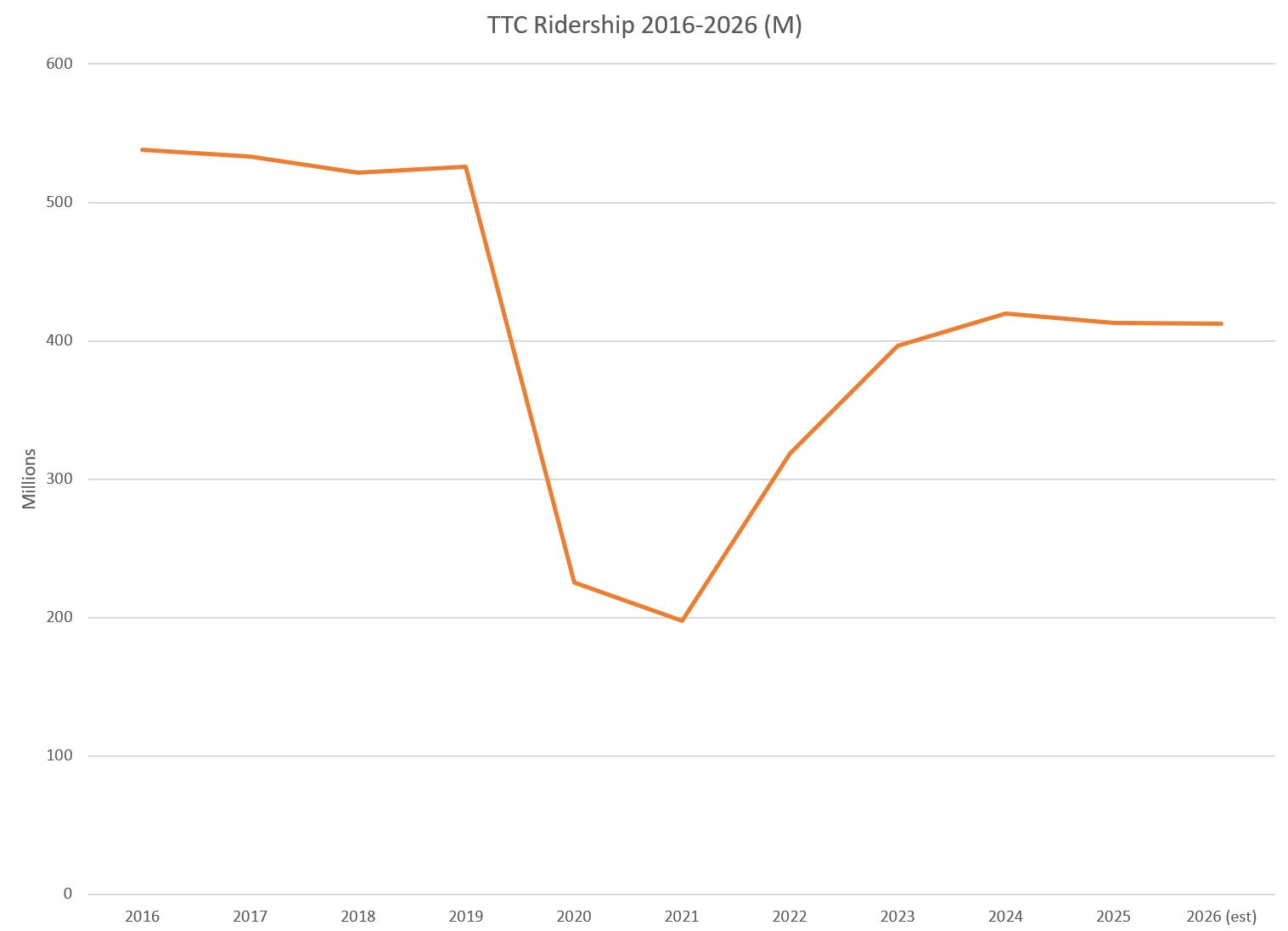
First, let’s get a basic stat out of the way: how many trips are people taking on the TTC? Here are the stats for 2016-2025 from the 2025 Annual Report, and the estimated ridership for 2026 from the most recent financial update.
By the mid-2010s, TTC ridership had already begun to decline. This was not a surprise to those who watched the numbers because in preceding years the rate of growth had slowed, and it finally turned negative. This was lost in all the hoopla about how successful the TTC was and the opening of a subway extension in late 2017.
2020-21 brought the pandemic and a huge drop in travel. 2020 looks good by comparison only because there are a few “before” months that buoyed the total. 2021 took the full brunt. Ridership grew back, but has plateaued since 2024 well below the 2019 level.
The slowdown in growth through the 2010s was thought to be due to filling up spare capacity, primarily in the off peak, where there had been room to attract ridership. A similar problem could be at work in the 2020s as service capacity and attractiveness eventually top out combined with work/study-from-home and the collapse of a strong downtown commuting market.
The 2026 estimate shows no improvement, and it is unclear how much this number is buoyed up by one-time events (the World Cup) offset by an extremely bitter winter that depressed demand early in the year.
Subway Service Levels
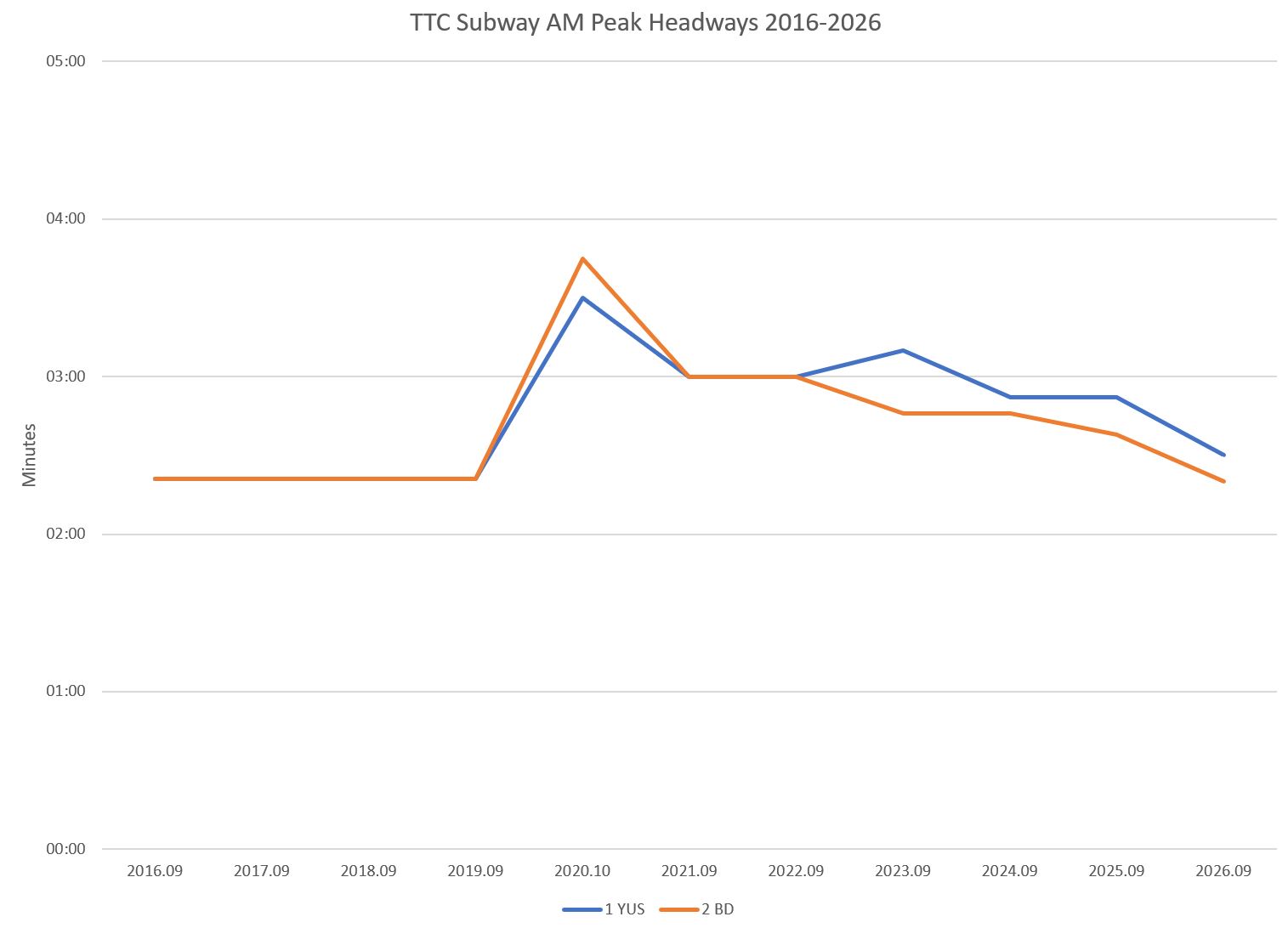
For many years, the peak subway service on both the Yonge-University and Bloor-Danforth subways was every 2’21”, a value dictated by limitations in the original signal systems on both lines.
This limit no longer applies to Line 1 YUS because it has ATC (Automatic Train Control) and a new fleet of cars that can “talk” to the signal system and run safely on a closer spacing. Line 2 BD was supposed to get new signals and a new fleet, but those projects went on the back burner thanks to former CEO Rick Leary, probably as a sop to then-Mayor Tory by deferring large capital expenses.
The “new” Line 2 would have been delivered by 2026, but now will come in the early 2030s. Even then, more frequent service is not possible without a fleet larger than the one now on order.
Bus Service in Scarborough
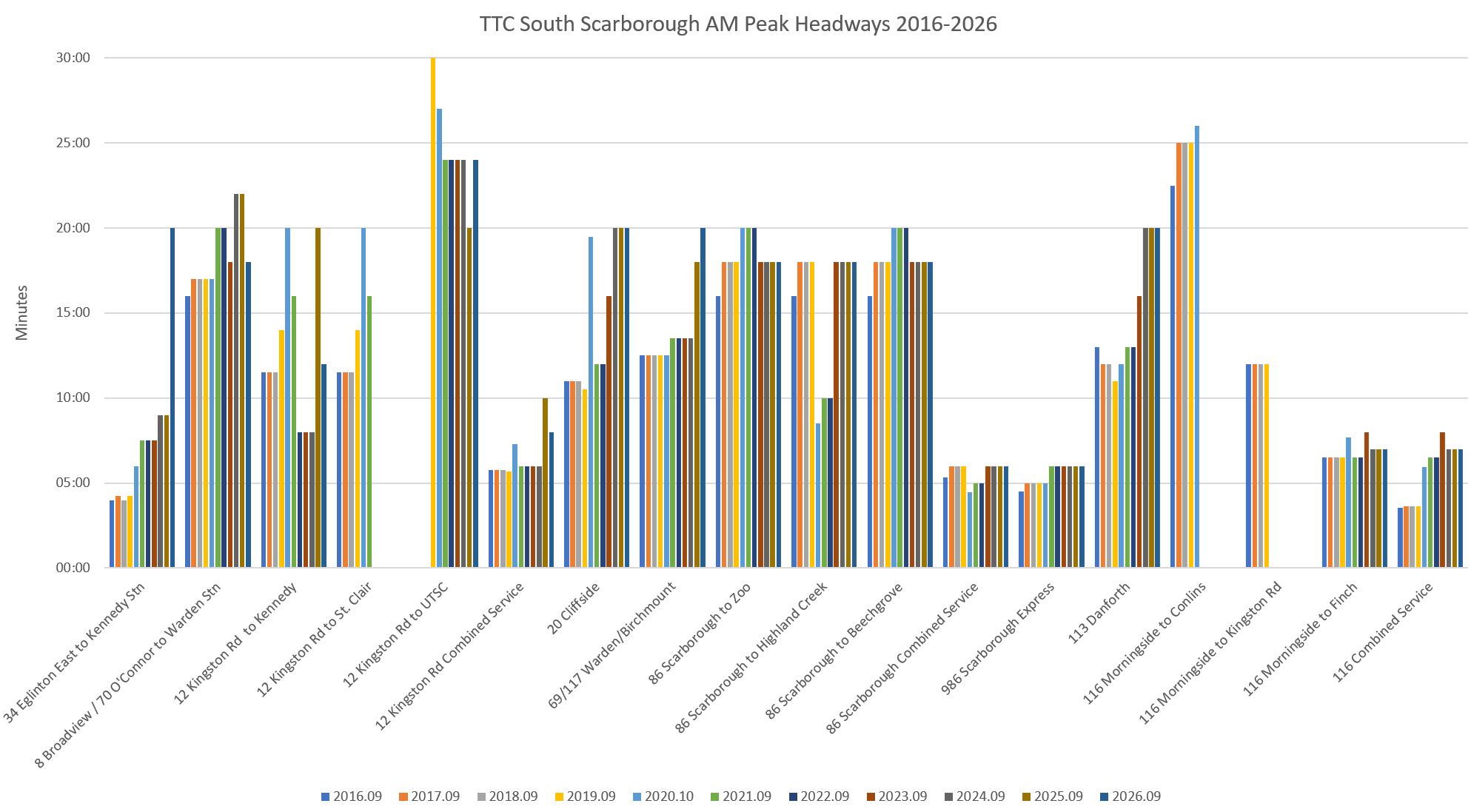
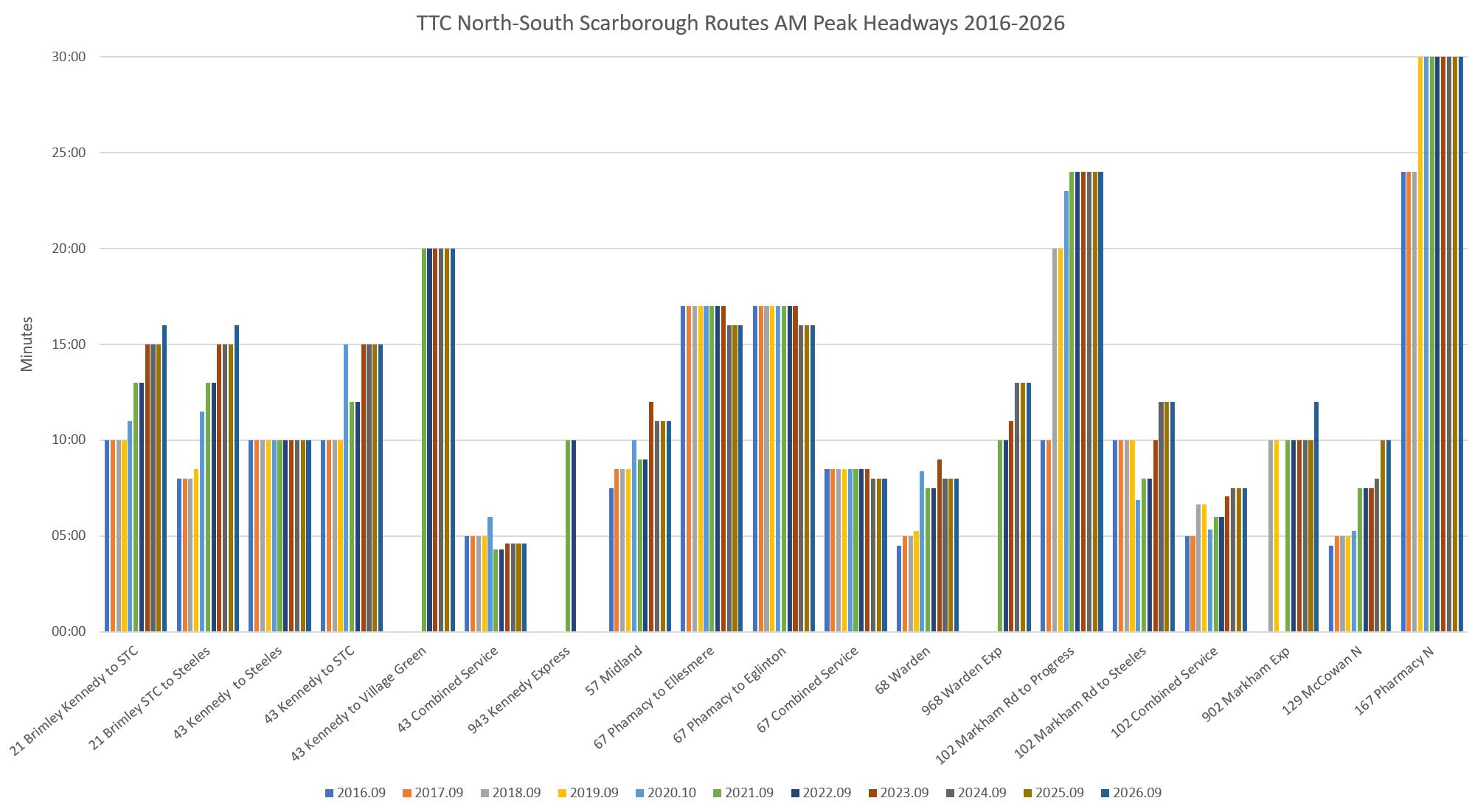
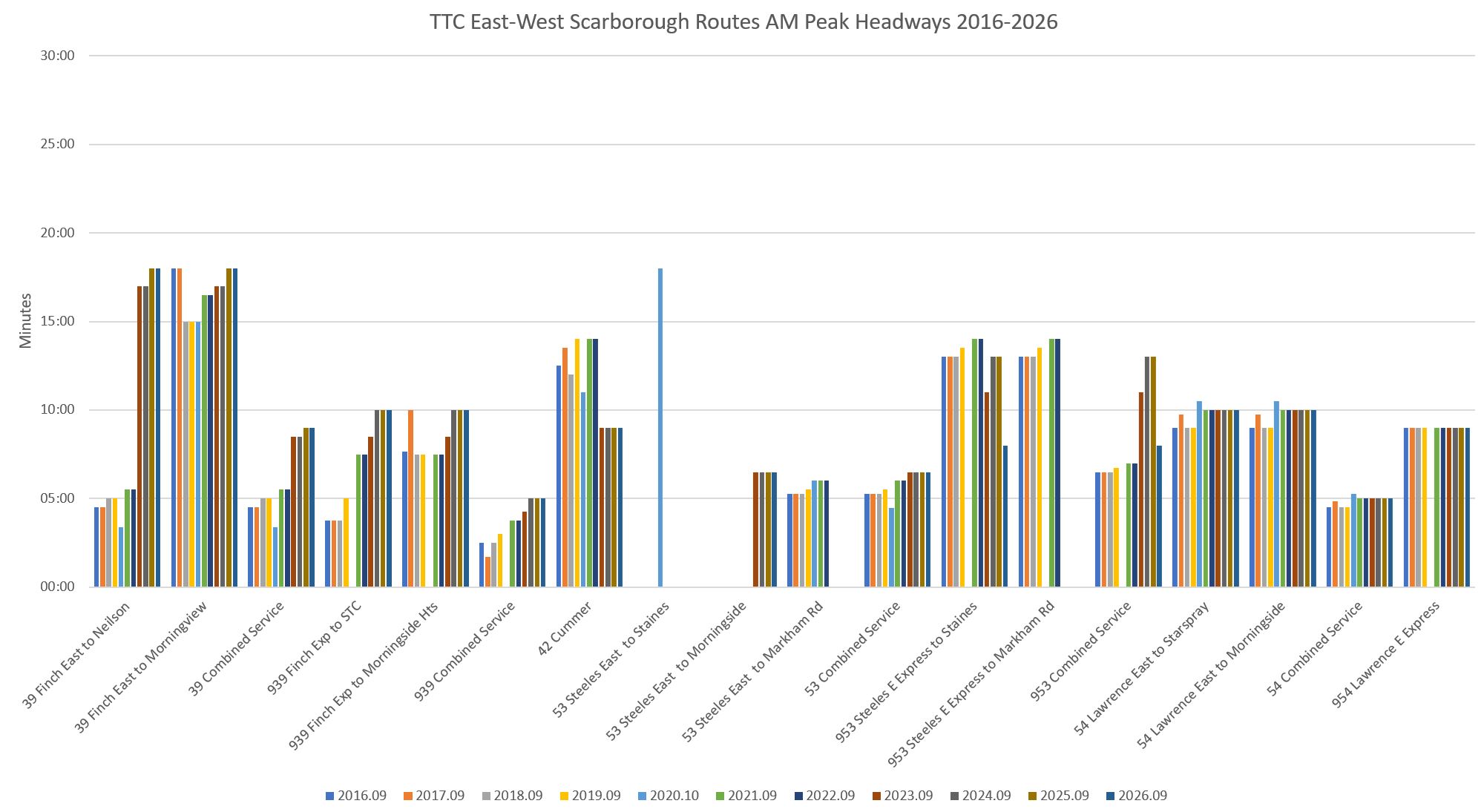
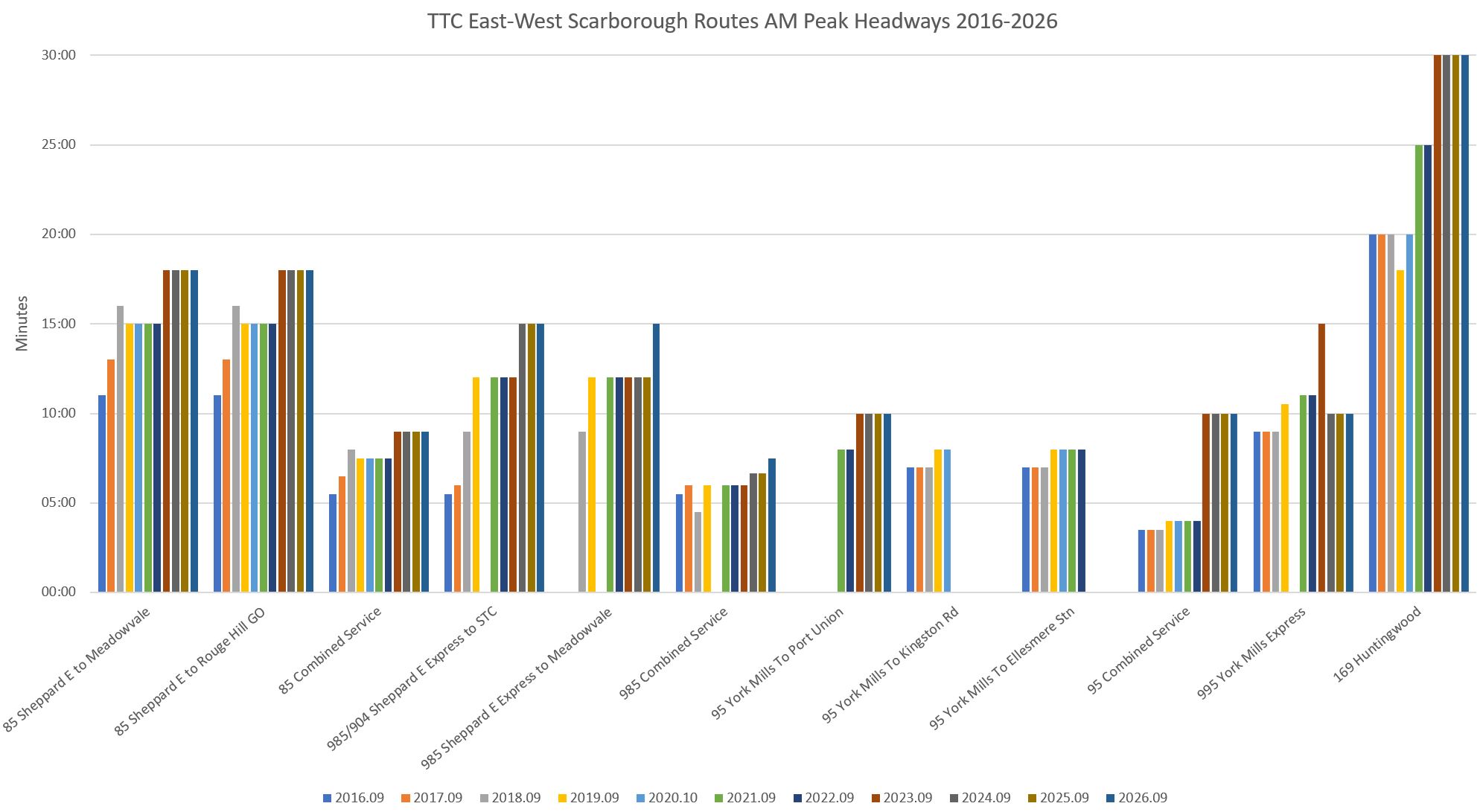
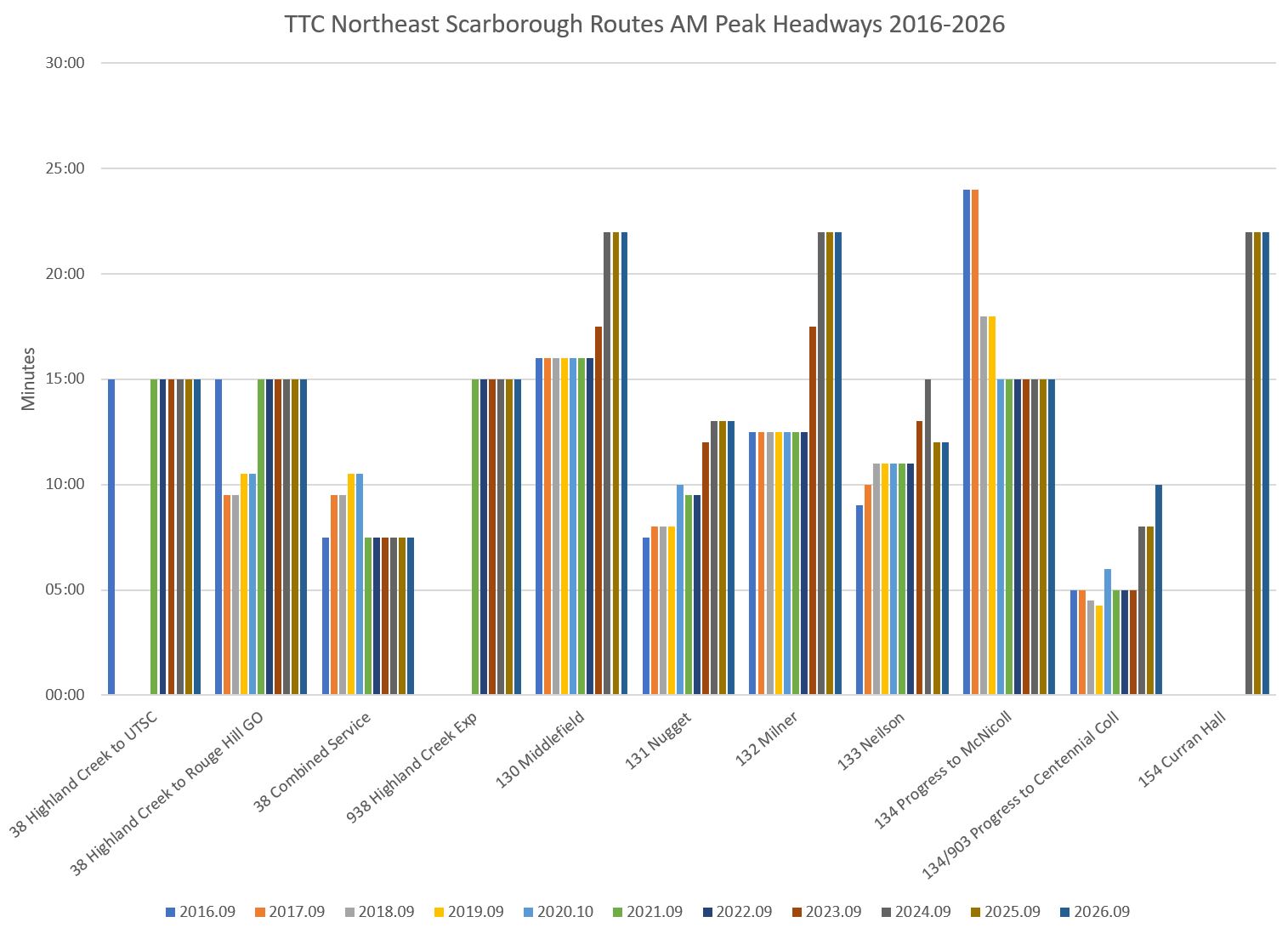
In the charts below, the scheduled AM peak headway (interval between buses) is plotted for every route, and with breakdowns for branching where applicable. Some route names/numbers have changed over the years, and the “old” data has been included with the “new” routes here for consistency. The routes are grouped, roughly, geographically to keep the amount of information on each chart manageable.
Data are for September service in each year except 2020 when the fall service summary did not come out until October because of the pandemic.
For each route, there is a cluster of columns with 2016 data on the left to 2026 on the right. The height of the column shows the headway, and so short columns are “better” because service runs more frequently. In many cases, the columns rise from left to right, the opposite of a “service is getting better” story.
As a general observation, the headways provided today are, in most cases, wider than those pre-pandemic. TTC claims that service is “back to 100%”, but this is measured by vehicle hours which include the effect of slower operation in traffic and longer recovery time provisions at terminals. What riders see is how often a bus shows up, and that determines a route’s capacity and wait times.
This analysis does not consider any change in route reliability that could add to wait times if service were less regular today than it was in years past. However, if headways rise, TTC “on time” standards allow wider swings outside the schedule compounding the effect on wait times for riders.
South
34 Eglinton East
Until Line 5 Eglinton Crosstown opened, service on Eglinton between Victoria Park and Kennedy was provided by the bus. The chart clearly shows a gradual reduction of service (columns get higher), and then a jump to 20′ headways as a parallel service to Line 5 in 2026.
8 Broadview/ 70 O’Connor to Warden Station
Service on St. Clair west of Warden station was originally provided by a branch of 70 O’Connor, and more recently by 8 Broadview. The scheduled service has grown slightly less frequent over time.
12 Kingston Road
The 12 Kingston Road has various branches that have changed from time to time. The service east to UTSC was added in 2019, although it was quite infrequent and remains so to 2026 even with a modest improvement.
The combined service on the branches stayed roughly the same until 2025.
20 Cliffside / 113 Danforth
The 20 Cliffside bus runs from Main Street Station to Kennedy Station. Service has been declining and is now considerably less frequent than in 2016.
The 113 Danforth bus also runs from Main to Kennedy but via a different route. The decline of service on the 113 mirrors that of route 20.
69/117 Warden/Birchmount South
Service on Warden and on Birchmount was originally provided by a single 69 Warden South route, but has now been broken into two separate routes. However, they are interlined and so the headways on bot legs remain the same. Service is less frequent in 2026 than in 2016.
86/986 Scarborough
The local 86 Scarborough bus has three branches shown below, along with the combined local service. There has been little change over the years. The 986 express service became less frequent in 2021 and has remained at that level to 2026.
116 Morningside
The basic service on 116 Morningside turns off Kingston Road at Guildwood, runs south and east to Morningside, the north to Finch. A Kingston Road short turn was dropped in 2020, and the branch to Conlins Road was dropped in 2021 reducing service on the southern part of the route.
North-South Routes
21 Brimley
The 21 Brimley bus operates separate branches north and south of Scarborough Centre. Service today is markedly less frequent than in 2016.
43 Kennedy
The 43 Kennedy bus originally had two branches, one to Steeles and one to Scarborough Centre. This was reorganized in 2023 with a Village Green branch (Centennial College) offset by a decline in the STC branch service. The combined service south of Progress today is slightly better than in 2016.
57 Midland
The 57 Midland bus runs less often today than in 2016.
67 Pharmacy
The 67 Pharmacy bus had a slight improvement in headway in 2024.
68/968 Warden
Both the local 68 Warden and the 968 express have seen service declines in recent years.
102/902 Markham Road
Local 102 service on Markham Road has declined over the years, and service was also reduced on the 902 express in 2026. Note that the values shown for the Steeles branch include the service to Major Mackenzie in York Region.
167 Pharmacy North
The 167 Pharmacy North bus runs infrequently, and service was reduced in 2019. It is at the policy maximum headway of 30 minutes.
East-West Routes (1)
39/939 Finch East
Finch East has several branches between the 39 local and 939 express services. Combined service for both of these on the common sections of the route is less frequent today than in 2016, although this is partly offset by the change to articulated buses on the express.
This route also shows the effect of traffic congestion on travel and recovery times. The service west of Victoria Park is included here to show the change on that part of the route.
| Service | 2016 Vehicles | 2016 Travel + Recovery | 2016 Headway | 2026 Vehicles | 2026 Travel + Recovery | 2026 Headway |
|---|---|---|---|---|---|---|
| 39A to Neilson | 22 | 96+3 | 4’30” | 6.5 | 101+16 | 18’00” |
| 39B to Morningview | 1 | 108+9 | 18’00” | 7.5 | 114+21 | 18’00” |
| 39C to Victoria Park | 6 | 54+0 | 9’00” | 4 | 55+17 | 18’00” |
For comparative purposes, the 939 Finch express to Morningside Heights has existed over the full period from 2016. The route changed to articulated buses with a higher capacity in 2024.
| Service | 2016 Vehicles | 2016 Travel + Recovery | 2016 Headway | 2026 Vehicles | 2026 Travel + Recovery | 2026 Headway |
|---|---|---|---|---|---|---|
| 199C/939C to Morningside Heights | 13 Buses | 99+1 | 7’40” | 12 Artics | 108+12 | 10’00” |
42 Cummer
Service on 42 Cummer east of Victoria Park (the values shown in this chart) improved in 2023 when the short turn at Victoria Park was eliminated. Service was reduced west of Victoria Park and one less bus was used on the route.
53/953 Steeles East
There are several branches of the 53/953 services on Steeles. The overall pattern is that service runs less often today than it did in 2016.
54/954 Lawrence East
Headways on the local service widened slightly from 2020 onward, but the express service is unchanged from 2016.
East-West Routes (2)
85/985 Sheppard East
Service on both the 85 local and 985 express routes runs less frequently today than in 2016.
95/995 York Mills
Local service on 95 York Mills is less frequent today due to the removal of the short turn service to Ellesmere Station. The express 995 service is slightly less frequent in 2026 than 2016.
169 Huntingwood
Service on 169 Huntingwood has been cutback over the years, and it now operates at the maximum policy headway of 30 minutes.
North-East Scarborough
38/938 Highland Creek
Both the local and express branch services have stayed the same since 2021 when the express was introduced.
130 Middlefield, 131 Nugget, 132 Milner and 133 Neilson
Service on all of these routes is less frequent today than in pre-pandemic years.
134/903 Progress
Service on the 134 local to McNicoll improved in 2020 and has remained at the same level. Express service declined starting in 2024.
154 Curran Hall
This is a new route introduced in 2024. Although the headway is still 22′ in 2026, this has required the addition of one bus to the original service. The original scheduled travel time of 72 minutes plus 16 minutes recovery time has expanded to 90 minutes travel plus 20 minutes recovery.


Do you have info on route 116 Morningside?
Steve: Ooops! I had it in my table, but in shuffling to even out the size of the charts, it was omitted there. I have added it to the southern Scarborough section. Thanks for catching that!
LikeLiked by 1 person