
Riders of the western branch of TTC’s Line 1 Yonge-University-Spadina have suffered through long-standing areas of restricted speed opertion for years. However, the problem has crept onto the eastern branch is recent months making for very slow trips over the most heavily used part of the line.
On the past weekend (September 19-20, 2026), Line 1 was closed between St. Clair and College for track repairs, but this is only one in a seemingly unending series of works.
Subway service becomes less and less credible through many types of delay, but also the sense that nothing is done. Much debate recently in social media and now in election campaigns focuses on Platform Edge Doors (PEDs) whose supposed purpose is to keep riders off of the tracks (regardless of their motive) and resulting delays. An installation-in-progress at TMU (formerly Dundas) Station is laughably inadequate to this task.
Any goal of increasing transit use is doomed if the service offered is slow and unreliable. Without downplaying the potential value of PEDs, a far more pervasive problem is part of the daily subway experience – slow zones.
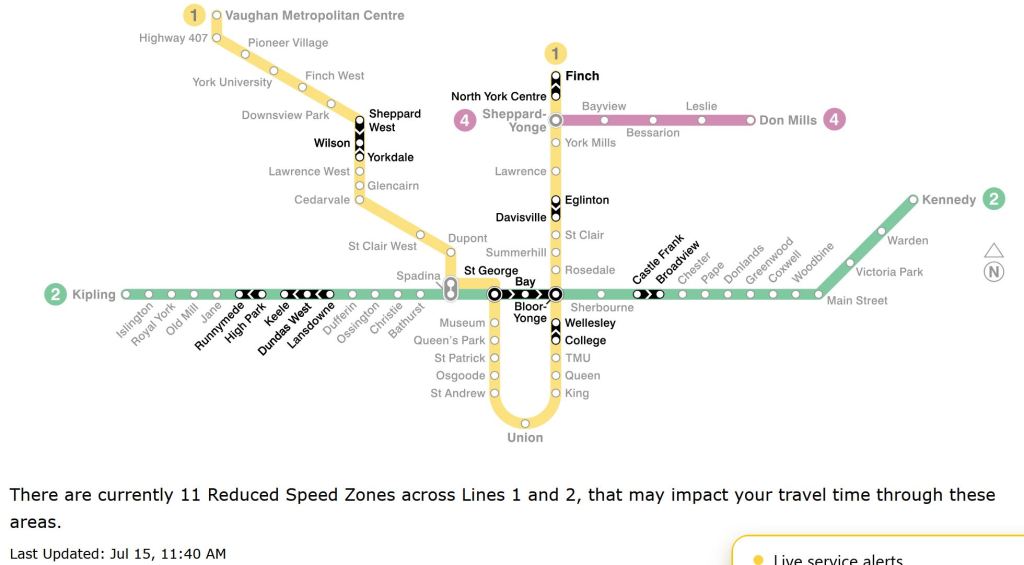
Here is the map of slow zones taken from the TTC’s site on Saturday, September 19. The “downtown” part of Line 1 is particularly bad, but the “Spadina” leg of the subway is close behind.
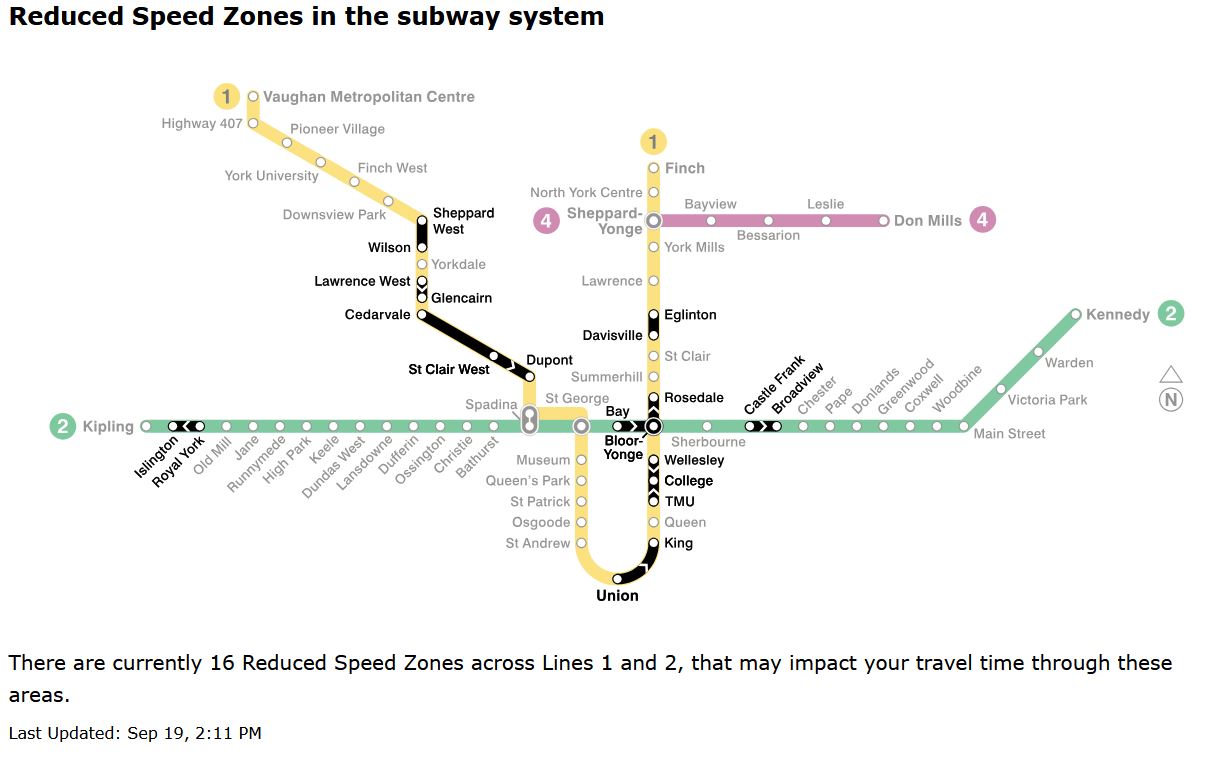
These are detailed in tables taken from the same TTC page (click to expand).
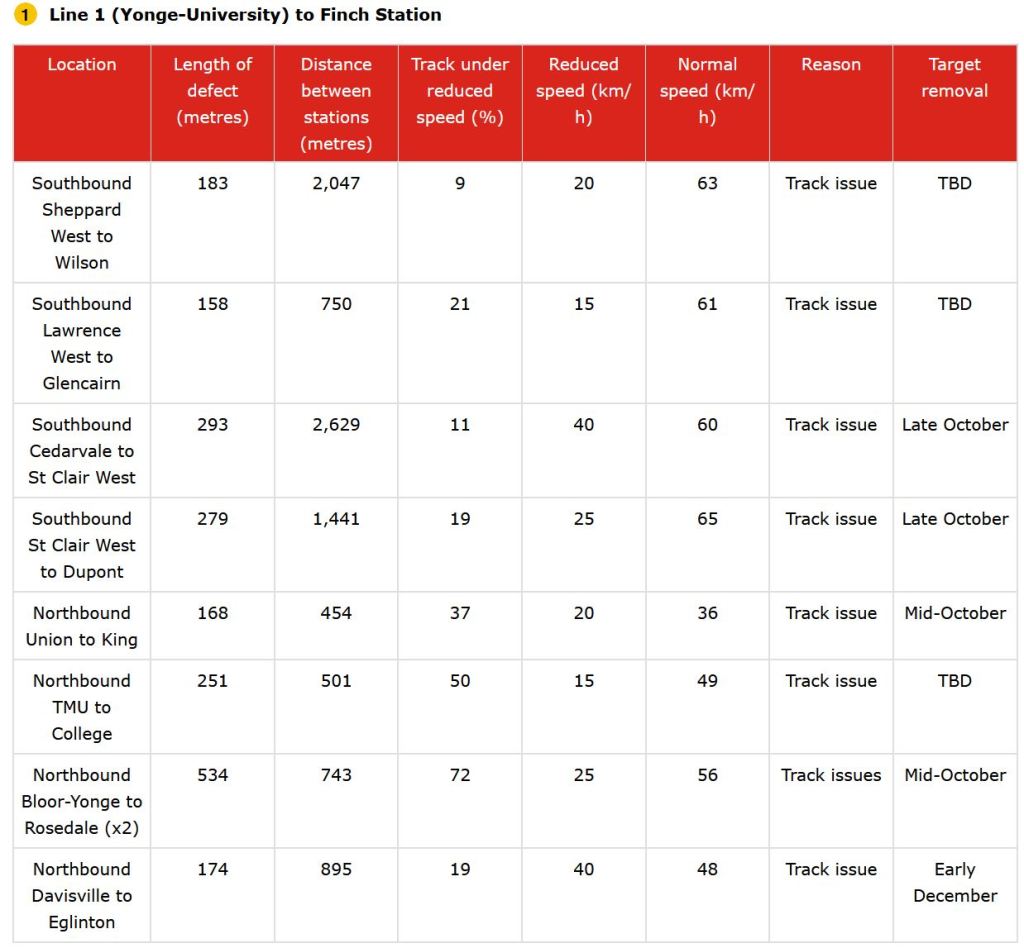
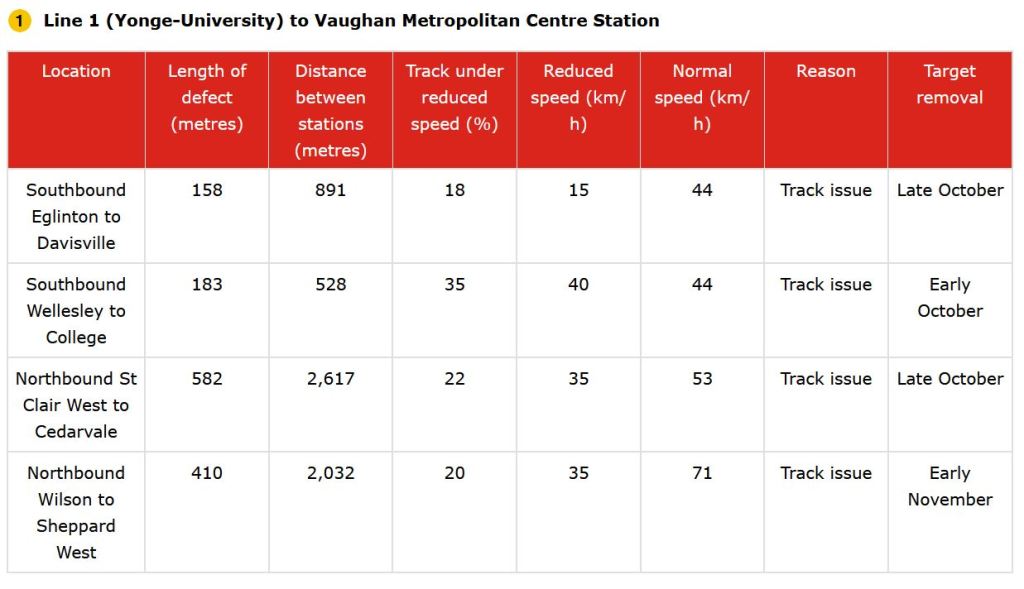
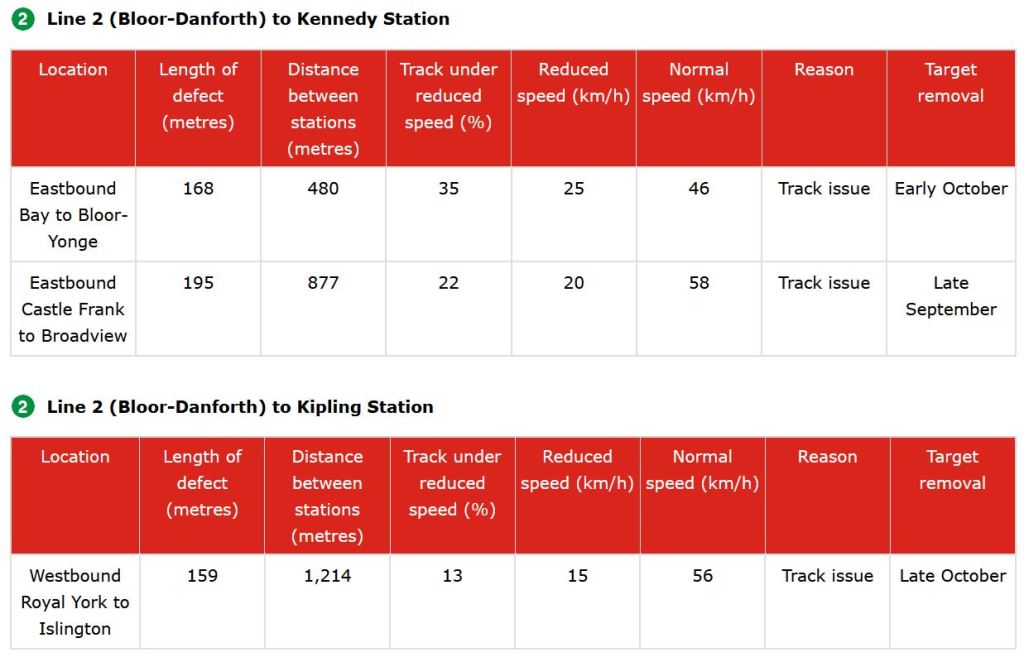
One recently eliminated zone at Queen Station both ways was described as being for “Ontario Line construction” with a resolution date of “TBD”. That sounded like a very long-running project, but it has vanished.
I recently learned that Queen Station has settled about 1cm thanks to work underneath it. This begs the question of whether this condition has been stabilized, and if the slow order was an attempt to minimize further problems as Ontario Line excavation digs below the existing structure.
Another issue with the number of slow zones is the TTC’s ability to perform maintenance work. The work car fleet, which suffered problems with hydraulic leaks (among other issues), is still not back at full strength. Without enough work cars, there is a limit on how much can be undertaken.
The background to this shortage goes back nearly a decade to the transition between CEOs Andy Byford and Rick Leary. Byford’s team had a plan to refresh and expand the work car fleet, but this was deferred by Leary as a cost-cutting measure. Older equipment needs more routine inspection and maintenance, and fails more frequently. This creates a scheduling problem both among projects needing the cars, and a cascading effect when they are pulled from service for maintenance, sometimes on short notice.
Parts of the subway, especially on Line 1, require major reconstruction to permanently correct track condition issues. This would require an extended shutdown, more than a weekend, and the thought of a weekday “bus shuttle” is daunting. Even Byford did not launch such a project.
In past articles, I have published charts showing the areas of each line affected by slow orders, and the full sets from 2024 to September 2026 are shown below. Here is a link to a PDF for those wishing to download them.
In these charts, the coloured bars extend between stations and the arrows within the bars show the direction of the slow order. The double arrow “<>” indicates “both ways”. (Click to expand.)
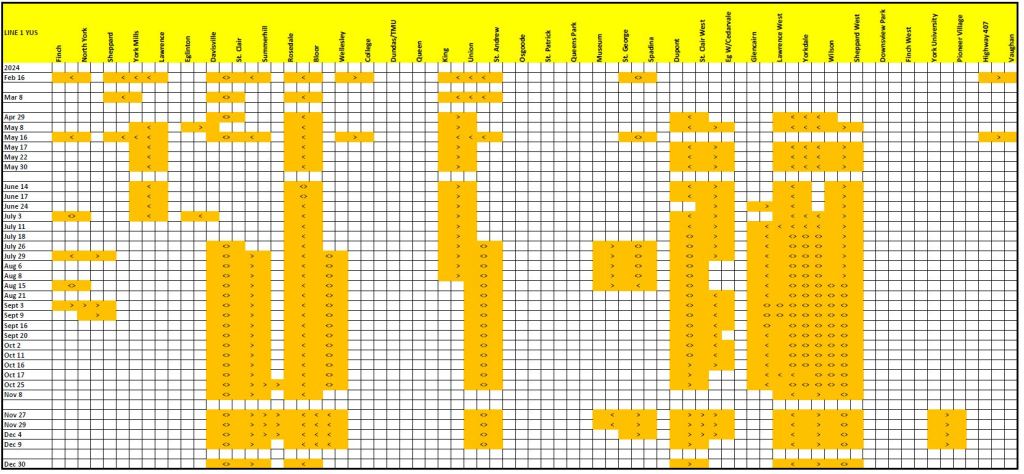
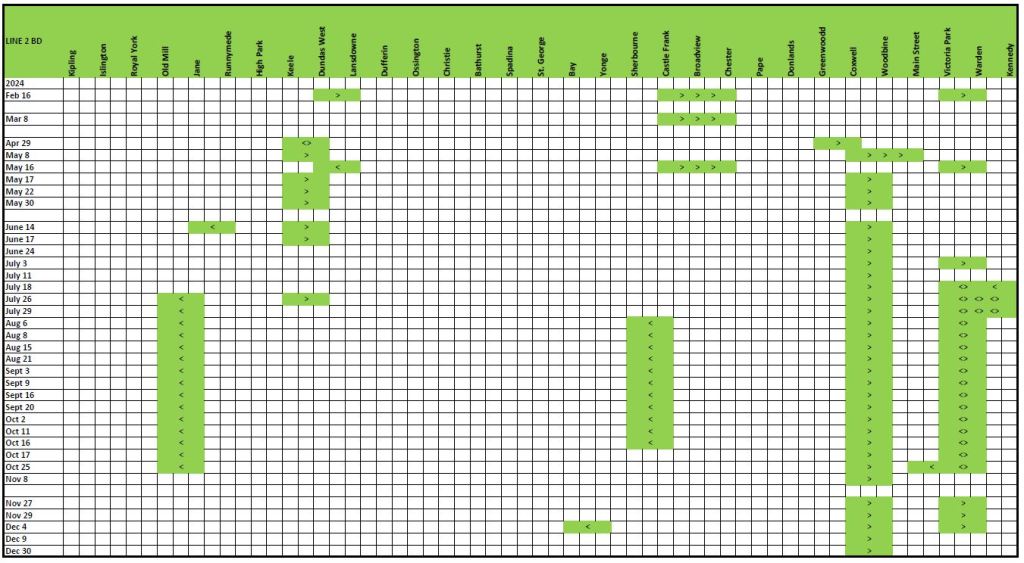
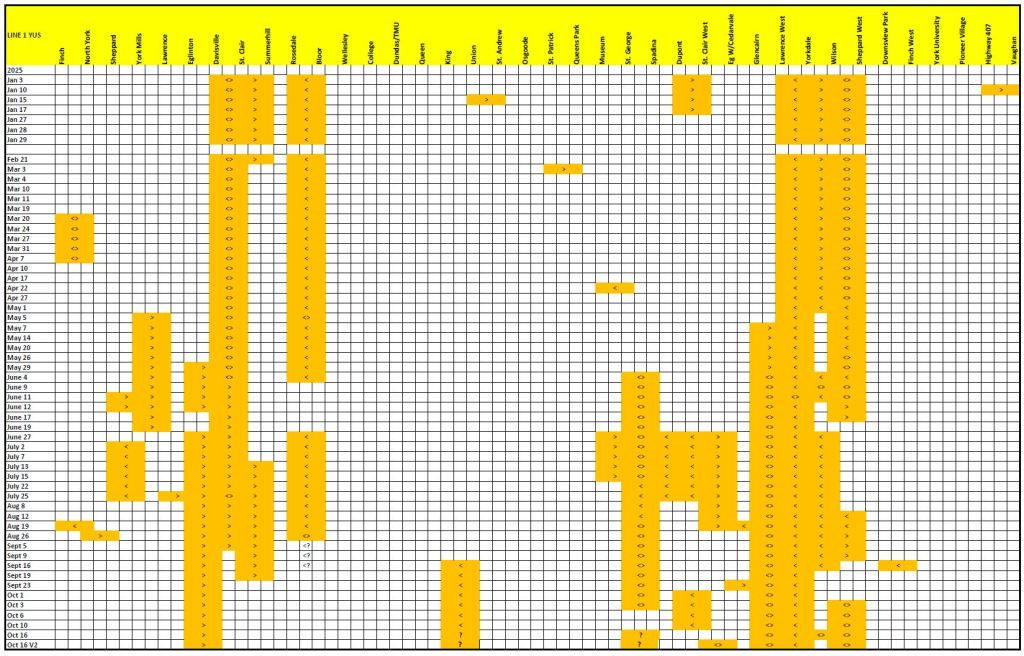
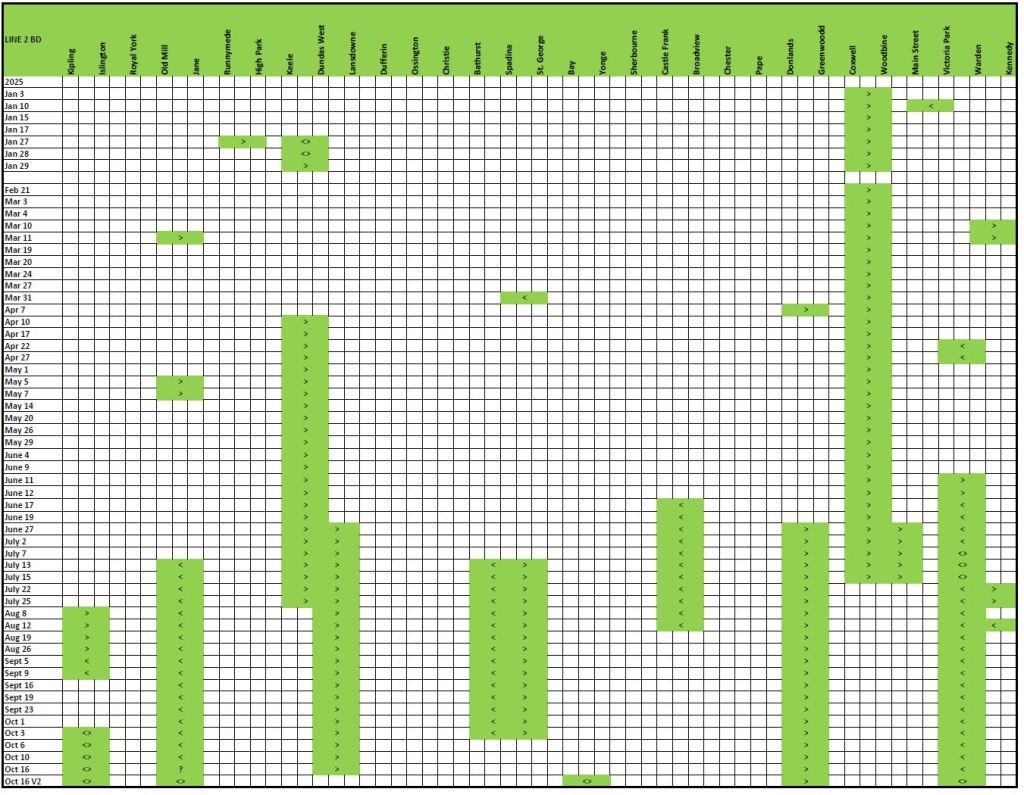
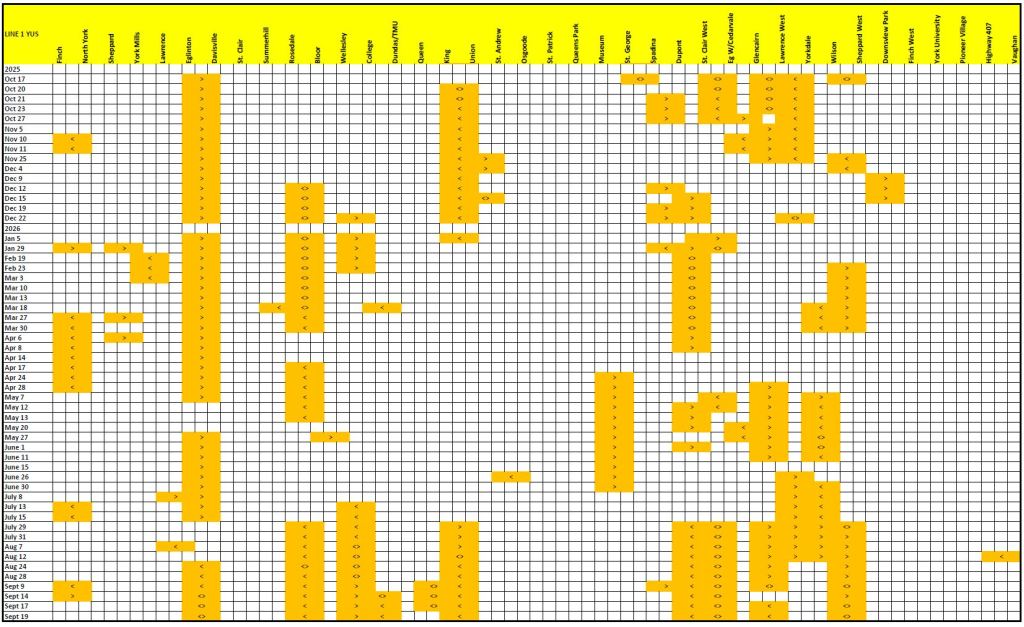
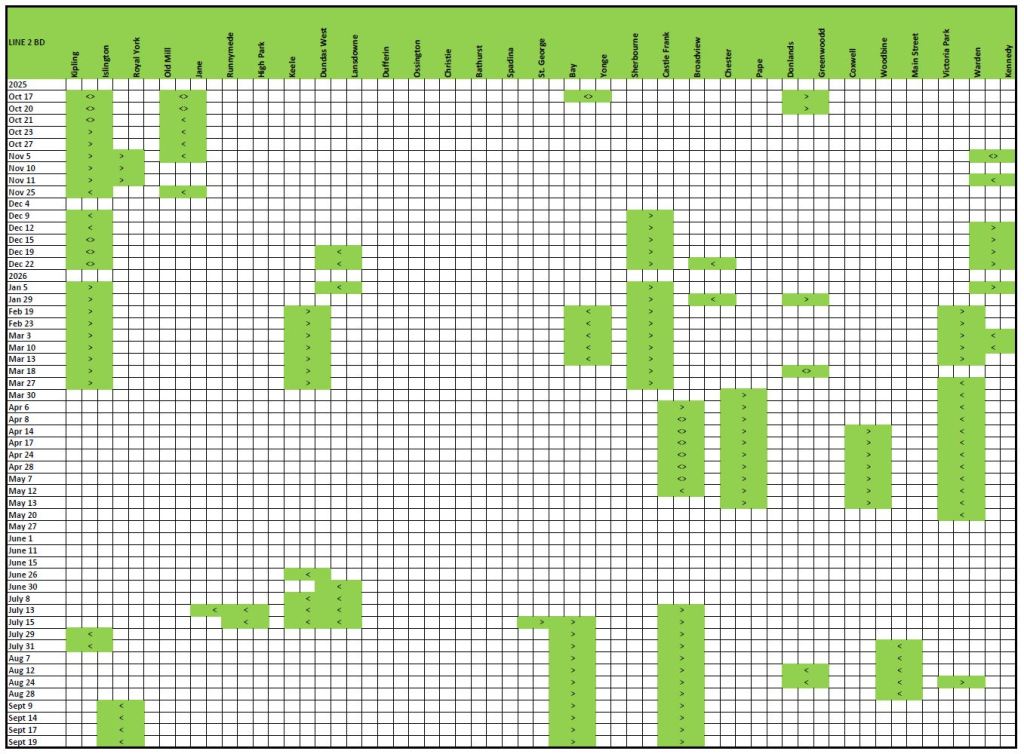
What is glaringly obvious here is that there are portions of the subway that have been almost continuously under slow orders notably:
- Eglinton to Davisville
- Rosedale to Bloor
- Cedarvale (Eglinton West) to Sheppard
- Islington to Kipling
- Warden to Victoria Park
These share a common factor: the track is out of doors built on ties and ballast as opposed to the concrete slab of a tunnel.
Another factor specific to Line 1 is the curves which are far more common than on Line 2. These are areas where rail wears more quickly, and the tighter the curve, the greater the wear. The oldest part of the line has tight curves between Wellesley and College, at Union Station and between Museum and St. George.
A notable lull in the number of slow zones occurred for the World Cup period where the total count dropped to 2, the only time it has been this low in three years.
This did not last, and only weeks later the count grew again.
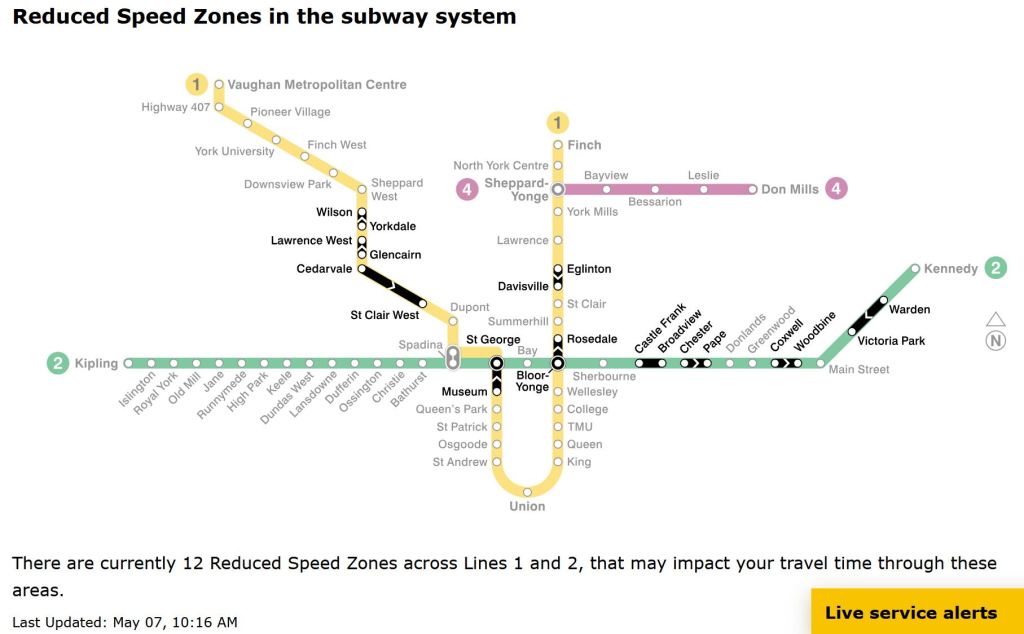
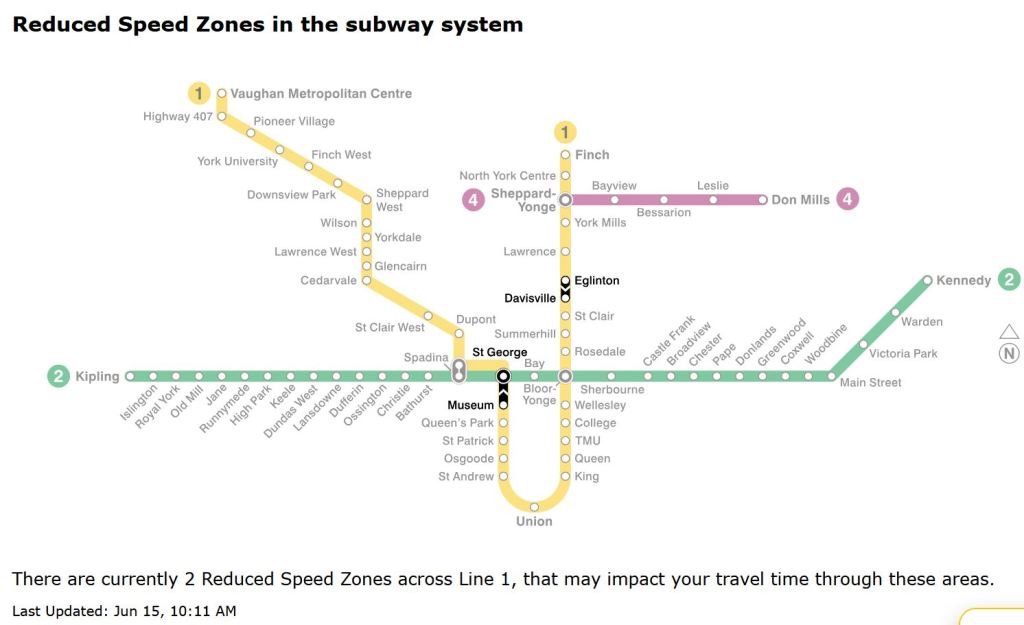
What happened? Before the games, there was a push to eliminate slow zones to put on the best show for subway service. However, a regular quarterly inspection of the system was deferred so that its results would not trigger a new set of slow orders just before the games.
The CEO’s monthly report to the Board cites many issues such as service and vehicle reliability, but is almost completely silent on slow orders and their effect. For example, there is a chart of delay causes. Note that the effect of RSZs is explicitly omitted.
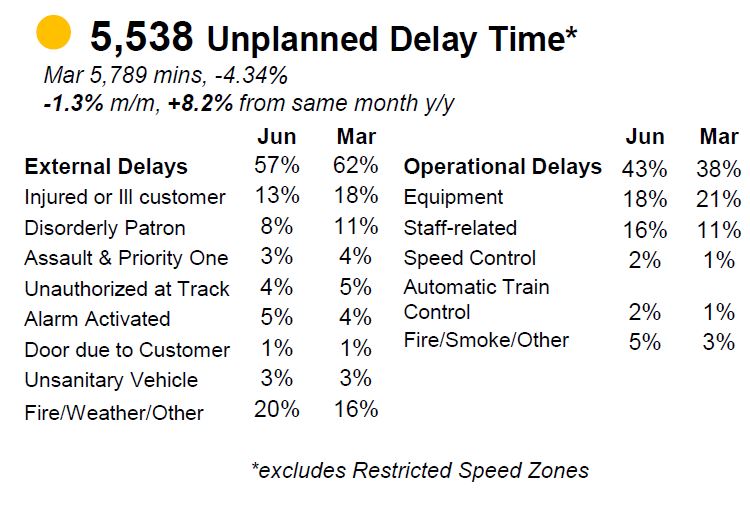
One problem for delay reporting is that the stats are organized by incidents. A train breaks down. A passenger is ill. The event lasts for a fixed period, and this counts toward the number of delays and total time. It does not reflect the number of trains held in the backlog, the number of passengers affected, nor the upheaval of replacement service if any.
By contrast, a slow order affects all passing trains and riders for days, weeks or months, but there is no accounting for this.
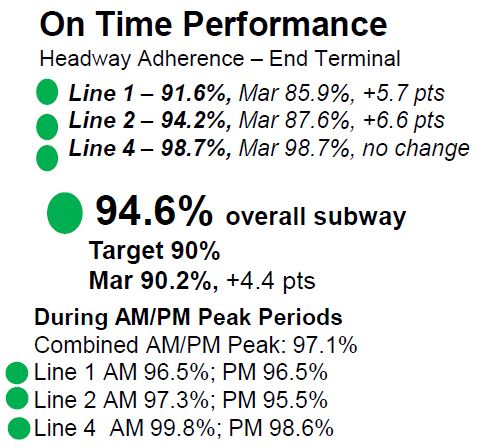
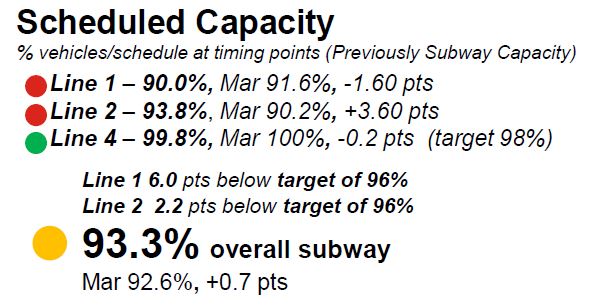
The CEO’s report includes two indices of service quality:
- On time performance (OTP)
- Proportion of scheduled capacity operated
These metrics can hide more than they tell.
OTP is measured relative to the scheduled headway (interval between trains) with a leeway of 100% as defined by the official Service Standards.
For services that operate better than 6 minutes, the vehicle is considered on-time when the headway deviation is less than 100% of the scheduled headway. For example a service that operates every 3 minutes is deemed on-time if the headway deviation falls between 0 minutes and 6 minutes. TTC’s goal is to have 95% of all trips operated within ±100% of the scheduled headway over the entire service day. [Service Standards at p. 18]
In other words, peak service trains are supposed to arrive every 2.5 minutes, but the headway can be up to 5 minutes and they are still “on time”. Off-peak trains scheduled 5 minutes apart can have a gap of 10 minutes and fall within the standard. Put another way, half of the service could be missing, but what remains would be “on time”.
If trains are missing, most commonly due to a delay that blocks service for a period, the number of trains/hour passing a point will be less than the scheduled level. The functional capacity of the line would be less than advertised. However, if the trains simply run more slowly, but all of them show up, this does not affect the stats.
Thanks to the new Automatic Train Control system (ATC), trains can run closer together on Line 1 than with the old block signal system, and this at least partly offsets the effect of slow orders. If the same proportion of Line 2 were under slow orders, its block signal system would limit the ability of trains to physically bunch up through the slow sections.
Another problem lies in reporting both OTP and capacity averaged over an entire month with no breakdown of time period or locations where service fell further below target.
There are other problems with the CEO’s Report, but that’s for another article. The issue here is that major aspects of subway maintenance and service quality are not reported nor tracked at the Board level.
What Can Be Done?
The first and vital act is that TTC management must publicly announce the extent of its problems including:
- track condition
- scale of issues – what can be repaired vs major replacement/upgrade of infrastructure
- status and adequacy of the work car fleet for the ongoing workload
This has implications for the capital program (replacement and expansion of the fleet) and for the scope of work (major reconstruction as opposed to running maintenance), as well as for staffing levels. Procurement of new cars is not a speedy process.
If more aggressive plans for service replacement are brought forward, these must include aggressive transit priority measures so that buses are not snarled in traffic. TTC management does intend that more extensive suspensions, partly offset by changes in subway operation, will occur in 2027:
Planning for 2027 closures is underway to increase maintenance windows and minimize customer impacts, including through expanded use of single-track operations on Line 1. [CEO’s Report, p. 5]
Regular reporting on status is also needed. The maps and tables on the TTC’s site are a start, but there is no formal tracking of trends and progress at the Board level. Moreover, there is no metric to track the cumulative effect of trip delays for passengers.
There should be no gaming of the system by timing major inspections to fall just after reporting intervals.
The TTC had a wakeup call with the SRT derailment in July 2023, and this prompted a review of conditions on the subway. There are also ongoing problems with slow orders on the streetcar system hampering its operation. While we are patting our backs about ridership recovery and talking of future growth, Toronto should pay attention to infrastructure maintenance and service quality if it hopes transit can be an attractive alternative to other travel modes.


True, but I recall Byford floating the idea in public. I also recall councillor Josh Matlow ridiculing Byford’s idea as impractical. So here we are years later, with aging roadbed, due to our culture’s apparent inability to make hard decisions. Sad.
LikeLike
I like that the TTC chose to represent slow zones using black on the map. It makes slow zones appear as diseased locations on a tree, which is fairly apropos.
When you look at operation of any system of any complexity, I look at state of maintenance as a first order approximation of management competence. It’s not a bad rule of thumb because maintenance is a forever budget line item, gets no glory, but criticality increases with time horizon.
In this respect, TTC’s rapid transit network is a case in point.
LikeLike
The MBTA did multiple extended closures to deal with its infrastructure maintenance crisis, and they had to contract out shuttle operation to charter bus operators because they didn’t have enough buses to do this themselves. And the MBTA carries fewer riders than the TTC does. The city would at a minimum probably have to completely close Yonge Street to traffic to effectively replace Line 1 with buses on a weekday.
LikeLike
Would be good to do an analysis of whether the shutdowns are actually fixing the problems and for how long. Not sure how to visualize this…
Steve: Although my charts have date gaps (I have better things to do than look up this info every day), you can see where a section was clear for a time then reappears as a slow zone. What is not in the TTC data is the to/from info that would reveal repeat offenders rather than different sections of a longer stretch.
LikeLike
I can’t imagine what it would take to do a full shutdown from Eglinton to Bloor but I am increasingly of the opinion that it needs to be done. I am thinking fondly of videos from places like Japan and the Netherlands where they’ve done a ton of work in advance to stage materials, prepare pre-fab segments, get everything in order, and somehow can drop in a massive new track segment overnight, or over a weekend.
If they handle such a shutdown like the usual water main projects on the streetcars where one crew crawls along several kilometres of track over the summer there will be riots in the streets.
Steve: To be fair to the TTC, the water main jobs are not done by then. When only trackwork is involved, especially if there is a concrete slab and steel ties already in place, they are quite brisk.
LikeLike
Has any analysis been done on what the options are for replacing the old roadbeds with something more durable?
Steve: Back in the 2010s when this was discussed, there was talk of a need for a concrete base slab under the track. This suggests that a panel-based replacement would be needed as actually pouring a new slab on site would take far too long.
Perhaps temporary crossovers could be installed in a few places to allow ~half service to share one side, while the other is replaced? If the issue is water infiltration, would a basic roof over the outdoor section help at all, or improvement to the drainage in the outdoor section?
Steve: There is already a crossover south of Eglinton Station, but more would be needed further south. There are two problems: first it would be difficult to maintain frequent service; second the ATC software would have to be reconfigured to “know about” the new track arrangements. I don’t think this is viable. They can do single track operation on the Vaughan extension because demand up there, especially off peak, is lighth enough that infrequent trains can handle it and not many riders are affected. Yonge south of Eglinton is quite another matter. Also I’m not sure the power distribution system is set up on the older part of the line to cut power on only one side.
I feel (hopefully) certain that in ~30 years this will have been addressed, who knows when. But it would probably help if there was a viable refined plan ahead of time which balances cost, benefit, and impact (both intensity and duration) of the obviously necessary work.
LikeLike
The TTC is advising that there are new ‘track issues’ that simply manifest themselves on a section as soon as another is repaired, in a whack-a-mole idiotic fashion. I spend months per year in Japan that has maintained rail systems moving hundreds of millions of passengers without any delay related to tracks, in the land of typhoons, earthquakes and volcanoes. Somehow their lines run at full capacity, full speed, all of the time. TTC is simply a 3rd world system that is a complete embarrassment to anyone that resides in Toronto.
LikeLike
Canada is no longer a first world country but a third world country as you have rightly noticed. We have two highly paid supervisors standing along intersections with metal rods changing streetcar switches at only God knows how many such intersections in Toronto. We have another highly paid supervisor standing around with a pen and notebook at a random intersection noting down streetcar arrival times, they are using satellite and fully autonomous drones doing this kind of stuff in India. Canada is lagging behind, they build high speed bullet trains in India and China but in Canada, we keep on building these extremely slow streetcar lines.
LikeLike
The TTC is doing some kind of down-to-the-dirt replacement at Long Branch loop. The west end was put in a concrete slab a few years ago — I guess inadequately. And the entrance/exit was presumably on ties, all one saw was gravel.
Anyway, this has gone on for weeks and weeks, and they are nowhere near done. Last I looked, much of the eastbound section past the shelter hadn’t even been started.
Those methods and work pace simply won’t work on the subway!
LikeLike
India and China are building bullet trains that we could easily run on e.g. College or Spadina? Fascinating!
Steve: The advocates for misplaced technology never give up.
LikeLike
Just some anecdotes about Line 1 western branch. Today early afternoon the train had a go-slow from Cedarvale to Glencairn. However, the entire ride from St. George to Vaughan Centre took 43 minutes compared to 45 minutes I plan on. Yesterday late afternoon southbound same route the train was very go-slow from Wilson to Glencairn.
Speaking of Glencairn, there is awful much debris at both ends outside the platform areas. I would be embarrassed if I was hosting some one from out-of-town. Overall, Line 1 western branch has lots of debris which looks like no one really cares about an efficient transit line.
LikeLike
With the Crosstown running, it might be viable to do longer shutdowns of parts of line 1 south of Eglinton since there’s a detour available now. Maybe during the holidays or summer when ridership is lower. They might even be able to offer single track service for local service only. It won’t be pretty though.
I imagine in Asian big cities, they must perform pre-emptive maintenance on their track before they fall into a degraded state. I wonder how much maintenance on TTC track would be required to not only catch up with the repair backlog but to get ahead of it like those megacities.
Steve: One important point about single track operation is that the ability to shut down power on only one rail is limited to the newest part of the system. That’s why you see it only on the Vaughan extension.
Revising power feeds and controls is very expensive.
LikeLike
How many Asian “big cities” have subway systems dating back 70+ years?
The problematic stretch south of Eglinton has been in use since 1954. I am not sure if lack of “pre-emptive maintenance” is the problem here.
Steve: Problems with this section (the lack of a concrete base slab) stem from a design decision in the early 1950s at the latest when the line was built. There are both drainage and stability problems. TTC can straighten up the track, but t won’t stay that way without constant attention.
It might be….the Russell Hill crash might have been prevented by some pre-emptive maintenance. Then again, subway trains have been running over that stretch without toppling over seventy-plus years.
Steve: A contributing factor at Russell Hill was a misaligned train stop which failed to halt a train running a red signal on a blind curve, but the ultimate culprit was bad operator training when running as close as possible to a red grade-timing signal was standard practice.
Just like the roads are all smooth in newly-built suburbs and not much maintenance is required…..for a while. It’s not even a question of whether pre-emptive maintenance is needed — it’s not. But wait 70 years and various utilities needing to be dug up, and it’s a different story.
Steve: Speaking of utilities, a lot of water mains from the suburban expansion era were built with plastic pipe which started to fail in recent decades. Meanwhile, the big water main replacements underway on King and Queen are digging up cast iron pipes that are over 110 years old.
LikeLike
To answer my own question, outside of Japanese cities, Beijing was the first Asian city with a subway, in 1971. Toronto’s trains had already been running for 17 years. The vast majority of China’s subways (or metros, anyway) opened in this millennium.
India opened the Kolkata metro in 1984, but all other Indian metros debuted in this millennium.
On the list of first opening dates, Toronto is #22 out of a total of 234 entries. A bit more than half are from this millennium.
It would be fair to criticize the Toronto system if newly opened sections had problems, and to be fair, there have been problems. But to imply that “large Asian cities” are so much smarter than us because their shiny new metros don’t have issues like our 70 year old subway has, is disingenuous. Note that most of Line 1 Yonge-University is either older than 50 years, or approaching its 50th birthday (Spadina line to Wilson).
It will be interesting to see how those shiny modern metros in large Asian cities will be running in 2050.
LikeLike