
Over coming years, Metrolinx will build new stations on the Ontario Line at Gerrard (Gerrard & Carlaw) and Leslieville (Queen & De Grassi). These structures will span local streets including two streetcar lines. Various partial and total closures of affected streets are needed for this work to proceed. Much of this involves sidewalk and curb lane closures, but there will be a five month period for each station where streetcar service is removed to allow Ontario Line work without energized streetcar overhead.
The full transit changes have not yet been published, but in each case streetcars will divert to the parallel street (Gerrard or Queen) between Coxwell and Broadview. Replacement bus service will bridge the gap diverting around station construction as necessary.
Details including parking restrictions, pedestrian and cycling effects, are in a City of Toronto report on the July 8 agenda of Toronto & East York Community Council:
Gerrard Station
Gerrard Station will be built above the intersection of Gerrard and Carlaw where the joint Ontario Line and Lakeshore East corridor crosses on a diagonal. Just northeast of the station, the line will dive underground into the tunnel carrying the OL north on Pape to the Don Valley beside the Leaside Bridge.
The land north and west of the corridor will be used as the work area for construction, and the two station entrances will be on that side of the structure (orange triangles in the upper left map below). During construction the existing westbound 506 Carlton and northbound 72 Pape stops will be shifted as shown on the upper right. The Carlton stop will move in Stage 2 (see below) and the Pape stop in Stage 3. These changes will remain for the entire project.
For those unfamiliar with the history of the area, this was originally a level crossing between road and rail, and the original Gerrard Street alignment survives in the street running diagonally in the southeast quadrant of the site.
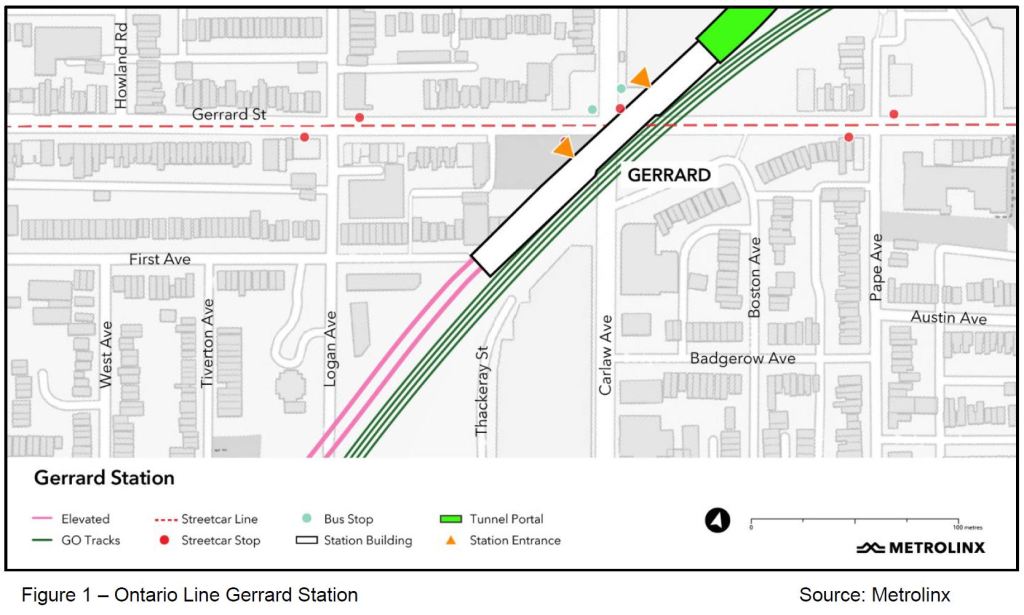

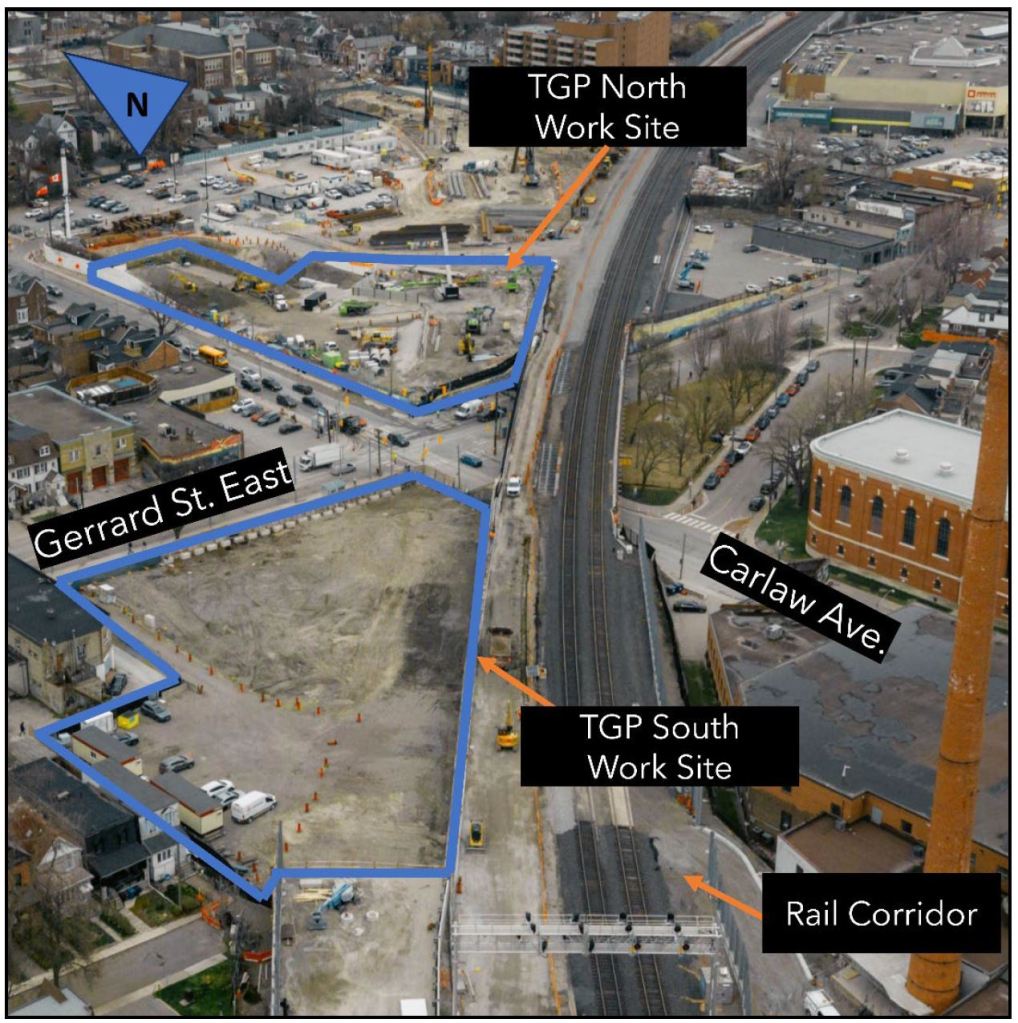
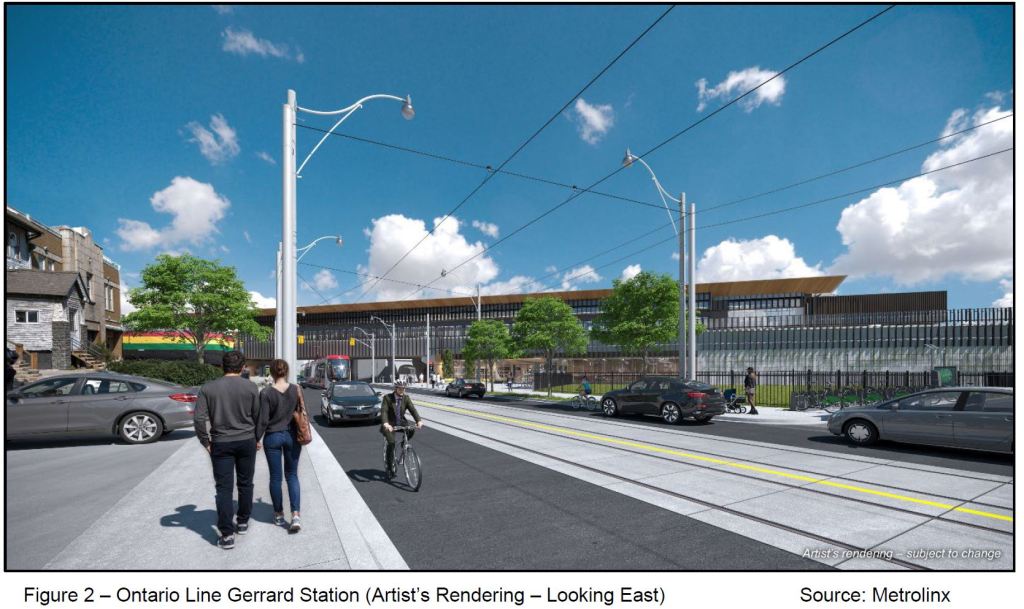
There will be several stages to this project. All dates are tentative given the nature of construction projects. For a detailed list of project staging and effects, refer to the City report.
- Stages 1 and 2 are for site preparation, and this work is complete or underway. Stage 2 requires curb lane and sidewalk closures westbound on Gerrard and southbound on Carlaw for demolition of walls adjacent to the sidewalk. Pedestrians will be shifted to the closed curb lane.
- July-August 2026: Stage 3 involves preliminary work (tie-back drilling, excavation and backfilling) at the north and south head houses of the new station. In addition to the stage 2 setup, sidewalk closure is required on Carlaw, east side, north of Gerrard. There will also be occasional closures the north curb lane of Gerrard east of Carlaw with pedestrian traffic diverted to the south side of Gerrard.
- August 2026-May 2027: Stage 4 includes the foundations for the station including piling and pier construction. The same road and sidewalk constraints from Stage 3 will remain in place.
- June 2027-August 2028: Stage 5 includes girder installation and superstructures at both head houses. The restrictions from Stage 4 will remain plus occasional overnight closure of the curb lane on Gerrard west of Carlaw.
- September 2028-June 2029: Stage 6 includes guideway girder installation across Gerrard and Carlaw. The Stage 5 arrangements will continue with the addition of up to four temporary weekend full intersection closures from 11pm Friday to 5am Monday.
- TTC overhead will be removed for four months within this period (TBA) to permit this work. The anticipated diversions are:
- All streetcars via Broadview, Queen and Coxwell. The report does not mention that there is no north-to-west curve at Broadview & Gerrard because the TTC omitted it in the last reconstruction. The westbound diversion will likely be via Dundas and Parliament as on past similar occasions.
- A replacement bus will operate from Castle Frank Station and Coxwell via Parliament and Gerrard.
- During the full weekend closures, the 72 Pape bus will divert via Jones between Danforth and Dundas, and there will be no service on Pape from Danforth to Gerrard.
- TTC overhead will be removed for four months within this period (TBA) to permit this work. The anticipated diversions are:
- February 2029-September 2031: Stage 7 contains the station construction. Closures from Stage 6 will remain until December 2030 after which work will occur within the station.
Leslieville Station
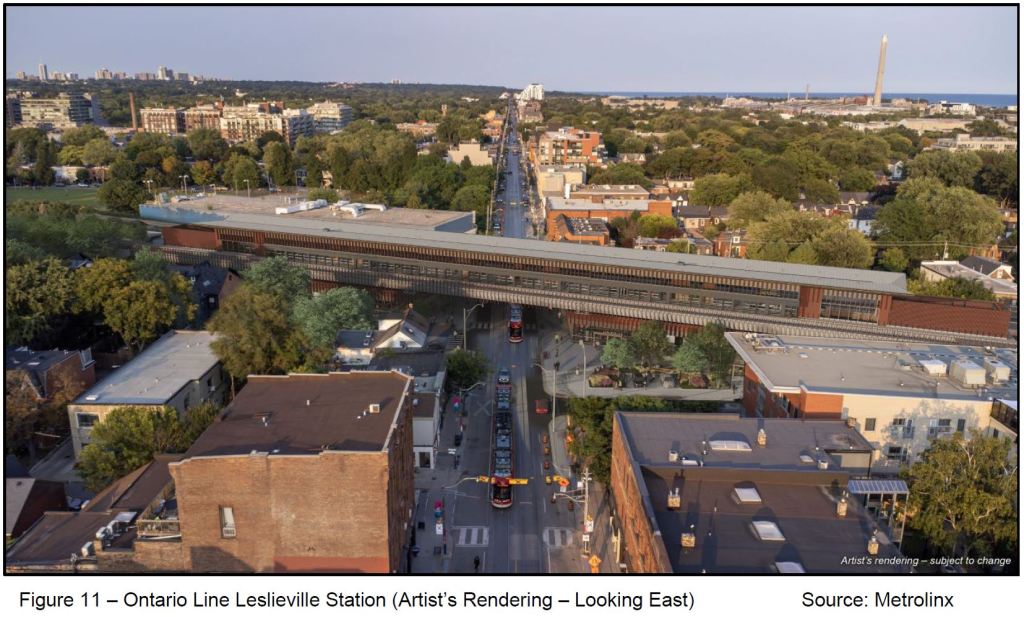
Leslieville Station will be built roughly north-south across Queen Street just east of De Grassi Street. Entrances will be on the north and south sides of Queen as shown by the orange triangles in the upper left map below.
Like the site at Gerrard, this was originally a railway grade crossing until the corridor was regraded in the 1920s. This was the site of Riverdale Station, although Metrolinx persists in calling this “Leslieville” even though that area is actually further east.
This will be a staged project extending over several years.
- January-June 2026: Stages 1 and 2 are for site preparation, and this work is complete or underway.
- July-October 2026: Stage 3A includes construction of piles for the new station (see illustration upper right below). Temporary closures of portions of De Grassi Street north of Queen will continue.
- October 2026-April 2027: Stage 3B continues the pile construction and adds pier caps. This work is above grade. In addition to the De Grassi closures already in effect, the east sidewalk of Strange Street south of Queen will be closed. The north curb lane of Queen Street will be closed to provide a pedestrian walkway around construction work north of the sidewalk.
- April 2027-December 2028: Stage 4A includes superstructure construction: falsework installation, structural assembly, guideway superstructure works, and preparation for precast girder erection. The lane and sidewalk constraints from Stage 3B will continue.
- July-November 2027: Stage 4B includes falsework and precast girder installation over Queen Street. For this stage, TTC overhead will be removed and all streetcar service (including access to Leslie Barns) will shift to Gerrard Street. Replacement buses will run on Queen. Road closures include:
- Nightly (11pm-5am) full closure of De Grassi Street, between Queen Street East and the public laneway north of Queen during girder delivery and installation activities. The laneway will remain open.
- Boulton Avenue will have temporary two-way traffic from Queen north to the laneway to provide access to De Grassi.
- Nightly (11pm-5am) full closure of Strange Street during girder installation.
- Curb lane and pedestrian walkway closures on Queen through the underpass a shown in the middle set of drawings on the left below.


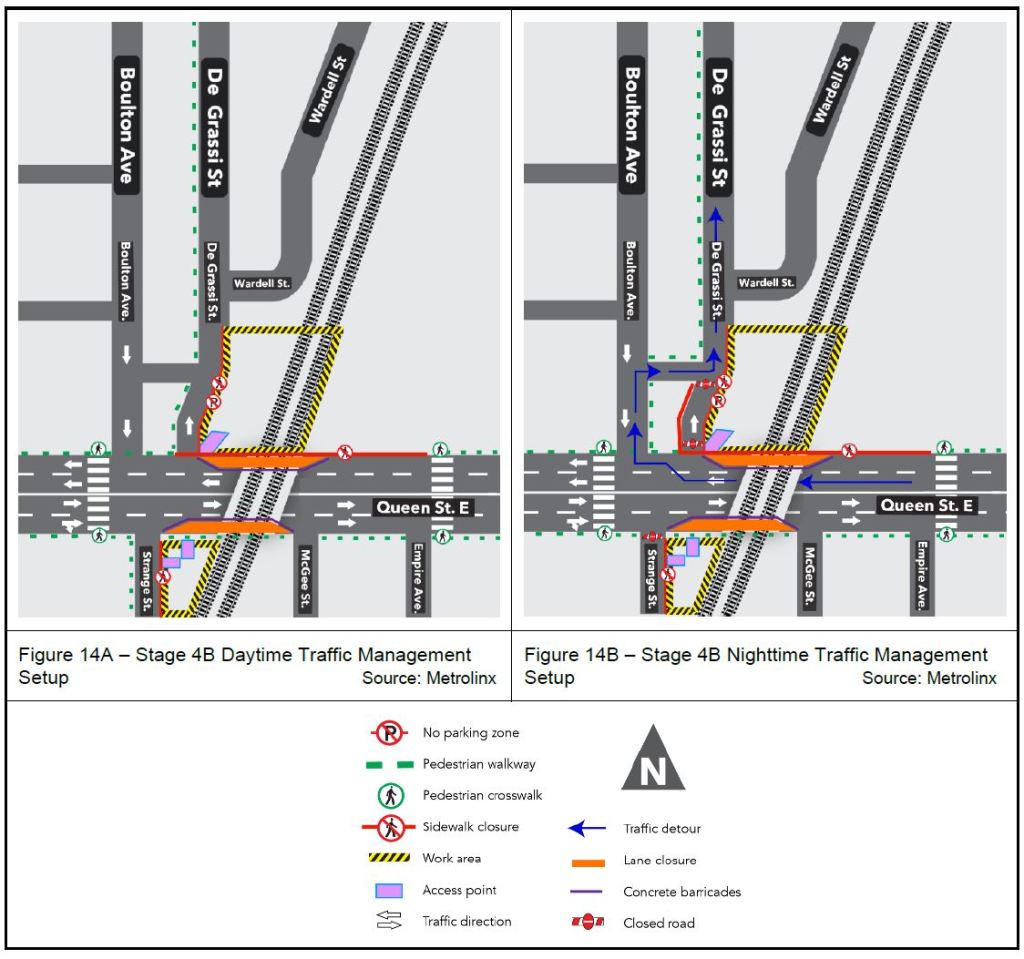
- November 2027 (10 days each): Stages 4C and 4D: These stages include structural steel installation for the north and south head houses. These stages will include closure of the curb lane on the side of Queen where work is underway, in addition to the other Stage 4 closures.
- August 2028-August 2029: Stage 5A: Construction of the station envelope at the two head houses. Stage 4 lane closures will be in effect plus temporary closure of the north sidewalk east from De Grassi through the work zone.
- June-August 2029: Stages 5B and 5C (25 days each): Installation of station facade. Some temporary de-energization of the TTC overhead and resulting diversions will occur in overnight periods. Some curb lane and sidewalk closures will be needed.


I know this is necessary. But for those of us who live in the area, it just keeps getting worse. Close Gerrard, Dundas and Queen????? Is that simultaneously or one after another? So hard to tell! Eastern is back open. Lakeshore is in pretty good shape out here now. Wasn’t. The ramp of course is missing. The entire east corner of the city has been a disaster for years – and it appears will be for years to come. But Pape and Danforth is not the mess it was, so that’s something. We needed a MAJOR improvement in public transit. But it sure isn’t working out well in my area for a period of say 15 years? And that’s a lot. There is an end in sight. I’m just not sure it isn’t 20 years.
Thanks for the information. Where else would I get this???
Cheers, Nancy
Steve: The press might pick it up, but there’s a huge agenda to cover at City Hall, and most of this doesn’t take effect until 2027 or later so it won’t get a lot of coverage.
LikeLike
I’m confused about Nancy’s comments about closures of Gerrard, Dundas, and Queen. Is there another document that’s not referenced here?
There’s no mention I see of Dundas closures. And the long-term closures on Gerrard and Queen are of parking, curb lanes, and sidewalks (with temporary protected walkways in the road).
The only full closures for car traffic I see are 4 (or is it 7?) weekend only closures. And the document notes that when one of Queen/Gerrard is closed, the other + Dundas will be open.
Perhaps there’s a misunderstanding? Or perhaps I’m missing something.
Steve: She lives in the area and has endured the constantly shifting loss of local streets to various projects. Dundas was closed for a time, and still has “temporary” bike lanes that constrain road traffic.
LikeLike
I cannot wait for the Ontario Line to open as this will make certain streetcar routes obsolete as demand shifts from the walking pace streetcars to the high speed Ontario Line trains.
Steve: When the transfer times to/from the OL are considered, I think few people will find them much faster especially at deep stations like Distillery, Queen/Yonge and Osgoode. If you have visited Line 5, you will get a sense of the time needed to get from surface to subway with Metrolinx’ deep bore designs. Also, large parts of the streetcar system are nowhere near the OL.
LikeLike
This is an important point. The OL is adding more complexity (in a good way) to the network, meaning it will draw in new riders whose path was not previously as attractive. It will not replace a streetcar line, as none follow that route, and only some demand will shift. And this is a good thing, we want to increase ridership overall, not just speed up the existing riders.
LikeLike
I have to agree with Nancy Irwin. As a senior who lives in the west Donlands and is TTC dependent (not a driver), these last few years have been a nightmare with all the shifting 504, 501 and 503 routes and to know this will continue for another 5 years or so, is agonizing. I’ve practically given up on trying to get into the east end. We get a bit of relief for a few months, then the madness starts again.
LikeLike
I’m trying to avoid reflexive critique of everything that happens in the transit or municipal space, particularly because I’m not a domain expert.
That being said: do we know how this kind of work is done elsewhere, and whether other cities are able to perform comparable projects with less catastrophic disruption than Toronto? I have to imagine they do.
Meanwhile in Toronto it feels like that’s not even an afterthought. Rerouting these streetcars for five (or what will likely be more) months is going to be a huge headache and disruption for everyone who takes the TTC in the area. I have to believe we could do better. Rather than these being temporary disruptions, when we look at the long term operation of these lines, it feels more like the brief periods without these disruptions is the brief, temporary condition.
Steve: Remember that there will be replacement bus service. It’s not as if the routes will be abandoned. That said, this adds to the general feeling that transit service in the “old” city can be degraded to suit whatever project happens to get in the way. Coupled with the long term decline in service reliability, this is not a recipe to bring people to transit.
LikeLike
Is Metrolinx planning on demolishing and rebuilding the Kingston sub overpass at Gerrard to make it safe for people using the westbound streetcar stop? Of course not. They wouldn’t spend an extra dime to help anyone in the community.
To all of the elevated fanboys, anyone with eyes can see what you will never show the public. If you stand at Queen and Degrassi, you can really see the enormous footprint of elevated stations that’s never shown in any brochure. You can thank that nepo loser Michael Schabas for all of this.
LikeLike
Why do people in the “old” Toronto (Steve’s own words on comments, the “old” part) complain so much about route diversions. I work at Midland and Sheppard but had to go to our downtown office so my route was 57 Midland sb to Midland RT, take the RT to Kennedy, switch to Line 2 to Spadina then south on 510 Spadina. When the RT closed, I just continued on the 57 to Kennedy to do the rest.
Guess what? Life changes. I could of also taken the 985 to Don Mills then Line 4 wb then Line 1 sb.
People want better transit but they complain like there is no tomorrow when there is temporary change.
Yes you might have to walk a bit more. I have a disability and have problems with stairs. I get over it and move on.
You want the DRL, what the OL is just a different name….there you go. Suffer a bit for great gain. Same for Lines 5 and 6. The locals suffered for a while.
You want to upgrade transit, then you have to suffer through the construction. I grew up in my teen years between Bayview and Leslie on Sheppard. Oh god was that horrible.
Steve: There are two issues here. First, that many of the changes in the past few years have appeared almost without notice, and have been modified on the fly. Even operators on replacement buses don’t always know how all of the diversions work. I have had to rescue a few lost travellers from bad advice they got from ops who didn’t know the diversion setup had changed.
TTC for its part does not manage diverted routes well, and seems to have the attitude that with a diversion, nothing can be done. Their public information can be incorrect or out of date, and often appears days before a change even though these are planned well in advance. Details of future changes are known internally weeks in advance, but they are communicated to the public at the last minute. Sometimes this is caused by a desire for a media event to announce changes close to the effective date, but that tactic does not serve riders who need to know what will be happening.
The other point is the idea that the people who “want” the OL, or whatever, are the same people who are inconvenienced by the construction and diversions. This is not necessarily true. The problem is compounded by Metrolinx’ appalling “community relations” where, to be kind, some of the official stories are at best wrong, if not deliberately misleading. Metrolinx has even tried to pit communities against each other. This behaviour undermines the credibility of transit projects generally.
Riders should not have to suffer through construction, and the TTC should do its best to make the temporary routes work and be well-understood by riders.
LikeLike
How does the existing GO overpass at Gerrard make the westbound stop (at Carlaw) unsafe?
I use it frequently, and have never encountered an issue. As opposed to the deathtrap that is Main Street north at Danforth, where there’s effectively two lanes of traffic between the streetcar tracks and the curb.
LikeLike
Five months to build a new transit station isn’t too bad compared to the longer closures for water and track construction you just posted about.
Steve: I think the interesting comparison is with some of the bridge replacements on GO where Metrolinx goes to great lengths to minimize disruption to its own services and to local traffic.
LikeLike
A streetcar stopped at the white line leaves more than half of the vehicle under the actual bridge. There’s a big blind spot on the approach to the stop because of the bridge supports and it puts the walking distance between the last door and sidewalk at about 20 metres.
The sidewalk is also extremely narrow, forcing crowding around the first two doors but maybe this can be fixed. The other issues will remain because Metrolinx didn’t want to spend any money on things that didn’t affect them. Remember they disingenuously claimed the demolition and rebuild of the other bridges was to help improve TTC service.
LikeLike
To all of the streetcar/LRT fanboys, anyone with a brain can see that it is slower than jogging and this is true for every single streetcar/LRT route in Toronto. I have stood at Queen and Degrassi, the elevated station coming up looks beautiful and so what exactly is your point? It is also going to make the Ontario Line faster than jogging but streetcar fanboys would rather see the Ontario Line built as a streetcar line like the disaster on Finch West.
Steve: Nobody has ever suggested making the OL a streetcar. The real horror of elevated stations comes if they are in the middle of the street especially a narrow one like most in the older parts of the city.
And the streetcar/LRT advocates never wanted something like Line 6 which is a poster child for incompetence in transit project design and management.
LikeLike
There have been a spate of catastrophic e-bike fires this summer.
But TTC scientists concluded that these fires are impossible to happen in summer.
Steve: If TTC management had their way, e-bikes would be banned at all times, but thanks to political intervention by the TTC Board, they are allowed in the warmer weather when snow/salt accumulations on the batteries won’t occur and the risk is lower.
Note that the fire reported by CITY was not on the TTC, but at an apartment. There is a common problem with poor charging practices making this type of location more likely.
LikeLike
Steve: Nobody has ever suggested making the OL a streetcar.
If streetcars provide such good transit, why do we need advocates like you to defend the streetcar system? If streetcars provide such good transit, why do the vast majority of riders hate them? If streetcars provide such good transit, why the vast majority of the world has gotten rid of them? It’s about time that we listen to the taxpaying public about whether we want to keep the streetcar system or follow the vast majority of the world in abolishing them.
Steve: There are streetcar and LRT lines all over the world, with new builds and system expansions continuing. There is also a robust car-building industry supplying vehicles, and this would not exist if streetcars/LRT were disappearing. The issue in Toronto is the appallingly bad operation and lack of priority for streetcars. The advocacy is to fix the problems and run a better system.
LikeLike