
Water main construction, coupled with track repairs, will force the diversion of 504 King streetcars from November 2026 to early Summer 2027.
Updated Aug. 1, 2026 at 10:40 pm:
The dates for various stages of the work have been announced on the TTC’s page for this project.
- November 2026 to August 2027:
- From Close to Dufferin, and from Portland to Spadina.
- March 2027 to late 2027:
- From Shaw to Bathurst
- June to August 2027:
- Intersection of King & York
The map below is taken from a report at Toronto & East York Community Council on July 8-9 (p 4).
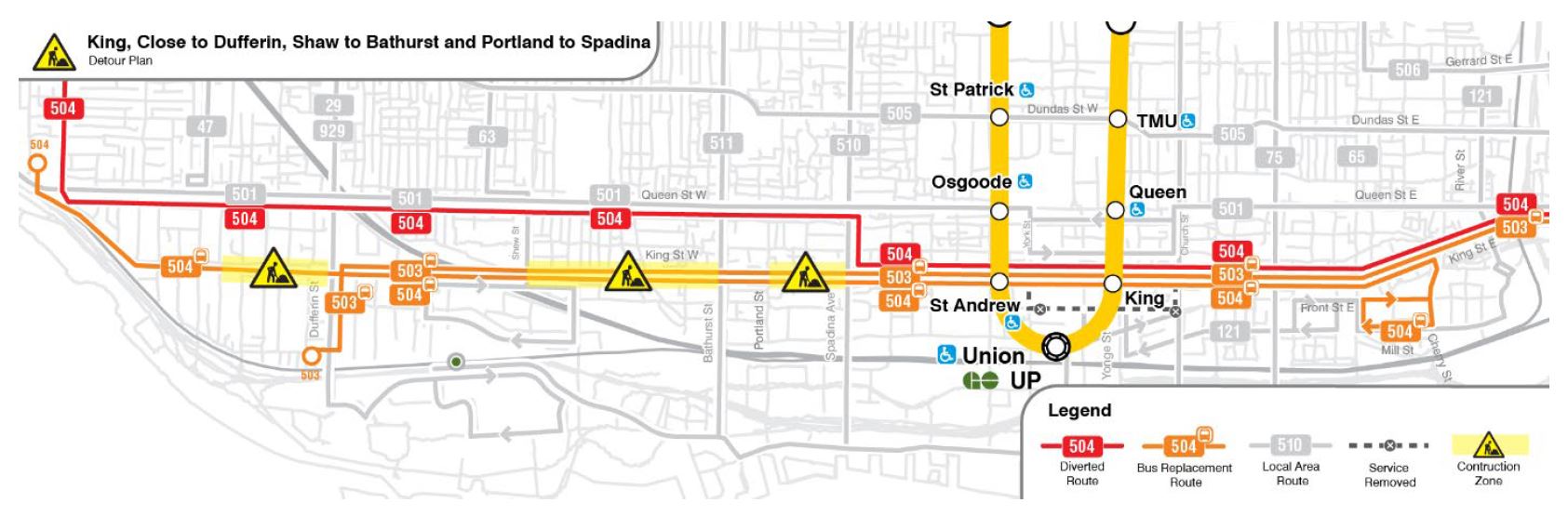
Two areas will be affected starting November 2026: Close to Dufferin, and Portland to Spadina. At the end of February 2027 work will begin between Shaw and Bathurst Streets.
The following services will operate over the 504 King corridor:
- 504 streetcar from Broadview Station to Dundas West Station diverting both ways via Queen between Roncesvalles and Spadina
- 504 bus service from the Distillery District to Sunnyside Loop
- 503 Kingston Road bus service from Bingham Loop to Dufferin Loop
- Not shown in the map is the 508 Lake Shore car whose summer 2026 suspension appears to continue through the construction period.
Night service will be provided by:
- 304 streetcar over the same route as 504 King car
- 304C bus over the same route as 504C King bus
Projects planned for 2027 includes watermain work and intersection reconstruction at King and York. This was originally expected in Fall 2026, but has been pushed back into the next construction year. TTC advises that King/York is scheduled to start in late June 2027 with the intention of completion before the film festival in September. Other projects will affect King West in 2027, but details for this work have not been announced.
Traffic regulations will be changed at several locations to assist transit vehicle movement during the construction. Details follow the “more” break.
Service Levels
Planned service levels (PM peak) are:
- 501 Queen streetcar: 10′ (6 cars/hour, no change)
- 504 King streetcar: 10′ (6 cars/hour, no change from the 504A service)
- Combined service of 5′ (12 cars/hour) on Queen West from Spadina to Roncesvalles
- 10′ service (6 cars/hour) to Dundas West and Broadview Stations (no change)
- 504C King bus: 5’30” (11 buses/hour)
- 503 Kingston Road bus: 5’30” (11 buses/hour)
- Combined service of 2’45” (22 buses/hour) on King from Sumach to Dufferin
Traffic Regulation Changes
Queen Street West currently has “No Stopping” restrictions in the peak period, peak direction. These will be changed extending both the hours and days they are in effect. Outside of these hours, there are no parking restrictions, and this will not change.
| Current | Proposed | |
|---|---|---|
| Roncesvalles to Dufferin | ||
| North Side | 4-6pm Mon-Fri | 7-11am & 2-7pm Mon-Fri |
| South Side | 7-9am Mon-Fri | 7-11am & 2-7pm Mon-Sun |
| Dufferin to Shaw | ||
| North Side | 4-6pm Mon-Fri | 7-11am & 2-7pm Mon-Fri |
| South Side | 7-10am Mon-Fri | 7-11am & 2-7pm Mon-Sun |
| Shaw to Spadina | ||
| North Side | 4-6pm Mon-Fri | 7-11am & 2-7pm Mon-Sun |
| South Side | 7-10am Mon-Fri | 7-11am & 2-7pm Mon-Sun |
The following left turn restrictions will be implemented:
- 7am to 7pm Mon-Sat
- Queen & Sorauren EB
- Queen & Dufferin EB
- Queen & Dovercourt EB & WB
- Queen & Strachan WB
- 2-7pm Mon-Fri
- Queen & Portland WB
- Queen & Augusta WB
These changes will take effect on November 1, 2026 and will remain in place until September 2027 or until streetcar service is restored on King Street.
Travel conditions will be monitored for both motor vehicle and transit travel times.
The report does not list any transit priority signalling changes. Three of the four turns at Spadina used by the diversion route already have priority signals, with only Queen eastbound missing.
The southbound left turn at Queen and Roncesvalles is already part of a single-direction phase.
Corrected July 6 at 10:00pm: It is the northbound left turn that has its own advanced green. Southbound cars will share the green with through traffic unless the phasing arrangements are changed to give turning King cars priority. Thanks to reader “Jarek” for catching this.
Details of construction projects, diversions and traffic regulation changes for the 2027 works will be brought to the new Council after the Fall 2026 election.


Will there ever be good news about dual-point switches in any intersection rebuild announcement? How can we keep throwing good money after bad? Is the TTC board incapable of directing the agency to spend wisely?
Steve: The TTC is studying various aspects of streetcar operation, but has not reported yet. The special work for King & York was probably ordered a few years ago before the issue of double blade switches became a cause celebre among certain tranit advocates.
LikeLiked by 1 person
This has changed in the KQQR rebuild. Northbound King has an advanced left to begin the cycle, then both northbound and southbound have a simultaneous green. There is currently no special allowance for southbound left.
Steve: Thanks for the correction. I should have remembered this, and have updated the article.
LikeLike
Steve,
When was the last time the 504 ran the full route without any scheduled construction, diversions, etc?
Steve: Do you mean a Dundas West to Broadview Station service? That would be in the days of the 514 Cherry which ran from Distillery Loop to Dufferin Loop while the 504 King ran over the end-to-end route. The last day of that arrangement was October 6, 2018 after which route 514 disappeared, and the 504A/B routes were born.
LikeLike
There’s a lot going on here. I have a hard time believing the lead time is that long or that they can’t modify the order.
With that said, they should be installing dual-point switches at all new intersections. I truly don’t understand the excuses. When you’re the only city in the world doing something you may be brilliant – but if everyone else used to do it your way and you’re the last man standing you’re obviously incompetent.
Either way, the advocates are also out to lunch by making it seem like dual point switches are the main culprit. The DIY switch electronics have been garbage since day one and need to be replaced yesterday. Any off the shelf system should do just fine. We can fix those within a year if we really care to do so.
If we’re going to have an annual closure of the King Streetcar we should at least be rewarded with modern technology.
Steve: The lead time is typically two years, and with the installation planned originally for this September, the order was likely placed in late 2024 or early 2025. That said, switches are standard parts that can be interchanged without rebuilding the whole intersection. But as you say, it’s the electronics that have always been the problem and the focus on double-blade switches grossly oversimplifies what needs to be done. There would also be an issue with traffic signal interfaces to give good transit priority, and the ongoing quality of track maintenance to prevent dangerous conditions from developing such as we saw at a few intersections in recent years.
LikeLiked by 1 person
Hi Steve,
Thanks for the information!
It seems rather prolonged for tangent/sewer work from November-May, who knows what between May and June, then York from late June-August.
Steve: Most of the time is consumed by watermain work, not track.
They might as well replace the tangent tracks from to Charlotte to University if York will be closed until TIFF, but they probably won’t.
I’m assuming they’re skipping Bathurst to Portland because of Ontario Line construction and this will cause a future diversion in the 2030s.
Steve: According to TOInview, Charlotte to University is planned for 4Q 2027. Timing is probably driven by watermain replacement.
Also they did re-electrify King and Shaw’s east to north switch before the World Cup, but didn’t bother for Dufferin’s east to north curve. At least they had extra personnel to manually adjust at Dufferin, but this will probably not be in place for the annual CNE diversion.
As for the bad electronics as another commenter pointed out, Dufferin’s east to south switch has been failing to reset recently and operators of the 504As have to go out and manually adjust.
Steve: I assume you mean west to south because that is the one that sends the 504Bs to Dufferin Loop. The curve used for the FIFA diversion was west to north. (Curves are named for the direction of travel.)
LikeLike
If I was the board, or the CEO, I’d just halt all rebuilds of intersections until they have a plan that is workable going forward. There is a point at which you just stop doing the bad old thing and tell everyone to focus on solving the problem and moving forward with that.
It’s not like this is particularly complicated – in that it’s been done in many cities, with similar vehicles, and all of the issues have been solved in multiple forms (signals, switches, weight/loading/forces, interlocking, priority, integration with other related systems, sensor types, sensor locations)…
At some point management has to realize – if we don’t have a plan, we will get into a situation where we replace a bunch of intersections and then have to write-off those replacements in order to use the new infrastructure down the line…so maybe it’s worth stopping work, coming up with the plan, and then starting work again…
The good thing is we are already going slow across all the intersections…so there should be little risk that a pause in rebuilds will actually result in any problems…
Steve: As I said in a previous reply, switches can be changed out independently of intersections and this can be done as a retrofit. The larger issue is to fix the electronics, electrify commonly used turns to speed diversions and short turns, and implement better integration with traffic signals. Leaving track in poor condition is a recipe for system deterioration. We really need to get away from slow orders everywhere, notably for straight-through movements where the wheel-rail dynamics of single-vs-double blade switches don’t matter.
LikeLiked by 1 person
I figured the reason for this – even when going straight – was the small risk (but big impact) of the switch being thrown while the vehicle is on top of it (without interlocking – ie knowing when the vehicle has completely passed, and keeping it locked in it’s original position until then).
Correct me if I’m wrong, but with the current system there is no way of keeping the switch locked in a straight position with the new vehicles (or any other position) …
I suspect for two reasons:
1) it would be harder to lock a single blade switch given the forces of the bigger vehicles – even in the straight position – this may have worked with the old vehicles? but with the new ones locking may not be viable (and even if it’s possible with single blades, the current ones installed likely don’t have the capacity since they were designed for lighter vehicles)
2) the sensors don’t exist anyways (or if they exist – they don’t work with the new vehicles – other than to operate the switch, but not to lock it)
So we don’t get the benefit unless we fix both of the issues – which means replace the switch, update the sensors…enable interlocking…then you can go at speed straight, and maybe slightly slower for curves…
(and we know there are some other things required to get back up to speed – like being able to communicate switch positions before arriving…so just fixing these two issues don’t get rid of the stop-check-go)…which is why even partial fixes here don’t really get a lot of improvements…they all are inter-related and need a full plan…
Steve: Actually, the technology to lock the switches is already there. There is a transmitter at the front and back of each car. When the front transmitter passes over the detector, the switch is set and locked. It is unlocked when the rear transmitter passes over the detector. If cars are in a train (i.e. pushing a disabled car), then the transmitters between the cars are turned off. One failure mode of switches is non-detection of the trailing, unlock, transmitter. This leaves the switch in locked status and it can appear to fail for the next car. As for switches throwing under a car, that is due to a switch controller failure, not to mechanical forces of the passing car.
As you say there are many related factors. Simply replacing single blade with double blade switches does not address most of them.
LikeLiked by 1 person
Streetcar tracks are always under construction and re-construction which makes it even more important that we fully grade separate ALL future LRT lines. Let us spend a little extra money now and build infrastructure that will offer rapid transit for the next 100+ years instead of spending billions of dollars on slow moving streetcars whose tracks are under perpetual reconstruction and constantly having to be bustituted.
Steve: Subway tracks wear out too, and you may have noticed the odd bus replacement for service during many recent repairs. “A little extra money” does not begin to describe the cost of grade separating everything.
LikeLike
The benign neglect of the streetcar system continues. It makes one pessimistic that any politician will stick their neck out to fund a replacement or even life extension for the Flexity fleet when the time comes, especially when the Ontario Line will likely be open by then.
Steve: Over past decades, streetcar infrastructure has been built so that track replacement only involves removing the top level of the structure (down to the top of the ties) rather than a full excavation and construction of a new foundation. Sadly, the benefits have been lost to the timing of major water main/sewer replacements that take far longer that the actual track work.
LikeLike
We don’t have to grade separate the entire streetcar/LRT network at the same time but let us commit to grade separating all future lines. Then as more money becomes available, we can grade separate existing lines one at a time. How come poorer countries such as Turkey, Pakistan, Iran, etc can build fully grade separated state of the art transit systems but a much richer Canada can’t? The fact is that even if there were money available to grade separate the entire streetcar network, you simply will not accept it under any circumstances. You need to start thinking about what provides best transit for the masses instead of your personal penchant for streetcars.
Steve: You are comparing rapid transit lines on major corridors in other cities to local transit lines here in Toronto. Apple and oranges. Also, your incessant comments under many different aliases about my “penchant for streetcars” ignores the fact that there are at grade streetcar lines all over the world.
LikeLike
Why would the 503 Kingston Road bus service continue west to Dufferin Gate Loop instead of turning back at York Street. Will this be a permanent route change?
Steve: This provides supplementary service on the busiest part of the King route while the streetcars are shifted to Queen. This arrangement has been used before.
LikeLike
I miss living on King Street W but wow will the suffering for King W Streetcar users ever end?
Steve: The map of pending City work on TOInview only goes out to 2027. They have been working their way on water main replacement westward for a few years, and the planned work gets them to Close. I don’t know what the condition of the water/sewer infrastructure is like from there west to Roncesvalles, or if Close is as far as the work will go.
LikeLike
TTC has a new (??) page on it [King construction] in their State of Good Repair section.
Steve: Yes, that’s quite recent. Thanks for catching it.
LikeLike
Whatever happened to the redevelopment of King Street long ago advertised as a part of the King Street Pilot? That was Joe Cressy’s days. I assumed track work would be done in conjunction with a complete street and sidewalk rebuild….
So are they really going to rebuild all this track only to tear up the street to refinish the tracks down the middle of cobblestone or whatever road treatment they had planned? Is the TTC planning for this? It’ll obviously be disruptive of the 504 all over again.
Steve: The rebuild will be with concrete, not decorative pavers, and I don’t think that was ever in the cards.
LikeLike