
Anyone requiring a “lift” on the TTC on the morning of April 20 will face a challenge: the passenger intercoms have failed for the entire subway network, and without them the elevators cannot run. TTC updated their alert on this to note that with assistance of station staff, people can use the elevators.
The Passenger Assistance Intercom in subway stations are not working. As a safety precaution, all elevators are out of service until this issue is resolved. We apologize for the inconvenience.
Last updated Apr 20, 2026 05:58:55
The advice changed somewhat later to recognize that elevators could be used with assistance:
Passenger Assistance Intercoms are temporarily out of service. Elevators remain in service, and TTC staff are available at all stations to help. Customers needing elevator access should speak with staff. Customers with accessibility needs can also use Wheel Trans or nearby surface routes. We’re urgently working to restore PAI service.
Last updated Apr 20, 2026 10:35:53
The problem remains at 1:20pm as I write this article.
The practice is imposed by the provincial Technical Safety and Standards Authority (TSSA) who require a working intercom for any elevator for rider safety in case the device fails.
For riders, unless the elevators have a permanent attendant, finding someone to assist in a journey can be challenging, especially in large stations with many elevators and lots of places staff might be found.
A total outage like this is very unusual, and begs the question of how there is a single point of failure that hobbles the entire subway system.
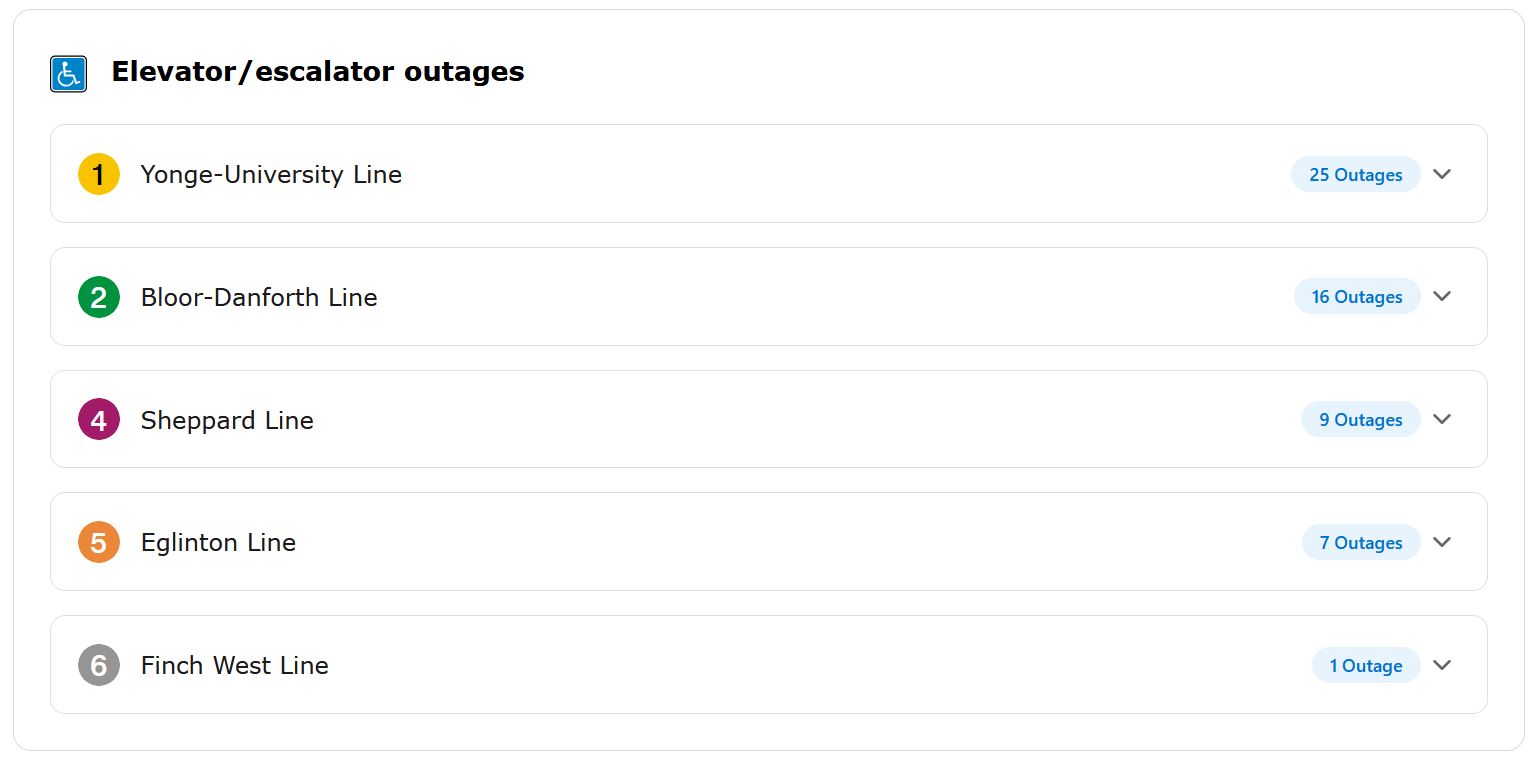
This situation prompted me to look at the TTC’s website where the landing page includes information about elevator and escalator outages. Here is the overview of status by line:
There is also an “On Time Performance” chart that includes tracking of elevator and escalator status:
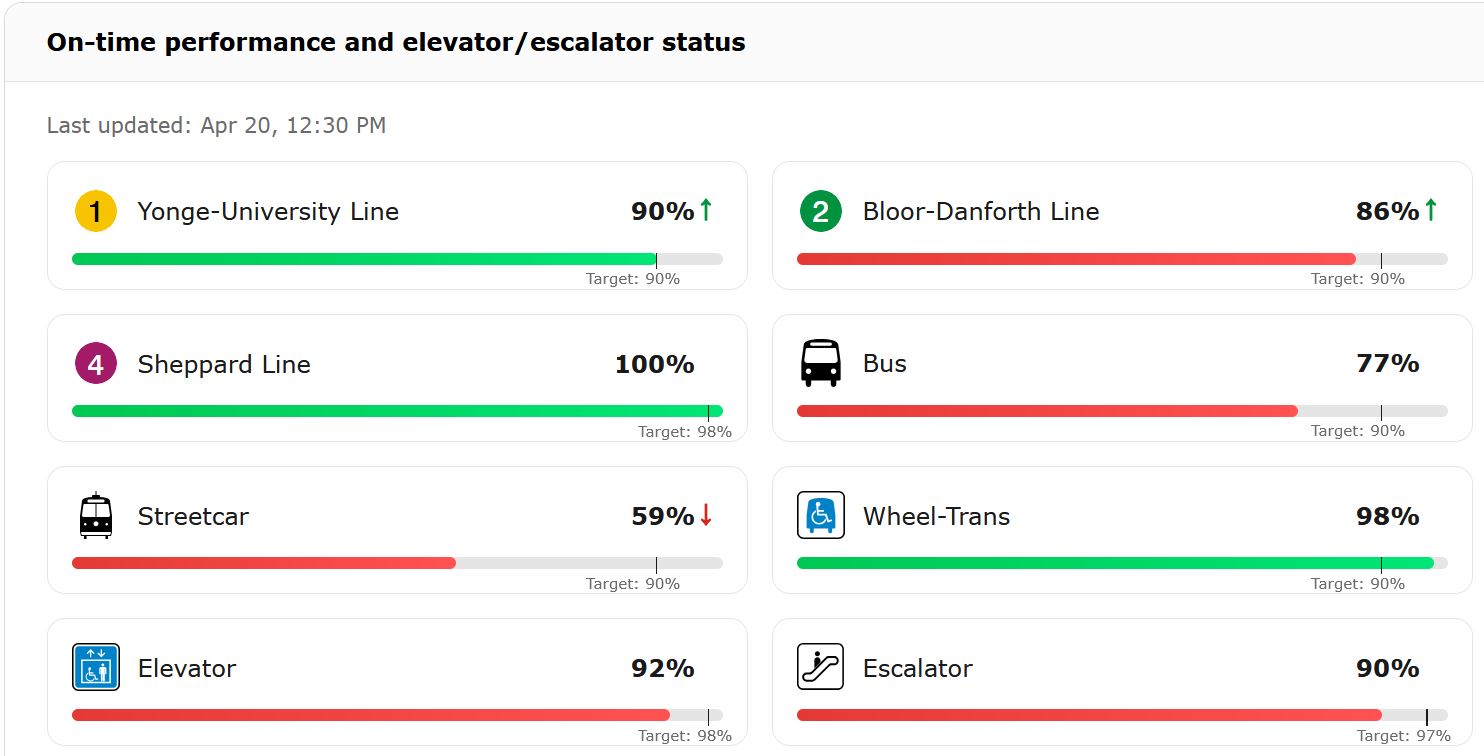
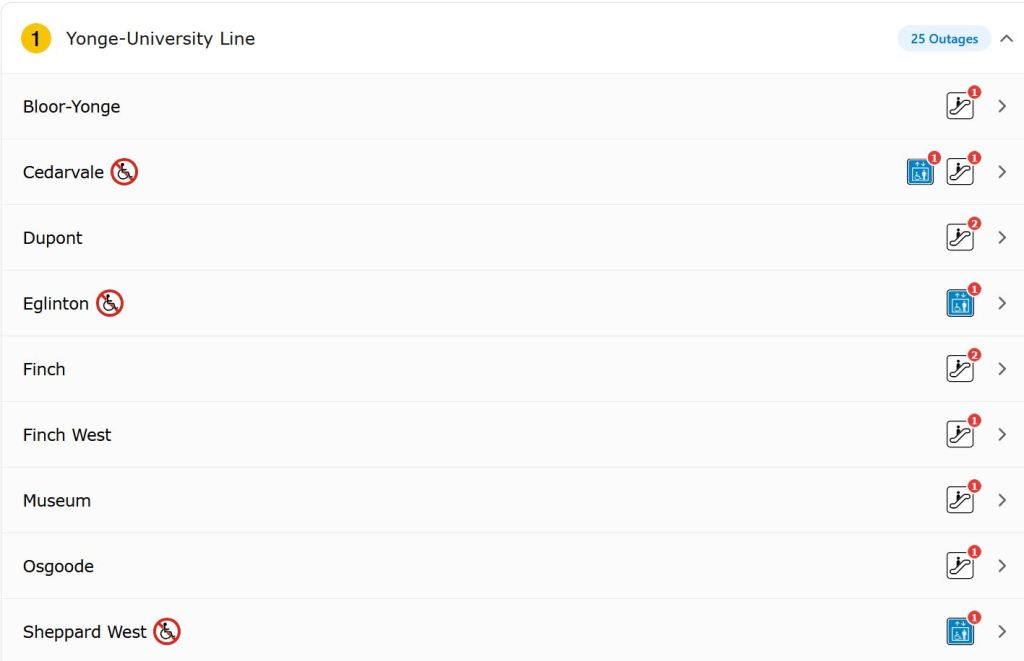
Those 90%+ values for vertical transport are impressive compared to the surface route stats, but they are below targets only slightly below100%. They do not give a feel for what is going on at the station level. That shows up in details available by opening line-specific folders. Note that the information here does not reflect the system-wide elevator outage. Even when the intercoms come back online and normal service is restored, there will be eight inaccessible stations on Lines 1 and 2 thanks to elevator outages, and many more where at least one escalator is not working.
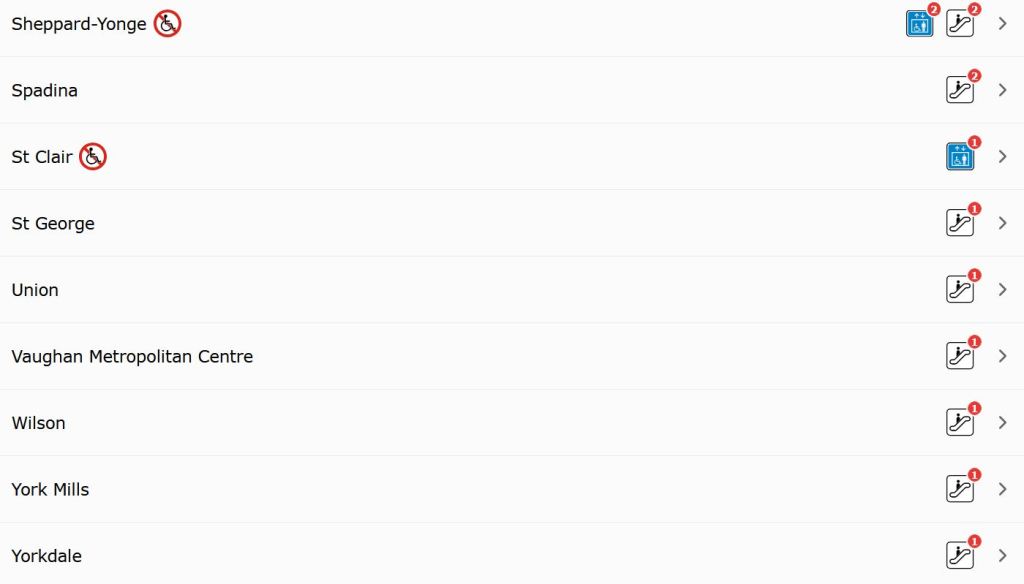
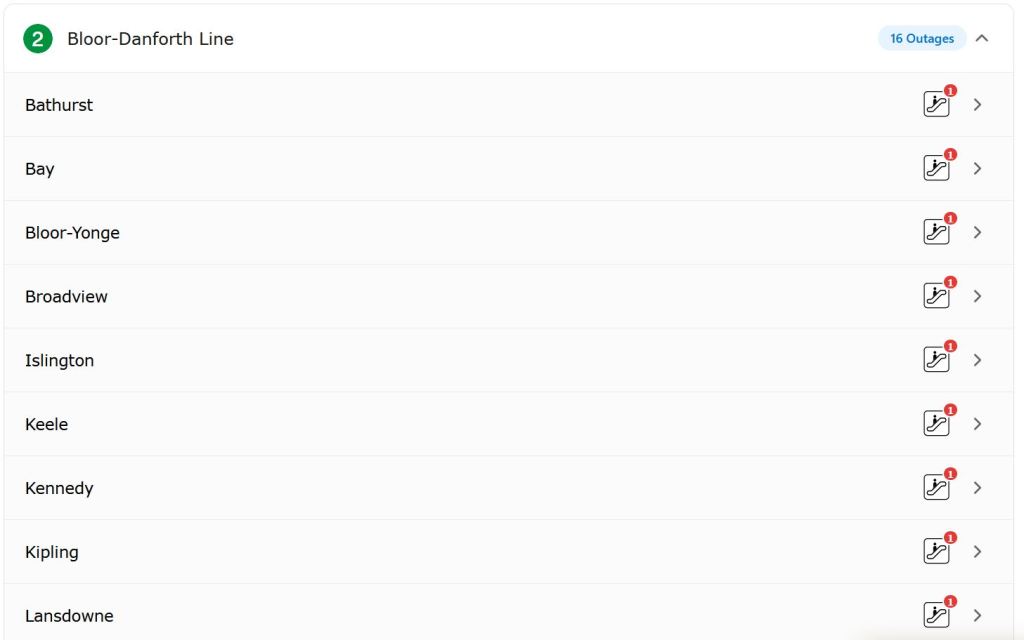
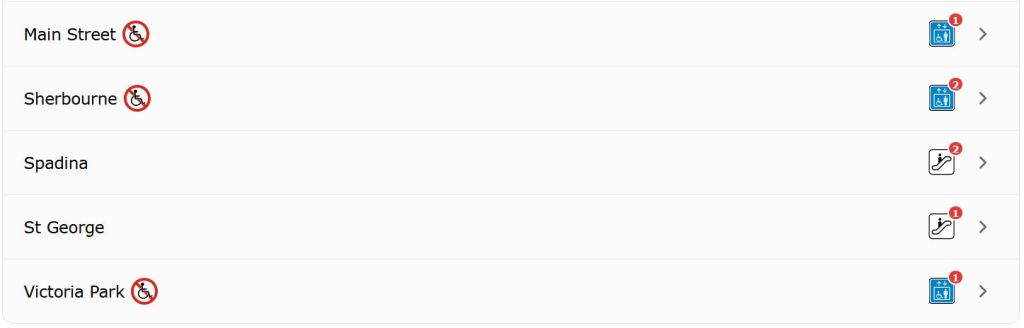
Lines 4, 5 and 6 stats are below. Note that Metrolinx through their P3 partners, Mosaic and Crosslinx, are responsible for Lines 6 and 5 respectively. The two out-of-service elevators at Sheppard-Yonge are in private buildings and are not maintained by the TTC.
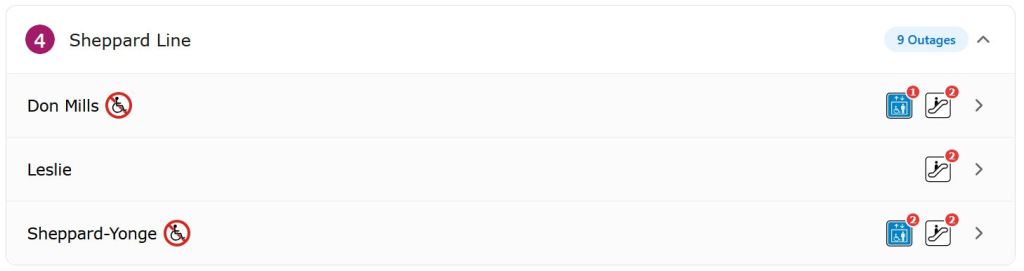
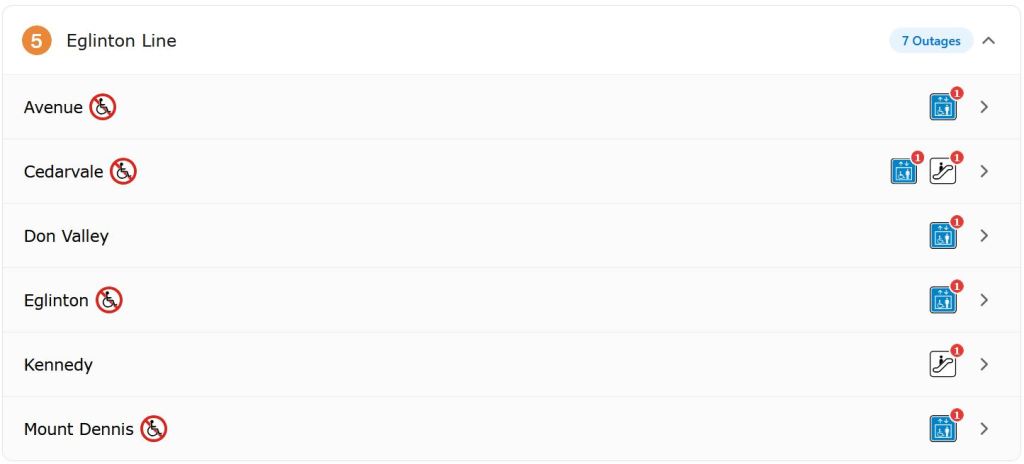

A key part of TTC accessibility planning is to shift riders from Wheel-Trans van trips to, in part, trips on the so-called conventional system. However, without reliable station accessibility this is impossible. Furthermore, many people who are not WT users, but whose mobility is less than ideal, depend on escalators and elevators without which they cannot access the subway. This is not a trivial number of riders.
We hear a lot about TTC State of Good Repair, but this applies more to vehicles, track, signals, and power supplies. Trains that move are obviously a key part of the system, but for riders who cannot get to and from platforms, the subway does not really exist.


Oh Lordy, Lordy, Lordy…
LikeLike
Up the Down staircase, squared…
LikeLike
Small correction, Metrolinx’s contracted consortiums for Lines 5 and 6 are different. Line 5 is maintained by Crosslinx Transit Solutions while only Line 6 is maintained by Mosaic Transit Group.
Steve: Thanks for catching that. Fixed.
LikeLike
This is why a parallel bus line to the underground rapid transit lines are needed. Preferably, with the same headway schedule as their corresponding rapid transit lines, of course.
LikeLike
This is another dataset which we don’t have access to, but which clearly exists. I’ve asked open data for historical elevator and escalator status but as is common, it’s in the backlog.
Steve: One problem you will encounter is that the “on time performance” is a snapshot taken at most a few times a day. If you watch the accessibility alerts, there are some elevators that routinely go in and out of service, sometimes multiple times per day. This would not be captured in the snapshot view.
LikeLike
Now you’ve got them reversed: Mosaic for Line 5 and Crosslinx for Line 6.
Steve: Oh dear. Too fast editing while running out the door! Fixed. Again!
LikeLike
I am currently travelling on the Eglinton Crosstown in my mobility scooter to show disability issues. My videos can be found on youtube @transitmobilescooter. I ask questions and point out serious issues. I find that information posted on the TTC website does NOT match reality, especially elevators.
LikeLiked by 1 person
Steve said: This would not be captured in the snapshot view.
Yes, it would be better to get the historical alerts…or a log…hopefully they can do it. Realtime feed would help the navigation apps and then historical would help the advocates.
LikeLike
While Ottawa’s LRT system is inferior in almost all aspects, one thing that did impress me was that every elevator in every station was doubled up; so if one elevator is down for repairs, the entire platform/station does not suddenly become inaccessible.
Of course, it’s significantly easier to design this in a new-build application rather than a retrofit scenario like TTC’s subway system, and it wouldn’t have helped in a scenario like today’s outage, but in certain spots on the system having multiple elevator shafts available would be incredibly helpful. On another side note, it’s unfortunate that the newest LRT lines here (designed around the same time as Ottawa’s system) did not also come with such a design.
LikeLiked by 1 person
I have definitely seen some people suggesting doubled up elevators on new builds like TYSSE and anything later but it’s fallen on deaf ears.
LikeLike
TransSee has a historical log of alerts going back to 2024. I can share the elevator related ones for analysis.
LikeLike