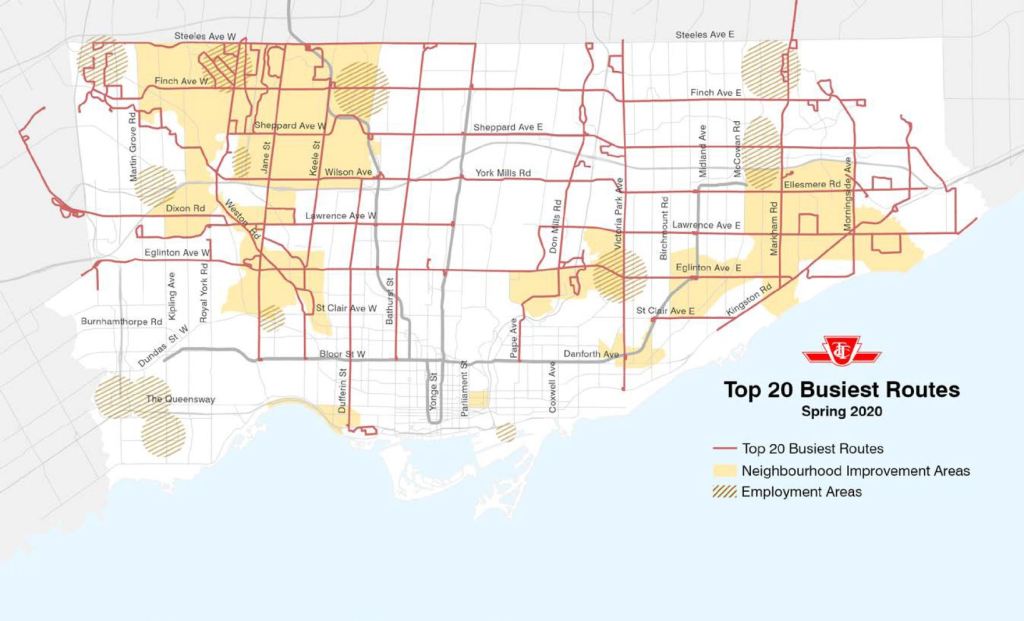
Of particular interest in the restoration of service to the transit network is the fact that recovery has been underway in some locations and times much more strongly than others. This corresponds to the difference in areas where work or study-from-home replaced commuting to an office or school. Maps in the previous article showed the top and bottom 20 routes for ridership relative to pre-pandemic levels in Spring 2020 (the point of lowest ridership) and in Fall 2021. For convenience, they are repeated here.
These ranking are by percentage of pre-pandemic ridership with no reference to absolute numbers. The busiest routes by ridership are shown in the maps below. This presentation inevitably displays the long routes which have a large number of boardings. Short routes like 65 Parliament may have recovered a large proportion of their demand, but the base number is necessarily small because of their smaller service territory.
This shows the danger of looking at absolute numbers out of a context such as riders per route kilometre (in effect, the density of demand), not to mention possible variations in the level of demand and boarding patterns along a long route.
Note: Calculations behind the charts in the original version of this article include a methodology problem. Short turn counts for vehicles crossing two screenlines (such as eastbound on Queen at Coxwell and at Woodbine) were distorted when these events did not occur in the same hour. Other problems included double counting of cars that looped twice at a short turn point (e.g. College Loop), and cars that were entering service via a loop being counted as short turns.
Changes in the text are shown by highlighting of the new version. All charts have been replaced.
My apologies for any confusion, but the charts used here avoid the potential confusion of values shown originally.
One of the many annoyances of trying to use transit service is to discover that your bus or streetcar has been “short turned”, that is to say, will not reach the destination advertised. This might happen before you board so that an arrival prediction turns out to be for a streetcar you can’t use, or as a “surprise” when the operator gets on the PA to announce that Transit Control wants to short turn the car.
This has been a problem for as long as I have been involved in advocacy for better transit service.
TTC Board members and Councillors hear about this problem a lot, and they in turn beat on management to eliminate the practice. This can produce unwanted side effects, notably the padding of schedules so that it is almost impossible, at least in theory, for a car to be late and, therefore, short turns should not be required.
Alas it is not quite that simple. Short turns occur for various reasons including schedule issues, crew change timing, major delays/diversions and “operational problems”, that catch-all phrase covering everything from a stuck door to a plague of locusts. (Some explanations for transit service problems have been with us so long they have taken on an almost Biblical character.)
Meanwhile, the CEO’s Report happily tells us every month that short turns are a thing of the past, that they are so rare that it might not even be worth tracking them as a service metric.
Source: June 2022 CEO’s Report
The big drop in the metric in spring 2019 coincides with a point where a “no short turn” edict was issued by the CEO. This is not really practical as there are many bona fide reasons for short turning vehicles, but the numbers obediently went down and have stayed down.
Regular riders, however, might choose to differ in their day-to-day observations.
Since 2019, we have come through the pandemic era when a great deal of traffic congestion and ridership disappeared. For a time, the type of event that would disrupt service was comparatively rare. However, with “normal” conditions returning, service is no longer insulated by these effects.
In my own travels, I routinely encounter streetcars that are not going to their scheduled destinations. Let me be the first to say that I understand the need for short turns, but am rather amazed that the reported counts stay very close to zero. This simply does not match actual experience. A short turn is a short turn, regardless of why it is required.
The question, then, is how to count these events reasonably easily without standing on street corners clipboard in hand. Vehicle tracking data that I already receive from the TTC’s Vision system (and which drives the many arrival prediction apps) provides a simple mechanism.
In this article I will review several common streetcar short turn locations to see what is actually happening.
If readers have specific bus routes and locations they would like to see, please leave your request in the comments.
Note: The charts in this article include a methodology problem. Short turn counts for vehicles crossing two screenlines (such as eastbound on Queen at Coxwell and at Woodbine) are distorted when these events do not occur in the same hour. This article has been replaced with a revised version, but I am leaving the original here for reference.
Service quality and reliability are, as regular readers here know, central to many of my critiques of the TTC.
Whether a route is short or long, busy or not, the TTC seemed incapable of accepting much less addressing service problems. For years, long before the pandemic, riders have complained about long, unpredictable waits and crowded buses, but the answer has always been that things really are not that bad. This is demonstrably not true.
The TTC relies on metrics based on averages, not on individual vehicle behaviour and this masks the wide variation in rider experience. 26 Dupont is an infrequent route with few riders, and it does not figure in the high end of the TTC’s attentions.
We have been through two years where the pandemic and the need to keep something, anything running took precedence. Now, with the hoped-for recovery, the TTC must address long standing problems that predate covid.
Looking ahead to their 2023 Service Plan, the TTC will attempt to deal with this issue as it is essential to improving transit’s attractiveness and luring riders onto the system.
The TTC began consultations for its 2023 Service Plan on June 29 with a pair of online meetings for community groups, and more will follow. There will be an online survey available starting on July 11.
At this point, the Service Plan is only a collection of proposals. The TTC seeks feedback on them that will lead to a revised version in the fall and a second consultation round before they go to the TTC Board for approval. The round one proposals relate mainly to the SRT shutdown in fall 2023 and the opening of Line 6 Finch West. In the second round, these proposals will be fine-tuned and other possible changes unrelated to the rapid transit plans will be added.
2022 Service Plan Follow-Up
Some service changes proposed in the 2022 plan have been implemented, and others will follow later this year:
Seasonal service on the new 172 Cherry Beach route (replacing the former 121 Front-Esplanade bus) was implemented in May, but the planned route through the Distillery District was impossible due to construction on Cherry at Lake Shore.
65 Parliament will be extended to George Brown College’s Waterfront Campus in September. There is no word on an extension of the 365 Parliament Blue Night bus which originally was going to be dropped. The 365 lost its weekend service in 2021, but that was recently restored.
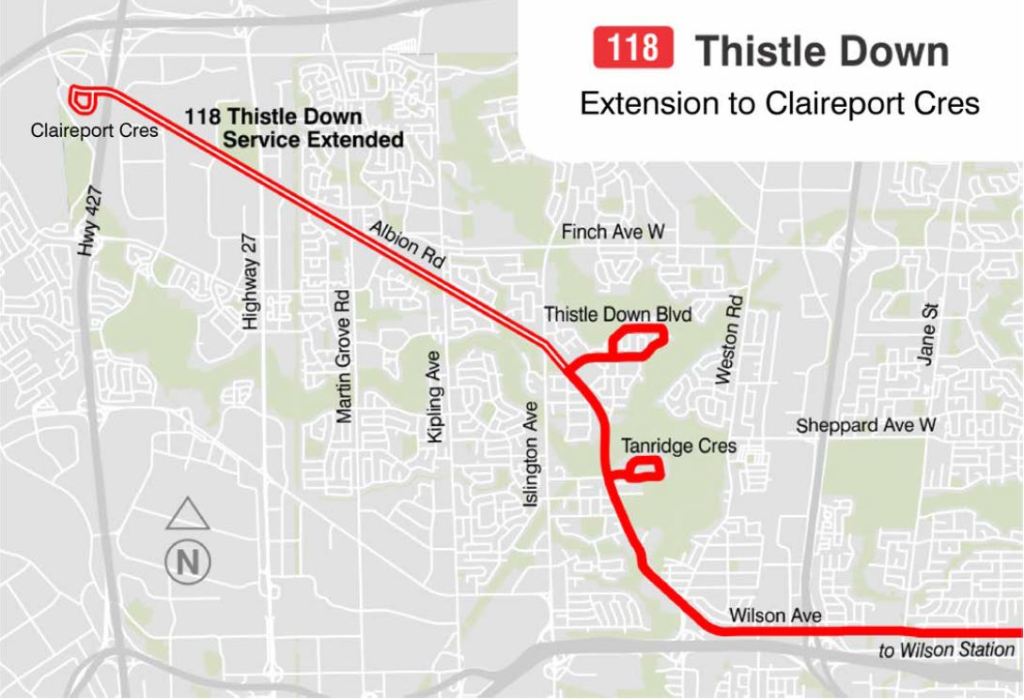
The 118 Thistledown extension to Claireport & Albion and the 8 Broadview extension to Coxwell Station will occur later in the fall, date TBA.
With the completion of the Line 1 Automatic Train Control project later this year, the TTC will be able to improve service on the subway. However, just what this means depends on the base against which “improvement” is measured.
There is a planned service improvement in September. Current service is not running at pre-pandemic levels, and we do not yet know if September will see a full restoration.
ATC will provide two benefits: trains can run closer together, but also travel times can be trimmed to reduce the number of trains needed. The degree that each of these will show up in new schedules remains to be seen. A related problem is that more frequent service can compound with excess running time to worsen terminal approach queues driving up travel time for riders.
Overall system ridership was at 57 per cent of pre-pandemic levels in June 2022 and is expected to rise to 70 percent in the fall. The TTC is finalizing their fall service plan to accommodate some return to in person office travel and post secondary demand. They plan to restore services to post secondary schools that were cut because of online courses. Details TBA.
There is no announced date for the opening of Line 5 Crosstown by Metrolinx, and so the planned route restructuring to support that line will likely not occur in 2022.





 Steve Munro