Readers with long memories might recall the early days of plans for a new streetcar order including discussions about how large a vehicle should be purchased. A major concern at the time was the possibility that the TTC would change schedules and run less frequent service with the larger cars just as they had when the articulated version of the CLRV (the previous generation of cars) arrived in the late 1980s.
That concern was softened by a TTC claim that service would actually improve. Peak periods would see slightly less frequent service, but a net increase in capacity, while off-peak periods would see little change in frequency effectively doubling the capacity of service. At the time, crowding was a big issue and this persisted right up to the pandemic in 2020, by which time all of the old cars had been retired. The management proposal was approved in July 2013.
As the CLRV/ALRV fleet aged, there were problems with reliability of older cars and the need to operate buses on some lines thanks to a shortage of working vehicles. Some repairs were done at considerable cost, but these were more cosmetic than a true life extension.
Moving forward to 2026, there has been a lot of talk of restoring pre-pandemic service levels. TTC fudges the numbers on this in many cases citing vehicle hours operated, not actual service frequencies which have been degraded by longer travel times.
(For example, if a round trip, including terminal layovers, takes two hours or 120 minutes, then 20 cars will provide a 6-minute service. If the round trip gets longer but no cars are added, the service is less frequent, but the number of vehicle hours stays the same. From a rider’s point of view, service is worse, but from a budget outlook, there is no change. This is at the heart of the discrepancy between TTC service claims and rider experience.)
After years of changing service levels and demand, the TTC’s Five Year Plan foresees a return to six minute headways, at most, as a new standard for daytime service. This has been rolled out on some routes over the past year, but not all.
Already at 6 minutes or better: 504 King, 510 Spadina
Improved to 6 minutes: 512 St. Clair (Sept/25), 511 Bathurst (Nov/25), 505 Dundas (Nov/25)
Pending, but with no committed date: 501 Queen, 503 Kingston Road, 506 Carlton, 507 Long Branch.
The Five Year Plan (at p. 4) includes provision for extra spending in 2027 and 2028, but this is not tied to specific routes. There is nothing in the Plan for 2026.
A related issue is the size of the streetcar fleet. Leading up to 2020, the issue was how many cars were actually available, and some service cuts flowed directly from this. With the recent delivery of 60 additional cars, fleet availability should not be an issue although service can still be limited by a lack of operators. The TTC currently schedules 163 cars at peak out of a fleet of 264. If services now operating with buses due to construction were also using streetcars (503 Kingston Road and the Broadview branch of 504 King), the peak requirement would rise to 178. Allowing for maintenance spares this would drive the total requirement to 214 leaving 42 surplus for service improvements (allowing for 8 spares).
February 2026 Schedule PM Peak
Full Streetcar Service
Possible Service
Peak Requirement
163
178
220
Spares at 20%
33
36
44
Total Requirement
196
214
264
Fleet
264
264
264
Surplus
68
50
0
The problem, of course, is that the TTC barely has budget headroom to operate existing services let alone increases.
In theory, some of the surplus cars will eventually operate the Waterfront East LRT extension, but that service is at least 8 years away even assuming Toronto finds the money to build it. In any event this will not require anywhere near all of the current surplus fleet. Another issue is that the “streetcar network” has not operated with 100% streetcar service for a few decades thanks to various construction projects and vehicle shortages.
There are parallel issues with the bus network, but they are complicated by issues of vehicle reliability and the need for a spare pool to cover the unreliable LRT service primarily on Line 6 Finch West. I will turn to the bus fleet in a separate article.
Back in 2013, the TTC proposed how it would operate with the new streetcar fleet. During peak periods, headways would widen particularly where existing service was very frequent. Notably on 501 Queen, there would only be a slight widening of the time between cars in the AM peak and no change in the PM peak. This reflected the fact that Queen was already running with the 75-foot long ALRVs and needed more capacity.
In the off peak, most routes would see no change in service level except for 510 Spadina due to its already frequent service of 50-foot CLRVs that could not be sustained at terminals with the larger new cars.
The overall fleet plan showed a buildup to a peak requirement of 168 cars plus 20% spares.
This plan gave a bright future for streetcar service and capacity growth, but things did not work out that way. Service today is generally lower than originally projected for the new fleet, and part of this reduction is due to slower operating speeds and greater provision for terminal recovery time even on routes with reserved lanes.
A related question is the effect that less frequent service has had on ridership. There is a post-pandemic slump on the streetcar system in part due to work-from-home for office jobs and remote learning for post-secondary students. However, even allowing for the pandemic era drop, the problem remains in attracting riders back to transit when streetcars are less frequent and slower, compounded by chronic problems with service reliability. Charts tracking streetcar ridership from 1976 to 2024, the last year published by TTC, are at the end of the article.
These routes are in the part of Toronto where transit riders should be easy to win, but a long decline in service frequency discourages those who have the option to use another mode including private autos, ride hailing or cycling. Service cuts during economic downturns do not magically get reversed as times improve, and ridership that might be wooed back to transit instead faces less reliable service and a political attitude that favours big spending on subway projects, not surface transit.
The remainder of this article looks at each route in detail to see how the actual service changed from the 2014 plan through the 2020s to today comparing:
The 2014 headways for AM Peak, Midday and PM Peak in the management proposal.
The proposed headways after routes converted to Flexity streetcars.
The actual scheduled service in January 2014, January 2020 (just before the pandemic) and February 2026. Driving times are shown separate from terminal recovery times to illustrate how each component has evolved.
Quite notable on many routes is the growth in both scheduled driving and terminal times. Although it is common in the mid-2020s to regard extended travel times and traffic delays as a recent, post-pandemic phenomenon, this pattern started earlier and is evident in 2014:2020 comparisons. Surplus time, it was argued, would prevent short turns, a claim that is demonstrably false as most riders know on a daily basis, but it slows service, wastes resources and forces wider headways.
The TTC’s Audit & Risk Management Committee will meet in the Boardroom at TTC Headquarters, 1900 Yonge Street, on Wednesday, March 11 at 9:30am. Two items on the agenda are of considerable interest:
The review of customer performance, metrics and real-time information covers at length the many problems with passenger information from the TTC including its website and various outlets for notices including social media and apps. This is an unusually candid review and long overdue.
Also included are charts showing the status of various recommendations from TTC and City audits, as well as from outside reviews. However, these are only summaries and there is no link back to source documents to cross-reference specific items, their severity and status.
Two confidential attachments address “The Subway Tunnel Maintenance and Rehabilitation Audit” as well as some findings from the UITP review.
Updated March 11 at 12:45pm:
Much of the meeting was conducted in camera. In the public session, a few concerns arose from the Committee:
There is a large and growing list of outstanding recommendations from both TTC Internal Audit and the City Auditor General, and the Committee was concerned about how, especially, high priority issues are tracked especially when they fall behind previously-promised due dates.
Although there was brief discussion of the issues of public facing information and performance metrics, the primary comments had the sense that finally problems are recognized, but without debate on specifics.
With respect to overtime, the Auditor will concentrate on exceptional cases where payments exceed expectations. Future reports will break down overtime by cause for clarity, e.g. planned work, weather related, special events, etc.
The TTC Board will meet on Tuesday, February 3, 2026 at 9:30am in North York Council Chamber. The agenda is rather thin, and there are several confidential issues that will trigger an in camera session. There is no formal item regarding Line 5 Eglinton, although one never knows what might come up in debate.
Of interest are the following items:
Updated February 2 at 10:10am: Slide decks for the invited presentations have been posted on the TTC site. Links to them are added below.
Narayan Donaldson on “Opportunities to improve Transit Signal Priority in Toronto”. According to the covering report “This presentation will discuss the strengths and weaknesses of the Transit Signal Priority (TSP) system used on Toronto’s streetcar, bus and LRT systems, compare it to a TSP system commonly used in the Netherlands, and suggest areas of improvement.”
Jonathan English on “Developing a Surface Transit Revitalization Plan” According to the covering report “This presentation will discuss steps that can be taken to improve speed and reliability of the streetcar network, as well as new LRT lines.”
After the meeting, I will write up the presentations in an update to this article.
This article presents an update on previous reviews to service levels in January 2026 comparing it both with January 2020, and with November 2024 to show what has changed over the past year. Also reviewed is the evolution of travel times on major routes to show the effect of congestion-related schedule changes from 2020 to 2026.
All headway and travel time data here come from the TTC’s Scheduled Service Summaries. An archive of these files is available on this site here.
The usual citation is the number of vehicle and train hours operated today versus the “before times”. Here are the raw numbers:
Planned Weekly Hours
Regular Service
Construction
Total
January 2020
185,825
7,068
192,893
January 2026
193,662
5,234
198,896
These values can be misleading because the 2026 and 2020 networks are not the same. Moreover, one vehicle hour does not provide as much service to riders today because of slower operation and increased recovery times in the schedules.
From a rider’s point of view what matters is the headway, the time between vehicles.
Although many routes have more frequent service today than in 2020, this is not universal. Riders do not travel on “average” routes, but on those needed for each trip. Their experience could reflect a decline in scheduled service on their routes. This is compounded by reliability and the perennial problems of bunching and gapping.
The table below compares January 2020 with January 2026 weekday headways. Five schedule periods are shown in the major groups reading across. Within these are the 2026 and 2020 headways, the percentage change, and the change in wait time.
Where the 2026 and 2020 times are unchanged, the cells are blank to avoid clutter. Otherwise, the 2026 headways are colour coded:
Green: Improved
Pink: Reduced
Blue: New service
Red: Service discontinued
There is a lot of pink in these charts indicating that many routes are less frequent today than six years ago.
Note that in January 2020, 503 Kingston Road and 505 Dundas operated with buses, and headways then reflected the lower capacity of those vehicles.
This article includes reviews of the 29/929 Dufferin local and express services to the end of 2025. The major item of interest is the introduction of “red lanes” south of Bloor Street and their effect on the bus service. Detailed charts are included here for:
November and December travel times in both directions between King and Bloor.
January 2024 to December 2025 historical stats on travel times.
The segment between Lawrence and Wilson that does not have transit priority, but which has much more congestion than at the south end of the route thanks to Yorkdale Mall.
General observations:
The benefit of the red lanes is more pronounced for northbound than for southbound trips, and only at certain times of the day.
There is much more severe disruption of service northbound near Yorkdale Mall, but no transit priority measures are proposed there.
Headways on Dufferin remain widely scattered near terminals (northbound at King, southbound at Transit Road just outside of Wilson Station).
Even on Christmas Day when weather was relatively benign and travel times were lower than normal, headways were not reliable.
Part of the improvement in travel time in December 2025 could be due to seasonal effects. When the data are in for early 2026, we will see how long-lived the saving actually is. I will publish an update to this article in a few months when the pattern is clear.
There are a lot of charts in this article, and I have put them all after the “more” break. Those who are interested in the details can open the full article.
I will turn to a review of 511 Bathurst streetcar and 7 Bathurst bus which both saw recent changes in future articles.
Update: For clarity, the red lanes currently extend only as far north as Dundas. After work up to Bloor is completed in the Spring, I will publish an update showing the effect.
The TTC will make changes to several routes on January 4. Some of this is simply the restoration of service oriented to school traffic, but several routes will see a mixture of adds and cuts to address ridership. The actual change from December to January is only 518 weekly hours, and most improvements are offset by cutbacks.
One new route, 906 Airport-Humber College Express will begin operating.
The detailed service plans for all changes are in a spreadsheet at the end of the article.
The last of the TTC’s 60-car add-on streetcar order arrived in Toronto recently, and entered service on December 16, 2025. This brings the streetcar fleet to 264 vehicles.
4663 at St. Clair Station Loop, December 16, 2025. Photo by Jeffrey Kay.
With so many streetcars, the real shame is that the service is so poor on many routes through a combination of 10-minute headways and erratic operation, not to mention the effect of never-ending diversions, construction projects and bus replacements.
The TTC began a shift to a 6-minute headway standard with 512 St. Clair earlier in 2025, and this was followed by 505 Dundas and 511 Bathurst in mid-November.
Due to construction at Queen & Broadview, the 503 Kingston Road car is operating with buses, and will continue to do so at least until April 2026. There are moves afoot within the TTC to kill off the all-day operation of the 503 downtown, but one of its biggest challenges comes from irregular service on the 503 itself, and the total absence of headway blending where the 503 joins the 501 Queen car westbound at Kingston Road and Queen. Pairs of 503 buses are a common sight today, and 503/501 pairs were common when streetcars plied both routes.
The TTC simply does not take seriously the effect of unreliable service on ridership.
As we see a move to a new 6-minute standard, the question is just how far the 264-car fleet will stretch. The table below shows all of the streetcar routes with headways and PM peak car requirements. Toronto has not seen every streetcar route active at the same time for a very long time thanks to equipment shortages during the later days of the CLRV fleet, and the omnipresent construction projects that always managed to keep a route running with buses. One might think that the TTC overextended its route closures simply to save on streetcar operations.
In fact, a big shortage lies in operating staff and in budget headroom to field more cars on a scheduled basis.
If all streetcar routes were operating with streetcars today, the TTC would need 172 cars for service. A 20% provision for spares would raise this to 206 leaving a substantial pool of cars on the sidelines.
The right-most column below shows the current peak requirements scaled up for routes that now run on headways above six minutes. For example, getting 501 Queen down from a 9-minute to a 6-minute service would require 14 more cars. The total for an all-streetcar operation would be 215 cars, plus 43 spares for a total of 258, only slightly below the fleet size.
Until we see details of the 2026 budget, we will not know if any more routes will join the 6-minute network in the coming year.
Route
Headway
Peak Cars
Cars Required for 6-Minute Network
501 Queen
9’00”
28
42
503 Kingston Road to York (April 25)
10’00”
12
20
504 King (April 25)
5’00”
27
27
505 Dundas
6’00”
25
25
506 Carlton (Sept 25)
10’00”
19
32
507 Long Branch
10’00”
8
13
508 Lake Shore
Trippers
5
5
509 Harbourfront
9’00”
6
9
510 Spadina
5’00”
14
14
511 Bathurst
6’00”
14
14
512 St. Clair
6’00”
14
14
Total
172
215
The 60 new cars were intended both to handle growth and to provide for the Waterfront East line that is still only a faint hope for better transit there. An update on this project is expected at Council early in the new year, but a projected opening date lies in the 2030s.
The TTC is also short carhouse space. Thanks to the arrival of all 60 cars well before planned work completes to expand storage and maintenance capacity at Russell and Hillcrest. Part of the main shops will be converted as a streetcar barn serving 512 St. Clair and possibly 511 Bathurst. Several Blue Night streetcar routes operate with improved headways simply to reduce overnight storage demands on the carhouses.
The streetcar system always pulls up the rear in reliability stats, and recovery of pre-pandemic demand is not as strong on that part of the network as elsewhere. This is due in part to a shift in travel and work patterns in the area streetcars serve, but one cannot help wondering how much the erratic service deters riders from returning.
An ironic side-effect of a move to 6-minute service is that this makes “on time” an easier target, but with bunching as a daily event. The reason is that TTC vehicles can be up to 5 minute late and still count as “on time”. On a 6 minute headway, this easily leads to pairs of “on time” vehicles every 12 minutes. The real condition of service is hidden by a too-easily attained “target”.
The bus network also has fleet utilization issues, but these are a mixture of scheduled service levels, vehicle reliability, budgeted headroom for growth and the use of “Run As Directed” buses. The “RADs” are a relic of the Leary era that were routinely cited as a catch-all alternative to addressing specific problems. The vehicles were not well-used and their numbers dwindled as the pool of spare operators moved to other duties, notably on Lines 5 and 6. I will turn to the bus fleet in a future article.
For 2026, streetcar routes face many challenges:
Provision of enough budget to allow improved utilization of the streetcar fleet.
Service management that actually brings evenly spaced streetcars on dependable headways.
Addressing the validity of operating practices that hamper streetcar speeds everywhere, rather than just at locations with problems such as badly worn track. This includes sorting out constraints that really do relate to “safety” as opposed to using that as a catch-all excuse for padded schedules.
Addressing track switch controller issues that have plagued the streetcar network for decades.
Providing real transit signal priority for streetcars including at locations where diversions and short turns see streetcars fight through traffic attempting turns with no signal assistance at all.
An end to construction diversions scheduled for longer periods than actually needed to complete road, water, track and overhead repairs or upgrades.
Getting City projects that are supposed to be co-ordinated with streetcar track and overhead repairs to actually start and end when they are planned.
The TTC will adjust schedules on December 21 to reflect lower demand over the holiday period.
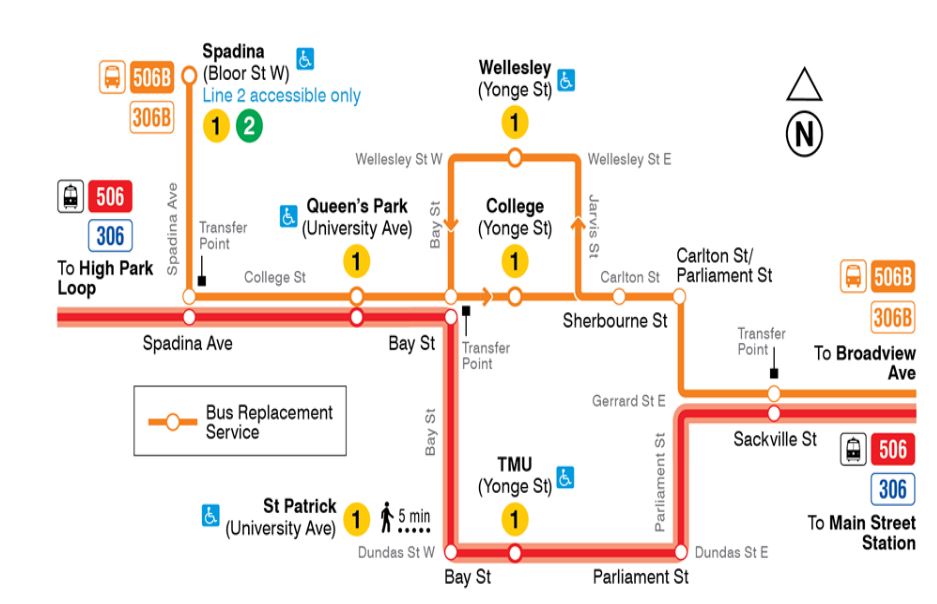
506/306 Carlton will revert to the normal route between Spadina and Bay following work at McCaul Street. Additional service on the west half of 94 Wellesley will be removed.
306 Carlton night service will be improved from a 20′ to a 15′ headway.
The following routes will get added, unscheduled service using surplus operators:
57 Midland
80 Queensway
89 Weston
123 Sherway
131 Nugget
960 Steeles West Express
Some routes which received unscheduled additions in November will lose it for the holiday period. This will be restored in January.
7 Bathurst
24 Victoria Park
25 Don Mills
29 Dufferin
100 Flemingdon Park
165 Weston Rd North
Service over the period will be adjusted day to day as shown below.
Date
Service Design
Fri. Dec. 19
Regular weekday service
Sat. Dec. 20
Regular Saturday service
Sun. Dec. 21
Regular Sunday service with minor changes
Mon. Dec. 22 to Wed. Dec. 24
Adjusted weekday service (school trips removed)
Thu. Dec. 25
Holiday service with most routes starting at 8am
Fri. Dec. 26
Holiday service with 32 shopping extras between 11am and 10pm
Sat. Dec. 27
Regular Saturday service with minor changes
Sun. Dec. 28
Regular Sunday service with minor changes
Mon. Dec. 29 Tue. Dec. 30
Adjusted weekday service (school trips removed)
Wed. Dec. 31
New Year’s Eve service (see below) (school trips removed)
Thu. Jan. 1
Holiday service with most routes starting at 8am
Fri. Jan. 2
Adjusted weekday service (school trips removed)
Sat. Jan. 3
Regular Saturday service with minor changes
Sun. Jan. 4
Regular Sunday service
Mon. Jan. 5
Regular weekday service including school trips
New Year’s Eve Service
Service will operate free of charge from 7pm on December 31 to 7am on January 1. Late evening service on most routes will be extended to 3am January 1.
Depart
Arrive
1 Yonge-University-Spadina
North from Union to Finch
2:31 am
3:02 am
North from Union to VMC
2:27 am
3:10 am
South from Finch
2:00 am
South from VMC
1:50 am
2 Bloor-Danforth
East from Kipling
2:15 am
East from Bloor-Yonge to Kennedy
2:40 am
3:02 am
West from Kennedy Station
2:18 am
West from Bloor-Yonge to Kipling
2:39 am
3:08 am
4 Sheppard
East from Sheppard-Yonge to Don Mills
2:57 am
3:05 am
West from Don Mills to Yonge to Sheppard-Yonge
3:09 am
3:17 am
Contract services on 52 Lawrence West to Westwood and 68 Warden to Major Mackenzie will end at about 3am. 160 Bathurst North, 102 Markham Road and 129 McCowan North will end at their usual times.
Note that the memo detailing these changes was issued before Line 6 Finch opened, and therefore contains no info about that route.