TTC 2019 Fleet and Capacity Plans Part II: Streetcars and Buses

Streetcars

There are several related projects in the 2019-2028 Capital Budget and in the 2019-2033 Capital Investment Plan. These include:

  • Completion of the 204 car Flexity order now in progress
  • Purchase of 100 additional cars for growth and expansion
  • Renovation of Russell Carhouse for maintenance of new streetcars
  • Major renovation of Harvey Shops for maintenance of new streetcars, and as the operating carhouse for (at least) 512 St. Clair

Allocation of the New Flexity Streetcar Fleet

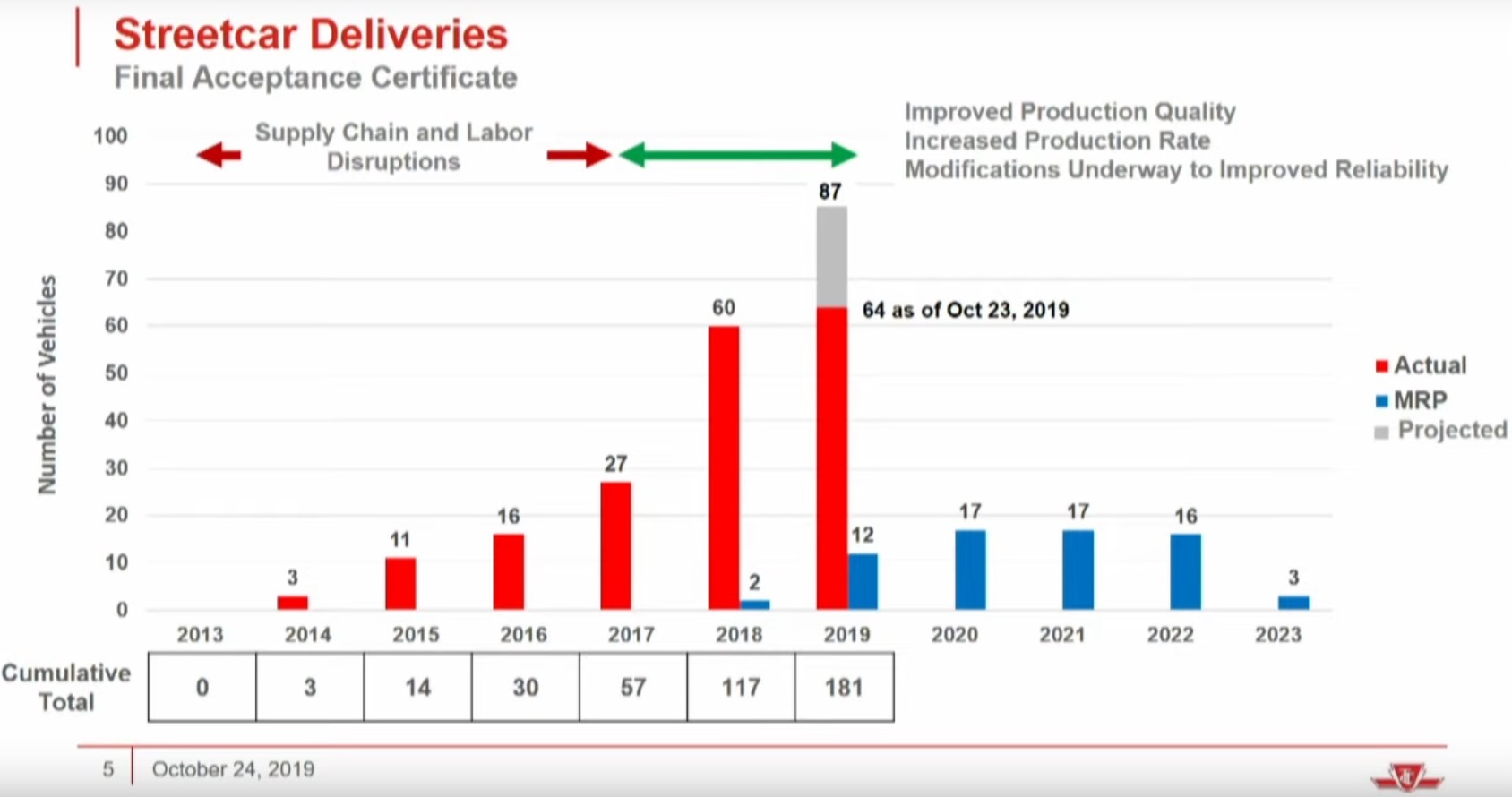
As I write this on March 20, 2019, the TTC has received cars 4400-4535 from the Thunder Bay plant and 4572-4573 from Kingston. Of these, prototype 4401 is at Bombardier for production refits, and a pool of four to six cars will be out for major repairs for the next few years.

CEO Rick Leary has stated on a few occasions that the buses now on streetcar routes will come free for service on the bus network by year end when all new cars have arrived, and that all of the legacy CLRV/ALRV (standard sized and two-section articulated cars respectively) will also be retired this year. This directly contradicts his own Capital Investment Plan which shows that buses will still be required into the mid-2020s when, in theory, a further order of 100 streetcars would arrive.

However, even assuming that Bombardier does deliver the last of its order up to car 4603, there will not be enough new cars to cover service on all of the lines. The table below compares service as it existed back in 2006 before the new cars were ordered, the TTC’s plans for Flexity implementation in 2013, the current schedule requirements, and the number of streetcars needed if all routes return to rail operation.

The numbers above are divided into six sets:

  • The 2006 AM peak service requirement for all streetcar routes assuming that there are no construction projects underway. This is a blend of sources to avoid diversions and substitutions.
  • The actual service in March 2019 (current).
  • The streetcar service operated a few years ago on routes that now have full or partial bus operation.
  • A hypothetical March 2019 service assuming that the five routes now with buses (511 Bathurst, etc) were operated using streetcars.
  • The TTC’s June 2013 deployment plan for the new cars.
  • A hypothetical March 2019 service assuming current Flexity service for routes that have already converted such as King, and the 2013 deployment numbers for routes that have not.

For the purpose of this discussion, the ALRV fleet is assumed to have been retired even though, officially, schedules still call for five of them to run on 501 Queen. In practice these, and some CLRV runs, are operating with Flexitys.

The total fleet requirement including spares at 20% would be 216 cars, and this is 12 more than the TTC will actually have without allowing for a half-dozen cars undergoing major repairs. This means that it is impossible to operate the streetcar system without either trimming service or leaving buses on some routes. When there are construction projects that block streetcar service (such as the work by Toronto Water now underway on Dundas), there would be enough cars operate the rest of the network. Otherwise, the most likely candidates for buses are the perennial targets, the Kingston Road services 502/503.

Some routes – King, Spadina and St. Clair – have more service today than the 2013 deployment plan provided, but this means that there are not enough cars to handle the rest of the network as originally planned. Service improvements on the streetcar system are limited to the added capacity that Flexitys will provide on routes still using old cars (e.g. Queen), but there is no headroom from 2020 onward.

Expanding the Fleet

In the 2018 Capital Budget, the TTC planned to acquire 60 more streetcars in 2019-20 for ridership growth, and 15 in 2020-21 for new Waterfront service. In 2019, this has changed to a larger order in the mid-2020s. However, the budget is inconsistent in its presentation of needs and timing.

The chart below is adapted from the fleet plan as it appears in the budget. (The copy I have is in black and white muddying some details depending on colour.) This shows a proposed purchase of 95 cars in 2025-28. It is already out of date because the CLRV and ALRV fleets will be retired sooner than planned. This creates a shortage that prevents full return to streetcar service at the end of 2019 when the Flexity deliveries are supposed to be complete.

Projections out to 2043 show a very substantial increase in the streetcar fleet to almost double the planned fleet in the early 2020s. That’s a lot more streetcar service than we have today. However good this might look, it does not address the challenge that there are not enough cars for the lines and service levels today, and this will not change in the near future.

A few pages later in the budget is a project to purchase 60 new cars which clearly shows the need for 60 cars starting in 2020, with even more in the future. Of particular note is the text about the effect of deferral on service. This project description is obviously out of date, but that is a common problem with the budget.

The actual spending has been moved to 2024-27. It goes without saying that whatever the date, this is an unfunded project.

Adding to the inconsistency is the statement in the 15 year Capital Investment Plan that the TTC would purchase “approximately 100 additional streetcars from 2025 to 2028 to meet demand, at a cost of $510 million”. [p. 54]

A further problem lies in the planned renovation of Russell Carhouse to handle Flexity maintenance similar to the work now underway at Roncesvalles. This will take that site out of operation for two years. Without Russell’s capacity, there would not be enough room to accommodate the extra 60 streetcars if they were procured as originally planned.

The TTC is also considering major changes at Harvey Shops which, as currently configured, can only be used for a small number of Flexitys. The scheme is to revise the layout of tracks and service areas, and to make this an operating site for, at least, the fleet needed on 512 St. Clair. This would very substantially reduce the dead head mileage for 512 St. Clair cars that shifted to Roncesvalles Division from the carhouse at Wychwood, only a short distance north of Hillcrest, in 1978. However, this capacity would not be available until 2028, and the Fleet Plan shown above does not include it. That site would also substantially increase storage capacity on the streetcar system because, in another project, the TTC proposes shifting bus maintenance operations to a new as yet unknown location. This is separate from the construction of another bus garage in the 2020s.

All of this assumes that money will be found to pay for the larger fleet and facility changes needed to accommodate it. In the chart below, all figures are in billions of dollars including inflation. Note that the $370 million for the current 204-car purchase is the remaining money to be spent in years that are part of the Capital Investment Plan, not the total project cost.

The TTC clearly has plans to improve and expand the streetcar system, but there is a deadly combination of constrained capacity growth and rising demand which will not be addressed in the short-to-medium term. That drives potential riders away from transit and adds traffic that streets cannot absorb more demand.

Buses

For many years, growth in bus service has been limited because the TTC has no place to put more buses even if they bought them. This allowed TTC management to avoid the basic issue of how much service was really needed, and budget hawks on Council to avoid increasing TTC subsidies to pay for this.

The chart below is adapted from the fleet plan in the capital budget. The first column shows the fleet makeup before 2014 and then shows the procurements and retirements over the period to 2034.

  • The “Net” column is a check on the arithmetic to ensure that the numbers actually net out. There is an error highlighted in red where the TTC claims it will retire more buses than it actually owns. This has only a small effect on the future fleet size (five out of two thousand buses).
  • There are 200 hybrids and 60 electric buses in the 2019 budget, followed by a pause for one year in 2020 when there will be no purchases. This is partly a result of timing pressure to spend federal PTIF dollars within the required window, and partly to provide an evaluation process for the electric buses.
  • Electric bus purchases will begin in earnest in 2021 with the last of the existing diesel and hybrid fleet being retired by 2033.

The projected service requirements have changed since the 2018 version of the plan, and both versions are shown in the chart. Four planned major events will reduce bus requirements:

  • The Eglinton Crosstown LRT opens in 2021 replacing frequent bus services on several routes.
  • The Finch LRT opens in 2023 replacing bus service west of Keele Street.
  • The Scarborough Subway Extension opens in 2026 shifting the termini of many routes to STC station.
  • The planned expansion of the streetcar fleet in the mid 2020s eliminates the need for buses to supplement/replace streetcar services.

The use of articulated 18m buses will increase by 68 vehicles in 2021 if this plan holds. The next round of artic purchase in 2025-26 will replace the 153 diesel artics now in the fleet, but there are no net additions.

With the shift of the bus fleet to electric operation, the TTC plans to convert its garages at a rate of two per year. However, they have not produced a plan that aligns this conversion with the rate at which electric vehicles will replace diesels and hybrids.

Garage space continues to be an issue. The current capacity across seven garages is 1,631 buses compared to a total fleet of 2,012, a shortfall of 381. Even when McNicoll Garage opens in 2020 adding capacity for 250 buses, there will still be a shortfall with system capacity of only 1,881. A ninth garage to add a further 250 spaces is not planned to open until 2031. That garage, like many projects, sits in the “out years” of the capital plans so that it does not contribute to the shortfall in available funding over the 10-year span of the budget.

This puts the TTC and its would-be customers in a long-standing box when looking at service improvements. For another decade, Toronto will be told that there is no room for more buses beyond the current fleet plans. The planned growth in peak service from 2026 onward is under one per cent per year.

TTC management plans to bring forward a service plan later in 2019 which will examine future demand. A vital part of such a report will be to look not just at minimal ridership and fleet growth, but to consider what happens if service improves at a substantial rate. Oddly, there is provision for this in the streetcar fleet plan, but not in the bus plan.

The 15-year Capital Improvement Plan includes construction of a collision centre and heavy overhaul facility for the bus fleet. This would release space now used at Hillcrest allowing it to be repurposed as a new streetcar shops and depot. The engine shops now at Hillcrest would become obsolete with the migration to an all-electric bus fleet.


Will the TTC Presto Project Ever End? (Updated)

Updated March 19, 2019 at 4:00 pm: The TTC has replied to questions I sent about the new Presto spending. There is a major change in project scope.

Buried in hundreds of pages of the TTC’s Capital Budget are a few sheets on the implementation of Presto, the fare system foisted on Toronto by Queen’s Park.

According to the project description, the estimated final cost (EFC) for the TTC would be $44 million (this is net of subsidies from other levels of government). However, as the project budget shows, $43 million was spent to the end of 2017, and a further $19.4 million in 2018. Most of the costs booked to date have been under the category of “Project Management”.

The project is supposed to wind up in 2019, but there is a budgeted TTC cost of $17.3 million.

And lo and behold! In 2020 there is a further $49 million.

Both the 2019 and 2020 spending are net new in the budget this year, although $47 million of the 2020 amount is still considered to be “unfunded”.

On March 5, 2019, I asked the TTC what this proposed spending was to cover considering that the Project Summary (below) is silent on this new money.

And so a question for everyone who is following the Presto story: Why is there a total of $66.3 million in new money included in the 2019-2028 Capital Budget that was not there last year? What will it pay for? Will this spending ever end, or are will Toronto continue to discover costs for Presto it missed when the project to adopt this system was sold to the TTC Board and Council?

The TTC Replies:

A portion of 2019 added funding is to enable TTC farecard staff to continue work on PRESTO implementation (products, service standards, etc.)  There is also a portion of unspent 2018 funds carried forward into 2019.

Some 2019 costs and the 2020 cash flow is a preliminary estimate for the cost of an on vehicle ticket solution for buses that will allow customers to pay with cash to obtain a ticket that will allow them to pass through faregates.  This is a very early estimate that was developed as part of the comprehensive list of projects identified in the Capital Investment Plan.  As noted, aside from initial funds for a feasibility study this project is not funded.

The 2019 funding increase was two part:

a) Continued PRESTO implementation costs

The PRESTO rollout was anticipated to be substantial complete in 2018 with the rollout of the PRESTO Ticket product, and solutions for cross boundary travel, downtown express travel and other PRESTO payment products. MX was unable to deliver these items, particularly PRESTO Tickets, as expected in 2018 and delayed the implementation to 2019. Resources were also added to the capital program to addresses software quality and system performance issues. Additional capital funds were requested to accommodate and support the continued work and change to the PRESTO implementation plan.

b) Commence initial Cash on Surface (Farebox Replacement) work

A solution is required to allow cash paying customers transferring from surface vehicles (buses, streetcars, Wheel Trans) to enter non-integrated TTC stations with fare gates. Initial capital funds were added to year 2019 and 2020 as a very early estimate that was developed as part of the comprehensive list of projects identified in the Capital Investment Plan.  This funding is for business case development and feasibility analysis only.

We had also added funds for the development of a fare payment solution for Wheel Trans contracted taxis in the event Metrolinx/PRESTO was unable to do so.

[Email from Stuart Green, March 19, 2019]

Continue reading

TTC 2019 Fleet and Capacity Plans Part I: Subway (Updated)

Note: At the time of publication (Noon on Monday, March 18, 2019), I await a response from the TTC to several questions on issues raised in this article. When the responses arrive, I will update the article.

Updated March 20, 2019 at 6:40 am: The spreadsheet of major project costs has been revised to show the correct final cost for the Line 2 Platform Edge Doors project. The value under “post 2028” was correct, but the EFC originally contained the value for the Bloor-Yonge project. This change does not affect the text of the article as PEDs were cited only in that table.

The TTC’s Capital Budget and Plan exist in a summary form in reports to the TTC Board and City Council, but there is a much more detailed version commonly known as the “blue books”. These are two large binders packed with information about capital projects.

For years, I have been reading them to sniff out issues that the general reports don’t cover or acknowledge. The 2019 edition became available at the beginning of March, and as I dove into it, many questions began to fill notes especially where there are direct conflicts between materials in the books themselves, and between these details and public statements and reports. Combing through this material may look like the height of transit nerdishness, but there is a crucial underlying issue here.

Cost-cutting politicians, not to mention ambitious transit managers, think that everything can be solved with a quick takeover of ownership and decision-making responsibilities. The temptation is to appear to do much while spending as little as possible. TTC and City practices chronically understate the capital needs of the transit system, and this makes a takeover appear cheaper than it really should be. Couple that with a government and its agency, Metrolinx, where detailed, long-range spending plans never appear in public, and we have a recipe for a system that will crumble from underfunding.

I cannot help but feel that project timings and overall plans for the system have been shuffled around without a thorough review of the effects especially where related plans overlap. Indeed, some project descriptions contain text that does not match the timing implied by the annual budget allocations. TTC management is supposed to be working on consolidated plans for both major subway lines, although the one for Line 2 was promised two years ago when Andy Byford was still the CEO.

A long-standing problem with capital budgets in Toronto, and not just at the TTC, is the overriding concern with the City’s debt ceiling. Toronto sets a target that the cost of debt should not exceed 15 per cent of tax revenue. Originally this was a hard cap for each year in a ten-year projection, but major projects in the near future made this impossible to achieve. Now the target is to stay at or below the ceiling on average. With a bulge in spending, and hence an increase in debt, in the mid 2020s, debt costs go over the line and this is “fixed” only by having years at less than 15% to make the average work out.

For a capital-hungry agency like the TTC there is a problem: future projects have requirements that simply do not fit into the City’s plans. The severity of this shortfall has been understated for over a decade by three simple expedients.

  • Project schedules in the budget are pushed beyond the ten-year mark where the related debt pressure would appear in City projections.
  • Projects are shown “below the line” in unfunded status with a hope that revenue sources such as new subsidies from other governments will appear.
  • Projects are omitted from from the budget completely.

The result is familiar to city-watchers with annual hand-wringing about the sky falling tomorrow, while somehow we manage to pay for today’s projects. In January 2019, the TTC knocked the legs out from this with the publication of a 15 year Capital Investment Plan revealing capital needs far greater than any numbers used in past projections. What had been a ten year, $9 billion plan that was roughly two-thirds funded (i.e. had known or likely monies available) went to a fifteen year, $33.5 billion plan with only one-third funded. This is just for “state of good repair”, and any system expansion sits on top.

In all of this lies a more subtle problem than simple financing. Years of shuffling projects made projected spending fit within City targets, and this served political needs to make key projects appear manageable. Overall planning, including the relationships between line items in the budget, took second place, if it was considered at all.

Capital planning requires a long-term view of the city and its transit system, and decisions made today have effects reaching more than a decade into the future. Toronto continues to suffer from delays in provision of new fleets for the surface system, including the garage space needed to hold a larger bus fleet, that go back at least to the era of Mayor Rob Ford. For years, the standard response to pleas for better transit service is that there are no buses and streetcars to provide more service, and even if we had them, we would have no place to put them. This flows directly from decisions to throttle spending.

Toronto faces the same challenge on its subway where decisions about the timing of spending, even of acknowledging the scope of requirements, limit the ability to address capacity problems.

This is a long article focusing on matters related to fleet planning, although there are related issues with infrastructure and facilities. Key points are summarized first, with details in following sections.

Continue reading

The Evolution of TTC Ridership and Fares 2005-2018

Recent discussions about TTC ridership and fare evasion included references to the numbers of riders who use each fare medium, but this was not published in detail in reports and presentations.

The TTC publishes a breakdown of ridership through the City of Toronto’s Open Data Portal including values for each type of fare annually back to 1985. Charts in this article use the data from 2005 onward. [Click on any chart to open an expanded version.]

Adult Fares

With the availability of Presto, Adult fare payments have been migrating to that medium for the past few years. The chart below shows the number of rides by fare type and the evolution of the preferred medium is clear over the years.

  • In 2005, the number of token fares (red) was lightly greater than the ticket fares (orange), but ticket use dropped off as this medium was withdrawn.
  • Metropass fares (dark blue, an estimated count of trips based on user diary records) grew  considerably to 2014, and then began to drop as Post Secondary passes (green) and later Presto (yellow) and Presto-based Monthly Passes (dark green) ate into Metropass usage.
  • Weekly passes have never accounted for much of the total. Other small fractions are broken out in a separate chart below.
  • Total Adult ridership has been falling since 2014, although this was masked in overall counts by the rise in Children’s trips with the advent of free travel.
  • Note that 2015 is shown with an asterisk. Ridership due to the Pan Am Games is not included in the totals to allow consistent year-over-year comparisons.
  • A Presto “SRVM” is a “Single Ride Vending Machine”.
  • Presto usage jumped substantially in early 2019 with the discontinuation of Metropasses, but this is not reflected in data to 2018 below.

The bands associated with monthly passes could overstate actual ridership depending on the accuracy of diary-based estimates. There is likely a drift between the ridership multiple (rides/pass) used to calculate the published figures and the actual ridership as discussed in my previous article about the Auditor General’s Report.

The data above show ridership values, and these are reformatted below as percentages of all Adult trips.

In order to make the low-usage media values clearer, the chart below includes only media for which less than five percent of Adult fares were paid with each type.

  • The Weekly Pass (turquoise) tops out at about 2.5% of all Adult fares in 2012 and then drops again on a clear downward trend by 2018. This pass will likely be replaced by some form of fare capping later in 2019, but there is no definite decision yet on this.
  • The two hour fare only came into use in mid 2018, and it does not yet represent a large number of trips. Indeed, counting these as “trips” is a challenge in comparison with the previous fare structure where a “free” transfer may have been valid, or not, depending on the nature of the trip.
  • The Presto Monthly Pass became available in mid-2018, but Metropass users opted not to convert to it in large numbers until 2019.

Senior and Student Fares

Seniors and Students receive approxiately a 1/3 discount over Adult fares at the ticket/token rate, although their discount for passes is lower. This means that more trips must be taken by a passholder to “break even” compared with paying by tickets.

  • There was a steady growth in Monthly Pass usage (dark blue) up to 2016 that was since reversed by Presto-based fares. Weekly passes (turquoise) accounted for a trivial number of trips.
  • Tickets (orange) and Cash (grey) have long been the dominant payment medium for this group of riders.
  • Presto fares (yellow) made a considerable inroad into ticket use in 2018.
  • Total ridership by Seniors and Students dropped slightly in 2018.

The chart below shows the same data as percentages of all Senior and Student fares.

The low-usage media for Seniors and Students are a small percentage of that market, which in turn is considerably smaller than the Adult fare market.

Children

The advent of free rides for children 12 and under more than doubled the estimated riding from this group. Presto “children” (although there is some dispute about how many of these are genuine) have added a few more.

Miscellany

Finally we come to a collection of fare media that collectively account for a small and declining amount of total ridership. Day Pass usage has been dropping thanks to Presto, and this medium will disappear entirely later in 2019.

Total Ridership

The jump of over 10 million rides associated with free children’s travel offset a chunk of the adult ridership loss as noted above. This also partly blinded the TTC Board and Senior Management from what was happening to their system overall. The decline of total ridership began in 2017, but the Adult decline had already been underway since 2015.

The complete set of charts in PDF format is linked below.

TTC_Ridership_Analysis_2005_2018

TTC Board Meeting: February 27, 2019

The TTC Board met at City Hall on Wednesday, February 27.

There was also a meeting of the Audit and Risk Management Committee at TTC Headquarters, 1900 Yonge Street, at 9:00 am on Tuesday, February 26 with many items that are also on the full Board’s agenda.

The City Auditor General’s report on Fare Evasion was on both agendas. Given its length and detailed content, I reviewed it in a separate article. An update on actions taken by the Board is included below.

Also in this article:

Continue reading

TTC Service Changes Effective March 31, 2019

TTC service changes for the schedule period running from the end of March through to mid-May 2019 are comparatively minor.

The reconstruction of King-Queen-Roncesvalles, originally planned to start this spring, has been delayed to 2020. Planned changes in affected streetcar services will not occur, although some revisions to 504 King are expected in May to address service reliability. The schedules for 29/929 Dufferin service have been left as originally designed for this period with all service extended to the Princes’ Gate Loop. This change will be reversed in May.

Construction begins on the CNR bridge over Coxwell Avenue. Half of the underpass will be closed at a time, and this begins with the northbound roadway. 22/322 Coxwell services will divert via Woodbine and Danforth.

Reconstruction of the bus roadway at Jane Station was planned to begin with these schedules, but work has been deferred until May. The new schedules provide for extension of the 26 Dupont and 55 Warren Park routes to Old Mill Station, but they will actually operate to Jane Station pending start of construction. At that time, the 35/935 Jane services will shift to on street loading on Jane Street.

On line 1 Yonge-University-Spadina, the crew relief and break point will move north to Vaughan Metropolitan Centre Station from Sheppard West Station.

Route 95/995 York Mills will be revised with weekday midday 995 express service added to the schedule. The midday 95B service to UTSC will be replaced with 95C service to Ellesmere Station as in the peak periods.

There are minor changes on several bus routes (see the linked summary for details) to adjust running times and headways.

Updated March 14, 2019: The number of vehicles on 167 Pharmacy North has been corrected in the spreadsheet linked below.

2019.03.31_Service_Changes

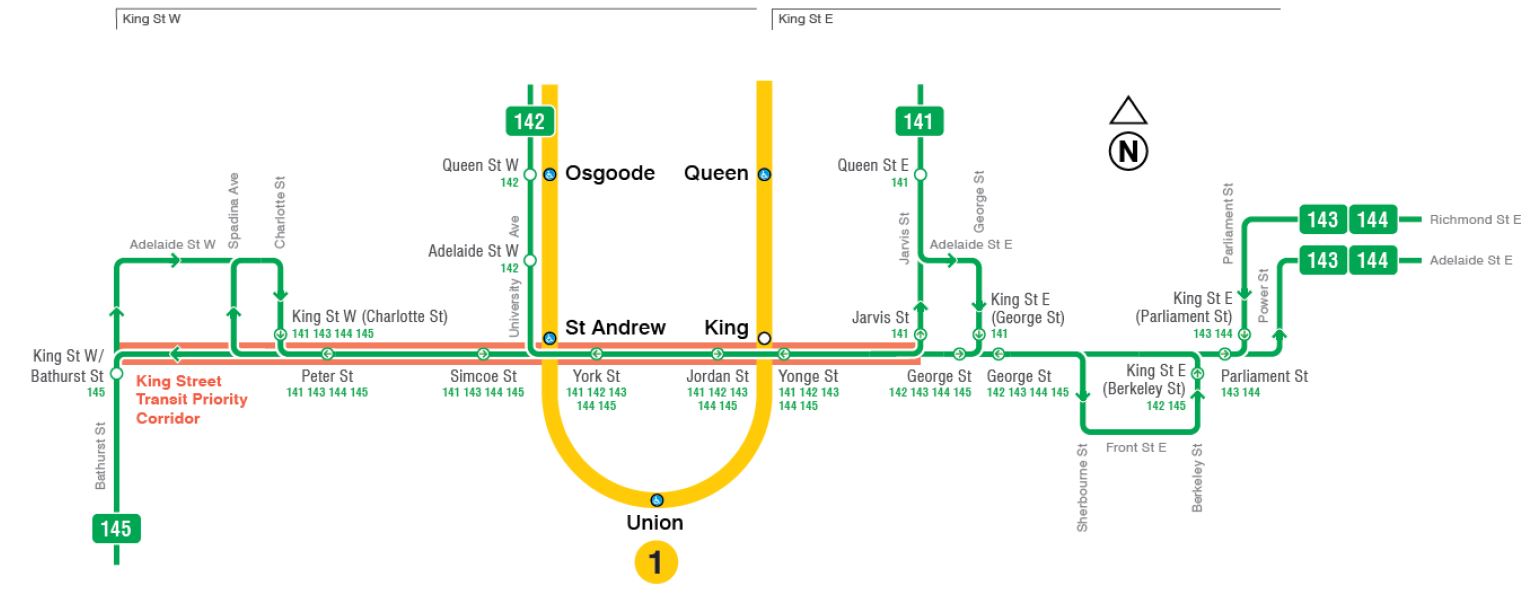
Waterfront Transit “Reset”: The Union Station Connection

Toronto’s Waterfront Transit Reset planning has been underway since 2016, and most of the decisions about routing were settled by early 2018.

A major outstanding issue was the link from Queens Quay to Union Station. Three options were originally under consideration:

  • Retaining the streetcar link with an expanded loop at Union to provide greater capacity and an underground junction at Queens Quay leading to the Waterfront East line.
  • Replacing the streetcar operation am “automated people mover” (now “APM”, but originally called a “funicular”) using two linked trains, one in each tunnel, and an expanded station at Queens Quay. The APM trains would be linked by a cable that would move the cars, and they would have no on-board propulsion. When one train is at Queens Quay, the other would be at Union.
  • Replacing the streetcar operation with a pedestrian walkway and moving sidewalk from Union to Queens Quay.

In the two latter schemes, the original idea was to keep the streetcars on the surface at Queens Quay with links down to a station below.

The walkway/moving sidewalk option was discarded early in the process because there was not enough room for a bidirectional ramp (akin to what used to be at Spadina Station) and walkway, and a unidirectional ramp would pose accessibility problems.

Two technologies remained – streetcar and automated people mover (APM) – for the tunnel with sub-options for the interchange between APM and streetcar.

Streetcar with expanded Union loop and Queens Quay Station (modified EA)

APM with streetcar below grade at Queens Quay / Bay

APM with streetcar at grade along Queens Quay

The design of a surface station at Queens Quay proved to be unworkable because of:

  • the space that would be taken out of the street by track, platforms and vertical access to the station below,
  • the volume of transfer traffic projected and its potential conflict with other activity for this location,
  • the need for an outdoor transfer connection.

For both remaining schemes, an underground station would be required at Queens Quay although the design would vary depending on whether the streetcar or people mover option was selected for the Union link.

Overall Evaluation

The two options were evaluated for various factors including user experience, overall network benefit, construction effects, and cost. On balance, the streetcar option won out, and the people mover option was not as simple and cheap as its proponents had thought. The one criterion on which the PM did rank better was construction difficulty.

This recommendation will go to Toronto’s Executive Committee, the TTC Board and Council in April along with reports on other major projects including SmartTrack and the Scarborough Subway Extension. How much attention the Waterfront will get in the midst of debates on larger projects remains to be seen, and of course there is always the problem that available funding falls far short of paying the bills for every project on the table.

Toronto talks a good line about “transit first” development, but never puts up real money. The waterfront is always a project for some indefinite future time, but not now. As a city, we love new buildings and crow over the number of cranes in the sky, but we assume that travel demands these buildings create will magically flow over the existing network. On a regional scale, this has delayed needed growth in GO Transit and the Relief subway line, and on a local scale it limits transit growth to a handful of very expensive subway extensions whose value is counted first in votes.

Development at a scale many parts of the GTA can only dream of will occur within a few kilometres of Union Station, and there is a great danger that transit will not be ready as buildings come on stream.

Continue reading

Fare Evasion on the TTC: The Auditor General’s Report

With official ridership stats flat or falling over the past few years, and the annual pressure to raise fares to balance the budget, the issue of fare evasion comes up regularly as an untapped revenue source. This became a particular concern with the move to all-door loading on, primarily, the streetcar network where the absence of a fare check at vehicle entry gives more scope for evasion than on buses or in subway stations.

Toronto’s Auditor General (AG) has issued a report and a video on this topic. They will be discussed at the TTC’s Audit & Risk Management Committee meeting on Tuesday, February 26, and at the full Board’s meeting on Wednesday, February 27.

The political context of fare management comes in on a few counts, and should be remembered when reading about dubious decisions and practices as flagged in this report.

  • As the TTC shifted to larger vehicles, primarily on the streetcar system, an important goal was to increase the ratio of riders to operators. However, as all-door boarding and Proof-of-Payment (PoP) became more common, the need to validate fare payments went up. The politicians who control TTC funding at the Board and Council levels have a fetish for “head count” where limiting the growth in staff, or better still reducing their numbers, takes precedence. The result was that the number of Fare Inspectors did not keep pace with the growth in PoP.
  • Presto was forced on the TTC by Queen’s Park under threat of losing subsidies for other programs. There is a strong imperative to report only “good news” about Presto both at Metrolinx and at the TTC for fear of embarrassing those responsible at both the political and staff levels for this system. Getting the system implemented took precedence over having a fare system that worked.
  • Historically the TTC has claimed that fare evasion on its system amounts to about 2% of trips. With fare revenue for 2019 budgeted at $1.2 billion, this would represent a loss of about $24 million in revenue. If the actual evasion rate is higher, assumptions built into the PoP and Presto rollouts especially about the scale of enforcement required, are no longer valid.

Through all of this, there are many examples of poor co-ordination between Metrolinx/Presto and the TTC, of poorly thought-out implementations of procedure and of operational practices that simply do not achieve the best possible results. There is plenty of “blame” to go around, but a fundamental problem is that the system “must work” for managerial and political credibility.

The AG conducted a six-week review of actual conditions on the subway, streetcar and bus networks in November-December 2018 and found that the actual evasion rate was substantially higher, especially on the streetcar system.

The dollar values shown here are built up from mode-specific evasion rates and the level of ridership on each mode.

Problems with Presto contributed about 5% to the $64.1 million total in lost revenue, but this does not include issues with fare gates or TTC practices regarding “crash gates” in stations which allow fast entry for riders with media that can be checked visually. The proportion of such riders has dropped substantially with the end of Metropasses, and will fall again when tokens and tickets are discontinued later in 2019.

The report contains 27 recommendations all of which have been accepted by TTC management. The challenge will be to see how they are implemented.

Summary

The Auditor General’s findings fall into broad groups:

  • The challenges of self-service fares where entrances are not always checked
  • Presto equipment reliability and performance
  • The ratio of fare inspection staff to the number of passengers
  • Deployment issues for fare inspectors

A related issue is that the way the TTC estimates ridership might not accurately reflect conditions in the field. The reported drop in “ridership” in the past few years could lie as much in the methodology of counting multi-trip (pass) usage and shifts from old-style passes to Presto as in a real loss of riders and system demand. Moreover, a weakening in the rate of growth is clear going back longer than Presto has been available on the TTC, or Proof-of-Payment was in widespread use.

Continue reading

King-Queen-Roncesvalles Project Deferred to 2020 (Updated)

Updated February 28, 2019: The TTC has confirmed that schedule and routing for 504 King and 501 Queen will not change at the end of March as originally planned. However, the 29 Dufferin schedule had also been changed to send all buses to the Princes’ Gates loop anticipating streetcar congestion at Dufferin Loop. This schedule change will remain for one schedule period and then be backed out in mid-May.

The City of Toronto announced today that the work planned for this summer at the King-Queen-Roncesvalles intersection and westward on The Queensway to Parkside Drive would be deferred to 2020 because of complications with the project.

Email from Chief Engineer, Michael D’Andrea.

“As you know, in early February, the City issued the tender for the planned project at the intersection at King / The Queensway / Queen / Roncesvalles. This project included: sewer and watermain replacement, replacing the entire TTC overhead and track infrastructure within the intersection and west along The Queensway, Streetscaping, road and intersection works along the Queensway, rehabilitating the bridge over Parkside Drive, removing the right-turn channel at Queensway and King Street and overall intersection / road improvements within the area. Based on feedback received to date from contractors considering the tender, there are areas of construction and design that require additional review and clarity to ensure the construction delivery schedule and budget can be upheld and delivered according to plan.

As a result, the City of Toronto is rescheduling the delivery of this project to 2020.

Efforts are underway between several City Divisions and TTC to firm up the design, schedule, and tender and reporting to the Infrastructure & Environment Committee. We expect to provide additional information to all stakeholders involved (Parkdale BIA / Roncesvalles BIA / St. Joseph’s Health Centre) in April – with more details to follow for the residents in the area at a later date.

We understand that the wait and anticipation for this construction has been a long time coming; however, the City and TTC wanted to ensure that the planned construction will be delivered according to the plan, schedule and budget that works to mitigate traffic and TTC service impacts as much as possible. We look forward to meeting with you and stakeholders soon, to further discuss these measures.”

I await clarification from the TTC whether the route changes contemplated to go into effect with the March 30 schedules will or will not take place. They are probably far enough away from finalization of those schedules to avoid having an inappropriate service design for diversions that are not required now.

When I hear definitively, I will update this article.

Meanwhile, the expected release of streetcars from the west ends of 501 Queen and 504 King will not occur, and this will prevent the change back to streetcar operation on other routes until more of the new cars are available.

The Tangled Web of Waterfront Transit and Sidewalk Labs

The Waterfront East LRT (streetcar) is a years-overdue project. Development marches east from Yonge to the Don River along Queens Quay while transit service amounts to a handful of infrequent and unreliable bus routes. I strongly support the LRT plan, and participated in various advisory groups at Waterfront Toronto and the recently disbanded Sidewalk Labs Mobility Advisory Committee with the hope of seeing the LRT project come to life.

Toronto as a city talks a good line about “transit first” in the waterfront, but does nothing to support this. There is always some other project more important. During the early days of SmartTrack, there were even claims that it would make the Waterfront East LRT unnecessary. That was complete balderdash, along with claims that ST would replace every other project, including a Relief subway line.

Now Mayor John Tory has shifted his position on ST’s benefits somewhat, but keeping his personal project alive diverts attention and funding. A Waterfront Reset study now underway by City Planning, Waterfront Toronto and the TTC owes more to the demand for better transit to the Humber Bay Shores than to the new developments in the eastern waterfront. Political dynamics on City Council are such that the western extension could be first out of the gate leaving the eastern waterfront high and dry, so to speak, for better transit. Design for an extension of the existing streetcar track at Exhibition Loop west to Dufferin with provision to go further is already underway. [See the Exhibition Place Streetcar Link tab within the Waterfront Reset page.]

The most contentious part of the Waterfront Reset has been the link to Union Station. One might think that simply expanding platform space there would be the obvious solution, but there are competing interests. Some residents and other activists argue for a surface LRT straight through the Bay & Queens Quay intersection to the eastern waterfront, while the existing Bay Street tunnel would be repurposed for various other technologies including a moving sidewalk or some form of “people mover”. For a while, Waterfront Toronto’s former CEO was pushing for a “funicular”, although the term is more applicable to transit routes on steep hills than in a relatively flat tunnel.

The existing underground streetcar infrastructure, consisting of a ~540-metre long tunnel under Bay Street from Queens Quay Station to Union Station, opened in 1990. This existing link provides connections between the central-western waterfront, TTC Line 1, GO trains and buses, and the lower downtown core. The existing streetcar loop at Union Station is currently inadequate for present service levels, to and from the west only, because of its single, curved streetcar platform, on a single track, with insufficient space for present volumes of waiting and alighting customers, and the loop would not function effectively or safely if additional service from the east was added.

Currently, options for the link between Union Station and Queens Quay have been narrowed down to a short list of technologies: expanding the underground streetcar capacity at Union Station (loop expansion); or, repurposing the existing underground streetcar tunnel with an automated dual-haul cable-pulled transit system. The study area for the Union Queens Quay Link is illustrated below. [Waterfront Reset web page]

Two designs were presented at a recent public meeting, but I did not report on them here as there are still many details to be worked out. Drawings for these options are not available online.

  1. Two new north-south tracks are added under Bay Street, one on either side of the existing structure. Platforms would be built beside these new tracks so that passengers would load and unload along straight segments rather than on the congested curve at the north end loop. Two configurations are possible: in one all unloading would occur on the east (northbound) side with loading on the west (southbound) side, while in the other each side’s platform would serve one of the two waterfront routes. (For example, cars bound for Waterfront East could serve the east side platform while those going west stopped on the other side. The four-track structure would allow cars to bypass each other.
  2. The streetcar tunnel would be repurposed with a “People Mover” using one train in each half of the existing structure. Queens Quay Station would be substantially modified both as a southern terminus for the People Mover, and with a new underground LRT station. A surface option for this setup was dropped from the short list because of the volume of passengers who would be transferring between the PM and the LRT.

It is ironic that the impetus for removing streetcars from Bay Street came from the hope that the existing portal between Bay and York streets could be filled in, and that a new portal east of Yonge would not be required. However, the People Mover option, with its underground station, does not achieve this goal.

The next public meeting of the Waterfront Reset project will be held in the Brigantine Room at Harbourfront, 235 Queens Quay West, from 6:30 to 8:00 pm on Monday, March 4, 2019.

A third route into Union, the Bremner LRT, did not appear in the City proposals. It would, in any event, be impossible in the People Mover configuration. This proposal never made sense as Bremner is not wide enough to host an LRT route separate from Queens Quay West. A third service competing for platform space and track time at Union would make that interchange even more challenging than with only the west and east LRT services. City Planning could do everyone a favour by formally removing the Bremner route from their maps. This would also end a rather contentious debate about how a this route would affect the area west of Bathurst and south of Fort York.

The Union loop should and could have been expanded during the extended shutdown of streetcar service for the reconstruction of Queens Quay West and the nearby work on GO’s Bay Street Concourse (to which the expanded loop will connect), but there was no political will to spend money on streetcars at Union.

The Union Station connection will be the most expensive part of any upgrade to waterfront transit facilities, and this cost has been a drag on political decision-making. The Waterfront Reset is supposed to report to Council in April as part of an omnibus report on transit projects in Toronto. Once again, the waterfront could take a back seat to the favoured projects: SmartTrack and the Scarborough Subway Extension.

This is the context in which Sidewalk Labs and their proposed Quayside development join the story.

Quayside

Development of the waterfront has followed a standard pattern. Waterfront Toronto, funded jointly by all three levels of government, upgrades infrastructure (mainly utilities and roads), and manages the process for inviting development on public land that is serviced by the new facilities. Private developers bid for the sites, and Waterfront Toronto maintains input through its desigmn review process. (Some privately owned sites ignored WFT, but the majority of the land is in public hands.)

The Quayside site spans Queens Quay mostly between Sherbourne and Parliament Streets. What is quite striking here is the huge size of the Port Lands to the east and south compared with Quayside itself. [Map from Sidewalk Toronto website] The Port Lands are almost 30 times the size of Quayside and the same size as a large chunk of downtown’s business district. A share in any development there is a big prize.

Waterfront Toronto took a different tack with invited bids for a futuristic centre where new technology would be at the heart of the Quayside development. This would not simply be another new set of condos on the water. The winning bidder was Sidewalk Labs, a subsidiary of Alphabet Inc. which is also the parent of Google. This company has very deep pockets. Sidewalk Toronto is their local presence.

Original concepts for the area stirred both excitement and skepticism, but the debate quickly focused on technology issues related to invasive monitoring of activities at Quayside, the ownership of data collected, and the role of technology generally including autonomous vehicle (AV) technology from Waymo, another Alphabet company.

Central to the Quayside proposal is the reduction of the carbon footprint both through building design (construction and operating effects) and by shifting much transportation demand to modes such as walking, cycling, shared vehicles and transit. Transit is particularly important because the projected volume to and from the eastern waterfront exceeds 3,000 passengers per hour. The origin-destination pattern for these trips is not conveniently within the Quayside precinct, but spread over downtown. Incoming school and work trips originate even further afield. This is not a demand that autonomous vehicles can touch both for capacity and for reach of service in the foreseeable future, certainly not in the period when the waterfront will develop and be populated.

For me, the Mobility Advisory Committee was a frustrating experience. There was a clear conflict between Sidewalk telling us about their wonderful technology and the committee’s ability to review and comment critically, if only thanks to time constraints, the number of committee members and infrequent meetings. There was far too much “sizzle” and far less hard detail, not to mention a sense that Sidewalk was rather full of themselves about their brave new technology world. The design for Quayside includes provision for AVs, and to some extent the proposed road layout was gerrymandered to increase the contiguous territory where AVs could operate without having to deal with a major artery such as Lake Shore Boulevard.

A fundamental problem with any discussion of AVs is that Quayside is quite small, and most of the local trips within it would be taken on foot or by cycling. AVs might be handy for some journeys, but they would not be the backbone of travel because most trips started or ended well outside of the Quayside area. If AVs were going to have any meaningful presence in Quayside, the project scope had to expand, but how this would occur was not obvious until the Star’s revelation of Sidewalk’s and Google’s designs on the wider waterfront.

A parallel and much more high profile controversy related to the data that would be collected by a very technologically active environment integral to the Quayside proposal. This is a transit blog and I will not delve into all of the threads that debate took, but the discussion served an unexpected purpose. With all of the focus on privacy and the integrity of personal data, other aspects of Sidewalk’s scheme and their wider designs faded into the background. The cynic in me suspects that for all that this might have annoyed Sidewalk, there was an advantage that the bigger picture of development scope and infrastructure funding did not receive the same attention, at least until the Star broke the story.

There was always a nagging suspicion that the real prize for Sidewalk was the wider waterfront, but most discussions looked only at the comparatively small Quayside district. The problem with only reviewing that small precinct is that neither transit nor any AV scheme will rise or fall on the comparatively modest demand of one development district, but of the combined effect of building throughout the waterfront.

A Leak at Sidewalk

On February 14, the Star’s Marco Chown Oved revealed that Sidewalk had designs on the entire Port Lands. His article is based on a presentation deck that has not been released. I asked, and he replied:

A revised presentation was issued by Sidewalk, but it does not include some of the more contentious text cited in Oved’s article.

The foundation of Sidewalk’s proposal is that they would not only finance infrastructure installation throughout Quayside and the Portlands, but that they would be repaid by tapping into future municipal revenues. They would not become developers, but would reap their reward as others built in the area they had serviced.

Internal documents obtained by the Star show Sidewalk Labs plans to make the case that it is “entitled to … a share in the uptick in land value on the entire geography … a share of developer charges and incremental tax revenue on all land.” … estimated to be $6 billion over the next 30 years. [Oved]

This sounds promising if you are a politician accustomed to finding someone in the private sector to take costs off of your hands, at least in the short term. However, it is a form of borrowing just like any debt, and there is no indication of the return Sidewalk (or its funding parent, Alphabet) would expect on its investment. Moreover, there is a risk that economic circumstances will change over coming decades and development could slow or stop in Toronto. Would that risk be part of any deal, shared with Alphabet, or would they expect payment even for infrastructure supporting vacant lots?

Development Charges are poorly understood in Toronto. They are levied city-wide against all new buildings, both residential and commercial, to recoup part of the cost of infrastructure upgrades. They are not site-specific, and buildings everywhere pay the cost of new infrastructure regardless of where it is needed. For example, new buildings downtown helped pay for the Spadina subway extension. (Provincial rules on the DC formula require that the portion of any benefit to existing properties be excluded from the calculation.) It is far from clear that the DC revenue from the Port Lands would be needed only to pay for infrastructure there.

As for tax revenue, property taxes support many municipal services of which only a small portion is capital debt service. Scooping marginal new revenues to pay back Sidewalk’s investment would starve the city of money it needs to support the new population, and this would also dilute the funds available to service City debt overall. (I will avoid the black hole of explaining how City debt financing works here.)

The idea of “Tax Increment Financing” (TIF) has been floated before and it was central to John Tory’s SmartTrack scheme. This something-for-nothing mirage has evaporated. We will now see the City investing substantially in new GO stations while having no control over the service provided to them or the fares charged. Indeed, some of the waterfront lands Sidewalk eyes for TIF benefits were likely also part of the original SmartTrack scheme. One can only collect a tax increment once, and one might even debate which of several projects (SmartTrack, GO RER, Relief Line, Waterfront LRT) contribute to the uplift in land values and taxes.

The revenue streams Sidewalk seeks are municipal, and their proposal is silent on any investment from the provincial or federal levels. Waterfront Toronto, by contrast, is built on a tripartite arrangement with all governments, notably in its signature project the Don Mouth regeneration. If Sidewalk expects to be repaid for its contribution, where are the other “partners”?

Looking more broadly, other financing entities might be interested in this project, and Sidewalk/Alphabet should not be given any preference. One way or another, the investment has to be paid back, and the affected governments will have to get the best deal (including possibly some self-financing) among whatever is on offer.

Earlier I mentioned that it was clear that Quayside alone was too small to be significant in its own right for some of Sidewalk’s goals. Oved quotes Sidewalk Labs CEO Dan Doctoroff:

“We don’t think that 12 acres on Quayside has the scale to actually have the impact on affordability and economic opportunity and transit that everyone aspires to,” Doctoroff said.

This is not exactly news, but a great deal of “consultation” took place on the basis that only the 12 acres were under consideration.

Brand new in the Sidewalk proposal is a new Google Canada headquarters located on the west side of New Cherry Street, a prime spot within “Villiers Island”, a new island that will be created as part of the Don Mouth project. [From p. 10 in the updated Sidewalk presentation deck]

This would have an interesting effect on the initial size of Sidewalk/Google’s presence by placing a major employment node on Villiers Island. If Google/Waymo want a testbed for AVs, this would put their HQ firmly in the neighbourhood and would increase the initial scope of “AV territory”, although this requires that streets be “AV friendly”.

One big concern about AVs is their co-existence with the LRT line. In an illustration of the new Queens Quay, an AV is clearly shown in front of a streetcar on the “LRT” right-of-way. Bad enough that there is a conflict with AVs stopping on the right-of-way, but with the expanded scope possible to serve the Google HQ, will Waymo expect to use the LRT right-of-way throughout the eastern waterfront? Would this be a condition of the contract for any financing of the LRT project?

Sidewalk knows that the LRT is an important component of waterfront development.

To encourage development, Sidewalk will finance an LRT expansion through the area and fund the construction of “horizontal infrastructure” such as “the power and thermal grid, and waste removal.”

“This is something that is on nobody’s realistic drawing board. We would ensure it gets financed and all we want to do is get paid back out of the increase in value in terms of property taxes and developer charges that are only possible when that LRT gets extended,” said Doctoroff.

“To be clear,” Doctoroff said. “We would not own the LRT. It would remain public.” [Oved]

However, it is not clear how much of the LRT Sidewalk would actually finance, and if this were only the eastern end through Quayside, this could leave the critical link to Union Station in doubt.

In the wider scope, Sidewalk envisages a second phase with an LRT extension south of the Ship Channel to serve land that is now intended to be primarily industrial (at the east end) and recreational (at the west). There is no sense of whether this is a tactic to increase future returns, or simply blue-skying by Sidewalk’s planners. Going over the Ship Channel (twice) will be an expensive proposition as lift bridges will be required to provide clearance for ships entering and leaving the channel. (The existing bascule bridge on Cherry Street will remain, but it cannot carry an LRT line.)

Conclusions

I cannot avoid the sense that Sidewalk has badly overplayed their hand, and in the process has compromised whatever discussions were in progress on their plans.

According to Oved:

One slide states there have been “weekly briefings with officials from the three levels of government,” and “regulatory dispensations,” have been drafted to allow the plan to go ahead.

The whole Sidewalk process has been shrouded in confidentiality agreements, and this has not engendered trust with folks like me, not to mention Council members, who try to keep tabs on what is happening. It is a classic problem of public-private partnerships where all critical debate and decisions happen behind closed doors beyond the ability of anyone outside an inner circle to review.

How much has actually been committed is impossible to know. Sidewalk may have been told “if you want to do X, then you will need dispensation Y”. What we do not know is whether those dispensations are simply for discussion or have the active support of staff and politicians in the various governments.

Sidewalk’s position is further undermined when they reveal that they view problems with public perceptions to be related to the narrow issue of technology use and control [see Oved]. The broader implications of a runaway development scheme cooked up behind closed doors are not mentioned. Implications of widespread information technology presence are understood by a relatively small group, but questions of “done deals” and influence in high places are political issues everyone understands.

The entire proposal contains many sweeteners including sustainability, support for the emerging industry of wood buildings, and supposed improvements in the infrastructure of delivering services to a community. These may offset concerns about invasive technology, but are all of these simply a smokescreen for a much bigger grab for control of the Port Lands?

The ink was barely dry on the Oved story when David Rider reported that a source at Queen’s Park told the Star’s Robert Benzie that the plan “had no chance of proceeding”.

“There is no way on God’s green earth that Premier Doug Ford would ever sign off on handing away nearly 500 acres of prime waterfront property to a foreign multinational company that has been unable to reassure citizens their privacy and data would be protected,” confided the high-ranking Progressive Conservative insider.

All public agencies and officials involved in this project need to go on record about their knowledge of and support for the Sidewalk proposal. This is not the time for bromides about the wonders of new technology and much-needed development.

If we are giving away control of the waterfront, it’s time we all knew what is going on.