
BRT Lite Comes to Scarborough

Updated October 12, 2020 at 6:20 am: Travel time charts originally published with this article included data for April 2018 for Saturdays as well as weekdays causing a dip in values at the end of that month. The charts have been corrected.

With the gradual appearance of red pavement, a reserved lane for buses is appearing on Eglinton Avenue East, along Kingston Road to Morningside, and up Morningside to Ellesmere. This lane has no physical constraints on use by other vehicles and therefore is not really a full BRT implementation, but rather “BRT-Lite”.

Like so much recently in our town, it has acquired a moniker “RapidTO”. I will leave it to readers to concoct a name for the really rapid service provided by the subway.

For reference, here is a portion of the TTC route map showing the affected area (click to enlarge).
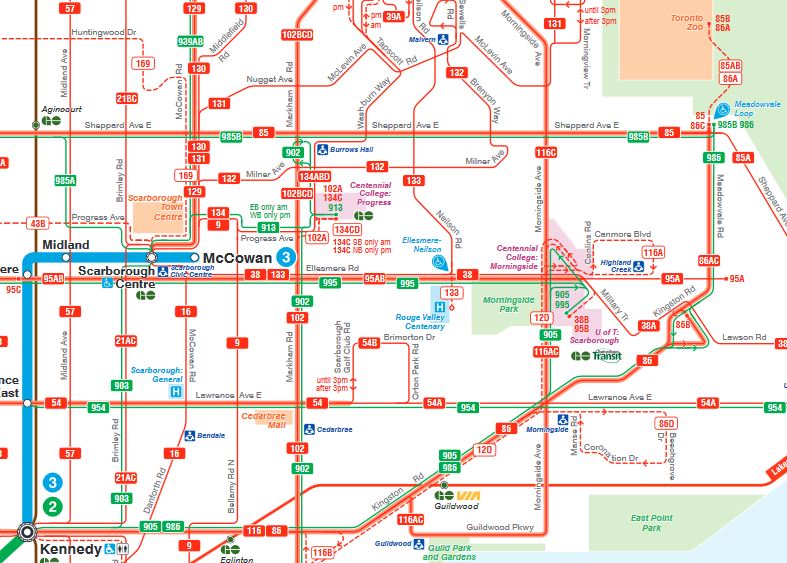
Four routes leave Kennedy Station:

  • 86 Scarborough local buses
  • 116 Morningside local buses
  • 905 Eglinton East express buses
  • 986 Scarborough express buses

The reserved lane begins at Brimley and then continues along Kingston Road. At Guildwood, the 116 Morningside route splits off, but the other services continue on reserved lanes.

At Morningside, the reserved lanes turn north along with the 905 Eglinton East Express buses and the 116 Morningside locals which have come up from Guildwood. The various 86 and 986 Scarborough service continue east and north to their destinations without a reserved lane.

The reserved lanes end at Ellesmere near the University of Toronto Scarborough Campus (UTSC).

The lanes on Kingston Road and Morningside will also be used by the 12D service from Victoria Park Station to UTSC, but this is a peak-only operation that I have omitted from this discussion because it is so infrequent (roughly two buses per hour).

This has been announced with much fanfare, but it will be important to track what actually happens with service in this corridor. The TTC has an uncertain attitude to the benefits of reserved lanes, and this goes back years to (at least) the St. Clair right-of-way project.

Reserved lanes can reduce travel times by keeping motorists out of the way assuming, of course, that someone makes the effort to keep the bus lanes clear. The TTC uses this saving in two different ways:

  • Running the same number of buses on a shorter scheduled trip time means that more frequent service and capacity can be provided at no extra cost. This is the approach taken with route 116 Morningside.
  • Keeping headways (the time between buses) the same but reducing the trip time allows a route to be served with fewer vehicles while maintaining but not improving service. This is the tactic used for 86 Scarborough, offset by express service on the 986.

Over the years, there have been many service reductions on the TTC through the reverse of the second point above. Traffic congestion might become a problem, and TTC management wants to guarantee that fewer or no buses are short-turned. To achieve this, travel times are increased so almost all buses will arrive on time or early at terminals with a generous provision of recovery time before their next trip.

This has usually been implemented by running buses less often so that the trip time can be longer. The downside, however, is that scheduled service is reduced and this becomes a “new norm”. Service increases to deal with capacity problems are often held hostage to budget limitations.

Two other changes will happen on the Eglinton-Kingston-Morningside corridor concurrently with the new bus lanes (effective Sunday, October 11):

  • The 905 Eglinton East and 986 Scarborough express buses will resume to operation
  • Some stops will be moved or consolidated.

The service to be provided on the express routes is comparable to that provided in March 2020 before much of the express network shut down in response to the pandemic. This will substantially increase service for those who travel between express stops.

Express service stops:

  • Eastbound 905 buses stop only at Kennedy Station, Midland Avenue, Brimley Road, McCowan Road, Bellamy Road, Markham Road, Kingston Road and Eglinton Avenue East, Guildwood GO Station, Galloway Road, Lawrence Avenue, Morningside Avenue and Kingston Road, Ellesmere Road, Ellesmere Road and Military Trail, University of Toronto at Scarborough Loop.
  • Westbound 905 buses stop only at University of Toronto at Scarborough Loop, Military Trail and Pan Am Drive, Morningside Avenue and Ellesmere Road, Kingston Road, Kingston Road and Lawrence Avenue, Galloway Road, Guildwood GO Station, Eglinton Avenue, Eglinton Avenue East and Markham Road, Bellamy Road, McCowan Road, Brimley Road, Midland Avenue, Kennedy Station.
  • Eastbound 986 buses operate express from Kennedy Station to Celeste Drive (Guildwood GO Station), stopping only at Markham Road and Celeste Drive; 986 buses then operate local from Celeste Drive to Meadowvale Loop.
  • Westbound 986 buses operate local from Meadowvale Loop to Celeste Drive (Guildwood GO Station); 986 buses then operate express from Celeste Drive to Kennedy Station, stopping only at Markham Road and Kennedy Station.
Continue reading

Toronto Council Pursues Details of Metrolinx Projects

An ongoing problem for anyone attempting to work with Metrolinx on their projects is the lack of transparency, the fog through which details emerge, if at all, on what they actually propose to do.

Distrust of Metrolinx to deal fairly and honestly with communities and their political representatives led to widely-supported motions when Council considered two reports regarding Metrolinx projects on October 1, 2020:

Included here are Council motions regarding:

Also included are recent replies to queries from me about the Ontario Line.

Continue reading

Eglinton Crosstown Delayed Again (Updated)

This article was updated at 2:00 pm on October 2, 2020 to include remarks from Metrolinx CEO Phil Verster. Scroll down the end of the article to see the update.

In the Toronto Star, Ben Spurr reports that the opening date for the Crosstown line has been delayed five months to 2022, and even then it will open in stages.

New report says the Eglinton Crosstown LRT could open five months late — and without its Eglinton stop

Metrolinx, the provincial transit agency overseeing the project, conceded earlier this year that the $5.3-billion, 19-kilometre LRT across midtown won’t be finished by the previously announced deadline of September 2021. Metrolinx says it now expects the line to open sometime in 2022, but a firm date hasn’t been set.

But according to a new report, Crosslinx Transit Solutions, the private group contracted by the province to build the line, has floated a plan for a phased opening. It would see most of the LRT in service by Feb. 28, 2022, with the exception of Eglinton station, which wouldn’t be fully complete until September 2022.

Source: Toronto Star

Construction watchers might see this as a confirmation of what they see looking at slow progress at key sites, but there are more important issues at work here.

The news came not from Metrolinx itself, but from a notice from Moody’s Canada that it was downgrading its rating outlook for Crosslink Transit Solutions “to negative from stable owing to the likely delay in the completion of the Eglinton LRT Project”. The rating of CTS debt is not changed, only the outlook for potential updates.

At issue is the question of how much of this delay’s cost will fall to the P3 partner CTS and how much to Metrolinx and the Government of Ontario. To the degree that CTS must absorb this, their financial situation would be weakened.

An intriguing point in this announcement is that the value of affected debt is cited as $731.9-million (Canadian), a relatively small part of the total project cost. The entire P3 concept was sold on the basis that financial risk would be transferred from the Province to its partners.

According to the Star, CTS has claimed extra costs for a variety of delays such as unexpected conditions at Eglinton Station and labour constraints due to the pandemic. Metrolinx denies these claims, but if they eventually do pay out, it would not be the first time.

Various dates are cited by the Star for the line’s opening:

  • February 28, 2022: The date for opening most of the line, except Eglinton Station, according to Moody’s report
  • May 2022: Completion of most of Eglinton Station
  • Fall 2022: Direct connection to the existing subway station opens

What is not clear is whether the February date includes provision for testing and acceptance of the nearly-completed line by Metrolinx.

Between May 2022 and opening of the subway link, passengers would have to transfer by walking on Eglinton between the existing subway entrance and a new entrance building to the LRT station.

For some time, the Metrolinx page for the Crosstown project cited an expected completion of 2021, but in March 2020 this was changed to 2022. This problem has been brewing for some time. Spurr reported the delay in February 2020 (see Eglinton Crosstown faces another setback, delayed until 2022).

The original target for substantial completion of the contract was September 2021, but there is an 18-month window to the “long stop date” when the agreement could be terminated. Now, only six months remain in that window. What exactly Metrolinx would face if they pulled the plug is unknown, but this would leave a nearly complete line tangled in legal problems.

The TTC and City of Toronto face ongoing costs for the service implications of the construction project, but this would be offset by a delay in the point where Metrolinx would begin billing the City for the line’s operation and maintenance (the TTC will only be directly responsible for part of this work).

“Metrolinx is focused on ensuring that (Crosslinx) fully meets its obligations to deliver a system as soon as possible — a system that is complete, fully tested and ready to provide high quality, safe and reliable service to our customers,” said Metrolinx CEO Phil Verster in a stern statement.

He said Crosslinx “has not achieved necessary production rates to achieve the original project schedule” and Metrolinx “will continue to hold (the consortium) accountable for these delays.”

Source: Toronto Star

Metrolinx may take a hard line attitude to non-performance by CTS, but more than bluster will be needed to achieve project completion. The expected June 2022 provincial election will bring considerable pressure to provide a ribbon cutting for Premier Ford at whatever cost is necessary.

Updated October 2, 2020 at 2:00 pm

Metrolinx has issued a statement from CEO Phil Verster through the Metrolinx Blog.

This includes the following comments:

Transit projects are delivered on-time when the contractor achieves the production rates they committed to and only through the proper management of their own logistics and operations. In the case of Eglinton Crosstown, our building partner, Crosslinx Transit Solutions (CTS), has not achieved necessary production rates to maintain the original project schedule that they committed to in their bid.

Any suggestion, like the one made in the Moody’s Credit Opinion, that the line could be considered ready to open without the ability for passengers to get on or off at the flagship station at Yonge and Eglinton, where tens of thousands of passengers will transfer on a daily basis between the Eglinton Crosstown and the TTC Line 1 Subway, is completely a distraction and is not in line with the obligations CTS took on when it signed the contract.

It is imperative that CTS now focuses on getting the project completed, including Eglinton Station, to the highest quality standards.

Source: Metrolinx Blog

It is clear from this statement that Metrolinx is taking a hard-line attitude to the current state of the project. Whether this will provoke improved performance by the CTS consortium, or create a logjam in negotiations remains to be seen.

This is among Metrolinx’ largest projects, and if the P3 is unable to deliver as promised, this will undermine the credibility of this method of project delivery. However, what could also happen is that industry’s appetite for such undertakings and especially for assumption of risk may be reduced threatening the bidding process for other projects including rapid transit lines and GO expansion.

The TTC 2021 Service Plan

The TTC Service Plan for 2021 is still in draft, but the TTC wants public feedback on their proposals. The deadline for comments is October 9, 2020.

See:

In earlier stages of public participation, the focus was on implementation of the RapidTO bus lanes, notably the one on Eglinton-Kingston-Morningside that has just been installed.

Now the TTC has added material about other proposals and there is a 24-minute video overview on the presentation page linked above.

Continue reading

TTC Covid Service Recovery Plans: Part II

This article continues comments written before the TTC Board meeting of September 24, 2020. The staff presentation had more information than in the report linked from the agenda.

The following chart was included in my first article on the TTC’s Covid response. The red and green lines in this chart marks the number of trips that accumulated more than a 30% and 50% load respectively. The 30% load has been the target for service through the summer, but this is challenging to achieve for a few reasons.

Demand on the bus network has recovered more quickly than on the rest of the system and now stands at almost 50%. This is not evenly distributed by route or time of day, and there will be trips that routinely face higher demand than can be handled.

However, on some routes, notably those that formerly had express services, the revised all-local service is well below the average of 85% of pre-covid service the TTC commonly cites. In a few cases, routes have only half of their previous service unless unscheduled extras are added to compensate.

TTC management note that both the green and red curves turned downward slightly in early September, and attribute this to the operation of more unscheduled buses than in earlier months thanks to operators who have been recalled from layoff.

The more severe challenge, however, is that there simply are not enough buses and operators even at full service to provide generous spacing with demand at 50% of pre-covid levels, let alone higher proportions.

More operators will be recalled in October 2020 and this will add to on-demand service for school travel, particularly in the midday which now will have peaks that did not previously exist as half-day attendees switch over from the morning to the afternoon panel.

The success of using demand responsive service will be seen in how these stats behave in coming weeks.

Continue reading

Drifting Timelines on Metrolinx Projects (Fall 2020 Update) (Revised)

Back in June 2020, I wrote about the gradual drift in the planned dates for various Metrolinx projects as reported by Infrastructure Ontario [IO for short].

See: Drifting Timelines on Metrolinx Projects

The September 2020 Market Update has been issued by IO and it shows changes in some projects from the June update.

Sept 26, 2020: Revised to include the change in financing method for the OnCorr GO Corridor project.

Is The P3 Model Falling Apart?

Two revisions in the large GO project procurement model involve a change from private sector financing to traditional government borrowing.

This suggests that the market willingness to finance projects on behalf of the government, or at least to do so at rates competitive with direct government borrowing, may be on the wane. That implies that the “P3” model may be coming unglued.

At its heart, this was always seen as an accounting mechanism to shift debt off of the government’s books, and without this shell game, a major argument for P3s could vanish.

The Future of Electrification

The change in financing model could shift any decision on propulsion technology back to the government.

Metrolinx had pushed this off its plate by saying that the bidders who were going to design and operate a future GO network would make that choice. This punted the knotty political problem of hydrogen trains touted former Premier McGuinty out of Metrolinx itself.

Will Ontario be willing to finance the large up-front capital costs of electrification itself with so many other pressures on financial resources, or is electrification about to fall out of consideration while spending focuses on service expansion?

Ontario Line

The project is in three sections of which the last will be the “Northern Civil, Stations and Tunnel” which includes the portion of the line east of the Don River and north to Eglinton, but not the Maintenance Facility which is included with the “South Civil” portion as it is needed relatively early in the project.

Some of the work on the North section between the Don River and Gerrard Station might be undertaken as part of the GO Corridor improvements, but exactly what this might entail has not been made public.

Since the last update, there are three changes for the North section:

  • The date for RFQ (Request for Qualifications) issue has been changed from Winter to Spring 2022.
  • The RFP (Request for Proposals) issue has been changed from Spring 2022 to Fall 2022.
  • The Financial Close (in effect, the contract signing) has been changed from Fall 2023 to Spring 2024.

The remaining portions of the line are on the same timeline as before.

The timelines for this project, with financial close for the first two portions in fall 2022 and for the third in spring 2024 puts this beyond the next provincial election expected in mid 2022, the four-year anniversary of the Ford government’s election. Who will be in place to make final decisions, and what the government’s financial position will be by then, remain to be seen.

Line 2 East Extension (Scarborough Subway)

This project is now shown with two portions: one for the tunnel, and the other for the stations, railway and systems.

There is no change in the tunnel portion of the project, but the remaining portion has reverted to the dates shown for the overall project in the Winter 2020 update.

GO Expansion Lakeshore West Corridor

The financial close for this project has been changed from Winter 2021 to Spring 2021.

GO Expansion Lakeshore East-West Corridor

This was originally to have been a “Build-Finance” project, but it is now “Design-Bid-Build”, a change that was made in August 2020 according to the IO report.

GO OnCorr Projects

[Added to this article on September 26, 2020]

This is a very large project including future operation of GO Transit and possible changes in the propulsion technology.

The procurement model has been changed from “DBOFM” (Design-Build-Operate-Finance-Maintain) to “DBOM”. The proponent will no longer finance the project which has a projected value of over $10 billion.

All other projects are unchanged. A summary of the Metrolinx projects tracking their changing status is available in this spreadsheet (revised version).

TTC Service Changes Effective October 11, 2020

The TTC will make changes on several of its routes in the schedules taking effect Thanksgiving weekend. Among the updates, the major groups are:

  • Changes to 116 Morningside, 86 Scarborough and 12 Kingston Road related to the implementation of the bus-only lanes on Eglinton, Kingston Road and Morningside.
  • Restoration of service on 905 Eglinton East and 986 Scarborough express services, also as part of the bus-only lane implementation.
  • A substantial increase in the number of 600-series crews (run as directed buses) to provide service for school trips.
  • Service cuts on certain routes during poor-performing periods.
  • Removal of seasonal services.

Eglinton East Bus Lanes

The travel time savings have two effects on routes, sometimes a mixture of both:

  • Reduced travel times allow the same level of service to be provided by fewer buses.
  • Reduced travel times allow service improvements by retaining the existing allocation of buses.

Service on the 86/986 Scarborough corridor will improve during peak periods with the return of the express service. The total number of buses operating on the two routes will be increased, even though running time savings allow some reductions in the number of buses allocated.

Weekday midday and early evening service on 86 Scarborough will be reduced by the elimination of the 86B Highland Creek service.

During all other periods, there is generally a reduction of one bus on 86 Scarborough but no change in service levels. This is made possible by the anticipated faster travel times on the reserved lanes.

The 986 Express service is restored at approximately the same service level as in March 2020, but with one less bus because of travel time savings.

On 116 Morningside, there are minor improvements in service during some periods by using the same vehicles on shorter travel times.

The 905 Express service is restored with the same number of vehicles as in the March 2020 schedules except for the AM peak and midday weekdays. This provides slightly more frequent service during all periods except the AM peak (when it is unchanged) due to reduced trip times.

The 12D Kingston Road to UTSC service will be slightly improved in the PM peak by the addition of one bus. It will also have more, not less, travel time than in the previous schedule and will have generous layover/recovery provisions. It is not clear why the TTC does not simply improve the service and trim the layovers which total over 20 minutes per round trip.

Seasonal Changes

The following seasonal services will not run after Thanksgiving Day, Monday, October 12, 2020:

  • 121D Front-Esplanade service to Ontario Place and Cherry Beach
  • 175 Bluffers Park

The 92 Woodbine South route will revert to its winter schedule due to reduced travel to Woodbine Beach.

Service Cuts

Some routes will have service trimmed during periods of light demand to free up resources for the 600 demand-responsive services.

  • 38 Highland Creek weekday late evening
  • 42 Cummer AM peak and weekday late evening
  • 51 Leslie AM and PM peak
  • 56B Leaside to Brentcliffe AM and PM peak service removed with partly offsetting improvements to 56A Leaside to Eglinton Station.
  • 121 Front-Esplanade moves to a 30 minute headway all day on weekdays.
  • 122 Graydon Hall AM peak
  • 134 Progress: All off peak service will operate as 134D to Finch via Centennial College, and articulated buses assigned to some runs on this route will be replaced with standard sized buses.
  • 900 Airport Express early and late weekday evening
  • 927 Highway 27 Express weekday midday

Other Changes

53A Steeles East will have scheduled peak service restored correcting an error when the 953 Steeles Express (which formerly provided this service) was suspended.

During the period when 505 Dundas cars are looping via Lansdowne, College and Ossington due to construction, a 505S shuttle bus will operate between Lansdowne and Ossington on Dundas.

512 St. Clair has operated with a irregular headways due to cancelled runs. These will be restored resulting in much more even scheduled service.

Details of the October changes are in this spreadsheet.

Coming in Mid-November

The mid-November schedule changes will include restoration of the following express services:

902 Markham Road, 929 Dufferin, 935 Jane, 941 Keele, 945 Kipling, 952 Lawrence West, 954 Lawrence East, 996 Wilson

No details about service levels have been released yet.

The TTC plans to restore the remaining express routes in early 2021.

TTC Bus Service Frequency and Reliability in 2020 (Part V)

This is the final set of route-level reviews of TTC service reliability within this series.

The routes discussed here serve parts of the central area and the old “inner” suburbs York and East York.

Continue reading

TTC Bus Service Frequency and Reliability in 2020 (Part IV)

The four east-west corridors detailed in this article share a common characteristic in their schedule changes between the pre-covid winter schedules and the spring-summer versions. The only change has been to remove the 9xx express service without any update to the underlying local services.

In some cases, this represents a substantial cut in the total service provided on portions of the route where roughly half of the “winter” service operated as express trips. Some of these cuts are substantially greater than the TTC’s oft-cited 80-85% level of pre-covid service, and this illustrates an ongoing problem with reporting stats on an average basis that hides the fine detail.

These are long routes where service might not even be well-spaced leaving the terminals, and headways become much worse along the way. The problems cannot be attributed to “congestion” in times of relatively light traffic, and there is clearly no attempt at headway management. In turn, the uneven headways cause crowding well beyond what all-day averages might suggest.

Continue reading

TIFF 2020 Wrap-Up

This year, I “attended” the Toronto International Film Festival from the comfort of my bedroom thanks to the near-shutdown of public venues for screenings and my own preference to cocoon during these difficult times.

The end of a festival always has a strange feeling after a week of hanging out in line, chatting with fellow film-lovers, grabbing lunch in favourite restaurants (while not eating or drinking so much I will fall asleep in the next movie). After the last film, the streets are emptier, the cinemas don’t feel like they’re girding for another day, and only the die-hards are still there for a closing night screening.

Walk out onto the street, wait for the streetcar, and ride back into the “real world” with days that don’t revolve around TIFF. This year was different. I gave my computer a rest after many online streams, and wandered into the kitchen to figure out what dinner would be.

Maybe next year we will be back in theatres again. Fingers crossed.

The films here are in order of my personal ratings. If a film is not here, that doesn’t mean it was not good, simply that I did not pick it as part of my schedule. Even the cut-down TIFF had more than one could watch in 10 days unless one were really, really in love with a computer screen.

The TIFF People’s Choice Award this year went to Nomadland, my own personal favourite. Frances McDormand brings us another wonderful characater, Fern, a woman who drifts from job to job among a community of nomadic workers in a version of America far from the classic dreams of city life with a home and a two-car garage. Superb. *****

Sir Anthony Hopkins stars with Olivia Colman in The Father , a tale of family relationships falling apart as his character, also named Anthony, slides into dementia. Without giving away the ending, the story is told from Anthony’s point of view and the audience must gradually shift its understanding of just what the “real” world is as the story unfolds. A tour-de-force of acting with an excellent script and direction from Florian Zeller. ****½

Mira Nair directs a large cast in her six-hour version of Vikram Seth’s A Suitable Boy originally produced for the BBC and coming to Netflix. Andrew Davies, a man with many period piece adaptations to his name, is credited as the screenwriter, but it was clear from the Q&A that his original design was adjusted to suit Nair’s desire to bring the political threads forward. She sees the difficult problems of finding a way to make India work politically in its early days as a parallel to the more humourous challenge of finding a suitable bridal partner. Absolutely delightful throughout. ****½

Continue reading