On May 2, Toronto’s Executive Committee considered a report on the future bus service to replace the Scarborough RT which will shut down in late 2023. The “debate” was notable for a few key reasons:
The staff report took the position that a busway in the SRT corridor was not on the table because it is not “funded” in City budget parlance. Therefore, the report concentrates on buses operating over city streets between Scarborough Town Centre and Kennedy Station.
There was considerable confusion about the cost of the SRT busway option, although it has been under study by the TTC for a few years.
Completion of the design to 30% lacks only $2.9 million in funding. The position of most Councillors and of staff is that the province should pay, and talks are underway as part of the wider Scarborough Subway funding arrangements. Meanwhile the design work sits.
The Committee was misled by City staff about the busway’s cost by confusion of busway-specific costs with other elements such as the eventual dismantling of the SRT which is a common cost for any scenario.
Several City staff appeared to have done little prep work for the debate even though it was well known in advance that this would an item of interest on the agenda.
Meanwhile, the hapless transit riders in Scarborough wait for a fast route to replace the SRT, but see this drifting off into the mist. There is a strong sense that this project is not a priority for the City unless someone else pays. That may sound very good as a negotiating stance, but it does little for riders.
This article reviews the estimates for the busway to sort out the confused material presented to Executive Committee. Possibly, if the planets all align over Scarborough, Council can unscramble this at its meeting on May 10.
Updated May 4, 2023: The High Park bus service erroneously mentioned in the media release below is supposed to go into service on June 18 according to the Seasonal Services page on the TTC’s website.
The TTC has issued a press release as a general announcement of the planned changes on May 7, 2023. It puts a rather generous spin on what is about to happen. First, here is the unedited text.
Starting this Sun., May 7, the TTC is introducing new schedules on some routes to improve reliability along busy corridors, add seasonal service to key city attractions, better align capacity with ridership demand and accommodate construction across the city.
“We are investing more than ever before as a City government in the TTC to continue to support transit service as it comes back from the unprecedented impact of the pandemic. The TTC is continuing to provide more service than ridership and to increase service on the busiest routes at the busiest times,” said Deputy Mayor Jennifer McKelvie. “Thank you to all TTC workers for continuing to provide safe and reliable service across our city for residents and visitors.”
“These service adjustments are a direct result of extensive consultation with communities and customers,” said TTC Chair Jon Burnside. “On behalf of the TTC Board, I commend the TTC for their focus on service improvements to important City corridors, including Markham Rd., Finch Ave., Wilson Ave., and Jane St.”
“The TTC is continuing to focus on delivering more frequent service to the areas across the city that need it most. This is all part of our strategy to match service to demand and ensure that we are meeting the needs of our riders,” said TTC CEO Rick Leary. “I’d like to thank everyone who engaged with us and provided feedback as we developed this latest schedule, and we look forward to continued feedback from our customers.”
Among the adjustments being made:
• Reduced wait times on overnight routes along Finch Ave., Jane St., and Wilson Ave., to every 20 minutes from 30 minutes. • Enhancing reliability on the Markham Rd. corridor – one of the TTC’s busiest – by extending service on the 902 Markham Rd Express to connect to busy employment areas at Morningside and Steeles avenues. • Launching seasonal routes to popular parks and attractions such as Cherry Beach, Bluffer’s Park, High Park and the Toronto Zoo.
The TTC will also continue to monitor service in real time and have additional, unscheduled vehicles available across all modes to fill gaps in service when and where possible.
TTC Media Release May 3, 2023
Let’s take these points in order.
… better align capacity with ridership demand …
That sound very productive, but it hides the fact that many service cuts both in May and in March were made on this basis. A related change in crowding standards implemented by management enabled service cuts on many routes, particularly in off-peak periods.
The TTC is continuing to provide more service than ridership and to increase service on the busiest routes at the busiest times …
Riders on those “busiest routes” might choose to differ. TTC has cut service on several trunk routes over the past months.
In March:
Line 2 Bloor-Danforth
501 Queen weekdays
25 Don Mills
29/929 Dufferin
35 Jane
36 Finch West
41/941 Keele
943 Kennedy Express
905 Eglinton East Express
In May:
Line 1 Yonge-University
501 Queen (weekend afternoons)
512 St. Clair
52 Lawrence West
85/985 Sheppard East
“These service adjustments are a direct result of extensive consultation with communities and customers,” said TTC Chair Jon Burnside. “On behalf of the TTC Board, I commend the TTC for their focus on service improvements to important City corridors, including Markham Rd., Finch Ave., Wilson Ave., and Jane St.”
I suspect one would be hard pressed to describe what the TTC did as “consultation” considering that they actively withheld information on service changes from City Councillors during the budget debates. The information only came to light thanks to a Freedom of Information request by TTCRiders. The official version of the May 7 changes was only released on the afternoon of May 1, although this existed in draft months earlier.
As for service improvements listed by Chair Burnside, yes Markham Road sees better service. However, the only changes on Finch, Wilson and Jane are to overnight service. Two of these routes saw daytime service cuts in March.
Among the adjustments being made:
[…] • Launching seasonal routes to popular parks and attractions such as Cherry Beach, Bluffer’s Park, High Park and the Toronto Zoo.
The Cherry Beach, Bluffer’s Park and Zoo services run every summer. They are not additions to the network but simply revivals of regular seasonal services under new branding. As for High Park, there is nothing in the announced changes of summer service into the park previously provided by 30 Lambton. High Park Station is now served by 189 Stockyards and 30 High Park, and there is no mention of an extension in the service memo for May 7, nor is there any mention on the TTC’s website.
Updated May 4, 2023: It turns out that there are plans effective June 18 for a 203 High Park bus. The existing 30 High Park will be renamed High Park North
The TTC will also continue to monitor service in real time and have additional, unscheduled vehicles available across all modes to fill gaps in service when and where possible.
The TTC has cited its “Run as directed” buses as a catch-all fix for service irregularities, but is unable to show how these vehicles have actually been used. At its last meeting, the TTC Board was told that there would be a presentation to their May 8 meeting on the use of RAD buses, but nothing has appeared on the agenda. With luck it will be a “walk in” report presented as part of the CEO’s report.
The TTC would attract better regard from those who try to support their work by being less secretive and defensive. Providing timely information allows debates about the city’s priorities to occur in context rather than with only vague rumours.
The TTC’s job is to provide good transit service. If as an organization it turns into a good news mouthpiece for the Mayor, the Board members, the CEO, it has lost its way. Toronto needs open debates about the future of so many services, not self-serving puffery.
With the federal announcement of funding for the TTC’s eBus project, the bid award has been posted on the MERX website as of May 2, 2023.
The bid closed on April 18, 2022, but was not awarded until late January 2023, likely subject to receipt of funding.
The dollar value of the awards are $343.5 million to New Flyer and $220.2 million to Nova Bus. Vehicle quantities are not included in the MERX information, and I await a press release from the TTC with more details.
The total of $563.7 million is split roughly 60/40 between the two builders. This implies that neither of them scored in the highest possible echelon on product evaluation. This would have led to a much higher proportion going to one of two, or even to a single bidder, based on the scoring system in the RFP.
By implication, BYD, the only other bidder, fell even lower in the scoring. This is not surprising considering the quality and reliability problems the TTC has encountered with their vehicles.
I will update this article with additional information as I receive it.
On May 1, 2023, the TTC released the final version of the service changes planned for May 7. These are substantially the same as the draft version obtained via a Freedom of Information request by TTCRiders. See Draft of TTC Service Changes Effective Sunday, May 7, 2023.
Back in January during budget debates, some Councillors asked for details of the service cuts that would be implemented due to increased crowding standards and financial constraints. TTC staff agreed that this information could be available within a week, but an unseen hand at a higher level (either the TTC CEO Leary or then-Mayor Tory’s office) blocked this. Actually admitting the effects of a budget before it was approved simply was not part of the TTC’s agenda.
The official, final version allows comparison with the draft version. Although the TTC suggested that TTCRiders publication of the draft could be misleading because of changes in the final version, in fact there is very little change.
This article includes only the updates since the draft version, and readers should look to the article linked above for the full list. The spreadsheet (linked later in the article) detailing all of the changes has been updated to reflect the differences between the draft and final versions.
Updated May 2, 2023 at 10:10 am: A overview of all routes showing which get more service and which get less has been added.
The TTC has announced that the 504 King streetcar is now actually running on King Street!
For the period from May 1-6, the 504B streetcar service from Broadview Station to Dufferin Loop will operate over the normal route. The west end 504C bus from Dundas West Station to the Distillery, and 504D from Broadview/Gerrard to Exhibition via Strachan will continue to operate until May 6.
Effective May 7, streetcar service will resume all the way to Dundas West Station, but all cars will operate to Distillery Loop because the Don Bridge on Queen will be under repair for a few months. The east end of the line will operate as a shuttle bus from Parliament & King to Broadview Station. West end service will be the standard combination of 504A cars to Dundas West and 504B cars to Dufferin.
This will change again on June 18 when major construction begins on Broadview Avenue and TTC service between Gerrard and Danforth will be suspended. For further details, see my article on this summer’s construction projects.
As I write this, the routes as defined to NextBus (which supplies most data to prediction apps) have not been updated for 504 King or 501 Queen (which starts its own major diversion around Ontario Line construction). This means that predictions for stops are going to be a mess probably for the coming week until the main update with the May 7 service changes is implemented.
With the shutdown of Queen Street for Ontario Line construction between Victoria and Bay, we will not see streetcars there for many years. The last cars will run just before midnight on April 30, 2023.
Until early 2024, the absence will be over a longer stretch from Broadview to McCaul until new diversion track via York and Adelaide is finished. In turn, that depends on relocating nine utility vaults under the new Adelaide trackage.
It is possible that the TTC will revise the diversion pattern once the Don Bridge reopens to streetcars later in 2023 (it will close for maintenance on May 7), but nothing has been decided yet.
Here are photos of various generations of streetcars on the central section of Queen as a memento while we await their return.
Note that this is a large gallery, and it will take a while to load after you first click on a photo.
Two months from now, on June 26, Toronto will elect a new Mayor thanks to John Tory’s unexpected departure. There will be at least fifty candidates on the ballot, although most of them will garner only a handful of votes.
I am not one of them, and have no ambitions to high office. That said, I certainly have hopes that our new Mayor will have a strong pro-transit agenda and will actually care about the City rather than brown-nosing their way to small favours from Queen’s Park.
For those who are interested, here is the campaign-sized version of my advice and platform were I running:
Service is key. Run as much as possible, everywhere, and run it well.
Build budgets based on what you want to see, not on what you think you can afford. Just getting by is not a recipe for recovery and growth. If the money doesn’t come, then look to “Plan B” but aim for “Plan A”.
Fares are a central part of our transit system, but the question is who should pay and how much. Strive for simplicity. Give discounts where they are truly needed. Make the transit system worth riding so that small, regular increases are acceptable.
Focus on ease of use among transit systems in the GTA, but do not equate “integration” with amalgamated governance.
Transit property: parking or housing?
Foster a culture of advocacy in management and on the TTC Board.
Beware of lines on maps. A “my map vs your map” debate focuses all effort on a handful of corridors while the rest of the network rots.
Plan for achievements in your current term and make sure they actually happen. Longer term is important, but the transit ship is sinking. You are running for office in 2023. Vague promises for the 2030s are cold comfort to voters who have heard it all before.
That’s more than will fit comfortably on a leaflet, but, hey, I am the blogger who writes long form articles about transit. As a commentator, my biggest worry lies with those who say “TL,DR”. In the following sections I will expand on the bullets above. Thanks for reading.
How much would all this cost? In many cases the answer depends on the scale and speed of implementation. Although I have a sense of at least order of magnitude costs, I am not going to be foolish enough to put specific dollar figures here. For too long, City policy has started with a budget rather than a philosophy, an aspiration to be great, and settled for just good enough. We almost certainly cannot afford everything today, but we need to know what tomorrow we strive for.
If the 2003 Ridership Growth Strategy taught us anything, it was that we should first talk about aspirations, about what the transit system might be, rather than precluding debate with the classic “we can’t afford it” response. It’s amazing what monies can be found once information is out in the open. We commit tens of billions to construction, but are terrified, at least politically, by far lower costs to improve transit for everybody today.
I have deliberately omitted a discussion of security and related social services here. These are not just transit issues, but part of a city-wide, society-wide problem that will not be solved with a simple show of force. Recent trends both in public opinion and official responses at the City and TTC show an emphasis on providing support for those who need it: the homeless and the mentally unwell. This should continue and expand.
An inevitable question is who will I endorse? That will come later in the campaign as candidates flesh out their programs. Some make their beds with the provincial Tories. As enemies of the city, collaborators, they deserve only contempt. For others, we are in promising early days.
In recent articles, I commented on the size of the bus fleet claimed in the CEO’s Report, the number of buses actually shown as active in the Scheduled Service Summary, and the ratio of spares to scheduled service.
Updated April 24, 2023 at 6:30pm: The chart of average daily mileage by each bus has been amended to show the garage assignments of each vehicle.
An underlying issue for a transit system with a large proportion of spare vehicles is that the active vehicle count can be lower than the total count. Poor-performing vehicles, be they near retirement or simply lemons that cannot travel far without a breakdown, can be sidelined with no effect on service.
However, this can create two key problems:
A culture of indifferent maintenance while keeping only the best buses on the road can minimize repair costs and keeps service quality up, at the expense of garage space and the capital value of the unused vehicles.
The headroom to improve service is lower than it would appear from the raw vehicle count if vehicles shown on the active roster are there in name only. If they were actually needed, they might not be reliable enough to provide service.
To determine the actual usage of the bus fleet, I obtained a summary of tracking data from Darwin O’Connor, proprietor of the TransSee website, for the period from March 1 to April 21, 2023. This allowed me to plot actual usage of the fleet in various ways. Many thanks to Darwin for this assistance.
First is a simple plot of active vehicles by day. The chart below shows the number of buses with non-zero mileage by day over the period. There are several interesting features of this chart:
The regular pattern of weekdays, Saturdays and Sundays is clear. Note the three-day weekend for Easter in early April.
Although scheduled service cuts were implemented on March 27, there was no change in the count of active buses which, if anything, rose slightly. There is a drop in the following week.
The number of active buses exceeds the peak scheduled service by about a hundred vehicles. These are not necessarily extra “run as directed” buses, but rather vehicles that only operate for part of the day and are replaced by others (for example, AM and PM peak trips).
The spike on March 13 appears to have been caused by a single day on which buses that were otherwise inactive were sent out in service. Looking at the detailed tracking data, they did not stay in service for long. However, this spike distorts the apparent number of active buses if one looks only over a wider range of dates.
Another way to look at the data is to plot the number of days buses were active over the 51-day period. The chart below shows the number of buses with non-zero mileage and the count of days active. For example, the high point shows that 141 buses were active on 47 of the 51 days. By contrast, 72 buses were active on only one day, and a further 43 for 2 to 10 days.
This means that 115 buses did not venture into service much during the period. In addition to these are buses still counted as active, but which did not operate at all. The TTC might nominally have a fleet of about 2,040 buses (although they claim 2,114 in an outdated chart in the CEO’s report), but the number actually available for service is likely below 1,900.
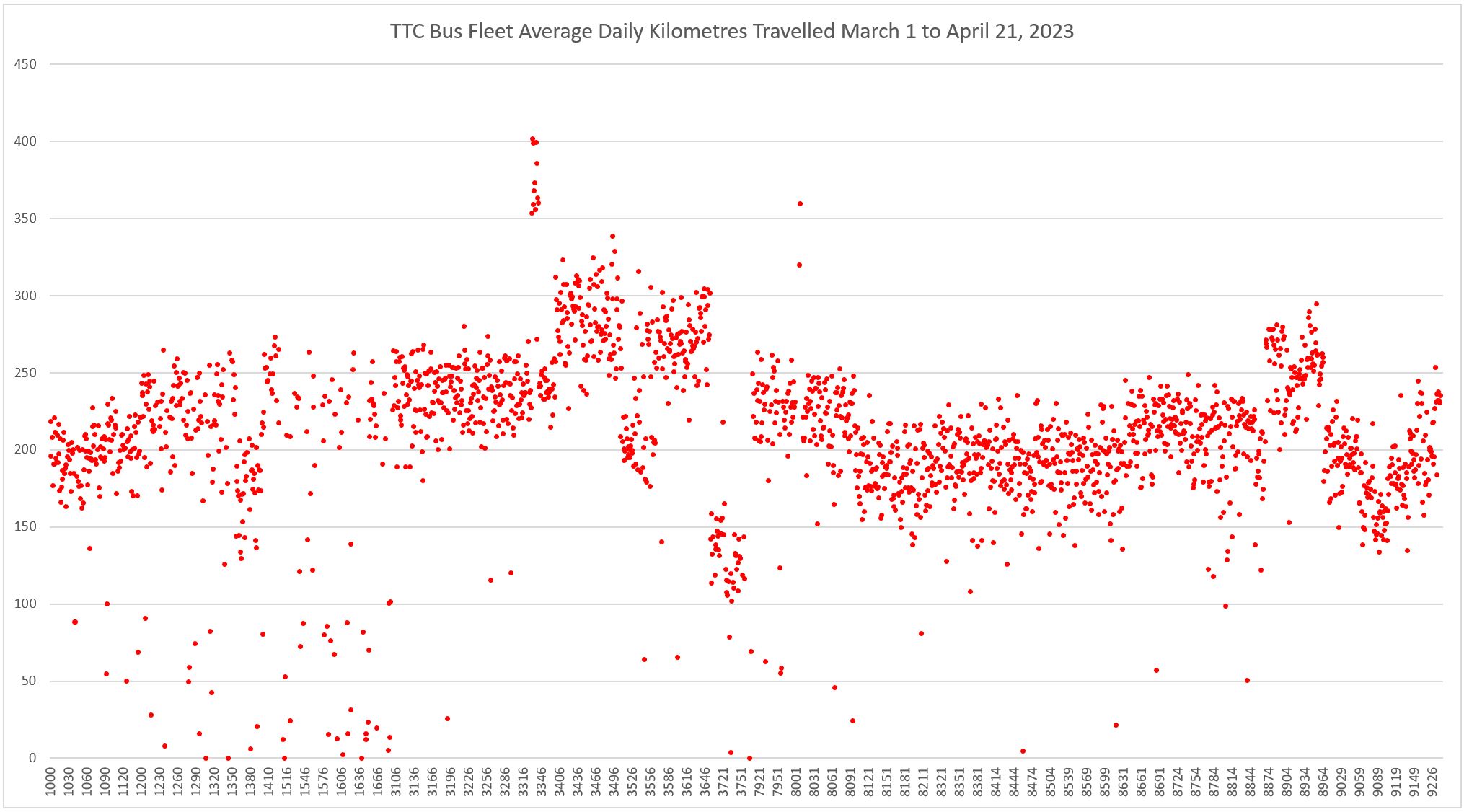
Yet another way to look at the data is to plot the daily average distance traveled by each vehicle considering only the days on which it was active. In other words, if the bus went out in service, how long did it stay there?
In the chart below, buses with no tracked mileage are not plotted. Note that the horizontal axis skips over breaks in fleet numbering. For example, there are no buses in the 2000, 4000, 5000 and 6000 ranges.
Items of interest here include:
A few buses sprang to life briefly, but have daily averages very close to zero.
Low average mileages are evident for older buses in the fleet:
7900 to 7979: 2006 Orion VII Diesel
8000 to 8099: 2007 Orion VII Diesel
1000 to 1149: 2006 Orion VII Hybrid
1200 to 1423: 2007-2008 Orion VII Next Gen Hybrid
1500 to 1689: 2008 Orion VII Next Gen Hybrid
The battery buses 3700 to 3759 stick out with consistently lower average mileage than other parts of the fleet. Some eBuses were completely inactive during the 51-day period:
New Flyer: 3705, 3706, 3715, 3720, 3724 (5 of 25 buses)
Proterra: 3729, 3732, 3736, 3739, 3744 (5 of 25 buses)
Buses assigned to 900 Airport Express have higher daily mileages (3330-3341, 8007, 8008) because they run on a very fast route.
Blocks of buses have higher daily mileage than others because they operate from garages with faster routes.
The TTC has just started to take delivery of over 300 new hybrid buses, and hopes to buy a comparable number of eBuses starting in 2024, subject to federal funding. If these displace the little used older fleet and increase the number available for sustained, all day service, this will be a significant contribution to what the TTC could achieve.
There will be a jump in service requirements in November 2023 when the SRT Line 3 is replaced by a bus shuttle from STC to Kennedy Station. That new fleet is arriving just in time. A budgetary oddity is that this service will be paid for from the Capital Budget as part of the cost of the Scarborough Subway Extension, and so it does not represent a net new cost to the TTC. Meanwhile, Queen’s Park is foot-dragging on paying for conversion of the SRT right-of-way as a bus roadway that would speed travel and reduce bus requirements.
Having more, working active buses to provide better service requires more operators and mechanics. A bus that sits in the yard costs next to nothing to “operate”. If hundreds of new buses sit idle (or allow middle-aged buses to be sidelined) this would be both a waste of capital and a betrayal of the promise of better service with a rejuvenated fleet.
The TTC has not produced a public fleet plan in years, and especially not one showing the effect of various scenarios for service growth or retrenchment. Current plans see only a 1% growth and this translates to small expansion of the bus fleet, especially considering that some bus services will convert to LRT when and if Lines 5 and 6 ever open.
Council’s goal to “green” the fleet may reduce diesel emissions, but the much larger target and goal is to move riders from private autos to transit. This cannot happen without better service and a working, fully available fleet.
Updated April 24, 2023
The chart below contains the same data as the scatter chart above showing average daily mileage for each vehicle, but with the dots colour coded to show the division to which the bus was assigned as of January 2023. The variation due to service characteristics in different parts of the city show up particularly for buses operating on faster suburban routes.
This is a follow-on to my article about the number of spares on the bus fleet.
The question of the day is why do we have so many surplus streetcars and subway trains. This article will provide some history of how the fleets and service levels evolved in recent years.
First off, I must report an error in my previous article which includes a table showing that the TTC has 551 spare buses. The actual number turns out to be 478.
The reason for the error is that a chart in the CEO’s report incorrectly shows the total bus count at 2,114. That was the value when this chart was originally used back in early 2021, but it has not been updated to reflect retirements of old vehicles. The actual number of active vehicles, according to the TTC’s Scheduled Service Summary for March 26, 2023, is 2,041. (This number does not appear as a total, but is obtained by adding up the number of active buses for each group in the fleet. See the last page of the summary for details.)
This still leaves the TTC with more buses on their hands than they strictly require for scheduled service plus maintenance, or to put it another way, with headroom to run more service without buying more buses.
The TTC has three new bus orders in the works for delivery in 2023-24:
135 40′ hybrids from New Flyer
68 60′ hybrids from New Flyer
134 40′ hybrids from Nova Bus
It is not clear how many existing buses these will replace and what the resulting fleet mix will be by the end of 2024.
Separately from these will be a new fleet of over 300 battery electric buses. This contract (or possibly contracts) has not been awarded yet while the TTC awaits confirmation of federal funding for “green” buses.