TTC Service Changes for March 26, 2023 (Preliminary Version, Updated)

In response to budgetary limitations, the TTC will be modifying service on several routes in two waves of changes. The first will occur on Sunday, March 26 and the second on Sunday, May 6. Details of the second wave are not yet available.

The first wave is detailed in a report to the TTC Board for its meeting of February 28, 2023.

This report shows the changes in headways and service levels on affected routes. It is not as detailed as the Service Memo that will come out just before these schedules are implemented, nor as the Scheduled Service Summary. When the fine details including changes in travel time and vehicle allocations are available, I will publish the usual breakdown.

Updated February 23, 2023 at 9:00am: A table consolidating old and new headways where changes occur has been added. The times in this table is shown in “mm:ss” format rather than in decimal minutes as in the original tables. The new version is at the end of the article.

Updated February 23, 2023 at 10:00pm: The tables in this article have been consolidated for simplicity. All times are now shown in mm’ss” format. The new version is at the end of the article replacing the version that was added earlier.

My apologies for the constant reformatting. With the widespread desire to see what the changes would be, I pushed the original tables out faster than I might otherwise, and my readers got to watch as I tweaked the format. The intent is to have a standard chart that will be used for all future comparisons of service.

Changes of Special Note

Within the list of changes, there are a few worth highlighting:

Subway Services

  • Service on 2 Bloor-Danforth will improve slightly in the AM peak, but will drop in other periods notably late evenings when trains will operate every 8 rather than every 5 minutes on weekdays.
  • Service on 4 Sheppard will be cut from 4 trains at all times to 3 with a corresponding widening of headways from 5’30” to 7’20”.

Express Services

Service will be suspended on the following routes and periods:

  • 935 Jane Express weekday evenings
  • 941 Keele Express weekday midday
  • 943 Kennedy Express peak periods
  • 984 Sheppard West Express weekends

In most cases, the local service will not be improved to compensate, and indeed there are local service cuts as well.

501 Queen Streetcar

Weekday service on 501 Queen will be reduced considerably except late evenings.

60/960 Steeles West

The 60C peak period service west of Pioneer Village Station to Kipling will be suspended.

Service Improvements

The 128 Stanley Greene bus was approved by the Board in the 2021 Service Plan, but was not yet implemented. It will begin operation during peak periods on a half-hourly headway.

The 335 Jane Night Bus will operate every 20 minutes rather than half hourly Monday-Friday (which effectively means Tuesday to Saturday).

The 336 Finch West Night Bus will operate every 10 minutes rather than half hourly after 5am Monday-Friday.

These changes are presented in the context of improvements to Neighbourhood Improvement Areas. The same cannot be said for the many service cuts affecting NIAs.

Continue reading

King-Queen-Queensway-Roncesvalles: February 21, 2023 Update

Construction continues on Roncesvalles and on The Queensway. Track work is complete at the intersection, but still in progress between Glendale and Parkside.

According to the latest email update from the city, Roncesvalles Avenue is expected to re-open by mid-March, and streetcar service should resume at the start of May.

After the track and road works on The Queensway are completed, the TTC overhead system must be installed. Streetcar service west of Sunnyside Loop would resume in “the summer”, but with no specific date.

Conversion of overhead on King west from Bathurst to Roncesvalles for pantograph operation is in progress. Segments are in various stages all the way from complete to not yet started with about 50% completion overall. 504 King streetcar service now ends at Bathurst, although many cars turn back at Spadina. 504C King bus service runs between downtown and Dundas West Station via Parkside until Roncesvalles re-opens in March.

The photos below show:

  • Stop construction southbound on Roncesvalles at The Queesway
  • Sunnyside Loop, now the temporary western terminus of 501 Queen service. The intersection at The Queensway and Sunnyside will be signalled, but this is not yet activated.
  • The Queensway at Glendale (St. Joseph’s Hospital)

Comparing TTC Service Levels: 2020 vs 2023

A major question facing transit advocates today is the degree to which TTC service is less frequent than in the pre-pandemic era, and more recently how it will be changing on a month-to-month basis.

As I write this on February 15, 2023, service changes were introduced a few days ago, and many more are planned for March 26, 2023. The TTC plans to release details of the March changes in its agenda for their Board meeting on February 28 for which the agenda should be available about a week in advance.

For each schedule change, I have published a detailed table showing old and new headways (the interval between vehicles), the changes in scheduled trip times, and the number of vehicles assigned to each route. This information is important for seeing that detail, but for a general audience, a simpler representation of the changes is needed.

In mid 2022, I published a comparison of May 2022 service levels with January 2020 to illustrate the degree to which service had changed between the pre-pandemic period and what, at the time, was thought to be the start of a strong recovery through 2022. This article includes tables in the same format comparing:

  • January 2020 to January 2023 as an update to the previous article, and
  • January 2023 to February 2023 showing the changes, where they occurred, on February 12, 2023.

In future articles about service changes I will include both the usual detailed spreadsheet as well as a chart showing the changes in the consolidated view used here. This will allow readers to quickly see where major changes occur, or not.

Updated February 16, 2023 at 12:45am: The pdf chart sets and some pages within the article have been replaced to correct an error in 76 Royal York South.

Continue reading

Toronto’s Board of Trade Contemplates Transportation

Prologue: When I started to write this story, John Tory was still Mayor of Toronto and the dynamics of City-Province relations assumed he was in charge. The context for these discussions was soon to change.

The Toronto Region Board of Trade holds a yearly “transportation summit”, and on February 8, 2023, this focused on the Greater Toronto Area’s transit, plans for the future, and the aftermath of the covid pandemic.

The TRBoT is no wild-eyed radical institution. The regional economy and businesses are at the heart of causes it advocates.

Both in the introductory remarks and in comments by speakers sprinkled through the day, the economic effect of traffic congestion was a mantra. This sets the framework for the importance of both transit and road projects, depending on who is speaking. The latest factoid describing Toronto’s problems is that we have the third worst congestion in North America and the seventh worst in the world.

CBC: Toronto ranks 3rd most congested city in North America. Here are the city’s worst traffic spots

A problem with this hand-wringing is that there is little acknowledgement that some particularly bad locations are related to major infrastructure projects such as the Gardiner Expressway rebuild and various rapid transit lines. Moreover, goods movement has severe problems in areas that historically have poor transit and show little chance of seeing any in the near future. No single project will solve the problem of many-to-many trips patterns that now depend almost totally on roads and private vehicles.

Continue reading

Goodbye, Mr. Tory

John Tory is no longer Mayor of Toronto. That astounding news landed on Friday evening, February 10, to the complete surprise of Toronto’s political scene. You can read the details in the Star, who broke the story, and other online sources.

The great irony here is that Tory was felled by that most garden variety political pecadillo, an affair with a staffer half his age. Meanwhile, up the road at Queen’s Park, Premier Doug Ford barrels through blatant conflicts of interest and corruption charges untouched, so far.

My topic is not to comment on either of these, but to look at Tory’s departure in the context of Toronto’s transit service and the TTC’s future.

Although Deputy Mayor Jennifer McKelvie will take over the office pro tem, we will not have a real Mayor until, at least, an election likely in May (based on legal requirements of the City of Toronto Act). This means a caretaker government at a time when a clear vision (whatever it might be) is needed for the City’s future. No individual Councillor has the Mayor’s influence to advance programs and lobby other governments for support. Each Councillor has their own shopping list, their own political links and favours, that do not necessarily align with Council as a whole, or at least those who have been the power brokers in Tory’s immediate circle.

Any project hoping for the Mayor’s support – the Eglinton East LRT extension, Waterfront transit, green buses, Osgoode Plaza, and many more – have lost the heft the Mayor’s office might have brought.

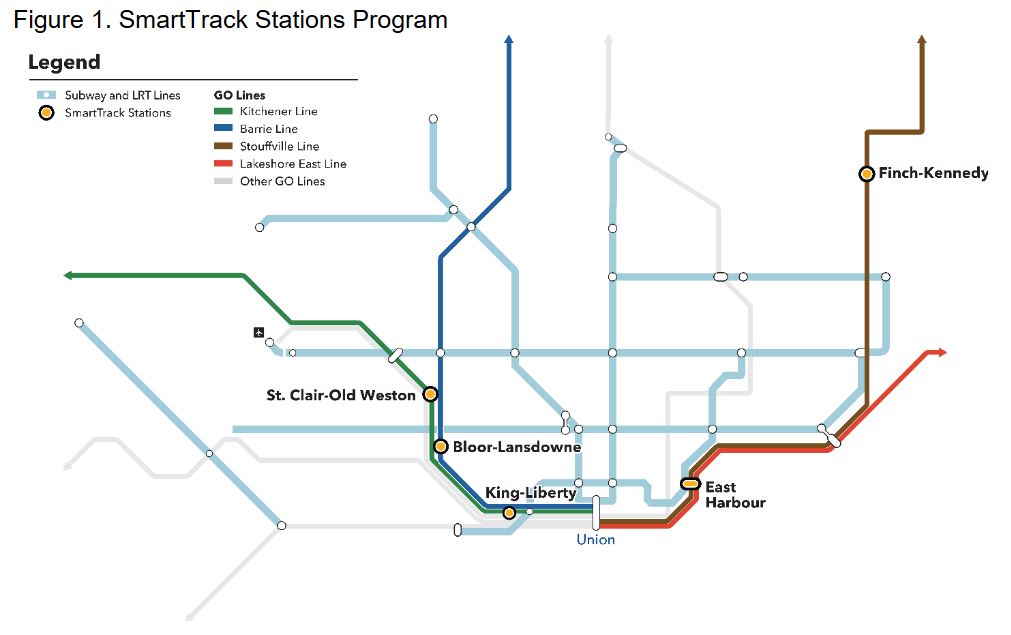
One “legacy” of the Tory years, SmartTrack, should face a quick death if only to release the substantial capital from the “City Building Fund” it represents. However, that is not easily done because there are commitments by the City to fund new GO Transit stations under the SmartTrack banner, and some of these are already nodes for major new developments. Which of them should survive deserves a thorough review. As for Metrolinx, they no longer have to maintain the fiction that there is a distinct service brand.

On the bright side, Tory’s deal-with-the-devil – Metrolinx propped up his pipedream in exchange for uncritical support – should be dead and buried.

SmartTrack was a distraction that warped planning and funding allocations for far too long. The website extolling its benefits in travel time savings for a 22-station line is still active long after that campaign scheme turned to dust.

Over at the TTC, the crisis lies in a lack of advocacy for significantly better transit. This touches many issues including a high-handed CEO rumoured to be a Tory favourite, and a lacklustre Board where much institutional memory was lost with the post-election turnover. Their job has been to keep the lights on, and to preside over budget cuts that could hogtie transit’s ability to regain lost ridership. Red paint on a few lanes in the city, assuming they could even get Council’s approval, will not attract more riders if the service is undependable and crowded, even if slightly faster. Buses have to show up to carry riders.

I often use the metaphor of a store window in talking about transit’s attractiveness. The grandest marketing campaign – “BIG SALE” signs plastered over the building – cannot make up for a lackluster collection of mouldy products and empty shelves. Too much of our transit planning and political capital goes to the razzle-dazzle.

This brings me to the question of who will replace John Tory as Mayor. I can easily name people who might have been good candidates three years out running to replace a finally-retired Tory, but everyone’s political plans rested on those three years to develop a city-wide presence and articulate a plan for what a new Mayor would bring. That luxury is gone, and quite bluntly “more of the same” is not an inspiring thought.

The interregnum will strengthen the Province vis-a-vis Toronto because Council is unlikely to speak with one voice, nor is there anyone to go hammer-and-tongs to Queen’s Park demanding a better deal for the City. Some other big city Mayor will have to take up the banner of increased federal funding and revenue tools.

The relationship between Toronto and other governments should be an important part of any Mayoral platform. Sadly, I expect that some candidates would be more than happy to fall even deeper into the “embrace” of the thugs at Queen’s Park and its agencies like Metrolinx. Toronto needs its own clear voice.

A new Mayor will have to deal with the long-standing suburb-downtown split in answering the question: what should our city be? There is no single answer to that, and anyone who tries a one-size-fits-all response will just make the problem worse. Transit is only one of many portfolios, and its political support varies across the city and beyond into the Toronto region. Even the basic question of “what should transit do” has no simple answer, especially as its role in serving downtown commuters shrank with the shift to work-from-home.

Toronto has grave financial challenges, but the larger problem will be to keep the City together rather than splitting into rival groups with unyielding demands for “their” City vision.

TTC Service Changes Effective Sunday, February 12, 2023

Updated February 10 at 3:45pm: The TTC has advised that the 504C bus will not return to Roncesvalles south of Howard Park until mid-March.

The TTC has announced several service changes effective February 12. These are, generally speaking, not the changes pending due to revised Service Standards and the 2023 Budget which will not come to City Council until February 15. Those changes will begin to appear in late March schedules, although there is a good chance that that the details will be published soon.

Notwithstanding that, some routes will see service cuts in February “to match demand”, although the TTC sometimes masks this as a schedule adjustment for reliability. A headway (the time between buses) might be lengthened to provide more round trip with the same number of vehicles, but this also affects the level of service.

Details of the changes are available in the spreadsheet linked below.

Service Changes for February 12, 2023

Continue reading

Osgoode Station Entrance Review

Metrolinx plans along several of its corridors have provoked community opposition and proposed alternative schemes, but Metrolinx has been quite intransigent about “just getting things built”, the mantra of the Ford government at Queen’s Park. Opposition is not merely steamrolled, but is painted as anti-transit, out of touch, and nimbyist in preventing the wider population from enjoying the benefit of new transit lines.

This does not endear Metrolinx to many groups (and they stretch well into the 905, not just central Toronto), but Metrolinx does not care. For them, it’s all about managing the message. Most communities just roll over and give in to an unstoppable force trying to make the best of a bad situation. “Consultation” amounts to picking the colour of the tiles for a bathroom reno, and hoping that the contractor actually installs the ones you selected.

Several sites along GO corridors and the Ontario Line have been subject to tree clearing either to open construction sites, or to remove trees that will conflict with electrification infrastructure. A small grove at Osgoode Hall, although far from the largest area Metrolinx has cleared, received much publicity because of its location. The northeast corner of Queen and University is a park beside one of Toronto’s oldest buildings, a green space complementing the square at City Hall just to the east and a more recent arrival, Campbell House, to the west.

Although the park was owned by the Law Society of Ontario, the portion Metrolinx requires was expropriated for the Ontario Line. The community around Osgoode Hall (a mix of the legal profession, the local BIA, residents and heritage advocates) convinced Toronto Council to undertake a review of Metrolinx plans in comparison with alternative designs that would preserve the treed parkland.

This report was produced by a consulting firm, Parsons, and was posted on the City’s website on February 4. It exists in two formats:

An interim injunction, in force until February 10, paused the felling of trees at Osgoode Hall for a time. Other locations have not been as lucky, nor have they had groups like the Law Society capable of taking on Metrolinx.

An important distinction for this site is that it also contains a heritage building, and there are concerns for potential damage Osgoode Hall might suffer from the overall construction plans. However, the injunction itself only applies to the trees, and it is not clear whether the wider issue of construction effects will form part of the broader argument when the application is heard.

Among the legal issues will be whether a heritage site with mixed ownership (the Law Society, Metrolinx and Ontario) can be treated as “indivisible” for the purpose of heritage preservation so that one owner, the LSO, can prevent changes on property of another owner, Metrolinx. There is also the question of whether Metrolinx can even be bound by an injunction as it is one of many agencies that are exempt from many provincial regulations.

In Brief

  • An interim injunction pauses work until February 10, with possible extension, pending further review.
  • The Parsons report commissioned by the City was published at the last moment, and was seized upon by Metrolinx to justify commencement of work on the same day as the injunction hearing.
  • Parsons concurs that the Metrolinx proposal is the best of those analyzed, but suggests that an alternative using the Campbell House site should be studied in more detail.
  • The Campbell House option would effectively displace the house from its location, and it is doubtful that it could return in as harmonious a setting as it has today.
  • Parsons does not afford the same treatment to the Osgoode Plaza proposal even though this is the major contender among the alternatives.
  • The City’s inaction on the proposed Osgoode Plaza is an (almost) missed opportunity to make the new station and the intersection into a major site downtown. If this is to be pursued, prompt action by the City is needed so that Metrolinx could adjust their construction plans accordingly.

If City Council, and most importantly Mayor Tory, are serious about an alternative to the Metrolinx plans for Osgoode Station, they should proceed as quickly as possible to endorse the Osgoode Plaza scheme and work with Metrolinx to adjust construction plans for Osgoode Station on the basis of road space on University Avenue that the plaza will free up.

In the presentation accompanying the report, the Osgoode Plaza option is shown first, and it is dismissed for various reasons notably the absence of detailed studies because the City has not yet embraced the proposed reconfiguration of University Avenue. Rather than recommending that the potential of this scheme be examined in greater detail, Parsons rejects it. This effectively prejudices the report to endorse the Metrolinx scheme as the only viable option, with a faint hope alternative that is worse than the original.

Continue reading

Seventeen

Here we are again at this blog’s anniversary. Looking back over the past year, let alone ahead to the next one, I regret that I am not in an up-beat, optimistic mood.

A year ago, I wrote:

In Ontario, there is hope that opposition will coalesce to drive the Premier and his band of incompetent fools from office. Whether we will get a new band of fools remains to be seen, but a Toronto, an Ontario in which nobody named “Ford” has any power is long overdue. Simplistic, populist slogans and dogma are no replacement for competent, dare I say, inspiring government.

This year I really do want to look forward, even with some misgivings on the social and political landscape.

The NDP and Liberal opposition did not manage to seize power, and won’t even have a shot at this until 2026. Meanwhile, we are stuck with Doug Ford and his gang of rogues who will sell off the province to their pals. Between rhetoric for the cameras, and legislation working against any interest that does not contribute to his party, Ford’s reign brings fresh disasters at every turn.

If there were a credible alternate view at the municipal level, I might hope at least for some balance, an alternate voice, but Mayor Tory continues to focus on doing whatever he can to cheapen Toronto. Some effects are not immediately visible, but they are cumulative. The City’s ability to be great, to inspire citizens to hope for more, drifts further and further out of reach.

Both “leaders” share a common problem: their egos and their dislike of criticism or opposition. They are right and everyone else is wrong, part of a rabble opposition who can be dismissed, if need be by legislative fiat.

On the transit front, their respective agencies echo this stance. Metrolinx and the TTC are run by CEOs who want things their way, and who answer, if that is the word, to boards utterly unwilling to challenge their rule (or under marching orders to shut up and vote the right way).

Without question, three years of the pandemic have stretched every agency thin. The lights stay on, flickering, only by infusion of special subsidies that already wane and could disappear within one fiscal year. That environment gave management a chance to take more power from their boards who, especially at the TTC, had many other problems as Councillors. That power will not likely be clawed back and delegated authority will be the “new normal”.

Continue reading

Waterfront East LRT Villiers Island Loop Proposal

Design of the Waterfront East LRT is still underway by Waterfront Toronto and the TTC. Whether this project will be funded in the near future and built remains to be seen, but one issue is now settled, pending public feedback and formal approval.

The question has always been “where will the line end”, at least in the interim configuration before the full buildout of trackage in the Port Lands.

Here is an overview map of the area. Note that it shows the configuration the rerouted Don River, and the new alignments of Cherry Street and of Queens Quay.

  • Starting at Union Station, the segment in red south and east along Queens Quay to the portal west of Yonge is a TTC design task that is now underway.
  • The blue segment along Queens Quay east to Cherry is a Waterfront Toronto design project. Note that it crosses a partly filled Parliament Slip (purple) rather than dodging north to Lake Shore Boulevard as Queens Quay does today.
  • The yellow segment is on New Cherry Street and Commissioners Street. It will include an extension of the streetcar network south from Distillery Loop and east via Commissioners Street. For those who are familiar with the area, New Cherry and the transit right-of-way will cross the Keating Channel on two new bridges (the red ones for those who know them).
  • Various extensions (dotted black lines) are proposed:
    • South via Cherry to Polson Street. This will take the line over the new Don River and will require twinning the existing yellow bridge where New Cherry makes the transition into Old Cherry as it crosses the new Don River.
    • East via Commissioners to Leslie Barns making a second connection to this major TTC site and a possible service through the eastern Port Lands. This will require twinning the double-span orange bridge which will carry Commissioners Street over the new Don River.
    • North via an extended Broadview Avenue to connect with GO and the Ontario Line at East Harbour Station and thence north to Queen Street.
Continue reading