At the TTC Board meeting on July 12, 2023, there was a brief discussion of the problem of short turns on streetcar lines. The information provided by management was, shall we say, less than a full accounting of what is actually going on.
This issue flared up many years ago particularly with short turns of service in The Beach among other areas, and in general a problem with erratic, gap-filled service on the outer ends of routes. TTC management committed to reducing or eliminating this problem, and to that end there was a “no short turns” policy that everybody seemed to know about at the operational level, but which was officially denied.
The stats did go down, but looking under the covers showed that not all was well:
Short turns are a bona fide service management tactic for dealing with delays to restore even spacing of service. There is nothing wrong with a short turn of some cars in a parade because this will restore service sooner than if every car trundles to the terminal and they return in a pack.
The official count of short turns fell to almost zero. However, this was due in part to selective reporting that was clear to (a) anyone actually riding the system and (b) anyone looking at vehicle tracking data.
Rick Leary got the equivalent of a gold star from the Board who frankly did not know any better, but occasionally wondered why claims of improved service did not align with complaints from constituents. The standard excuses for occasional upsets due to congestion and construction were regularly trotted out even though service could be erratic at times and locations when these were clearly impossible.
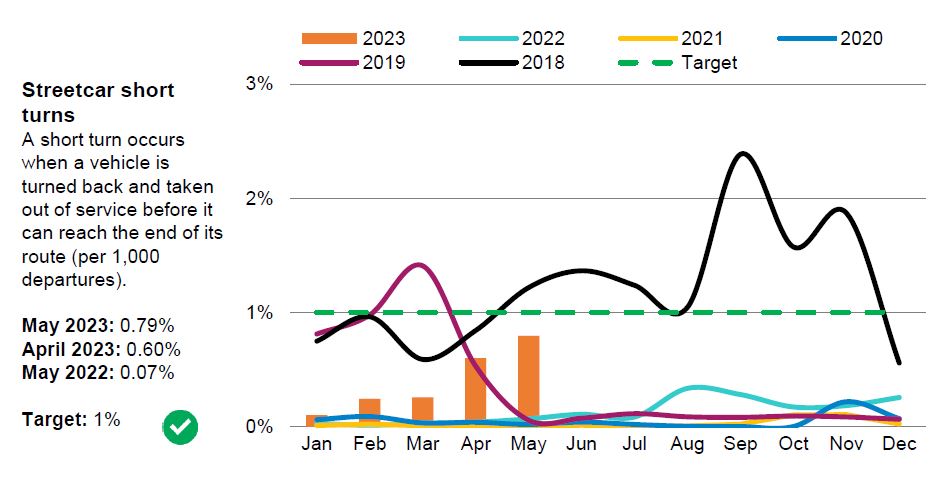
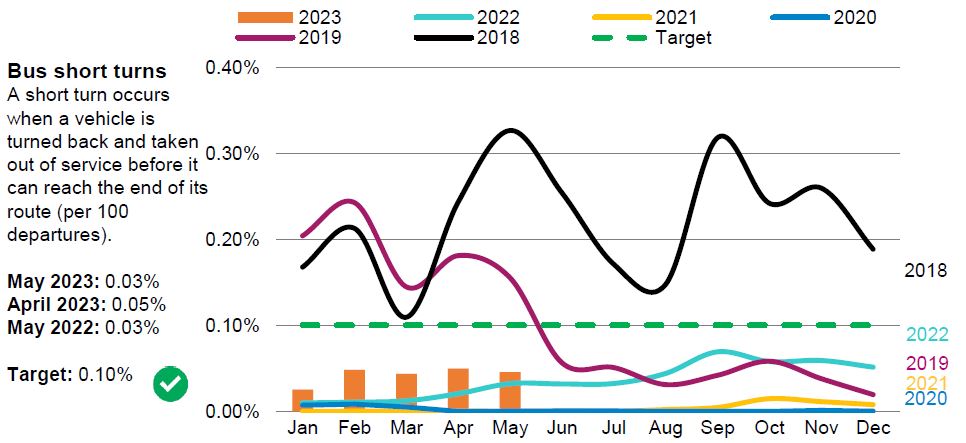
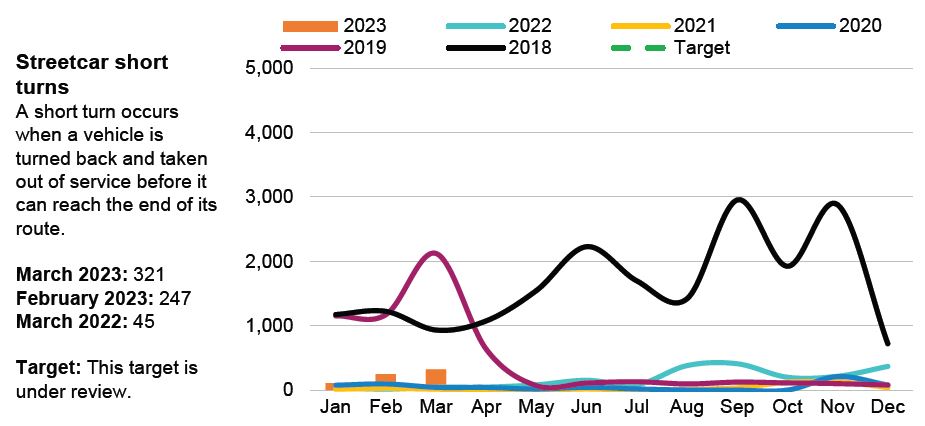
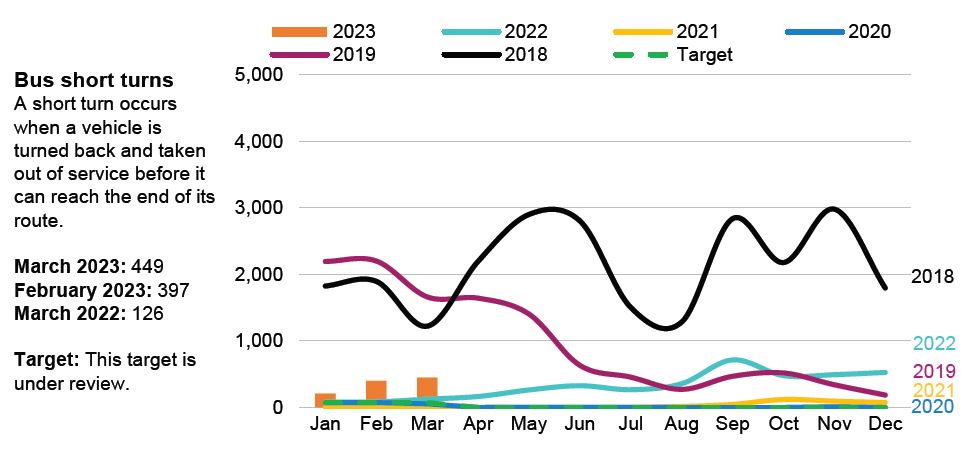
The charts below from the July 2023 CEO’s Report show the official count of short turns on the streetcar and bus network. An important factor in comparing the two is that the buses overall have many routes where congestion and construction do not affect most, if any, trips. The figures are not broken out by route to flag the “bad actors”. Moreover, the values are presented as a percentage of all trips so that time-of-day effects are hidden.
The “no short turns” policy implementation is quite clear in the data from Fall 2018 through Spring 2019. In reviewing actual short turn counts from tracking data, I have found that the values are consistently under-reported, and they do not represent actual conditions. For example, the proportion of service outbound on 501 Queen from downtown (as counted at Woodbine vs Greenwood) reaching Neville Park ranges from 100% to below 50% in January to June 2023.
Updated July 15, 2023: In June 2023, the TTC changed its reporting of short turns from an absolute number to a percentage. The scale of these charts does not make sense because the streetcar chart claims it is per 1000 departures, but cites a percentage (per 100). For comparison, the May 2023 charts are below.
I have written many times on this site about service quality and there are many factors at play including:
Unreasonably short or long scheduled travel times. This may sound like an odd pairing, but both can produce erratic service.
Too short times lead to short turns to keep operators on time especially for crew changes.
Too long times lead to extended layovers at terminals.
Lack of headway discipline at terminals and along routes.
Lack of headway management for vehicles re-entering service from a short turn to “split” a gap rather than simply running behind a through vehicle and carrying few passengers.
There are, of course, ad hoc situations where accidents, short-term construction or special events produce conditions that are not “standard”. These are normal and have to be managed to the degree possible. One side effect of the overall reduction in service on streetcar lines to a 10 minute level on many routes is that there is no spare capacity when delays occur, and wider headways make the effect on riders of any missing vehicle (either not in service or short-turned) greater.
This is not the first time the system encountered that problem, and tuning out surplus capacity has been a generic issue across the network any time budget “efficiency” takes precedence over service. The phrase “adjusting service to meet demand” goes back over four decades.
Service standards that allow for some empty space on vehicles are important because they guarantee some flexibility to absorb small problems without service collapsing. An analogy for motorists is that a highway totally jammed with cars does not move traffic at all well, and some empty space is necessary to ensure the road is usable. On transit, empty space is viewed as waste while on our roads no congestion is a holy grail.
The remainder of this article reviews the short-turning situation on most streetcar routes and the underlying causes.
When I receive the detailed plans for coming schedule periods, I will post the usual omnibus articles.
Updated July 13, 2023: The eastern terminus of the 506C bus has been corrected to Victoria Park Station.
Updated July 14, 2023: The 506 Carlton street service will resume on Gerrard East to Coxwell on Monday, July 17.
Updated July 15, 2023: The map of the revised 506 Carlton routing has been posted by the TTC.
Week of July 17 (Updated)
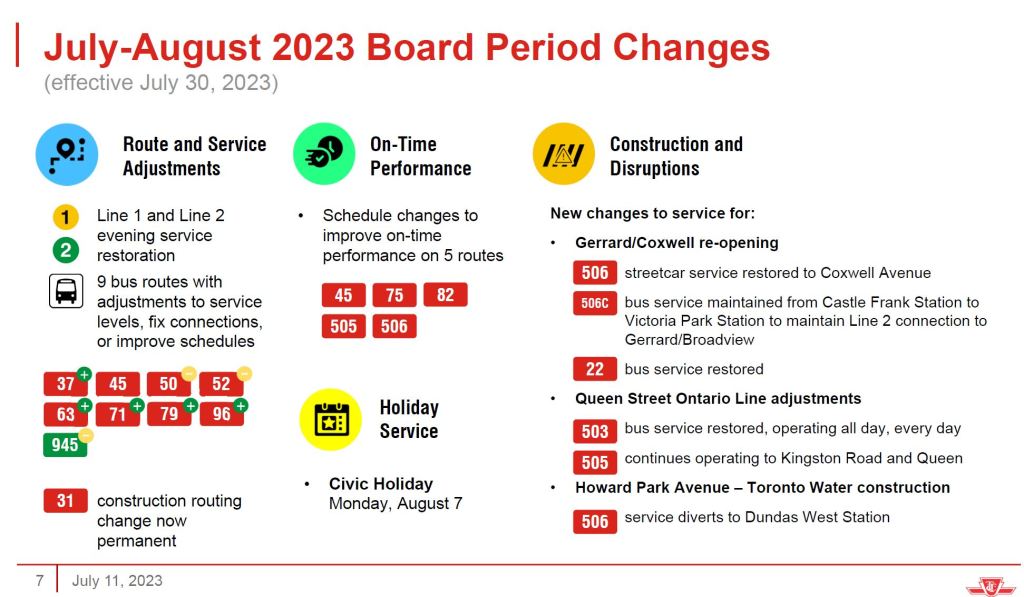
With the completion of water main and track work at Coxwell & Lower Gerrard, the 506 Carlton cars will be extended east from Broadview via Coxwell to Woodbine Loop on July 17. Service to Victoria Park Station will continue to be provided by the 506C Carlton bus.
Through bus service on Coxwell from Danforth to Queen will be restored on July 30 when 22 Coxwell return.
July 30
Several changes will occur on Sunday, July 30 including adjustments in response to demand levels, scheduling improvements and construction work.
The 31 Greenwood bus route which has been operating temporarily via an expanded south end loop will be permanently extended to Queen & Eastern Avenue.
The 506 Carlton route will be shifted to Dundas West Station as its western terminus to permit water main construction on Howard Park Avenue.
September 3
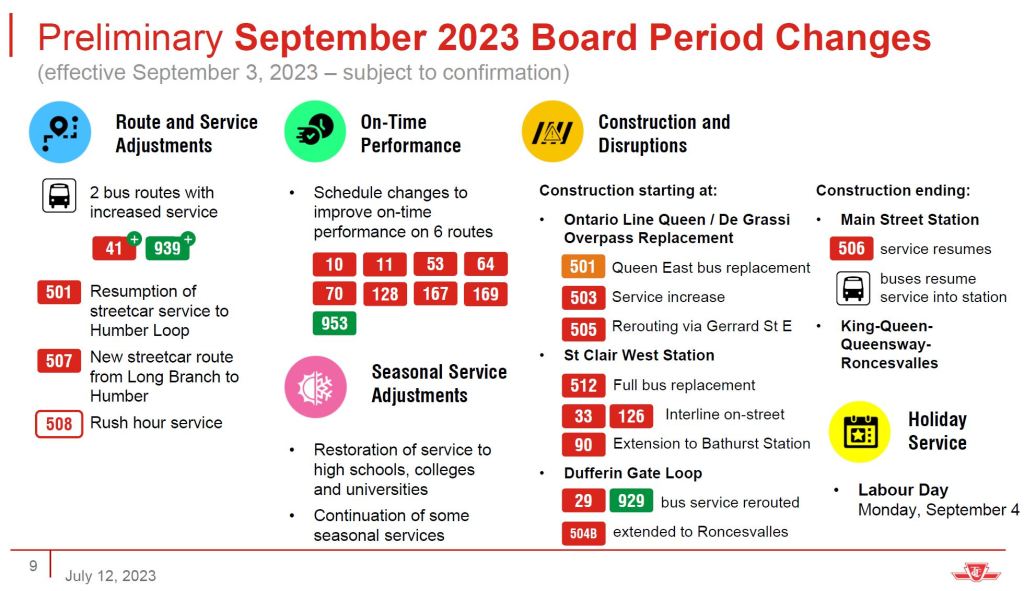
Streetcar service will return to Long Branch with 501 Queen cars running to Humber Loop, and 507 Long Branch cars from Humber to Long Branch. The peak period 508 Lake Shore (via King) will also return.
Streetcar service will return to Upper Gerrard and Main Street Station with completion of construction work there.
Streetcars will be replaced on Queen East and on St. Clair for construction.
On 501 Queen, the Ontario Line work at Degrassi (east of Broadview) will require bus service in place of streetcars. As previously announced, the temporary 505 Dundas service to Woodbine Loop will be routed via Gerrard and Coxwell due to the Metrolinx work on Queen.
On St. Clair, reconstruction of St. Clair West Station Loop will require buses over the entire 512 route. This will also affect 33 Forest Hill and 126 Christie (which will interline rather than looping at St. Clair West), and 90 Vaughan which will be extended south to Bathurst Station.
Reconstruction of Dufferin Loop will alter the south end loop arrangements for the 29/929 Dufferin services, and the 504B King to Dufferin service will be extended to Roncesvalles.
The duration of these new construction projects has not been announced.
The Toronto Region Board of Trade recently published a review of municipal transit systems against an overall set of targets. Intriguingly, this document goes by two names:
Needs Improvement: Toronto Region Transit Report Cards is the title cited on the main announcement page for this report.
Needs Improvement: Getting to World-Class Transit is the actual title on page 1 of the report itself.
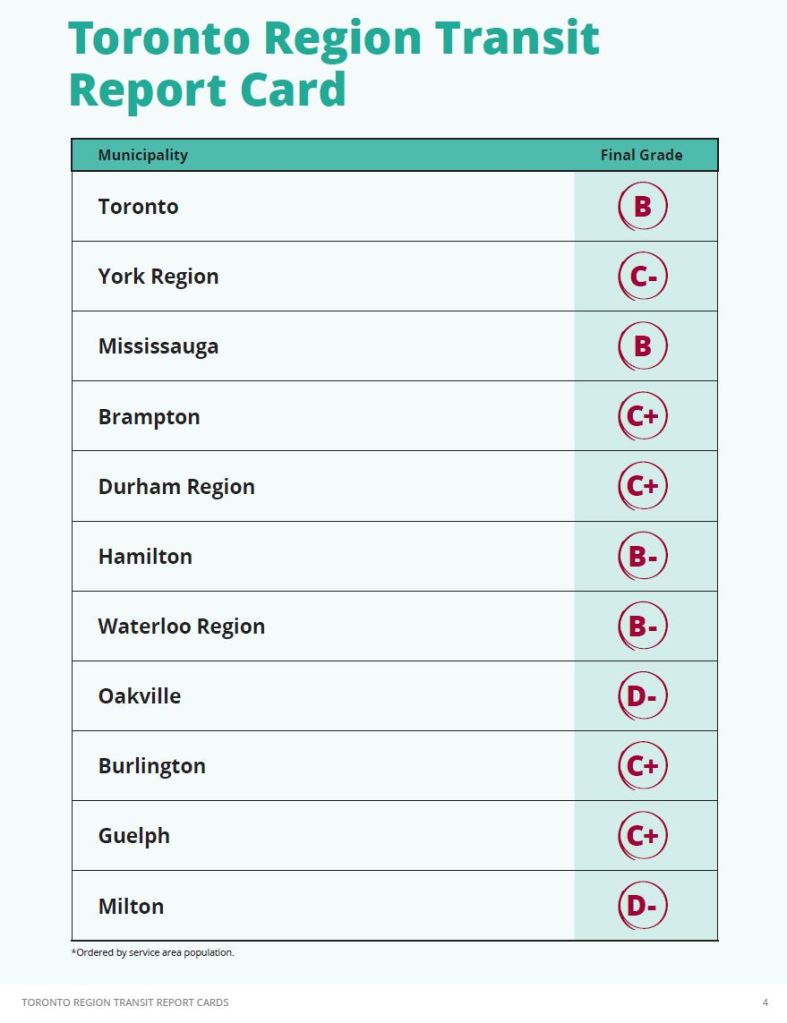
To little surprise, the most mature among the municipal systems received the highest grades: Toronto, Mississauga, Hamilton and Waterloo Region. The challenge with any grading system, assuming that it is uniformly applied, is the structure and goals used in any evaluation.
Updated July 12 at 11:10pm: Comments by Darwin O’Connor of TransSee.ca regarding reliability metrics are now reflected in the text of this article.
Updated July 10, 2023 at 3:00 pm: The City of Guelph had their grade upped from a D+ in the original rankings to a C+ based on service reliability which is quite high on that system. This raises a few key questions:
Was the “reliability” metric cited by Guelph the same as the one used by the Board of Trade for other systems? Just what does Guelph’s claimed reliability score of 88% mean?
(Updated) Darwin O’Connor, who calculated the reliability metrics for the Board of Trade Report, advises that he also provided the Guelph score and used the same methodology as for other cities where tracking data were available.
Reliability counts for 35% of the total mark. Was Guelph scored zero on this simply because the Board of Trade didn’t have service tracking data for them?
Reliability data are also listed as “Not Available” for Oakville and Milton. Considering that neither of them has a 15 minute service area, awarding them substantial marks for being “on time” with what they do run would be boost that might not be fairly earned.
(Updated) O’Connor replies: “TransSee is unable to provide reliability data for Oakville because their API doesn’t have a method to get all vehicle locations at once. I also didn’t have tracking data for Milton because my data source is unofficial. I expect if it was included they would get a better mark like Guelph did.”
If anything, this gaffe reveals sloppiness in the Board’s methodology and the typical problem of looking only at the high level summary without poking “under the covers” to verify the results. The Board of Trade should try harder for accuracy and completeness on their next transit outing.
The Board regards the ability to move workers, students and residents as an important economic goal, and the absence of good transit as a drag on the region’s economy.
“Improving transit is critical to addressing our reputation as North America’s third-most congested city – a key barrier to the economic competitiveness of our region,” said Jan De Silva, President & CEO of the Toronto Region Board of Trade. “These report cards highlight where we’re falling short and, as a result, what we can look to as we seek to provide a world class transit network that will better-connect workers to jobs, students to school, and residents to their lives.”
TRBOT Media Release, July 5, 2023
There is a fundamental difference between a mere evaluation of our transit systems versus each other, and one that would qualify systems as “world class”. That term sets a much higher threshold, and there is no sense that the Board of Trade took this into account when constructing its grading system.
Updated July 10, 2023 at 3pm: The chart below is the revised version showing Guelph with a C+ grade.
“Getting to an A” is the premise behind the review, but much less clear is whether that “A” will actually bring the type of transit network and service to be truly competitive, to be “world class”.
The Board acknowledges the limitations of its review and notes that some conditions “are the result of a historical lack of investment and operational resources”. That is a delicate way of saying that transit has not been a priority at the political and social level. As population and travel growth shift the emphasis toward transit, “… suburban cities now find themselves pressured to stand up an urban-quality transit system that helps residents move within and throughout the region …”.
Key findings include:
The combination of network coverage (where there are routes close to people and destinations) and service is poor in most of the region.
Service reliability is particularly bad in Toronto with only 58% of trips meeting an “on time” standard.
Another important factor is that a line on a map does not guarantee good service, or service at the time and to the destination a rider might require. GO Transit, a system notably absent from the Board’s analysis, looks good on a map, but not quite so good on the timetable.
For an organization like the Board of Trade, this is a rare recognition that transit is more than a handful of high profile construction projects. A dominant car-oriented culture led directly to the congestion that bedevils the region. Cars enable travel throughout the region, but a corresponding web of transit service never developed. Our collective focus on big ticket projects to support commuting traffic primarily to Toronto’s core left other travel to lower-quality bus service, if that.
In all the hoopla about billions in “transit investment” we forget that over a decade ago the Metrolinx regional plan clearly showed that their proposed network would at best keep congestion from worsening, but would not relieve the underlying problem.
In this article, I will review the scoring system and the goals it seeks to achieve, what the Board considers worthy of an “A” grade. Are we aiming high, or is our definition of “world class” merely good enough to remove some of the more embarrassing gaps in our region’s transit network?
For those wanting the answer up front, no, I believe that the Board, and by extension the political voices they represent, are aiming low. Either they would give everyone an “A” grade for middling improvements, or they would be forced to admit that “world class” is out of reach.
The target for “frequent” transit service is not exactly high. If we were evaluating a road network on a similar basis, we would be happy with two lane roads on a roughly 1.6km grid. That would be a square from roughly Bloor to Dundas, and from Yonge to a bit west of Spadina. The roads would only require capacity for 200 people/hour each way equivalent to four full buses on a 15 minute headway. Some roads would close every evening and all weekend.
That is hardly a “World Class” transit service. The target coverage and service level befit a rural area with cows and sheep grazing by the roadside, not an urban transit system. This target understates the true shortfall in transit as a viable travel alternative.
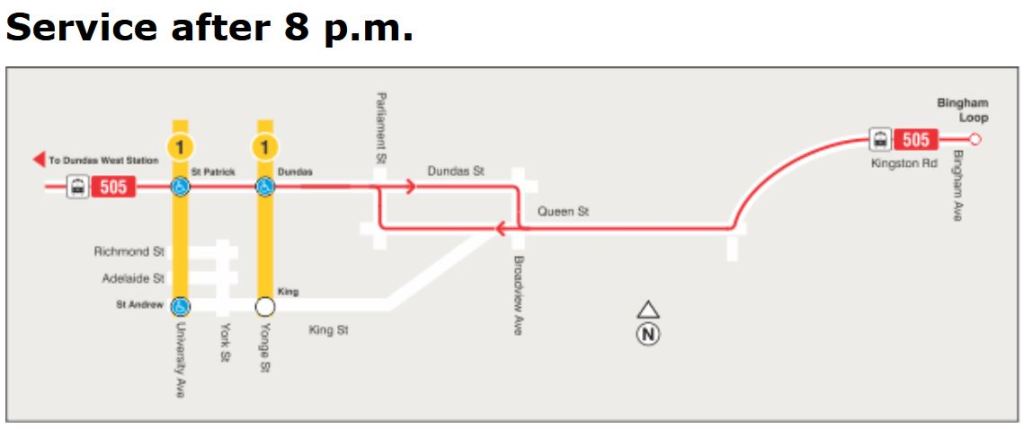
On May 7, 2023, the eastern terminus of 505 Dundas shifted from Broadview Station to Bingham Loop due to sewer work, track construction and road paving on Broadview north of Gerrard. This will continue into at least the late Fall 2023.
This operation was not a success by any measure with extremely erratic service on Kingston Road where the 505 replaced the 22 Coxwell bus and the 503 Kingston Road streetcar. Service on the main part of 505 Dundas from Broadview to Dundas West Station has also become less reliable.
July 4, 2023, service changes (505 Dundas was cut back to Woodbine Loop and 503 Kingston Road buses (running as unscheduled extras) provided service to Bingham until 8pm to correct this problem, but riders endured almost two months of bad service. This affected not just Kingston Road but the entire 505 Dundas route.
This article reviews service during the May-June 2023 period when 505 Dundas cars ran to Bingham with comparisons to the “before” conditions on routes 505, 503 and 22. It is a long article with many charts for those who are interested in the details of how this service has behaved over the past six months. In Part II I will turn to reviews of operations on a sample of days in May-June.
In brief, the May schedules unwound improvements made in February that adjusted travel times to better match conditions. Moreover, Februrary saw major service cuts to the 505 Dundas route which compounded with less reliable service to make for much wider gaps between cars. In many ways, this was an “own goal” by the TTC.
Oh the irony! The TTC’s Annual Service Plan consultations are all about how to handle a few (but not all) of the construction projects coming in 2024, but the elephant in the room remains bad communications and changes on the fly.
The new routes implemented in May and June 2023 were in cases impractical thanks to a combination of unduly optimistic running times in schedules, less than adequate transit priority and line management whose priority was not the provision of well-spaced, reliable service. Several changes will take effect on July 4 and 5 to correct some of these problems, but the information is scattered through the TTC’s website, if you can find it at all.
First, a summary of the changes:
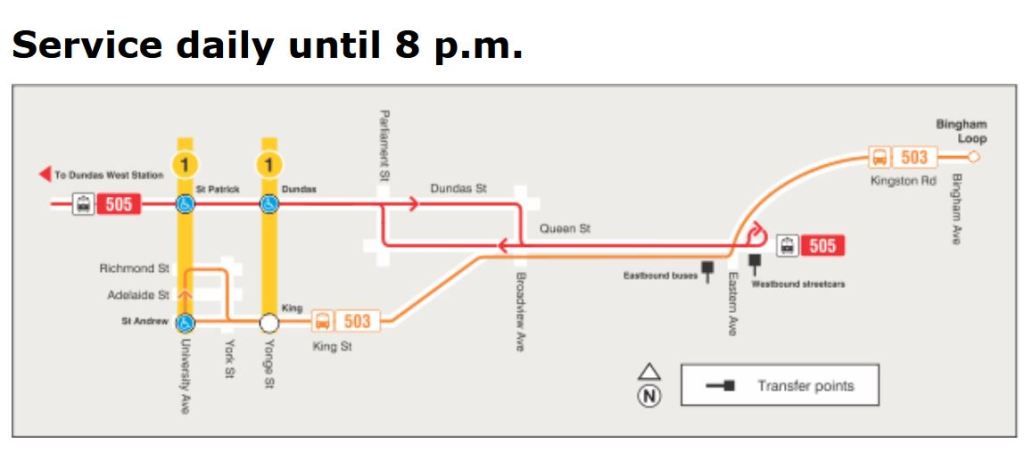
The 501/504 shuttle bus (an ad hoc service implemented to cover for the absence of the 503 Kingston Road car to King Street downtown) will be rebranded as “503” and will serve Kingston Road to Bingham Loop until 8pm every day. This will become a scheduled bus service at the end of July, and will revert to 503 streetcars likely in October.
The 505 Dundas car will only operate east on Queen from Broadview to Woodbine Loop, except after 8pm when service to Bingham will be provided by streetcars.
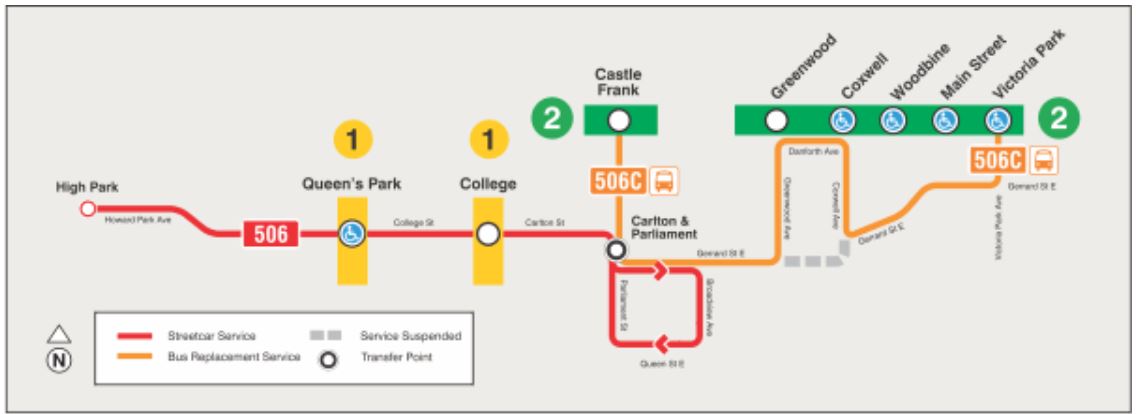
The 506 Carlton car will only operate to Queen and Broadview and will return west to route via Queen and Parliament Streets without running east to Woodbine Loop.
The 512 St. Clair car will be restored, temporarily, west of Lansdowne to Gunns Loop. While it lasts, this will correct for the erratic service now provided there by the 47 Lansdowne extension.
The challenge is to find out that this is happening to your route. The TTC website is very poorly organized with information in many places that is inconsistently placed and linked (or not) to the main route pages affected. Some items are out of date, but remain in place to confuse riders. Some items describe major changes but are hard to find if you don’t know the site in detail.
These are the hallmarks of a site maintained by many groups each with its own (probably jealously guarded) responsibility for providing information. Nobody appears to care about overall site consistency and ease of navigation, or if they do, are in any position to change what is a clearly broken process. Some information is just plain wrong indicating that whoever created or updated the page was either sloppy, or does no know what is actually happening.
Updated July 4, 2023 at 7:10am: Changes to the TTC website since this article was posted are noted in various places below.
Updated July 5, 2023 at 4:30pm: Changes to the TTC website since the July 4 update are noted throughout the article.
With the albeit brief re-appearance of streetcar service on Kingston Road courtesy of the 505 Dundas rerouting to Bingham Loop, and the holiday weekend, it’s time for a look at Kingston Road today and as it was decades ago. Parts of the street have changed a lot, others are very much the same.
All photos in this post were taken by me and should be credited if they are reposted elsewhere.
The TTC will implement two route changes in July to address, in part, problems with service reliability on construction diversions.
Updated June 30, 2023: The location of Salsa on St. Clair has been corrected.
Updated July 1, 2023: The 506 Carlton cutback to Queen and Broadview has been added.
503 Kingston Road / 505 Dundas
Effective Tuesday, July 4, 2023 (July 3 is a holiday), service on Kingston Road to Bingham Loop (Victoria Park) will be revised on weekdays and Saturdays from 6am to 8pm, Sundays from 8am to 8pm:
505 Dundas cars will turn back at Woodbine Loop in stead of running through to Bingham.
503 Kingston Road buses will operate between Bingham Loop and York Street via King. Because these are “extras”, not scheduled buses, they will not appear on trip prediction apps.
After 8pm on all days, the 505 Dundas car will run through to Bingham Loop as it does now.
This change should relieve problems with tight running times that caused many short turns on 505 Dundas and wide gaps both on Kingston Road and on Dundas west of Lansdowne. (I will publish an analysis of 505 Dundas headways and reliability in early July.)
Effective Sunday, July 30, 2023, the 503 Kingston Road bus will operate between 6am and 1am (starting at 8am on Sundays) over its Bingham to York route.
Streetcars are expected to return in the fall, likely on Thanksgiving weekend. It is not yet clear whether the 503 streetcar will permanently replace the evening and weekend service formerly provided by the 22A Coxwell bus.
506 Carlton (Added July 1, 2023)
The 506 Carlton streetcar service will be cut back in the east end to Broadview rather than running east to Woodbine Loop. This will correct a problem with inadequate running time that caused many streetcars to short turn without getting to Woodbine Loop anyhow.
The map below shows the 506C bus diversion via Greenwood and Danforth around track construction at Coxwell and Lower Gerrard. This configuration will be in effect until mid-July when buses can again operate via Gerrard and Coxwell without diverting.
512 St. Clair
Effective Wednesday, July 5, 2023, the 512 St. Clair car will resume operation west to Gunns Loop. Construction at the GO Barrie corridor bridge west of Caledonia has been delayed allowing through service until August. The date when turnbacks at Lansdowne (Earlscourt Loop) will resume is not specified in the TTC announcement.
On the weekend of July 8-9, 2023, streetcar service will be suspended on at least part of the route (TBA) for the Salsa on St. Clair festival between Oakwood and St. Clair West Station.
Service on the temporarily extended 47 Lansdowne bus on St. Clair has been quite erratic. (Stay tuned for an analysis of this operation in coming days.)
On June 27, I was one of several guests on CBC’s Metro Morning doing “where do we go from here” pieces about newly elected Olivia Chow’s challenges as Mayor of Toronto.
The item was not posted on the show’s website, and so here for those who missed it is my own recording.
The TTC is part way through production of its 2024 Service Plan as well as a 5-Year Service Plan and Customer Experience Action Plan. In Round Two, consultation will focus on plans for service changes triggered by major construction projects. Five pop-up sessions are planned at Flemingdon Park, Union Station, Liberty Village, Finch Terminal, and Pape Station between June 29 and July 12, 2023. Details are available here.
Also available on that page is a link to a survey seeking feedback on various proposals. Please note that my site is not an official TTC conduit for feedback, although it is no secret that many at the TTC do read articles and comments here. Any specific feedback for the TTC should be submitted through their own survey.
Round Three in August-September will present draft concepts for the 5-Year Plan and Customer Experience Action Plan, and these will be refined into final drafts for Round Four in October-November.
The remainder of this article presents an overview of the survey and proposals for construction-related service changes.
There are no proposals for new routes nor of overall service levels in this round. The election of Olivia Chow as Mayor will no doubt bring a review of existing services, but that is not in the scope of this round.
An important issue left over from the 2023 Budget process and the recent service cuts is the question of Service Standards. These are described as “Board Approved”, but in fact the 2023 changes were implemented by management as part of the budget with only retroactive consent from the Board. Moreover, the actual effect of the changes was withheld from the Board and Council until well after the budget was approved.
Transparency in budgets and service planning will be an important change looking ahead to 2024. With a new Mayor I hope to see a much improved process.