Adelaide Street track almost finished! New traffic signals on King! Almost no work on York Street. And some really appalling track.
All photos in this article were taken by me on April 10 and 14, 2024.
Updated April 17, 2024: Photos showing pavement patching at King & Church added.
Updated April 21, 2024: Photo showing rail gap and pavement patch on westbound rail, west side of the intersection added.
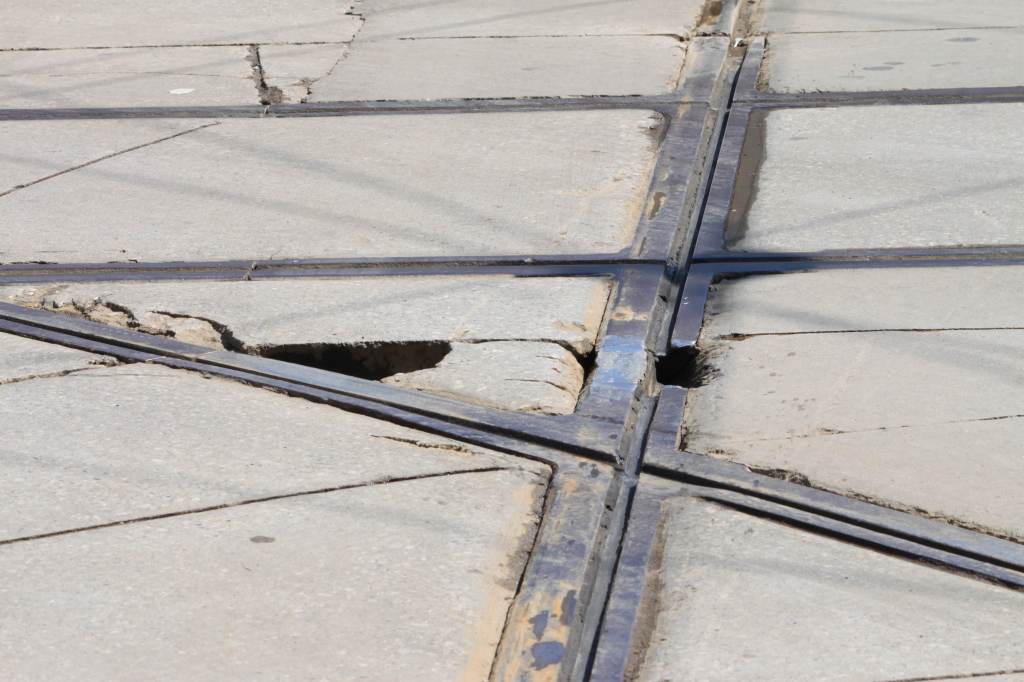
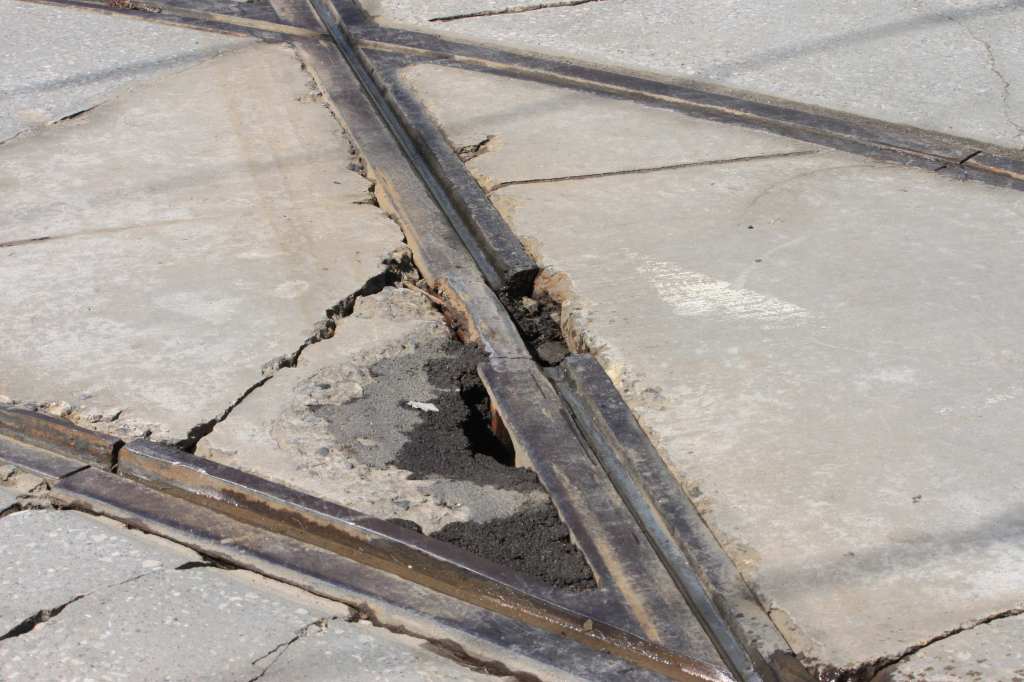
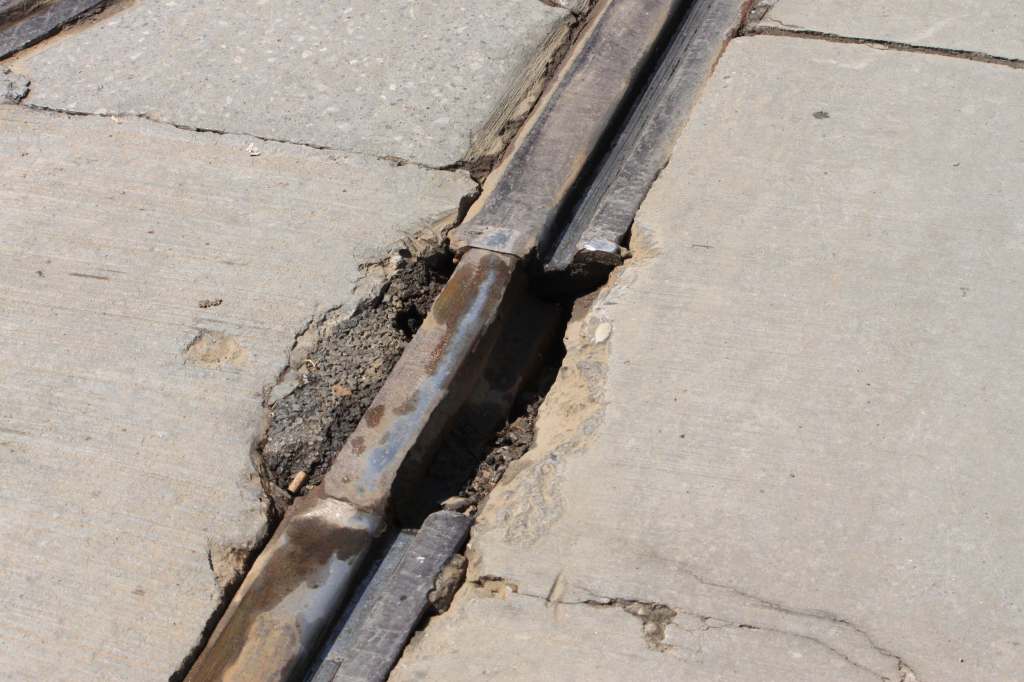
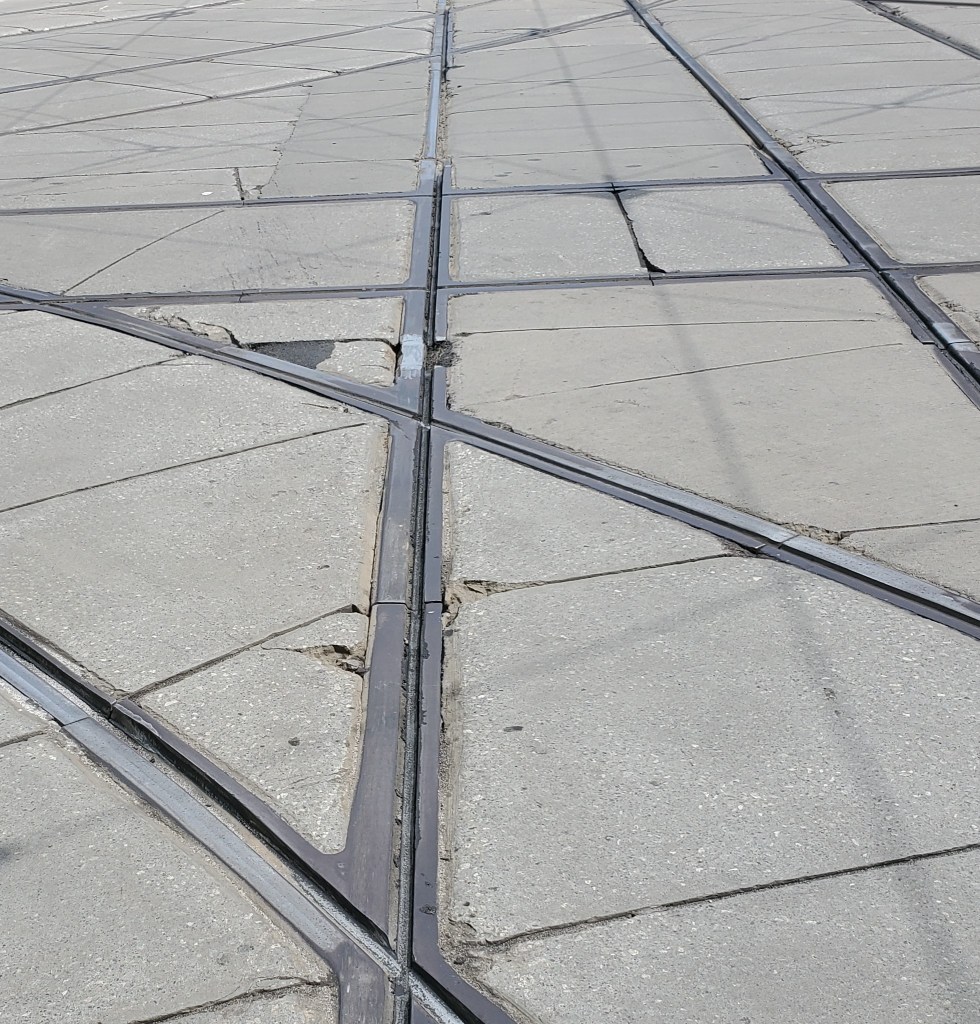
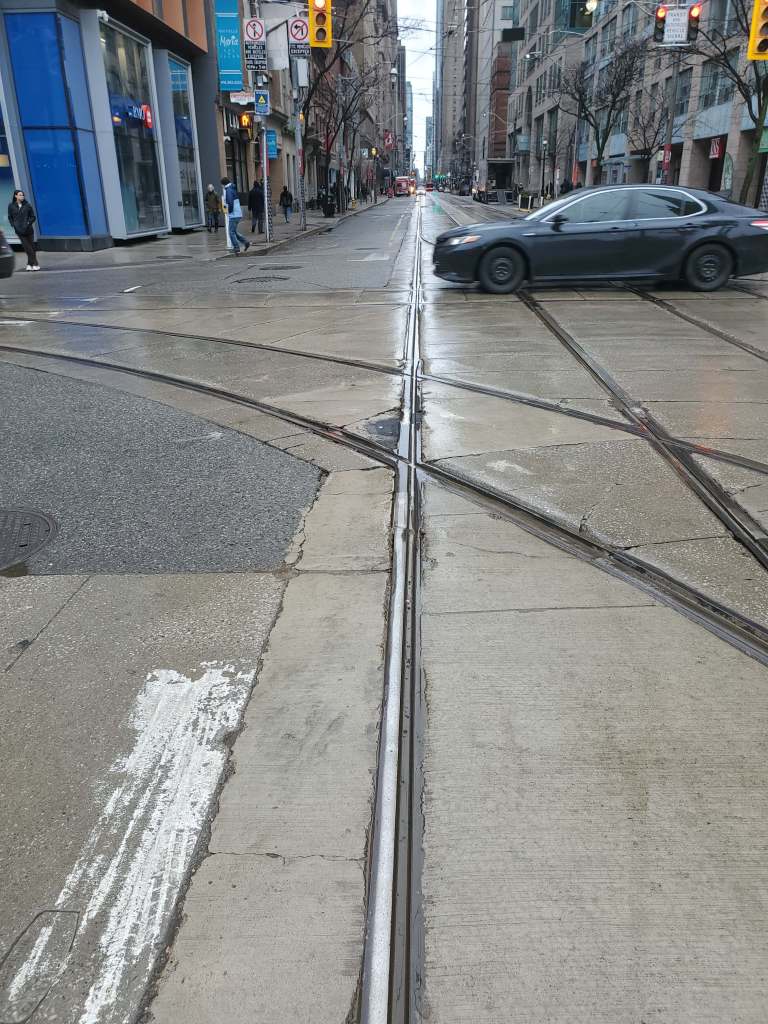
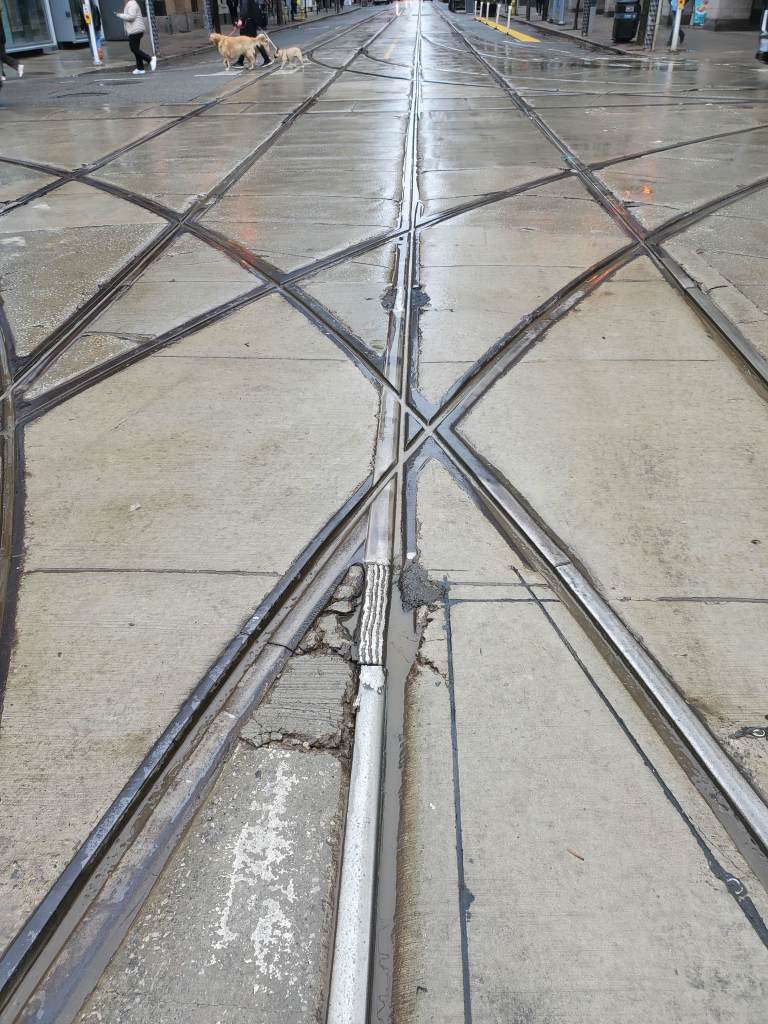
The basic problem with some of the repairs is that they do not necessarily provide a continuous surface for streetcars. The reason for this is that the diamonds are designed to carry cars on their flanges so that the main part of the wheel does not produce the familiar “thunk” where at the crossing of two tracks. Some of the breaks shown here are within the diamond, and the flange way has completely broken off. As streetcars pass, their wheels fall off of the adjacent intact flange way into the gap even though the main rail head is continuous. This is particularly evident on the northerly westbound rail (see photos at the end of the article).
Updated April 26, 2024: Photo of work in progress on York Street south of Richmond added.
Adelaide Street
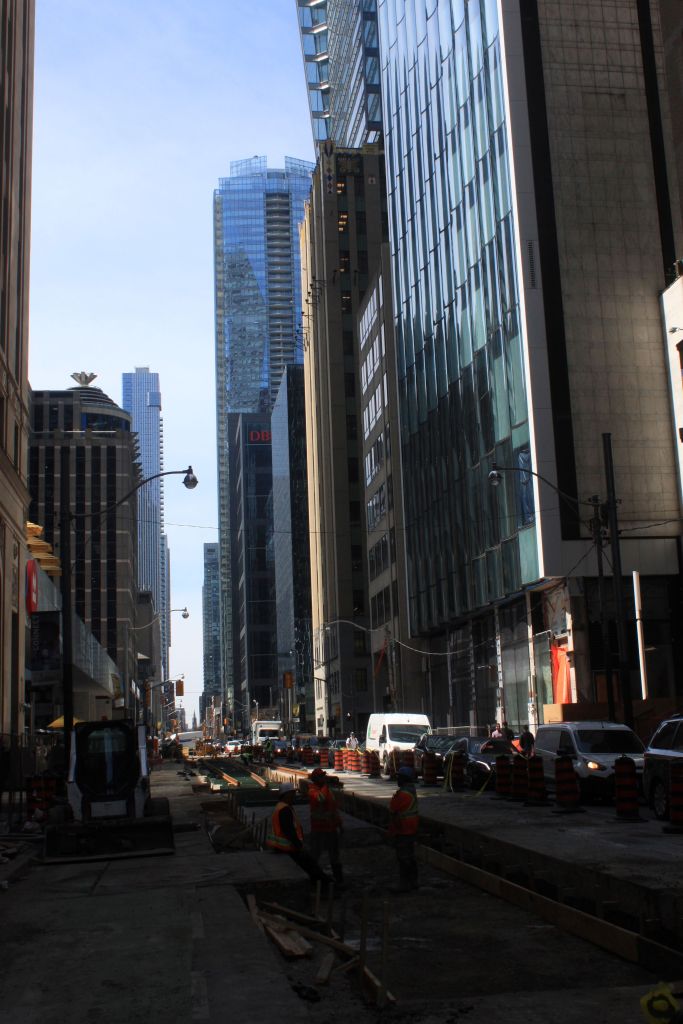
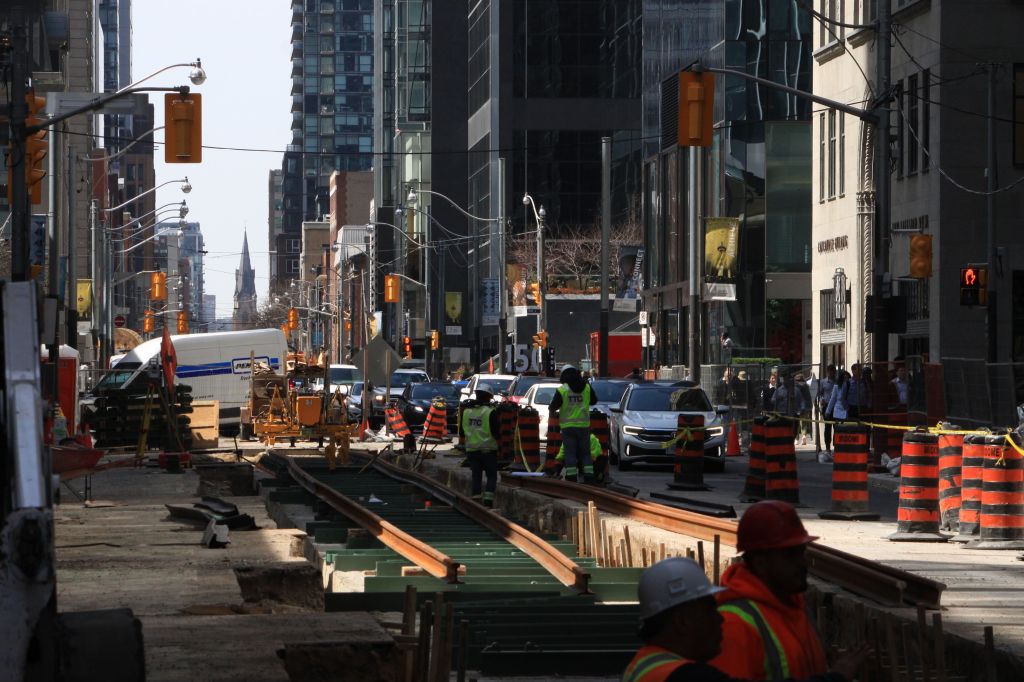
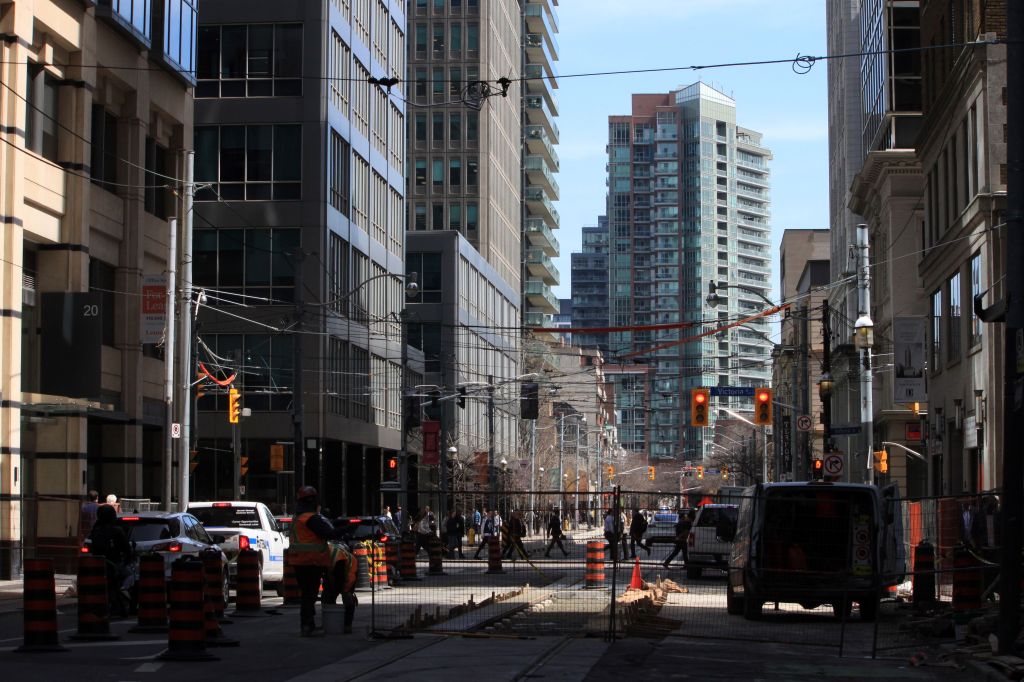
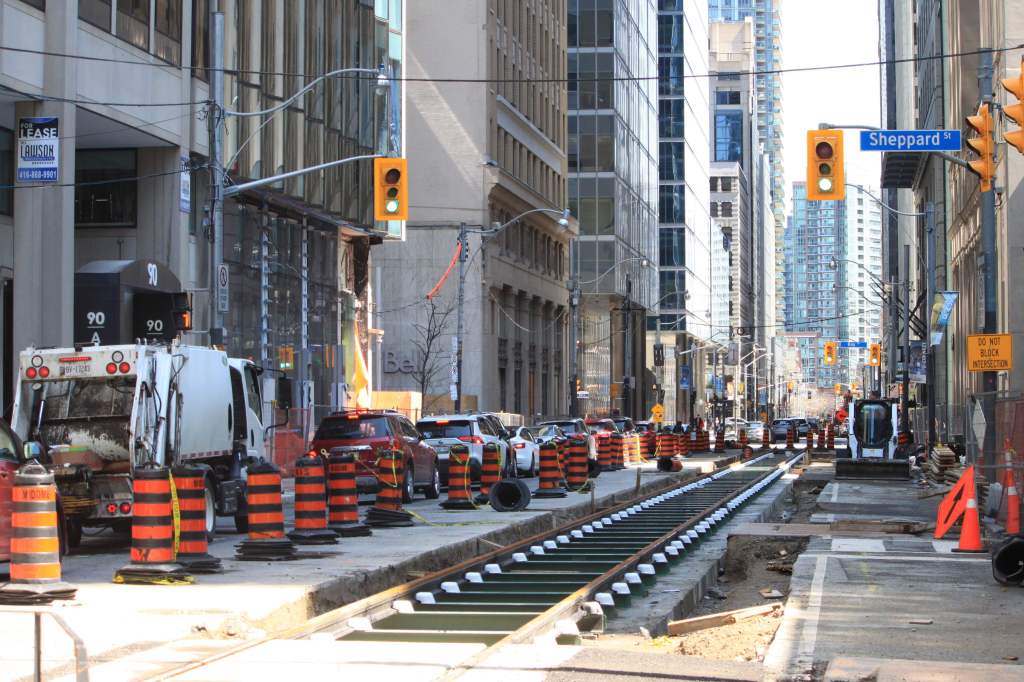
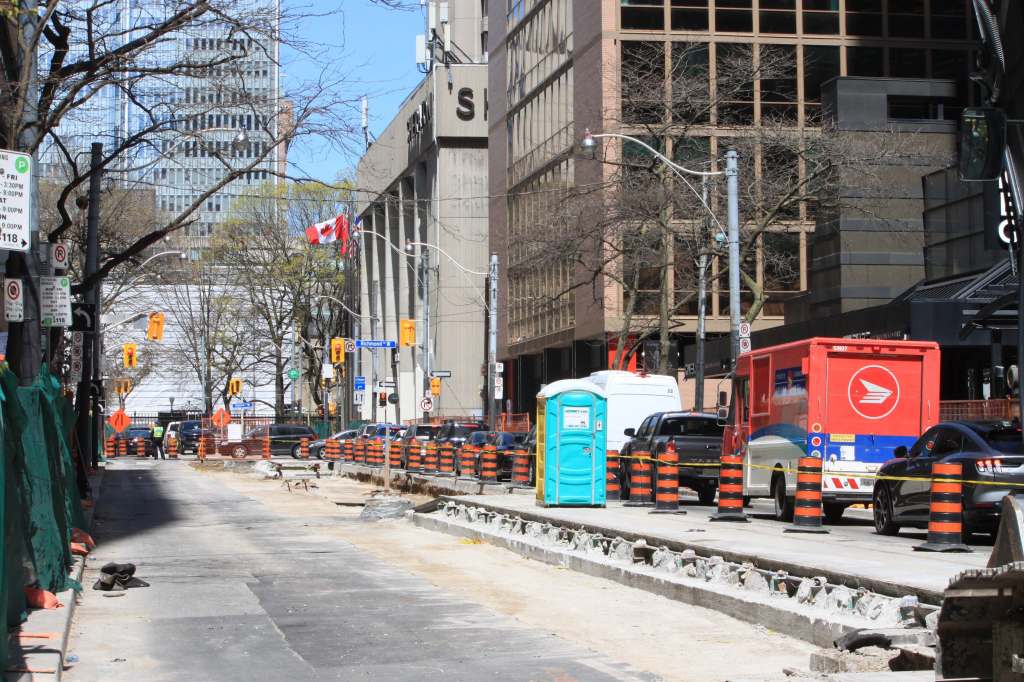
The two remaining chunks of new/replacement track are finally being installed on Adelaide Street, and some work is underway for new overhead. This will be the eastbound 501 Queen diversion for the Ontario Line construction.
Adelaide W from Bay 2024.04.10Adelaide W. to York 2024.04.10Adelaide E. to Victoria 2024.04.10Adelaide E. from Sheppard to Bay 2024.04.14
York Street
Almost nothing has happened with the new track to be installed on York south from Queen. There is a pile of rail on Queen west of York, and some pavement cuts prior to excavation, but that’s all. Metrolinx is not exactly rushing with their part of the project.
Updated April 26, 2024
Excavation for a new trackbed appears to be complete between Richmond and Adelaide Streets.
Looking north from Adelaide toward Richmond on York. Apr. 26/24
King Street Signals
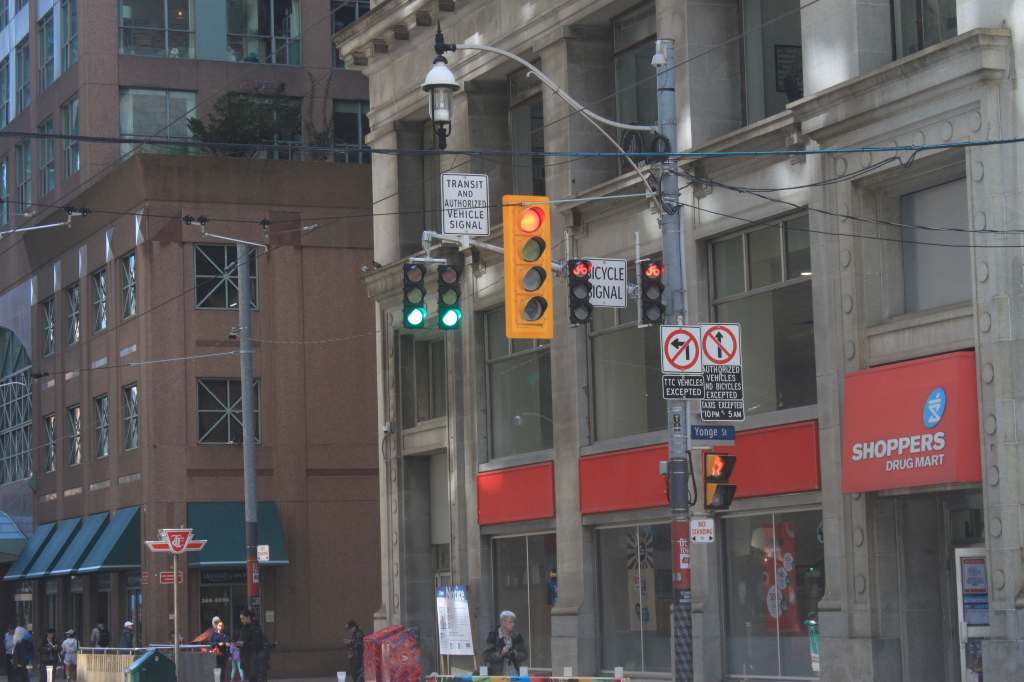
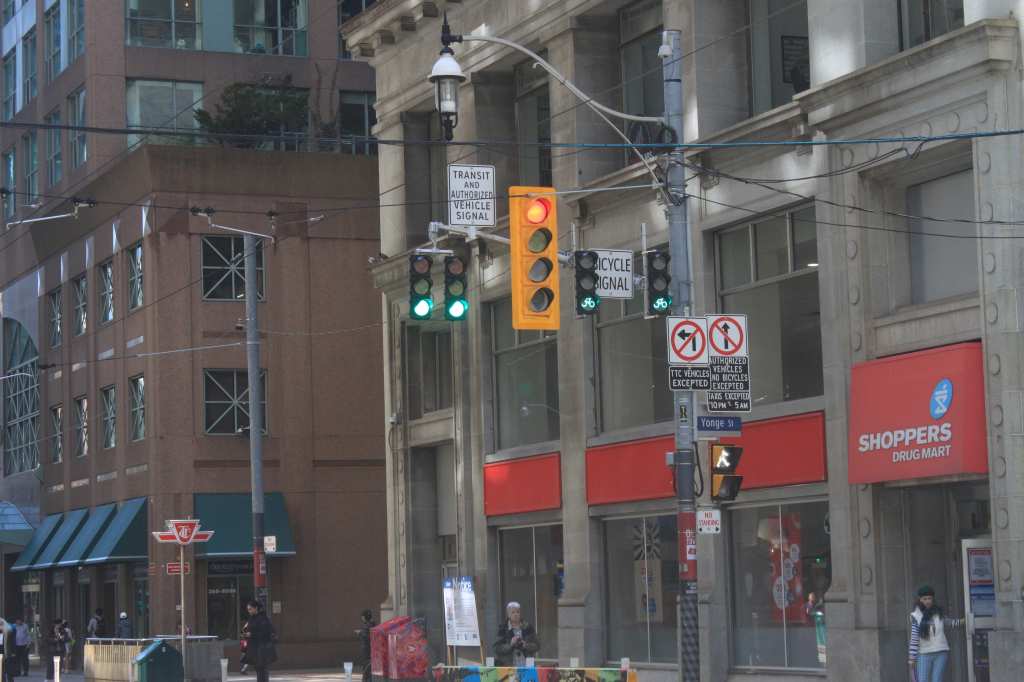
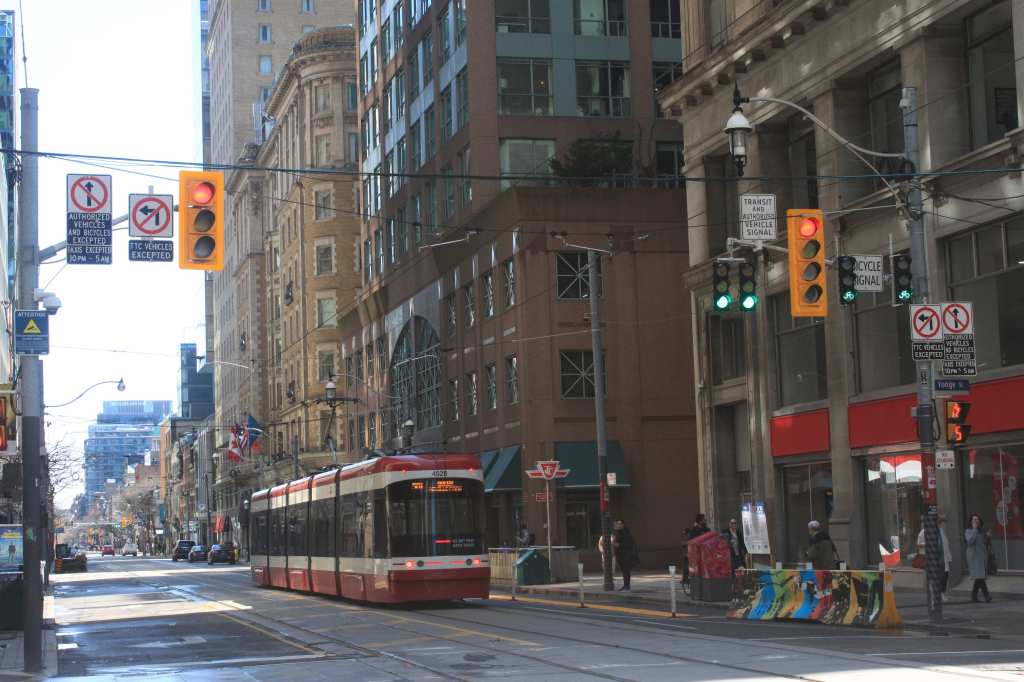
New signals intended to deter straight through auto movements have been activated on King at Church and at Yonge. The intent is to make a straight through movement one that must drive against a solid red signal. If the City ever installs red light cameras, there will be a bonanza in tickets.
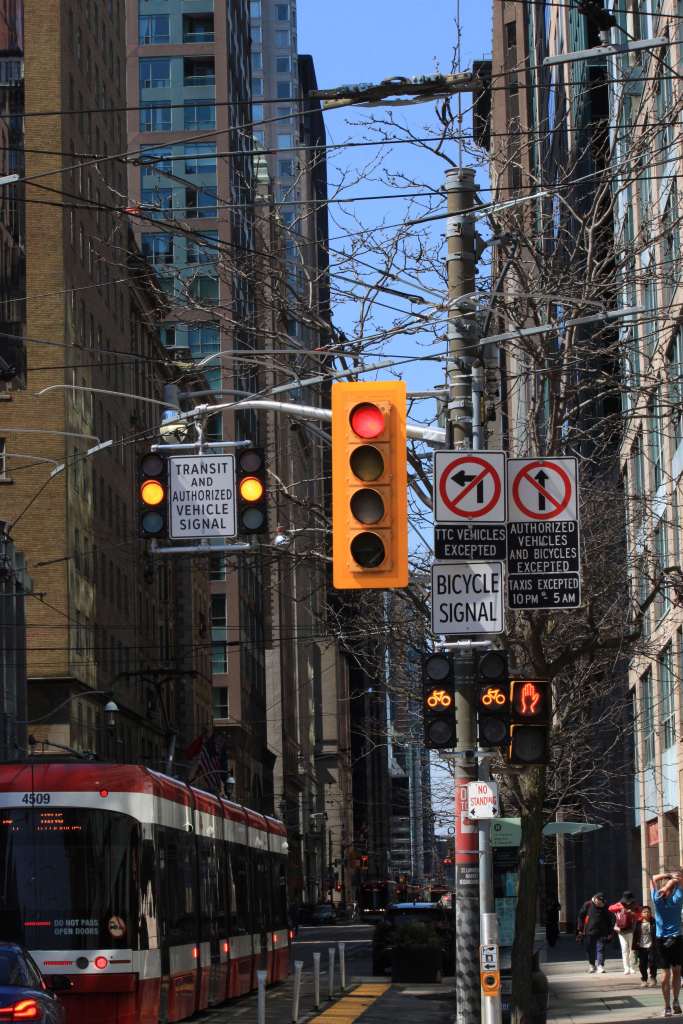
The design provides separate signals for pedestrians, cyclists and authorized vehicles (mostly transit, but also taxis from 10pm to 5am). The signage, already complicated, is now more extensive and guaranteed to confuse any motorist. Indeed, during my visit, a 501 Queen bus created a traffic jam waiting for a conventional green signal while ignoring the transit signal.
Here is the collection of signs westbound at King and Church Streets. The signals are in the process of turning red for King, and they show an amber aspect for transit and cyclists.
An important point about signals is that they do not only tell people what they can do (for example, the red hand tells pedestrians not to walk, a green bicycle tells cyclists they can proceed). This gives some hint to everyone of how all traffic is expected to behave.
Nobody knows what an “authorized vehicle” is, and this is especially tricky for unmarked “cabs” like Ubers. If a car drives through a full red signal, is it allowed or not?
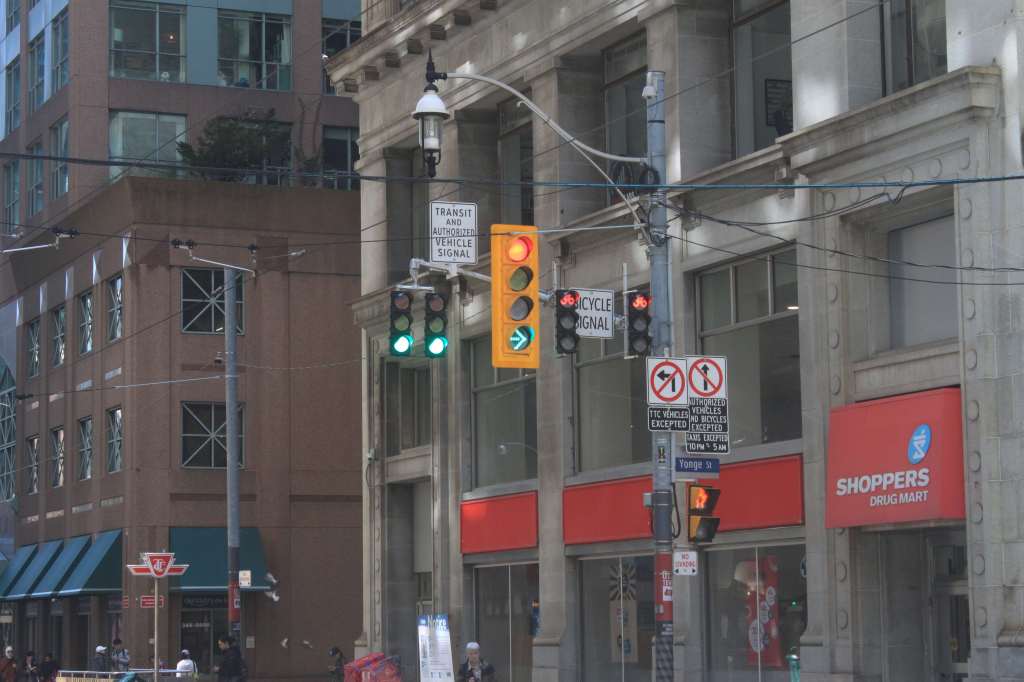
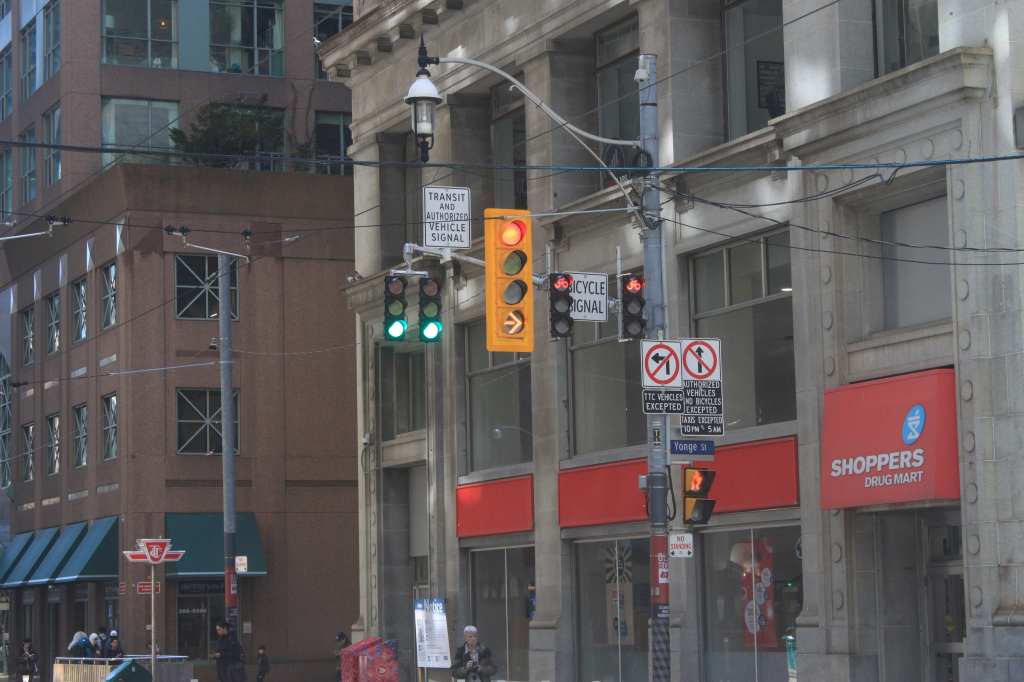
The large red aspect on the main signal (with the yellow backboard) never changes, but it will on occasion be joined by a green arrow in the bottom aspect.
Here is the cycle of displays eastbound at King and Yonge as east-west travel gradually opens up.
1. Transit and right turns allowed2. Transit allowed, right turns ending3. Transit allowed4. Transit, cyclists and pedestrians allowed5. Pedestrian cycle counting down. Next comes the amber phase for others.
This confusion shows how important the establishment of simple, clear barriers like a few short transit malls with planters and other physical limitations. Send motorists a clear message: “Don’t even think about driving here.”
All photos taken on April 14, 2024.
King & Church Track
Although the TTC told a good story recently on their subway track maintenance, the situation on the streetcar network is not quiet so rosy. A low point is at the intersection of Church & King, long overdue for complete reconstruction, where there are three separate pavement gaps and ad hoc rail repairs.
Westbound north rail 2024.04.14Eastbound south rail 2024.04.14Westbound south rail 2024.04.14
It is hard to take TTC claims that they value safety highly and repair faults promptly with conditions like this.
Updated April 17 & 21, 2024: The photos below show recently applied pavement patching.
Westbound north rail 2024.04.21Eastbound south rail looking west 2024.04.17Westbound south rail looking west 2024.04.17
* City Council Transmittal – CC15.1 Budget Implementation Including Property Tax Rates, User Fees and Related Matters
* Financial and Major Projects Update for the Year Ended December 31, 2023
* Easier Access Phase III – Project Status Update April 2024
Approval of Public Art Concepts for the Bay, Castle Frank, Christie, Donlands and Lansdowne Stations
I have already written about the SRT report, and here will discuss only the deputations and discussion at the Board meeting.
(*) Part II will review the Asset Management Plan, and Part III will cover updates on TTC finances, Major Projects and Easier Access.
A Draft Report on the TTC’s “Innovation and Sustainability Framework” was deferred to the May Board meeting, and I will comment on that when it reappears.
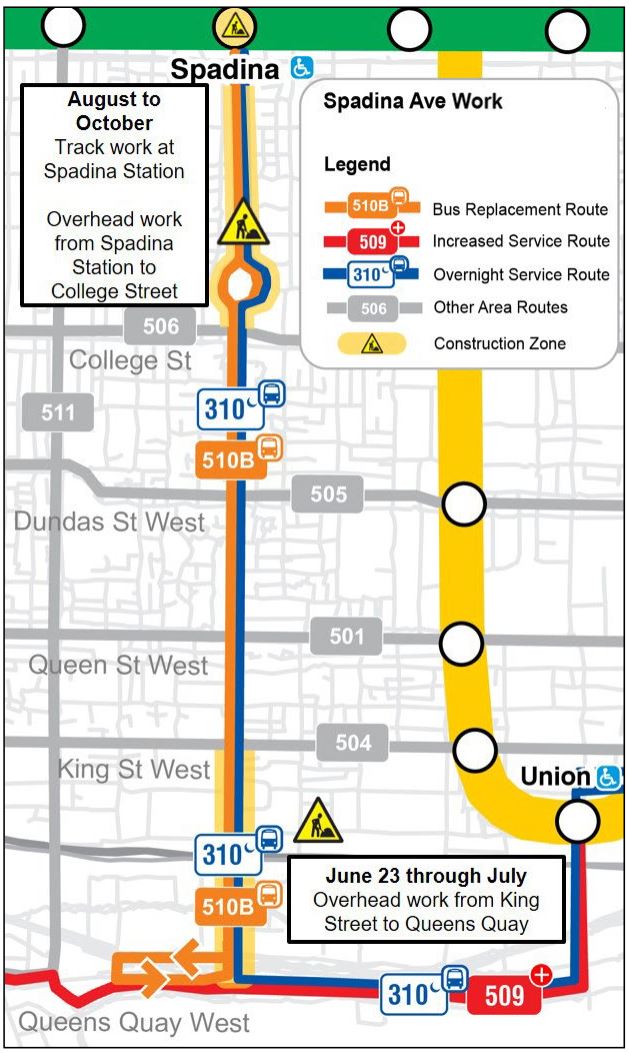
The TTC has announced plans for construction projects that will require replacement of streetcars by buses on 510 Spadina starting June 23 until October 2024.
In June and July, overhead will be rebuilt between King and Queens Quay. This will not affect route 509 Harbourfront, and service on that route will be increased to offset the missing 510 Spadina cars on Queens Quay.
In August through October, overhead work will shift to the section from College to Spadina Station.
At Spadina Station, track will be replaced and other work will be done in preparation for a platform extension that will be enabled by excavation for a nearby condo.
There is no word on plans for the overhead between College and King, or whether another shutdown will be required for that segment.
Both the 510 daytime and 310 night buses will operate in mixed traffic stopping curbside along their route. Buses will use the surface loop at Spadina Station.
Among the reports on the TTC Board agenda for April 11 is a recap of the SRT investigation. I have already written about shortcomings and contradictions in this report and will not belabour that here.
The fundamental question is whether management are being entirely transparent in their presentation. If there is someone on the Board bold enough to challenge them, here are a few key questions:
Ten days before the derailment, a high reaction rail was reported at the site, but this was logged as a low priority problem. The misalignment, reported as 1/2 inch, is on a par with the normal clearance between the LIM motor under SRT cars and the reaction rail. What repairs, if any, were made to correct this problem, and were the bolts holding the reaction rail checked for their integrity?
At the site, joins in both the reaction rail cap and the main reaction rail were at the same position. This weakens the structure because the two sections cannot reinforce each other against deflection by magnetic forces as trains pass. The sections are supposed to be staggered to prevent this type of failure. Why weren’t they, and how many other locations on the SRT shared the same problem?
How recently installed were the bolts that failed at the derailment site?
Consultant reports state that the manufacturer, Hilti, did not intend its anchors to be used in a situation where the bolts would flex under load as on the SRT. Why was this not reported to the Board in the September 2023 briefing?
New bolts on the SRT were not those supplied by Hilti, but were substituted by the TTC. The replacement bolts were longer and they used a different thread profile than the originals. Were these approved by Hilti?
What portions of the SRT were reviewed by the consultants, and did they find other defects similar to those at the derailment site?
Have all the reports, either internal or produced by consultants, about the derailment been made public? If not, why not, and when will they be made available?
TTC management claims that they did not reduce the level of maintenance on the SRT even though it was to close in fall 2023. However, the consultants point out that capital repairs (as opposed to routine inspections) were discontinued, and that only that type of work would have detected loose reaction rail bolts. How does TTC management reconcile these claims?
At the September 2023 Board meeting, TTC staff stated that the consultant’s recommendations for work to inspect and restore the SRT to safe operation would take longer then the planned remaining life of the line. How can the need to do so much work be reconciled with claims of regular inspection and repair?
Why were the consultant reports posted to the TTC’s website in November and December 2023 with no notice to the public nor to the Board?
The TTC would like to put the derailment behind them and focus on improvements going forward. However, one must ask how long the practices leading to the SRT crash were used, and whether shortfalls were the result of budgetary “efficiencies” rather than good engineering. By extension, what other parts of the TTC might be compromised, and what is needed to correct this situation.
On April 3, 2024, the advocacy group TTCriders submitted a request to the City of Toronto Auditor General for a review of TTC maintenance practices. This arose both from the July 2023 SRT derailment and other recent events on the subway including a broken switch and a flurry of slow orders.
Full disclosure: I was asked to review a draft of the TTCriders letter and suggested minor edits, but am not a party to their request.
Both in the staff presentation at the TTC’s September 26, 2023 Board Meeting and in comments responding to TTCriders, the TTC has been quite clear that it regards the root cause of the SRT derailment to be loose mounting bolts for the reaction rail. This does not tell the full story, especially in light of consultant reports that were published well after the September 26 meeting.
The published version of the Network Rail report is dated August 23. The Hatch report is Sept 28. Gannett-Fleming’s is Oct 12. Systra’s is Nov 30. For an extensive review of these, see my previous article:
A common thread in the consultant reports was that inspection and maintenance practices were inadequate, staff were not trained in the potential danger of defects that they discovered, and many staff were juniors who had not fully qualified as track inspectors. At the time, this was treated as a problem limited to the SRT. Recent events suggest that poor practices extend beyond to the rail network generally, and this is a more pervasive problem than originally reported.
The staff presentation in September was part of a larger review of the SRT replacement service, and the report title gives no hint that the derailment is part of this. Elsewhere in the same agenda, the CEO’s report celebrates the “Farewell to the SRT” event but makes no mention of the derailment reviews.
In the TTC’s review of these reports, presented in the April 11 Board meeting agenda, these suppositions are countered, although not entirely convincingly. It is fair to assume that most people will not be familiar with the detailed reports and will take the TTC’s rebuttal at face value. [The April 11 report is discussed later in this article.]
TTC spokesperson Stuart Green said CEO Rick Leary ordered the external reports the night of the derailment to get answers on what happened while including links to the reports posted on the TTC website. He also said the matter was discussed at the Sept. 26 TTC board meeting.
“TTCriders was represented at this same meeting so presumably they heard the same information and are fully aware what the root cause was,” he wrote.
Certainly TTCriders and anyone else attending the September 26 meeting or playing the video later “heard the same information”. The problem lies in being “fully aware” of the root cause which was not the loose bolts, but the failure to detect and correct the problem, and more generally the state of inspection work and staff training. A related problem identified by the consultants was that previous repairs at the derailment site had created a weakness in the reaction rail which, combined with loose bolts, made the failure causing the derailment more likely.
The September presentation noted the difficulty of inspecting the reaction rail supports which required hands-and-knees posture to peer under the track in all manner of weather and lighting conditions. In practice, this level of inspection was rare because it was so difficult. Oddly enough, the Vancouver SkyTrain system uses a separate test, striking the support bolts with a tool, and listening for a dull “thud” instead of a clear “ping”. The “thud” indicates a loose bolt requiring closer inspection.
A common indication that there were problems is scuffing of the reaction rail. This was noted at several locations on the line. One does not have to peer under the track to see this early indicator of a developing problem. However, scuffing could also result from minor clearance problems with specific cars and this would not necessarily be interpreted as a location warranting detailed reaction rail review, especially if the marks had been seen repeatedly.
The most damning item is in the TTC’s own Maximo defect tracking system as reported by an inspection team two weeks before the derailment (July 9, 2023). The item highlighted below shows the reaction rail was “raised 1/2 inch on the approach end”. This was a defect serious enough to be visible without the usual difficulty of inspecting under the reaction rail. A related oddity is a two-week gap in reporting of any further problems leading up to the derailment.
In summarizing the investigation at the September meeting, TTC staff stated that the “immediate cause” of the derailment was the failed anchor bolts. Further, the consultants had recommended that if the SRT were to resume operation through November, then all of the newer bolts installed from 2016 onward should be tested and retrofitted as necessary. This work would have required “time well beyond the planned closure date”, and so the line remained closed. (See meeting recording.)
The estimated scope of this work implies a pervasive problem that was either undetected or whose potential severity was not understood, or worse ignored.
An important distinction here is that the term “immediate cause” has morphed into “root cause”. No matter the frequency of track inspections, the loose bolt problems would not be detected because they were not visible.
A further concern is the manner in which consultant reports were quietly posted on the TTC’s website with no announcement in November and December 2023. My coverage of them was the first that some TTC Board members I have spoken with knew about them.
The documents are posted under the Projects page for the future of Line 3 SRT replacement service, hardly a location one would look for technical info on the derailment. Three of the reports were posted in mid November and one in December. It is easy to verify that they were not there earlier by looking at Internet archives for the page on October 2 and December 7, 2023. The first three reports went up almost two months after the Board meeting, not “a few weeks” as expected. However, there was no media release about them nor were they brought to the Board’s attention.
At the September meeting, Councillor Matlow asked whether there could have been a reduction in maintenance or negligence due to the anticipated shutdown of the line. The Gannett-Fleming consultant replied that there were multiple possible causes for the bolts coming loose, but did not address the frequency of inspections.
Staff and consultants reiterated that inspections for problems of loose bolts were very difficult and they would generally not be spotted. It would not matter how often a walking inspection passed potentially defective reaction rail mounts because these were not visible. Indeed, there was an inspection on the morning of the derailment that found no issues.
The Network Rail consultant mentioned marks on the reaction rail surface in passing, but then talked about the impossibility of seeing bolt problems because they are under the reaction rail, and movement was seen only with a train passing. He also said that issues were being reported and fixed, but this is contradicted by the Maximo logs which show a reaction rail lifted 1/2 inch at the site two weeks before the derailment (see above).
One major problem with the Maximo records is that there is no explicit log of repairs made in response to problem reports. Moreover, the consultants noted that almost all issues were logged with a relatively low priority for repairs. I attempted to FOI the repair work orders. However, the TTC advised that the only record was that a defect report was closed, and that there was no information on the actual repair work. If true, this makes post-incident review of the nature of repairs, if any, impossible.
In September, Matlow asks whether there was an increase in maintenance on the aging system. Staff replied about the 2016 plan to replace the anchors which was well-intentioned, but as we know from the reports there were design and installation issues that eventually caused the failure.
Councillor Holyday pursued the anchor design issue. The replies mentioned that there were other locations with scuff marks but mostly from different causes. There was no mention of a problem, flagged by consultants, of repairs that created a weak spot due to cuts in both layers of the reaction rail at various points including the derailment site.
Matlow asked CEO Leary about how the TTC will prevent another accident, and Leary talked briefly about changes already underway and lessons learned. He then mentioned a planned November report, but this was the unfunded capital projects report, not a more detailed SRT report.
Leary pivoted to the Line 2 trains and signal system, and funding problems that could lead to shutdowns. He explicitly mentioned avoiding having old vehicles in service in the future. This ignored his original support for rebuilding Line 2 trains for a 40-year lifespan, and of keeping conventional signals because ATC would have been incompatible with these trains. Now he has changed his position.
City Council reaffirm the policy that maintaining the existing system in a state of good repair is the first priority for investment in transportation.
Despite the State of Good Repair (SOGR) ranking first, some Councillors pursued their subway dreams. Amending motions included the Finch West LRT extension to Pearson Airport, the Bloor subway extension to Sherway, and the Sheppard subway western and eastern extensions. All of these are long-term projects that will have no effect on the transit system for a decade at least.
(Two lines, the Eglinton East and Waterfront East LRTs, were not under discussion as they are already City “priority” projects, although what benefit this status confers remains to be seen.)
The TTC’s Capital Plan includes a very long list of projects for which there is only partial committed funding, or none at all. Meanwhile, the backlog in SOGR work will climb to about $8 billion over the coming decade in spite of $13 billion in spending. In other words, the 10-year budget should be $21 billion, but is actually only 60% of that figure.
Even this pales by comparison with the 15-year total which now stands at almost $48 billion of which only 25% is funded. This number does not include many proposals including the rapid transit projects favoured by Council.
SOGR is seen by some as getting in the way of their preferred system expansion projects, and that a way forward might be paved (so to speak) with a focus on a short list of the most important SOGR items. This is absolute folly, but typical of the priorities that created the problem in the first place.
This misses the key question about our transit system: what do we want it to be? This includes choices not just for capital repairs and/or expansion, but for the overall scope and quality of service transit will provide.
Will the TTC always be a second class service except in a handful of rapid transit corridors, will transit play a much larger role in moving people around the entire city, or will it decline for want of resources to an unattractive last choice for travel? Only after we decide on the goal can we address the question of where to spend, and how much we need.
The 15-year Capital Plan grew substantially from 2023 to 2024 with the principal additions in the bus fleet and a provision for added capacity under the TransformTO Net Zero program. The big jump in bus costs reflects the higher unit cost of battery buses now assumed to be the standard. (Facility Maintenance and Network Wide Assets are new categories in 2024, but they simply replace the “Other” group from previous years with a comparatively small increase.)
Portfolio
2022-2036 ($m)
2023-2037 ($m)
2024-2038 ($m)
Subways
$25,400.0
$25,343.0
$27,613.0
Buses
$6,300.0
$6,948.0
$8,705.2
TransformTO
$5,339.8
Streetcars
$2,230.0
$2,277.0
$2,307.4
Facility Maintenance
$2,415.1
Network Wide Assets
$1,474.8
Other Infrastructure
$3,300.0
$3,478.0
Grand Total
$37,230.0
$38,046.0
$47,855.3
Even the $5.3 billion TransformTO line is an understatement because it accounts only for bus fleet expansion, not for the other modes, and there is no discussion of the related operating cost and competing funding needs.
A quick-and-dirty way to approach the budget is to pick a “top five” project list as if, by implication, all of the rest can wait their turn behind Councillors’ aims for their “deserving” wards. A top five list is a simplistic approach that does not recognize the complexity of TTC’s maintenance needs. Even worse, it implies that if the worst of the backlog is addressed, we can sleep soundly.
I challenge anyone to pick only five lines from the tables below as the subset we could pay for while downplaying the rest.
Another challenge lies in project linkages (you cannot buy more buses without some place to store and maintain them), and in deciding which items should be stripped of priority, in effect relegated to a “bottom five” group. That will be a hard fight.
a. Overview of the TTC, its Governance, Safety and Communications b. Code of Conduct and Municipal Conflict of Interest Act c. Being an Effective Director d. Key TTC Strategies and Plans e. Strategy Training Exercise
Although the agenda page advertises this as a public meeting and invites public deputations, the report states that it will be held in camera as permitted by the City of Toronto Act (S. 190.3.1). The report recommends that the “training materials” be publicly released after the session, although this could be amended. More importantly there will be no public record of the Board’s discussion.
The first three topics should be familiar to most of the Board as they have been in office for some time. Only three Councillor members changed with the arrival of Mayor Chow, and the existing Tory-era Citizen members are still in place except for one who resigned late in 2023. His replacement has not yet been appointed by Council. Training on how the TTC works should be an orientation session for new members, not a topic consuming a full Board meeting that could be spent on overall policy discussion.
Some years ago, the TTC Board attempted to arrange an agenda-free meeting to discuss general policy, but this was hijacked by management with a dog-and-pony show on their own accomplishments and the duties of the Board. This could be a repeat performance.
The time is long overdue for the Board to ask hard questions of management, of each other and of the City about the TTC’s future. We got a sense of what is possible at the recent Audit and Risk Management Committee meeting. Board members Saxe and Osborne grilled management who, frankly, were not fully prepared to answer questions about the Fare Inspection audit report. We have also seen an accumulation of issues regarding infrastructure maintenance and priorities that require informed debate and direction.
Probably the largest overall issue is budget, service and maintenance planning for 2025. In December 2023, the TTC Board wanted to establish a Budget Committee, but this has not yet happened. The motion was couched as a request to staff to report on the idea in Q2 2024 rather than as direction to “do it now”. By the time Q2 ends, it will be too late.
A Budget Committee must exist before the budget is locked down to allow a proper debate about options. For too many years, the budget has landed on the Board’s desk at the last minute with no scope for review of any but the most trivial parts.
As a matter of history, the TTC Budget Committee has not existed since January 10, 2019. Even then it had been moribund since November 2017 thanks to lack of interest by its members, a less than sterling example of good corporate governance.
The fundamental questions are what should the TTC be doing, and what can it do. Starting with the attitude that “we can’t afford it” is an abdication of the Board’s responsibility.
Toronto should know what might be possible and how much this will cost, and only then make decisions about what we choose to afford. The past decade plus of Ford/Tory tax policies precluded this approach, but with a new administration, it is time to seize control of the transit debate.
Here are questions I would ask were I on the TTC Board. This is not an exhaustive list, but then the “education and training” meeting is only scheduled for one day.
On March 31, the TTC will make service changes on several routes. Many of these include small service increases and/or adjusted travel times to reflect conditions on the routes.
Major changes include:
Reconfiguration of routes for construction at:
Lawrence West and Lawrence Stations
Sheppard-Yonge Station
Pape Station
Return of streetcars on 301 Queen Night
Service on 905 Eglinton East Express will change from using articulated to standard buses
Adjustments to travel times on bus routes in the STC corridor
Updated Mar. 20/24 at 11:15 pm: The URL in the link below to the Fare Compliance Strategy has been corrected.
Updated Mar. 21/24 at 2:45 pm: A section about children’s Presto cards has been added at the end of this article.
On March 19, 2024, the TTC’s Audit & Risk Management Committee considered a presentation from their Internal Audit group and management’s response regarding an updated Fare Evasion study conducted from April to October 2023. See:
The fieldwork was conducted on weekdays and weekends between 6:30am and 1:00am with a total of 25,730 observations. The intent was to update findings from the 2018 and 2019 studies to post-pandemic conditions. One addition to the scope was a review of underpayment of cash fares. Two items remained outside of the scope: illegal entry to stations via bus loops, and fare evasion on Wheel-Trans and night services.
The Committee is small with only three members, of whom only its chair, Councillor Dianne Saxe and citizen board member Julie Osborne were present. They both had time to ask many questions, and it was clear that the report’s findings took them very much by surprise.
The headline number is an estimate that fare evasion costs the TTC $123.8 million annually, and that 11.9% of riders (on a weighted basis across the three modes) do not pay. This is about double the rate found in 2019. A further $17.1 million is lost to underpaid cash fares.
Lurking behind this entire discussion is the question of Special Constables and Fare Inspectors. The higher the purported loss, the greater the political pressure to regain the missing revenue through enforcement. I will not impute a motive behind the audit study, but observe that finding $140.9 million “under the cushions” every year will get Council’s attention. Whether enhanced enforcement will lead to productive staffing decisions and a real increase in revenue is quite another matter.
The TTC has announced route changes coming soon to routes serving Broadview and Pape Stations due to impending Ontario Line construction. This will occur in two stages. Note that the dates are approximate and depend on construction progress.
Effective Sunday, March 31, 2024
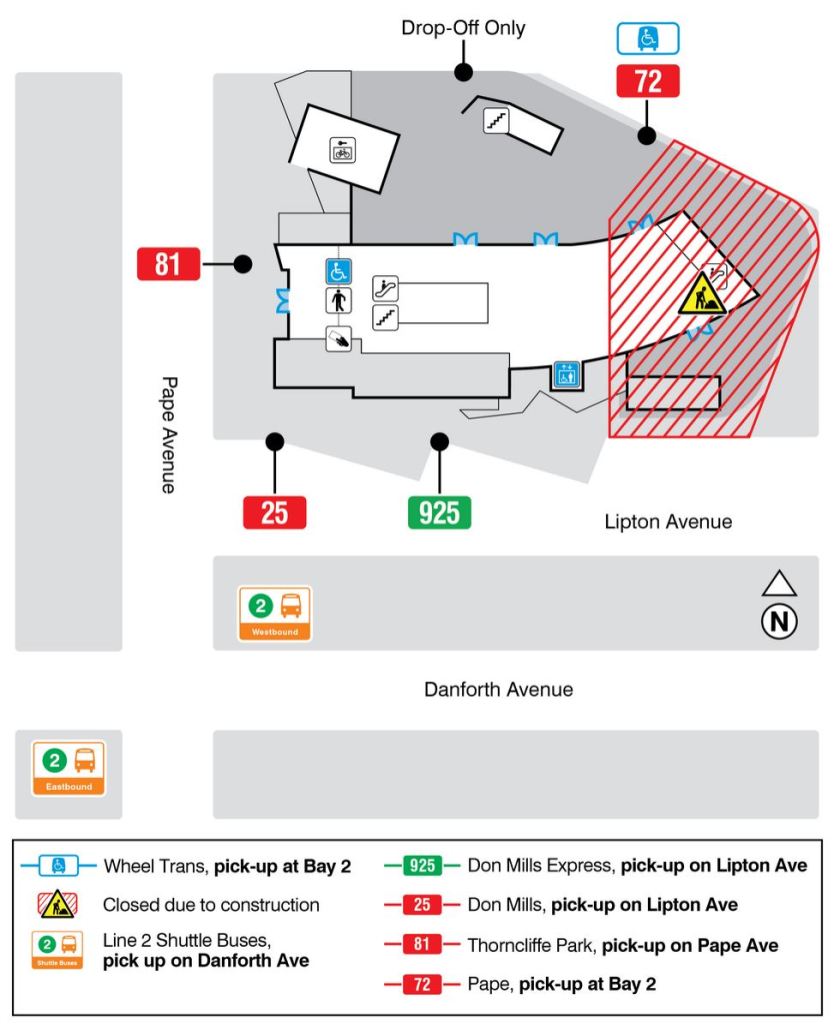
With the next schedule change on March 31, 2024, loading arrangements at Pape Station will change as shown in the map below.
All routes will drop off at Bay 1 just inside the station entrance from Pape.
72 Pape will shift east to Bay 2.
Wheel-Trans will share Bay 2 with the Pape bus.
25 Don Mills and 925 Don Mills Express will load on the street on Lipton Avenue. New bus bays will be built there starting on March 25 by Metrolinx.
81 Thorncliffe Park will load at a stop in front of the main entrance of Pape Station.


 Steve Munro