Yonge Subway Extension Additional Information Report (Updated)

[My apologies for the temporary absence of this item.  I have been updating it.]

A supplementary report on ridership projections and other impacts on the Yonge Subway is now available on the TTC’s report website.

While I do not agree with all of the report’s conclusions, this is a refreshing attempt to look at the growth and development of the transit system on a wholistic, networked basis, rather than as a single line.

The TTC persisted in using subway train capacities that do not match their own service design criteria, ignoring current over capacity problems and downplaying future growth.  This has changed between the December and January staff reports, and with that change come important new concerns about current and future available capacity. 

At this point we have no idea of the feasibility of the proposed Bloor-Yonge platform reconstruction project.  The TTC alternately treats this as something for the indefinite future or as a co-requisite of the extension’s construction, depending on which report one reads.  Cost, constructability and operational impact during the conversion are all unknowns.

I remain seriously concerned that the TTC is playing a dangerous game with capacity of the subway system and views the downtown relief line as a far-distant, last resort fix.  This will push more and more passengers into a single route and make the system even more vulnerable to delays and disruptions than it is today.

Today’s TTC meeting produced the expected result, the endorsement by the Commission of the project, but it is still subject to a long list of caveats.  The definitive list is in the recommendations of the Toronto Executive Committee from January 5, 2009 (item EX28.1).

However, after presentations by me, Karl Junkin and David Fisher, there was considerable debate.  Vice-Chair Mihevc wound up as the sole dissenting vote in the approval motion, but it was clear that the complexity of the issues related to the future of the Yonge Subway is now grasped by the Commission. 

Well, almost all of them.  Commissioner Perruzza seems to think that York Region should be free to build whatever it wants, connect it to Toronto’s system, and let us worry about how to deal with the aftereffects.  Unfortunately, nobody has stepped forward, certainly not from York, offering to actually pay for it. Continue reading →

The Scarborough LRT That Wasn’t (Updated)

Updated January 16:  The Metrolinx board has agreed to publish the Benefits Case Analysis for the SRT replacement project.  As I write this, they don’t have a working website, but once the report is available, I will review it here.

Updated January 11:  John F. Bromley has kindly supplied photos of CLRVs 4000 and 4001 showing the cars with pantographs.

My archives yield up interesting goodies from time to time.  In anticipation of the Benefits Case Analysis report at Metrolinx for the SRT replacement and extension project, I thought it worthwhile to revisit the original Scarborough LRT.

Here’s Progress Report No. 1.


Yes, it’s a streetcar!  That was the original plan, and the line was built for CLRVs.  That’s why there is a streetcar-radius curve at Kennedy, and if you look closely, the remnants of clearance markers on the original low platform at track level.  When the station opened, even though it was RT by then, the graphic over the up escalator was a streetcar.

Note the design for the station at STC where the streetcars are at the same level as the buses.  It didn’t take long for someone to hoodwink Scarborough Council into thinking that this simply would not do, and the streetcars needed their own level lest they isolate the land south of the station from development.  Anyone who knows the site knows that the bus roadway does quite a good job of that.

pr2pg5c

By Progress Report No. 2, which is otherwise quite similar to No. 1, the design has changed to an elevated structure.  Moves were already afoot to substitute RT technology, but the streetcar line took the political hit for imposing an elevated on Scarborough’s new Town Centre.

In time, the RT technology replaced the LRT scheme.

A few things worth noting here are that the estimated cost has gone from $108.7-million in the LRT plan to $181-million in the RT plan.  The final cost would actually be in excess of $220-million thanks to add-ons including extra cars.  The CLRV fleet was planned to be 22, and the RT fleet we wound up with is 28.

The RT promo also claims that because the wheels are not used for traction or braking, there will be lower vibration compared with conventional vehicles.  In those days, the CLRVs were still running with the original Bochum wheels, and streetcar track construction guaranteed lots of corrugations and noise.  The RT developed its own problems in time because those wheels do bounce, and they are also used for the final braking effort when they can (and do) slide producing flat spots.

Now, almost 30 years later, we are finally looking at extending the RT further north.  If this is done as LRT, it will be able to share a new carhouse and trackage with the Sheppard East LRT, and will also form the northern portion of the eventual Scarborough-Malvern line.

When the Metrolinx analysis comes out next week, we will see whether the lure of expensive, unnecessary high technology still rules the decision, or whether we can start to undo the damage of building that orphan RT line so many years ago.

Update:  Here is John F. Bromley’s photo of CLRV 4000 fitted with a pantograph at the SIG factory in Neuhausen, Switzerland on June 29, 1977.

clrvwithpantographjfb

Here is a photo of 4001 leaving Orbe, Switzerland on the Orbe Charvonay Railway on October 6, 1977.  This photo was taken by Ray Corley, and is provided by John F. Bromley.

clrvwithpantographrfc

Vancouver: More Service / Great Blog

Calls for added service on transit systems are nothing new.  We have seen lots of them in Toronto as we struggle to implement the Ridership Growth Strategy despite a shortage of operators, vehicles and, I suspect, budget headroom.

Meanwhile in Vancouver, riding is growing apace, and the additional challenge of the coming winter Olympics has yet to be digested.

A very fine blog from Vancouver is run by Stephen Rees.  In a recent post about service quality to outlying sports venues, he included the following:

If transit is to be an attractive, useful alternative to driving then Translink has to get much better at understanding how to make routes easy and convenient to use. The biggest block to transit use in this region is lack of service frequency and the planners at CMBC and Translink are both way out of line on what they feel is a “frequent” service. It does not mean ‘more buses than we had last year’. It means that people do not get passed up at stops – and do not have to wait for interminable periods of time due to chronic unreliability. It is not just how many buses you have, but how you use them and how much priority the bus gets in congested traffic. In my travels recently I have been been frequently struck by how easy it is to use buses elsewhere – and how frustrating it is to be stuck at a bus stop here not having the slightest idea of when – or if – the next bus will arrive.

Sound familiar?

North Toronto vs the T&YRR

A comment from David O’Rourke in the post about the radial line to Sutton drew a response from John F. Bromley who I thank for the information here. It has been edited slightly.

In 1911, North Toronto, not yet part of the City of Toronto, battled with the T&YRR over the railway’s attempt to build a separate private right-of-way for their Metropolitan line, 100 feet west of Yonge Street. The town wanted the line to be double-tracked on the street itself while all the railway wanted was passing sidings.

Continue reading →

So You Want To Go To Sutton

In the midst of the discussion of the Richmond Hill extension of the subway, I thought it was time for a bit of historical perspective.

The TTC ran “radial” streetcar service from Glen Echo Loop to Richmond Hill until 1948.  Remnants of this operation were still visible when I was young, and Glen Echo was served from the south by trolley buses.

However, in a much earlier time, the line ran from just north of the CPR tracks at North Toronto Station to Sutton. Continue reading →

Who Will Ride the Yonge Subway?

Updated January 9:  The 2009 Subway Fleet Plan has been scanned and linked from this post.

Toronto’s Executive Committee voted on Monday to approve submission of the EA for the Richmond Hill extension to Queen’s Park, but added a number of riders on their support for the line.  This parallels actions taken at the last TTC meeting to strengthen the pre-requisites for City participation in this project.  The conditions include:

  • Full funding for construction and operation of the extension beyond Steeles Avenue at no cost to Toronto.
  • Full funding for any cost of an additional subway yard.
  • Completion of the Automatic Train Control system on the YUS line, including the Vaughan extension.
  • Any measures to relieve capacity problems at Bloor-Yonge would be funded as part of this project.

City and TTC staff have been requested to report directly to the January 27 Council meeting on various potential ancilliary costs including:

  • Bloor-Yonge station expansion
  • Fleet expansion and subway yard costs
  • Second entrances to other downtown stations
  • Need for an eastern Downtown Relief Line
  • Need for extending the Sheppard line west to Downsview
  • Sequencing of these options relative to the Richmond Hill line’s construction

Notable by its absence from this list is any reference to GO Transit’s Richmond Hill service.  This must be included because the level of GO service has a big impact on the modelled ridership for any future TTC network.

Karl Junkin, who comments here regularly, presented a deputation on this item which is supposed to be linked from the City’s site.  However, that link is currently not working.

Karl Junkin Yonge Analysis

Karl covers a lot of the ground that was in my own report on TTC fleet planning and other posts about the Richmond Hill extension.   Staff have been directed to meet with Karl and provide comments on his concerns in a report to Council.

Much of this turns on hte question of how many people will actually be riding the subway in 2017 when the Richmond Hill extension is planned to open.  TTC staff have, to their considerable discredit, played fast and loose with teh relevant data depending on the argument of the moment.

When it suits their purpose to conjure up a need for vastly more trains on the line and increased capacity at Bloor-Yonge, then the estimates can be stratospheric.  When the goal is to pretend that the Richmond Hill extension can be accommodated with no increase in service, then — Presto! Chango! — more riders but no more service.  The word “bamboozle” comes to mind here, although somewhat less Parliamentary language might be more appropriate.

Let’s review the estimates we have seen recently. Continue reading →

Front Street Extension: Going, Going …

This morning, the Planning and Growth Management Committee adopted a report recommending that the Front Street Extension be removed from Toronto’s Official Plan.

Soon, soon, the FSE will be officially dead.

Now if we can only get a sensible look at the Waterfront West LRT line rather than the piecemeal approach of past years.

For the record, I do not agree with schemes to bring transit into downtown via Front Street because this will run into severe problems in front of Union Station where current plans call for considerable increase in pedestrian space.

GO Transit’s Relief Line: The 1986 Study

This post continues a series looking at old proposals for ways to get commuters into downtown Toronto.  This isn’t a new problem, and as we have already seen, the TTC and Metro Planning were contemplating various alternatives four decades ago.

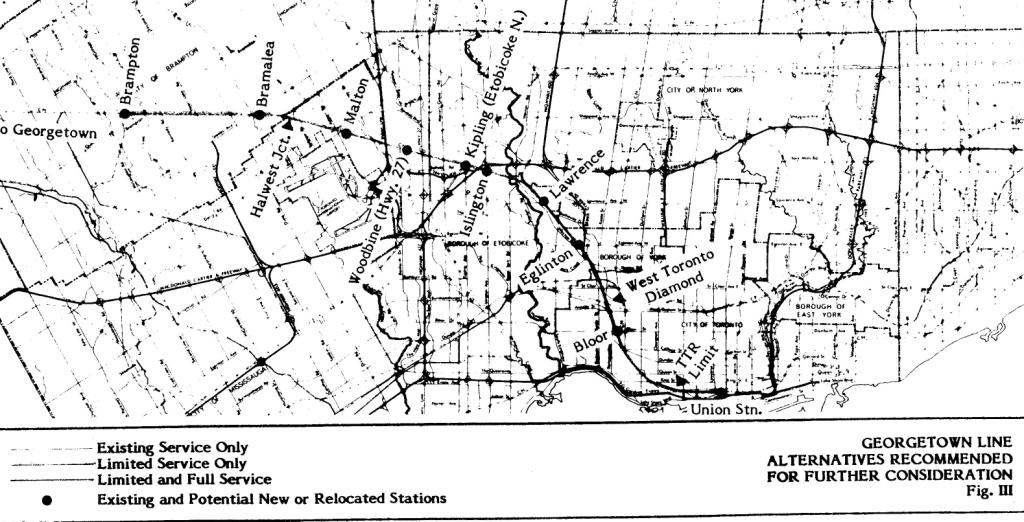
In response to the proposed Downtown Relief Line and other subway schemes, GO Transit commissioned a study of the possibilities for GO Rail service.  This study recommended frequent, all-day service between Halwest (the point where the York Subdivision, CN’s Toronto bypass, meets the line to Brampton) to Doncaster (the point where the CN Bala Subdivision, used by the Richmond Hill train, crosses the York Sub).

As is quite evident from any GO timetable, this didn’t get built.  One reason was that interest in the DRL waned as the political dynamic and planning focus turned away from downtown to the so-called “centres” that would grow within Toronto’s suburbs.  Travel into downtown continued to grow, and the GO Lake Shore service handled much of the transit-based increase.

A few points worth noting:

  • The option of using the connecting track from the CN to the CP between Oriole and Leaside was considered to be the superior route, although it had its problems including a potential conflict with the proposed Leslie Street extension.
  • For reasons that are not explained, the equipment cost for the most limited of services is higher than for all-day service.  In general, I would treat the cost estimates with some suspicion because (a) they are two decades old and (b) ancilliary costs such as connections to the TTC at Dundas West don’t appear to be included.
  • The inclusion of a cost comparison between subway and GO construction was clearly intended to plump for GO as the much cheaper alternative.  However, the study does not address the variation in origins and destinations that requires both local and express services in any corridor as discussed here previously.
  • There are no demand projections, only a feasibility study of what service could be operated.

Richmond Hill Georgetown Study June 1986

Figure II: Richmond Hill Line

Figure III: Georgetown Line