Metrolinx Fare Integration Backgrounders

About a month ago, I reported on the Metrolinx Fare Integration Study. At the time of that article, the backgrounders to the Board Meeting presentation had not gone online. They went up a short while later, and now I’m getting around to discussing them.

There are three papers:

These make interesting reading if only to give a sense of what this study has been up to, and the direction it seems to be headed. As I wrote before, Metrolinx has shown a preference for distance-based fares because that is what they know. They are a long-distance carrier compared with any of the “local” transit systems in the GTHA, and developed in an environment where paying more for longer trips was a logical way to do things. (The question of how fairly those “distance based” fares are calculated is a separate matter.)

Continue reading

Thoughts On A Liberal Government

This blog has been churning along since January 2006, and for almost all of that time, Stephen Harper and his Conservatives have been running Canada. The idea that Ottawa would have a significant role in transit beyond the occasional showcase project simply was not part of the landscape.

Now, to everyone’s amazement, we have a Liberal majority government, one whose campaign platform includes a very substantial presence in infrastructure spending including the public transit portfolio.

We will get our communities moving again, by giving our provinces, territories, and municipalities the long-term, predictable federal funding they need to make transit plans a reality.

Over the next decade, we will quadruple federal investment in public transit, investing almost $20 billion more in transit infrastructure. [Liberal platform p 12]

That is a lot of new spending, but is has to stretch over the entire country and the next ten years. Advocates of many schemes will project their enthusiasm onto that pot of money saying “Look! We have funding”, but it’s not that simple.

It is instructive to look at how funding is divided up today. The federal gas tax allocations for 2014-15 totalled $2-billion of which $750-million went to Ontario, and of that about 20%, $150-million, to the City of Toronto for transit capital spending. On a proportionate basis, this would yield only $1.5-billion “more” funding over the next decade. This has to be read in the context of targeted funding for specific projects such as the Spadina subway extension that lies outside of the gas tax stream. If all of the new Liberal funding comes from that $20b pot, the actual change, all things considered, may not be as generous as expected.

Other funding lines in the Liberal platform focus on housing and non-transit infrastructure. These are not to be ignored especially to the extent that they relieve municipal governments of spending where they have carried a substantial share of the programs. However, if total spending goes up, Toronto may be forced to bump its investment level in transit and other portfolios because “we don’t have a funding partner” will no longer be a convenient excuse for inaction.

Whatever money does appear on the table, it will not be enough to build every single pet project, and Toronto cannot evade hard decisions about priorities claiming that the Feds will shell out for everything. There is also the delicate question of how much new matching funding will arrive from Queen’s Park Liberals who do not share the deficit spending plans espoused by their federal cousins.

Capital projects, especially on the scale of transit infrastructure, require a long view. Projects may be “shovel ready” in some cities, although Toronto has little in that status thanks to years of dithering and backtracking on transit priorities. Major proposals would do well to reach significant construction spending within the current federal mandate or even well into whatever follows. Toronto may build a bus garage here or renovate a subway station there in the short-to-medium term, but the big projects are years away.

This brings us to the rationale for new spending. If the idea is to stimulate the economy and create employment in the short term, a clear focus of Conservative programs, then long term project funding is doomed. Conversely, if the aim is to invest in the future of Toronto, the GTHA and cities in general, a longer view is possible at the expense of big, immediately visible results and ribbon cutting.

Inevitably, the conflict will be between one shot announcements and “long-term predictable funding”. These address very different political goals and produce very different outcomes. Without a shift away from unpredictable ad hoc decisions (the Scarborough Subway and SmartTrack promises are two examples), local pols will continue to jockey for yet more isolated planning to suit quick political ends, rather than looking at broad-scale goals and benefits. Long-term funding only works with long-term planning.

Absent from any federal platforms was new federal money for transit operating costs. These will grow through the combined pressures of inflation, population growth, shifts from auto to transit and eventually the need to operate all of the new buses, LRVs and subway trains that might arrive thanks to higher capital spending. Operating subsidies, service quality and fare strategies will challenge municipal budgets, and the long-standing question of provincial funding, of getting back to the “Davis formula”, cannot be ignored.

There is a new government, a new outlook on national priorities, and the debate on our transit future begins today. We all want more transit, but nothing is free, and even the “new” money has its limitations. Let us spend it wisely.

Playing Fast and Loose With SmartTrack (Updated)

In a previous article, I wrote at length about the City of Toronto’s reports on the status of SmartTrack to be discussed at the October 20, 2015 meeting of the Executive Committee.

Two related items also deserve comment.

First up is an article in the Star by Tess Kalinowski in which she reveals that Metrolinx CEO, Bruce McCuaig, wrote to City Manager, Peter Wallace on October 6, over a week before the reports were posted on the Executive Committee Agenda. His letter said quite clearly that SmartTrack would only be an incremental upgrade of GO service, not a separate operation running on GO’s trackage.

“Metrolinx and the province believe that the (city report) should reflect the scenario where SmartTrack is an incremental increase in RER (regional express rail) service, rather than an independent and parallel service that co-exists with RER,” he wrote.

“The risk of creating unmet expectations is too great,” said McCuaig.

The letter also suggests the city stop referring to SmartTrack as a “surface subway” since federal rail regulations would prohibit TTC-style subway trains from operating on GO tracks.

The full text of the letter is not yet online, and it is notably absent from the Executive Committee agenda.

Updated October 19, 2015 at 11:45 am:

Metrolinx has issued a statement pledging its continued support for “key elements” of SmartTrack, whatever that means.

MetrolinxStatement_20151019

Second is the appearance of an “advocacy group” called FAST (Friends and Allies of SmartTrack) which appeared to spring out of nowhere earlier this week. This is no ordinary citizens’ group plotting in someone’s kitchen how to get some new transit line built, but a well-financed group with close ties to Mayor Tory. Their website reproduces the Tory campaign colours and links to SmartTrack material from that era.

Continue reading

SmartTrack Update: Many Reports, Many Unanswered Questions (Updated)

Updated October 21, 2015 at 9:30 am:

The Executive Committee spent a few hours discussing this report. As the morning wore on, it was clear that Mayor Tory was becoming unhappy with questions about his scheme. By the end of the debate when he spoke, he said:

I think a number of the questions raised by members of council today are perfectly legitimate questions which I’m sure our staff have taken note of and if they weren’t already being asked and answered, those questions, they will now be.  I just hope and I sense a generally positive sort of sense around here but I hope that we don’t get into being either sort of Douglas or Debbie Downer about these things. [Adapted from a quotation in the Toronto Sun]

Tory went on to say that he had “a mandate” from voters to build SmartTrack in a manner distressingly reminiscent of Rob Ford’s “mandate” to tear up Transit City. The problem with both claims is that voters did not elect Tory or Ford for those specific purposes, but in a reaction against the previous administrations, particularly in Tory’s case. Moreover, that “mandate” does not mean that the platform necessarily made sense as proposed, only that it was an attraction to voters that a candidate had concrete ambitions. We have already seen Tory backtrack on his claims that Toronto did not need more bus service (responding to Olivia Chow’s half-hearted support for transit), and there is no reason for SmartTrack to be treated as a divine plan on stone tablets.

As answers from staff to various questions made abundantly clear, there is a lot of work to do between now and first quarter 2016 when all of the details are supposed to return to Council. Staff went out of their way to avoid giving any indication of the way preliminary work might be headed lest they be drawn into a debate about “conclusions” before the supporting studies are in place.

The Executive Committee made a few amendments to the report’s recommendations:

1.  Requested the City Manager to forward the report (October 15, 2015) from the City Manager for information to the Toronto Transit Commission, the Ministry of Transportation, Metrolinx, the City of Mississauga and York Region.

2.  Requested the Chief Planner and Executive Director, City Planning to report to the Planning and Growth Management Committee on the results of the public consultations arising from the Preliminary Assessments of the Smart Track Stations, as set out in Appendix 2 to the report (October 15, 2015) from the City Manager, particularly with respect to the development potential of new stations.

3.  Requested the City Manager to work with Toronto Transit Commission, Metrolinx, and GO Transit, to develop a One Map Strategy where by major intersections and/routes of these transit operators are shown on future hard copy and electronic local and regional transit maps, once SmartTrack routes and stations are established.

The first recommendation is the original staff proposal simply to transmit the update report to other agencies. The second arose from a concern by Councillor Shiner, chair of the Planning & Growth Management Committee, that implications of and potential for redevelopment around SmartTrack stations be understood as soon as possible. During debate, he spoke about the success of development a long the Sheppard line, an ironic stance considering how strongly he had opposed development around Bayview Station when it was at the design stage.

The third recommendation arose from Councillor Pasternak, who never tires of advocating the “North York Relief Line” (otherwise known as the Sheppard West extension to Downsview). His desire is that maps show all of the projects that are in the pipeline during studies, not just the one that happens to be the subject of debate.

A notable absence in the staff presentation was any reference to the Scarborough Subway Extension as an alternative route for travel to downtown. That presentation covered substantially the same information as the background reports, but it included a few new charts about comparative travel times with SmartTrack in place.

STvsTTC_TravelTimes1

The important difference between this map [at p23] and the Tory SmartTracker website (which shows comparative travel times) is that the TTC includes the access and wait times for SmartTrack in its calculations. This reduces the proportionate saving over a trip. Another issue, of course, is that many riders do not work at Union Station, and taking SmartTrack there would be an out-of-the-way trip. This is not to downplay what SmartTrack might do, but to point out that if ST is to be part of a “network”, then advocacy for it must look at how it benefits all of the trips originating in some part of the city (say northeast Scarborough), not just those that conveniently lie on its route. This will be an issue in comparative ridership projections for ST and the Scarborough Subway Extension because those who are bound for midtown will almost certainly have a shorter trip simply by taking the subway rather than ST.

The original article follows below:

Continue reading

A “Reset” For Waterfront Transit Plans? (Updated)

Updated October 15, 2015 at 10:20 am:

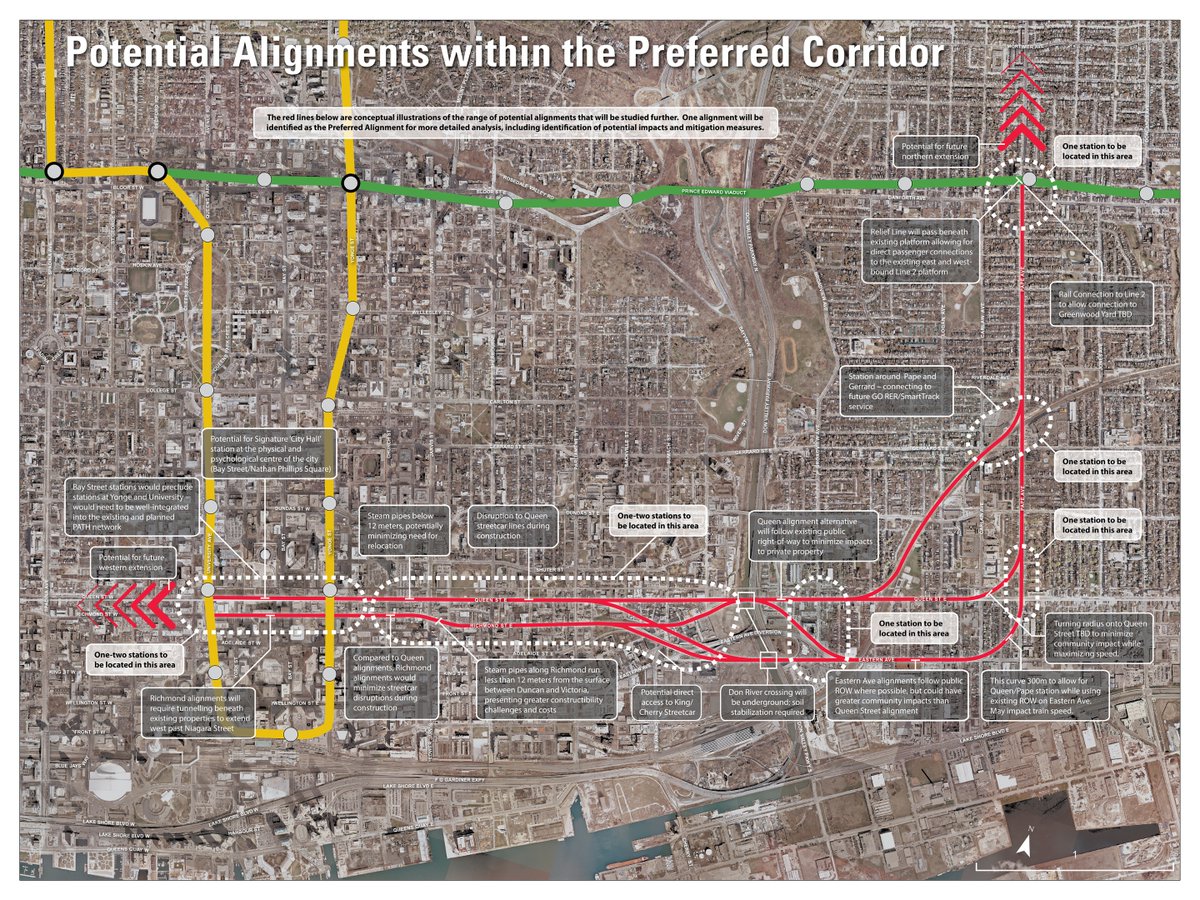
Because the options for the Waterfront West line are not fully explained or explored in the City report, I have added the drawings of the options from the Environmental Assessment to the end of this article.

A few weeks ago, I reported on a presentation at the TTC Board meeting by Deputy City Manager John Livey on the status of various rapid transit plans and studies. This was by way of a preview of reports that were expected at the City’s Executive Committee meeting on October 20, 2015.

One of these reports has now surfaced on the subject of Waterfront Transit, while another on SmartTrack is still in preparation. (Reports on the Relief Line and Scarborough Subway studies are not expected until the new year pending results from the UofT’s new demand model.)

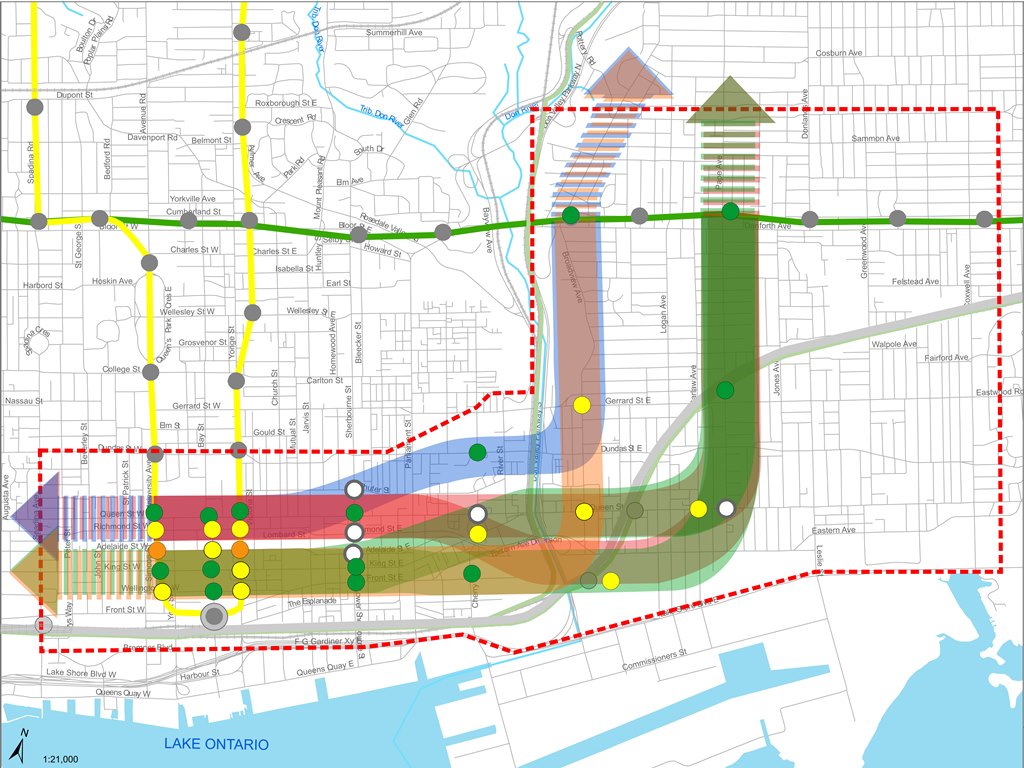
The new report proposes a “reset” in the status of the many waterfront studies and proposals given that many of them are incomplete or out of date. The area of study will be south of Queensway/Queen from Long Branch to Woodbine, although there is passing mention of Scarborough which has its own collection of transit problems in the Kingston Road corridor.

The fundamental problem along the waterfront and areas immediately to the north is that population and plans for development continue with no end in sight, while transit planning, such as it exists at all, looked much further afield for signature projects. Moreover, origins and destinations in the present and future waterfront are not conveniently located along a single line where one scheme will magically solve every problem. Transit “downtown” is not simply a matter of getting to King and Bay. There is a mix of short haul and long haul trips, and a line designed to serve the first group well almost certainly will not attract riders from the second.

There has been significant growth in many precincts along the waterfront, including South Etobicoke, Liberty Village, Fort York, King/Spadina, City Place, South Core, and King/Parliament.  Further, significant growth is planned for emerging precincts, including Lower Yonge, East Bayfront, West Don Lands, North Keating, Port Lands and the First Gulf site.  There is currently a latent demand for transit south of Front Street as witnessed by transit loading on the King and Harbourfront streetcar services.  King Street, for example, represents the most southerly continuous east/west transit line and is regularly experiencing near or at-capacity conditions through much of the weekday peak periods.  The extent of latent and anticipated future demand creates an imperative for defining a long-term transit solution as soon as possible. [pp 1-2]

Better transit on King and Queen, whatever form it might be, will address demand from redevelopment of the “old” city north of the rail corridor, but it cannot touch the “new” city south to the lake. Service on the rail corridors (Lake Shore and Weston) can address some longer trips, but with constraints on both line capacity and service frequency. Despite politically-motivated claims, the GO corridors will not be “surface subways” with service like the Bloor-Danforth line, and GO service is constrained to operate through some areas that are not well placed relative to the local transit system.

Continue reading

Metrolinx Proposes Revised Names For Crosstown Stations

Metrolinx has proposed new names for several stations in the Eglinton corridor:

  • “Keele” to “Silverthorne”
  • “Dufferin” to “Fairbank”
  • “Bathurst” to “Forest Hill”
  • “Avenue” to “Oriole”
  • “Bayview” to “Leaside”
  • “Don Mills” to “Science Centre”
  • “Ferrand” to “Aga Khan & Eglinton”

Comments will be accepted by Metrolinx until October 7, 2015.

Updated October 2, 2015 at 9:30 am

201509_NewStationNames_ECLRT

Although the consultation affects only the stations listed in red in the list above, other changes are proposed including renaming “Eglinton West” to “Allen”.

The asterisk beside “Mt. Pleasant” is actually an error, and should be beside “Eglinton” because the proposal recommends a “change” from “Eglinton-Yonge”. Of course, the station isn’t called that yet.

Updated October 2, 2015 at 12:50 am:

The comments that have already been left on Metrolinx’ site suggest that many of their proposals are not exactly popular. I cannot help think that whoever is responsible for this report has a poor sense of Toronto (maybe another consultant who does all their work on Google Maps?), nor a sense of which neighbourhood names are actually used.

I cannot help think of the mystery surrounding stations at “St. Andrew” and “St. Patrick” that memorialized old ward/parish names that almost nobody knew fifty years ago, but which are now an inherent part of the city’s mental map of itself. Taking old names for an area may provide an historic link, but confuse people who have no idea of where these places are.

Of course we already have a precedent with Steeles West Station that has been renamed “Black Creek Pioneer Village” in reference to an attraction that is quite a distance from the station, and we almost got “University City” for Finch West.

Has anyone noticed, by the way, that this is called “Keele & Finch” in the “future” map in the report, “Leslie & Eglinton” is labelled “Sunnybrook Park” on the same map, and SmartTrack is nowhere to be found.

A Frustrating Update on Transit Expansion Plans

The TTC Board received an update from City and TTC staff on the status of major transit expansion plans in Toronto at its meeting of September 28. The presentation was largely delivered by Deputy City Manager John Livey with backup from Mitch Stambler, TTC’s Head of Service Planning. Also at the table, but notable for her silence, was the Toronto’s Chief Planner Jennifer Keesmaat. A contingent from Metrolinx, another agency studying transit expansion, was in the public gallery, but they did not participate in the presentation or discussion.

This session was a prologue for a report coming to Toronto’s Executive Committee on October 20, 2015, but a great deal of detail remains to be fleshed out. This proved frustrating for the Board members on two counts. First, the lack of detail prevented the TTC from making informed comment on the plans, and second, the process itself has largely bypassed the TTC Board and concentrated work at the City and Metrolinx.

To some extent, the TTC has itself to blame for this situation. During the Ford/Stintz era, meaningful policy debates at the TTC were rare, and the TTC ceded responsibility for large scale planning to the City of Toronto under Keesmaat’s department. At the political level, staying informed about issues is a comparatively new desire by Board members (not to mention some members of City Council) when the issues are more complex than a dumbed-down subways-subways-subways mantra. They have a lot of catching up to do.

Detailed reports on four major projects will come before the TTC and Council over coming months, and these will inundate members with not only a great deal of information but force some hard decisions about just which projects, and at what scale, the City should pursue. These are:

  • The Relief Line
  • The Scarborough Subway Extension
  • Waterfront transit
  • GO/RER, SmartTrack and TTC service integration

ExpansionPlanMap_6

The situation is complicated by parallel work at Metrolinx, an agency with very different goals from the TTC and the City, and by the inevitable political wrangling over the relative importance of projects. Whether any reports coming forward from staff will be trusted, especially in an environment where Councillors and the Mayor routinely dismiss “expert” advice that does not suit their biases, remains to be seen. Equally difficult will be the question of whether the reports are spun, in advance, to suit specific outcomes rather than presenting “just the facts”.

One difficulty already lurking in the wings is the question of demand modelling. The University of Toronto together with City Planning is developing a new model for GTHA travel. This is much more ambitious than current models in that it covers the entire region and models travel over the entire day, rather than focussing on AM peak flows. The model also allows for route and mode choice by incorporating considerations of fares and line capacity (crowding). At this point, the model is still being calibrated and validated, a process that uses known historical data (from the 2011 Transportation Tomorrow Survey) to confirm whether the model generates flows that accurately mimic what actually happened. (The TTS is conducted every five years by UofT on behalf of municipal and provincial agencies, and the next set of data will reflect demands in 2016.)

Draft results for the new projects and network will not be available until October 2015, and a report on details will not come to Council until the first quarter of 2016. One suspicion is inevitable given this delay: is the “calibration” intended to produce a desired outcome? That’s a tricky question both because it speaks to the independence of the process and also to the way in which the model is used. For example, a model may well reproduce past behaviour perfectly, but that’s a known target and the context for it (then-existing transit, road and land use configurations) are a matter of record.

Future modelling depends not only on the nuts and bolts of the model itself, but of the assumptions put into its configuration. A well-known example of flawed modelling was for the Sheppard Subway in which unduly rosy assumptions about job numbers and locations gave the subway a projected demand well above what it actually achieved. The further one goes into the future, the cloudier the view becomes, and the presumed distribution of population and employment can involve political as well as basic economic dimensions. If, for example, the concentration of jobs in the core area and the polarization of high and low income housing concentrations continues, this has profound effects on future demand. Moreover, such concentration may not suit politicians who view their own turf as the rightful place for future growth.
Continue reading

TTC Service Changes Effective October 11, 2015

The October 2015 schedule changes continue the implementation of new Service Standards on many routes.

New or revised Blue Night Services will operate on:

  • 300 Bloor-Danforth (extended to Kennedy Station)
  • 335 Jane to Jane Station (revised south end destination)
  • 302 Kingston Road – McCowan to Bingham Loop (Victoria Park & Kingston Road)
  • 352 Lawrence West from Pearson Airport to Sunnybrook Hospital
  • 312 St. Clair – Junction (extended to Dundas West Station)
  • 353 Steeles (extended to Staines Road)

One major change is related to construction activity: Coxwell Station bus loop will close to allow construction of the new elevators making this site accessible. While the work is in progress, the 70 O’Connor and 22 Coxwell routes will be joined into one service.

2015.10.11 Service Changes

TTC Contemplates Fare Option Principles

Updated on September 24, 2015 at 1:45 pm: The TTC has clarified a few points about its table of fare policies. The text of this article was updated to reflect this.

At its meeting on September 28, 2015, the TTC Board will receive a staff presentation on the principles to be used for evaluation of possible fare systems. At this point, specific changes to fares are not up for debate, but staff seek direction from the Board on where to focus their analytical efforts.

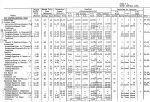
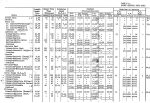
An important table comparing fare options across the GTHA is included in the report. Pass-based fares including the monthly discount program fall into a separate category of “loyalty programs”.

GTHAPolicies1 GTHAPolicies2

This chart drives home the fact that 2 hour time-based transfers are common in the GTHA while distance-based or zone-based fares are comparatively rare. Such a chart should have been part of the recent Metrolinx Fare Integration report, but it was not, potentially misleading the Metrolinx Board about the relative prevalence of GO’s world-view on fare structures.

Within Toronto, the TTC flags three challenges for any fare system:

  • Demand exceeds peak period capacity on some routes. By implication any fare structure that drives up demand will only worsen this situation.
  • Revenue control. The TTC does not entirely trust that any new fare system will yield the same revenue.
  • Complex fare and transfer rules. Within Toronto, the transfer rules make integration with other fare systems difficult if not impossible.

However, these may be offset somewhat through other improvements such as system-wide proof-of-payment and Presto rollout.

A timeline shows how various features of a new fare system would be implemented.

Timeline

Note that a move to support a wider range of cards beyond Presto is timed for 2017. This date is part of the Presto plans, as reported at the recent Metrolinx Board meeting. An essential change in the Presto model is that all of the fare handling logic moves to the “back end” of the system and the card (or some equivalent such as a SmartPhone app) merely provides a rider’s “credential” saying “this is me” to the system. Such a change makes possible a much richer set of fare integration and loyalty programs because a rider’s travel can be accumulated over time (much as a phone bill is) and the appropriate rates and discounts applied after the fact based on usage.

Underlying the analysis will be the assumption that new fare policies would not be implemented until 2018 when the technology underpinning would be in place. There is an expectation that the price gap between cash fares and Presto would widen relative to current practice as this is already the case in other parts of the GTHA.

There are seven principles proposed for the analysis:

  1. Improve the customer experience
  2. Meet the needs of our different customer groups
  3. Increase ridership
  4. Optimize TTC fare revenue
  5. Optimize TTC operations
  6. Embrace new technology to modernize our fare offering
  7. Support fare integration initiatives across the Greater Toronto and Hamilton Area

The analysis will review:

  1. Cash fares and single ride options
  2. Loyalty programs
  3. Peak and off-peak fares
  4. 2hr time-based transfers
  5. Fare by distance/zone
  6. All-door boarding on buses
  7. Proof-of-Payment (POP) system wide including buses and subway
  8. “Tap on” to all buses and streetcars
  9. “Tap on and off” at all subway stations

Notable by their absence in this list is a discussion of service classes such as premium express fares and any scheme in which the “rapid transit” network would be a separate fare tier.

Also included on a regional basis will be considerations of low income discounts and fare equity as well as co-fares.

The analysis will come back for debate and endorsement by the TTC Board at its December meeting.

The Evolution of Demand on the Union Pearson Express

Updated September 24, 2015 at 11:30 am:

Metrolinx has released details of its daily ridership counts.

Ridership Summary 20150921

Although they claim via Twitter that ridership is going up, when the numbers are actually graphed, this is not true.

The chart below shows:

  • The projected ridership rising from 3,000 per average weekday to 5,000 over the first year of operation (blue).
  • The actual ridership from the Metrolinx stats (green).
  • The moving average weekly ridership (red). For the first six days, these are the values for the operation to date.

It is quite clear that the ridership has settled into a regular pattern after a dip in early July. There is little evidence of a Pan Am Games effect on the numbers. As and when Metrolinx releases additional ridership data, I will extend this chart.

What is missing from the Metrolinx data is a statement of the average fare paid and a breakdown by fare type. This would reveal both the nature of ridership and the effect, if any, of promotional fares on demand.

UPX_Ridership_20150924

The original article follows below.

Continue reading