The Scarborough Subway Fiasco

For the benefit of out-of-town readers who may not follow the moment-to-moment upheavals in Toronto politics, the lastest news about the Scarborough Subway is that it will cost $900 million more than originally forecast, and the Eglinton East LRT line has gone up by $600 million.

Updated 10:45pm June 17: The increase in the Eglinton LRT line’s cost may only be $100m, not $600m. Awaiting further details to confirm this.

No details of the components of these increases have been published yet, but here are the current (as of 6:45 pm on June 17) media reports:

  • The Star: Mayor John Tory accused of ‘political posturing’ as Scarborough transit plans balloon by $1 billion
  • The Globe & Mail: Scarborough subway cost rises by $900-million
  • Torontoist: The Bad Decision on the Scarborough Subway Extension Gets Worse

Earlier this year, the much-touted “optimized” plan for Scarborough changed the subway scheme from a Kennedy to Sheppard line stopping enroute at Lawrence and Scarborough Town Centre (STC), to a one stop extension whose terminus and only station was to be at STC. Money saved by shortening the subway would be directed to the Eglinton East LRT project linking Kennedy Station to University of Toronto Scarborough Campus. [See Scarborough Transit Planning Update]

At this point, the total project cost remained within the original 3-stop subway project’s estimate of $3.56 billion (as spent dollars including inflation) of which the City of Toronto’s share would be $910 million financed primarily by a 1.6% Scarborough Subway property tax over 30 years. The remainder would come from Queen’s Park and Ottawa, but their contributions are fixed and any overruns are on the City’s dime.

Material from this report reappeared in a March update on the overall transit network [see Developing Toronto’s Transit Network Plan: Phase 1] and in the May-June presentations to various public consultation meetings. At no time was the possibility of a cost overrun for the Scarborough network mentioned.

Meanwhile, ridership estimates for Scarborough were revised downward quite drastically with a projected AM peak hour demand of 7,300 inbound from STC station. About half of this would be existing SRT riders and the rest would be net new to the transit system. The May presentation makes a point of defending the lower numbers, but here is what City Planning staff said only a few months earlier in their March report:

Preliminary ridership forecasts … indicate:

  • The options are capable of capturing significant ridership. Daily users range from 115,000 to 147,000 in 2031. Morning peak hour, peak point, peak direction ridership ranges from 13,700 to 17,700.
  • Assuming the McCowan 3 option, the introduction of SmartTrack would reduce ridership on the subway extension to about 109,800 daily users and 12,600 peak hour, peak point, peak direction riders assuming 15-minute SmartTrack service in 2031. Assuming 5-minute SmartTrack service daily users would be about 88,200 and peak hour, peak direction, peak point ridership would be about 9,800 riders. In either case, the peak point ridership would be comparable or higher than that observed today near the terminal points of existing subway lines, with the exception of the Yonge line in the vicinity of Finch station. [p. 32]

During his election campaign, John Tory trumpeted SmartTrack as the one line that would solve every problem claiming very high peak and all day ridership based on service probably three times better than we will ever see. SmartTrack is now proposed with trains every 15 minutes, not every 5, and this has a huge effect on ridership both on ST and on neighbouring lines as the numbers above show.

Planners have been twisting themselves into pretzels trying to justify building a subway with the lower projected demand saying it wouldn’t really work at the higher level because there would be no capacity further downstream for existing riders (similar to the problem we now see south from Finch Station). That’s all very well, but the same planners sold Council with the subway concept by touting the much higher estimates that “justified” subway construction as ridership would be at the edge of what an LRT line could handle.

These two arguments cannot both be right, and it is quite clear that planning numbers either were gerrymandered or that they were simply the product of unreliable analysis. Either way, all future projections are suspect especially if they change conveniently to suit the political needs of the day.

Throughout all of this, there has been no change, until today, in the cost estimates, the other vital factor in deciding between transit options. To put this in context, other studies have turned on amounts in the low hundreds of millions to justify choice of a “cheaper” option, while other projects languish because they are “not affordable”. $1.5 billion is no small change.

Technical issues have now come to light that render the original cost estimates meaningless. According to the Globe:

An analysis in Scarborough showed that the topography would require deeper tunnels in some places. The stations themselves would have to be 45 to 90 per cent deeper than thought, raising their construction costs immensely. And the high water table of the area would require more concrete than expected.

This is not something that was discovered last week. Mayor Tory attempted to pirouette around the cost problems with the idea that somehow the “private sector and others” could find a better way to do things. However, the TTC’s CEO Andy Byford, in a restrained comment, demured. From the Star:

TTC CEO Andy Byford said a third-party already helped with the engineering estimates to look at creative solutions for tunnelling or station design.

“I welcome the suggestion of having a third party at least review our costs because we want to make sure that we’re being as efficient as possible,” Byford said, adding: “I want to deliver the Scarborough subway for the best possible price.”

But asked if it’s realistic to expect hundreds of millions of dollars could be shaved off the costs, Byford said: “I think that would be a challenge.”

Indeed, Byford is now in a difficult position because his political neutrality on the subway vs LRT question cannot survive. Any new money to build the more-expensive plan will have to come at the expense of something else. Already, the TTC Budget Committee meeting where a preliminary “wish list” of funding requests to Ottawa was to appear (Byford said as much during the announcement at Greenwood Yard of DRL funding) was cancelled, and we have no idea just what projects TTC management, let alone the Board, feel should vie for funds. At some point, Byford may have his “Gary Webster moment” at City Council where he should openly state a professional opinion. (The reference is to Byford’s predecessor who was sacked by Rob Ford for having the temerity to oppose the subway plan.)

Nothing has been published beyond the Mayor’s comments to the media, and if there was a prepared statement, it still is not available on his website.

The tunnelling issue noted above is one part of the cost, but there are likely to be others as I have already discussed on this site. The key point is that the TTC has many interlocking projects that must proceed before the Scarborough Subway can open.

There are five projects in the future on BD which have serious interdependencies:

  • T1 replacement
  • ATC
  • Scarborough extension
  • New storage facility
  • One-person train operation

Some are below the line and some are above the line. However, the dates and order of projects don’t align, so to minimize changes and maximize efficiencies the correct order should be:

  • New storage facility (ready for permanent 6 car consists)
  • New trains (ready for ATC)
  • ATC or OPTO (with ATC and OPTO ready trains)
  • ATC or OPTO
  • Scarborough extension

[Email from Mike Palmer (Deputy Chief Operating Officer, responsible for subway operations)]

The new storage facility will likely be near Kipling Station. It will be designed around the physical requirements of the new 6-car trainsets, and it will provide concurrent storage for the new and old fleets.

ATC (Automatic Train Control) is a prerequisite for the Scarborough extension which would be built using that technology. Conversion of the existing line to ATC would, strictly speaking, not be required before the SSE opens, but no T1 trains (the existing fleet) could operate on the extension without an expensive and short-lived retrofit. Hence the need for a new fleet sooner than might otherwise have occured.

OPTO is one person train operation. This cannot go into effect until the trains all have suitable cab equipment to allow an operator at the front of a train to monitor the entire train without assistance from a guard at the rear end.

That’s quite a shopping list as a pre-requisite to the SSE, and the TTC has yet to incorporate these projects fully in its capital budget “above the line” (ie: as funded projects). It is not clear whether the TTC Board or members of Council are aware in detail of these issues either, or how much they might contribute to the added cost for the extension.

As an historical note, in the days before the TTC contemplated a move to ATC, fleet planning was based on the premise that all cars for both lines were interchangeable. The result has been that because the YUS is now fully operated with TR trains and Sheppard is being converted, there is a surplus of the older T1 equipment whose only remaining use is on the BD line. With conventional signalling, the SSE could have opened using this equipment, but that’s not how it will be built, and the fleet plans are in disarray as a result.

Why the LRT line has grown in cost is a mystery. It is unclear whether this arises from design changes or estimating errors, although the scope for such error is much less with a surface route. Either way, the magnitude of the change is substantial, and as with the subway, threatens the credibility of a plan that was sold to Council only months ago. By extension, any other plan the City might put forward is also suspect.

Through all of the consultation, we have heard very little about SmartTrack beyond the probable location of its stations and the likely service level. What we do not know is how much it will cost to build the surviving chunk of the route from Mount Dennis to Unionville. Indeed, there is reason to question going beyond the Toronto border considering that the GO/RER plan will itself bring frequent service to the same area. What we do know about ST is that it will poach riders from parallel routes, and that service expansion beyond a basic 15-minute level involves expensive reconstruction of the rail corridor to provide more capacity. Contary to what Tory’s “experts” told us, the track is not just sitting there for the taking by his signature service.

Of the original $8-billion, some has been saved by discarding the Eglinton West segment, now proposed to be part of the Crosstown project, but we really do not know how much Toronto will have to pony up to implement the ST service.

If nothing else, this whole fiasco should be an object lesson to professional staff who tailor their plans and professional advice too closely to a political agenda. When that agenda is ill-advised, but pushed forward through sheer pig-headedness, the quality of planning cannot help but be tainted along with the credibility of the planner. This is a dangerous game.

Toronto, somehow, survived the Rob Ford era and there was some hope that a credible transit plan might be cobbled together under the new Tory regime. However, Mayor Tory has proved as intransigent about acknowledging he is wrong, that circumstances do not support his plan, as his predecessor. If Toronto had time and money to spare, we might say “this too shall pass”, but we have neither.

Propping up the egos of various politicians, including the notorious Scarborough crew at Council and Queen’s Park, is getting expensive. This is complicated by the fervour with which they exhort subway supporters to demand what Scarborough “deserves”. That too is a dangerous game as there are crazies out there with less than healthy wishes for those who advocate something other than a subway. It’s Trumpism on a local scale – giving license to treat subway critics as people who don’t matter.

During his election campaign, John Tory dismissed SmartTrack critics as naysayers who simply wanted to oppose things for the sake of it. That was bullshit then, and it is today with his comments about those who question his continued support for the subway plan.

On a personal note, I have been fighting for better rapid transit in Toronto suburbs, yes, with an LRT network, something all of the planners once supported, for over forty years. A lot got in the way including provincial interference in technology choice, and economic or political downturns that snuffed out hopes for good transit funding. A lot of Scarborough was farmland when this process started. They are still waiting.

King Street Service Update: June 2016

The City of Toronto is about to launch its review of how King Street “works”, and Chief Planner Jennifer Keesmaat has an op-ed in the Star, It’s time to reimagine Toronto’s streetcar ‘King’.

Both for personal interest and as part of my work for the TTC and City of Toronto on the behaviour of streetcar routes, I have been following the 504 King route for some time using TTC vehicle tracking data. This article updates the consolidated stats in anticipation of the King Street project with data to May 2016, and looks in detail at some of the current information from that month including vehicle speed profiles.

For information about the creation of these charts, please see Methodology for Analysis of TTC’s Vehicle Tracking Data.

Continue reading

Analysis of Services on Wilson Avenue (Part I)

Wilson Avenue is served by many bus routes and branches, and this arrangement has been through two major reorganizations since fall 2015. In these articles, I will review the changes and the quality of service provided at various locations along the route.

Until March 27, 2016, service on Wilson Avenue was provided by 96 Wilson and 165 Weston Road North with most trips originating at York Mills Station.

In October and November 2015, both routes became part of the 10-minute network, and their schedules were reorganized accordingly. Blended service is provided in off-peak periods on the common section of the routes on Wilson Avenue between Weston Road and Yonge Street.

In March, this was changed to split off routes 118 Thistle Down, 119 Torbarrie and 186 Wilson Rocket as separate entities but on the same routes as the original branches of 96.

  Before                                      After

  96A Wilson YMS to Carrier Drive             Unchanged
  96B Wilson YMS to Claireville               Unchanged
  96C Wilson YMS/WS to Thistle Down           118 Thistle Down from WS
  96E Wilson WS to Humber College Express     186 Wilson Rocket from YMS
  96G Wilson YMS to Sheppard & Torbarrie      119 Torbarrie from WS
  165A Weston Road N YMS to Steeles & Weston  Unchanged

  YMS: York Mills Station
  WS:  Wilson Station
  • The 186 Wilson Rocket operates weekday peak and midday periods from York Mills Station whereas its predecessor 96E was peak only from Wilson Station.
  • All Thistle Down trips are now to/from Wilson Station only.
  • Service to Torbarrie remains peak only and its eastern terminus is now Wilson Station, not York Mills Station.
  • Additional 165 services operate into York Region with various destinations including seasonal service to Canada’s Wonderland.
  • The 96A and 96B services are identical over most of the route branching primarily at their outer ends just beyond Humber College, terminal for the 96E/186. The 96C/118 service branches off at Albion Road, and the 96G/119 west of Jane Street.

An obvious question here is whether all of this shuffling made any difference in the service beyond giving the various sub-routes their own numbers.

For those who want the short version, the service is a bit better, but still not very good, and it certainly does not meet the TTC’s goal of providing reliable service at terminals, let alone along the way. Wilson provides a good example of inferior service for riders notably when there is an attempt to blend multiple routes and branches. There is no individual location or time to point at, but rather an overall lack of rigour in provision of service throughout all of the routes at all times and days of the week.

There is no sign through any of the data here of an attempt to manage headways (or equivalently, to keep buses “on time”). In some periods and locations, many overlapping services could usually guarantee a bus to somewhere a rider is going. Inbound on Wilson, any bus will take you at least to Wilson Station, and most will go beyond to York Mills. However, for individual branches, simply letting the service operate as it might produces a much less satisfactory result with unreliable service, wide gaps and bunching.

These are services that would benefit from explicit “time point” dispatching with vehicles expected to leave points enroute, notably those where services merge as well as points where an enroute layover to achieve an even headway could easily be handled. A range of +1 to -5 minutes relative to the schedule on this route gives far too much latitude.

In Part II of this article I will examine running times in comparison with schedules for these services if only to deal with the usual “if only we had more running time” argument that has become the standard response to unreliable service.

The schedule summaries for these routes and periods are at the end of this article for reference.

Continue reading

Scarborough Subway Ridership and Development Charges

The Star’s Jennifer Pagliaro reports that City Council has approved a confidential settlement with BILD, the Building Industry and Land Development Association, to avoid an Ontario Municipal Board hearing that could lead to rejection of the Bylaw implementing the Development Charges intended to pay for the Scarborough Subway. The matter was before Council in confidential session on June 7, 2016.

Staff miscalculations on the ridership of the Scarborough subway will leave taxpayers on the hook for millions more, after city council voted to settle a dispute with developers.

According to a secret report before council on Tuesday, the contents of which were shared with the Star, the city’s lawyers advised councillors to accept a settlement with the group representing developers, the Building Industry and Land Development Association (BILD).

The settlement, which reduces the amount builders will have to pony up to help finance the subway, is expected to cost the city as much as $6 million in lost revenues.

If the settlement is for only $6 million, the City should consider itself lucky because the calculation underlying the DCs is based on flawed ridership estimates and an out of date network design. Moreover, the original authorization appears to double count subway revenue with both a special Scarborough Subway Tax and Development Charges to recover the same costs.

Recent news of a 50% reduction in expected Scarborough Subway ridership from 14,100 to 7,300 passengers in the AM peak hour reignited political debate on the viability of the subway scheme. However, these numbers are not just hypothetical indicators of how the line might perform, they are integral to the calculation of Development Charges (DCs) that would help to fund the City’s share of this project.

See also my previous articles:

The formula to calculate development charges is complex, but at its heart is one key measure: how much of a new transit project will benefit existing properties versus future development. If the primary role of a new subway is to improve the lot of current riders, then only a minority of its cost can be recouped by DCs (and thus from future purchasers of new properties).

Toronto allocates DCs on a city-wide basis rather than assigning each project only to the neighbourhoods it will directly serve. These charges already help pay for many projects as shown in the introduction to the study establishing the level of new charges for the SSE.

The Council of the City of Toronto passed a Development Charges (DC) By-law, By-law 1347-2013 in October 2013, for the recovery of capital costs associated with meeting the increased needs arising from development. The effective date of the Bylaw was November 1, 2013. The recovery of DCs is on a City-wide basis and relates to a wide range of eligible City services:

  • Spadina Subway Extension
  • Transit
  • Roads and Related
  • Water
  • Sanitary Sewer
  • Storm Water Management
  • Parks and Recreation
  • Library
  • Subsidized Housing
  • Police
  • Fire
  • Emergency Medical Services
  • Development-Related Studies
  • Civic Improvements
  • Child Care
  • Health
  • Pedestrian Infrastructure

For commercial property, there is some justification to this because increased mobility makes travel to jobs simpler well beyond the location of any one project. For example, the Scarborough Subway might be held out as a way to stimulate growth at the Town Centre, but it would also reduce commute times to other parts of Toronto, notably downtown.

For residential property, especially for the large proportion of new development downtown, this link is less clear, and DCs on new condos can wind up funding transit projects of little benefit to the new residents.

This split is part of the eternal battle between sharing the cost of public services across the city and charging them locally or by user group.

In the case of the Scarborough Subway Extension (SSE), the split between new and existing beneficiaries was determined by the change in ridership projected with the subway project. The benefit was allocated 61% to new development and 39% to existing riders. The ratio is high because, at the time of the calculation, the projected peak hour ridership for the SSE was estimated at 14,100 compared with a base value of 5,500. Both of these numbers are suspect.

The base value was factored up from actual SRT ridership of 4,000 per hour to 5,500 to represent the load the subway would have had were it to exist in 2015. That value of 4,000 is equivalent to a load of about 240 per train when the peak service was 17.14 trains/hour (3’30” headway) as in 2012. However, by 2013 service had been cut to 13.33 trains/hour (4’30” headway) to reduce equipment requirements on the aging line. That is the service operating today, although a further cut to 12 trains/hour (5’00” headway) is planned for June 20, 2016. Some of the demand that would be on the SRT travels via alternate routes, some is packed into fewer trains, and some has probably been lost to the TTC. What the ridership might be today were the RT not capacity constrained is hard to tell, but it should certainly be higher.

The high value for future subway ridership combines with the low value for presumed current demand to load much of the SSE’s cost onto new development.

The situation is complicated by two competing ridership estimates:

The contexts for the three estimates differ, and this goes some way to explaining why the numbers are so far apart:

  • A line to Sheppard will attract more ridership than one ending at the STC.
  • A subway station at Sheppard, in the absence of improvements to the GO corridor such as RER and SmartTrack, will attract ridership from Markham just as Finch Station does from the Yonge corridor north of Steeles.
  • Removal of the station at Lawrence East, coupled with new GO corridor services, will reduce demand on the subway.

There is no guarantee that the land use, job and population assumptions underlying the three estimates are the same, especially when the highest number was produced in the context of boosting the importance of STC as a growth centre.

What we are left with, however, is the likelihood that the level of DCs allocated for the Scarborough Subway project were based on the most optimistic scenario for new ridership, and a network configuration quite different from what will actually be built. If the calculation had been done on the basis of lower ridership numbers, the DC revenue available to fund the Scarborough Subway would have been considerably lower.

Continue reading

A Cat’s Cradle of Transit Plans (Updated)

Updated June 6, 2016 at 11:30 pm: The chart of the demand profile for the Eglinton East LRT has been updated by City Planning to correct an error in labelling where inbound and outblound values were reversed. The new chart has been placed into this post, and the link to the source pdf has been updated below.

Public consultation sessions are coming to an end on the “motherlode” of transit projects (as they were described earlier this year by Toronto’s Chief Planner, Jennifer Keesmaat). This process will soon bring a consolidated set of reports and recommendations for Council. So far, the presentations have been subdivided between various projects.

A major challenge for politicians, the media and the general public is to sort out all of these schemes and to understand how they all fit together. This is not just a question of how we will finance all of the projects, but of how each project and the choices made for it will affect everything else. Where typical studies in Toronto might have wrestled with whether a new line should go under street “A” or “B”, and where the stations might be located, today’s work requires understanding of how the network will evolve over time and how it will work as a whole in a few decades.

The process is complicated further by having municipal (City Planning & TTC) and provincial (Metrolinx) components, and the secretive nature of Metrolinx studies means that some vital information about its projects is not yet public. The Metrolinx reports are expected to appear on their Board’s agenda for June 28, and this implies public availability sometime in the preceding week.

The consolidated City reports should be available on June 21 when a briefing session is to occur at City Hall a week before the June 28 Executive Committee meeting.

Continue reading

A Boost for the Relief Line

This afternoon, June 1, there was a small miracle at the TTC’s Greenwood Yard. Assorted politicians and transit management gathered for an announcement of transit funding, of new transit funding, and for that perpetual orphan of Toronto’s political scene, the (Downtown) Relief Line.

Steven Del Duca, Ontario’s Minister of Transportation, announced that Metrolinx would be given “more than $150 million” to work with the City and the TTC on advancing planning and design for the Relief Subway Line to bring it to “shovel ready” status.

This is a substantial commitment of financial support, but more importantly of political support. Del Duca was joined by Mayor John Tory in singing the Relief Line’s praises as a necessary part of growing capacity on the transit network building out from earlier improvements through GO/RER and SmartTrack.

According to Chief Planner Jennifer Keesmaat (whose Twitter session is in progress as I write this), study of the RL will focus initially on Phase 1 (Danforth to downtown), but will then shift to the northern and western extensions. The northern extension is of particular importance because, according to Metrolinx demand projections, it will have a major effect in offloading demand from the Yonge Subway and the Bloor-Yonge interchange.

RLUpdateProjectedDemand_P31

[Source: Metrolinx Yonge Relief Network Study p. 31]

With both the Mayor and Queen’s Park supporting the RL, and with provincial funding of the design work, the Toronto City Council gridlock over transit priorities can be “relieved” for at least a few years. The RL will not have to compete with other schemes for City funding, and with Metrolinx holding the purse, Council will not be able to divert the money to pet “relief” lines for suburban Councillors. Indeed, the whole suburbs-vs-downtown argument, which is born in part by a desire to be at the front of the line, need not pollute the RL study.

The Metrolinx role is also important because the RL (aka the “Don Mills Subway” to many on this site) needs time to be presented for what it can do for suburban Toronto were it to run north at least to Sheppard & Don Mills via Thorncliffe Park. Many riders would have a completely new route to downtown comparable to the service now provided by the Spadina Subway, and this would be completely separate from the existing congested system. Capacity released on the Yonge line would be available to riders from the proposed Richmond Hill subway extension, and the reduction of transfer traffic at Bloor-Yonge could eliminate the need for an extremely expensive and complicated expansion of platform and circulation capacity there offsetting some of the Relief Line’s cost.

Del Duca acknowledged the considerable work already done by the City and TTC on this file. Indeed, had it not been for the TTC’s Andy Byford with support from City Planning raising the alarm about the need for a Relief Line, nothing would have happened.

Some comparatively short term improvements will provide “relief” on the Yonge line, but these will be backfilled by pent up demand over the next decade.

RLUpdateCapacityChart_P20

[Source: Metrolinx Yonge Relief Network Study p. 20]

Smart Track may shave another small amount off of this, but notwithstanding the Mayor’s enthusiasm, the City’s own demand projections published as part of the Scarborough studies show that SmartTrack has a very small effect at Bloor-Yonge.

Tory is still somewhat confused about just what Smart Track’s effect will be considering how much it has been scaled back since his election campaign. He was happy to talk about track work now in progress in Scarborough (on the Stouffville corridor) as being part of Smart Track, when in fact it is the double-tracking work for improved GO service that was in the works before he even ran for office. And he still talks of this as if it were an $8 billion project when a great deal has been lopped off of the project’s scope.

Finally, the TTC CEO Andy Byford is happy just to see money coming his way from all three governments on both the capital and operating sides (although, the latter more grudgingly from the City).

As for construction, that’s still some years off, and it will be important to think of the project in phases, not as one megaproject. It will take five to six years to get to “shovel ready” status, and the issue then is how quickly we want to build the line. A lot of transit capital planning lately has been hostage to constrained finances at both the City and at Queen’s Park. By the early 2020s, the Scarborough subway project should be winding down and spending can shift to the Relief Line.

Now in all this excitement, if only someone would treat other orphaned projects like the Waterfront and Sheppard LRTs seriously.

TTC Board Meeting: May 31, 2016

The TTC Board will hold its regular meeting at 1:00 pm on May 31, 2016 in Committee Room 1 at City Hall.

Items of note on the agenda include:

  • The monthly CEO’s Report
  • Purchase of 97 diesel buses
  • Metrolinx response to a request for additional parking in the Kipling Terminal project

The agenda also includes the draft financial statements which I covered in a separate article.

Continue reading

A Messy “Reset” For Waterfront Transit Planning (Updated)

The first of two public meetings on the City of Toronto’s so-called “reset” of transit plans for the waterfront was held on May 25, and a second is to follow tonight (May 26).

The presentation deck from these meetings is now available online.

Updated May 27, 2016 at 5:30 pm: The preliminary evaluation grids for various routing options have been added to this article following the original discussion of each section of the study. This raises an obvious question of how options can be scored before important factors such as demand projections, design and costing are known, and whether the preliminary scores will bias the discussion and evaluations to occur in Phase 2 of the study. Scroll down to the end of each section for the additional material. (Apologies for the resolution. The grids are not available online, and I am limited by the quality of the paper copies distributed at the meeting.)

There is a lot of material to digest here, and the process is not helped by several factors:

  • Council has imposed a very short timeframe, considerably less than would normally be taken for the scope of work.
  • All proposals that have ever been on the table for the past few decades and a few new schemes are up for discussion, including some that should have been discarded quite early in the process. In part this is due to the many incomplete studies of various sections of the route that never got to the point of killing off the unworkable options.
  • The City and consultant staff presenting this material are not intimately familiar with the details of many proposals, nor with the history of how they came to be part of past studies.
  • Conflicting goals of previous studies, not to mention of today’s Councillors and community groups, make a “one size fits all” solution impossible.
  • Beyond identifying a few locations where GO/Metrolinx might add stations in the Lake Shore corridor, there is little discussion of the role GO/RER can and, equally importantly, cannot play in handling travel.
  • There is very limited origin-destination or demand information with which to validate or compare proposals, or to put them in the wider context of competing demands for transit funding.
  • A vital consideration for any network is the effect on travel times. After spending millions (or even billions), how would the speed and capacity of travel have improved?
  • The real meat of any discussion remains for an as-yet unapproved “Phase 2” study that would include [text taken from the presentation]:
    • Feasibility studies (including but not limited to demand forecasting, operational assessments, further developed cost estimates);
    • Potential Environmental Assessment(s) or amendments to existing Environmental Assessment(s);
    • Pursuing the implementation of short term strategic improvements that minimize long term throwaway costs; and
    • Advancing a Business Case and pursue funding opportunities.

As someone who has worked for years in hopes of better transit service to the waterfront, all of this is quite disheartening. So many competing ideas are on the table, so many competing priorities, and so little desire to spend pervades the discussion. We may end up with nothing at all.

Growth in the Waterfront

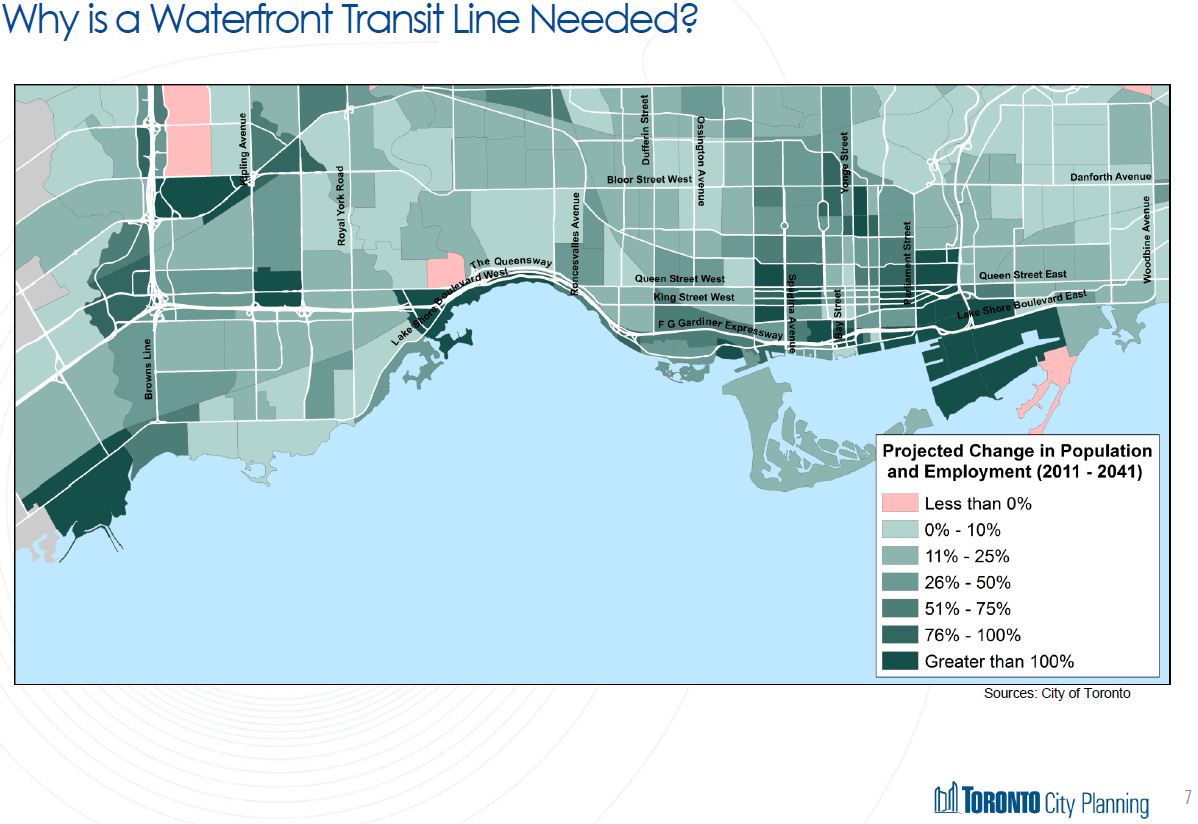
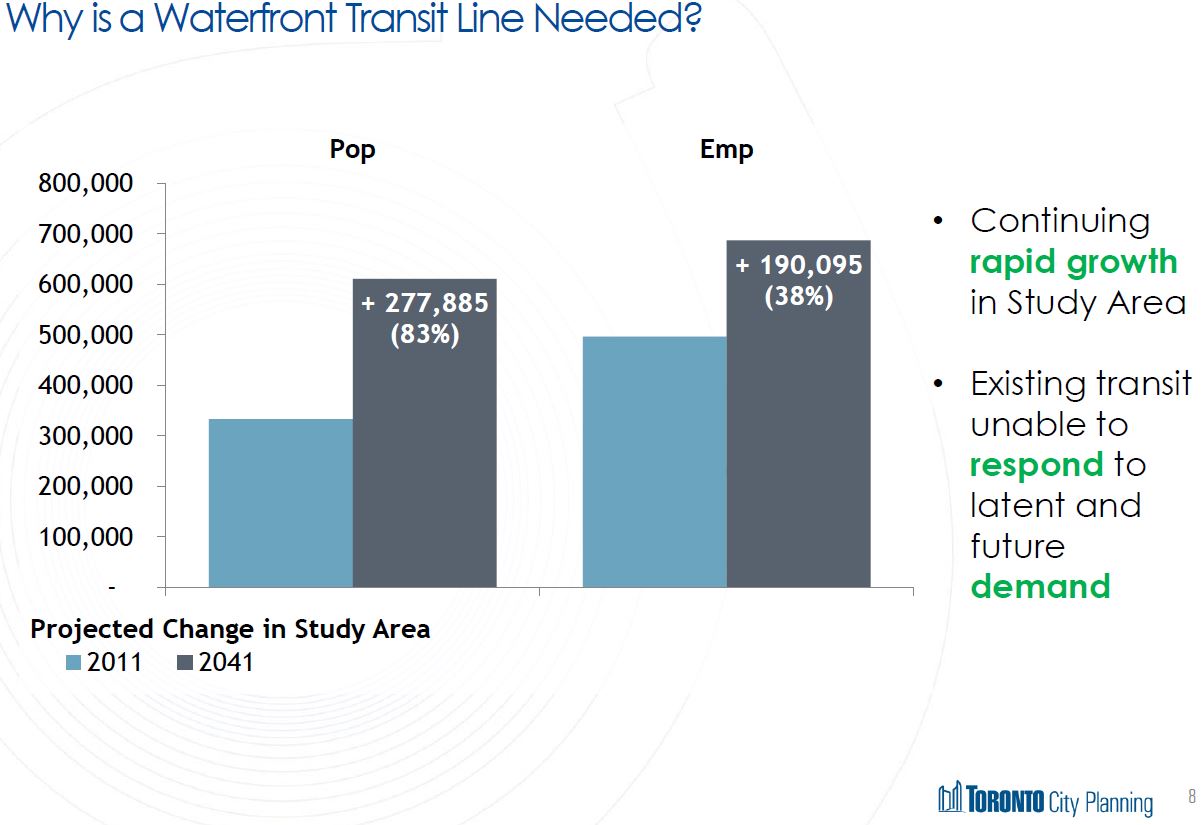
The need for better transit to many parts of the waterfront is quite obvious to anyone who looks at the forests of new condo towers along the water and neighbourhood close by to the north. Much of the projected population growth in Toronto is located in the southern part of the city (an area considerably bigger than the traditional “downtown”), but transit improvements there always come second (at best) to proposed expansion elsewhere. Where suburban subway boosters take a “build it and they will come” approach to subway advocacy and treat rapid transit as a trigger that will, they hope, bring new population and jobs, the waterfront already has both, and is growing apace without adequate transit support. Improved transit to the eastern and western waterfront rank in the top five performers of the City’s “Feeling Congested” study.

201605_PopEmpGrowthto2041

201605_PopEmpGrowthto2041_Chart

This growth will not all arrive “tomorrow”, but it certainly will build in over coming decades. Already, access by transit across the waterfront is inadequate, and this will only get worse as time goes on.

Continue reading

Who Pays For The TTC 2000:2015 (Revised)

May 24, 2016: This article has been revised to reflect an inconsistency in my handling of Wheel Trans operating subsidies over the period. Specifically, up to 2009 I had included them in the total subsidy, but from then on, I had excluded them. This has been corrected and the WT subsidy is now shown as a separate component. Also, a one-time provincial WT subsidy in 2008 has been included.

In previous articles, I reviewed the details of TTC funding in the annual financial statements up to 2013. With the publication of the draft 2015 statement, it’s time for an update. This and other reports will be considered by the TTC’s Audit and Risk Management Committee on May 25, 2016.

The full set of charts used in this article is available in the following PDF:

2000 2015 Subsidy Summary_Revised

Caveats:

  • This analysis consolidates information from several parts of the notes to the financial statements and is presented in a different manner from those statements to simplify tracking by year and source of subsidies. Although the numbers all come from “official” sources, the arrangement and presentation is my own.
  • In 2015, the City’s operating subsidy included a “capital from current” payment of $19.2 million that purchased 50 new buses. Although this was booked as an operating subsidy (for reasons shrouded in the mysteries of that year’s budget fiddling by the Mayor and Council), it is really a capital subsidy and I have counted it in that category for consistency. This one-time subsidy disappears in 2016, but this is not a “cut” in operating funding.

Operating Subsidies

The TTC’s operations are funded primarily through the farebox. In 2015, fare revenue contributed $1.109 billion while other sources (advertising, outside city services, rentals and miscellaneous) brought the grand total to $1.179 billion. The remaining $518.6 million was funded by the City of Toronto and Province of Ontario.

Over the years, Ontario subsidy has been paid primarily through a share of its Gas Tax revenue. Ontario transfers a lump sum to Toronto, and the City splits it between Operating and Capital budgets. The amount going to Operations has not changed for many years.

Ontario under the Harris government killed off all operating subsidies, and they did not return until 2004. The explicit link as a share of gas tax began in 2006, and a special subsidy was paid in 2008 because of the unusual financial circumstances of that year.

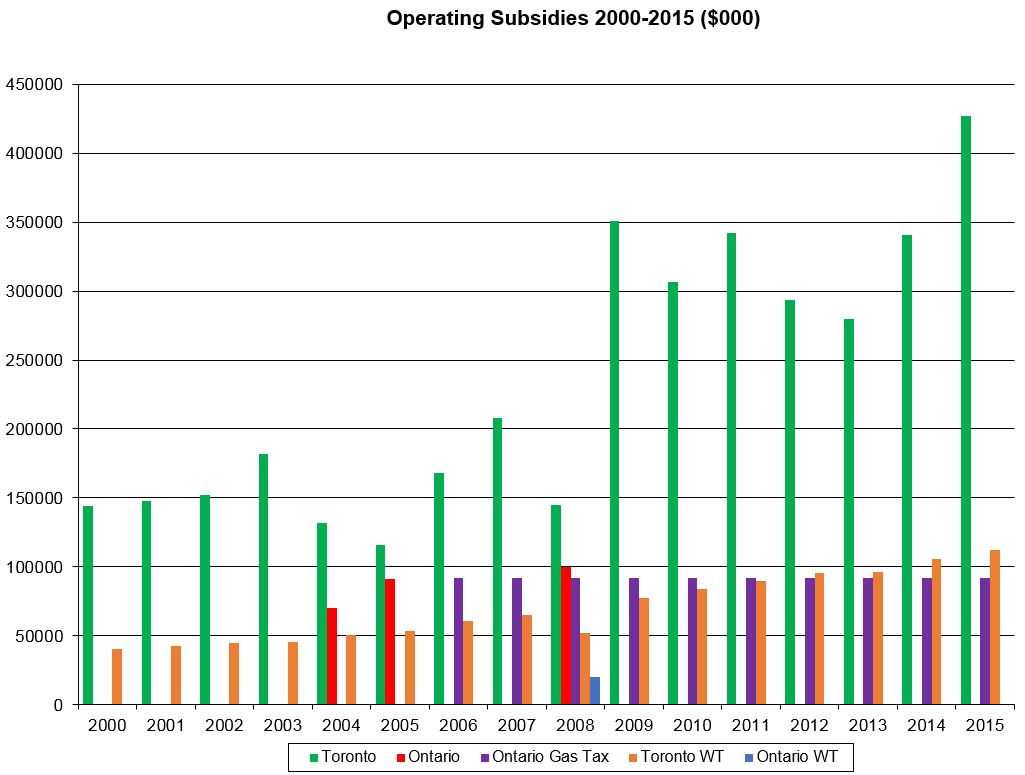
The total subsidy grew consistently to 2009 (the last year of the Miller administration at City Hall), but it was cut back under Rob Ford and more or less flat-lined through to the first year of the Tory regime. For 2014, funding rose again to the 2009 Miller level, but of course this makes no allowance for inflation over the intervening years. For 2015, the second year of the Tory mayoralty, there was an increase in operating funding. (Note that the Capital from Current payment has been excluded here and combined with the Capital Budget funding shown later in this article.)

The subsidies are presented in two formats below: total subsidy received, and individual sources. Either way, it is clear that the City of Toronto has carried the lion’s share of the operating subsidies. This is a far cry from the era when the City and Province split this cost 50-50. Over the 16-year period, the total paid by Toronto was $4.85 billion while Ontario paid only $1.20 billion.

20002015_OperatingSubsidies_Revised

The chart below shows the components of the operating subsidy separately. Except for 2008, the City’s funding of Wheel-Trans has grown, albeit slowly even when conventional service funding was cut back. The result is that the “conventional” cuts as a percentage are deeper than when the numbers are presented in aggregate.

20002015_OperatingSubsidies_Separated_Revised

Capital Subsidies

Capital subsidies pay for new projects such as the subway to Vaughan (aka “Toronto York Spadina Subway Extension” or “TYSSE”) and for replacement of worn out infrastructure and rolling stock. The money arrives in various ways depending on the political and financial situation when various programs and projects were launched.

  • Some money, primarily gas tax, arrives on an annual basis.
  • Some money comes from reserves that were funded through budget surpluses when times were good (generally before the 2008 financial meltdown).
  • Some money comes from “commitments” by governments that are paid out as the projects they fund proceed.
  • A large portion of the ongoing capital program is funded by the City of Toronto through a combination of current revenues and debt.

In the first chart below, the total capital spending shows large growth over the past decade primarily due to the TYSSE project and major fleet updates. The gas tax contributions are broken out here to show how relatively small they are compared to other sources of funding.

“Other” includes money from York Region for its share of the TYSSE and from Waterfront Toronto which is itself funded 1/3 by each level of government.

The amounts here are only for spending through the TTC itself and do not include Metrolinx LRT projects within Toronto.

20002015_CapitalSubsidies

The second chart presents the same data but with the sources broken into separate columns. This shows quite clearly the increased level of capital spending by the City of Toronto compared to other sources. Over the 16-year period, about 47% of all capital funding has come from the City with most of the remainder split between Canada (23%) and Ontario (26%).

20002015_CapitalSubsidies_Separated

The third chart consolidates gas tax and other subsidies by government, and breaks out the York Region contribution for the TYSSE.

20002015_CapitalSubsidies_ByGovernment

Gas Taxes

Although we hear a lot about contributions from both levels of government through the gas tax, it is important to remember that the actual amounts have been almost flat for several years. In real dollar terms, the amount is declining thanks to inflation. Ontario’s gas tax is split between the Operating and Capital budgets at the City’s discretion.

20002015_GasTaxes

2005 was a special year for federal contributions because it actually covered more than one year’s revenue. The federal contribution is pegged to Toronto’s share of the national population which has actually been declining. In both cases, the total amount available is based on cents-per-litre. This does not vary with the price of fuel, but it also is linked to actual fuel consumption. As a revenue source, this is not growing and could even be eroded by fuel efficiency, a shift to lower car ownership, and a move to untaxed fuels.

Reserves and Receivables

When times are good, governments have surpluses burning a hole in their pocket that they cannot spend within the current fiscal year. To fix this “problem”, the money is transferred to a reserve usually with a name indicating how the money is to be used (and a political slogan showing how much they care about transit).

During the mid-2000s, several funds were promised, but the cheques did not actually arrive until 2007-2008. Meanwhile, the TTC (actually Toronto on its behalf) spent money in anticipation of reimbursement from other governments. The 2008 financial crisis brought an end to this sort of funding, but many reserves had been created. These have mostly been depleted as of 2015.

The charts below show the situation in aggregate, and broken down into separate reserves.

20002015_ReservesReceivables

20002015_ReservesReceivables_Separated

  • CSIF: Canada Strategic Infrastructure Fund. Most of the money in this reserve has been spent, and the fund is supposed to wind down in March 2016, although an extension has been requested.
  • PTCT: Public Transit Capital Trust. This federal program was short-lived and the reserve was depleted in 2008.
  • ORSIF: This was an Ontario program to give the TTC money for rapid transit infrastructure outside of the standard subsidy channels as Toronto was the only city with this type of transit. The reserve was depleted in 2011.
  • OBRP: This was an Ontario program to fund bus replacements, but it no longer exists. Most of the funding came into and out of City accounts in the same year, and so little appears in the reserves.
  • TTIP/GTIP: More discontinued Ontario programs for transit improvement. Like OBRP, little of the money stayed in City accounts long enough to show up in the reserves.
  • Quick Wins: This is the 2010 Metrolinx program to fund various system improvements. The reserve will likely be depleted in 2016.

Unless there is a major change in funding principles by Ontario and Canada, the use of reserves will likely disappear from transit budgets to be replaced by in-year funding either for specific projects (reimbursing spending as it occurs) or as block transfers (like the gas tax) for use by the City at its discretion.

Project-Based Funding

TYSSE

The Spadina extension to Vaughan is funded by Toronto, York Region, Ontario and Canada. To the end of 2015, the proportions contributed by each level of government have remained the same with only the total dollar amount moving up and down. From 2016 this will change as the cost overruns on this project will not be equally shared with the local municipalities on the hook for the extra spending.

20082015_TYSSE

Transit City

Metrolinx took over the Transit City projects from the TTC and reimbursed the City for its costs. Funding continues to show up in the financial statements because of work done on Metrolinx’ behalf by the TTC. Note that any clawback of sunk costs for the Scarborough LRT will require that some of this funding to be reimbursed to Ontario.

20092015_MlxTransitCity

Low Floor LRV Project

The TTC is buying 204 new low floor streetcars from Bombardier with the cost subsidized 1/3 by Ontario. As is common in vehicle supply contracts, front-end loading funds the vendor’s startup costs and the remainder is paid out as vehicles are received and accepted. The lack of progress on this project is clear in the low levels of subsidy paid out in recent years.

20092015_LFLRV

Scarborough Subway Extension

As of 2015, this is not an approved project because Council has not finalized the route design and there is no approved Environmental Assessment. Toronto has been accumulating revenue from a dedicated SSE tax in its accounts, but this does not show up in the TTC financial statements.

Spring and a PCC Arrive at Harbourfront

With Victoria Day weekend and the arrival of unquestionably late spring weather in Toronto, people are turning out in droves on Queens Quay: pedestrians, strollers, bladers, cyclists, streetcars and more than a few bewildered motorists.

The TTC will operate one PCC on Sunday afternoons from now through Labour Day weekend on the route. No fare is charged, and a free transfer is possible to the subway at Union Station.