Toronto’s Network Plan 2031: Part I, SmartTrack

For the past months, Toronto Planning, the TTC and Metrolinx have hosted a number of public consultation sessions leading up to two critical meetings on the same day: June 28, 2016.

One will be the Toronto Executive Committee’s consideration of a series of reports on various transit proposals.

The other will be the Metrolinx Board’s first meeting in four months with several related items on the agenda.

Reviewing all of this material will require several article that I hope to finish before the meetings where these issues will be discussed actually occur.

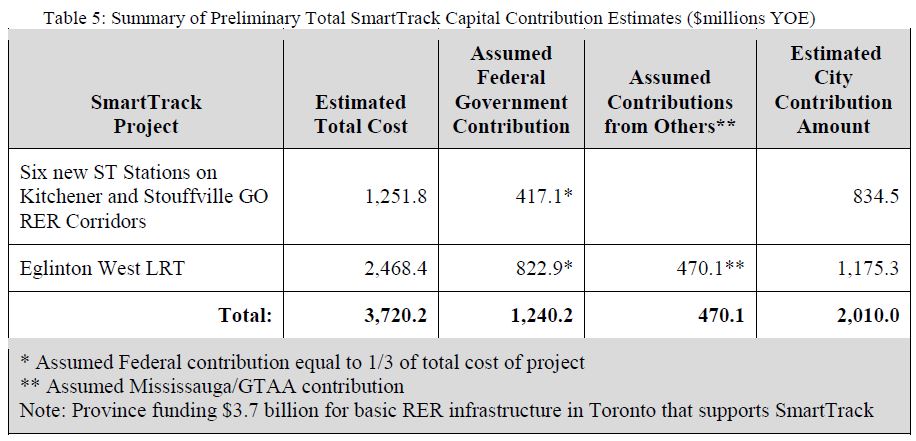
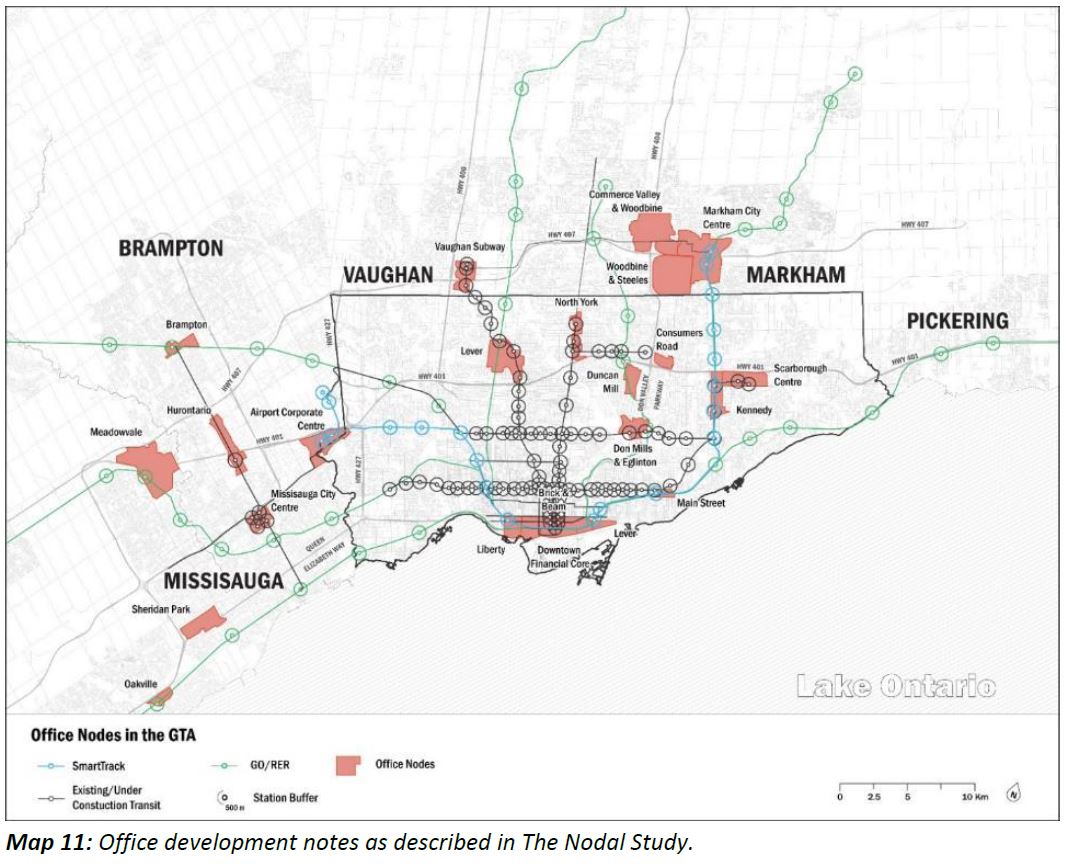
Here I will begin with SmartTrack because of all of the proposals, that has been the most threadbare one throughout the public consultation. It is complicated by being a joint project with Metrolinx who own the tracks over which the trains will operate, and who now quite clearly will also own and operate the trains regardless of what the service is called.

Continue reading

College & Bathurst Construction

The reconstruction of College & Bathurst began on June 20, and is expected to continue for three weeks. This will involve both the full replacement of trackwork as well as other road and watermain works. The eastbound safety island will be removed because there is not sufficient space to expand it for accessibility requirements. The westbound island will be rebuilt and expanded.

The originally announced diversion for the 506 Carlton service operating with streetcars for the east end of the route was a loop clockwise via Bay, Dundas and McCaul. This has been revised so that 506 cars now run south on Parliament from Gerrard to Queen, and then west to McCaul Loop. The meet between 506 streetcars and buses is at Parliament.

This change is required because of construction at Bay to remove the two existing safety islands. Whether the route will revert to the original loop once it is physically possible remains to be seen.

Construction photos will be added here as the work progresses.

June 22, 2016

June 26, 2016

Spinning a Tale in Scarborough

Brad Duguid, Ontario’s Minister of Economic Development & Growth, also the de facto spokesman for the Scarborough Liberal Caucus, was on CBC’s Metro Morning talking about the planned Scarborough Subway Extension (SSE) and its fast-inflating estimated cost.

Duguid had been quoted in the press a few days earlier as saying that downtown elitists have been opposed to the SSE from the start echoing the divisive us-versus-them context for so much of this debate. He likes to sound oh so reasonable, but his message is full of half-truths and puffery designed to support the “we don’t get our share” chorus so common from Scarborough pols and others.

The [subway] project has been on the books for 30 years.

Well, no, it hasn’t. The TTC’s original plan for Scarborough was that an LRT corridor would run northeast all the way to Malvern. (See Once Upon a Time in Scarborough and The Scarborough LRT That Wasn’t). More recently, the Transit City plan included an LRT network for Scarborough, and this received the endorsement of Council. Only when former Mayor Ford chose to use the potential of a subway as bait did Council change its mind.

If anyone has a plan for a subway from Kennedy to STC that has more status than the back of a napkin or a fantasy map, I’ll be happy to see and comment on it.

LRT was put in there as a political decision by the Davis government to promote UTDC globally.

The UTDC was a provincial agency that concocted the RT technology, and they couldn’t get a sale if Toronto wasn’t buying. This technology is most emphatically not LRT, no matter what Duguid and others like to call it, for the simple reason that it requires a completely segregated right-of-way. The true LRT line was already under construction when Queen’s Park pulled the plug, and there are remnants of the LRT design still visible in the RT structures.

Scarborough Town Centre is one of the fastest growing city centres in Canada.

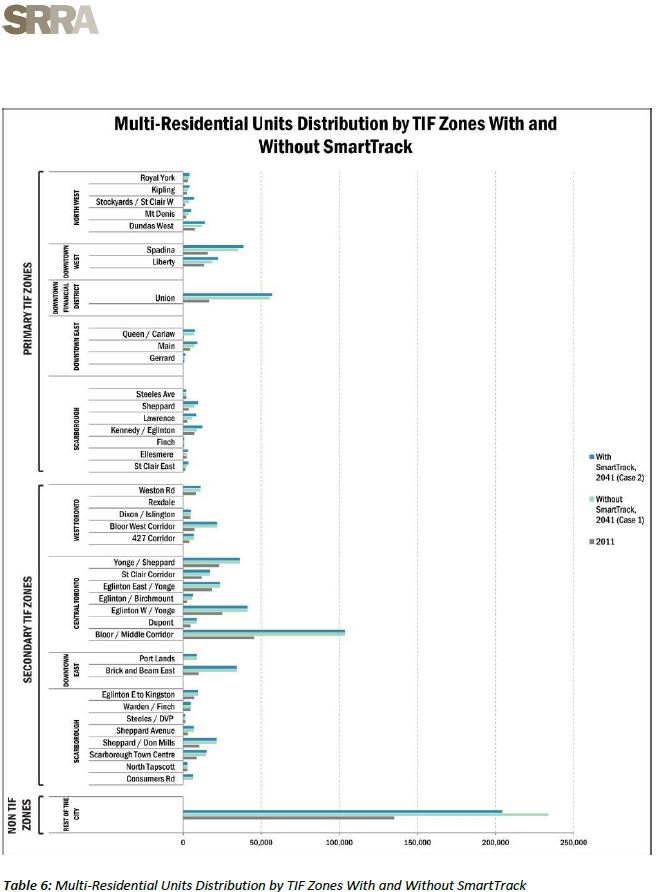
Very little development, compared to the rest of Toronto, is planned for STC according to Toronto Planning’s own numbers. How many times must the following chart be published to drive home this fact?  [Source: How Does the City Grow, June 2015]

More generally, growth is not happening in the so-called centres which between them have less than 10% of the proposed development. The myth that the former “downtowns” of the old cities will become major nodes in their own right is neatly torpedoed here.

ProposedTorontoDevelopment_201506

Everyone is entitled to their views and opinions.

In a classic “yes, but” statement, Duguid tries to undo his slur against those who criticize the SSE project, but goes on to talk of how Scarborough residents have been fighting for a subway for years.

I [Duguid] have been involved in this debate for 30 years. All we’re asking for is that the fastest growing city centre be attached to higher order transit.

Fighting for “higher order rapid transit” (a phrase he uses a few times without recognizing that it actually includes LRT), maybe, but not specifically for a subway. The problem for years has been that subways and the rattletrap SRT are the only points of comparison Scarborough riders have, and it’s a no-brainer to choose one over the other. The LRT option has always been undersold, and then under Rob Ford, denigrated as “streetcars” (said with a pejorative sneer) when in fact the SLRT could be entirely on its own right-of-way.

The price came in over the estimate, but that was done a number of years ago. The price it’s come in at is the price it’s come in at.

No. The estimate was updated in 2016 for Council’s decision to go with the “optimized” Scarborough plan of a 1-stop subway and the LRT from Kennedy Station to UTSC. Does Duguid now claim that Council made a multi-billion dollar decision on a flimsy, unreliable estimate?

When challenged about insulting critics as a tactic to advance the SSE project:

Not everyone who has opposed this is from downtown, but generally critics are people who are less than 10 minutes to a subway station from their homes.

I don’t have the home addresses of the many SSE critics at my disposal, and there is no secret that I live within sight of Broadview Station. The point here is not where I live, but where people in Scarborough live, and most of them will not be within 10 minutes of the one remaining station on the SSE. Indeed, the “optimized” Scarborough plan does well on access not because of the subway, but because the LRT line to UTSC brings so many more people close to a station.

Scarborough people have been paying for the subway system for years. It is important to the entire city. We have to think about more than our ridings.

Duguid is getting too rich for words here implying that he’s not pushing the subway just to get votes even though his own party did just that, going along with Rob Ford’s fictional ideas about transit planning rather than opposing him. Yes, Scarborough has paid taxes for years into the pot, as has every other part of Toronto, including Etobicoke which is not exactly subway-rich. The SSE tax as well as development charges for new transit generally fall overwhelmingly on buildings nowhere near Scarborough, and the subway will be built mainly by funds raised outside Scarborough borders. That may be a fair trade, but not if the pricetag keeps going up and up, and not if other transit projects are cancelled to pay for it.

Yes, Scarborough too must think about more than itself, and stop acting like a brat who only wants the most expensive toy in the shop window.

Scarborough has been paying for years, but the minute something is going to SCC, such a big deal is made out of it. It’s easy for folks with higher order transit to oppose it, but it’s important to the people of Scarborough.

It is a flat out lie to say that people elsewhere in Toronto oppose “something going to SCC”. The problem here is that Duguid wants only a subway and will accept nothing else. We all need and want more and better transit, but we can’t have it when every penny is vacuumed up for one project.

Ridership numbers have to be put in perspective. STC is the first station in the system, and if the line were full here, people wouldn’t be able to get on elsewhere. It will be the 7th busiest station. If we had only looked at [terminal] ridership, we wouldn’t have built any of the subway lines.

Both the Yonge and Bloor subways were built in corridors where surface transit was already carrying thousands more riders than the RT is today, and where there was a concentrated demand to carry people from their homes to jobs downtown and on other parts of the (mainly) streetcar network. The same is not true for Scarborough, especially for transit carrying people to jobs at STC.

The Yonge extension was built to carry the very heavy demand pouring into Eglinton Station on buses from the north. The Spadina line was partly to relieve this, and partly to serve Yorkdale Mall not to mention sanitizing the proposed Spadina Expressway corridor. The extension through York University to Vaughan is well documented as a political creation, not the result of planning that would have independently justifed a line that far north.

This transcends politics.

That claim brought a guffaw from host Matt Galloway. The whole project has always been about politics, about being a “subway champion” for Scarborough and telling people how hard you are fighting for what they have been convinced they need.

The fact is that I’ve been supporting this since before I got into public office, for nearly 30 years. Scarborough residents take it very seriously. The subway will fulfill our full potential, and I fight strongly for it.

Actually, Scarborough has very substantial travel demands that have nothing to do with the Town Centre, and the subway won’t help them one bit. Moreover, most people who work at STC don’t originate from areas served by the subway network (or particularly well by transit) and they drive out of preference or because they have no choice.

Duguid and company have painted themselves into a corner by backing an option that is increasingly beyond the level where mutual back-scratching at Council and a hope for peace in the family will bring approval for the project. They’re now stuck having convinced voters that there is only one option, and that if Scarborough doesn’t get it, this will be the rich, elitist, downtown Toronto blocking their manifest destiny.

One might ask the same of City Councillors and the Mayor who short change transit at every opportunity and may even cut service rather than raise taxes and fares to pay the bills in 2017.

Our government already would have contributed 2/3 of the original cost estimate. We are the major contributor, and are unwavering in support. We will give the city the space to determine what the plans might be for the other part of the project – the line to UTSC – but we’re not in a position to commit more money.

In other words, don’t come to Queen’s Park looking for a handout, and if you have to raid the piggybank for the billion you thought you had for the UTSC LRT, then that’s Toronto’s decision. Needless to say, Duguid does not represent the ridings that the LRT would serve.

The real issue here is why a provincial Minister gets away with making such inflammatory statements about a decision which, in theory, is Toronto’s to make. Queen’s Park will spend the same dollars on Scarborough regardless of what is built, but they gingerly avoid commenting on which plan they prefer.

We’re getting almost an announcement a day from the Wynne government about transit expansion, even for some LRT funding, but Queen’s Park has stayed out of the Scarborough debate until now. When the bill comes due for the extra cost of a one-stop subway, when the hoped-for line to UTSC vanishes from the map, will Duguid or Wynne be anywhere to be found?

Cherry Street Day One

The first day of revenue service was beautiful and warm, ideal for tourists and photographers, although service on the 514 Cherry was quite spotty at times with cars running bunched and off schedule.

For anyone trying to find a 514, there was the added challenge that the TTC export to NextBus has not been set up correctly, and the “main” route appears to be from Queen and Broadview to Dufferin Loop with a spur down Cherry Street. This fouls up predictions for stops on the “spur”, and the clever rider must know enough to look nearby on King to see when a car might show up. Then there is the small matter of the claim that the car goes to “Cherry Beach” which I mentioned in yesterday’s post.

An additional issue was the absence of a low floor car among the five scheduled vehicles, although 4421 was running as an extra all day. The problem appears to be that the TTC neglected to flag crews for this route as requiring Flexity training, and so the operators generally can only drive the older high-floor cars. With 4421 running as an extra, it does not appear on NextBus and anyone needing an accesible vehicle faces an indeterminate, long wait while the car makes its 80 minute round trip. This extra will also be crewed with operators on overtime, rather than as a piece of work integrated into the normal schedule.

Yes, we all know there are not yet enough Flexitys to flesh out all of the service, but like 509 Harbourfront, the 514 could be operated with a few cars sprinkled in (well spaced, please) between the CLRVs as a first step. The TTC made a big point of flagging this as a new accessible service, but have been back peddling saying “when we get more new cars”. That’s not what Chair Josh Colle said in the press release two days ago:

“The 514 Cherry Streetcar will reduce congestion and provide more frequent service along the central section of TTC’s busiest surface route, the 504 King. The new route will be served by the low-floor streetcars, which will provide a more comfortable experience for our customers, and add a new east-west accessible route.” – TTC Chair Josh Colle

4421 was the first car out of Dufferin Loop providing an early trip at about 7:30 am, while 4044 was the first car from Distillery Loop at 7:45.

Another aspect of the route that is not working is the “transit priority” part of the signal system. Yes, there are transit signals, but they cycle through whether a streetcar is anywhere in sight or not. This is particularly annoying at King & Sumach which is a multi-phase signal that now includes eastbound and northbound “white bar” call ons for streetcars. These operate whether they are needed or not, and steal green time that could be used for King Street itself where the 504 cars spend considerable time awaiting their signals.

Although the TTC took several stops served by the 514 (and 504) out of service on June 19, they did little to flag this situation at the stops. Old pole cards, some falling off or visible only from one direction of approach, were all that told people the stops were not in service. The usual TTC signs for out of service stops, so commonly seen for construction projects and diversions, were nowhere to be found, and many riders were waiting at the stops (which were served by considerate operators). Some of the streetcars continue to announce these stops, and they remain in the stop list on NextBus and on the TTC’s schedule pages.

Finally, the shelters installed on Cherry Street are of a smaller type that was supposed to have been discontinued as they provide no “shelter” at all. An example is in the photo at Front Street below beside the former Canary Restaurant.

A lot of this may seem like small change, but collectively there is a lack of attention to detail especially on a new route’s launch where current, accurate info should be the easiest to provide. These are the details that annoy riders because the system and its “customer service” cannot be relied on.

The line is quite photogenic, and the real shame is that there is so little of it. When or if the planned Waterfront East streetcar and the link of Cherry under the rail corridor and into the Port Lands will happen is anyone’s guess.

Finally, there has been some discussion on Twitter about the absence of a stop northbound on Sumach at King. The reason for this is evident when one looks at a Flexity sitting where the stop should be: the sidewalk lip is some distance from the car and does not provide the sort of platform one would expect. This creates a safety hazard were this used as a stop, and probably interferes with operation of the wheelchair ramp. In the absence of a stop (and without a sympathetic operator), north to eastbound transfers (514 to 504) must be made at the next stop west on King at Sackville. This is not the most intuitive arrangement for riders, and the configuration of the sidewalk at Sumach should be corrected as soon as possible.

Kvetching About 512 St. Clair

The opponents of the 512 St. Clair streetcar right-of-way don’t miss any opportunity to slag the line. The TTC doesn’t help when it does not fully explain what is going on with this summer’s construction projects, and paints the work primarily as “accessibility” and “new streetcar” related.

A common complaint in Toronto is that nobody co-ordinates construction projects. Well, for those who bother to pay attention to the announcements of such things, co-ordination on a large scale is happening, and St. Clair is part of it. Many projects fit together like a jigsaw puzzle this summer.

  • St. Clair Station bus and streetcar loops require structural repairs that will take from now until late in the year. This has nothing to do with accessibility (the station already is accessible), nor with overhead changes for new streetcars (new pantograph-friendly overhead has been in place since 2011).
  • The ramps leading into St. Clair West Station Loop were not rebuilt during the line’s shutdown a few years ago (this is the only part that was, for some reason, omitted). They are the original installation from the Spadina subway opening and require reconstruction.
  • St. Clair West Station is not accessible, and work on this will begin this summer. However, that has nothing to do with the shutdown for all bus and streetcar routes serving the loop.
  • The overhead within St. Clair West Station must be converted for pantograph operation, but this is work that would typically be done overnight, or at most over a weekend.
  • Presto conversion of St. Clair West Station can be conveniently done while the station is closed, but did not strictly require it.
  • Reconstruction of small sections of the islands on St. Clair is required for proper operation of the low floor cars’ boarding ramps, but these island also require electrical fit-outs for Presto. This work is similar to that was done on Spadina.
  • Track construction at College & Bathurst prevents streetcar operation including access to St. Clair (although if this were the only issue, it would be handled by storing cars at Hillcrest or on the line as has been done in the past). The controlling factor is the ramp construction at St. Clair West. The Bathurst trackage will re-open in mid-July.
  • Work on College Street West by Toronto Water and as part of local street improvements for the BIA requires partial street closures. This has been co-ordinated with TTC trackwork at Bathurst and at Lansdowne.

In all of this, if one wants to knock the TTC, one might ask “why were the islands not done sooner” and “why were the ramps at St. Clair West left so long”. As for the islands, that’s partly a head-scratcher for accessibility, but Presto is a net new requirement. I suspect that the work could be done in under two months, but co-ordination with the other projects makes for one shutdown, not two. The ramps are another matter, and I have never heard an explanation of why this work was not done during the previous shutdown.

As for the replacement bus service running in mixed traffic, yes, that is going to be annoying. TTC does not want to use the streetcar right-of-way understandably because of narrow clearances with the overhead poles and the meandering path the lanes take. Those poles (notably absent on Spadina) were put in despite many questions to the TTC (including from emergency services) about the need for this design. What was really happening was that there was a boffin in the consulting firm working on the new streetscape who wanted the street lighting poles (which traditionally held up the TTC’s overhead) to be spaced further apart than TTC requirements. In the fullness of time, this wasn’t how the street was built (because the illumination level would not have been adequate), but meanwhile the TTC insisted on its own centre median poles except where buses share the right-of-way west of Bathurst.

It wasn’t a technical requirement, it was the combined stupidity of the street designer and the TTC’s sticking with a design that they no longer required. The result we have is a streetcar right-of-way that cannot host temporary bus service.

There is a lot to complain about with the TTC, and I am often criticized for writing more about the negatives than the positives. However, this is a case where a great deal of work has been collected into one set of shutdowns, and that is precisely the sort of thing the TTC and City should be doing.

Toronto Faces Hard Transit Choices in 2017 Budget

On June 22, 2016, Toronto’s Budget Committee will consider the City Manager’s opening salvo in the 2017 Budget Process. This report signals a dark time for transit funding on both the Operating and Capital fronts.

Operating Budget

On the Operating side, the starting point for the budget is an assumed “inflationary” increase in the residential tax rate of 2% in line with Mayor Tory’s stated policy. This will yield $52 million in new revenue, small change beside an overall $11 billion budget. Property taxes account for about 1/3 of the City’s total revenue, and so a 2% increase in the tax represents only a .67% increase against the overall budget with the balance to come from other sources. Also, because of the ongoing rebalancing of commercial and residential rates, the commercial tax goes up by only .67% (one third of the residential rate). This pattern will continue until about 2020.

Other revenue growth comes from increased assessment (mainly new buildings) and the Land Transfer Tax.

The largest single jump in expenses lies with the TTC’s budget, $178 million. This combines the effects of service improvements (some of which carry over from 2016, but now for a full 12 months), increases in base costs for materials and labour, and the implementation of new services or functions that bring unavoidable new costs. These include the transition to Presto and the ramping up of operating expenses for the Spadina subway extension due to open late in 2017, but with pre-opening costs that will accrue earlier.

Costs broken out in the report include:

  • $136 million for base TTC costs (existing operations and provisions for growth)
  • $42 million for Presto, annualization of changes made in 2016, and effect of new assets coming into use (the TYSSE)

Presto was supposed to be cost-neutral, but during the transitional period, the TTC will bear many costs of the old fare collection system as well as all of the cost of the new one. It remains to be seen whether this will ever balance out considering the TTC’s plan to redeploy Station Collectors for Customer Service purposes within stations. TTC staff have not produced a detailed report showing the costs and savings of old versus new systems, identified whether available savings are being achieved, or when they might occur.

An additional pressure on the TTC is the projected shortfall in 2016 fare revenue of $25 million. This could be offset by deferral of service improvements intended to handle growth, but also intended to reduce crowding and make the system more attractive. A detailed report on ridership is expected at the TTC’s July 11 Board meeting. The City Manager provides for $12 million as the cost of lower 2017 revenue compared with 2016, and this is additional to the $178 million above.

The City Manager recommends that Council select one of three options:

a) Across the Board budget reduction target of -2.6% net below the 2016 Approved Net Operating Budget for all City Programs and Agencies; or
b) A budget reduction target of -5.1% net below the 2016 Approved Net Operating Budget for all City Programs and Agencies and a 0% net increase budget target for Toronto Transit Commission, Toronto Police Service and Toronto Community Housing that maintains 2017 funding equal to their 2016 Approved Net Budget; or
c) A budget reduction target of -3.8% net below the 2016 Approved Net Operating Budget for City Programs and Agencies; a budget reduction target of -4.1% for the Toronto Transit Commission to absorb incremental debt servicing for its capital costs and a budget reduction of a 0% increase for the Toronto Police Service and Toronto Community Housing that maintains 2017 funding equal to their respective 2016 Approved Net Budget.  [p. 3]

In the TTC’s case, it is important to remember that the “Net Operating Budget” is much smaller than the total budget because of City subsidies. For 2016, the subsidy was made up of:

  • $493.6 million from the City (which in turn includes $90 million of Provincial gas tax)
  • $1.0 million from the City’s TTC Stabilization Reserve

If the subsidy is flat-lined for 2017, this would set it at $493.6 million plus whatever other reserves might be available. A 2.6% reduction translates to $12.83 million, and a 4.1% cut would be $20.24 million. This would be on top of the TTC’s need to find $178 million for 2017 operations, and the $12 million provision for lost fare revenue.

Note that this is only the subsidy for the “conventional” transit service. Wheel-Trans faces its own pressures from building demand and new mandated eligibility criteria, and there is no indication of how the City, which funds almost the entire WT operation, plans to pay for this.

Of the proposals, the third is most troubling because it requires a shift of capital debt costs from the City to the TTC Operating Budget. For 2017, this would take $25 million out of money available for service or require an offsetting fare increase. It is ironic that one tenet of the City Manager’s budget direction is:

The “offloading” of expenses to other City Programs and Agencies will not be accepted. [p. 13]

Clearly the transfer of capital costs now borne by the City generally to riders does not count as “offloading” in his mind.

The preliminary City budget includes $12 million for additional TTC fare revenue which, in an era of low or no ridership growth, would translate to a comparable increase in existing fares. The probable TTC fare revenue for 2016 is $1.15 billion [TTC CEO’s Report May 2016, p. 47]. A $12 million bump implies a 1% fare increase, or only a few cents per ride. If there is to be any fare increase, this is an impractical amount. Based on projected ridership of 544 million, the average fare for the year will be $2.11. At the very least, the increase would be 5¢ on the adult fare (corresponding less on discount fares) yielding at least 2.5% more revenue, not 1%. This is still small change compared to the shortfall.

The effect of an ongoing low tax policy is that actual spending per capita, adjusted for inflation, would fall by 8.6% over the coming five years. Many accounting tricks that have papered over the holes in past budgets are no longer available.

It will be difficult to find the necessary savings to keep spending in line with revenue growth without relying on one-time revenue sources or other unsustainable measures such as the deferral of necessary expenses. While the City has faced budget challenges in the past, mitigating measures which helped balance the budget previously are either not expected to reoccur (e.g. large MLTT revenue growth, social assistance savings) or are no longer feasible (e.g. deferring TCHC pressures, deferring capital projects). As a result, the level of expenditure restraint anticipated for 2017 will require all City Programs, Agencies and Accountability Offices to bring forward 2017 Budgets that reflect innovative and transformative service delivery and service adjustments in order to meet the fiscal, service and tax expectations of Council.  [pp. 10-11]

New “revenue tools” are in the news again, although just how aggressive Council will actually be to pursue them is quite another matter. The last time this came up, Council rejected every single new revenue source available to them. The closer we get to the 2018 election cycle, the more averse Council becomes to anything that smells like a “tax grab”. Such is the legacy of the Ford era where City revenue is only considered as a wasted tax, as gravy, not as enabling much needed and valued services.

The City Manager notes:

It should be noted that revenue tools currently under study may not be available for the 2017 Budget process and should not be considered as providing any significant relief for 2017. Should any become available for use, they must be considered as a bridging strategy to sustainable operating budgets only. New revenue sources must be considered for the sizable unfunded capital needs that have been identified as critical to maintaining reliable City service delivery and meeting city building and other strategic objectives.  [p. 14]

A change in the budget process for 2017 will place the decision (or at least a preliminary one) on the size of a TTC subsidy (and possibly other TTC policies) before Council much earlier than in past years.

In prior years, the City Manager and Deputy City Manager & Chief Financial Officer have set the operating budget target as the key guideline for budget preparation for all City Programs and Agencies in advance of budget preparation. These targets have been met with varying degrees of compliance and impact. Beginning with the 2017 Budget process, City Council must approve operating budget targets for all City Programs, Agencies and Accountability Officers.  [p. 11]

In effect, the Budget Committee and Council will decide how much the TTC will get before the TTC Board and its Budget Committee even meet to consider the issue.

For many years, transit policy debates have been hamstrung by a lack of information about policy alternatives. What would it cost to add service? What would be the effect of a change in fare structure? Where is the outlook for TTC riding, service and role as par of the GTHA’s transportation network? The next Board meeting is scheduled for July 11, and the TTC’s Budget Committee has cancelled all three of its planned meetings to date in the TTC calendar. So much for an active, public discussion of transit options.

Is the Board afraid to address these issues, possibly exposing a rift between what transit might be and the Mayor’s lacklustre support for improvements, or are they simply too lazy to do their job?

A significant requirement in the City’s budget process is the provision of a five-year fiscal projection. The TTC has resisted providing such information for years, and to the degree it even complied with the request, the numbers were the most basic pro-forma calculations simply scaling up existing costs and revenues with no provision for new programs or policy changes. Of particular importance is the matter of the net operating cost of the Spadina subway extension for which the TTC has yet to produce a number as part of its future budgets.

Capital Budget

The bad news doesn’t take long to appear:

Given the limited funding for City services, there is no additional financial capacity to fund any new capital works in 2017. As a result, City Programs, Agencies and Accountability Officers must submit 2017 – 2026 Capital Budget and Plans on a status quo basis. This requires capital plan requests to adhere to the 2017 – 2025 Capital Plan’s annual debt funding approved by Council as part of the 2016 Budget process, and projects be added in the new tenth year, 2026, that can be accommodated within current debt targets as provided by the Deputy City Manager & Chief Financial Officer.  [p. 2]

As mentioned above, the City is not even prepared to take on additional costs of TTC-related debt, and want to push this onto the Operating Budget where it will compete with service improvements and any fare discount policies that might be proposed.

New revenues may appear, notably from Ottawa, to assist with transit financing, but there are two major issues:

  • The first tranche of federal money, the already-announced $840 million, is for “state of good repair” works needed to keep the lights on, not to build new lines or enhance services.
  • The federal money does not represent 100% financing of anything, and if the City adds a new project to the list using federal funds, it must find matching funds of its own from a pool that is already empty.

The City Manager concludes:

The path forward requires both expenditure and revenue strategies; City Council needs to recognize the true costs of delivering its services so that services may be adequately funded. It is equally important to establish realistic financial and performance targets aimed at areas of growth versus those for reduction. The City cannot achieve fiscal sustainability through expenditure reductions alone. The City requires revenues that increase annually to help fund City services and hence it is not sustainable or realistic to constrain total revenue increases. [p. 15]

Budget Schedule

Operating base budgets are to be submitted to the City Manager by June 20 (two days from when I write this). A further submission including suggested expense reductions and any requests for new spending is required by August 2, 2016 [see Appendix 1, p. 22].

To date in 2016, the TTC Board has not had any discussions about budget or overall priorities for where the TTC is going as an agency. Budget subcommittee meetings, including one planned for June 16, have been cancelled, and a full Board meeting to discuss policy directions on April 7 was also cancelled. There are no public documents indicating what the TTC’s priorities might be, or even discussing options for future services, fare structures and priorities for the use of new capital subsidies. That issue was supposed to have been on the June 16 agenda according to CEO Andy Byford at a recent provincial funding announcement, but the info has yet to surface.

The Board will meet once, on July 11, before the August 2 deadline, and it is simply not possible to absorb the implications of the options or discuss policies in a single meeting. Even those of us who know TTC budgets in detail need time to absorb all of the information, and I count few of the Board members in that number.

In the midst of a debacle over the rising cost of the Scarborough Subway (whatever one’s position might be on that project), the absence of a wider context of the TTC’s future as a transit service, and of other calls for scarce subsidy dollars, is a dereliction of the Board’s duty.

514 Cherry Opening Ceremonies

The 514 Cherry streetcar had its official opening on June 18, 2016, although regular service will begin on June 19 at 7:45 am. The route will operate between the new Distillery Loop near Cherry and Mill Streets in the Distillery District and Dufferin Loop at the western entrance of the Canadian National Exhibition grounds.

20160619Map514Changes

This is only the beginning of what should be a much larger network in the eastern waterfront, but work on that stalled thanks to the previous administration at City Hall. The impetus to restart on a serious basis will be funding of the Don River realignment and the active development of the land south of the railway corridor. Some idea of the potential network is shown in the following illustration from the Gardiner Expressway realignment study.

Cherry Street will be realigned south of the railway and will cross the Keating Channel on a new bridge including provision for streetcar track. New track along a realigned Queens Quay East will meet up at Cherry and provide the link to Union Station. Also shown (dotted) below is the proposed southerly extension of Broadview Avenue including streetcar track from Queen to Commissioners Street (out of frame below this illustration). Track on Commissioners would link east from New Cherry Street at least to Broadview and thence to Leslie Street and the southwest corner of Leslie Barns.

GardinerFig7HybridAlternative

For the occasion, five streetcars were on hand:

  • Flexity 4421, the newest of the cars in service
  • ALRV 4225
  • CLRV 4140
  • PCC 4500
  • Peter Witt 2766

4421 laden with many passengers and a few politicians set off from Distillery Loop after the usual speechifying such occasions bring, and made a round trip to Dufferin Loop. On its return, the original four cars were still waiting, but in due course the whole parade set off back to the carhouse.

An amusing note from our journey was that the car stopped at (and even announced) most of the stops along King Street that are scheduled to be taken out of service on June 19. This will be the only time that a 514 Cherry car served those stops. No, we did not have a photo op at each one to mark its passage.

Already there is word that operators are displeased with the absence of a loo at Distillery Loop. It’s a shame the Canary Restaurant isn’t still in business at Front Street where streetcars stop right at the door. I suspect this would have been a favourite layover point.

The TTC appears to be slightly confused about the location of the eastern terminus of 514 Cherry. According to the schedule website, this would be Cherry Beach Loop which is somewhat further south across both the Keating Channel and the Ship Channel, a lot sandier, and notably without any track. Not even any Swan Boats.

20160619_514_CherryBeachLoop


The Scarborough Subway Fiasco

For the benefit of out-of-town readers who may not follow the moment-to-moment upheavals in Toronto politics, the lastest news about the Scarborough Subway is that it will cost $900 million more than originally forecast, and the Eglinton East LRT line has gone up by $600 million.

Updated 10:45pm June 17: The increase in the Eglinton LRT line’s cost may only be $100m, not $600m. Awaiting further details to confirm this.

No details of the components of these increases have been published yet, but here are the current (as of 6:45 pm on June 17) media reports:

  • The Star: Mayor John Tory accused of ‘political posturing’ as Scarborough transit plans balloon by $1 billion
  • The Globe & Mail: Scarborough subway cost rises by $900-million
  • Torontoist: The Bad Decision on the Scarborough Subway Extension Gets Worse

Earlier this year, the much-touted “optimized” plan for Scarborough changed the subway scheme from a Kennedy to Sheppard line stopping enroute at Lawrence and Scarborough Town Centre (STC), to a one stop extension whose terminus and only station was to be at STC. Money saved by shortening the subway would be directed to the Eglinton East LRT project linking Kennedy Station to University of Toronto Scarborough Campus. [See Scarborough Transit Planning Update]

At this point, the total project cost remained within the original 3-stop subway project’s estimate of $3.56 billion (as spent dollars including inflation) of which the City of Toronto’s share would be $910 million financed primarily by a 1.6% Scarborough Subway property tax over 30 years. The remainder would come from Queen’s Park and Ottawa, but their contributions are fixed and any overruns are on the City’s dime.

Material from this report reappeared in a March update on the overall transit network [see Developing Toronto’s Transit Network Plan: Phase 1] and in the May-June presentations to various public consultation meetings. At no time was the possibility of a cost overrun for the Scarborough network mentioned.

Meanwhile, ridership estimates for Scarborough were revised downward quite drastically with a projected AM peak hour demand of 7,300 inbound from STC station. About half of this would be existing SRT riders and the rest would be net new to the transit system. The May presentation makes a point of defending the lower numbers, but here is what City Planning staff said only a few months earlier in their March report:

Preliminary ridership forecasts … indicate:

  • The options are capable of capturing significant ridership. Daily users range from 115,000 to 147,000 in 2031. Morning peak hour, peak point, peak direction ridership ranges from 13,700 to 17,700.
  • Assuming the McCowan 3 option, the introduction of SmartTrack would reduce ridership on the subway extension to about 109,800 daily users and 12,600 peak hour, peak point, peak direction riders assuming 15-minute SmartTrack service in 2031. Assuming 5-minute SmartTrack service daily users would be about 88,200 and peak hour, peak direction, peak point ridership would be about 9,800 riders. In either case, the peak point ridership would be comparable or higher than that observed today near the terminal points of existing subway lines, with the exception of the Yonge line in the vicinity of Finch station. [p. 32]

During his election campaign, John Tory trumpeted SmartTrack as the one line that would solve every problem claiming very high peak and all day ridership based on service probably three times better than we will ever see. SmartTrack is now proposed with trains every 15 minutes, not every 5, and this has a huge effect on ridership both on ST and on neighbouring lines as the numbers above show.

Planners have been twisting themselves into pretzels trying to justify building a subway with the lower projected demand saying it wouldn’t really work at the higher level because there would be no capacity further downstream for existing riders (similar to the problem we now see south from Finch Station). That’s all very well, but the same planners sold Council with the subway concept by touting the much higher estimates that “justified” subway construction as ridership would be at the edge of what an LRT line could handle.

These two arguments cannot both be right, and it is quite clear that planning numbers either were gerrymandered or that they were simply the product of unreliable analysis. Either way, all future projections are suspect especially if they change conveniently to suit the political needs of the day.

Throughout all of this, there has been no change, until today, in the cost estimates, the other vital factor in deciding between transit options. To put this in context, other studies have turned on amounts in the low hundreds of millions to justify choice of a “cheaper” option, while other projects languish because they are “not affordable”. $1.5 billion is no small change.

Technical issues have now come to light that render the original cost estimates meaningless. According to the Globe:

An analysis in Scarborough showed that the topography would require deeper tunnels in some places. The stations themselves would have to be 45 to 90 per cent deeper than thought, raising their construction costs immensely. And the high water table of the area would require more concrete than expected.

This is not something that was discovered last week. Mayor Tory attempted to pirouette around the cost problems with the idea that somehow the “private sector and others” could find a better way to do things. However, the TTC’s CEO Andy Byford, in a restrained comment, demured. From the Star:

TTC CEO Andy Byford said a third-party already helped with the engineering estimates to look at creative solutions for tunnelling or station design.

“I welcome the suggestion of having a third party at least review our costs because we want to make sure that we’re being as efficient as possible,” Byford said, adding: “I want to deliver the Scarborough subway for the best possible price.”

But asked if it’s realistic to expect hundreds of millions of dollars could be shaved off the costs, Byford said: “I think that would be a challenge.”

Indeed, Byford is now in a difficult position because his political neutrality on the subway vs LRT question cannot survive. Any new money to build the more-expensive plan will have to come at the expense of something else. Already, the TTC Budget Committee meeting where a preliminary “wish list” of funding requests to Ottawa was to appear (Byford said as much during the announcement at Greenwood Yard of DRL funding) was cancelled, and we have no idea just what projects TTC management, let alone the Board, feel should vie for funds. At some point, Byford may have his “Gary Webster moment” at City Council where he should openly state a professional opinion. (The reference is to Byford’s predecessor who was sacked by Rob Ford for having the temerity to oppose the subway plan.)

Nothing has been published beyond the Mayor’s comments to the media, and if there was a prepared statement, it still is not available on his website.

The tunnelling issue noted above is one part of the cost, but there are likely to be others as I have already discussed on this site. The key point is that the TTC has many interlocking projects that must proceed before the Scarborough Subway can open.

There are five projects in the future on BD which have serious interdependencies:

  • T1 replacement
  • ATC
  • Scarborough extension
  • New storage facility
  • One-person train operation

Some are below the line and some are above the line. However, the dates and order of projects don’t align, so to minimize changes and maximize efficiencies the correct order should be:

  • New storage facility (ready for permanent 6 car consists)
  • New trains (ready for ATC)
  • ATC or OPTO (with ATC and OPTO ready trains)
  • ATC or OPTO
  • Scarborough extension

[Email from Mike Palmer (Deputy Chief Operating Officer, responsible for subway operations)]

The new storage facility will likely be near Kipling Station. It will be designed around the physical requirements of the new 6-car trainsets, and it will provide concurrent storage for the new and old fleets.

ATC (Automatic Train Control) is a prerequisite for the Scarborough extension which would be built using that technology. Conversion of the existing line to ATC would, strictly speaking, not be required before the SSE opens, but no T1 trains (the existing fleet) could operate on the extension without an expensive and short-lived retrofit. Hence the need for a new fleet sooner than might otherwise have occured.

OPTO is one person train operation. This cannot go into effect until the trains all have suitable cab equipment to allow an operator at the front of a train to monitor the entire train without assistance from a guard at the rear end.

That’s quite a shopping list as a pre-requisite to the SSE, and the TTC has yet to incorporate these projects fully in its capital budget “above the line” (ie: as funded projects). It is not clear whether the TTC Board or members of Council are aware in detail of these issues either, or how much they might contribute to the added cost for the extension.

As an historical note, in the days before the TTC contemplated a move to ATC, fleet planning was based on the premise that all cars for both lines were interchangeable. The result has been that because the YUS is now fully operated with TR trains and Sheppard is being converted, there is a surplus of the older T1 equipment whose only remaining use is on the BD line. With conventional signalling, the SSE could have opened using this equipment, but that’s not how it will be built, and the fleet plans are in disarray as a result.

Why the LRT line has grown in cost is a mystery. It is unclear whether this arises from design changes or estimating errors, although the scope for such error is much less with a surface route. Either way, the magnitude of the change is substantial, and as with the subway, threatens the credibility of a plan that was sold to Council only months ago. By extension, any other plan the City might put forward is also suspect.

Through all of the consultation, we have heard very little about SmartTrack beyond the probable location of its stations and the likely service level. What we do not know is how much it will cost to build the surviving chunk of the route from Mount Dennis to Unionville. Indeed, there is reason to question going beyond the Toronto border considering that the GO/RER plan will itself bring frequent service to the same area. What we do know about ST is that it will poach riders from parallel routes, and that service expansion beyond a basic 15-minute level involves expensive reconstruction of the rail corridor to provide more capacity. Contary to what Tory’s “experts” told us, the track is not just sitting there for the taking by his signature service.

Of the original $8-billion, some has been saved by discarding the Eglinton West segment, now proposed to be part of the Crosstown project, but we really do not know how much Toronto will have to pony up to implement the ST service.

If nothing else, this whole fiasco should be an object lesson to professional staff who tailor their plans and professional advice too closely to a political agenda. When that agenda is ill-advised, but pushed forward through sheer pig-headedness, the quality of planning cannot help but be tainted along with the credibility of the planner. This is a dangerous game.

Toronto, somehow, survived the Rob Ford era and there was some hope that a credible transit plan might be cobbled together under the new Tory regime. However, Mayor Tory has proved as intransigent about acknowledging he is wrong, that circumstances do not support his plan, as his predecessor. If Toronto had time and money to spare, we might say “this too shall pass”, but we have neither.

Propping up the egos of various politicians, including the notorious Scarborough crew at Council and Queen’s Park, is getting expensive. This is complicated by the fervour with which they exhort subway supporters to demand what Scarborough “deserves”. That too is a dangerous game as there are crazies out there with less than healthy wishes for those who advocate something other than a subway. It’s Trumpism on a local scale – giving license to treat subway critics as people who don’t matter.

During his election campaign, John Tory dismissed SmartTrack critics as naysayers who simply wanted to oppose things for the sake of it. That was bullshit then, and it is today with his comments about those who question his continued support for the subway plan.

On a personal note, I have been fighting for better rapid transit in Toronto suburbs, yes, with an LRT network, something all of the planners once supported, for over forty years. A lot got in the way including provincial interference in technology choice, and economic or political downturns that snuffed out hopes for good transit funding. A lot of Scarborough was farmland when this process started. They are still waiting.

King Street Service Update: June 2016

The City of Toronto is about to launch its review of how King Street “works”, and Chief Planner Jennifer Keesmaat has an op-ed in the Star, It’s time to reimagine Toronto’s streetcar ‘King’.

Both for personal interest and as part of my work for the TTC and City of Toronto on the behaviour of streetcar routes, I have been following the 504 King route for some time using TTC vehicle tracking data. This article updates the consolidated stats in anticipation of the King Street project with data to May 2016, and looks in detail at some of the current information from that month including vehicle speed profiles.

For information about the creation of these charts, please see Methodology for Analysis of TTC’s Vehicle Tracking Data.

Continue reading

Analysis of Services on Wilson Avenue (Part I)

Wilson Avenue is served by many bus routes and branches, and this arrangement has been through two major reorganizations since fall 2015. In these articles, I will review the changes and the quality of service provided at various locations along the route.

Until March 27, 2016, service on Wilson Avenue was provided by 96 Wilson and 165 Weston Road North with most trips originating at York Mills Station.

In October and November 2015, both routes became part of the 10-minute network, and their schedules were reorganized accordingly. Blended service is provided in off-peak periods on the common section of the routes on Wilson Avenue between Weston Road and Yonge Street.

In March, this was changed to split off routes 118 Thistle Down, 119 Torbarrie and 186 Wilson Rocket as separate entities but on the same routes as the original branches of 96.

  Before                                      After

  96A Wilson YMS to Carrier Drive             Unchanged
  96B Wilson YMS to Claireville               Unchanged
  96C Wilson YMS/WS to Thistle Down           118 Thistle Down from WS
  96E Wilson WS to Humber College Express     186 Wilson Rocket from YMS
  96G Wilson YMS to Sheppard & Torbarrie      119 Torbarrie from WS
  165A Weston Road N YMS to Steeles & Weston  Unchanged

  YMS: York Mills Station
  WS:  Wilson Station
  • The 186 Wilson Rocket operates weekday peak and midday periods from York Mills Station whereas its predecessor 96E was peak only from Wilson Station.
  • All Thistle Down trips are now to/from Wilson Station only.
  • Service to Torbarrie remains peak only and its eastern terminus is now Wilson Station, not York Mills Station.
  • Additional 165 services operate into York Region with various destinations including seasonal service to Canada’s Wonderland.
  • The 96A and 96B services are identical over most of the route branching primarily at their outer ends just beyond Humber College, terminal for the 96E/186. The 96C/118 service branches off at Albion Road, and the 96G/119 west of Jane Street.

An obvious question here is whether all of this shuffling made any difference in the service beyond giving the various sub-routes their own numbers.

For those who want the short version, the service is a bit better, but still not very good, and it certainly does not meet the TTC’s goal of providing reliable service at terminals, let alone along the way. Wilson provides a good example of inferior service for riders notably when there is an attempt to blend multiple routes and branches. There is no individual location or time to point at, but rather an overall lack of rigour in provision of service throughout all of the routes at all times and days of the week.

There is no sign through any of the data here of an attempt to manage headways (or equivalently, to keep buses “on time”). In some periods and locations, many overlapping services could usually guarantee a bus to somewhere a rider is going. Inbound on Wilson, any bus will take you at least to Wilson Station, and most will go beyond to York Mills. However, for individual branches, simply letting the service operate as it might produces a much less satisfactory result with unreliable service, wide gaps and bunching.

These are services that would benefit from explicit “time point” dispatching with vehicles expected to leave points enroute, notably those where services merge as well as points where an enroute layover to achieve an even headway could easily be handled. A range of +1 to -5 minutes relative to the schedule on this route gives far too much latitude.

In Part II of this article I will examine running times in comparison with schedules for these services if only to deal with the usual “if only we had more running time” argument that has become the standard response to unreliable service.

The schedule summaries for these routes and periods are at the end of this article for reference.

Continue reading