Reviving the Scarborough LRT Proposal (Updated)

Updated July 5, 2016 at 8:00 am: Revised drawings for Kennedy Station have been added showing better detail of the the LRT lines and a temporary bus terminal. Minor textual changes have been made in the article including an observation that the scope of replacement costs for removing the existing SRT structures will vary depending on the timing of shutdown and the degree to which existing structures are adapted/recycled.

Updated at 8:45 am: The potential sources of cost overstatement for the updated LRT option have been summarized.

With the recently announced increase in the projected cost of the Scarborough Subway Extension, the question of reverting to the original LRT plan for Scarborough has surfaced again. It is no secret that I favour this plan, but the political environment has been so poisoned that discussion of the options is, mildly speaking, difficult. When the Mayor feels that he must imply racism in critics who are simply trying to advocate for their view of a better transit system, Toronto politics are at a new low. However, the implications of the LRT plan must be addressed on their merits, not on simplistic political comments unworthy of the Mayor’s office.

On June 29, the TTC issued a briefing note regarding the cost of the LRT option in the context of current events. The question here is whether the claims and assumptions behind this note are legitimate and represent what could be achieved with a “best effort”, as opposed to presenting a less attractive picture to give the impression that the LRT represents an unacceptable downside.

Continue reading

Property Taxes and Subway Financing

The financing of a new rapid transit project in Toronto is a complex business, and probably the most complex part of the whole thing is the effect this has on property taxes.

This article is intended as an introduction to how these taxes actually work. It is not an exhaustive review, and there are subtleties beyond my scope here.

This is an article for people who like the gory details, and so I will insert the break right here.

Continue reading

Smart Track Fantasy: Tax Increment Financing

Back when SmartTrack was first announced as the centrepiece of John Tory’s mayoral campaign, the most obvious question was “how will you pay for this”. At the time, “this” consisted of very frequent service running over existing GO transit trackage plus a heavy rail extension to the Airport Corporate Centre, and it had a nominal price tag of $8 billion. On the presumption that each level of government, so overwhelmed by the obvious necessity of SmartTrack, would pony up 1/3 of the cost, the campaign then turned to the issue of how the City of Toronto’s share, $2.6b, might be financed.

Enter the tax wizards of Tax Increment Financing (TIF), a financial scheme not unrelated to pulling rabbits out of hats or making the attractive assistant float in mid-air with no visible means of support.

The premise of TIF is simple: If there is a piece of land that, but for public investment, would sit empty for all eternity, then any taxes that might arise from induced development there are “found money”. In other words, if we take a swamp, drain it, clean up the pollution, build roads and utilities and install a transit corridor, all with public money, then the development that follows can be used to finance the investment through its future property taxes.

It’s rather like investing in a pair of glass slippers and then charging Cinderella for wearing them. She’s going to marry into money, and her family can afford to pay you back.

Continue reading

The High Cost of Presto Taps

One great irony of annual reports is that they are usually glossy packages meant to say “look how good we are”, but they are like coffee table books where more people look at the pictures, and few read the fine print.

Buried in the Metrolinx Annual Report for 2015-16 are the details of the revenues, costs and subsidies applicable to parts of Metrolinx’ operations. There are specific figures for the UPX and Presto divisions, but not for GO Transit or the administrative/planning side of Metrolinx.

In a previous article, I reviewed the subsidies paid for UPX, and now I will turn to the Presto fare card.

Figuring out just how well Presto is used takes a bit of work because the information appears irregularly in reports to the Metrolinx Board. Here are the relevant excerpts.

June 2016:

PRESTO card taps per month:
February 2016: 16.2 million
March 2016: 17.5 million
April 2016: 17.5 million
**Taps refers to the total number of boardings by month for balance transactions, Period Pass transactions, and Transfers.

February 2016:

PRESTO card taps per month:
November 2015: 17.3 million, up from 15.6 million in November 2014
December 2015: 14.7 million, up from 13.6 million in December 2014
* Decrease in monthly taps for December may be attributed to holilday season

December 2015:

PRESTO card taps per month:
August 2015: 14.0 million
September 2015: 16.6 million
October 2015: 17.4 million

September 2015:

No usage stats reported.

June 2015:

As of June 1, 2015:
More than 417 million taps and $1.3 billion in fare payments to date including period pass taps.

March 2015:

More than 287 million taps* and $1.1 billion in fare payments to date.
*Excludes period pass taps

December 2014:

More than 266 million taps* and $1,032 million in fare payments to date.
*Excludes period pass taps

In the delta from March to June 2015, the tap count changes by 140 million, but the caveat about exclusion of period pass taps disappears. This gives some indication of the proportion of taps that serve pass holders as opposed to single fares.

It is clear that the monthly tap count sits somewhere in the 17.5 million range.

From the Annual Report, we know the revenue (fees from client agencies plus card sales) as well as the cost of the Presto system.

Fee and Sales Revenue     $ 9.454 million
Expenses                  $71.2   million
Net Cost                  $61.746 million

Taps/month                 17.5   million
Taps/year                 210.0   million
Gross Cost/Tap            $0.339
Net Cost/Tap              $0.294

The report is silent about whether there is any inter-divisional payment by GO Transit to cover the cost of Presto transactions in a manner similar to the fees charged to other systems using this fare card. GO Transit’s fare revenue was $464 million, and a 2% charge would amount to $9.3 million, roughly equal to the total fees collected by Presto.

As a matter of comparison, the TTC estimates its fare collection costs at 5% of revenues, and that is the basis for the agreement on Presto fees that the TTC will pay. With an average fare of just over $2, the cost per ride of fare collection is about $0.10. Given that the average ride would involve two taps (on average, riders transfer once in their journey), the cost of fares “per tap” would be about $0.05 on the existing TTC system.

The way the numbers are presented prevents a clear understanding of Presto’s cost or the degree to which it is subsidized either by GO fare revenue or by general subsidy payments from Queen’s Park. A basic question all transit systems using Presto must ask is for a clear understanding of the relationship between the fees they are charged for fare handling and the actual cost of Presto operations.

UPX Ridership Update (Updated)

Note: The figures showing revenues and costs for UPX have been corrected as of 12:35 pm, June 30.

A section on future ridership requirements vs operating costs has been added.

Updated 5:30 pm June 30, 2016: Due to conflicting information in the Metrolinx Annual Report, it is possible that the level of subsidy per rider has been overstated in the original article. Pending clarification from Metrolinx, I have added a separate version of the calculation taking into account both sets of figures.

Also, the three days in February 2016 cited originally as “missing” were actually free days and these were not included in Metrolinx counts to avoid skewing the averages. Similarly, reporting “zero” for these days would skew the averages. Therefore, the approach taken below of using the previous week’s data, during a period of little change in ridership, allows the moving average and overall trend to more accurately reflect what would have happened in the absence of the promotional weekend.

Updated 5:45 pm June 30, 2016: Metrolinx has confirmed that there is an error in their Annual Report.

Metrolinx has published the ridership for the Union Pearson Express up to the end of May, 2016. The daily counts rose dramatically once fares were reduced on March 9, 2016, and the values are running well above the original projections after a long period of poor performance.

Exact origin-destination counts are not available, but Metrolinx reports that about 80% of travel is to and from the airport while the remainder are trips between other stations on the line.

UPX_Ridership_20160531

Note: In the source data, values are zero for February 13-15, 2016 as this was a free weekend for promotional purposes. The values from February 6-8 have been substituted for continuity.

Total ridership to March 31, 2016 (the end of the fiscal year) was 751,500.

The revenue situation for operations up to March 31, 2016 is revealed in the annual report. Budgeted revenue for UPX was considerably higher than actual.

Source          Actual         Per Rider     Budget
 
Fares           $15,165,000    $20.18        $43,275,000
Other Revenue   $ 8,762,000    $11.66        $ 7,093,000
Total           $23,927,000    $31.84        $50,368,000

According to the report:

UP Express non-fare revenue of $8.8 million consists of sponsorship and partnership revenues earned in the year. [p 43]

Updated June 30, 2016 at 5:30 pm:

There are two separate sets of figures in the Annual Report related to the subsidy. One claims that the subsidy paid was $63.2m while other shows this value as the total operating cost of UPX. This leads to different calculations of  the per rider subsidy. For completeness, I have left both calculations below pending clarification from Metrolinx.

(As of 5:45 pm Metrolinx has confirmed that their original report was in error.)

Revised version:

Metrolinx has published both the total revenue and the total cost for UPX, and from this we can deduce the operating subsidy.

                               Per Rider
Total Cost     $63,200,000     $ 84.10
Revenue        $23,927,000     $ 31.84
Subsidy        $39,273,000     $ 52.26

With a total cost of $63.2m for 10 months’ operation, an annualized value would be about $76m. If the average fare falls to $10 (half the level with the original tariff), then 7.6m riders would be required to break even.

That is equivalent to about 20,800 riders per day, roughly 2.5 times the current level of demand. This would require an average load of about 144 per train on every trip, both ways, to and from the airport, close to a 2-car train’s capacity. (Calculation based on 4 trips/hour each way, 18 hours/day)

A break-even situation is not in the cards for UPX, and it will continue to drain subsidy dollars from other more widely-used parts of GO operations.

Original version (based on erroneous Metrolinx report):

Metrolinx received approximately $233.8 million in operating subsidies from the Province of Ontario, of which $71.2 million was allocated to the direct costs of PRESTO operations and $63.2 million to the direct costs of UP Express. [p 44]

Yes, just over 1/4 of the subsidy paid to Metrolinx went to support the UPX. This does not include any capital amortization which is provided for separately.

                               Per Rider
Subsidy        $63,200,000     $ 84.10
Revenue        $23,927,000     $ 31.84
Total Cost     $87,127,000     $115.94

With a total cost of $87m for 10 months’ operation, an annualized value would be about $104m. If the average fare falls to $10 (half the level with the original tariff), then 10.4m riders would be required to break even.

That is equivalent to about 28,500 riders per day, roughly 3.5 times the current level of demand. This would require an average load of about 200 per train on every trip, both ways, to and from the airport, greater than the train capacity. (Calculation based on 4 trips/hour each way, 18 hours/day)

A break-even situation is not in the cards for UPX, and it will continue to drain subsidy dollars from other more widely-used parts of GO operations.

Toronto’s Network Plan 2031: Part VI, Crosstown East LRT Extension

This article deals with the report Eglinton East LRT Preliminary Options Analysis which is before Toronto’s Executive Committee on June 28. It is part of a large package of transit proposals that have been discussed in several previous article in this series.

The Crosstown East, as it is now known, was originally the Transit City Scarborough-Malvern LRT line. It had fallen off of the map as part of the Transit City cutbacks imposed by Queen’s Park, but was resurrected early in 2016 as part of the “optimized” Scarborough network of a one-stop subway to STC from Kennedy, SmartTrack service in the GO Stouffville corridor, and the LRT to University of Toronto’s Scarborough Campus (UTSC).

With the recent announcement that the subway proposal will soak up more of the funding already earmarked for Scarborough than originally thought, the LRT line could be in jeopardy again. This would be quite ironic given that it was used as a sweetener to bring some members of Council onside with the one-stop subway plan. Indeed the LRT provides the majority of the benefit in the “optimized” scheme through its many stops close to residents who otherwise would not be on a rapid transit corridor. The package would not look as good for many of Toronto’s planning goals if the LRT line were omitted, but by bundling the stats, subway advocates can make the subway appear better than it would be on its own.

Of the reports before Council, this is the simplest of the proposals in that the options to be reviewed are quite similar differing only in whether the line would end at UTSC or continue north to Sheppard. The latter option dates from a time when it would connect to the Sheppard East LRT and a proposed carhouse at Conlins Road. Such a connection remains possible if Queen’s Park ever overcomes its aversion to LRT on Sheppard (or more accurately, its aversion to telling the Scarborough Liberal Caucus it will never see a subway extension there).

Continue reading

Toronto’s Network Plan 2031: Part V, Crosstown West LRT Extension

This article continues my review of the reports going to Toronto Executive on June 28. I will pick up the thread again just before the whole things winds up at Council in July.

Previous articles in this series are:

The report discussed here is

Continue reading

Toronto’s Network Plan 2031: Part IV, Relief Line

This is the fourth part of my review of the reports on the agendas of Toronto’s Executive Committee and the Metrolinx Board. The full list is in the first article.

This report reviewed here is the Relief Line Initial Business Case.

Following a series of public meetings and background reports over past months, the Relief Line study has settled on a proposed alignment from Pape Station south to Eastern Avenue, then west to the Don River (passing beside the Unilever/Great Gulf development site), jogging north back to Queen Street west of the river, and thence to University Avenue. This is referred to as Option 3. The other options were:

  • 1: Surface transit improvements on Queen and King, but no Relief subway line
  • 2: Relief line from Pape Station to downtown via Queen
  • 2A: Relief line from Pape Station to downtown running diagonally from Gerrard to Queen via the GO rail corridor.

Future extensions to the north and west are also contemplated, but this “Business Case” report deals only with the first phase.

As the route selection process evolved, so did the scoring system used to rank the options. For example, the employment benefits of the Unilever site were not considered in earlier schemes where a Queen Street alignment all the way from Pape to University ranked highest. By the time we get to the “final” ranking, the Pape/Eastern/Queen alignment clearly wins out. Some of the change is due to the use of the City’s “Feeling Congested” evaluation matrix that has been brought to many of the recent studies. The priorities of these evaluations are more weighted toward social and city building benefits, and less to raw travel-time saving.


ReliefLine_Alignments

Relief to the Bloor-Yonge interchange is projected, although the larger benefits occur when the line is extended north to Sheppard & Don Mills.

The first phase of the Relief Line is anticipated to provide a net reduction of 3,400 to 5,900 riders on Line 1 (Yonge) south of Bloor during the AM peak period. The subsequent extension of the Relief Line north to Sheppard Avenue is projected to provide even greater relief, with a net reduction of 6,500 to 9,900 riders relative to the Base Case in 2041. [p 3]

The future second phase is shown in this map:

ReliefLine_Phase2

The detailed ridership estimates have not been published, but the presumed network elements that would exist for the modelling are:

• Eglinton Crosstown LRT from Mt Dennis to Kennedy Station (currently under construction);
• Toronto-York- Spadina Subway Extension (currently under construction);
• Sheppard Avenue East LRT (funded);
• Scarborough Subway Extension (3 stop) (funded); and
• Connections to new subway stations from existing local bus and streetcar routes [p 16]

Notable by their absence are SmartTrack and the Crosstown East LRT to UTSC, and the Scarborough Subway is presumed to be the 3-stop version to Sheppard Avenue. Considering that the configuration of the “optimized” Scarborough network changed some months ago, the use of an out-of-date model is surprising.

The projected cost of the Relief Line has been widely reported as almost doubling. This is misleading because it contrasts current 2016 dollar estimates ($4.1 to $4.4 billion) with projected spending when the project is actually constructed sometime in the late 2020s or beyond. Earlier estimates have been quoted in older dollars at correspondingly lower projected total cost.

Of the increase, $300-400 million is due to the selection of the Pape/Eastern alignment which makes for a longer route. Roughly $2 billion is due to inflation between the 2016 estimates and the likely period of construction.

An interesting observation in the report is that the benefits case methodology confers a substantial value to reduction of travel time. However, the RL’s primary effect is not intended to speed riders from the outer suburbs to downtown, but to improve flows through the network, especially on the initial downtown-to-Pape phase. Therefore, a significant component of some “benefit” estimates – travel time savings – is not available to the Relief Line despite the major contribution it brings to network behaviour and the expansion potential it creates.

It is important to note that the focus in the Metrolinx business case guidance is on travel time savings benefits and benefits associated with reduction in auto-use. As a result, there are several key benefits associated with local transit and city building objectives that are not monetized in this economic evaluation. Further work is required in the development of the business case tool to ensure the economic evaluation includes the monetization of the types of benefits expected from transit expansion projects which provide a more local service. [p 33]

This begs the question of whether the traditional “benefit analysis” which does contain a travel time saving component truly presents the “value” of new transit lines, or if it is skewed to reward projects serving longer commuter-type trips and the infrastructure they require.

Continue reading

Toronto’s Network Plan 2031: Part III, Fare Integration

This article is the third installment of my examination of reports going to Toronto Executive Committee and to the Metrolinx Board on June 28, 2016. For a complete list, see Part I of this series.

This article deals with two separate reports from the City of Toronto and from Metrolinx about Fare Integration. These two reports have quite different outlooks. For Metrolinx, there is an acknowledgement that any new fare policy will be difficult, but a determination to stay the course with their work plan and fare models. For Toronto, the focus is on the inequity of short versus medium and long-distance GO fares (a problem not just for Toronto as a node), and on the changes needed for GO to become more than a 905-to-Union Station commuter railway.

Additional material comes from the Metrolinx Fare Integration Advocacy Groups & Academics’ Workshop held on June 24, 2016. Presentations from this workshop are not yet online.

Continue reading

Toronto’s Network Plan 2031: Part II, Scarborough Subway Extension (Updated)

This article continues my examination of the mound of reports going to Toronto Executive Committee and to the Metrolinx Board on June 28, 2016. For a complete list, see Part I of this series.

The subject here is the Initial Business Case for the Scarborough Subway Extension.

A few central points underlie the study:

  • In a review of possible subway alignments through the Scarborough Town Centre, an east-west alignment comes out on top because it would better support future growth of the STC precinct via an eastern extension that is impossible with a north-south alignment.
  • Options that would produce an east-west alignment are eliminated from consideration before a full technical and financial evaluation because it is claimed that the SRT would have to be shut down for the entire period of construction.
  • The preferred alignment via McCowan includes technical challenges, and there are alternatives via Brimley, but these have not been studied in detail. There is no sense of the comparative cost of the alternatives.

Opening date for a Scarborough Subway is now pushed off to 2025 because various reviews, debates and studies have pushed back the start date for the project.

The report is completely silent on related capital projects that are pre-requisites to an SSE including:

  • Replacement of the existing fleet of cars serving the BD subway to allow automatic operation over the extension.
  • Provision of a new subway yard.
  • Launch, but not necessarily completion, of a project to re-signal the existing BD subway.

Updated June 25, 2016 at 10:30 pm:

In the evaluation of options that would require the shutdown of the SRT during construction of whatever might replace it, the report states:

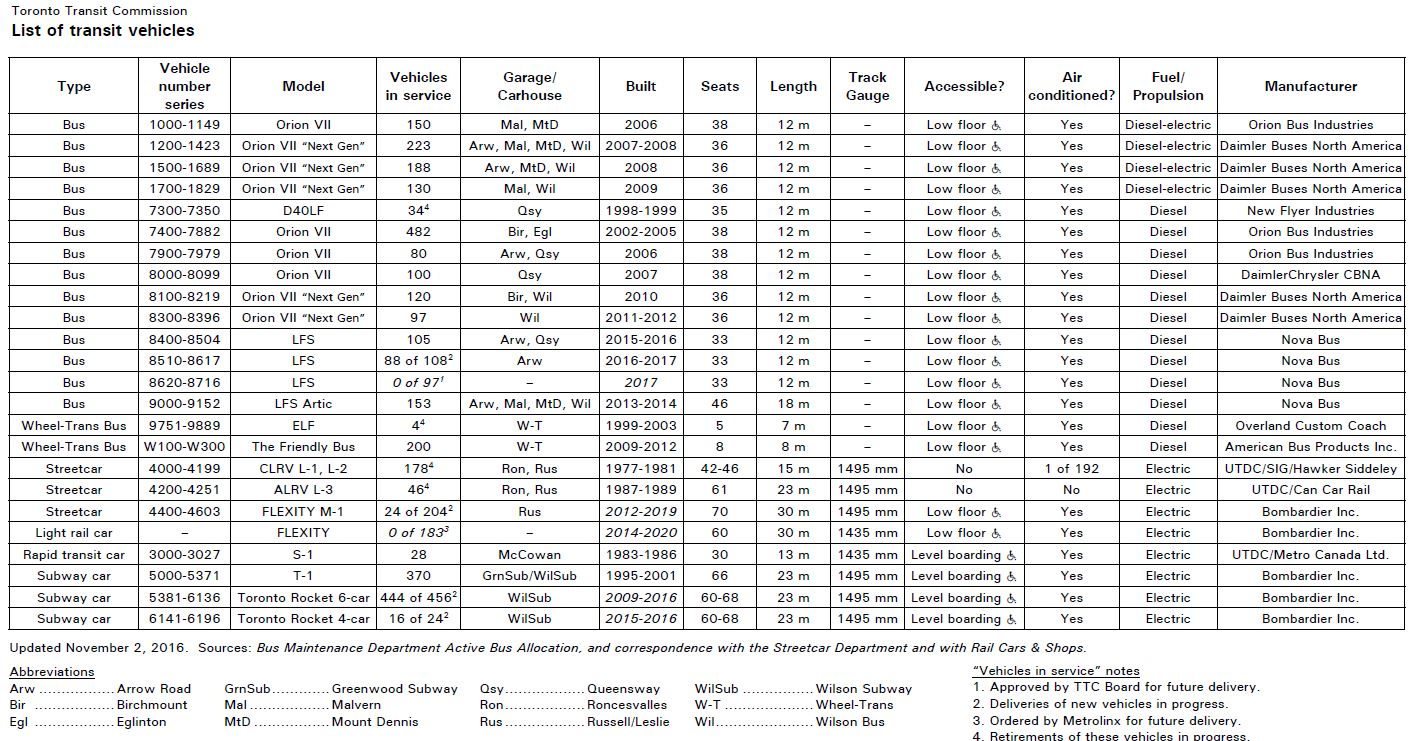
Bus replacement for the SRT service during the construction period would require 63 additional buses and infrastructure requirements such as a bus facility to accommodate the additional bus fleet, and bus terminal expansions at Scarborough Centre and Kennedy Station. The cost of shutting down the SRT during the construction period would amount to approximately $171 million (YOE/Escalated $).

However, this makes no allowance for the following savings:

  • Avoiding the need to keep the existing SRT operating, a value estimated in July 2013 as $132 million including inflation. See Scarborough Rapid Transit Options at p 7.
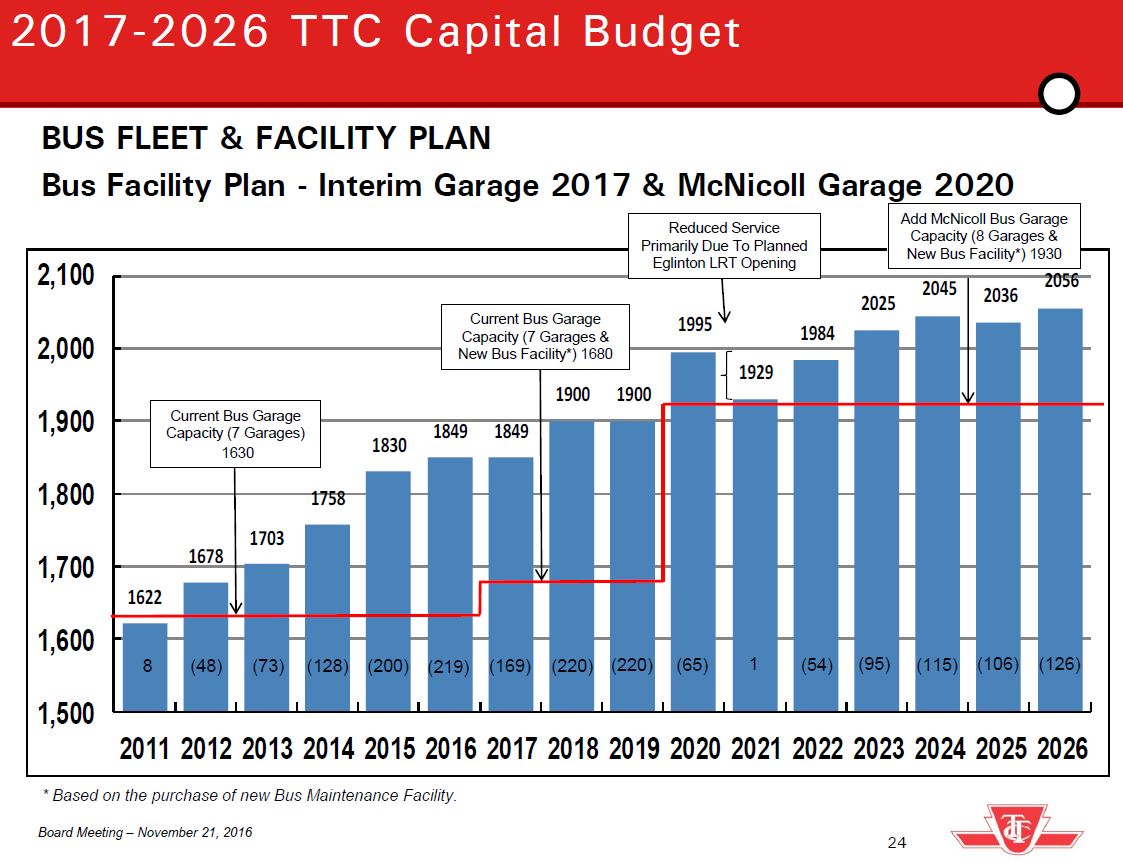
  • Buses and garage space provisioned for the temporary shuttle would have a life beyond the end of the project, and indeed the TTC requires another new bus garage beyond McNicoll Garage in northern Scarborough. Only the cost of buying, building and operating these earlier than would otherwise occurs counts as a net cost against the project.

This is either an error in calculation, or a misrepresentation of the true cost of replacing SRT operation.

Given that the LRT option would require a shorter shutdown of the SRT than the subway options, the cost of the bus shuttle would be correspondingly lower.

[End of update]

Continue reading